OrbitalHub

Where curiosity reaches escape velocity.

Domain is for sale. $50,000,000.00 USD. Direct any inquiries to contact@orbitalhub.com.

Archive for the Robotic Exploration category


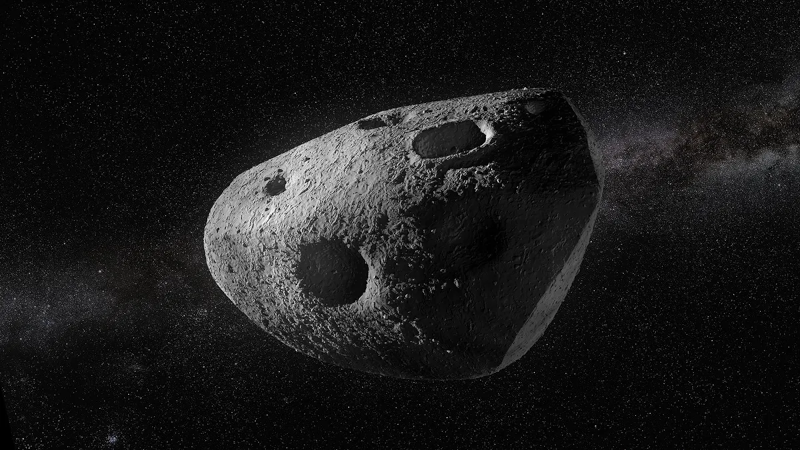
The European Space Agency announced in February 2026 that contracts for the Ramses spacecraft had been awarded following a successful final design review, clearing the path for a launch window opening in mid-April 2028. The mission targets asteroid 99942 Apophis, a 375-meter near-Earth object that will pass within approximately 32,000 kilometers of Earth on April 13, 2029. The encounter will bring Apophis closer than some Earth-orbiting satellites, creating conditions for scientific observation and planetary defense data collection that no spacecraft has previously had the opportunity to gather at such a precisely predicted event.

Apophis has occupied a unique place in planetary defense calculations since its discovery in 2004, when initial observations suggested a meaningful probability of impact with Earth in 2029. Subsequent radar observations refined the orbital calculation, eliminating the impact risk for 2029 and for every subsequent orbit for at least the next century. The 2029 flyby nonetheless represents a rare opportunity because Apophis will be large enough and close enough to observe with ground-based radar, space telescopes, and a rendezvous spacecraft simultaneously, producing a comprehensive dataset on an asteroid’s response to gravitational forces from a major planet.

The Ramses mission profile calls for launch in the April-to-May 2028 window aboard an Ariane 6 rocket from French Guiana, with direct trajectory to Apophis. The spacecraft will arrive in February 2029, approximately two months before the Earth flyby, allowing it to establish orbit around or near the asteroid and begin scientific observations before planetary proximity changes the environment. The tight timeline means Ramses must leverage existing technology and mission-proven systems, a constraint that shaped the spacecraft’s design and instrument payload. The mission builds directly on the Hera spacecraft currently approaching Didymos, using the same spacecraft bus architecture and many of the same instrument designs to reduce development time and risk.

Upon arrival at Apophis, Ramses will characterize the asteroid’s size, shape, mass, spin state, and surface composition through a combination of imaging, spectroscopy, and radar measurements. The spacecraft’s primary scientific objective during the approach and early encounter phase is to document how Earth’s gravitational field alters the asteroid’s physical state. The tidal forces from a close planetary passage can stretch and compress an asteroid, potentially triggering seismic activity, landslides, or the ejection of surface material. Apophis is large enough and passing close enough to Earth that these effects should be measurable, providing a direct test of models that predict asteroid physical evolution during planetary encounters.

The instruments aboard Ramses include a wide-angle camera for surface mapping, a thermal infrared spectrometer for mineralogical analysis, and a radar instrument capable of probing subsurface structure to depths of several meters. These tools will build a comprehensive picture of Apophis that will remain scientifically valuable long after the 2029 flyby. The radar data in particular will illuminate the internal structure of an asteroid that has been shaped by millions of years of collisions and thermal cycling, offering insights into how rubble pile objects like Apophis assembled and evolved.

Ramses will accompany Apophis through the April 2029 Earth encounter, maintaining proximity as the asteroid’s trajectory bends by approximately 1.7 degrees due to Earth’s gravity. The change in Apophis’s trajectory, while small in angular terms, represents a significant perturbation for an object in solar orbit, and measuring it precisely will improve the accuracy of future orbital predictions for Apophis and other near-Earth objects. The spacecraft will also observe Apophis’s rotation state during the encounter, as tidal torques from Earth can alter the rotation period and axis orientation of an asteroid passing at close range. This effect has been documented for other asteroids during planetary flybys but has never been directly measured by a spacecraft at the time of closest approach.

The decision to commit to the Ramses mission reflects a broader shift in European planetary defense strategy toward active characterization of known threats rather than purely detection-focused approaches. ESA’s Space Safety Programme, which funds Ramses, also encompasses the Hera mission at Didymos and the development of impact monitoring systems that track near-Earth objects for potential threat assessment. The cumulative program represents Europe’s contribution to an international network that includes NASA’s Planetary Defense Coordination Office, JAXA’s contributions to radar observation campaigns, and ongoing coordination through the United Nations Committee on the Peaceful Uses of Outer Space.

The timeline for Ramses is aggressive by planetary science standards. From contract award in early 2026 to launch in mid-2028 is approximately 26 months, compressing a development process that typically spans four to five years for a interplanetary spacecraft. The approach works because Ramses inherits much of its design from Hera, which itself benefits from heritage systems developed for ESA’s earlier planetary missions. The spacecraft bus uses the same carbon fiber composite structure, the same propulsion system architecture, and the same power distribution and thermal control designs. What changes is the scientific payload, which Ramses adapts for the specific observation requirements of the Apophis encounter.

When an asteroid passes near a planet, the planet’s gravitational field exerts slightly different forces on the near and far sides of the asteroid. The difference between these forces, called the tidal force, scales with the inverse cube of the distance between the two bodies. At 32,000 kilometers, the tidal acceleration at Apophis’s surface from Earth reaches approximately 0.003 meters per second squared, a small but sustained perturbation that acts continuously as the asteroid passes.

The resulting stress distribution within the asteroid depends on its internal structure. A solid monolithic object responds to tidal loading by deforming slightly and building internal stress that is relieved after the planetary encounter ends. A rubble pile object, where individual fragments are held together by gravity and interlocking rather than cohesive forces, may behave differently. The tidal forces can cause individual blocks to shift, potentially generating seismic disturbances that cause surface material to move or eject. The distinction matters for planetary defense because it affects whether an asteroid is more likely to fragment during an Earth encounter, which would change the risk calculation for future close approaches.

Apophis’s size class, around 375 meters, sits near the boundary where asteroid internal structure transitions from predominantly monolithic to predominantly rubble pile. Objects below approximately 300 meters tend to be solid, while larger objects are more likely to have fragmented and reassembled over cosmic timescales. Radar observations from the 2021 Apophis flyby suggested the asteroid has a smooth region on one side and rougher terrain elsewhere, consistent with a surface that has been reworked by impact events but may retain some internal coherence.

The rotation state of Apophis will be carefully monitored as the encounter approaches. Tidal torque from Earth can transfer angular momentum to the asteroid, speeding up or slowing down its rotation depending on its initial spin axis orientation relative to the approach trajectory. The effect is typically small for single-pass encounters but can accumulate over multiple close approaches. Apophis will not make another comparably close Earth approach for at least several centuries, limiting the cumulative effect, but the 2029 encounter provides a valuable data point for validating tidal torque models used in asteroid evolution studies.


In the coming days, a spacecraft launched from Cape Canaveral in October 2023 will pass close enough to Mars to feel the planet’s gravity bend its trajectory. NASA’s Psyche spacecraft is executing a gravity assist maneuver, using Mars as a gravitational redirector to adjust its speed and direction toward a distant asteroid in the outer main belt. The flyby is scheduled for approximately May 15, 2026, when the spacecraft will pass within 1,500 kilometers of the Martian surface, close enough for ground-based telescopes to detect it and for the spacecraft’s instruments to record data about the planet’s environment.

The gravity assist is not an accident or an afterthought. It is an intentional engine of the mission design, reducing the propellant the spacecraft must carry for its journey to 16 Psyche, a metal-rich asteroid that orbits the Sun at approximately 2.9 times the Earth-Sun distance. Without the Mars flyby, reaching 16 Psyche would require more acceleration from the spacecraft’s solar-electric propulsion system and a longer travel time. The maneuver leverages orbital mechanics to do in minutes what would otherwise require months of thrusting.

16 Psyche is one of the most massive objects in the asteroid belt, with a diameter of approximately 280 kilometers. What distinguishes it from most asteroids is its composition. Spectroscopic observations from Earth suggest that the asteroid may be composed primarily of iron and nickel, similar to the metallic cores of rocky planets like Earth. The leading hypothesis is that 16 Psyche is the exposed core of a protoplanet that was disrupted by collisions early in the solar system’s history, stripping away its rocky mantle and leaving the metallic interior as a separate body. If this interpretation is correct, 16 Psyche offers a direct view of planetary core material without the need to drill through hundreds of kilometers of overlying rock.

The Psyche mission will test this hypothesis through a year-long scientific investigation beginning in August 2029. The spacecraft carries a magnetometer to search for evidence of a remnant magnetic field, which would support the core remnant hypothesis. A gamma ray and neutron spectrometer will characterize the elemental composition of the surface, distinguishing iron-rich regions from silicates. A multispectral imager will map the surface geology and topography. A technology demonstration called the Deep Space Optical Communication system will test high-bandwidth laser communication at interplanetary distances.

The solar-electric propulsion system aboard Psyche uses xenon as its propellant. The xenon atoms are ionized by electrons emitted from hollow cathodes, accelerated through a series of electrostatic grids, and expelled at velocities exceeding 19 kilometers per second. The resulting thrust is modest, on the order of a few pounds, but it operates continuously over months, producing a cumulative velocity change that equals or exceeds what a chemical rocket could achieve with far more propellant mass. The system is the highest-power electric propulsion ever flown on a planetary mission, drawing up to 45 kilowatts from the spacecraft’s large solar arrays.

The Mars flyby serves multiple engineering purposes simultaneously. The primary objective is trajectory modification, changing the spacecraft’s heliocentric orbit to align with 16 Psyche’s orbital plane and reduce the arrival velocity. The secondary objective is calibration of the science instruments, which will observe Mars during the approach and departure phases, providing an opportunity to compare the spacecraft’s measurements against known values for a well-characterized planetary body. The magnetometer will pass through Mars’s bow shock and magnetotail, providing data on the planet’s interaction with the solar wind.

Lindy Elkins-Tanton, the mission’s principal investigator, noted on April 29 that NASA’s Eyes on the Solar System simulation tool had been updated to show the upcoming flyby, allowing the public to visualize the encounter in real time. Raw images from the spacecraft are available through NASA’s public image archive, and the team is expected to release imagery from the Mars approach beginning in early May. The spacecraft is operating nominally, according to periodic updates from the Jet Propulsion Laboratory, with no reported anomalies in the weeks leading up to the encounter.

The timing of the flyby reflects the orbital geometry of the mission. Psyche launched in October 2023, placing it in a trajectory that intersects Mars’s orbit at the appropriate point in May 2026. The 2029 arrival date is fixed by the orbital mechanics of the transfer trajectory from Earth to the asteroid belt. The launch window for 16 Psyche occurs only once every 4.7 years, when the relative positions of Earth, Mars, and the asteroid align. If Psyche had missed the 2026 Mars flyby opportunity, reaching 16 Psyche would have required waiting for the next window in 2031, at which point the mission would arrive in 2036.

A gravity assist works by exploiting the orbital motion of a planet. When a spacecraft approaches a moving planet, the planet’s gravitational field redirects the spacecraft’s path. More precisely, the spacecraft is falling toward the planet, but because the planet itself is moving, the spacecraft’s velocity relative to the Sun changes as it swings around the planet’s trailing side. In the planet’s reference frame, the spacecraft approaches and departs at the same speed but in different directions. In the Sun’s reference frame, the spacecraft has gained or lost velocity depending on whether it passed behind or ahead of the planet’s motion.

The Psyche spacecraft is passing behind Mars as seen from the Sun, which means it will gain velocity relative to the Sun, raising its orbital energy and moving it outward toward the asteroid belt. The magnitude of the velocity change, approximately 2.5 kilometers per second, is modest compared to the total velocity budget of the mission but occurs at precisely the right location and direction to maximize its effect on the trajectory.

Navigation of the flyby requires precise knowledge of the spacecraft’s position and velocity relative to Mars at the time of closest approach. The navigation team at JPL uses ground-based tracking data, including measurements from the Deep Space Network, to estimate the trajectory and command correction maneuvers when necessary. The margin for error is small: arriving at Mars with a velocity error of even a few meters per second would change the trajectory after the flyby by enough to require additional correction burns that consume propellant and alter the arrival time at 16 Psyche.

The instruments aboard Psyche that will observe Mars during the flyby include the magnetometer and the multispectral imager. The magnetometer will detect perturbations in the interplanetary magnetic field caused by Mars’s bow shock, the boundary where the solar wind encounters the planet’s magnetic environment. The imager will acquire context images of the Martian surface from a distance, providing an opportunity to test the camera’s performance on a real planetary target before the encounter with 16 Psyche.

The Deep Space Optical Communication technology demonstration, which uses a laser transmitter to send data at rates far exceeding what conventional radio systems can achieve, will be tested during the flyby. The Mars proximity provides a useful target for the optical communications link, with ground stations on Earth pointing toward the spacecraft as it passes near the planet. The test will demonstrate whether optical communication can be used for high-bandwidth science data transmission during future deep space missions, potentially revolutionizing the data return capabilities of interplanetary spacecraft.

Video credit: NASA Jet Propulsion Laboratory


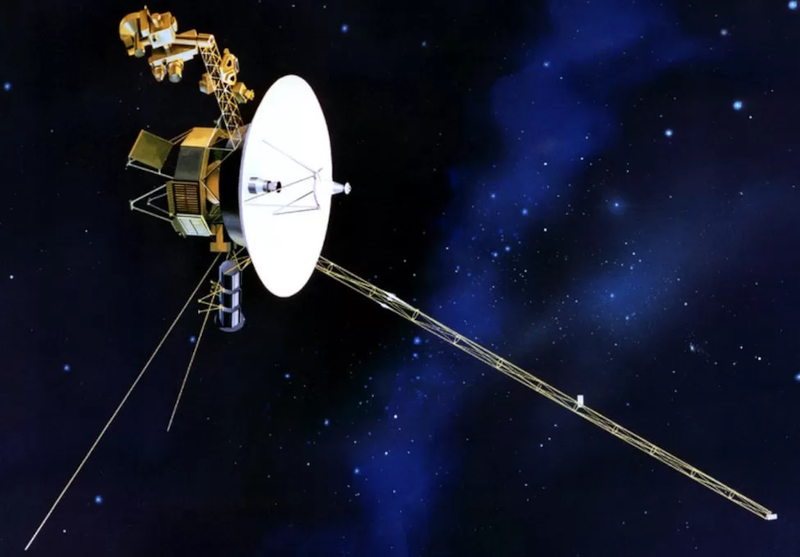
On February 27, 2026, Voyager 1 experienced an unexpected drop in power levels during a routine roll maneuver. The spacecraft, now more than 25 billion kilometers from Earth, relies on a radioisotope thermoelectric generator that produces less electricity each year as its plutonium fuel decays. The February anomaly triggered a response from mission engineers at NASA’s Jet Propulsion Laboratory in Pasadena, who recognized that any further power decline could force the spacecraft’s fault protection system to shut down systems autonomously, a recovery process that would carry significant risk for a spacecraft operating in interstellar space.

The team acted before that became necessary. On April 17, 2026, engineers sent commands to shut down the Low-Energy Charged Particles experiment aboard Voyager 1, an instrument that had operated nearly continuously since the spacecraft launched in September 1977. The LECP measures ions, electrons, and cosmic rays originating from both the solar system and the galaxy beyond, and it played a central role in confirming that Voyager 1 had crossed the heliopause into interstellar space in 2012. Turning it off was not a decision made under pressure. Years earlier, the science and engineering teams had agreed on a sequence for shutting down spacecraft systems while preserving the mission’s ability to continue collecting data. The LECP was simply next on the list.

The command had to travel 23 hours to reach the spacecraft, and the shutdown process itself took another three hours and fifteen minutes. Of the ten instrument sets Voyager 1 carries, seven have now been turned off. Voyager 2 lost its LECP in March 2025. Both spacecraft now retain two science instruments each: the Plasma Wave Subsystem, which detects oscillations in the charged particle environment, and the Magnetometer, which measures the strength and direction of magnetic fields in interstellar space. These two instruments provide the only ongoing measurements of the region beyond the Sun’s protective bubble, and keeping them operating is the mission’s overriding priority.

The shutdown buys approximately one year of additional operation. During that time, engineers are finalizing a more ambitious fix they call the Big Bang, named with characteristic mission humor for the dramatic swap of multiple powered systems at once. The concept involves turning off a group of higher-power devices and simultaneously activating lower-power alternatives that serve the same thermal and operational functions. Keeping the spacecraft warm enough to prevent its fuel lines from freezing is the central challenge. The plutonium generator provides heat as well as electricity, and as output declines, the thermal margin that protects tubing and mechanisms narrows. The Big Bang approach addresses this by shedding power loads that are less critical while maintaining the thermal environment the spacecraft needs to survive.

The team will test the procedure on Voyager 2 first, beginning in May and running through June 2026. Voyager 2 is closer to Earth, making communication more responsive, and it has slightly more power margin than its twin, making it the safer test subject. If the May-June tests succeed, engineers will attempt the same swap on Voyager 1 no earlier than July 2026. There is even a possibility that Voyager 1’s LECP could be switched back on if the power savings materialize as projected.

Both Voyagers lose approximately four watts of power per year. At launch, each generator produced about 470 watts. They now produce roughly 250 watts, and the decline continues. The spacecraft were built to last five years. They have now operated for nearly 49. The Big Bang represents the latest in a series of engineering compromises that have kept the probes functional far beyond anyone’s expectation, trading instrument capabilities for survival, and survival for the chance to keep returning data from a region of space that no other human-made object will reach for generations, if ever again.

The one-light-day milestone, when Voyager 1 reaches exactly the distance that light travels in one day, approximately 25.9 billion kilometers, is expected in November 2026. It will be a symbolic moment. The real story is quieter: a team of engineers, some of them not yet born when the spacecraft launched, making decisions about power allocation and instrument status for two probes that crossed the boundary between solar system and galaxy before most people reading this were born.

Radioisotope thermoelectric generators convert heat from radioactive decay into electricity through the Seebeck effect, where temperature differences between semiconductor materials generate a voltage. The Voyager RTGs contain plutonium-238, which decays with a half-life of 87.7 years, meaning the fuel supply shrinks by roughly 0.8 percent each year. The generator’s electrical output follows roughly the same curve, which is why the four-watts-per-year decline is predictable and planned for.

The thermal output of the RTG, currently around 2,400 watts, exceeds its electrical output by an order of magnitude. This heat is not waste; it is the primary thermal management mechanism for the spacecraft. The electronics and propulsion systems are designed to operate within a specific temperature range, and the RTG’s warmth keeps them there. As the generator cools, the thermal margin decreases, requiring engineers to balance electrical load against thermal load in ways that were not anticipated during the 1970s design phase.

The fault protection system that nearly triggered in February operates on voltage thresholds. If power drops below a certain level, the spacecraft automatically shuts down non-essential systems to preserve core functions. The shutdown is designed to be recoverable, but recovery requires the spacecraft to orient its high-gain antenna toward Earth and receive commands, a process that takes time and is complicated by the 23-hour communication delay. More importantly, an uncontrolled shutdown could leave the spacecraft in a state where instruments needed for science are offline. Preventing that scenario drove the decision to shut down LECP deliberately rather than wait for the fault system to act.

The Big Bang, if successful, will further reduce power consumption by switching to redundant systems that draw less current while performing the same thermal maintenance functions. The switch must be simultaneous because the spacecraft’s thermal control depends on continuous heat input. Any gap in heating could allow components to cool below their minimum operating temperature, causing damage that would be irreversible at 25 billion kilometers.


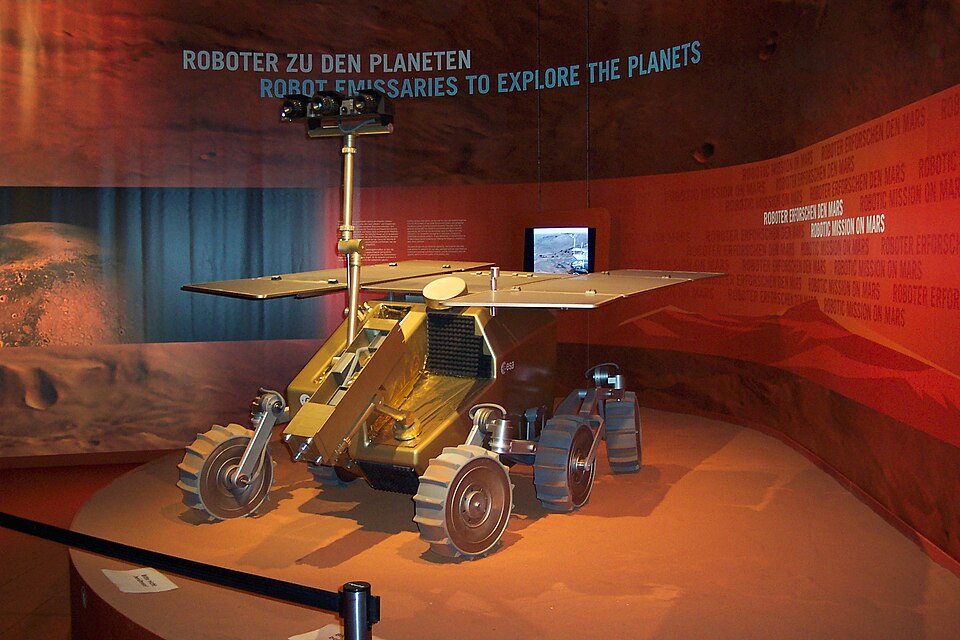
After more than a decade of delays, geopolitical shifts, and mission redesigns, ESA’s Rosalind Franklin rover finally has a confirmed launch provider. NASA announced on April 16, 2026, that SpaceX’s Falcon Heavy will launch the European Mars rover from Kennedy Space Center’s Launch Complex 39A in late 2028, with arrival on the Red Planet expected around late 2030. The contract, worth approximately $176 million through NASA’s Launch Services program, marks SpaceX’s first interplanetary mission to Mars and the culmination of an arduous journey for Europe’s first Mars rover.

The mission’s history reads like a geopolitical drama spanning multiple continents and two decades. Originally conceived in 2001 as part of ESA’s Aurora Programme, the rover was designed to search for biosignatures of past or present life on Mars through the most ambitious subsurface drilling attempt ever attempted on another world. The original plan called for a Russian-provided launch vehicle and landing platform through a partnership with Roscosmos, the Russian space agency. That partnership dissolved following Russia’s invasion of Ukraine in 2022, when ESA member states voted to suspend cooperation with Russia.

The rover’s scientific payload centers on a 2-meter drilling system, nearly double the depth achieved by any previous Mars rover. NASA’s Perseverance, for comparison, drills to 7 centimeters, while the Soviet-era Lunokhod rovers never attempted subsurface sampling on another world. The drill retrieves core samples that have been shielded from the harsh Martian surface radiation and oxidation that destroys organic compounds near the top layer of regolith. Once collected, the samples enter the Analytical Laboratory Drawer, where nine instruments including the Panoramic Camera and mass spectrometer characterize the composition.

The landing site, Oxia Planum, was selected after years of debate among planetary scientists. This region shows evidence of ancient clay mineral formation, which requires liquid water to create. Clay minerals serve as excellent preservers of organic compounds, as they can trap and shield complex molecules from degradation. The choice reflects the mission’s core hypothesis: if life ever arose on Mars, the chemical traces would be most likely to survive in protected subsurface environments.

NASA’s role extends beyond launch services. The agency is providing radioisotope heater units, tiny devices that use the decay heat of plutonium-238 to keep electronics warm during the frigid Martian nights. Without these units, the rover would not survive the temperature swings that plunge to minus 100 degrees Celsius. The Trump administration’s FY2027 budget proposed cutting approximately $100 million from NASA’s ROSA program that funds these contributions, but NASA proceeded with the SpaceX contract regardless, signaling continued commitment to international science partnerships despite broader budget pressures.

The selection of Falcon Heavy from Launch Complex 39A places the mission alongside NASA’s own heavy-lift ambitions. LC-39A has hosted Apollo missions, space shuttles, and Falcon Heavy launches including the historic Tesla Roadster flight in 2018. The capacity to lift approximately 3.5 tonnes to trans-Mars injection provides the delta-v needed for the eight-month journey. The backup launch windows in 2030 avoid the Mars dust storm season that historically has disrupted landing operations.

Drilling into bedrock on Mars presents challenges that exceed any previous subsurface expedition. The 2-meter drill must operate in temperatures ranging from minus 80 degrees to plus 20 degrees Celsius, with the mechanical systems enduring thermal cycling that weakens metals through repeated expansion and contraction. The drill string uses a percussive mechanism similar to rotary hammers, powered by electric motors that must produce sufficient torque while drawing minimal current from the solar panels.

The sample retrieval mechanism seals the cores in containers that maintain the terrestrial context of each sample. On Earth, contamination from drilling fluids and equipment can obscure the scientific signal, so the rover’s sample handling system was designed to minimize terrestrial organic contact. Each core breaks into fragments that fit into the analytical instruments, where the mass spectrometer detects organic compounds through vaporization and ion separation.

Solar power at Mars delivers approximately 40 percent of the energy available at Earth, requiring the largest solar array ever deployed on a planetary rover. The 1,200-watt-hour daily capacity must power movement, drilling operations, instrument analysis, and communications while maintaining survival systems through the Martian night. During dust storms, the array may produce only a fraction of rated power, limiting operations until conditions improve.


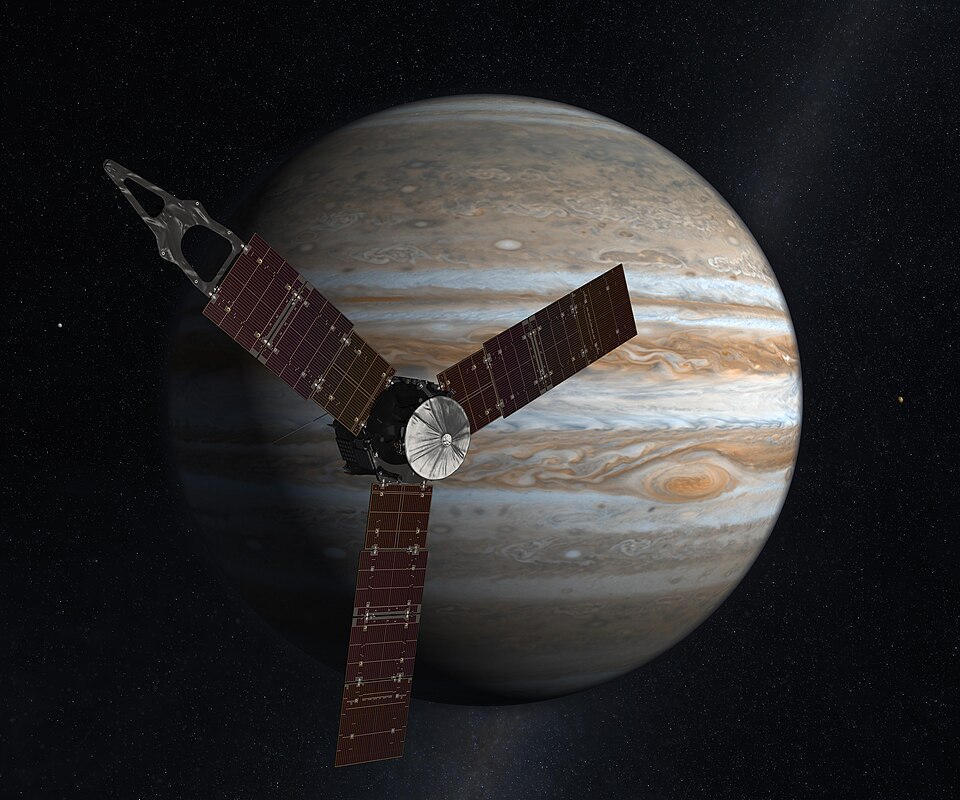
NASA’s Juno spacecraft, orbiting Jupiter since 2016, continues to deliver surprising discoveries about the largest planet in our solar system. Data from the mission, announced in early 2026, reveals that Jupiter experiences lightning storms vastly more powerful than any seen on Earth, with individual bolts carrying up to 10 trillion joules of energy. These findings add to a growing catalog of discoveries from the mission, which has fundamentally changed our understanding of gas giant planets.

The discovery of extreme lightning came from analysis of Juno’s Microwave Radiometer, which detected 613 microwave pulses from lightning over 12 flybys between 2021 and 2022. Each pulse represents a discharge hundreds of times more powerful than typical terrestrial lightning. The largest events contain energy equivalent to approximately 2,400 tons of TNT, roughly one-sixth the energy of the Hiroshima atomic bomb.

Jupiter’s atmosphere produces these powerful storms in ways that differ from Earth’s. On our planet, lightning requires the separation of electric charges in water-based storm clouds. Jupiter’s atmosphere contains water clouds at depths where pressures exceed several bar, but the precise charge separation mechanism remains under investigation. Ammonia clouds may play a role in Jupiter that water clouds play on Earth.

The detection of lightning at polar latitudes surprised researchers, who had expected such activity to be limited to equatorial regions. The storms occur in both polar vortices and in the belts that characterize Jupiter’s atmospheric circulation, suggesting that the underlying mechanisms operate across a wider range of conditions than previously recognized.

Other Juno discoveries from early 2026 include the most powerful volcanic eruption ever observed on Io, Jupiter’s innermost moon. The event surpassed all previous records for volcanic output on that moon, which holds the distinction of being the most volcanically active body in the solar system. The observation demonstrates that Io’s interior remains vigorously active, driven by tidal heating from its interaction with Jupiter and the other Galilean moons.

Juno’s measurement of Europa’s ice shell thickness revealed an average of approximately 29 kilometers over half the moon’s surface, providing critical data for missions planning to explore the subsurface ocean. The ice shell represents the barrier between the surface and the ocean that may contain liquid water, and understanding its thickness affects how future missions might access that ocean.

A February 2026 announcement revised Jupiter’s measured dimensions. Using radio occultation data from 13 flybys, Juno revealed that Jupiter is approximately 8 kilometers narrower at the equator and 24 kilometers flatter at the poles than previous estimates from the 1970s Pioneer and Voyager missions. These refinements improve models for understanding Jupiter’s interior structure and for interpreting observations of exoplan gas giants.

Despite these achievements, Juno’s future remains uncertain. NASA considered terminating the mission in its FY2026 budget, citing the approximately $260 million annual cost. The spacecraft remains healthy as of April 2026, but no decision has been announced about mission extension beyond the current phase.

Lightning on gas giants occurs in atmospheres composed primarily of hydrogen and helium, with trace amounts of water, ammonia, and other compounds. The electrical properties of these atmospheres differ from Earth’s water-based clouds, where charge separation occurs as water droplets collide and freeze.

The energy in Jupiter’s lightning reflects the planet’s immense size and the scale of atmospheric dynamics. The Great Red Spot, a storm larger than Earth, demonstrates the energy available in Jupiter’s atmosphere. Convective updrafts in the belts and zones drive the circulation that produces electrical activity.

Juno’s Microwave Radiometer detects lightning at wavelengths around 1.4 centimeters, where the instrument can peer hundreds of kilometers deep into Jupiter’s atmosphere. This penetration depth allows detection of lightning from depths where water clouds exist, at pressures exceeding several bar. Radio wavelengths also pass through the cloud layers that would obscure optical detection.

The detection of powerful lightning has implications for the interior energy balance of Jupiter. Lightning requires energy from atmospheric dynamics, which in turn reflects heat from Jupiter’s interior. The power output of lightning storms contributes to the overall energy budget that Juno has measured from orbit.


The European Space Agency’s Hera spacecraft is on course for a November 2026 rendezvous with the Didymos binary asteroid system, carrying with it the culmination of humanity’s first attempt to change the orbit of a celestial body. Launched in October 2024 aboard a SpaceX Falcon 9, Hera is now completing the final leg of its 24-month journey, having already executed a critical deep-space maneuver in February-March 2026 that refined its trajectory toward the asteroid pair.

The mission represents the follow-up to NASA’s Double Asteroid Redirection Test, which struck the moonlet Dimorphos in September 2022 at approximately 6.6 kilometers per second. That impact shortened Dimorphos’s orbital period around its parent asteroid Didymos by about 32 minutes, and that seemed dramatic until subsequent research revealed something even more significant: the entire binary system’s orbit around the Sun had actually shifted by more than 10 micrometers per second. For the first time in history, human activity had measurably altered an asteroid’s solar orbit.

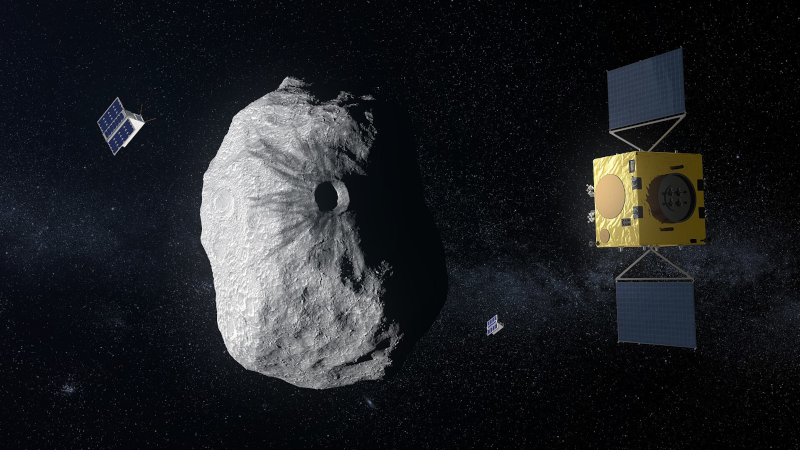
Hera’s primary objective is to document what happened. The spacecraft carries three main instruments: an Asteroid Framing Camera that will map the surface in color, a thermal infrared imager to measure temperatures across the moonlet, and a laser altimeter to precisely gauge topography. The spacecraft also carries two briefcase-sized CubeSats named Milani and Juven tas that will deploy once Hera arrives at Didymos. Milani will analyze surface composition using spectroscopy, while Juven tas will attempt a landing on Dimorphos to measure subsurface density using ground-penetrating radar.

When Hera enters orbit around Didymos in late 2026, it will begin mapping the impact crater created by DART. The spacecraft will approach to within a few hundred meters of the asteroid, close enough to produce images with 10-centimeter resolution. This close proximity work represents some of the most demanding navigation in deep space, requiring software that can reconstruct the environment from cameras and sensors in real-time.

The February 2026 trajectory correction burned 123 kilograms of propellant, the largest maneuver of the mission. This burn aligned Hera for the approach phase that will bring it to Didymos in November. Ground controllers at the European Space Operations Centre in Darmstadt monitored the burn, which lasted just under three minutes and changed the spacecraft’s velocity by approximately 180 meters per second.

Data from Hera will inform future planetary defense strategies. The kinetic impactor technique demonstrated by DART works, but questions remain about exactly how efficiently momentum transfers from an impact to an asteroid. The density and porosity of the target affect outcomes significantly. If an asteroid is rubble-pile in structure, held together by its own gravity, impact energy spreads differently than if it were solid rock. Hera will answer these questions.

When a spacecraft collides with an asteroid, the resulting deflection depends on several factors described by the momentum equation p = mv, where momentum equals mass times velocity. The spacecraft carries momentum equal to its mass multiplied by its impact velocity. But the asteroid also receives momentum from ejected material accelerated away from the impact site. This “bonus” momentum from ejecta can substantially exceed the spacecraft’s incoming momentum, sometimes doubling or even tripling the effective deflection.

The efficiency is measured by beta, a factor indicating how much more effective the impact is than the spacecraft alone. DART achieved a beta of approximately 2.5, meaning the deflection was 2.5 times what the spacecraft’s momentum alone would predict. Hera will measure beta more precisely, enabling accurate predictions for real threat scenarios.

The challenge for future missions is timing. A deflection works best when performed years in advance, as even a small velocity change accumulates over multiple orbits. The earlier the intervention, the less delta-v is required. For an asteroid discovered decades before potential impact, a gentle push could suffice where a late intervention might require unprecedented velocities.