OrbitalHub

Where curiosity reaches escape velocity.

Domain is for sale. $50,000,000.00 USD. Direct any inquiries to contact@orbitalhub.com.

Archive for the Robotic Exploration category


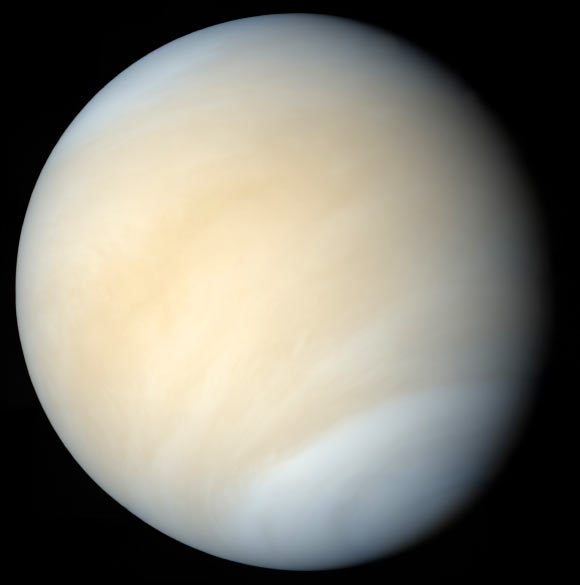
Venus in real colors, processed from Mariner 10 images, showing the pale yellow cloud deck with subtle banding. Source: NASA / Mattias Malmer / Mariner 10 imagery, via sci.news rehost


Venus looks like a smooth yellow disc through any backyard telescope. Point an ultraviolet camera at it, and the same clouds darken into a patchwork of bright and dim regions that has been tracked, named, and puzzled over since the 1920s. The dark patches are not shadows. They are absorbers, real material mixed into the sulfuric acid droplets of Venus’s upper cloud deck, and they soak up enough short-wavelength sunlight to change the planet’s appearance at wavelengths the human eye cannot see.

A new analysis from the Foundation for Applied Molecular Evolution puts a sharp quantitative number on how strong that absorption has to be. The team, led by Jan Spacek with collaborators Yeon Joo Lee of South Korea’s Institute for Basic Science, Janusz Petkowski of the Wroclaw University of Science and Technology, and Paul Rimmer of Cambridge, ran Venus’s observed UV reflectance through a radiative-transfer model that removes the contribution of cloud-droplet scattering and leaves behind a pure absorption coefficient for the liquid inside the droplets. The reported value at 375 nanometers is about 1,278 per centimeter in decadic units, Sci.News writeup of Spacek et al. 2026. That is roughly the absorption strength of a moderately concentrated dye, and it is the kind of number a lab spectroscopist can compare directly against a candidate molecule in a cuvette.

Every Venus mission proposal for the last forty years has, somewhere in its science case, a paragraph about the unknown UV absorber. The substance controls how much sunlight reaches the cloud tops, which sets the upper atmosphere’s energy budget, which feeds back into the superrotation that whips the cloud deck around the planet every four days. If we cannot identify it, every model of Venus’s climate is operating with a free parameter that has been tuned rather than measured. There is also a deeper reason the absorber matters: the cloud deck sits between roughly 50 and 70 kilometers altitude, with pressures and temperatures that on Earth would not be ruled out as a habitat for some kind of microbial life, and the phosphine debate of 2020 was in effect a debate about what kind of chemistry the clouds could host. A clean identification of the absorber would not settle that question, but it would remove one of the major unknowns. The paper was published in Astrobiology on August 25, 2026.

Astronomers have known about Venus’s UV markings since the late 1920s, when ultraviolet-sensitive photographic plates showed the planet as a mottled disc rather than the bland yellow ball it appears at visible wavelengths. The Pioneer Venus Orbiter in the late 1970s, Venus Express from 2006 to 2014, and Akatsuki since 2015 have all mapped the markings in detail. They track the four-day superrotation of the upper cloud deck, which is itself a puzzle: the atmosphere rotates about sixty times faster than the solid planet below. The markings brighten, dim, and re-form over timescales of days to years, and they do not correlate cleanly with any single altitude or temperature layer.

The candidate list is long. Sulfur allotropes, ferrous chloride, hematite, several organic compounds, even microorganisms have all been proposed at various points. None of them, on their own, match all the observational constraints at once: the right absorption strength, the right wavelength dependence, the right behavior over time, and chemical survival in a cloud environment that is mostly concentrated sulfuric acid with traces of water. The Spacek et al. paper takes a different approach. Instead of asking which molecule fits, the team asks how strong the absorption in the bulk cloud liquid has to be, in units a lab spectroscopist recognizes.

They start from spacecraft measurements of Venus’s reflectance between 365 and 455 nanometers and feed those measurements into a radiative-transfer model that treats the cloud droplets as Mie scatterers and accounts for multiple scattering by atmospheric molecules above the cloud deck. The output is the absorption coefficient of the bulk cloud liquid, the same quantity you would get from putting a sample in a cuvette and running a UV-visible spectrometer.

The peak comes out at about 1,278 per centimeter at 375 nanometers. To put that in concrete terms, porphyrin-type pigments in the lab, used here only as familiar examples of efficient absorbers rather than as biological claims, would need to be present at concentrations on the order of 10 grams per liter to hit that coefficient. Many of the inorganic candidates proposed over the years would need to be present at concentrations that strain chemical plausibility in a sulfuric acid aerosol.

A second result is just as important. The spectrum is steep. Between 365 and 455 nanometers, the inferred absorption drops sharply. That rules out the broad, brown, tar-like absorption that simple organics tend to develop when soaked in concentrated sulfuric acid over time. Whatever the absorber is, it resists being converted into that messy mixture. In Spacek’s words, the relatively sharp absorption profile is consistent with a chemically defined absorber that resists conversion into the tar-like mixture. The shape of the spectrum is now a constraint any future candidate has to satisfy.

The radiative-transfer step is the heart of the result and worth a closer look. Venus’s clouds are optically thick, with optical depths well above unity at UV wavelengths, so a photon entering the cloud deck is likely to scatter many times before it is absorbed or reflected back. From orbit, you see a planet that is darker than the underlying absorption alone would suggest, because each scattering event lengthens the photon’s path through the absorbing medium.

Spacek’s group accounts for that with a two-stream treatment, separating the cloud droplet’s scattering cross section from its absorption cross section. The droplet’s bulk refractive index at the relevant wavelengths is the standard sulfuric acid value. The atmospheric path above the cloud deck, mostly carbon dioxide with sulfur dioxide, is treated as a Rayleigh-scattering layer with a small but non-negligible contribution. The model then inverts the observed reflectance to recover the absorption coefficient of the bulk liquid.

The choice of wavelength window matters. Below 365 nanometers, Venus’s atmosphere starts to absorb strongly on its own, mainly through sulfur dioxide bands, and the cloud signal gets harder to disentangle from the gas signal. Above 455 nanometers, the absorber is less active, and the signal-to-noise ratio on the recovered absorption coefficient drops. The 365 to 455 nanometer window is the cleanest band where the absorption is dominated by the cloud droplet’s liquid content.

The 1,278 per centimeter number is a decadic absorption coefficient, the base-10 version of the natural absorption coefficient. In spectroscopy, a value around 1,000 per centimeter in a one-centimeter path length corresponds to roughly 90 percent absorption. That is an aggressive target for any single-component absorber at the concentrations likely in a Venusian cloud droplet, which is why the paper frames its conclusion in terms of either very high concentration, very efficient molecules, or both. The porphyrin-class example is used precisely because porphyrins are exceptionally efficient absorbers per molecule.

A subtler point: the constraint applies to the bulk liquid absorption, not to a single molecule’s molar extinction. A mixture of moderately efficient absorbers at high enough concentration can also produce a bulk coefficient of 1,278 per centimeter, and the paper’s framing does not distinguish between the two cases.

Spacek et al. have not identified the absorber. They have done something arguably more useful: they have turned a planetary-science puzzle into a laboratory measurement with a specific number. A bulk liquid absorption coefficient of about 1,278 per centimeter at 375 nanometers, with a steep roll-off toward 455 nanometers, is now the constraint any candidate has to hit.

The next steps are clearer for it. Lab spectroscopy can screen proposed compounds against this number without flying anything to Venus. Atmospheric modelers can use the tight constraint to reduce the free parameters in their climate simulations. And mission planners designing future Venus cloud-sampling platforms, whether they are looking for chemistry or for the more speculative question of cloud-borne biology, now have a sharper target list to test.
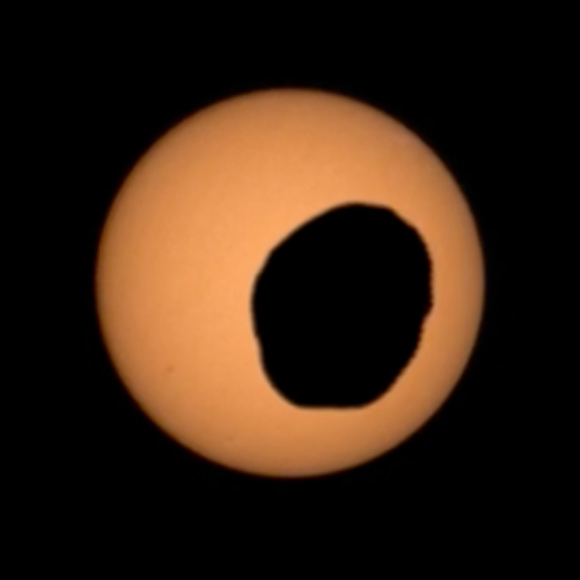


Perseverance catches Phobos slipping across the Sun on sol 1948. Image: 2026 08 26 perseverance phobos sun transit.


On 12 August 2026, on the 1,948th Martian day of its mission, NASA’s Perseverance rover stopped what it was doing for a few minutes, pointed its Mastcam-Z camera at the Sun, and watched Phobos, the inner of Mars’s two moons, slide across the solar disk. The animation that came back has been colorized to mimic what a person on the Martian surface would have seen looking up through a pair of protective eclipse glasses: a small, dark, lumpy silhouette gliding across a glowing orange Sun, never covering enough of it to qualify as a true eclipse (Sci.News).

A partial transit like this is small in the moment and large in the long run. Perseverance has been recording these crossings since it landed in Jezero crater in February 2021, and the team keeps shooting them because each one is a measurement of where Phobos is, and where it is going. By comparing the recordings taken years apart, scientists can refine the moon’s orbit, watch how the orbit is decaying under Mars’s tidal pull, and update the timeline for the day Phobos will finally break apart at the Roche limit or crash into the planet (Sci.News). The same kind of observation, applied to a star instead of a moon, was how exoplanet hunters in the Kepler and TESS era measured the size and orbital period of worlds around other stars. Phobos in front of the Sun is the equivalent demonstration, just two doors down from Earth.

The other reason the recording matters is that Phobos is one of the few Solar System bodies small and close enough that a single orbiting spacecraft can resolve its shadow path from the surface. The moon is only about 26 by 22 by 18 kilometers across, smaller than many asteroids, and orbits Mars at roughly 6,000 kilometers from the surface. That closeness is also why the transit never becomes a total eclipse: from the Martian surface, Phobos never appears large enough to cover the Sun’s disk, only to carve a moving bite out of it.

The 12 August 2026 observation was Perseverance’s most recent entry in a routine the rover has been keeping for more than four Earth years. The Mastcam-Z instrument, a pair of zoomable color cameras mounted on the rover’s remote sensing mast, has been used on multiple earlier sols to record Phobos and Deimos transits. Each observation produces a short video of frames that the team can stack, time-stamp against the rover’s onboard clock, and compare with prior sessions.

What is new with sol 1948 is mostly cosmetic. The animation was tinted on the ground to simulate the visual impression a human observer on Mars would get looking up through solar-eclipse glasses, the same orange-tinted look eclipse chasers use on Earth. The raw data is still a time series of dark silhouettes moving across a bright source. The team released the public-friendly version after running the standard calibration, and the Sci.News writeup on 24 August pulled it back into the news cycle as part of a steady drip of small Mars-science updates (Sci.News).

Behind the video is the same physics that makes a solar eclipse work on Earth: a foreground object passes between the observer and the Sun, casting a moving shadow. The differences are size and geometry. Phobos is roughly 150 times smaller than Earth’s Moon and sits about 200 times closer to Mars than the Moon does to Earth, so its angular size is far too small to cover the Sun. The Moon’s apparent diameter almost exactly matches the Sun’s during a total solar eclipse on Earth, which is the happy coincidence that makes totality possible. Phobos never gets that close to covering the Sun, so the term “transit” is the right word, with “annular eclipse” reserved for a slightly bigger blocker that still falls short of totality.

Mastcam-Z is the workhorse camera on Perseverance’s mast, sitting about two meters above the Martian surface at the eye level of a roughly 6½-foot-tall person, with the two cameras separated by about 24 centimeters to give stereo vision (NASA Mars 2020 Mastcam-Z page). It was designed primarily to study rocks and soils from a distance, with a zoom range that lets the team build topographic maps of terrain features, and it can record 1600 by 1200 pixel frames at up to about 148 megabits per sol of returned imaging.

The transit record itself is what the orbital dynamicists want. Phobos orbits Mars in 7 hours and 39 minutes, faster than any other moon in the Solar System relative to its parent planet’s rotation, and tidal drag is slowly shrinking that orbit. The standard textbook figure is that the orbital radius is decreasing at roughly two centimeters per year, or about two meters per century, and the projections for when Phobos will either break up into a ring or crash into the surface run from about 30 million to 50 million years out (Wikipedia: Phobos (moon))). Observations like the sol 1948 transit tighten the numbers behind those projections by giving the orbit a fresh astrometric fix.

The geometry also gives a measurement that is hard to get any other way: from a fixed landing site like Jezero, the exact path of Phobos across the Sun depends on where Phobos is in its orbit at a particular second. Cross-referencing that path against time, the rover team can solve for orbital elements that mass and remote sensing measurements cannot constrain.

A subtle point worth flagging is that Perseverance did not move to capture this transit. The rover was wherever it happened to be on sol 1948, and the team aimed the mast at the Sun from there. This matters because location is one of the unknowns in the orbital fit: if Jezero’s coordinates are even slightly off in the Mars-fixed reference frame, every recorded shadow path inherits that error. Years of persistent observations from the same rover at the same site cancel most of that error out.

The 12 August 2026 Phobos transit is a small piece of work by a long-running rover that has already spent more than five and a half years on Mars. The Mars 2020 mission’s headline job, caching samples for a future return mission, is well into its second decade of planning, and Mastcam-Z observations of this kind are now a small but reliable side-product that keeps adding data to the Phobos literature. Expect another of these recordings every few months from Jezero as long as the rover stays healthy, and the public versions appear in the standard NASA Mars 2020 image release channels over time. The longer-running payoff sits in the orbit itself: each transit shaves uncertainty off the prediction for the day Phobos stops being a moon.


September 12, 2026

The loneliest arrival of the decade

Posted by


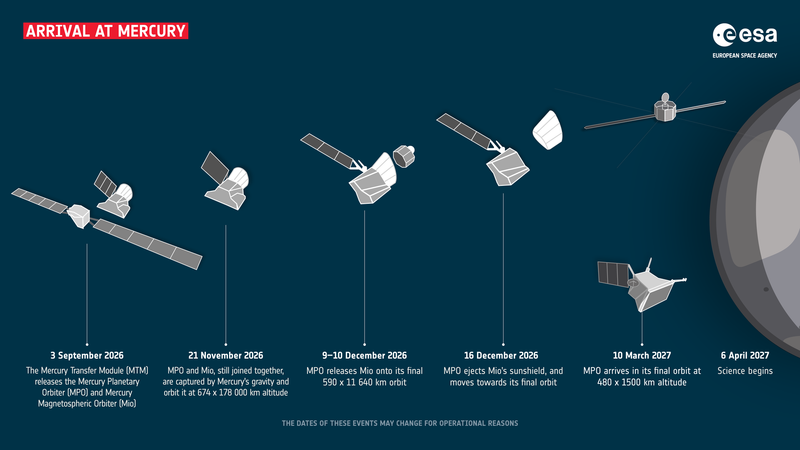
BepiColombo's arrival at Mercury, showing the four-stage separation sequence from MTM separation on 3 September 2026 through science operations beginning on 6 April 2027. (ESA)


On 15 June 2026, at 15:24 CEST, a spacecraft 100 million kilometers from Earth received a single command through ESA’s Estrack deep-space antennas: stop firing. After almost eight years of nearly continuous thrust, the four QinetiQ T6 ion engines on the Mercury Transfer Module shut down for the last time. With that, the European/Japanese BepiColombo mission crossed an invisible line. From that moment, the spacecraft was on a ballistic trajectory, coasting with no propulsion toward the deepest gravity well in the inner Solar System. Mercury orbit insertion is scheduled for 21 November 2026 (ESA BepiColombo mission timeline, July 2026 update). What used to be a braking problem became a falling problem, and falling problems don’t have throttle knobs.

Mercury is the least explored planet in the inner Solar System, and the hardest one to reach without surrendering. It sits deep inside the Sun’s gravity well, moving at 47 km/s on average, more than three times Earth’s orbital speed. To fall into orbit around it rather than whip past it, a spacecraft must shed almost all of the kinetic energy it gained falling toward the Sun from Earth. NASA managed the trick with Mariner 10 in 1974 and MESSENGER in 2011. The Soviets never made it. The Japanese never tried. If BepiColombo succeeds, it will be only the third spacecraft in history to enter orbit around Mercury, and the first from Europe or Japan (ESA BepiColombo overview).

The mission also carries the heaviest scientific payload ever sent to Mercury, sixteen instruments distributed across two orbiters stacked on a propulsion bus. The trajectory they are flying is, by itself, an engineering demonstration: a multi-year, multi-flyby spiral through nine planetary encounters that uses gravity assists from Earth, Venus, and Mercury itself to bleed off energy without spending propellant.

BepiColombo launched from Kourou on 19 October 2018 aboard Ariane 5, lifting a 4,100-kilogram composite spacecraft into a series of looping escape orbits. The plan was, in spirit, simple: spiral inward. In practice, the MTM had to do most of the braking. Its four T6 ion thrusters, each producing only about 145 millinewtons of thrust (about the weight of a sheet of paper resting on a hand), fired almost continuously for years, accumulating more than 15 kilometers per second of total delta-v.

Then, in April 2024, the system lost a fight with itself. A short circuit in the MTM power conditioning unit reduced available thrust to roughly 90 percent of nominal. The original December 2025 arrival was no longer reachable. ESA’s flight dynamics team at ESOC in Darmstadt had to rebuild the entire interplanetary approach from the ground up, slicing flyby altitudes closer to Mercury by about 35 kilometers to recover the energy deficit through sharper gravity assists. The sixth and final Mercury flyby, on 8 January 2025, came in at just 295 kilometers above the night-side surface. Close enough that the spacecraft’s M-CAM monitoring cameras caught permanently shadowed craters at the north pole that may hold frozen water (ESA, January 2025 flyby report).

What happens between now and April 2027 is a four-stage separation sequence that ESA’s infographic captures cleanly. On 3 September 2026, still on approach, the MTM detaches and falls away, its job done and its xenon tanks empty. On 21 November 2026, a stack of two science orbiters fires a chemical-propellant braking burn and is captured into a high-altitude polar orbit. On 9–10 December 2026, ESA’s Mercury Planetary Orbiter (MPO) ejects the shielded Japanese Mio spacecraft onto its own elliptical polar trajectory. On 16 December 2026, MPO jettisons Mio’s protective sunshield (MOSIF). Over the next three months, MPO uses its own thrusters to lower itself to its working orbit of roughly 400 by 1,500 kilometers, arriving on 10 March 2027. Routine science begins on 6 April 2027 (ESA BepiColombo arrival timeline, July 2026).

The propulsion architecture is the story. The T6 ion thruster, built by QinetiQ Space in the UK, ionizes xenon and accelerates the ions through a grid biased at roughly 2,000 volts. Specific impulse runs around 4,300 seconds, about five times better than the best chemical bipropellant engine on the spacecraft. The trade is brutal: thrust is so low that BepiColombo had to spiral inward for eight years to make the maneuver work. The reward is propellant efficiency. The MTM carried only about 580 kilograms of xenon, and that modest tank delivered the equivalent delta-v of tens of metric tons of hydrazine.

Once the MTM separates, MPO has to handle the rest of the braking with its own chemical propulsion: a hydrazine-based system capable of producing about 1,000 newtons of total thrust across four 22-newton thrusters. To enter Mercury orbit, MPO must dissipate roughly 1.8 km/s of hyperbolic excess velocity in a series of maneuvers spread over weeks. Because Mercury’s gravity well is so deep, an error of even one meter per second in the insertion burn propagates into hundreds of kilometers of orbital drift by the end of the commissioning phase.

The two orbiters work at very different altitudes on purpose. Mio, the JAXA Mercury Magnetospheric Orbiter (formerly MMO), sits in a highly elliptical 400 by 12,000 kilometer orbit that swings it through the magnetosphere to sample solar wind interactions. MPO, in a tighter near-circular polar orbit, holds its instruments nadir-pointed at the surface. Eleven instruments on MPO and five on Mio together cover imaging (SIMBIO-SYS), X-ray fluorescence (MIXS), gamma-ray and neutron spectroscopy (MGNS), laser altimetry (BELA), magnetometry (MERMAG), and exospheric sampling (SERENA, PHEBUS). Temperatures range from about -180°C on the night side to +430°C on the day side, so most optical and infrared instruments sit behind thermal blankets and, where needed, gold-coated mirrors.

The water-in-shadow question is one of the cleaner open cases. Earth-based radar returns from Mercury’s polar craters are consistent with volatile ices buried under regolith. BepiColombo’s MGNS and MIXS instruments should, in principle, detect hydrogen directly through neutron moderation and detect elemental composition through characteristic X-ray emission. The permanently shadowed craters (Prokofiev, Kandinsky, Tolkien, and Gordimer at the north) were imaged by M-CAM 1 during the January 2025 flyby. Their rims just catch the sun, while their floors stay below 100 K year-round.

Three months from now, an interplanetary spacecraft that has spent almost a quarter of its life quietly thrusting through the inner Solar System is going to fall into the smallest planet’s gravity well. Whether the chemical insertion burn works depends on years of trajectory redesign, on the integrity of a 90-percent-power propulsion system that engineers coaxed across nine planetary encounters, and on a separation sequence that has to be executed cleanly four times in two months. If it works, BepiColombo will spend the next several Earth years mapping an airless, 430-degree-Celsius world whose permanently shadowed craters might, just maybe, hold enough water to matter for human exploration later this century.

If it doesn’t work, the spacecraft will whip around Mercury on a flyby trajectory, and the data already gathered by M-CAM during the six gravity assists will have to carry more of the mission’s scientific weight. As ESOC mission operators Ignacio Tanco and Nacho Clerigo have stressed in briefings, the arrival phase is not a single event but a six-month sequence of one-of-a-kind operations, each of which has to go right in the right order.


September 9, 2026

BepiColombo drops its ride to Mercury

Posted by


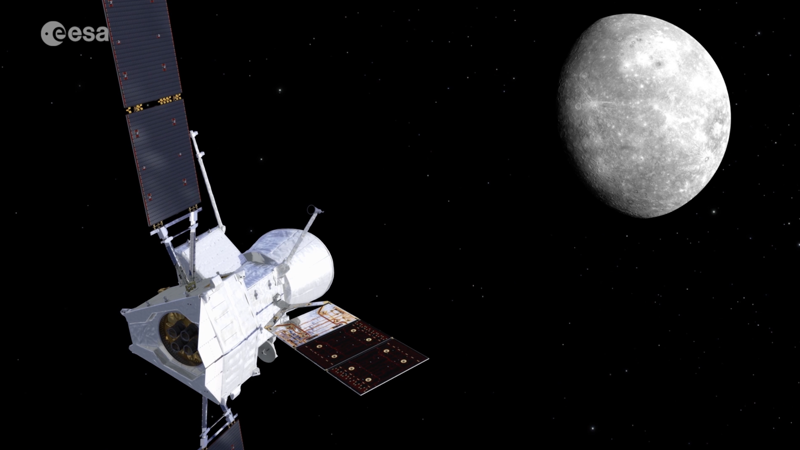
The BepiColombo composite spacecraft - ESA's Mercury Planetary Orbiter (MPO) at the base with its single solar array extended, JAXA's Mio (Mercury Magnetospheric Orbiter) sheltered inside the white MOSIF sunshield on top, and the Mercury Transfer Module's large rectangular solar wing visible behind the stack - approaches a half-lit Mercury against a black starfield. Credit: ESA / ESA Multimedia image (24 June 2026).


On Thursday afternoon at 14:00 CEST, a stack of four spacecraft modules that left Earth on an Ariane 5 in October 2018 will, very briefly, become three and then two. ESA’s Mercury Transfer Module is scheduled to detach from BepiColombo’s two science orbiters as the mission’s controllers at the European Space Operations Centre in Darmstadt look on, with the first signal from the freed composite expected back on Earth by 15:53 CEST if everything goes to plan (ESA, 27 August 2026). After eight years and nine gravity assists, the part of the spacecraft that made the trip possible is no longer needed, and the part that has to do the science is, ungainly and for the first time, on its own.

Getting to Mercury is the kind of orbital mechanics problem where the obvious solution is forbidden. Falling toward the Sun does not slow a spacecraft down; it speeds it up, pulled by solar gravity, so the usual chemical-brake trick used at Mars is not enough to be captured into orbit around the smallest planet. BepiColombo has to match Mercury’s velocity almost exactly, and that takes far more energy than reaching even the distant gas giants. The mission’s answer was to spend years bleeding speed against an ion engine instead of staging a single dramatic burn, and the upcoming separation is the moment the engine is, finally, switched off and thrown away. As ESA’s mission manager Santa Martinez put it to Euronews on 1 September, “Mercury is a challenging destination. It’s very difficult to reach, it’s very difficult to operate there.”

Why a separation matters this much, and why the next two months are unusually tense, comes down to what changes about the spacecraft on Thursday. For the cruise the four modules sat one on top of the other inside a tight stack, with their instruments and cameras physically blocked from space by the boxy MTM at the base. Once the MTM floats off, the upper composite begins an entirely new mission with an entirely new thermal and radiation budget. Solar flux near Mercury is roughly ten times what it is near Earth, and the MTM had been there partly to shield the orbiters during the inner solar system transit. The flight director, Ignacio Tanco, has described the moment to Euronews as working “with a very hot pizza oven running right on your back” and “on a knife edge,” because the MPO’s solar panels have to be tilted within fractions of a degree of the Sun. Push them slightly away and the spacecraft starts losing power; angle them slightly closer and they start to bake. There is no second chance to find the right pointing before the thermal balance tips.

The spacecraft itself carries a long memory. BepiColombo launched on Ariane flight VA245 from Kourou on 20 October 2018 and reached escape velocity the same day, then spent almost exactly eight years climbing and falling through the inner solar system using four QinetiQ T6 ion thrusters on the MTM, with a maximum combined thrust of about 290 millinewtons, the most powerful ion engine array ever operated in space. The cruise used one Earth flyby in April 2020, two Venus flybys in October 2020 and August 2021, and six Mercury flybys between October 2021 and January 2025, the last of which imaged the permanently shadowed north polar craters Prokofiev, Kandinsky, Tolkien and Gordimer. The mission’s overall cost is estimated at 1.65 billion euros, and the arrival has already slipped about eleven months from its original December 2025 date because of a power-related anomaly that limited the available thrust before the fourth Mercury flyby in September 2024. On 15 June 2026 at 13:24 UTC the MTM’s solar electric propulsion was switched off for good, and from then on the mission is ballistic: BepiColombo is, in engineering language, “weakly captured” by Mercury’s gravity and following a free-falling trajectory through space.

What happens after 3 September is a sequence of three distinct steps rather than one event. From the separation through late November, the MPO and Mio remain mechanically and electrically joined, with the Magnetospheric Orbiter Sunshield and Interface (MOSIF) still attached, and the two orbiters fly free of the propulsion module for the first time in their lives. Then, between late November and early December 2026, a series of chemical thruster burns raises the orbit’s apocentre and lets Mercury’s gravity do the rest, putting the composite into polar orbit. Once captured, MPO and Mio separate from each other and head to their distinct orbits, MPO in a lower polar orbit for surface and interior science and Mio in a higher polar orbit at 590 by 11,640 kilometres for magnetospheric work. Engineers then spend roughly four months commissioning instruments on both orbiters, and only in April 2027 does the dedicated science campaign begin. The waiting list, when it eventually opens, is unusually long. Mercury’s iron core makes up roughly sixty percent of the planet’s volume, and the mission’s principal question is why a planet that small should pack such a dense metallic interior, and what that interior is doing to the unexpectedly long-lived magnetic field that makes Mercury (along with Earth) the odd rocky planet out. The two orbiters will “taste” the planet’s tenuous exosphere of hydrogen, helium, oxygen, sodium, potassium and calcium at the same time that MPO maps the surface, measuring surface temperatures down to a few hundred metres per pixel and sounding the crust with the RIME ice-penetrating radar that was deployed once in 2023 and has waited seven years to be used on Mercury. Separation on Thursday is the first of a small handful of moments that decide whether any of that science happens, and it is the one the ESA team can already see clearly. After MTM separation, mission controllers listen for the post-separation acquisition of signal and then go through the first health checks. If the composite is in the expected attitude, the high-gain antenna locking on Earth, and the temperatures inside the expected range, MPO and Mio spend the next three months coasting together in what ESA calls a Mercury approach configuration, conservatively waiting for the November capture window. The MTM, the workhorse that brought them there, has no attitude control after separation, so ESA’s flight dynamics manager Frank Budnik has been clear that “you cannot control it, you cannot manoeuvre it,” and the module will begin to tumble away in its own orbit past Mercury rather than around it. After eight years, the most powerful ion engine array ever flown is, for a few million kilometres at least, just a derelict tumbling through interplanetary space with the Sun in its face and no way to turn around.


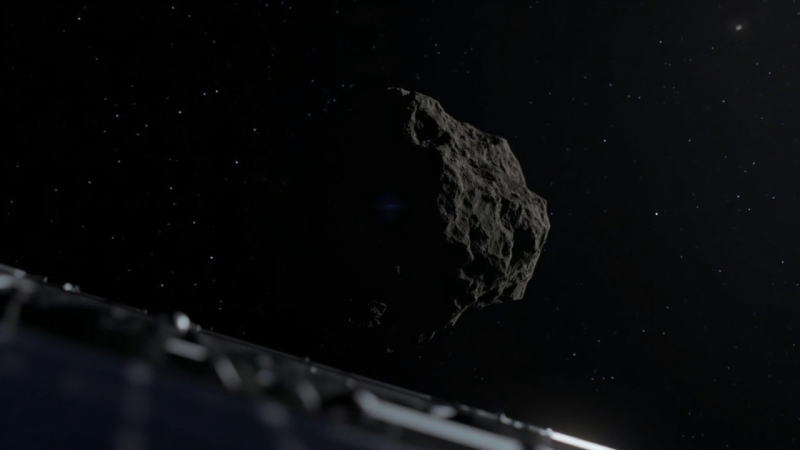
Artist's view of the small, jagged quasi-satellite Kamoʻoalewa, as seen from roughly 20 km during Tianwen-2's approach on July 2, 2026.


A small, jagged rock tumbling through space about 20 million kilometers from Earth just had its portrait taken. On July 6, 2026, the China National Space Administration released the first close-range images of (469219) Kamoʻoalewa, captured by the Tianwen-2 spacecraft from roughly 20 kilometers away on July 2. The pictures are grainy, low-resolution, slightly fuzzy at the edges. They are also the only close-up views humans have ever gotten of Earth’s most stable known quasi-satellite, and they sharpen a debate that has dragged on for nearly a decade about where this object came from. The rock’s elliptical path around the Sun takes it between roughly 0.1 and 0.3 AU closer and farther from Earth’s orbit, depending on where in the multi-decade cycle you sample it. From a ground-based telescope on any given night, Kamoʻoalewa is a faint dot moving against the stars: too small for any existing instrument to resolve as a disk, but bright enough that sensitive CCDs can pin down its spectrum and its rotation period. Both numbers have mattered for the past decade’s argument.

Kamoʻoalewa (a Hawaiian name meaning “oscillating celestial object”) was discovered in 2016 by the Pan-STARRS survey at Haleakalā Observatory in Hawaii (JPL Small-Body Database). Estimates put it somewhere between 16 and 40 meters across, it rotates once every 27 minutes, and it shadows Earth in a peculiar gravitational dance. Not a true moon, but a small body trapped in a 1:1 mean-motion resonance with our planet, looping the Sun in an orbit nearly identical to ours. From Earth’s perspective, the rock traces a slow, bean-shaped path that drifts between leading and trailing horseshoe configurations on timescales of decades. For at least the past hundred thousand years, give or take an order of magnitude, it has been Earth’s quiet companion. At some point it will leave.

For most of that history, nobody could get close enough to study it. Ground-based spectroscopy showed a spectrum that resembled space-weathered lunar regolith, with a weak 1.0 μm absorption band and a steep red slope that closely matched samples returned by Apollo 14 and the Chang’E-5 lander (Zhang et al., Nature Communications, May 2026). That match suggested the asteroid might be a piece of the Moon, blasted off by a relatively recent impact and gently nudged into a co-orbital path. But other groups showed that heavily weathered LL chondrite powder could produce a similar spectrum, and a Flora-family origin in the main belt remained plausible. Without a sample in hand, the question stayed open.

Tianwen-2 launched on May 29, 2025 from the Xichang Satellite Launch Center on a Long March 3B rocket, carrying 11 scientific instruments and a sample-return capsule designed for two distinct collection methods: a Hayabusa-style touch-and-go to grab regolith kicked up by a small thruster pulse, and an anchor-and-attach approach using robotic arms to clamp onto boulders and retrieve larger fragments. The spacecraft’s primary target was Kamoʻoalewa; an extended mission will later send it onward to main-belt comet 311P/PANSTARRS using a lunar gravity assist, with arrival in 2035.

The cruise phase took just over a year. Tianwen-2 first detected Kamoʻoalewa on June 6, 2026 at a range of 30,000 kilometers and refined the asteroid’s ephemeris from kilometer-scale uncertainty down to tens of meters (CNSA, July 2026). By June 19 it had closed to 2,000 km. Two weeks later, the framing camera returned the first resolved frames: a small, asymmetrical, jagged fragment, rotating visibly between exposures. The shape, in early analysis, looks more like a single competent block than the loose rubble pile some pre-arrival models had predicted.

The clincher will be the samples themselves, scheduled for collection later this year and return to a landing site near Jiuquan in late 2027. Tianwen-2 is the third mission in a decade-long run of asteroid sampling attempts, after JAXA’s Hayabusa2 (returned 5.4 g from Ryugu in December 2020) and NASA’s OSIRIS-REx (returned 121 g from Bennu in September 2023). Both of those targets were bigger than this one — Ryugu at about 900 m, Bennu at about 500 m — and both had escape velocities of tens of centimeters per second. Tianwen-2 is operating at a scale where escape velocity drops to a few centimeters per second, which puts the spacecraft closer to the asteroid in gravitational terms than a hang glider is to a hillside.

A new Nature Communications paper from Zhang and colleagues, published May 27, 2026, lays out what Tianwen-2’s near-approach spectroscopy already tells us about composition. The body’s reflectance spectrum matches the Itokawa-like LL chondrite class but with deeper space-weathering features than Hayabusa2 saw on its target. That tilts the evidence away from the lunar-ejecta hypothesis and toward a main-belt origin, but does not settle it. Samples in hand will.

Sampling on a 27-minute rotator is not trivial. A touch-and-go sequence has to compensate for the asteroid’s rotation, surface translation, and the very weak gravitational field — escape velocity from a 27-meter rocky body is on the order of a few centimeters per second. The Tsiolkovsky rocket equation, Δv = v_e * ln(m_0 / m_f), governs the maneuver budget for the descent burn. With a hydrazine thruster exhausting at roughly 2.2 km/s, Tianwen-2 has only a few hundred meters per second of total Δv available for the rendezvous, descent, sampling, and escape sequence combined. Each kilogram of mass the spacecraft sheds by venting or by jettisoning a sampling arm after contact translates directly into extra Δv headroom on the way home.

The anchor-and-attach method sidesteps some of that timing pressure. The arms can latch onto a boulder and ride the rotation with the asteroid for one full spin, giving the sampling drill time to work without the spacecraft having to hover. For both methods, the engineering constraint is the same: a few hundred grams of regolith, in a sealed capsule, must survive the return trip.

After the samples are sealed, Tianwen-2 will swing by the Moon for a gravity assist — adding roughly 1 km/s of heliocentric velocity for a negligible fuel cost — and aim for an Earth return in November 2027. If the capsule lands intact, the lab work begins: isotope ratios, cosmic-ray exposure ages, mineralogy. For the lunar-ejecta camp, the smoking gun would be a sample’s oxygen isotope signature falling outside the range of known meteorites and inside the range of lunar rocks. For the Flora-family camp, the clincher would be cosmic-ray exposure ages older than any plausible lunar crater’s age.

Either answer is interesting. A confirmed lunar origin would make Kamoʻoalewa the first known natural sample of the Moon without ever landing there, and would let planetary scientists calibrate impact-ejection dynamics with real data rather than simulations. A confirmed main-belt origin would rewrite the textbook on how quasi-satellites are captured and how space weathering proceeds on small bodies. By late 2028, with luck and a soft landing in Inner Mongolia, we will know which way the cosmic dice rolled when this little fragment came tumbling into Earth’s neighborhood. Until then, the new images are already doing their job: they have made an abstract orbital curiosity into a place with a shape, a spin, and a surface.


In the early hours of March 17, 2026, engineers at the European Space Agency watched as a spacecraft roughly 1.6 billion kilometers away executed the largest trajectory correction of its mission. Hera’s three main engines fired in sequence over several hours, consuming 123 kilograms of hydrazine propellant and delivering a velocity change of 367 meters per second. The maneuver aligned the spacecraft’s solar orbit inclination with that of the Didymos binary asteroid system, confirming that the probe remains precisely on course for its rendezvous in November. Hera will spend the coming months quietly cruising toward a planetary science milestone that researchers have been anticipating since September 2022, when NASA deliberately collided a spacecraft with a small moonlet called Dimorphos.

The DART mission, Double Asteroid Redirection Test, impacted Dimorphos on September 26, 2022, at approximately 6.1 kilometers per second. The collision was not designed to destroy the asteroid but to test whether kinetic energy transferred from a spacecraft could measurably alter the orbit of a body around its parent asteroid. Scientists estimated the impact would shorten Dimorphos’s orbital period around Didymos by roughly 10 percent, a change that ground-based telescopes began measuring within days. The initial finding of approximately 32 minutes shortening was striking enough to declare the test a success, but the full picture required more time and more data to emerge.

In March 2026, NASA announced the conclusion of a multi-year analysis combining radar observations, ground-based telescope measurements, and 22 stellar occultations recorded by volunteer astronomers worldwide. The results confirmed not only that Dimorphos’s orbital period around Didymos shortened by approximately 33 minutes but also that the entire binary system’s orbit around the Sun changed in a measurable way. The Didymos-Dimorphos system’s 770-day solar orbit shortened by approximately 0.15 seconds per revolution, and its orbital speed increased by roughly 11.7 microns per second. The mechanism behind the solar orbit change differs from the immediate transfer of momentum during the impact. Instead, the effect arises from the substantial ejection of rocky debris from Dimorphos following the collision. When the DART spacecraft struck Dimorphos, it displaced millions of kilograms of material that accelerated away from the asteroid in various directions. The conservation of momentum in the system meant that the ejected debris carried away additional orbital energy, effectively acting as a secondary propulsion event. The phenomenon is called momentum enhancement, and the DART results indicate it approximately doubled the net impulse delivered to the asteroid compared to the spacecraft’s own momentum alone.

The 22 stellar occultations that contributed to the measurement illustrate an elegant form of interplanetary science that requires no spacecraft at all. When an asteroid passes in front of a distant star as seen from Earth, the star’s light dims in a characteristic pattern that encodes information about the asteroid’s size, shape, and orbital position. Volunteer astronomers using commercially available equipment recorded these events across multiple continents between October 2022 and March 2025, building a dataset precise enough to detect changes in Dimorphos’s trajectory measured in meters per second. The coordination required to time these observations across dozens of sites reflects the kind of international scientific collaboration that planetary defense has increasingly attracted.

The binary nature of the Didymos-Dimorphos system added complexity to the analysis because the two bodies orbit each other while together orbiting the Sun. Changes in the internal orbital period affect the center of mass of the system, which in turn affects how the system responds to external gravitational influences. Researchers found that the momentum enhancement from debris ejection altered the binary orbit in ways that rippled outward to change the system’s solar orbit. This had never been directly measured before and provides a data point that asteroid deflection models had predicted but never confirmed.

Hera’s mission now is to examine the aftermath of this event at close range. The spacecraft carries two CubeSats named Juventus and Milani that will deploy upon arrival to conduct complementary measurements. Juventus will use a tri-axial magnetometer and a susceptibility probe to characterize Dimorphos’s internal composition and magnetic properties, while Milani will conduct spectroscopic analysis of the asteroid’s surface to map mineralogy and search for organic compounds. The primary spacecraft will map the DART impact crater in high resolution, measure the mass of Dimorphos through subtle gravitational effects on Hera’s trajectory, and characterize the surface morphology that resulted from the collision and subsequent debris cascade.

The approach phase beginning in October 2026 represents the highest-risk period of the mission aside from arrival itself. Hera’s onboard software will use its asteroid framing cameras to autonomously detect and track Didymos and Dimorphos during the three-week approach, a capability that has been tested in simulations but never validated in the actual environment. The navigation challenge is compounded by the binary system’s mutual orbit, which means both bodies are moving relative to each other at velocities that require the spacecraft’s guidance system to track two objects simultaneously. Engineers have uploaded software updates during the cruise phase to prepare for these operations, and mission controllers will monitor the process from ESA’s European Space Operations Centre in Darmstadt.

Understanding why DART produced effects extending to the solar orbit requires examining the three-body dynamics that govern binary asteroid systems. When two objects orbit each other, their motions are governed by their mutual gravitational attraction, which depends on their masses and the distance between them. The impact by DART altered the orbital velocity of Dimorphos, which changed the balance of forces in the binary system. This in turn changed the rate at which the two bodies orbit each other, and the resulting shift in the location of the center of mass altered the system’s overall momentum.

The momentum enhancement factor of approximately 2 observed in the DART results has significant implications for the design of future deflection missions. If a spacecraft impact can deliver twice the expected momentum transfer through debris ejection, then smaller missions could achieve the same deflection effect, reducing launch mass requirements and mission costs. However, the magnitude of the enhancement depends on the surface properties of the target asteroid, which vary considerably. Loose rubble pile asteroids like Dimorphos produce more debris than solid rock bodies, making the enhancement factor difficult to predict for new targets.

The crater formed by DART on Dimorphos will provide direct evidence of the surface response to hypervelocity impact. The crater size and shape encode information about the target’s material properties, including its tensile strength, porosity, and layering. Hera’s high-resolution camera will resolve features down to a few meters, allowing scientists to compare the observed crater with pre-impact predictions and refine impact models for future use.