


JUICE picked up 3.5 km/s skimming Earth’s atmosphere edge
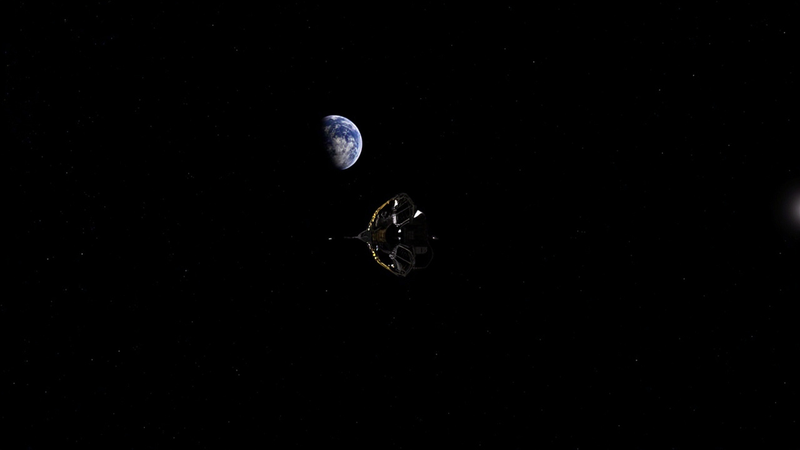
At 13:45 CEST on 28 September 2026, ESA’s Jupiter Icy Moons Explorer skimmed 8,640 kilometers above the Indian Ocean – close enough that an atmospheric physicist would call the altitude “edge of space.” The flyby added 3.5 kilometers per second to the spacecraft’s velocity and rotated its trajectory by twenty degrees, almost without touching its fuel tanks. Closest approach was over open ocean, well clear of populated regions, and was captured by JUICE’s two monitoring cameras at the moment the spacecraft began to climb back out of Earth’s gravity well. It is the second of three Earth (and one Venus) gravity assists the probe will use over an eight-year cruise to reach Jupiter in 2031. This time, instead of treating Earth as just a waypoint, ESA turned the encounter into a dress rehearsal for the eleven scientific instruments that will eventually map Ganymede, Europa and Callisto – the three large, icy, ocean-bearing moons that give the mission its name.
The phrase “gravity assist” hides a century of celestial mechanics. In the Newtonian picture, a spacecraft swinging past a moving planet picks up or loses kinetic energy from the planet’s own orbital motion, the way a tennis ball struck by a moving racket leaves faster than it arrived. In a pure two-body problem the gain is reversible. In the real three-body mess of spacecraft, planet and Sun, the assist can be planned to add a fixed velocity increment for a fixed angle of deflection. Each leg of the trajectory is treated as a Keplerian orbit about a single dominant body, with sudden changes at the boundary – the patched-conic approximation that has guided interplanetary navigation since the 1960s. For JUICE, the propellant budget for the cruise phase is 386 kilograms. The first gravity assist came in 2024 with a record-breaking lunar-Earth double flyby, in which the Moon bent the trajectory before Earth added energy. The second came on 31 August 2025 at Venus, where JUICE picked up 5.1 km/s at 5,088 km altitude. The third was the 28 September Earth flyby. The fourth, and final, will be a third Earth encounter in January 2029, which lines up the spacecraft for Jupiter orbit insertion in July 2031.
In the four weeks leading up to the flyby, JUICE’s flight control team at ESA’s European Space Operations Centre in Darmstadt had scheduled six possible trajectory-correction maneuvers. They used one – a tiny nudge a few days before closest approach – to align the spacecraft with the geometry needed to extract the maximum energy from the swing-by. “The flyby required ultra-precise navigation in real time,” said spacecraft operations manager Angela Dietz. “Thanks to our very careful planning, we used only a small amount of the propellant reserved for this flyby. This gives us more to use at Jupiter to carry out observations of the planet’s icy moons.” The other five maneuver windows were quietly dropped.
The flyby was also a third opportunity to test JUICE’s scientific instruments on a real, well-understood target – a privilege planetary missions rarely have. The first came in 2024 during the lunar-Earth gravity assist. The second came in 2025 when JUICE turned its cameras and spectrometers on the interstellar comet 3I/ATLAS as it tore through the inner solar system on its hyperbolic passage from beyond the Sun. Now, with Earth filling the field of view, project scientist Claire Vallat’s team prioritized ten of the eleven instruments based on their relevance to Jupiter science and on the timing of the encounter. JANUS, the German-Italian visible imager, captured color frames of the Moon and Earth at a ground sample distance better than any previous mission of this type. RIME, the radar sounder, pinged the lunar surface in test mode to validate its dielectric calibration. J-MAG, the magnetometer, and PEP, the particle environment package, spent several days in Earth’s magnetotail, collecting plasma data that will help validate the way JUICE will eventually study Ganymede’s intrinsic magnetic field – the only intrinsic magnetic field known to exist around any moon. The data started arriving at ESA’s European Space Astronomy Centre (ESAC) within hours of the encounter. While JUICE sat in the magnetotail, the European-Chinese Smile mission watched the same disturbances from the inside, measuring the auroras and field-aligned currents that connect the polar atmosphere to the distant tail. The combined dataset lets scientists correlate what happens at the polar oval with what happens sixty Earth radii downstream – a joint geophysics experiment that neither mission could have done alone.
The eleven instruments JUICE carried into the flyby represent the bulk of a payload developed under ESA leadership with hardware from across Europe, NASA, JAXA and the Israel Space Agency. JANUS, the camera system, has a 0.07 degree per pixel ground sample distance at closest approach – sharp enough to resolve features a few hundred meters across on Ganymede from orbit. GALA, the Ganymede Laser Altimeter contributed by DLR, will fire a 30-millijoule pulse at 30 hertz into the surface and time the return to centimeter accuracy; that topographic map is what scientists will use to detect the few-centimeter tidal bulge Ganymede’s ice shell should flex under Jupiter’s gravity. MAJIS, the visible and infrared imaging spectrometer, will measure how sunlight and thermal emission change across the moons’ surfaces between 0.5 and 5.5 micrometers. SWI, the sub-millimeter wave instrument, will measure temperature and composition in Jupiter’s stratosphere. UVS will trace the Jovian auroral ovals. RIME will probe tens of kilometers below the icy crust looking for the dielectric signature of a liquid-water ocean – the data needed to tell whether Europa and Ganymede host subsurface seas like the one Cassini inferred beneath Enceladus.
The mechanics of the flyby, meanwhile, are governed by the patched-conic approximation JUICE’s navigation team used to design the encounter. Earth’s gravity well at closest approach is a potential roughly 60 km/s deep at the surface, dropping to less than 0.1 km/s at 8,640 km altitude. A spacecraft entering and leaving this well with a hyperbolic excess velocity of a few km/s picks up almost no net energy – but it can change direction substantially, since the asymptote’s direction rotates by an amount that depends on the geometry of the swing-by. The twenty-degree rotation JUICE achieved is enough to take it from an out-of-ecliptic post-Venus trajectory to one in Jupiter’s orbital plane. The instrument activity had to be squeezed into the time the spacecraft spent under power, since parts of the closest approach passed through Earth’s shadow – a constraint that pushed Vallat’s team to pre-plan every exposure and every magnetometer burst months in advance.
What the next five years look like depends on how well JUICE’s instruments survive their first long bath in deep space. The first calibrated data from the Earth flyby – high-resolution images, spectra, magnetometer and plasma logs – should start arriving at ESAC within weeks and be released to the scientific community in early 2027. The January 2029 flyby will be JUICE’s last swing through the inner solar system. The final burn for Jupiter orbit insertion will come in July 2031, using the same main engine that has been unlit since 2024. By then, the engineering we celebrate this week – the careful navigation, the simultaneous run of ten instruments on a planetary scale, the single tiny burn that put the spacecraft on exactly the right approach – will be a footnote in a mission that, if it works, will give us our first sustained look at the three icy worlds where life might still exist in our own back yard.
 Subscribe to our RSS feed









There are no comments.
Add A Comment