


Curiosity just found the first physical proof that sandstorms once ripped across Mars
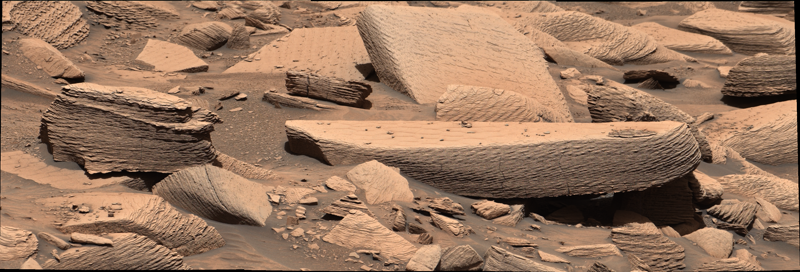
Somewhere around 3.6 billion years ago, on what was probably an unremarkable afternoon, a sandstorm rolled into Gale crater on Mars. It may have lasted only hours. By the next day, the wind was back to normal and the surface was a sunlit desert again. No one saw it. Nothing else on the planet recorded it. But the storm left a physical imprint, and NASA’s Curiosity rover drove past that imprint on December 12, 2024, on its 4,391st Martian day, and photographed it (NASA Science Photojournal, July 20 2026).
The imprint is now the cover paper of the July 1, 2026 issue of the journal Geology. A team led by Steven Banham of Imperial College London describes millimeter-thick, crinkly laminations inside a rock the rover team nicknamed “Jawbone Canyon,” in the Mirador formation on the lower slopes of Mount Sharp. The structures are supercritical climbing wind ripple strata: a class of wind-deposited layering so rare on Earth that sedimentologists have only documented it in a handful of modern and ancient settings, and never before on another planet (Banham et al. 2026, Geology 54(7):611, DOI 10.1130/G54158.1).
Mars climate science has long had a sandstorm problem. Orbital cameras have shown that dust devils and regional dust storms lift fines off the surface today. Climate models assume that early Mars had a thicker atmosphere capable of moving sand. But the physical evidence for sustained sand-moving winds on ancient Mars has been almost entirely indirect: cross-bedded sandstones that record long-term wind patterns, dune fields that froze into rock, ventifacts worn by saltation.
Those records cannot resolve a single weather event. A climbing wind ripple is the signature of a wind strong enough, lasting long enough, and carrying enough sand that the ripples could not migrate as fast as new sand arrived. The crests piled up on the stoss side instead of sliding down the lee side. Each millimeter-thick lamina is the trace of a burst of sand transport; the climb angle records how fast sediment accumulated relative to how fast the bedform moved. The team measured angles of 10 to 18 degrees, values the paper says can only be produced by storms lasting minutes to hours, not by seasonal winds over thousands of years.
That makes the Jawbone Canyon outcrop the first direct physical evidence of a sandstorm on Mars. The paper’s wording is measured: “These climbing ripple sets occur in a thin succession, which suggests that they record a broader sustained event, such as a sandstorm or gale, lasting several hours or more.” The phrase is doing real work, because the alternative explanations had to be ruled out one by one. The central argument is a negative: ordinary wind regimes cannot deposit climbing ripples of these thicknesses at these angles, so whatever made them had to be stronger than everyday wind.
A secondary argument reaches further. Banham notes in the paper and in press interviews that the modern Martian atmosphere, at roughly 6 millibars of mean surface pressure, is too thin to drive saltation at the scale required to build these structures (Astrobiology.com, April 4 2026). The deposits imply that the atmosphere three and a half billion years ago was denser than today’s. The exact density is not pinned down, but the qualitative conclusion is clear: the air on early Mars was heavy enough to push sand in ways the present-day air cannot.
The find was not part of any planned observation. Curiosity’s science team operates in shifts, and one of the standing tasks is to scan the black-and-white navigation panoramas taken at the end of each drive for anything anomalous. Banham and his collaborators, including Linda Kah of the University of Tennessee, Joel Davis of Imperial College London, Sanjeev Gupta, Gerhard Paar, and several JPL-Caltech sedimentologists and mission scientists, noticed unusual textures in those panoramas as the rover approached the Mirador formation. They targeted the rocks with the higher-resolution Mastcam, and at full resolution the laminations resolved into the climbing ripple patterns.
Banham described the find as serendipitous: “We weren’t really looking for these deposits, and then lo and behold, we drove around the corner and found them. We were lucky that we had just the right people on shift that recognized them.” The rock itself is modest in size, roughly a meter wide and 20 centimeters high, with six discrete packages of ripple layers stacked through its thickness. The laminae dip toward the north, which means the wind that built them came from the south. Similar climbing ripples were later identified at a nearby site the team named Dry Lake, and the paper argues that the deposits formed near the margin of a larger dune field or in a wind-scoured depression where airflow patterns concentrated sand accumulation.
The discovery is also a vindication of the Mastcam team’s instinct to keep taking high-resolution follow-up imagery of “unusual” textures. Climbing ripples this small could have been mistaken for noise in lower-resolution data, or simply dismissed as weathered outcrop. The fact that a thin succession of six packages survived in one place for over three billion years, exposed at the surface for the rover to roll up to, is its own piece of good fortune.
The terminology is precise. In sedimentology, ripples are small bedforms, typically a few centimeters tall and tens of centimeters in wavelength, that form when wind or water flows over a bed of loose sand and organizes it into regular undulations. In a normal subcritical regime, sand grains saltate up the windward (stoss) face and avalanche down the leeward (lee) face, and the ripple migrates downwind without growing vertically. In a supercritical regime, the wind is strong enough and the sand supply is high enough that grains accumulate faster on the stoss face than they can slide off the lee face, so the ripple climbs. The climb angle is set by the ratio of vertical accumulation to horizontal migration; a 10-degree angle corresponds to roughly six times as much vertical deposition as horizontal migration.
Climbing ripples have been documented in a small number of terrestrial settings: deep-sea turbidity currents, certain wind-blown dune margins, and a few fluvial flood deposits. They are rare because the conditions that produce them are themselves unusual. On Mars, no one had ever identified them, in part because orbital images cannot resolve millimeter-scale laminae and in part because no previous rover had driven through sedimentary terrain with both the imaging resolution and the science team bandwidth to spot them.
The Banham paper lays out the diagnostic criteria: millimeter-scale lamina thickness, climb angles between 10 and 18 degrees, preserved stoss-side grainflow cross-stratification, and lateral continuity across the outcrop face. All four appear at Jawbone Canyon. The team estimates that a single 50-millimeter-thick layer could have formed in 6 to 20 minutes under storm conditions; the full succession of six packages therefore records on the order of an hour or two of sustained sand transport (Daily Galaxy, July 17 2026).
Curiosity has been on Mars for more than thirteen years. In that time it has found evidence of ancient lakes, rivers, groundwater, organic molecules, and a past climate that was at least intermittently habitable. What it had not found, until now, is direct evidence of an ancient sandstorm. The Jawbone Canyon outcrop fills that gap with a single rock roughly the size of a kitchen table.
The immediate payoff is a new constraint on early Mars atmospheric density: the air had to be thick enough to drive saltation at storm intensities. The longer-term payoff is a search template. Banham has said the next thing he wants the team to find is raindrop impact marks, craters in fine sediment left by rain, which would settle a separate debate about whether early Mars ever saw liquid rain rather than only snow and surface runoff. “It would be magic if we found those,” he said. The climbing ripples are not the last stop on Curiosity’s geology to-do list. They are evidence that the rover is still, after 4,391 sols, finding things on Mars that no one had asked it to look for.
 Subscribe to our RSS feed









There are no comments.
Add A Comment