OrbitalHub

Where curiosity reaches escape velocity.

Domain is for sale. $50,000,000.00 USD. Direct any inquiries to contact@orbitalhub.com.


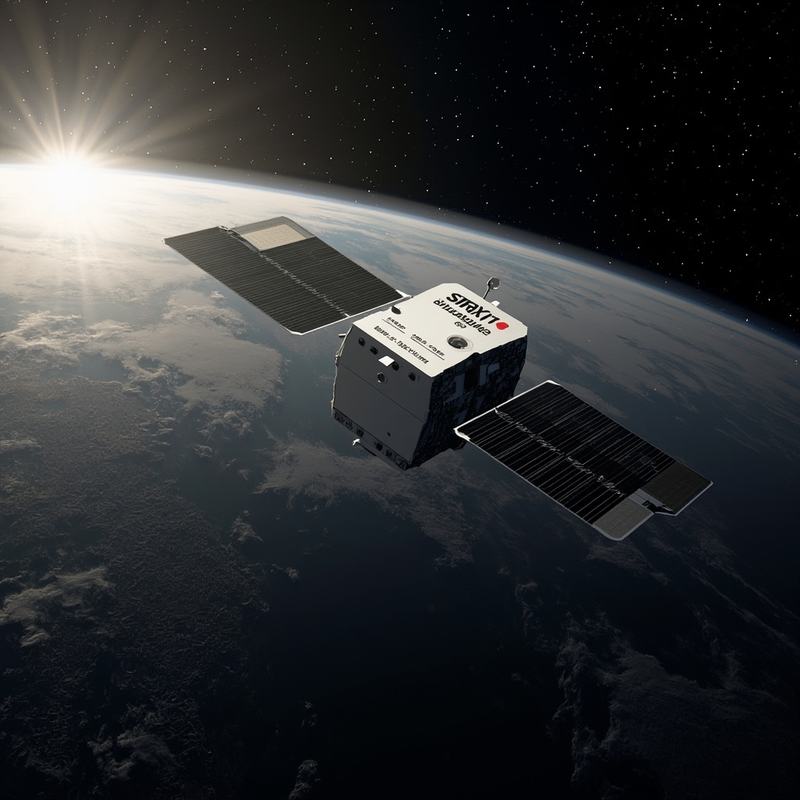
Synspective's StriX-12 synthetic aperture radar (SAR) satellite in low Earth orbit at ~500 km altitude in sun-synchronous orbit, its deployable X-band slot-array antenna extended and two solar arrays deployed, with Earth below rendered in muted grayscale SAR-backscatter tones (urban areas bright, water dark, terrain in mid-tones).

Rocket Lab’s 96th Electron mission, named “Owl By The Dozen,” lifted off from Launch Complex 1 in Mahia, New Zealand, at 3:22 PM New Zealand Standard Time on September 19, 2026, and placed a single Synspective StriX satellite into a precise 572 km sun-synchronous orbit (Rocket Lab, September 19, 2026). One satellite, one mission, one line in the launch log. The line below it matters more. Synspective is no longer a constellation-builder pitching a future roadmap; it is now a constellation-operator pitching capacity to anyone who can sign a contract.


The reason it took twelve satellites to get there is the reason synthetic aperture radar (SAR) was the most expensive way to look down at Earth for most of its history. SAR works through cloud, through rain, and through the polar night — three failure modes that optical imaging cannot survive. The instruments that proved it could be done were government-funded and large: Canada’s RADARSAT-2, Germany’s TerraSAR-X, Europe’s Sentinel-1 family, and the just-launched NASA-ISRO NISAR, which reached orbit in July 2026 on an Indian GSLV with a $1.2 billion NASA contribution (SpaceNews, 2026). Those are flagship observatories, not commercial services. Synspective’s bet since its 2018 founding has been that X-band SAR could be done on a 100-kilogram-class satellite with a foldable planar slot-array antenna that opens to roughly five meters across once on orbit, at one-tenth the mass and one-twentieth the cost of a large SAR satellite (Synspective press release, March 2026). Twelve operational satellites later, that bet is producing 1-3 meter ground-resolution imagery across Stripmap and Sliding Spotlight modes, in any weather, day or night.

The company was founded on February 22, 2018, when Keio University space-policy professor Seiko Shirasaka met small-satellite engineer Motoyuki Arai, who had been running SAR technology development inside Japan’s Cabinet Office ImPACT initiative (Synspective corporate history, 2024). The ImPACT program had spent eight years funding compact SAR architectures through JAXA and the Tokyo Institute of Technology. Shirasaka brought the policy and commercial framing; Arai brought the hardware. StriX-1 reached orbit in September 2022. The four years since have been about factory cadence: StriX-α and StriX-β as demonstrators, then operational satellites through 2024, 2025, and 2026 — StriX-9 in May 2026, StriX-10 in June, StriX-11 on September 15, and now StriX-12 four days later (Synspective press releases, 2026). The cadence is the headline. A constellation that grows by one every few weeks can be refilled, replaced, and reshaped on a commercial timetable.

September 2026 is also the month Synspective changed what it sells. On September 16, the company announced Synspective OMNIA, a program that lets partners — national space agencies, prime contractors, regional governments — lease a dedicated share of StriX capacity, the same way cloud customers lease dedicated server instances rather than renting virtual machines by the hour (Synspective corporate site, September 16, 2026). Two days later, on September 18, the company signed a launch services agreement with Mitsubishi Heavy Industries for two additional StriX satellites on the H3 rocket, the Japanese flagship launcher that has been flying cleanly since its 2023 maiden flight (SpaceWatch Global, September 18, 2026). And on September 19, the Rocket Lab mission placed the latest StriX into the orbit plane Synspective’s operations team had assigned it. Three milestones, one direction: from building capacity to renting it.

The competitive context is unavoidable. Finnish operator ICEYE has built the largest commercial SAR constellation in the world, with more than thirty satellites in orbit and a deep backlog of customer contracts. American operators Capella Space and Umbra are scaling their own X-band fleets, with government and commercial customers on both sides of the Atlantic. Synspective’s pitch is different in two ways: Japanese-government alignment on procurement and export, and a deep partnership with NTT DOCOMO for emergency-response data that gives the company a domestic anchor no foreign operator can match. Publicly announced customers include Nihon Suido Consultants for water-infrastructure monitoring and several ASEAN disaster-management agencies (Synspective press releases, 2021-2026). OMNIA is the formal mechanism that turns those relationships into a product.

What makes a 100-kilogram radar satellite actually useful is the same thing that makes a five-meter antenna possible in a refrigerator-sized box: synthetic aperture. Range resolution is bounded by the bandwidth of the chirped pulse the radar transmits, following Δr = c / (2B), where c is the speed of light and B is the chirp bandwidth. StriX’s published maximum bandwidth at X-band is around 300 MHz, which gives a slant-range resolution near 0.5 meters, equivalent to roughly 0.7 meters on the ground at typical incidence angles (Synspective SAR Data Product Guide v13.0, 2025).

Azimuth resolution is the harder problem, because the synthetic aperture is what lets the small real antenna behave like a much larger one. As the radar moves along its orbital track, it transmits a pulse, listens to the echo, moves on, and repeats. Coherently combining returns accumulated across a synthetic length L_synth produces a synthesized beamwidth θ_synth = λ / (2 L_synth). For StriX’s X-band frequency around 9.65 GHz, λ is approximately 3.1 centimeters; a one-kilometer integration length gives azimuth resolution near 1.5 centimeters in slant range, which projects to the 1-3 meter ground resolution Synspective advertises once geometric corrections are applied (Cumming & Wong, Digital Processing of SAR Data, 2005).

The trade-off between the two acquisition modes is the trade-off between area and detail. In Stripmap, the antenna points at a fixed angle off-nadir and the swath width is set by the elevation beamwidth — typically 10-30 kilometers for StriX at this altitude. In Sliding Spotlight, the antenna steers backwards as the satellite moves forward, lengthening the synthetic aperture and shrinking the pixel size at the cost of a smaller illuminated footprint. StriX’s documented resolution floor sits near 1 meter in Sliding Spotlight and closer to 3 meters in Stripmap (Synspective SAR Data Product Guide v13.0, 2025). A tenfold reduction in swath width buys you a threefold improvement in pixel size, which is roughly the trade-off the operators of every compact SAR constellation have accepted since the late 1990s.

The reason any deployable antenna is needed at all is the fundamental constraint of small satellites. A real-aperture radar’s azimuth resolution is set by the physical length of the antenna along the flight direction. At 572 km altitude and X-band, a 5-meter real antenna gives roughly 60 meters of azimuth resolution — useless for sub-3-meter products. The foldable planar slot-array design lets that 5-meter structure launch inside a 100-kilogram spacecraft roughly the size of a small refrigerator and unfurl once on orbit. The same physical trick that has made commercial SAR affordable is what makes every modern low-Earth-orbit constellation economical: folding space into the rocket fairing, then unfolding it once there.

What changes because of this is the texture of the commercial Earth-observation market. Through 2025, the data vendors in this space sold finished imagery — a one-time product, delivered as a GeoTIFF or a processed surface-change map. With OMNIA, Synspective has moved up the stack to selling committed observation time and the right to task specific satellites, which is closer to selling bandwidth than to selling print. The two H3-launched StriX satellites scheduled for late 2027 will push the operational constellation past fourteen satellites on the way to a planned thirty-satellite fleet. Each additional plane reduces revisit time for any point on Earth from days to hours. Inside Japan, that means faster response to typhoons and landslides; across Southeast Asia, it means disaster-management agencies can ask what a flood looks like right now and get an answer before the clouds clear. The flattening of remote sensing into a utility has been forecast for a decade. The orbit-stop of September 2026 is when that forecast started becoming an operational reality.
 

September 24, 2026

The 2.5-million-kilometer triangle

Posted by


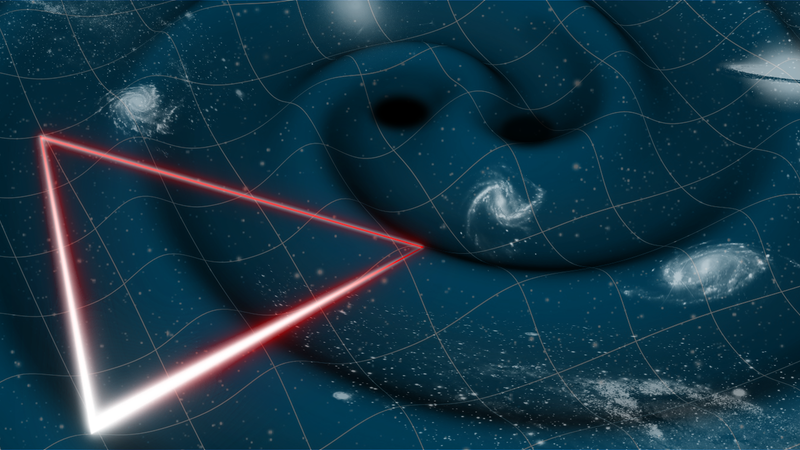
A glowing triangle of laser links hangs against a curved grid of spacetime, drawn down into a dark central well, with spiral galaxies scattered across the background.


In a heliocentric orbit 50 million kilometers behind Earth, three spacecraft will fly in a triangle whose sides are longer than the Earth-Moon distance by almost seven times. At each vertex, a 46-millimetre gold-platinum cube will sit in near-perfect free fall inside a vacuum canister, while a one-watt laser reaches across 2.5 million kilometers of empty space to time-stamp its neighbour. The faintest change in that distance — as small as a few picometres, less than the diameter of a hydrogen atom — is the entire scientific signal. This is ESA’s LISA, the Laser Interferometer Space Antenna, and it is now in industrial construction with a launch set for summer 2035 aboard Ariane 6 (ESA, 2026).

LIGO’s 2015 announcement of a gravitational-wave detection ended decades of physics waiting for direct evidence (LIGO/Virgo, 2016). What gets reported less is the frequency window. Ground interferometers cannot measure below about 10 Hz: seismic noise, thermal creep of mirror suspensions, and shot noise from laser power all crowd out the lower bands. Earth-bound machines hear the final seconds and minutes of stellar-mass black hole mergers. They are deaf to the slow cosmic drum: supermassive black holes millions to billions of solar masses spiralling in over millions of years, white-dwarf binaries in our own galaxy ticking away for the age of the universe, and the primordial ripples left over from inflation or phase transitions (NASA LISA page, 2024).

The 0.1 mHz to 1 Hz band is where most of the gravitational-wave sky lives. LISA is built for exactly that band. It will measure strain noise S_h(f) on the order of 10⁻²⁰ Hz⁻¹/² near 1 mHz — a sensitivity roughly four orders of magnitude beyond anything reachable on the ground. Extreme mass-ratio inspirals (EMRIs), where a stellar-mass object plunges repeatedly through the curved spacetime around a supermassive black hole, will stay in LISA’s band for years of observation. Each such event produces a “treasure map” of the central black hole’s mass, spin, and quadrupole moment, mapping the near-horizon geometry in a way no electromagnetic telescope can match.

The empirical case that gravitational waves existed was settled in 1974. Russell Hulse and Joseph Taylor discovered the first pulsar in a binary system, PSR B1913+16, and over the following decades the binary’s orbital period shrank by exactly the amount general relativity predicts when gravitational radiation carries energy away from the system (Hulse & Taylor, 1975). The 1993 Nobel Prize in Physics marked that indirect detection. Three decades later, LIGO heard two black holes collide directly. Both milestones showed that the waves are real; neither could hear the ones that matter most for cosmology.

ESA has tried to fly a space detector since the 1990s. The earliest LISA design used six spacecraft instead of three. Two after the LISA Pathfinder test mission launched in December 2015, the mission delivered a physics result that pushed the formal adoption over the line. Between February 2016 and July 2017, two free-floating test masses inside Pathfinder’s 38-centimetre cavity kept a relative acceleration below 3 × 10⁻¹⁴ m s⁻²/√Hz at 1 mHz (Armano et al., 2017), and a year later the team reported measurements down to 20 microhertz that exceeded LISA’s planned drag-free requirement (Armano et al., PRL 120, 061101, 2018). ESA’s Science Programme Committee adopted LISA as the L3 mission on 25 January 2024. The agency signed the prime contractor deal with OHB System AG at the Paris Air Show in 2025: an €839 million award and the first time OHB has led an ESA flagship (ESA, 2025).

Industrial work began immediately. Phase 1 design kicked off in January 2025, with a System Preliminary Design Review due in late 2026 and Critical Design Review in late 2030. A 26.1 million euro contract to Thales Alenia Space, signed in May 2026, secured the Cassegrain telescope assemblies — the same optics that will send a 25 picowatt beam across 2.5 million kilometers and capture roughly the same amount of power back.

Funding politics complicated the schedule. The White House FY2026 NASA budget submitted in early 2025 proposed zero funding for LISA, which would have collapsed the U.S. instrument contribution. Congress reinstated an 80.5 million dollar line item for the year. ESA’s response, articulated by Director General Josef Aschbacher, was to begin building European replacements for the NASA-supplied lasers, telescopes, and charge-management devices, an insurance policy rather than a retreat. The LISA Pathfinder science consortium and OHB both work to a 2035 baseline launch.

The single hardest requirement is that each spacecraft must follow its free-falling test mass to within a few nanometres per second. Anything else — the gentlest puff of solar radiation, a photon from Earth’s albedo, the pressure of a passing cosmic ray — would jerk the test mass against the spacecraft wall and overwhelm the signal. The solution is a closed drag-free loop: an inertial sensor monitors the position of the cube relative to the spacecraft, and clusters of cold-gas micronewton thrusters fire to keep the chassis floating around it. Pathfinder demonstrated the thruster at roughly 0.17 microNewton per root hertz of white noise in flight (Armano et al., PRD 99, 122003, 2019), with the residual common-mode noise traced to the feed system rather than the thruster itself.

The strain signal that LISA will record, the dimensionless quantity h = ΔL/L for a passing gravitational wave, sits around 10⁻²¹ for a typical supermassive black hole merger at cosmological distance. Across 2.5 million kilometers, that strain produces an arm-length change of about 2.5 × 10⁻⁹ m, which is picometre territory. The interferometer must distinguish those changes from laser frequency noise, which would otherwise mask the signal because the round-trip light time of about 16.7 seconds means no two spacecraft see identical phase at the same instant.

This is why time-delay interferometry is mandatory. On the ground, equal-arm Michelson geometry cancels laser noise by symmetry. LISA’s arms are unequal and rotating, so the data pipeline algebraically combines six one-way links at given time delays — the familiar α, β, γ, ζ, and “second-generation” combinations — into virtual equal-arm observables whose frequency noise averages to zero to far better than the raw data (LISA Consortium technical notes, 2023). Without that post-processing, even picosecond timing is not enough.

The constellation orbit does the rest. All three craft fly Earth-trailing heliocentric orbits, 20 degrees behind Earth, with the triangle inclined about 60 degrees to the ecliptic. The arms breathe by roughly one to two percent over a year as the spacecraft trace out their cartwheel pattern. That slow modulation is itself a calibration tool, because its signature in the data is known to high precision.

By the mid-2030s LISA should be listening for gravitational waves from systems our species has never directly observed: a million solar mass merger from the early universe, a tight white-dwarf binary in the Milky Way halo, the slow, slow plunge of a small body into a galactic-centre black hole. Each detection will probe spacetime where its curvature is at its strongest and most dynamic. The hardware is large, slow, and quiet by design. Pathfinder showed that the drag-free concept survives the ride. The industrial build now underway will decide whether the triangle closes when it matters most.

Image credit: ESA, CC BY-SA 3.0 IGO (LISA-inspired artwork, hosted by University of Florida PSSL).


An illustration of a fully stacked Starship and Super Heavy standing on a Starbase launch pad at sunrise, the configuration Ship 41 and Booster 21 will take once stacking for Flight 14 is complete


Twenty-six Starlink V3 satellites are bound for the payload bay of Ship 41 at Starbase, Texas, on a flight that has not yet left the ground. SpaceX is now targeting Monday 28 September 2026 for Starship Flight 14, with the window opening at 7:15 a.m. Central Time, 12:15 UTC, from Pad B. That is the fourth date set for this mission: attempts on 15, 18 and 22 September were each stood down, and the 28 September slot is still pending final regulatory approval. Ship 41 has completed its cryogenic proof testing and its static fire campaign, and Booster 21 has been moved to the pad for stacking. If the count reaches zero, Booster 21 will lift Ship 41 off the pad and, for the first time in the program’s three-year test campaign, hand a Starship upper stage enough velocity to circle the planet. The flight, designated IFT-14, would be the first orbital mission of the world’s largest operational rocket. Every previous Starship test, including the successful Flight 13 on 24 July 2026, was flown on a deliberately suborbital arc that splashed down either in the Indian Ocean or the Pacific (SpaceX, September 2026).

What changes because of this is the shape of the test program itself. For thirteen flights, SpaceX used the upper stage’s engines to push it downrange without ever crossing the orbital velocity threshold of roughly 7.8 km/s. The result was a “passively safe” trajectory that guaranteed reentry and splashdown at a known point even if all vehicle control was lost (Ars Technica, 15 September 2026). To stay on a closed orbit around Earth, Ship 41 will have to perform two burns in space, a coast phase of nearly ten hours, and a controlled deorbit burn at the end of the mission, all while carrying real revenue payload. That last detail is why SpaceX Chief Financial Officer Bret Johnsen told the Goldman Sachs Communacopia and Technology Conference audience on 10 September 2026 that this is “a revenue-generating flight” (TeslaNorth, 10 September 2026). No previous Starship test ever carried satellites that were intended to serve paying customers.

The procurement story behind the announcement starts with Starlink V3 itself. Each V3 satellite adds about 1 Tbps of downlink capacity and 160 Gbps of uplink capacity to the constellation, roughly ten times faster on the downlink and twenty-two times faster on the uplink than a V2 mini Starlink (PCMag via BaseNor, 15 September 2026). Twenty-six of them on Flight 14 will add a combined 26 Tbps of capacity in a single mission, more than ten times what a Falcon 9 V2 mini launch delivers (TeslaNorth, 16 September 2026). V3 satellites are too large to fit inside a Falcon 9 fairing; they can only reach orbit on Starship (SpaceX IPO filing, May 2026; azmth.space, 15 September 2026). The first batch of twenty V3s flew inside Ship 40 on Flight 13 in late July. This is the second and larger batch, with three of the twenty-six modified to carry cameras aimed back at the ship’s heat shield during deployment.

The engineering choices that make the orbit possible begin with Booster 21’s hardware fix. On Flight 13, Booster 20 had successfully used all thirty-three of its Raptor 3 engines during boostback, the first time a Block 3 Super Heavy had done so, before the terminal phase of the landing burn went wrong. Three of the thirteen center engines showed signs of ice clogging and triggered an early shutdown, leaving only eight engines to complete the burn before the booster splashed down hard in the Gulf of Mexico (Tech Times, 16 September 2026). The cause was straightforward. Liquid oxygen, stored at roughly −183 °C, draws moisture into propellant feed lines and filters where it can freeze into crystals. The center engines of the booster feed from a dedicated liquid-oxygen header tank used only during terminal deceleration, and that header tank’s filters were not sized to keep the contamination out under flight loads. Booster 21 carries redesigned filters on the propellant path between the header tank and the center cluster, along with new software for relight reliability (SpaceX, 15 September 2026). A successful landing burn on Flight 14 will be the qualification event for that change before SpaceX attempts the first tower catch of a Block 3 booster on Flight 15.

Ship 41’s heat shield is the second engineering story of the day. SpaceX recovered Ship 40 from the Indian Ocean in early August largely intact, harvested two of its ceramic heat-shield tiles, and plans to refly them on Ship 41 (Ars Technica, 15 September 2026). Three upgrades followed. Stronger retention mechanisms on tiles in regions at highest risk of shedding during ascent. Additional shielding against plasma flow paths behind the tile field. And a curved tile design that has shown it can reduce heating in the gaps between individual tiles. Three of the twenty-six V3 satellites carry cameras pointed back at the ship’s flank during their deployment sequence, so the mission returns not just operational spacecraft but a heat-shield health dataset from inside the bay.

The trajectory is also new. All earlier Starship flights followed ballistic arcs aimed at splashdown zones west of the Bahamas, in the Indian Ocean, or, in the case of the catch attempts, at Starbase itself. Flight 14 will splash Ship 41 down in the Pacific Ocean west of Chile, the geometry forced by a true orbital insertion at 275 km altitude. The booster will attempt a controlled splashdown in the Gulf of America on its own landing burn, not a tower catch (SpaceX, 15 September 2026). SpaceX has not yet received regulatory approval for an upper-stage tower catch in this campaign; that step is reserved for later flights.

The numbers underneath are what make the orbital geometry work. A Block 3 Super Heavy at liftoff carries 3,650 tonnes of methalox propellant across its two stages, with the booster delivering 89.5 Meganewtons of thrust from thirty-three Raptor 3 engines and the upper stage pushing six engines of its own, three of them Raptor Vacuum variants with a vacuum specific impulse of 380 seconds (Wikipedia, SpaceX Starship; SpaceX, 2024). The orbital velocity target of 7.8 km/s, multiplied by the natural logarithm of the mass ratio, gives the rocket equation Δv = v_e * ln(m_0 / m_f) that Tsiolkovsky wrote in 1903 and that every orbital mission since has had to satisfy. For a single-stage-to-orbit architecture, the ratio m_0 / m_f must clear roughly twenty. Two stages let Starship keep both ratios smaller, with Booster 21 shedding its structure shortly after its boostback burn and Ship 41 climbing to operational orbit on its own.

The mission control plan adds one explicit safety gate. Ship 41 will execute the burn to enter orbit only after the flight control team has confirmed “sufficient redundancy on hardware critical” to the later deorbit burn (SpaceX, 15 September 2026). If the ship is not healthy enough to come back down on command, it stays on its initial suborbital trajectory and splashes down in the Pacific regardless. The decision is made in flight, after launch and stage separation, rather than at any point in the ground count.

What’s next is the catch. Musk confirmed in mid-September 2026 that Flight 15 will attempt the first Block 3 booster tower catch, building directly on the Flight 14 landing burn (Starlust, 15 September 2026). From there, SpaceX’s published roadmap points toward higher flight cadences, larger payloads of up to sixty V3 satellites per launch, and the eventual test of orbital propellant transfer, the unproven technology that still gates every Mars mission. Flight 14 is not the destination. It is the flight that would end Starship’s run as a suborbital demonstrator and finally make it what it was always meant to be: a vehicle that goes around.


September 24, 2026

Half a century without wheels

Posted by


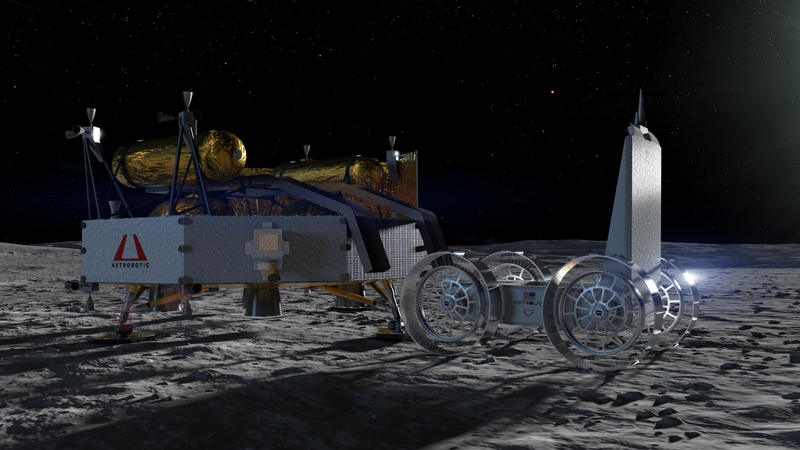
Artist rendering of Astrobotic's Griffin-1 lander deploying Astrolab's FLIP rover on the lunar surface. Credit: Astrobotic/NASA.


The last time anyone wheeled across the Moon, Richard Nixon was settling into his second term and the Apollo program still had a flight or two to go. The astronauts were Eugene Cernan and Harrison Schmitt. The vehicle was the three-wheeled Lunar Roving Vehicle from Grumman. The run was December 11, 1972. After 35.7 km and a final tool-bag swap, the rover’s parking brake was released, the motor was left running, and the dust of Taurus-Littrow settled. No wheel has rolled on another world since. That is fifty-four years, give or take a lunar quarter.

Watching for the next set of tracks is now a matter of commercial mission timing rather than national will. Currently scheduled for no earlier than July 2026, Astrobotic’s Griffin Mission One is meant to land a 625 kg payload on the rim of Nobile Crater near Mons Mouton at about 85°S, 53°E, and deploy the first wheeled explorer intended for that basin since Apollo 17 (Astrobotic, 2024; NASA CLPS updates, June 2026). The vehicle is the FLIP rover from Venturi Astrolab, a four-wheeled, 500 kg prototype that the company describes as a pathfinder for a much larger FLEX rover planned for 2027 or 2028. Two years and a couple of pivots ago, none of this looked likely. A NASA-sponsored rover meant to ride Griffin ended up canceled, then resurrected on a different lander, then carried home by a private-sector vehicle that almost did not exist in time.

Rovers are not a luxury in any plan to live on the Moon. The walking range of an Artemis astronaut in an EVA suit is a few kilometers per day, even on the best terrain. Anything beyond that hinges on a pressurized rover, an unpressurized rover, or a fleet of robotic scouts. With astronauts planned to land on Mons Mouton and other south polar sites in the late 2020s, the engineering question is not whether a vehicle should be on the surface first. It is what it should test.

The lunar south pole carries the strongest case for that urgency. Sunlight grazes the rim craters at angles so shallow that parts of their interior walls have not seen direct sunlight in billions of years. Permanently shadowed regions (PSRs) can reach 25 K, cold enough that water ice delivered by comets and volcanism over geological time has never sublimed away. NASA’s Moon Mineralogy Mapper (M3) on Chandrayaan-1 detected ice-bearing spectra at these latitudes in 2009. The LCROSS impact in October 2009 kicked up a plume with a clear water signature. Yet a remote detection is not an inventory. To decide whether to send a crew, mine regolith, or build a fuel depot, you need a rover that drills, measures, and survives the long polar night. CLPS is the on-ramp: each lander is one more bet that a company can land precisely enough to shrink future mobility risk (NASA CLPS program page, June 2026).

Astrobotic’s story starts with the company’s first flight. Peregrine Mission One launched on the maiden flight of ULA’s Vulcan Centaur in January 2024, then suffered a propellant leak that kept it from landing and forced the spacecraft to burn up over the South Pacific. Less than six months later, in July 2024, NASA canceled the VIPER (Volatiles Investigating Polar Exploration Rover) mission, which had been slated to ride Griffin. The agency cited cost overruns that had pushed VIPER past $450 million. The flight contract with Astrobotic was kept, because the agency still wanted a precise polar landing demonstration. The launch was bumped from late 2024 into 2025, then to 2026 (Astrobotic, 2024).

The mission that took shape goes like this. A SpaceX Falcon Heavy lifts the 4,500 kg Griffin lander from Launch Complex 39A at Kennedy Space Center. After a multi-day cruise, Griffin uses terrain-relative navigation and a pulsed main engine on liquid oxygen and liquid hydrogen to set down inside Nobile Crater. The flight avionics were proven against NASA’s Deep Space Network in a three-week test in late 2024, with telemetry flowing through DSN’s Goldstone, Canberra, and Madrid complexes (Astrobotic, October 2024). On the surface, Griffin will deploy Astrolab’s FLIP rover, a small Astrobotic CubeRover variant, the BEACON rover from Mission Control, and a stack of cultural and science payloads including Interlune’s helium-3 prospecting instrument.

The story behind the payload swaps is the more interesting angle. NASA reversed the VIPER cancellation in September 2025 and reassigned the rover to Blue Origin’s Blue Moon Mark 1 lander under task order CS-7, scheduled for late 2027. The same rover that was supposed to ride Griffin now goes elsewhere. Meanwhile, Astrolab, which had been working on a larger FLEX for the Lunar Terrain Vehicle competition, scaled down to a near-half-tonne demonstrator it could deliver in under twenty months. The narrowness of that window is why FLIP exists at all. Astrobotic’s Steve Clarke, in trade-press remarks, called the timing “the cleanest kind of opportunity.”

The dust problem drives more design choices than any other. Lunar regolith is roughly 20–100 µm grains of impact-shattered glass and mineral fragments. Electrons from the solar wind implant positive charge in the dayside top layer while the unlit subsurface stays negative, producing local electric fields that lift fine particles. The result is dust that clings electrostatically, abrades seals, frosts radiators, and fouls optical surfaces. FLIP carries METAL (Moon Exploration for Titanium with Active Lighting), a multicolor camera and radiometer from NASA Ames designed to estimate helium-3 concentrations in regolith, and LDES (Lunar Dust level sensor and Effects on Surfaces) from Johnson Space Center, which quantifies how dust degrades critical surfaces over time (NASA CLPS payloads, May 2026). The hyper-deformable wheels Venturi Space built in Switzerland are tuned to absorb impacts and shed dust by flexing the contact patch outward.

The thermal problem runs next. The Moon’s 29.5-day rotation means fourteen Earth days of sunlight followed by fourteen of dark at the equator. At the south pole the pattern is shorter and more chaotic, with some craters rim-locked in shadow for over seventy hours. FLIP’s high-performance batteries, built by Venturi Space in Monaco, are sized to keep avionics warm through a single night. Surviving multiple cycles is held in reserve for FLEX. Mons Mouton was picked because of ridge crests with safe-haven illumination that exceed the rover’s solar threshold for parts of each long polar night.

The mass problem is governed by Tsiolkovsky. For a stage with exhaust velocity v_e and mass ratio m_0/m_f, the budget is Δv = v_e * ln(m_0 / m_f). Translunar injection from low Earth orbit needs roughly 3.2 km/s on top of the launcher’s job, and Falcon Heavy delivers about 16.8 t to TLI fully expendable, 10.3 t with side-booster recovery. Griffin ships close to 4.5 t wet, well within margin even on a partly reusable Falcon Heavy profile. The lunar LiDAR demo from Marshall Space Flight Center is another flight-first: a hardened time-of-flight scanner for hazard detection, sized to feed terrain maps back to operators faster than orbital imagers can.

If Griffin lands cleanly and FLIP rolls, several quiet records fall in one season. The first American wheeled surface mobility since Apollo 17. The first precise landing at Mons Mouton, a site NASA has been circling for more than a decade. The first time a private company delivers another company’s rover on top of its own.

Worth watching next is not the headline. It is the dust log, the wheel telemetry, and whether the batteries survive a long polar night. By the time humans reach Mons Mouton, commercial rovers will have already mapped places no orbital camera can resolve.


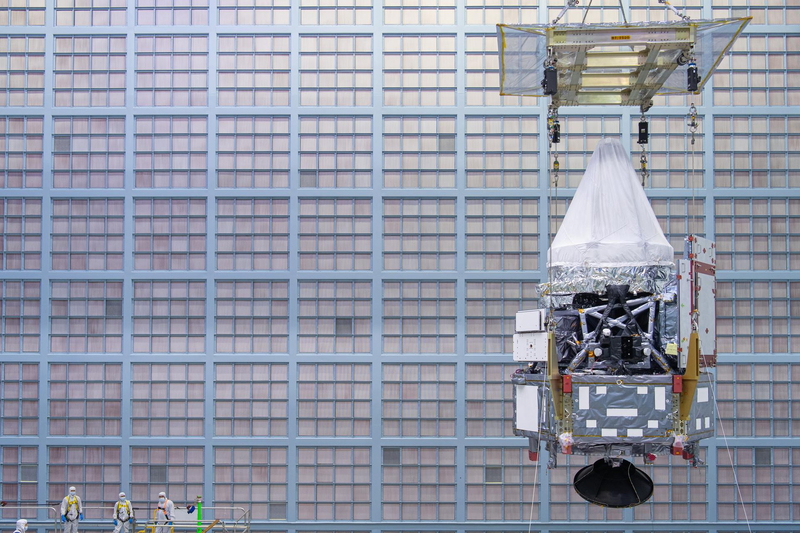
The Roman Space Telescope's Integrated Payload Assembly, crane-lifted in the cleanroom at Goddard Space Flight Center. NASA/Chris Gunn, GSFC_20250612_RST_034435.


The 2.4-meter primary mirror sitting inside the Payload Hazardous Servicing Facility at Kennedy Space Center has traveled a stranger path to space than most astronomy hardware. It was ground in the late 1990s for a classified U.S. reconnaissance satellite. When the National Reconnaissance Office shut the parent program down, the optic spent more than a decade in a cleanroom. In 2012, the NRO handed two of these surplus mirrors to NASA. The agency coated them in vapor-deposited silver, polished them to a surface roughness of roughly 1.2 nanometers, and built the next flagship astrophysics mission around the spare (NASA, “Telescope Mirrors”; NASA Science).

That mission is the Nancy Grace Roman Space Telescope, and its Falcon Heavy payload fairing closes around Booster B1091 sometime in the early morning of August 30, 2026, from Launch Complex 39A. The “NET” caveat is real; range conflicts and pre-flight testing routinely slip a few days. As of mid-July, technicians were cleaning the spacecraft’s two deployed booms inside the servicing facility after the observatory arrived at Kennedy by barge on June 21 (NASA/John Kraus, KSC-20260621-PH-AJN01 series).

Roman is not a “next Hubble” in the usual sense. Hubble stares at small patches of sky with extraordinary sharpness. Roman goes wide. The Wide Field Instrument pairs the 2.4-meter mirror with an infrared detector mosaic that delivers a 0.281-square-degree field of view, roughly 100 times Hubble’s infrared footprint, at comparable angular resolution (NASA, “WFIRST AFTA Final Report”). In raw survey speed, the gain is closer to a factor of a thousand for the kind of cosmology Roman is built to do.

That speed unlocks three programs no other planned mission can do in this decade. The first is a statistical answer to the “is the dark energy equation of state changing?” question, traced through Type Ia supernovae and weak lensing across billions of galaxies. The second is a first homogeneous census of cold, snow-line-and-beyond exoplanets via gravitational microlensing toward the galactic bulge. The third is an in-space tech demo for high-contrast direct imaging of exoplanets at contrast ratios near 10⁻⁸, a step toward the Habitable Worlds Observatory the 2020 decadal survey recommended for the 2030s.

The community paid for this with patience. Roman’s cost cap famously bobbed around the $3.2 billion mark in the mid-2010s as the coronagraph scope grew. Launch slipped several times. The most recent beat was a pull-forward: NASA’s June 3 announcement moved the target from September 2026 to August 30, 2026, almost a full year earlier than the May 2027 baseline (NASA, June 3 2026 release).

Roman’s lineage runs through three programs. The first was a 2010 decadal-survey flag, the “Wide-Field Infrared Survey Telescope,” then budgeted at around $1.6 billion. By 2013, the design had accreted a coronagraph for exoplanet imaging. Then the 2012 NRO mirror gift let engineers scale the aperture from 1.5 meters to 2.4 without breaking cost caps. The “AFTA” (Astrophysics Focused Telescope Assets) study is the document that locked in the present configuration (NASA, 2013 AFTA report).

Flight hardware assembly moved to Goddard Space Flight Center in the late 2010s. The Coronagraph Instrument, built at JPL, hit thermal-vacuum contrast demonstration at roughly 4 × 10⁻⁸ in 2023, an order of magnitude better than its threshold (JPL, 2023 milestone reports). The integrated observatory passed pre-shipment review in early 2025, was sealed into its shipping container, and rode NASA’s Pegasus barge down the Intracoastal Waterway from Maryland to Florida over several weeks in mid-2026.

The arrival was a quiet milestone. Most of the work ahead is procedural: hydrazine load, fairing encapsulation, Falcon Heavy stacking, a wet/dry rehearsal, and a launch period that runs through the equinox, chosen because the mission’s primary microlensing field, the galactic bulge, is best observed in spring and fall from a Lissajous orbit around the Sun-Earth L2 point (Penny et al., 2019, ApJS).

Three pieces of the Roman design carry the science weight.

The mirror. At 410 pounds (186 kg), the ULE (ultra-low expansion) glass mirror is less than a quarter of Hubble’s mass for the same diameter (Lyman et al., “Roman 2.4-m mirror,” 2018). Silver rather than aluminum gives it higher infrared reflectivity between 0.5 and 2.0 µm. The 1.2 nm surface figure is not symbolic; for a coronagraph designed to suppress starlight, the residual wavefront error is what leaks planet photons into the stellar halo.

Wide Field Instrument. Eighteen H4RG-10 detectors feed the 300-megapixel focal plane, read out every 1.4 seconds in the wide-filter survey mode. With a 0.281 deg² footprint, Roman can map a square-degree in a single orbit, a task that took Hubble weeks. For the Galactic Bulge Time Domain Survey, the cadence is fifteen minutes in the W146 wide filter across seven fields totaling 1.97 deg², for six 72-day seasons over the five-year prime mission (Zasowski et al., 2025, “GBTDS Final Design”). Each microlensing event detected in this campaign will have simultaneous near-infrared photometry, which breaks the degeneracy that ground-based optical campaigns leave behind.

Coronagraph. Roman carries the first active coronagraph to operate beyond Earth orbit. Two deformable mirrors with thousands of actuators run a closed-loop low-order wavefront sensor at sub-nanometer correction rates. The instrument combines a Hybrid Lyot design and a Shaped Pupil design, switching by a filter wheel. Threshold contrast is 10⁻⁷ at a 3 λ/D inner working angle; expected performance is 10⁻⁸ to 10⁻⁹ for visible-light observations (Trauger et al., 2016; Poberezhskiy et al., 2024). That will not image an Earth twin. It will image Jupiter and Saturn analogs in reflected light around the nearest sun-like stars, and prove that the deformable-mirror algorithms the Habitable Worlds Observatory would inherit actually survive launch and L2 thermal cycling.

The gravity-lens math that makes the exoplanet survey work is the same Einstein formula that confirmed general relativity in 1931. The lensing cross-section for a solar-mass star peaks near the Einstein radius, roughly:

θ_E ≈ sqrt(4GM / c² × (D_ls / (D_l D_s)))

For a typical galactic-bulge observation, θ_E corresponds to about 1–10 AU projected separation, the snow-line region of the lens system. Roman’s 1-milliarcsecond astrometric precision from the same focal plane measures the centroid shift of the lensed images during the event, which lets astronomers recover the lens mass directly instead of fitting degenerate light-curve models (Koshimoto et al., 2025).

Roman will not arrive at L2 alone. Its ride to Earth-escape trajectory costs about 1,940 meters per second, comfortably inside Falcon Heavy’s margin. After a thirty-day transit and a four-month commissioning window, Wide Field Instrument first light should land in early 2027. The first coronagraph frames will follow, and with them the proof that the next generation’s “terrestrial-planet imager” is a plausible line item rather than a wish.

The deeper lesson is older than the mirror itself. The hardware that almost stayed classified is now the wide eye NASA needs to weigh the matter the universe is mostly made of. In astronomy, almost all of the interesting answers since 1998 have come from instruments that fit on one airplane pallet. Roman is the next one to fly.


September 22, 2026

A six-band eye for fire

Posted by


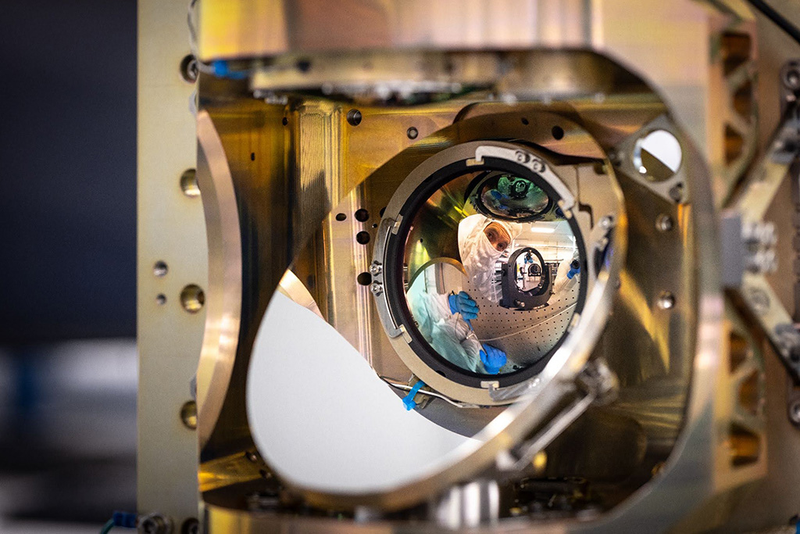
The Quickbeam six-channel infrared instrument onboard FireSat. Credit: Muon Space.


At 03:12 UTC on July 7, 2026, a Falcon 9 lifted off from Vandenberg Space Force Base carrying the heaviest single rideshare payload SpaceX had ever dispatched from California: SpaceX’s Transporter-17 mission. Buried among dozens of small satellites were three boxy 100-kilogram buses built by Muon Space, each carrying an instrument the company calls Quickbeam, a six-channel multispectral infrared imager built for one job: spotting wildfires smaller than a suburban kitchen before they become the next headline (SpaceNews, July 2026).

Two weeks earlier, the same instrument on the FireSat Protoflight demonstrator had imaged a small roadside fire northwest of Medford, Oregon, on June 23, 2025. The fire was missed by every other orbital sensor. By the time ground crews arrived, the flames had burned 0.4 hectares. The Protoflight data, published by the Earth Fire Alliance (EFA) on July 23, 2025, made a quiet case for the constellation now commissioning in low Earth orbit: a new generation of spacecraft designed not to study weather or map land cover, but to catch the first watt of heat a forest fire gives off.

Wildfire managers call the first hour after ignition the golden hour. If a fire is suppressed within sixty minutes of ignition, the cost of attack falls by an order of magnitude; if not, the same fire becomes the kind of runaway that closes highways, evacuates towns, and sends smoke across continents (CAL FIRE briefing, October 2025). The problem is that almost every existing satellite fire product was built for something else. MODIS on Terra and Aqua, the workhorse of orbital fire detection for twenty-five years, returns a pixel every ~1 km. VIIRS on Suomi-NPP and JPSS improves that to 375 m. Both see fires only after they are big enough to saturate the detector, and both push alerts in hours, not minutes, because the data lands in a research processing pipeline rather than a dispatch queue.

What fire agencies wanted was a sensor with three properties that the older instruments could not deliver together: spatial resolution sharp enough to resolve a single-campfire ignition, thermal sensitivity high enough to read temperatures below 600 K without saturating, and a latency path short enough to put an alert into a dispatcher’s screen before the wind changes. Quickbeam is the first instrument designed to satisfy all three (Earth Fire Alliance, program overview, 2025).

Quickbeam is a six-channel multispectral imager spanning short-wave infrared (SWIR), mid-wave infrared (MWIR), and long-wave infrared (LWIR). Three of the channels sit in the SWIR at 1.0–2.5 µm, where they map vegetation moisture and burn scars and pick up reflected sunlight on daylight passes. A single MWIR channel covers 3.0–5.0 µm, the fire-detection sweet spot: hot surfaces near 800 K peak here, and atmospheric transmission is high enough that the band survives most smoke columns. The remaining two channels work the LWIR at 8.0–12.5 µm, useful for background temperature, cloud masks, and the dual-use atmospheric work the U.S. Space Force funded as part of the same instrument (Muon Space product brief, 2025).

The 5 × 5 meter ground sample distance per pixel is roughly forty times finer than what VIIRS delivers in its active-fire band. Each satellite flies in a sun-synchronous orbit at ~600 km altitude and images a 1,500 km swath on every pass. With three satellites phasing that orbit, the constellation returns to any fire-prone region at least twice a day today, with a target of one global revisit per hour by 2029 once the full 50-satellite constellation is in place (Earth Fire Alliance roadmap, 2026).

The hardware underneath the optics matters as much as the optics themselves. FireSat rides on Muon’s Condor-M bus, a 100-kg-class small satellite built around what the company calls a CarefulCOTS approach: every commercial part is selected by analysis for radiation, thermal, vacuum, and shock resilience, then qualified per GSFC-STD-7000 or SMC-S-016 with universal derating per NASA EEE-INST-002 (Muon Space, Condor-M spec sheet, 2025).

The numbers tell the rest of the story. The bus delivers 500 W of peak payload power and 200 W orbit-average, supports 30 Gbps payload data interfaces, and dumps 5 TB per day through its RF downlink (50 TB per day if the customer buys the optical comms option). Pointing knowledge is 5 arcseconds 1σ, control is 15 arcseconds 1σ — fine enough that a 5 m pixel stays a 5 m pixel after stacking. Onboard Δv of 3 km/s lets the constellation maintain its precise spacing without waiting for atmospheric drag to do the work over months.

CarefulCOTS, rather than full radiation hardening, is what lets the satellite cost what it costs. A traditional aerospace IR imager of similar capability can run into the hundreds of millions per copy. FireSat is built to a price point closer to a commercial imaging smallsat, which is the only way a 50-satellite constellation makes sense.

Latency is the part most coverage misses. A fire detection that travels satellite → ground station → processing center → alert API is still thirty minutes old by the time it reaches a dispatcher. FireSat runs a Google Research convolutional neural network directly on the satellite’s edge inference chip, assigning a probability score to every 5 × 5 m tile during the same orbital pass that collected the imagery. Alerts with confidence above 85% are pushed over optical inter-satellite links and dispatched directly into CAL FIRE, US Forest Service, and partner-agency APIs within five minutes of acquisition (Earth Fire Alliance technical brief, 2026).

This is a substantial change in how Earth-observation data flows. The traditional pipeline treats satellites as data factories whose product is then mined by analysts. FireSat treats the satellite as a sensor that produces decisions. The downstream user receives an alert keyed to a confidence score, not a raw image. Below threshold, no alert fires; above, the alert is geo-referenced and time-stamped in the same message.

The three satellites launched on Transporter-17 are now in a three-month commissioning and calibration period, with first operational data expected in October 2026. CAL FIRE, the Colorado Division of Fire Prevention and Control, and agencies in Texas, Oregon, the Amazon, Portugal, Australia, and three African countries are signed up as early adopters. The full constellation target is fifty-plus satellites by 2030, with a goal of a twenty-minute global revisit and a nine-minute revisit for the most fire-prone corridors.

What FireSat is really testing is whether a single-purpose constellation, designed around one metric (median time from ignition to alert), can outperform decades of general-purpose Earth-observation infrastructure. The Protoflight demonstration, the Medford fire, the Oregon roadside ignition nobody else saw: these are the early evidence. If the operational constellation hits its five-minute latency goal at 5 m resolution, the cost-benefit math on wildfire suppression shifts in a way that no amount of MODIS data ever could.

FireSat is a reminder that “satellite for X” can mean something other than “satellite that happens to be useful for X.” Every previous fire-detection system inherited its design from weather, land-imaging, or atmospheric-chemistry missions. Quickbeam was built from a detector layout upward to optimize for the MWIR fire peak, smoke penetration, and edge inference. The constellation is sized not to map the planet but to return to a wildfire fast enough that suppression still works. If it hits its numbers, the next decade of wildfire management will look less like remote sensing and more like an alert service, and the first hour of a fire will start to look very different from the last twenty years.