


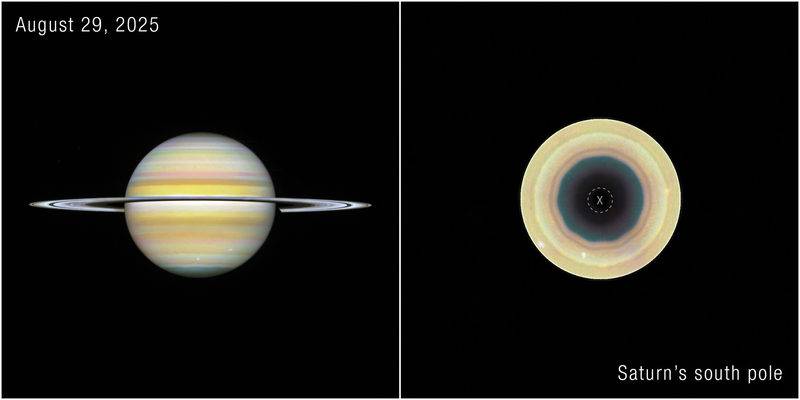
For nearly forty years Saturn’s famous six-sided jet stream at the north pole stood alone. Voyager caught it first in 1981, Cassini watched it for thirteen years, and Hubble has photographed it every year since 1990 without ever finding anything like it at the other end of the planet. That asymmetry was the puzzle. On 2 September 2026, Agustín Sánchez-Lavega of the University of the Basque Country and a team of co-authors put the puzzle to rest with a paper in Science Advances: there is now a ten-sided atmospheric wave encircling Saturn’s south pole, a decagon at roughly 63°S, about 167,820 km across, that nobody saw coming because, until 2023, the south pole itself had been hidden from view by Saturn’s axial tilt (Sánchez-Lavega et al., Science Advances, 2 September 2026).
The find resets what astronomers thought they knew about how giant planets organize their weather. Saturn’s northern hexagon has been the textbook case of a polygonal jet stream since David Godfrey stitched the Voyager frames together in 1987: a wave locked into a near-stationary eastward jet at 78.5°N, with sides about 14,500 km long and winds racing clockwise at roughly 100 m/s (NASA Cassini science, hexagon page). For four decades the absence of a southern counterpart fed two competing ideas, namely that the hexagon was a fluke of the north, or that the south was simply hiding something. Cassini, which orbited Saturn from 2004 through its deliberate plunge in September 2017, never caught the south in the right geometry. The decagon’s arrival now suggests the truth is neither. The polygon family may be a normal mode of giant planet polar circulation, and we are watching a new instance of it spin up in real time. The decagon has been “growing stronger,” according to co-author Amy Simon of NASA’s Goddard Space Flight Center, who runs the Hubble Outer Planet Atmospheres Legacy (OPAL) program that produced the confirming images (NASA Science, 3 September 2026).
The discovery is a layered story about patience, amateurs, and orbital mechanics. Saturn’s 26.7° axial tilt means the south pole tilts away from the Sun and from Earth’s line of sight for roughly half a Saturn year, about 14.5 Earth years. The southern hemisphere dropped out of Earth’s view around 2012 and only crept back into favorable geometry in 2023. That is why no professional survey caught the pattern earlier. The first people to notice something were amateurs. Trevor Barry, an Australian observer, and Jean-Paul Oger, a French amateur astronomer, both contributed planetary images to the Planetary Virtual Observatory Laboratory (PVOL), a citizen-science archive run by Sánchez-Lavega’s group at the Universidad del País Vasco in Bilbao. In 2024, those ground-based images began showing an undulating band at high southern latitudes that did not fit any catalogued feature. By August 2025 the pattern had sharpened into something a non-expert could see with a small telescope, with ten straight sides, ten corners, riding inside a westward jet stream that nobody had mapped before. Hubble confirmed it. Amy Simon’s OPAL team had been photographing Saturn annually since the program began in 2014, and a backward look at the October 2023 dataset showed a faint ten-vertex polygon already in place. By August-September 2025, when OPAL returned to Saturn with sharper filters and the planet had rotated through enough viewing geometries to expose every side, the decagon was unambiguous: ten sides, each about 16,782 km long, total width 167,820 km, with brightness that varied unevenly around the circle (Space.com, 3 September 2026; Sánchez-Lavega et al., 2026).
What changed because of this: the decagon’s position drifts slightly depending on which wavelength you observe it in. That drift is the key to its physics. Hubble’s OPAL filters sample different altitudes in Saturn’s atmosphere: violet and red wavelengths probe the upper troposphere, methane-band filters probe higher stratosphere. The fact that the wave is visible across those filters, and that its apparent center shifts between them, means the decagon is not a cloud-level coincidence. It extends vertically through multiple layers, a stack of waves locked in phase from the cloud tops at roughly 200 mbar down into the deeper troposphere where ammonia ice gives Saturn its pale gold color. NASA’s James Webb Space Telescope is being lined up to take the decagon’s temperature, with the goal of pinning down how deep the pattern really goes (NASA Science, 3 September 2026).
The mechanism behind polygonal jets on giant planets is one of the more stubborn open problems in planetary fluid dynamics. Two families of explanation compete. The shallow model treats the polygon as a Rossby wave trapped in a thin weather layer, with the underlying deep atmosphere providing only a passive eastward jet that fixes the wavelength. The deep model, advanced most clearly in a 2020 PNAS study by Cabanes, Spiga, and co-authors, runs in a Saturn simulation in which deep thermal convection alone spontaneously spawns a six-sided jet at the right latitude, with the right wave number, with no tuning (Cabanes et al., PNAS, 2020). That result matters because the hexagon’s wave number is set by the planet’s rotation rate and the static stability of the deep atmosphere, following a dispersion relation that looks roughly like n ~ sqrt(Ro / Fr) where the Rossby number Ro = U / (f * L) describes the balance between inertia and Coriolis force, and Fr = U / (N * H) is the Froude number measuring stratification. A gas giant’s fast rotation (Saturn’s day is about 10 hours 33 minutes) drives f high, which suppresses higher wave numbers and lets n = 6 win out where the jet is strongest. The decagon, sitting at a less polar latitude where Coriolis forcing is weaker, would correspond to a larger n. Sánchez-Lavega’s group argues the decagon is consistent with the same deep-convection story, with the wavelength set by a different balance of stratification and rotation at 63°S. Crucially, the new feature is not as robust as the hexagon. “The decagon is situated at a less polar latitude than the hexagon in the southern hemisphere, and is perhaps not as robust, as we have seen that it has formed,” Sánchez-Lavega told reporters (ScienceAlert, 3 September 2026). That is what makes it scientifically interesting. If the decagon fades within a few years, the deep-convection model has to explain why some wave numbers persist and others do not. If it locks in and lasts, the model needs to explain why. Either answer rewrites the theory.
Saturn will continue to give up its secrets slowly. The OPAL team is already planning Hubble and Webb time over the next northern autumn and winter to see whether the decagon sharpens or softens, and whether the underlying jet stream at 63°S strengthens with it. The same machinery, ground-based amateurs feeding image archives that professionals mine with new algorithms, has now caught the first emergence of a planetary-scale weather pattern in the act. For a community that spent forty years assuming the hexagon was a singular accident, the lesson is that giant planets are too large and too well-insulated to change on human time scales, except when they do. We have a Saturn with two polygonal jet streams now. Cassini ended its mission in 2017, but the planet it studied is still doing things nobody expected.
 Subscribe to our RSS feed









There are no comments.
Add A Comment