


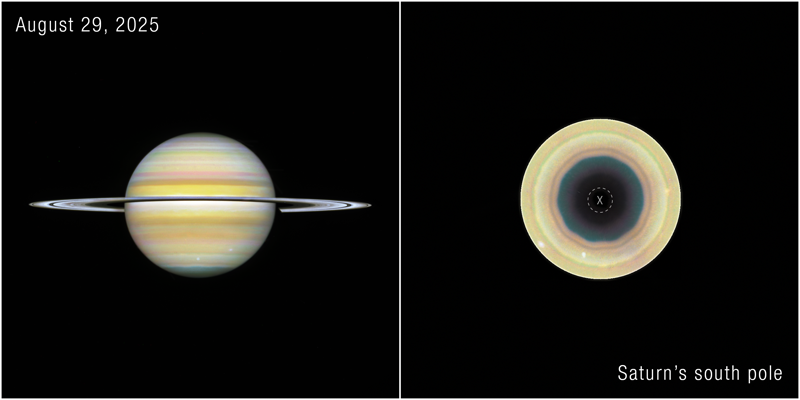
For forty-plus years, the hexagonal jet stream at Saturn’s north pole has been the canonical oddity in the outer solar system: a perfectly geometric, six-sided wave that has outlasted every spacecraft and every telescope pointed at it. As of early September 2026, Saturn has decided to compete with itself. The south pole, which never produced a long-lived polygonal feature in the four decades of Cassini and Voyager imaging, has now grown a 10-sided wave in one of its powerful jet streams. A team led by planetary scientist Agustín Sánchez-Lavega of the University of the Basque Country reports the find in a paper in Science Advances, with co-authors from NASA’s Goddard Space Flight Center and the University of California, Berkeley’s Space Sciences Laboratory (NASA Science). The data come from the Hubble Space Telescope’s Outer Planet Atmospheres Legacy (OPAL) program, and the wave is the first decagonal standing wave ever confirmed at Saturn’s southern hemisphere.
The decagon matters beyond the visual symmetry, because it changes how planetary scientists read Saturn’s atmosphere. Until this observation, the northern hexagon was treated as singular: an exceptional accident in a single jet stream. The southern decagon shows that polygonal standing waves are not unique to one latitude on Saturn. They can form in either hemisphere, in different jet streams, with different numbers of sides. That shifts the framing from “why does Saturn have one hexagon” to “why does Saturn’s jet stream physics tend toward polygonal standing waves when the conditions are right,” a framing that the OPAL team has already begun to push at scientific meetings (UC Berkeley SSL).
The path to the discovery started in 2024. Sánchez-Lavega runs the Planetary Virtual Observatory Laboratory (PVOL) at the University of the Basque Country, a site where amateur observers worldwide submit ground-based images of the planets. In 2024, two contributors, Trevor Barry and Jean-Paul Oger, sent in imagery that contained a subtle undulating band at Saturn’s southern pole. The wave looked similar to a transient perturbation NASA’s Cassini spacecraft had imaged briefly in 2004. Additional ground observations in 2025 strengthened the signal. Sánchez-Lavega then turned to the higher-resolution Hubble archive. He had been searching for a southern counterpart to the northern hexagon in Hubble images since 1990. The OPAL program’s annual Saturn portraits, taken since 2018, provided the resolution and the consistency to settle the question (Sci.News).
When the Hubble images from 2023 onward were projected onto a south-polar view, the decagon was clearly visible at roughly 63°S latitude, embedded inside the eastward-to-westward jet stream that flows along the 60.5°S parallel and winds at high speed around the pole. Cassini’s 13-year survey had found no long-lived polygonal feature there, only a fleeting wave that lasted a few days and was never seen again before Cassini’s deliberate plunge into Saturn’s atmosphere in September 2017. The decagon must have emerged between Cassini’s end and Hubble’s 2023 OPAL frame, a window of roughly five to six years. The Space Telescope Science Institute released the result alongside a press release dated 2 September 2026, and the NASA Astronomy Picture of the Day feature for 8 September 2026 carried the side-by-side globe-and-polar projection to a much wider audience than the team expected.
The structure is genuinely three-dimensional. The decagon shows up in OPAL images taken at multiple wavelengths, and each wavelength probes a different altitude in Saturn’s atmosphere. The visible wave is in the upper troposphere, where the wind speed at that latitude reaches about 400 kilometers per hour. The feature extends vertically through several atmospheric layers, which is what rules out the simpler explanation that this is just a cloud-top illusion: the wave has roots that go deeper than a single altitude. The aerosol that gives the decagon its blue color has not been identified. Its wavelength-dependent visibility is part of what made the feature easy to miss in ground-based data and easy to confirm in Hubble’s sharper, space-based imagery.
The team has a working hypothesis for why the decagon formed when it did. Just to its north, at about 55°S, an anticyclone vortex first appeared in 2023. By 2025 that vortex had darkened sharply, and shortly afterward the decagon emerged. The suspicion, in the words of co-author Michael Wong of UC Berkeley’s Space Sciences Laboratory, is that “perhaps the vortex caused the initial perturbation, and then the balance of forces caused the persistent decagon.” Sánchez-Lavega built a shallow-water equation model to test whether the geometry could arise from the right combination of zonal wind shear and forcing. The model produced a 10-sided wave under conditions consistent with what Saturn shows, which is encouraging but not yet a full explanation. Whether the decagon settles into the decades-long stability of the northern hexagon, or fades back into the background as Cassini’s transient did, is the open question the OPAL team will be tracking with each annual observation.
Saturn’s jet streams are forced by the same basic physics as Earth’s atmospheric circulation, but at a different scale: faster winds, deeper atmospheres, no solid surface to break up the flow. Standing polygonal waves are an unusual solution to that physics. They arise when the vertical shear of the jet stream and the rotation rate of the planet conspire to lock a wave into a stable shape. Saturn’s northern hexagon is the textbook example: a wave that has sat at the same latitude, with the same number of sides, for at least 40 years, surviving seasonal swings of sunlight that should have perturbed it (Wikipedia). The southern decagon gives planetary scientists a second data point under different conditions, which is exactly the kind of comparison needed to test models of why polygons form at all. It also raises a possibility that several groups have begun to explore: that the northern hexagon, the southern decagon, and the polygonal transients Cassini caught in 2004 are all manifestations of the same underlying physics, with the number of sides, the longevity, and the exact latitude set by the local jet stream conditions. Saturn’s atmospheric dynamics, it turns out, may have a stronger tendency toward polygonal standing waves than a single feature ever suggested.
The OPAL program, which began formally in 2018 to fill the post-Cassini observation gap, now has a fresh round of Saturn portraits scheduled through at least the rest of the decade. Whether the decagon survives into Hubble’s eventual successor era, or fades the way the 2004 perturbation did, is something readers will be able to check on a year-by-year basis. The headline result, for now, is the quiet reset: Saturn’s south pole is no longer the unmarked half of the planet. It has its own geometric weather, and the pattern is still changing.
 Subscribe to our RSS feed









There are no comments.
Add A Comment