OrbitalHub

Where curiosity reaches escape velocity.

Domain is for sale. $50,000,000.00 USD. Direct any inquiries to contact@orbitalhub.com.

Archive for September, 2026

September 21, 2026

A fresh Type Ia supernova in NGC 7331

Posted by


A fresh Type Ia supernova in NGC 7331. Image: 2026 09 13 sn 2026aaiv ngc 7331 supernova.


On the evening of 1 September 2026, a 0.5-meter telescope on Maui logged a new dot of light next to the core of a spiral galaxy in Pegasus. The Transient Name Server now calls it SN 2026aaiv, and the galaxy it landed in is NGC 7331, the same one that has been used for two centuries as a stand-in for the Milky Way. The supernova is a Type Ia, the kind that turns a stellar cinder the size of Earth into something brighter than the hundreds of billions of stars around it.

What makes this one different is timing. The same survey that found it is built to catch asteroids days before they hit Earth, and the supernova classification certificate arrived in the TNS inbox before most of the world knew NGC 7331 had a transient in it. The event is also still rising. By 11 September it sat at magnitude 15.7, dim to the eye but bright enough for a backyard telescope with a small CCD, and amateur observers were already reporting spectra that show the telltale silicon absorption line at 6355 angstroms moving at roughly 10,500 kilometers per second. If the light curve behaves the way most Type Ia light curves do, the supernova should peak somewhere between magnitude 11 and 12 in the next two weeks, visible through modest amateur instruments under a dark sky.

The host galaxy does most of the work in this story. NGC 7331 sits about 43.8 million light-years away in the constellation Pegasus and is one of the brighter galaxies Charles Messier left out of his 18th-century catalog. The galaxy is unbarred, which separates it from the barred spiral we now think the Milky Way is, and its central bulge rotates in the opposite direction to its disk, an arrangement that has kept astronomers arguing about it since the 1990s. It hosts a similar number of stars, a comparable central supermassive black hole, and a similar star-formation rate to our own galaxy. When the Hubble Caldwell catalog entry for Caldwell 30 calls it an analog to the Milky Way, that is the comparison it means.

A Type Ia supernova is a different animal from the core-collapse explosions that mark the deaths of massive stars. The progenitor is a white dwarf, the dense leftover of a sun-like star that has shed its outer layers and is now sitting at roughly the radius of Earth with about 1.4 times the mass of the Sun. Alone, a white dwarf just cools. Add a companion star in a tight orbit and the dwarf’s gravity becomes a siphon, pulling gas off the neighbor until the white dwarf crosses a mass threshold that ignites its carbon core in a runaway thermonuclear burn. The whole star detonates in roughly a second, and the explosion reaches a peak brightness that is remarkably uniform from event to event. That uniformity is the property that turned Type Ia supernovae into standard candles and powered the 1998 discovery of the accelerating expansion of the universe.

The uniformity has a price. Because every Type Ia reaches roughly the same peak luminosity, the Phillips relationship lets astronomers correct small differences in peak brightness back to a common value and use them to measure distances to around seven percent accuracy. The underlying physics still has open questions, including whether every Type Ia reaches the canonical 1.4-solar-mass Chandrasekhar limit before detonating, but the practical distance ladder has held up across three decades of cosmology.

The survey that found SN 2026aaiv is the Asteroid Terrestrial-impact Last Alert System, a NASA-funded robotic network run by the University of Hawaii’s Institute for Astronomy. ATLAS began observations in 2015 with one telescope at Haleakala; it now operates five 0.5-meter units across Hawaii, Chile, South Africa, and, as of February 2025, Spain. Each telescope surveys one quarter of the observable sky four times per clear night, and the addition of the southern and Spanish stations pushed ATLAS from every-other-night coverage to nightly coverage of the entire dark sky. Its primary job is to give one day’s warning for a 30-kiloton town-killer asteroid and several weeks’ warning for smaller regional impactors, but the same wide-field optical survey turns up a steady stream of supernovae, variable stars, and other transients. SN 2026aaiv is one of those byproducts.

The TNS classification certificate was filed by Claudio Balcon of the Belluno Astronomical Observatory on 2 September at 22:54:58 UTC, using a spectrum taken with the BL41 telescope’s FOSC-E spectrograph at low resolution. The classification software (GELATO and SNID-SAGE) matched the spectrum against a library of Type Ia templates and concluded that the new transient looks like a normal thermonuclear explosion. The redshift came out at 0.003, almost identical to NGC 7331’s recessional velocity, which is how the survey knew within hours that the candidate sat inside the galaxy rather than far behind it.

The image above is the 2018 ESA/Hubble view of NGC 7331, taken with the Wide Field Camera 3 during follow-up of a different supernova, SN 2014C, which still appears as a small red dot near the galaxy’s central yellow core in the original frame. The galaxy’s disk is inclined to our line of sight, so the spiral arms wrap around the core in a way that gives the long-exposure view a strong sense of depth. SN 2026aaiv is a new transient on top of the same spiral-arm structure; the position listed on the WISeREP page puts it within NGC 7331’s bright central regions, at right ascension 22:37:05.618 and declination +34:24:35.37.

For anyone with a small telescope in the northern hemisphere, the next two weeks are the window. NGC 7331 transits the local meridian late in the evening at this time of year, climbs to a usable altitude from mid-northern latitudes, and is bright enough at magnitude 10.4 to find with a finderscope. Independent observers have already posted imaging runs with smart telescopes that show the supernova as a new dot superimposed on the galaxy’s bulge. The follow-up spectroscopy that will pin down whether SN 2026aaiv is a normal Type Ia or one of the over-luminous peculiar variants depends on amateur spectroscopists mailing in their calibration files as the light curve climbs.

The most likely outcome is the boring one. SN 2026aaiv will brighten, peak somewhere between magnitude 11 and 12, and then fade over the following months. The value of catching it in real time is not the supernova itself but the cross-check it provides against the standard-candle distance scale. A well-observed Type Ia in a galaxy whose distance is already pinned down by Cepheid variables and the Tully-Fisher relation lets cosmologists test whether the peak-luminosity corrections that go into every Hubble constant measurement still hold for the next generation of telescopes. NGC 7331 has been used as a Milky Way analog for two and a half centuries. For the next few weeks, it is also a working physics laboratory, and the lights are on.
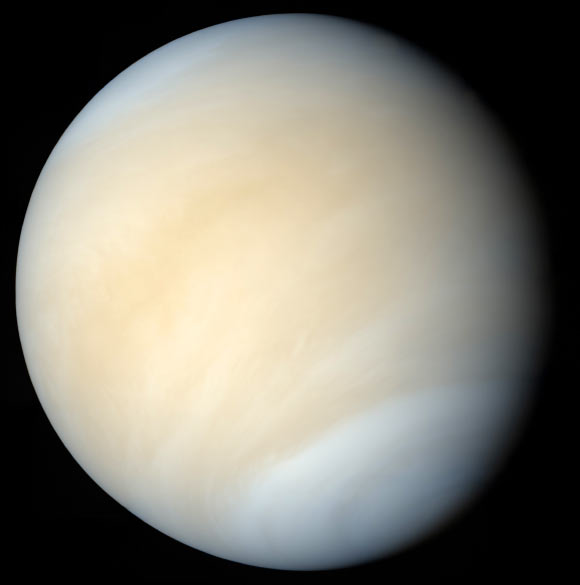


Venus in real colors, processed from Mariner 10 images, showing the pale yellow cloud deck with subtle banding. Source: NASA / Mattias Malmer / Mariner 10 imagery, via sci.news rehost


Venus looks like a smooth yellow disc through any backyard telescope. Point an ultraviolet camera at it, and the same clouds darken into a patchwork of bright and dim regions that has been tracked, named, and puzzled over since the 1920s. The dark patches are not shadows. They are absorbers, real material mixed into the sulfuric acid droplets of Venus’s upper cloud deck, and they soak up enough short-wavelength sunlight to change the planet’s appearance at wavelengths the human eye cannot see.

A new analysis from the Foundation for Applied Molecular Evolution puts a sharp quantitative number on how strong that absorption has to be. The team, led by Jan Spacek with collaborators Yeon Joo Lee of South Korea’s Institute for Basic Science, Janusz Petkowski of the Wroclaw University of Science and Technology, and Paul Rimmer of Cambridge, ran Venus’s observed UV reflectance through a radiative-transfer model that removes the contribution of cloud-droplet scattering and leaves behind a pure absorption coefficient for the liquid inside the droplets. The reported value at 375 nanometers is about 1,278 per centimeter in decadic units, Sci.News writeup of Spacek et al. 2026. That is roughly the absorption strength of a moderately concentrated dye, and it is the kind of number a lab spectroscopist can compare directly against a candidate molecule in a cuvette.

Every Venus mission proposal for the last forty years has, somewhere in its science case, a paragraph about the unknown UV absorber. The substance controls how much sunlight reaches the cloud tops, which sets the upper atmosphere’s energy budget, which feeds back into the superrotation that whips the cloud deck around the planet every four days. If we cannot identify it, every model of Venus’s climate is operating with a free parameter that has been tuned rather than measured. There is also a deeper reason the absorber matters: the cloud deck sits between roughly 50 and 70 kilometers altitude, with pressures and temperatures that on Earth would not be ruled out as a habitat for some kind of microbial life, and the phosphine debate of 2020 was in effect a debate about what kind of chemistry the clouds could host. A clean identification of the absorber would not settle that question, but it would remove one of the major unknowns. The paper was published in Astrobiology on August 25, 2026.

Astronomers have known about Venus’s UV markings since the late 1920s, when ultraviolet-sensitive photographic plates showed the planet as a mottled disc rather than the bland yellow ball it appears at visible wavelengths. The Pioneer Venus Orbiter in the late 1970s, Venus Express from 2006 to 2014, and Akatsuki since 2015 have all mapped the markings in detail. They track the four-day superrotation of the upper cloud deck, which is itself a puzzle: the atmosphere rotates about sixty times faster than the solid planet below. The markings brighten, dim, and re-form over timescales of days to years, and they do not correlate cleanly with any single altitude or temperature layer.

The candidate list is long. Sulfur allotropes, ferrous chloride, hematite, several organic compounds, even microorganisms have all been proposed at various points. None of them, on their own, match all the observational constraints at once: the right absorption strength, the right wavelength dependence, the right behavior over time, and chemical survival in a cloud environment that is mostly concentrated sulfuric acid with traces of water. The Spacek et al. paper takes a different approach. Instead of asking which molecule fits, the team asks how strong the absorption in the bulk cloud liquid has to be, in units a lab spectroscopist recognizes.

They start from spacecraft measurements of Venus’s reflectance between 365 and 455 nanometers and feed those measurements into a radiative-transfer model that treats the cloud droplets as Mie scatterers and accounts for multiple scattering by atmospheric molecules above the cloud deck. The output is the absorption coefficient of the bulk cloud liquid, the same quantity you would get from putting a sample in a cuvette and running a UV-visible spectrometer.

The peak comes out at about 1,278 per centimeter at 375 nanometers. To put that in concrete terms, porphyrin-type pigments in the lab, used here only as familiar examples of efficient absorbers rather than as biological claims, would need to be present at concentrations on the order of 10 grams per liter to hit that coefficient. Many of the inorganic candidates proposed over the years would need to be present at concentrations that strain chemical plausibility in a sulfuric acid aerosol.

A second result is just as important. The spectrum is steep. Between 365 and 455 nanometers, the inferred absorption drops sharply. That rules out the broad, brown, tar-like absorption that simple organics tend to develop when soaked in concentrated sulfuric acid over time. Whatever the absorber is, it resists being converted into that messy mixture. In Spacek’s words, the relatively sharp absorption profile is consistent with a chemically defined absorber that resists conversion into the tar-like mixture. The shape of the spectrum is now a constraint any future candidate has to satisfy.

The radiative-transfer step is the heart of the result and worth a closer look. Venus’s clouds are optically thick, with optical depths well above unity at UV wavelengths, so a photon entering the cloud deck is likely to scatter many times before it is absorbed or reflected back. From orbit, you see a planet that is darker than the underlying absorption alone would suggest, because each scattering event lengthens the photon’s path through the absorbing medium.

Spacek’s group accounts for that with a two-stream treatment, separating the cloud droplet’s scattering cross section from its absorption cross section. The droplet’s bulk refractive index at the relevant wavelengths is the standard sulfuric acid value. The atmospheric path above the cloud deck, mostly carbon dioxide with sulfur dioxide, is treated as a Rayleigh-scattering layer with a small but non-negligible contribution. The model then inverts the observed reflectance to recover the absorption coefficient of the bulk liquid.

The choice of wavelength window matters. Below 365 nanometers, Venus’s atmosphere starts to absorb strongly on its own, mainly through sulfur dioxide bands, and the cloud signal gets harder to disentangle from the gas signal. Above 455 nanometers, the absorber is less active, and the signal-to-noise ratio on the recovered absorption coefficient drops. The 365 to 455 nanometer window is the cleanest band where the absorption is dominated by the cloud droplet’s liquid content.

The 1,278 per centimeter number is a decadic absorption coefficient, the base-10 version of the natural absorption coefficient. In spectroscopy, a value around 1,000 per centimeter in a one-centimeter path length corresponds to roughly 90 percent absorption. That is an aggressive target for any single-component absorber at the concentrations likely in a Venusian cloud droplet, which is why the paper frames its conclusion in terms of either very high concentration, very efficient molecules, or both. The porphyrin-class example is used precisely because porphyrins are exceptionally efficient absorbers per molecule.

A subtler point: the constraint applies to the bulk liquid absorption, not to a single molecule’s molar extinction. A mixture of moderately efficient absorbers at high enough concentration can also produce a bulk coefficient of 1,278 per centimeter, and the paper’s framing does not distinguish between the two cases.

Spacek et al. have not identified the absorber. They have done something arguably more useful: they have turned a planetary-science puzzle into a laboratory measurement with a specific number. A bulk liquid absorption coefficient of about 1,278 per centimeter at 375 nanometers, with a steep roll-off toward 455 nanometers, is now the constraint any candidate has to hit.

The next steps are clearer for it. Lab spectroscopy can screen proposed compounds against this number without flying anything to Venus. Atmospheric modelers can use the tight constraint to reduce the free parameters in their climate simulations. And mission planners designing future Venus cloud-sampling platforms, whether they are looking for chemistry or for the more speculative question of cloud-borne biology, now have a sharper target list to test.


September 20, 2026

McGetchin, the Moon’s newest crater

Posted by


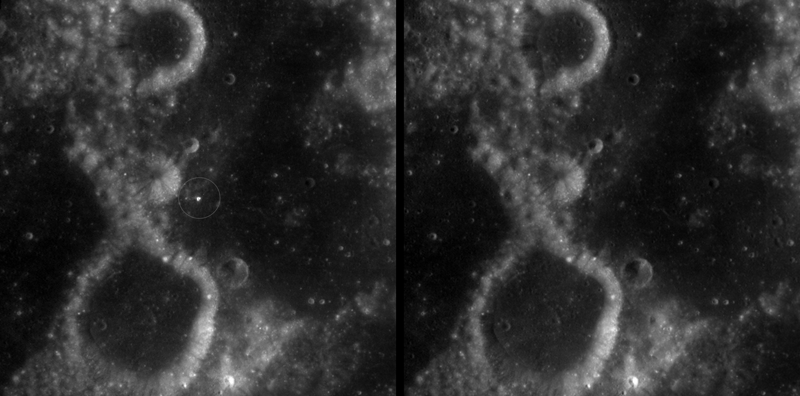
Two side-by-side black-and-white panels of the lunar surface captured by LRO's Wide-Angle Camera. The left panel shows a thin white circle around a small bright spot just right of center; the right panel shows the same area before the impact with no circled feature. The stacked-frame difference image is what tipped off Robert Wagner to the new crater.


On October 24, 2025, Robert Wagner sat down at his computer for a routine data-quality check and found a hole in the Moon that no one knew was there. The bright pixel he traced to the lunar eastern limb has now been confirmed as McGetchin crater, a 222-meter bowl carved into the surface by an impact that hit sometime between April 11 and May 22, 2024. Two papers in Science Advances on September 16, 2026 announce the find and describe what the impact did to the ground around it, and the LROC team has named the feature for Tom McGetchin, the Apollo-era field geologist who helped figure out how impact melts behave. The crater itself is roughly the length of two American football fields across and about 43 meters deep, three times the diameter of the previous record-holding fresh lunar crater spotted from LRO a decade ago.

Why this matters is that the Moon keeps taking hits, and almost no one sees them happen. There is no atmosphere to slow incoming rocks, so a small comet or asteroid fragment the size of a three- to six-story building reaches the surface essentially intact, and the only evidence it leaves is what the next orbital pass can resolve. NASA has been chasing these fresh craters with LRO since the spacecraft reached lunar orbit in June 2009 (NASA Science), and the mission has catalogued at least one thousand new impact craters and flagged a hundred thousand more surface changes from impacts or their ejecta. McGetchin is the largest of the lot, and the find arrived not because anyone was watching for it but because Wagner stacked hundreds of Wide-Angle Camera frames from before and after the impact and let the difference stand out. That methodology turned a routine quality check into a once-per-century discovery.

The story begins with a click on a thumbnail. Wagner is an image-processing specialist who works on the LROC system through Intuitive Machines, the company that has been landing commercial spacecraft on the lunar surface. He was running his usual comparison between a freshly assembled Wide-Angle Camera global map and an older one, looking for change at scales larger than about 50 meters, the size of objects his wide-field system can actually resolve. Wide-Angle Camera pixels are roughly the size of American football fields, so to spot a new feature he has to stack many frames on top of each other and let software subtract everything that did not change. Things that stay the same turn gray, and anything new shows up bright or dark. Most of what the software flags is noise, but the gray-on-gray hack works well enough that, when Wagner scrolled to a tile on the eastern limb, a bright spot circled by a darker halo stopped him cold. “It was by far the most obvious impact debris pattern I’ve ever seen in one of these images,” he said in the NASA release.

After Wagner flagged the spot, the LROC team turned the Narrow-Angle Camera on it. That instrument images the surface at about one meter per pixel, three orders of magnitude sharper than the Wide-Angle Camera, and it gave a clean view of the bowl itself and the ray pattern flung outward by the impact. The crater is roughly circular and 222 meters across, with a clean rim and a darker interior, and the ejecta blanket around it is what registered as the bright halo Wagner had seen from a distance. Independent confirmation came from comparing LROC Narrow-Angle Camera frames acquired on December 5, 2024 and again on March 3, 2025, and from thermographic observations by LRO’s Diviner instrument. The team published its analysis of the impact and its thermal aftermath in Science Advances this week (USRA newsroom); a separate paper in the same issue models the kinetic energy and the regolith disturbance, which Diviner picked up as a roughly 4-mile-wide cold spot about 16 degrees Fahrenheit cooler at night than the surrounding terrain. A follow-up Narrow-Angle Camera pass was later rolled 51 degrees to the east, producing a dramatic oblique view of the new bowl (LROC oblique view M1527218499L,R).

The deep-dive question is what the cold spot tells us about how the surface is changing in real time. Lunar regolith is a layer of loose, jagged grains sitting on top of more coherent bedrock, and over billions of years micrometeorite gardening has ground those grains into a fairly uniform fluff. An impact like McGetchin’s dumps energy into that layer in microseconds, and the explosion excavates a bowl and throws material outward. Some of that material lands around the rim, and when it does it piles up loosely, the way a sandbox pile sits lighter than the sand you started with. Loosely piled regolith does not conduct heat as well as the more compacted original surface, so at night it cools faster and to a lower temperature. Diviner saw exactly that signature, and the cold halo around McGetchin extends about 4 miles in diameter, far past the crater itself. The regolith disturbance has implications for any future rover that drives across the lunar surface: a fluffier surface means different wheel-soil interaction, and the team flagged that directly in the Science Advances paper.

The energy numbers help frame how rare an event this is. Wikipedia), citing the research papers, puts the impact energy at roughly 6.5 × 10^10 kilojoules, and the recurrence interval at about 132 years. NASA’s release phrases it as “once in a century or even longer,” which matches within the usual uncertainty of small-body population models. Either way, the take-away is that LRO has been on station long enough to catch the rare events in the lunar impact rate distribution, not just the everyday ones, and that what Wagner found is statistically one of the largest fresh craters the modern Moon has produced. The mission has been circling the Moon for more than 17 years and has mapped the topography, surface composition, thermal environment, and radiation environment there, and that sustained archive is what made the stacking comparison possible. Without it, the bright spot Wagner spotted would have been indistinguishable from a thousand other random brightness changes in any single Wide-Angle Camera frame.

What this means going forward is that the LROC team plans to keep running these global comparisons on a multi-year cadence and follow up with Narrow-Angle Camera close-ups and Diviner thermography whenever something new shows up. The same method that found McGetchin is now calibrated against a known impact and a known regolith response, so the next rare event should land faster and with less manual work. The Moon’s eastern limb will keep taking hits; the question is whether the next large one is caught the way this one was, by a quality check that turned out to be the headline.


September 14, 2026

Three solid stages and a 3D-printed engine

Posted by


Vikram-1 on the First Launch Pad at SDSC-SHAR before Mission Aagaman. Credit: IANS / Skyroot Aerospace via ETV Bharat.


On July 18, 2026, at 06:35 UTC, a 22-meter rocket lifted off from the First Launch Pad at the Satish Dhawan Space Centre on Sriharikota island. Twelve minutes later, four payloads were floating in a 450-kilometer orbit at a 60-degree inclination, marking the first time an Indian private company had reached orbit under its own name. The rocket was built by Hyderabad-based Skyroot Aerospace, and the mission was named Aagaman, Sanskrit for “arrival.” It gave India a third-country credential — only the United States and China have carried one since 2008.

For two decades, India’s orbital launches have carried the same institutional stamp: the Indian Space Research Organisation, ISRO. PSLV, GSLV, and the upcoming GSLV Mk III have flown from the same two pads at Sriharikota since 1993. When the government created the Indian National Space Promotion and Authorisation Centre, IN-SPACe, in June 2020, the explicit goal was to break that monopoly. Funding followed: India’s private space sector pulled in roughly $353 million from 2020 through 2024, with another $150 million in fiscal 2025, and the startup count climbed from a handful to more than 200 (Financial Express, 2026).

What was still missing was a proof of orbit. Suborbital hops like Vikram-S in November 2022 showed that a private firm could build a rocket and reach space. They did not show that one could deliver a payload to a precise altitude and inclination. Vikram-1 closes that gap. With Mission Aagaman complete, Skyroot joined SpaceX and Rocket Lab in the United States and LandSpace’s Zhuque-2 in China as the only commercial operators to have reached orbit with a privately developed first stage (Reuters, July 18 2026).

The market is large enough to make the milestone more than symbolic. India already runs one of the more aggressive small-satellite launch programs in Asia, and Chandana told CNBC that 70 to 80 percent of Skyroot’s eventual customers will sit outside India, across the United States, Europe, and Southeast Asia. A dedicated small-sat ride at roughly $15,000 per kilogram or less could undercut dedicated Electron and Taurus-Mini flights for payloads under 350 kilograms.

The two founders met at ISRO. Pawan Kumar Chandana had spent six years on Indian launch vehicle programs, mostly at the Vikram Sarabhai Space Centre (VSSC). Naga Bharath Daka had designed avionics modules for flight computers. Both studied at IIT Kharagpur. They left ISRO in 2018, raised about $1.35 million from Myntra founder Mukesh Bansal and CureFit co-founder Ankit Nagori, and registered Skyroot Aerospace on June 12, 2018, two years before any private launch regulation existed.

IN-SPACe arrived in 2020, after Skyroot had already begun carbon-fiber airframe tooling. By 2022 the company launched Vikram-S on Mission Prarambh, a suborbital flight that reached about 89 kilometers and validated roughly 80 percent of the technology stack: the all-carbon composite airframe, the solid propulsion, the thermal protection, and the avionics.

Vikram-1 took another three and a half years. The three solid stages (Kalam-1200, Kalam-250, and Kalam-100, named for missile scientist A. P. J. Abdul Kalam) each had to be static-fired at ISRO’s STEX/VAST complex at Sriharikota. The liquid Orbital Adjustment Module with its Raman engine was hot-tested at the ISRO Propulsion Complex at Mahendragiri under IN-SPACe oversight. Skyroot’s first 100 percent 3D-printed bipropellant injector ran successfully in 2020; a Raman-II hot fire at Mahendragiri ran 10 seconds in July 2023 at a chamber pressure of 8.5 bar.

The launch attempt slipped from 2024 into a 23-day window opening July 12, 2026. Chandana told CNBC-TV18 that “we have done everything that could be done to test Vikram-1 on ground.” On July 18 an automated hold extended the countdown while engineers rechecked navigation parameters; lift-off came at 12:05 PM IST, roughly 35 minutes behind the original schedule. Payload separation finished by T+900 seconds, and Skyroot declared mission success. At least one more developmental flight sits between Aagaman and any commercial manifest.

Vikram-1 is a four-stage rocket, 22 meters tall and 1.7 meters in diameter, the first orbital launcher in India built entirely from carbon-fiber-reinforced polymer (CFRP). The material choice matters because CFRP motor cases weigh roughly 30 to 50 percent less than equivalent steel or aluminum cases at the same burst pressure (Nature 2021, CFRP motor-case studies). For a small launcher, that drop translates directly into payload fraction: every kilogram saved in dry mass leaves room for a kilogram of propellant, and propellant is cheaper to deliver to orbit than structure.

The three solid motors run a typical Indian composite propellant: about 68 percent ammonium perchlorate oxidizer, 18 percent aluminum powder, and 14 percent hydroxyl-terminated polybutadiene (HTPB) binder. The first-stage casing, the Kalam-1200, is the longest monolithic composite motor built at ISRO’s Solid Propellant Space Booster Plant, 11 meters long and 1.7 meters in diameter, loaded with about 30 tonnes of propellant. The case is filament-wound at angles of roughly ±55 and ±20 degrees over the cylinder, transitioning to ±45 and 80 degrees at the domes, an arrangement tuned to balance hoop stress, axial load, and torsional stiffness. Inside the case, an EPDM rubber insulator protects the carbon fiber from 3,000-Kelvin combustion gas. Thrust vector control on the upper solid stages uses a carbon-ablative flex nozzle deflecting the throat a few degrees with hydraulic actuators.

The fourth stage, the Orbital Adjustment Module, is a cluster of four Raman engines burning monomethylhydrazine against nitrogen tetroxide (MMH/NTO), the classic hypergolic storable bipropellant. Hypergolic ignition fires the moment the two liquids touch: no spark, no igniter, no start sequence to fail. That property lets the module relight multiple times during a single mission, which is the whole selling point for rideshare flights where each payload owner wants a slightly different altitude.

The Raman engine uses 100 percent 3D-printed injector and chamber hardware. According to Skyroot, additive manufacturing cuts injector mass by roughly 50 percent and trims part count and lead time by roughly 80 percent compared with machined injector plates. A single laser powder-bed-fusion build produces the injector in one piece, eliminating several hundred discrete passages and brazed joints. That kind of simplification makes a small team viable against larger state programs.

For the sizing math: with a 1,200-kilonewton first stage, a specific impulse near 270 seconds at sea level, and a structural mass fraction in the 0.10 to 0.12 range, the ideal delta-v budget for a 450-kilometer circular orbit at 60-degree inclination comes to about 9.4 kilometers per second. The four stages roughly hit that, leaving a margin near 1.2 kilometers per second for gravity and drag losses, in line with industry norms for small launchers.

The full Vikram family still has to come online: Vikram-2 with its 3D-printed Dhawan cryogenic engine in 2027, then Vikram-3. The team is now 500 engineers, working from a 60,000-square-foot “Max-Q” campus in Hyderabad that the company describes as the largest private rocket development facility in South Asia. Investment caught up in May 2026, when Skyroot became India’s first space-tech unicorn at a $1.1 billion valuation after a $60 million round that included GIC, BlackRock, Sherpalo Ventures, and Playbook Partners.

The wider lesson is structural. India did not get a private space industry by accident; it got one by writing rules, opening access to shared test stands, and waiting long enough for the engineering to mature. The flight on July 18 was a scheduled checkpoint on a plan that started in 2020, not a surprise ending. Other countries will study whether that same sequence (regulator first, infrastructure second, orbital capability third) can run faster in their own markets. That question will probably matter more than Vikram-1 itself.


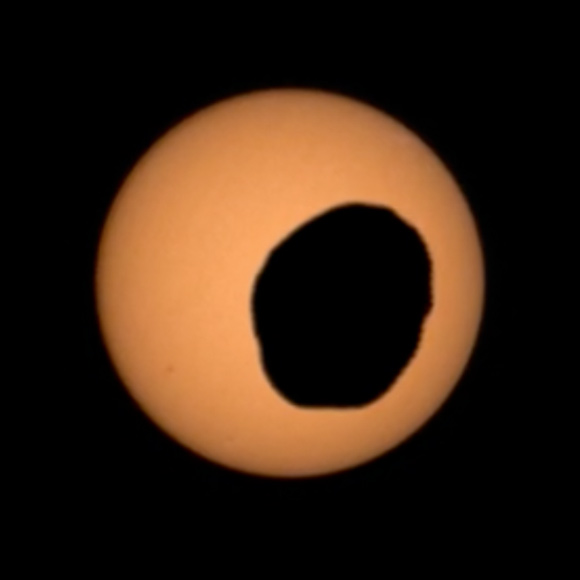
Perseverance catches Phobos slipping across the Sun on sol 1948. Image: 2026 08 26 perseverance phobos sun transit.


On 12 August 2026, on the 1,948th Martian day of its mission, NASA’s Perseverance rover stopped what it was doing for a few minutes, pointed its Mastcam-Z camera at the Sun, and watched Phobos, the inner of Mars’s two moons, slide across the solar disk. The animation that came back has been colorized to mimic what a person on the Martian surface would have seen looking up through a pair of protective eclipse glasses: a small, dark, lumpy silhouette gliding across a glowing orange Sun, never covering enough of it to qualify as a true eclipse (Sci.News).

A partial transit like this is small in the moment and large in the long run. Perseverance has been recording these crossings since it landed in Jezero crater in February 2021, and the team keeps shooting them because each one is a measurement of where Phobos is, and where it is going. By comparing the recordings taken years apart, scientists can refine the moon’s orbit, watch how the orbit is decaying under Mars’s tidal pull, and update the timeline for the day Phobos will finally break apart at the Roche limit or crash into the planet (Sci.News). The same kind of observation, applied to a star instead of a moon, was how exoplanet hunters in the Kepler and TESS era measured the size and orbital period of worlds around other stars. Phobos in front of the Sun is the equivalent demonstration, just two doors down from Earth.

The other reason the recording matters is that Phobos is one of the few Solar System bodies small and close enough that a single orbiting spacecraft can resolve its shadow path from the surface. The moon is only about 26 by 22 by 18 kilometers across, smaller than many asteroids, and orbits Mars at roughly 6,000 kilometers from the surface. That closeness is also why the transit never becomes a total eclipse: from the Martian surface, Phobos never appears large enough to cover the Sun’s disk, only to carve a moving bite out of it.

The 12 August 2026 observation was Perseverance’s most recent entry in a routine the rover has been keeping for more than four Earth years. The Mastcam-Z instrument, a pair of zoomable color cameras mounted on the rover’s remote sensing mast, has been used on multiple earlier sols to record Phobos and Deimos transits. Each observation produces a short video of frames that the team can stack, time-stamp against the rover’s onboard clock, and compare with prior sessions.

What is new with sol 1948 is mostly cosmetic. The animation was tinted on the ground to simulate the visual impression a human observer on Mars would get looking up through solar-eclipse glasses, the same orange-tinted look eclipse chasers use on Earth. The raw data is still a time series of dark silhouettes moving across a bright source. The team released the public-friendly version after running the standard calibration, and the Sci.News writeup on 24 August pulled it back into the news cycle as part of a steady drip of small Mars-science updates (Sci.News).

Behind the video is the same physics that makes a solar eclipse work on Earth: a foreground object passes between the observer and the Sun, casting a moving shadow. The differences are size and geometry. Phobos is roughly 150 times smaller than Earth’s Moon and sits about 200 times closer to Mars than the Moon does to Earth, so its angular size is far too small to cover the Sun. The Moon’s apparent diameter almost exactly matches the Sun’s during a total solar eclipse on Earth, which is the happy coincidence that makes totality possible. Phobos never gets that close to covering the Sun, so the term “transit” is the right word, with “annular eclipse” reserved for a slightly bigger blocker that still falls short of totality.

Mastcam-Z is the workhorse camera on Perseverance’s mast, sitting about two meters above the Martian surface at the eye level of a roughly 6½-foot-tall person, with the two cameras separated by about 24 centimeters to give stereo vision (NASA Mars 2020 Mastcam-Z page). It was designed primarily to study rocks and soils from a distance, with a zoom range that lets the team build topographic maps of terrain features, and it can record 1600 by 1200 pixel frames at up to about 148 megabits per sol of returned imaging.

The transit record itself is what the orbital dynamicists want. Phobos orbits Mars in 7 hours and 39 minutes, faster than any other moon in the Solar System relative to its parent planet’s rotation, and tidal drag is slowly shrinking that orbit. The standard textbook figure is that the orbital radius is decreasing at roughly two centimeters per year, or about two meters per century, and the projections for when Phobos will either break up into a ring or crash into the surface run from about 30 million to 50 million years out (Wikipedia: Phobos (moon))). Observations like the sol 1948 transit tighten the numbers behind those projections by giving the orbit a fresh astrometric fix.

The geometry also gives a measurement that is hard to get any other way: from a fixed landing site like Jezero, the exact path of Phobos across the Sun depends on where Phobos is in its orbit at a particular second. Cross-referencing that path against time, the rover team can solve for orbital elements that mass and remote sensing measurements cannot constrain.

A subtle point worth flagging is that Perseverance did not move to capture this transit. The rover was wherever it happened to be on sol 1948, and the team aimed the mast at the Sun from there. This matters because location is one of the unknowns in the orbital fit: if Jezero’s coordinates are even slightly off in the Mars-fixed reference frame, every recorded shadow path inherits that error. Years of persistent observations from the same rover at the same site cancel most of that error out.

The 12 August 2026 Phobos transit is a small piece of work by a long-running rover that has already spent more than five and a half years on Mars. The Mars 2020 mission’s headline job, caching samples for a future return mission, is well into its second decade of planning, and Mastcam-Z observations of this kind are now a small but reliable side-product that keeps adding data to the Phobos literature. Expect another of these recordings every few months from Jezero as long as the rover stays healthy, and the public versions appear in the standard NASA Mars 2020 image release channels over time. The longer-running payoff sits in the orbit itself: each transit shaves uncertainty off the prediction for the day Phobos stops being a moon.


ISRO's EOS-05 (GISAT-1A) hyperspectral Earth observation satellite parked at geostationary altitude 36,000 km above the equator, its 700 mm Ritchey-Chrétien telescope pointed nadir at the Indian subcontinent below — visualized as a false-color hyperspectral data cube across VNIR and SWIR bands.


At 02:55 Indian Standard Time on 4 September 2026, the seventeenth operational Geosynchronous Satellite Launch Vehicle — GSLV-F17 — cleared the second launch pad at Sriharikota with a 2,368-kilogram payload, lit its indigenous cryogenic upper stage, and pushed India’s heaviest geostationary passenger into a sub-geosynchronous transfer orbit eighteen minutes later (ISRO mission brochure, August 2026; Wikipedia EOS-05). What makes that routine sentence matter is what the payload is. EOS-05, also known as GISAT-1A, is the first hyperspectral Earth-observing imager ever stationed at geostationary altitude. From roughly 36,000 km above the equator it can sweep the entire Indian landmass every thirty minutes at 42 m resolution and revisit a selected field every five minutes — a cadence no low-Earth-orbit constellation can match for fast-moving hazards.

What changes because of this is the temporal resolution of what India can see. Until now, the country’s civilian Earth-observation stack lived mostly at 600 to 800 km on the IRS series and on a small number of dedicated weather satellites. EOS-05 folds two things into one geostationary platform: near-real-time imaging, and the hyperspectral imaging no civilian operator has flown from GEO before. The combination has no current peer. From 35,786 km, 414 spectral channels are now listening to the subcontinent across visible, near-infrared and short-wave infrared bands, watching floods, fires, crop stress and industrial plumes as they happen rather than as a satellite passes overhead.

The history behind the launch matters. The first GISAT was meant to do exactly this. On 12 August 2021, GSLV-F10 lifted off from the same Sriharikota pad with the 2,268 kg GISAT-1 and its cryogenic upper stage failed to ignite; the satellite burned up over the Bay of Bengal (The Wire, August 2021). ISRO rebuilt the cryogenic engine programme, re-qualified the Cryogenic Upper Stage, and quietly prepared a near-twin spacecraft with refinements drawn from five years of post-failure analysis. EOS-05 carries the same 700 mm Ritchey–Chrétien telescope and I-2K bus as the lost satellite, with upgraded detector thermal control and a more capable onboard formatter. When the same rocket class that failed in 2021 succeeded on 4 September 2026, it completed a five-year recovery that almost no one outside India’s space programme was watching.

What the rocket did after lift-off tells the harder part of the engineering story. GSLV-F17 did not drop EOS-05 at geostationary altitude. It dropped it into a low sub-GTO at around 171 km, a parking orbit deliberately chosen to keep the cryogenic upper stage’s burn time short (Wikipedia EOS-05). From there, the spacecraft used its own apogee motor in three burns over 5, 6 and 7 September to climb to its operational 35,786 km × ~35,786 km geostationary orbit. The two longest burns on 5 and 6 September totalled roughly 5,406 seconds — ninety minutes of cumulative thrust — raising apogee from 20,000 to 31,129 km and then to 35,786 km in stages. This is the standard GEO playbook, but EOS-05 is the heaviest payload GSLV has ever pushed through it.

The optical design is what makes the instrument special. A 700 mm Ritchey–Chrétien primary is small by ground-astronomy standards — Hubble’s mirror is 2.4 m — but it is the largest aperture ISRO has ever flown for Earth observation. From 36,000 km, diffraction-limited resolution scales linearly with aperture and inversely with wavelength, so the trade-off comes down to where you point your photons. EOS-05 splits the available light three ways. The multispectral Visible and Near-Infrared (MX-VNIR) channel uses six broad bands from 0.45 to 0.875 μm and lands at 42 m ground sample distance — the finest spatial resolution any imaging payload has ever delivered from geostationary orbit. The hyperspectral VNIR (HyS-VNIR) channel splits the same window into 158 narrow slices from 0.375 to 1.0 μm at 318 m. The hyperspectral Short-Wave Infrared (HyS-SWIR) channel runs from 0.9 to 2.5 μm across 256 bands at 191 m. Adding 158 and 256 gives 414 hyperspectral channels; with the six multispectral bands stacked on top, the total detector count exceeds 420.

The reason that matters is spectroscopy. A multispectral imager sees colour; a hyperspectral imager sees chemistry. Mineral dust has a different spectral signature than volcanic ash; healthy vegetation has a sharp red-edge near 0.7 μm; a chlorinated industrial plume absorbs differently than a hydrocarbon one. From low Earth orbit, agencies have done this for decades — NASA’s Hyperion on EO-1, ESA’s EnMAP, the Italian Space Agency’s PRISMA hypersatellite — but those satellites revisit a given point every few days at best. EOS-05 is the first time the world has had that chemical sensitivity continuously, watching one continent, refreshed every thirty minutes. A cyclone making landfall on the Odisha coast, a methane plume from a gas flare in Assam, a crop pest outbreak spreading through Punjab — all become things that can be detected within a single orbit of the satellite above.

The engineering trade-offs behind those numbers come down to two constraints. First, photon budget: a 700 mm mirror at 36,000 km gathers roughly the same per-unit-area flux as a small ground telescope, and the satellite stares at any given scene for tens of seconds rather than the milliseconds a LEO sensor collects per pass. The HyS-SWIR bands pay for that penalty with coarser spatial resolution (191 m instead of 42 m) and wider spectral slices. Second, thermal stability: a hyperspectral detector must hold its wavelength calibration to a fraction of a band over hours of stare time, so EOS-05 carries a closed-cycle cooler that pins the SWIR focal plane near 150 K. Without it, the 256 SWIR channels would smear into noise within minutes of eclipse exit.

What this changes is the cadence of Indian disaster response and agricultural monitoring. The Indian National Disaster Management Authority, the Indian Agricultural Research Council, and state forest departments will receive a continuous stream of 42 m imagery refreshed every thirty minutes over the entire country — a temporal density no civilian operator on Earth could match from GEO before this year. The same data feeds weather models through cloud-motion winds and aerosol optical depth retrievals that no other geostationary weather satellite can currently produce, because none of them carry hyperspectral imagers. The six-band MX-VNIR will provide what the older INSAT-3DR can only approximate in coarse thermal IR; the 414 hyperspectral channels will provide what the LEO hyperspectral fleet cannot — continuity.

Two other satellites are still on ISRO’s drawing board for the GISAT series — GISAT-2 and a planned third. For the next few years, EOS-05 will sit alone at 36,000 km, pointing its 700 mm mirror at one subcontinent, and rewriting what Earth observation means when you can watch a country breathe.