


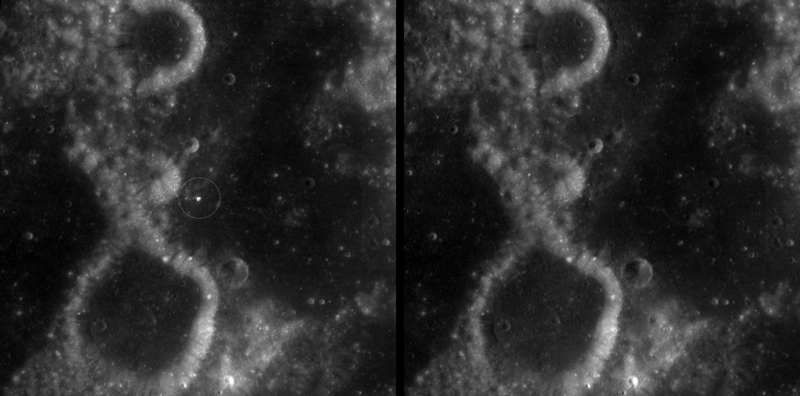
On October 24, 2025, Robert Wagner sat down at his computer for a routine data-quality check and found a hole in the Moon that no one knew was there. The bright pixel he traced to the lunar eastern limb has now been confirmed as McGetchin crater, a 222-meter bowl carved into the surface by an impact that hit sometime between April 11 and May 22, 2024. Two papers in Science Advances on September 16, 2026 announce the find and describe what the impact did to the ground around it, and the LROC team has named the feature for Tom McGetchin, the Apollo-era field geologist who helped figure out how impact melts behave. The crater itself is roughly the length of two American football fields across and about 43 meters deep, three times the diameter of the previous record-holding fresh lunar crater spotted from LRO a decade ago.
Why this matters is that the Moon keeps taking hits, and almost no one sees them happen. There is no atmosphere to slow incoming rocks, so a small comet or asteroid fragment the size of a three- to six-story building reaches the surface essentially intact, and the only evidence it leaves is what the next orbital pass can resolve. NASA has been chasing these fresh craters with LRO since the spacecraft reached lunar orbit in June 2009 (NASA Science), and the mission has catalogued at least one thousand new impact craters and flagged a hundred thousand more surface changes from impacts or their ejecta. McGetchin is the largest of the lot, and the find arrived not because anyone was watching for it but because Wagner stacked hundreds of Wide-Angle Camera frames from before and after the impact and let the difference stand out. That methodology turned a routine quality check into a once-per-century discovery.
The story begins with a click on a thumbnail. Wagner is an image-processing specialist who works on the LROC system through Intuitive Machines, the company that has been landing commercial spacecraft on the lunar surface. He was running his usual comparison between a freshly assembled Wide-Angle Camera global map and an older one, looking for change at scales larger than about 50 meters, the size of objects his wide-field system can actually resolve. Wide-Angle Camera pixels are roughly the size of American football fields, so to spot a new feature he has to stack many frames on top of each other and let software subtract everything that did not change. Things that stay the same turn gray, and anything new shows up bright or dark. Most of what the software flags is noise, but the gray-on-gray hack works well enough that, when Wagner scrolled to a tile on the eastern limb, a bright spot circled by a darker halo stopped him cold. “It was by far the most obvious impact debris pattern I’ve ever seen in one of these images,” he said in the NASA release.
After Wagner flagged the spot, the LROC team turned the Narrow-Angle Camera on it. That instrument images the surface at about one meter per pixel, three orders of magnitude sharper than the Wide-Angle Camera, and it gave a clean view of the bowl itself and the ray pattern flung outward by the impact. The crater is roughly circular and 222 meters across, with a clean rim and a darker interior, and the ejecta blanket around it is what registered as the bright halo Wagner had seen from a distance. Independent confirmation came from comparing LROC Narrow-Angle Camera frames acquired on December 5, 2024 and again on March 3, 2025, and from thermographic observations by LRO’s Diviner instrument. The team published its analysis of the impact and its thermal aftermath in Science Advances this week (USRA newsroom); a separate paper in the same issue models the kinetic energy and the regolith disturbance, which Diviner picked up as a roughly 4-mile-wide cold spot about 16 degrees Fahrenheit cooler at night than the surrounding terrain. A follow-up Narrow-Angle Camera pass was later rolled 51 degrees to the east, producing a dramatic oblique view of the new bowl (LROC oblique view M1527218499L,R).
The deep-dive question is what the cold spot tells us about how the surface is changing in real time. Lunar regolith is a layer of loose, jagged grains sitting on top of more coherent bedrock, and over billions of years micrometeorite gardening has ground those grains into a fairly uniform fluff. An impact like McGetchin’s dumps energy into that layer in microseconds, and the explosion excavates a bowl and throws material outward. Some of that material lands around the rim, and when it does it piles up loosely, the way a sandbox pile sits lighter than the sand you started with. Loosely piled regolith does not conduct heat as well as the more compacted original surface, so at night it cools faster and to a lower temperature. Diviner saw exactly that signature, and the cold halo around McGetchin extends about 4 miles in diameter, far past the crater itself. The regolith disturbance has implications for any future rover that drives across the lunar surface: a fluffier surface means different wheel-soil interaction, and the team flagged that directly in the Science Advances paper.
The energy numbers help frame how rare an event this is. Wikipedia), citing the research papers, puts the impact energy at roughly 6.5 × 10^10 kilojoules, and the recurrence interval at about 132 years. NASA’s release phrases it as “once in a century or even longer,” which matches within the usual uncertainty of small-body population models. Either way, the take-away is that LRO has been on station long enough to catch the rare events in the lunar impact rate distribution, not just the everyday ones, and that what Wagner found is statistically one of the largest fresh craters the modern Moon has produced. The mission has been circling the Moon for more than 17 years and has mapped the topography, surface composition, thermal environment, and radiation environment there, and that sustained archive is what made the stacking comparison possible. Without it, the bright spot Wagner spotted would have been indistinguishable from a thousand other random brightness changes in any single Wide-Angle Camera frame.
What this means going forward is that the LROC team plans to keep running these global comparisons on a multi-year cadence and follow up with Narrow-Angle Camera close-ups and Diviner thermography whenever something new shows up. The same method that found McGetchin is now calibrated against a known impact and a known regolith response, so the next rare event should land faster and with less manual work. The Moon’s eastern limb will keep taking hits; the question is whether the next large one is caught the way this one was, by a quality check that turned out to be the headline.
 Subscribe to our RSS feed









There are no comments.
Add A Comment