


On the evening of 1 September 2026, a 0.5-meter telescope on Maui logged a new dot of light next to the core of a spiral galaxy in Pegasus. The Transient Name Server now calls it SN 2026aaiv, and the galaxy it landed in is NGC 7331, the same one that has been used for two centuries as a stand-in for the Milky Way. The supernova is a Type Ia, the kind that turns a stellar cinder the size of Earth into something brighter than the hundreds of billions of stars around it.
What makes this one different is timing. The same survey that found it is built to catch asteroids days before they hit Earth, and the supernova classification certificate arrived in the TNS inbox before most of the world knew NGC 7331 had a transient in it. The event is also still rising. By 11 September it sat at magnitude 15.7, dim to the eye but bright enough for a backyard telescope with a small CCD, and amateur observers were already reporting spectra that show the telltale silicon absorption line at 6355 angstroms moving at roughly 10,500 kilometers per second. If the light curve behaves the way most Type Ia light curves do, the supernova should peak somewhere between magnitude 11 and 12 in the next two weeks, visible through modest amateur instruments under a dark sky.
The host galaxy does most of the work in this story. NGC 7331 sits about 43.8 million light-years away in the constellation Pegasus and is one of the brighter galaxies Charles Messier left out of his 18th-century catalog. The galaxy is unbarred, which separates it from the barred spiral we now think the Milky Way is, and its central bulge rotates in the opposite direction to its disk, an arrangement that has kept astronomers arguing about it since the 1990s. It hosts a similar number of stars, a comparable central supermassive black hole, and a similar star-formation rate to our own galaxy. When the Hubble Caldwell catalog entry for Caldwell 30 calls it an analog to the Milky Way, that is the comparison it means.
A Type Ia supernova is a different animal from the core-collapse explosions that mark the deaths of massive stars. The progenitor is a white dwarf, the dense leftover of a sun-like star that has shed its outer layers and is now sitting at roughly the radius of Earth with about 1.4 times the mass of the Sun. Alone, a white dwarf just cools. Add a companion star in a tight orbit and the dwarf’s gravity becomes a siphon, pulling gas off the neighbor until the white dwarf crosses a mass threshold that ignites its carbon core in a runaway thermonuclear burn. The whole star detonates in roughly a second, and the explosion reaches a peak brightness that is remarkably uniform from event to event. That uniformity is the property that turned Type Ia supernovae into standard candles and powered the 1998 discovery of the accelerating expansion of the universe.
The uniformity has a price. Because every Type Ia reaches roughly the same peak luminosity, the Phillips relationship lets astronomers correct small differences in peak brightness back to a common value and use them to measure distances to around seven percent accuracy. The underlying physics still has open questions, including whether every Type Ia reaches the canonical 1.4-solar-mass Chandrasekhar limit before detonating, but the practical distance ladder has held up across three decades of cosmology.
The survey that found SN 2026aaiv is the Asteroid Terrestrial-impact Last Alert System, a NASA-funded robotic network run by the University of Hawaii’s Institute for Astronomy. ATLAS began observations in 2015 with one telescope at Haleakala; it now operates five 0.5-meter units across Hawaii, Chile, South Africa, and, as of February 2025, Spain. Each telescope surveys one quarter of the observable sky four times per clear night, and the addition of the southern and Spanish stations pushed ATLAS from every-other-night coverage to nightly coverage of the entire dark sky. Its primary job is to give one day’s warning for a 30-kiloton town-killer asteroid and several weeks’ warning for smaller regional impactors, but the same wide-field optical survey turns up a steady stream of supernovae, variable stars, and other transients. SN 2026aaiv is one of those byproducts.
The TNS classification certificate was filed by Claudio Balcon of the Belluno Astronomical Observatory on 2 September at 22:54:58 UTC, using a spectrum taken with the BL41 telescope’s FOSC-E spectrograph at low resolution. The classification software (GELATO and SNID-SAGE) matched the spectrum against a library of Type Ia templates and concluded that the new transient looks like a normal thermonuclear explosion. The redshift came out at 0.003, almost identical to NGC 7331’s recessional velocity, which is how the survey knew within hours that the candidate sat inside the galaxy rather than far behind it.
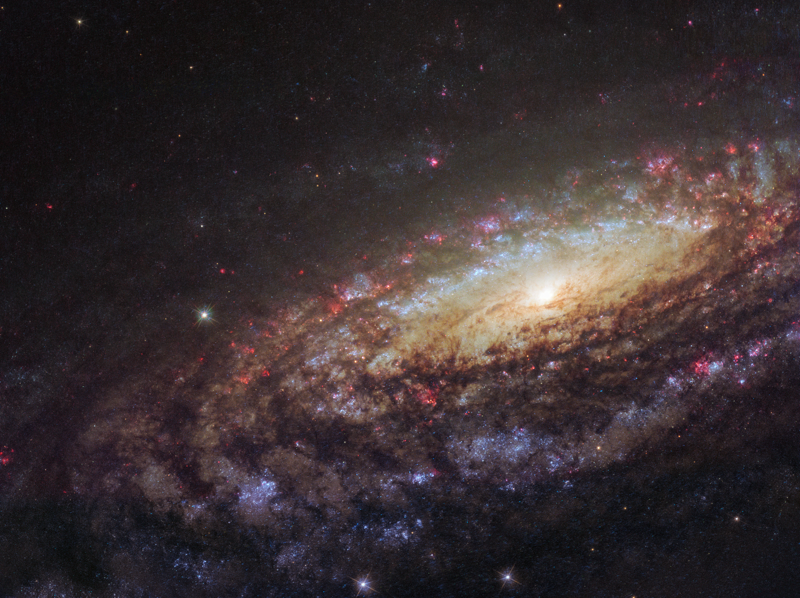
The image above is the 2018 ESA/Hubble view of NGC 7331, taken with the Wide Field Camera 3 during follow-up of a different supernova, SN 2014C, which still appears as a small red dot near the galaxy’s central yellow core in the original frame. The galaxy’s disk is inclined to our line of sight, so the spiral arms wrap around the core in a way that gives the long-exposure view a strong sense of depth. SN 2026aaiv is a new transient on top of the same spiral-arm structure; the position listed on the WISeREP page puts it within NGC 7331’s bright central regions, at right ascension 22:37:05.618 and declination +34:24:35.37.
For anyone with a small telescope in the northern hemisphere, the next two weeks are the window. NGC 7331 transits the local meridian late in the evening at this time of year, climbs to a usable altitude from mid-northern latitudes, and is bright enough at magnitude 10.4 to find with a finderscope. Independent observers have already posted imaging runs with smart telescopes that show the supernova as a new dot superimposed on the galaxy’s bulge. The follow-up spectroscopy that will pin down whether SN 2026aaiv is a normal Type Ia or one of the over-luminous peculiar variants depends on amateur spectroscopists mailing in their calibration files as the light curve climbs.
The most likely outcome is the boring one. SN 2026aaiv will brighten, peak somewhere between magnitude 11 and 12, and then fade over the following months. The value of catching it in real time is not the supernova itself but the cross-check it provides against the standard-candle distance scale. A well-observed Type Ia in a galaxy whose distance is already pinned down by Cepheid variables and the Tully-Fisher relation lets cosmologists test whether the peak-luminosity corrections that go into every Hubble constant measurement still hold for the next generation of telescopes. NGC 7331 has been used as a Milky Way analog for two and a half centuries. For the next few weeks, it is also a working physics laboratory, and the lights are on.
 Subscribe to our RSS feed









There are no comments.
Add A Comment