OrbitalHub

Where curiosity reaches escape velocity.

Domain is for sale. $50,000,000.00 USD. Direct any inquiries to contact@orbitalhub.com.

Archive for September, 2026

September 29, 2026

First radio detection from an exoplanet

Posted by


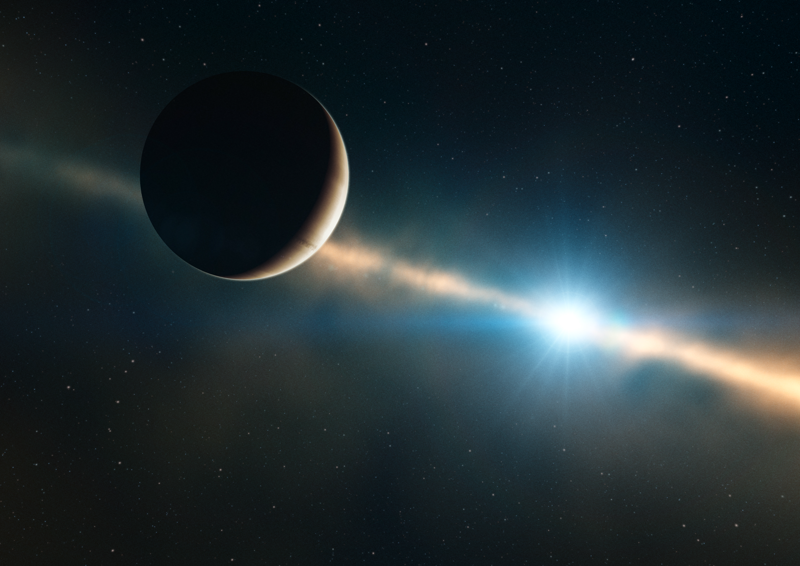
An artist's impression shows the gas giant Beta Pictoris b in the foreground as a thin crescent against a bright star, with the edge-on debris disk of the Beta Pictoris system stretching diagonally across the frame. ESO credit.


On 15 September 2026, a graduate student at the Harvard and Smithsonian Center for Astrophysics posted a 32-page preprint to arXiv announcing the first radio detection from a planet outside our solar system. The team, led by Kevin Ortiz Ceballos with co-author Edo Berger at Harvard and Yvette Cendes at the University of Oregon, had used the MeerKAT radio array in South Africa to pick up rapid, repeating, and strongly circularly polarized bursts coming from Beta Pictoris b, a 12-Jupiter-mass gas giant orbiting its host star at roughly ten astronomical units (Ortiz Ceballos et al. 2026, arXiv:2609.16720). The signal, picked up at frequencies between 0.85 and 3.5 gigahertz, was coherent, variable on timescales of seconds, and beamed. The most plausible source was auroral electron-cyclotron-maser emission generated in the planet’s own magnetosphere. From the highest observed frequency, the team inferred a magnetic field of at least 1.25 kilogauss at the emission site, the first direct magnetic-field measurement ever made on an exoplanet.

This matters for a reason that has nothing to do with technosignatures or aliens, even though those were the first things many readers searched for in the headlines. A planet’s magnetic field controls how its atmosphere weathers the wind of charged particles blowing off its host star. Earth has held onto its atmosphere for billions of years in part because its 0.5-gauss dipole field deflects the solar wind. Mars, with no global field to speak of, lost most of its. Measuring magnetic fields on exoplanets is therefore a prerequisite to asking whether any of them could be habitable, and until last week, every attempt to do so directly had failed.

The reason the failure rate was so high starts with the difference between magnetic activity on a star and magnetic activity on a planet. Both produce radio emission, and stars, especially young and magnetically active ones, are much louder than the planets that orbit them. Pinning a radio signal to a planet rather than its star requires angular resolution finer than the orbital separation, and Beta Pictoris b is the best natural laboratory available. Its host, Beta Pictoris, is an A6V star about 19.6 parsecs away in the constellation Pictor, magnetically quiet, with an upper limit of roughly 0.3 kilogauss on its dipole field. The planet itself sits about ten astronomical units out and reaches a peak angular separation near 0.55 arcseconds over its 24-year orbit, wide enough for a long-baseline radio interferometer to disentangle. The MeerKAT array in the Karoo desert is a 64-dish precursor to the Square Kilometre Array, and its sensitivity at decimetre wavelengths is the highest of any currently operating radio telescope in the southern hemisphere. The team observed Beta Pictoris four times between February 2025 and May 2026, twice in the L band between 0.856 and 1.712 gigahertz and twice in the S band between 1.75 and 3.5 gigahertz. The first epoch was a wide survey for quiescent radio emission from brown-dwarf and exoplanet analogues. It found a source. A nine-hour follow-up confirmed it, and subsequent S-band campaigns with the array split into two sub-bands pinned the emission to the planet’s coordinates relative to background quasars (Astrobiology.com summary, Sept 24 2026).

Two properties of the signal cinched the identification. First, it was highly circularly polarized, with the strongest S-band burst roughly 70 percent polarized in one handedness and the L-band bursts showing variable handedness between epochs. Coherent radio emission with that level of polarization and rapid time variability is the signature of the electron-cyclotron maser instability, a process in which electrons spiralling in a magnetic field release their kinetic energy as electromagnetic waves at the local cyclotron frequency. Incoherent gyrosynchrotron emission, the alternative mechanism, produces only modest circular polarization and cannot generate brightness temperatures above about 10^8 kelvin. The team’s brightest L-band burst of 307 microjanskys at 1.28 gigahertz, if it came from a region the size of the planet, would correspond to a brightness temperature above 6 times 10^10 kelvin. Second, the upper edge of the emission frequency mapped directly to the magnetic field strength at the source. For fundamental electron-cyclotron-maser emission, the cyclotron frequency is about 2.8 gigahertz per kilogauss, and the team observed emission extending all the way to 3.5 gigahertz, the top of their S-band coverage, which requires a field of at least 1.25 kilogauss at the emission site (Live Science, Sept 23 2026). That is roughly 290 times stronger than Jupiter’s surface field of 4.3 gauss and about 2500 times stronger than Earth’s, and it is consistent with the predictions of energy-flux dynamo scaling for a young, hot, super-Jupiter. The host star cannot produce it: its measured upper limit is a quarter of a kilogauss, and A stars do not generally host kilogauss surface fields anyway. The mechanism is the same one that powers Jupiter’s aurorae, scaled up. Jupiter’s aurorae, the brightest in the solar system after the Sun’s, are driven partly by the interaction of its magnetic field with the solar wind and partly by the tidal stripping of its volcanic moon Io, which loads the magnetosphere with plasma. Beta Pictoris b has no Io and probably no moon, but it orbits a young A star that is itself a few hundred times more luminous than the Sun and emits a correspondingly stronger wind. Charged particles streaming from the star are funneled along the planet’s magnetic field lines into the polar regions of its upper atmosphere, where they radiate. The result is the same pattern seen in brown-dwarf ultracool dwarfs that host similar kilogauss fields: coherent radio bursts at the rotation period, with circular polarization that flips sign depending on the orientation of the magnetic axis. The team also notes that previous weak X-ray emission attributed to the star may in fact originate from the planet, which would put Beta Pictoris b on the same radio-to-X-ray correlation as ultracool dwarfs and brown dwarfs, a unified scaling law that has held up across more than two orders of magnitude in magnetic field strength.

The implications extend beyond Beta Pictoris. Suzanne Aigrain of Oxford, who was not involved in the study, told Live Science that the detection “hopefully paves the way for many more,” and that future instruments will be able to make similar measurements for smaller planets (Live Science, Sept 23 2026). The Square Kilometre Array, currently under construction in South Africa and Australia, will be roughly an order of magnitude more sensitive than MeerKAT, and its low-frequency coverage will reach further into the parameter space where cooler, lower-mass planets generate their radio emission. By the end of the decade, magnetic-field measurements on Neptune-mass planets around nearby M dwarfs may be routine, and the question of which of those planets can hold onto an atmosphere will be answerable from observation rather than from theory. The preprint is not yet peer-reviewed, and the authors are careful to point out that no radio detection has previously been unambiguously localized to an extrasolar planet rather than its host star, with the previous tentative cases including the 2023 YZ Ceti bursts unable to fully exclude a stellar origin. The Beta Pictoris result rules that out by combining milliarcsecond astrometric localization with the polarization and timing structure, and Wired’s coverage flags the same caveat (Wired, Sept 24 2026). For now, the preprint remains the first clean detection, and a proof of concept for a method that will dominate exoplanet characterization once the SKA comes online. The image below shows the system as ESO imagined it before this result, with the planet a dark crescent in front of the bright star and the debris disk crossing edge-on. What the picture cannot show is what the MeerKAT data now adds: a kilogauss magnetic field wrapped around that crescent, the first one ever measured on a world beyond our Sun.
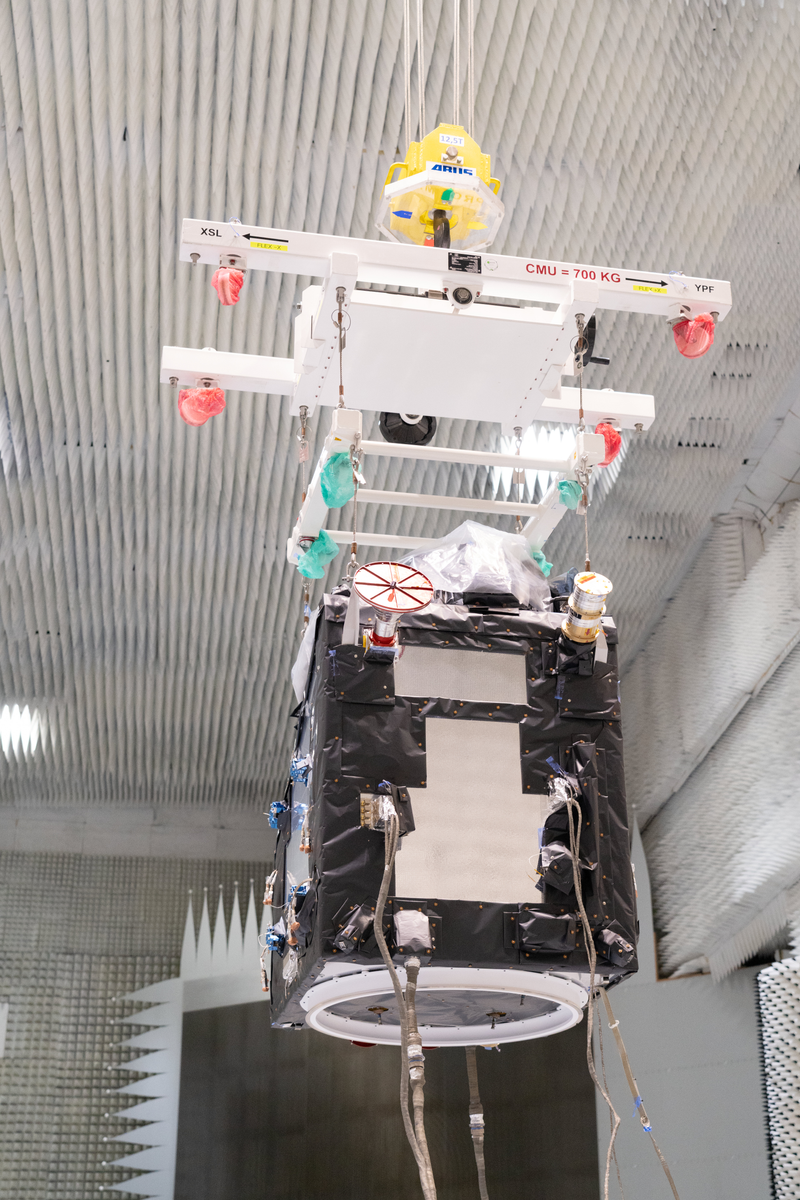


ESA's Fluorescence Explorer satellite FLEX on display at a Thales Alenia Space cleanroom in Cannes, France, April 2026. Credit: ESA


In late August 2026, inside a clean tent at the Ensemble de Lancement Vega in Kourou, French Guiana, technicians finished filling a small Italian-built satellite with 30 kilograms of hydrazine. The spacecraft had crossed the Atlantic once already, aboard the MN Colibri, departing Cannes on 9 July and arriving at Pariacabo harbour on 12 July (Wikipedia, “FLEX (satellite),” August 2026). On 15 September 2026 it leaves the ground on a Vega-C, alongside the Copernicus Sentinel-3C satellite (ESA FLEX facts and figures, 2026). The mission has a 3.5-year design life, an 814-kilometre sun-synchronous orbit, and a 400-kilogram dry mass. Its job is not imaging clouds or measuring sea level. It will stare down at forests and croplands and try to measure a faint red glow that plants produce when they photosynthesise, a signal too dim to see with the eye and almost too dim to see from low Earth orbit.

Roughly 120 gigatonnes of carbon per year move between the atmosphere and terrestrial vegetation through photosynthesis, more than ten times the mass of all the carbon humanity emits from fossil fuels (Le Quéré et al., Earth System Science Data, 2024). Almost every climate projection depends on getting that number right, and the spread across current carbon-cycle models is on the order of ±20 GtC/yr. Sun-induced chlorophyll fluorescence, the 1–2% of absorbed light that leaves re-emit at wavelengths around 685 nm and 740 nm, is a direct optical window onto photosynthetic efficiency, because every absorbed photon ends up in one of three places: photochemistry, heat, or fluorescence (Wikipedia, “Chlorophyll fluorescence,” 2026). In a healthy leaf, roughly 82% of absorbed photons drive carbon fixation; the rest is split between heat and this faint red glow.

Until now, fluorescence has been measured with bench-top instruments or aircraft campaigns like HyPlant flown out of Forschungszentrum Jülich (eoportal, FLEX, 2017). There is no global, repeatable, satellite-derived fluorescence product for the terrestrial biosphere. ESA selected FLEX as the eighth Earth Explorer in November 2015, and the satellite has spent a decade working up to one question: can you read the productivity of a soybean field, a larch forest, and a millet plot, all from 800 kilometres up, using only sunlight the leaf itself emitted back?

The hardware story of FLEX starts in November 2016, when ESA awarded the main instrument contract to Leonardo. In January 2019, Thales Alenia Space in Cannes became prime contractor for both spacecraft and instrument integration. The bus is an evolution of the Myriade family that flew COROT and PARASOL, but the avionics come from the Sentinel-3 line. In orbit the satellite measures 1.5 m × 4.9 m × 1.6 m, mass is 400 kg, end-of-life power is 950 W from a deployable solar array backed by a 57.6 Ah Li-ion battery (ESA FLEX facts and figures). The single instrument, the FLuorescence Imaging Spectrometer (FLORIS), covers 500–780 nm with variable spectral sampling: 0.1 nm in the two telluric oxygen absorption bands (O2-A at 759–769 nm and O2-B at 686–697 nm), 0.5–0.65 nm across the red edge, and 2.0 nm in the photochemical reflectance index band (500–600 nm). Spatial resolution is 300 m on a 150 km swath (eoportal, FLEX).

The clever trick is the tandem formation with Sentinel-3. FLEX orbits 40–100 km ahead of a Sentinel-3 platform, so that OLCI and SLSTR look at the same footprint within 6–15 seconds of FLORIS (eoportal, FLEX). Sentinel-3’s broad-band radiance is used to estimate the reflected sunlight contribution inside the O2-A and O2-B absorption lines, which can otherwise swamp the fluorescence signal at the 1–3 mW m⁻² nm⁻¹ sr⁻¹ level the mission is trying to recover. Two spacecraft, two spectrometers, one number.

Late summer 2026 was the home stretch. By April 2026, the integrated satellite had passed functional and environmental testing at Cannes (ESA, “FLEX shows off,” April 2026). It shipped on the MN Colibri to Pariacabo in early July 2026, was uncrated on 21 July, and was fuelled in late August. The launch is scheduled for 15 September 2026 at 22:21 local time from the ELV pad at the Guiana Space Centre on flight VV30 of the Vega-C, alongside Sentinel-3C (ESA press release N° 35–2026, 20 July 2026).

Vega-C is a four-stage European workhorse: a P120C solid first stage (4,323 kN, 279 s Isp, 141.6 t of HTPB propellant), a Zefiro 40 solid second stage (1,304 kN, 293.5 s Isp), a Zefiro 9 solid third stage (317 kN, 295.9 s Isp), and a storable AVUM+ upper stage (RD-843 engine, UDMH/N₂O₄, 2.42 kN, up to five restarts) (Wikipedia, “Vega C,” 2026). FLEX at 400 kg plus Sentinel-3C at roughly 1,250 kg fits inside the rocket’s 2,300 kg sun-synchronous capability.

The fluorescence signal is small because most absorbed light goes to chemistry and heat. Under steady-state illumination, leaf-level energy partitioning is

Y_PSI + Y_NPQ + Y_F = 1

where Y_PSI is the quantum yield of photochemistry through Photosystem II, Y_NPQ is non-photochemical quenching (heat dissipation via the xanthophyll cycle and PsbS protein), and Y_F is the fluorescence yield. FLEX measures Y_F directly; the carbon flux GPP (gross primary production) is then typically inferred as

GPP ≈ APAR × Y_PSI

with APAR (absorbed photosynthetically active radiation) reconstructed from FLORIS’s PRI and red-edge bands plus Sentinel-3’s OLCI/SLSTR radiances.

The reason the O2-A band (759–769 nm) matters is that molecular oxygen in the atmosphere absorbs sunlight there. Inside that absorption feature, any photons reaching the satellite must have been re-emitted at the surface, by the leaf. The depth of the absorption line in a downward-looking spectrum tells you how much extra radiance fluorescence is adding, after correcting for surface reflectance and atmospheric scattering. The Fraunhofer IOF in Jena built the double-slit assembly that defines FLORIS’s spectral resolution in those bands down to 0.1 nm. The narrower the slit, the cleaner the line-depth measurement, but the weaker the signal-to-noise ratio (Wikipedia, “FLEX (satellite),” 2026).

The 27-day repeat cycle at 814 km and 98.64° inclination matches Sentinel-3A’s ground track, so every 27 days the tandem pair sees the same vegetation at the same local time of day and solar geometry. That is essential for separating fluorescence from bidirectional reflectance effects. The 814 km altitude was chosen to give a 27-day repeat with 14+ orbits per day, and to keep the 300 m pixel footprint compatible with Sentinel-3 OLCI.

The third axis of the engineering is calibration stability. FLORIS is an imaging spectrometer, so pixel-to-pixel and band-to-band gain drift will alias straight into apparent fluorescence trends. On-board calibration uses solar diffuser references plus periodic lunar looks. The Sentinel-3 OLCI instrument flies the same calibration philosophy, which is one reason ESA reused its avionics and reference samples on FLEX.

Once commissioned, FLEX is expected to deliver monthly global maps of sun-induced chlorophyll fluorescence at 300 m × 300 m, the first such dataset produced routinely from orbit (ESA FLEX facts and figures). For plant physiologists, the result will be a four-dimensional look at photosynthetic efficiency, with direct implications for drought monitoring, agricultural yield forecasting, and the calibration of dynamic global vegetation models. For the carbon-cycle community, the value is a top-down constraint on GPP that does not depend on meteorological reanalysis.

If FLEX works, it will retire a long-standing assumption baked into climate models, that the greenness of a canopy, measured by NDVI or similar indices, is a proxy for what the canopy is actually doing. Two fields can look equally green and yet be photosynthesising at very different rates, depending on water stress, nutrient status, and temperature. FLEX will measure the difference. The world has never watched photosynthesis happen from space in real time. In three weeks, it will start to.


September 28, 2026

A 700-million-dollar antenna at Mars

Posted by


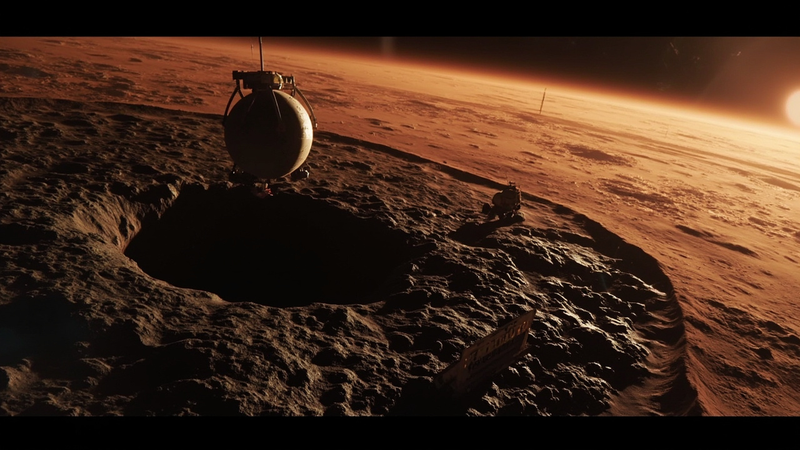
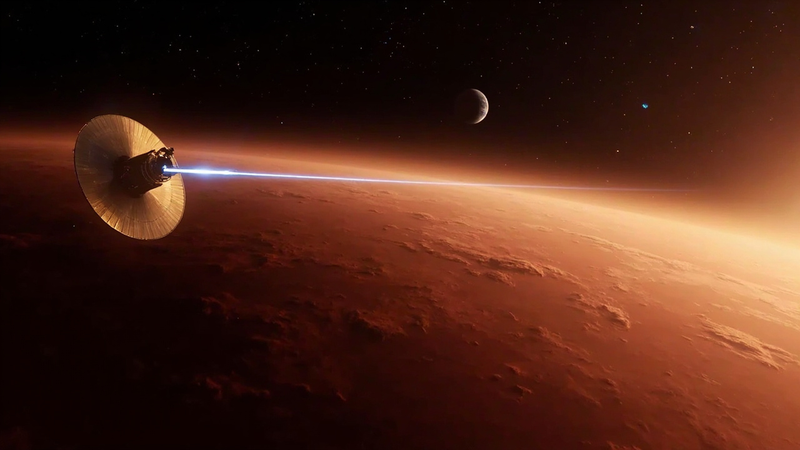
A relay spacecraft with a large dish antenna orbits above the rust-coloured limb of Mars, firing a thin blue beam along the planet's curve, with a small moon in the distance.


For twenty years, every byte of data sent home from the surface of Mars has ridden a UHF radio piggyback on a science orbiter that happened to be passing overhead. On 2 September 2026 NASA ended that arrangement. The agency announced that Blue Origin will design, build, launch, and operate a dedicated Mars Telecommunications Orbiter under a firm-fixed-price contract worth up to $700 million, with delivery by the end of 2028 and full operations at the red planet in 2030 (NASA news release, 2 Sep 2026). For the first time since the cancelled 2005 Mars Telecommunications Orbiter, NASA is buying communications capacity at Mars the way it buys launch services from SpaceX: a fixed commercial price for a working spacecraft, with the operator running the show.

The award is small in dollar terms compared to flagship planetary missions and large in strategic terms. It formalizes the commercial-services model that has reshaped cislunar space and applies it 1.4 astronomical units farther out. It puts the first dedicated deep-space relay at a planet, not at the Moon. And it gives Blue Origin — eight years after New Shepard reached the Kármán line — a planetary-scale role that no other company has held.

Every rover since Sojourner has paid a tax for its bandwidth. The UHF Electra relay on Mars Reconnaissance Orbiter tops out near one megabit per second, and that link is shared with instruments the orbiter was actually launched to run (Edwards et al., 2003). The Deep Space Network’s direct X-band uplink is even thinner — a single HiRISE frame takes 1.5 hours at MRO’s 5.2 Mb/s peak (JPL, “Deep Space Communications,” 2017). Perseverance’s plume telemetry, Ingenuity’s flight logs, the trace-gas measurements from ExoMars TGO — all of it competes for slots in orbits selected to do science, not to be comms towers.

A purpose-built relay changes the calculus. Operators can schedule lander passes against an orbit designed for continuous visibility, freed from the geometry of a science primary mission. Layer a deep-space optical terminal on top — analogous to the Deep Space Optical Communications package Psyche has been flight-qualifying since 2023 — and the link budget explodes. DSOC pushed 267 Mb/s from 31 million kilometers in late 2023 and held a link to 467 million kilometers in July 2024 (JPL, 11 Dec 2023; NASA, 25 Apr 2024).

The second-order effect is what NASA gets to stop doing. SCaN has been forced for two decades to add relay payloads to every Mars science orbiter as a tax for participating. Stripping that out frees mass, power, and cost on the next generation of orbiters — a meaningful simplification when the Mars Sample Return architecture is still being rebuilt and human Mars exploration sits on NASA’s stated timeline.

NASA’s request for proposals went out in May 2026, drawn up under procurement authority inserted by the 2025 One Big Beautiful Bill Act, which explicitly allocated $700 million for the orbiter. The Act’s wording tied the procurement to companies that had previously received Mars Sample Return study money and pitched a telecom element as part of those studies — eight firms in total: Aerojet Rocketdyne, Blue Origin, Lockheed Martin, Northrop Grumman, Quantum Space, Rocket Lab, SpaceX, and Whittinghill Aerospace. The competitive field narrowed quickly. The award names Blue Origin as prime, with no public teaming structure disclosed.

Blue Origin owns the full stack: bus, telecom payload, launch on its own New Glenn 7×2, trans-Mars injection, Mars orbit insertion, and operations. The published draft specification lists an areocentric orbit with a 180 km periareon and 4,500 km apoareon — a high-elliptical geometry that gives long dwell times over a fixed surface region while still clearing the atmosphere at the low end. New Glenn 7×2 has a trans-lunar capacity near 7 metric tons (NASA ELV Performance). The company has flown the vehicle successfully twice and failed once — the pad explosion that took LC-36A offline — so it will need to commission LC-36B or shift to Vandenberg to honor the 2028 commitment.

Behind the announcement is the same calculation that produced Commercial Lunar Payload Services and Human Landing System: in a budget environment where every Mars architecture decision is being fought between sample-return, human-exploration, and science advocates, the cheapest move is to buy the bits and let the science missions keep their mass margins.

The relay orbit is the design lever that makes everything else work. A 180 × 4,500 km areocentric orbit gives roughly 8 to 10 hours of continuous visibility over a fixed surface target per orbital period near 7.5 hours. Compared with the 250 km circular sunsynchronous science orbit flown by MRO, the relay geometry trades observation time for surface dwell time. The radio link uses UHF proximity at 390 to 450 MHz with the CCSDS Proximity-1 protocol stack — identical to what flies on MRO, MAVEN, ExoMars TGO, Curiosity, InSight, and Perseverance. Every Mars asset currently on the surface can fall back to the new relay with no hardware changes (Edwards, 2003).

The free-space loss for the UHF proximity leg is bounded by:

L_fs = (4 * pi * d * f / c)^2

At 400 MHz and a slant range of about 1,000 km, path loss lands near 158 dB — the reason surface antennas are low-gain whips and the orbiter carries the high-gain nadir-pointed Electra package. The Earth-return leg at X-band (8.4 GHz) and Ka-band (32 GHz) from Mars runs at roughly 261 dB and 281 dB of free-space loss. Closing a 1 Mb/s link to a 70 m DSN aperture at X-band requires an EIRP around 38 dBi — achievable with a 1.5 m steerable dish.

The optical path changes the math. At 1.55 μm and 1.4 AU, beam divergence dominates over L_fs. The angular beamwidth of a diffraction-limited 22 cm aperture is:

theta = 1.22 * lambda / D ≈ 8.6 microradians

At Mars-Earth range, that gives a beam footprint on Earth near 1,200 km — the same order as the DSOC ground footprint demonstrated in flight, which is why DSOC paired a 22 cm spacecraft telescope with a 5 m Hale-class ground receiver (JPL DSOC poster, 2014). A relay with both a UHF proximity payload for handoff and an optical Earth-return payload for bulk data could push daily return into the terabit range, an order of magnitude over today’s network.

The contract also stress-tests the fixed-price model at interplanetary distances. NASA’s answer was to make the procurement compatible with commercial commsat buses — Blue Origin is expected to leverage a scaled Blue Ring platform — and to define the service in throughput and availability terms, not hardware specifications. The bet is that a commercial GEO production line can be retooled for an areocentric relay without a bespoke NASA-only factory.

The Mars Telecommunications Orbiter was proposed in 2004, cancelled in 2005, rediscovered in 2018 as NeMO, stalled in 2025, and finally contracted 21 years later. If Blue Origin hits the December 2028 delivery date, its 2030 arrival will coincide with a Mars surface far busier than the one Perseverance and Curiosity see today. Mars Sample Return needs continuous relay coverage during lander choreography. Human Mars missions need guaranteed high-bandwidth links that do not depend on a science orbiter being overhead.

The deeper story is that the relay architecture of the inner solar system is being privatized the way launch has been. The agency that built the Deep Space Network is handing its first dedicated relay at Mars to a commercial prime. The hardware questions are interesting; the procurement question is the one that will define the next twenty years.


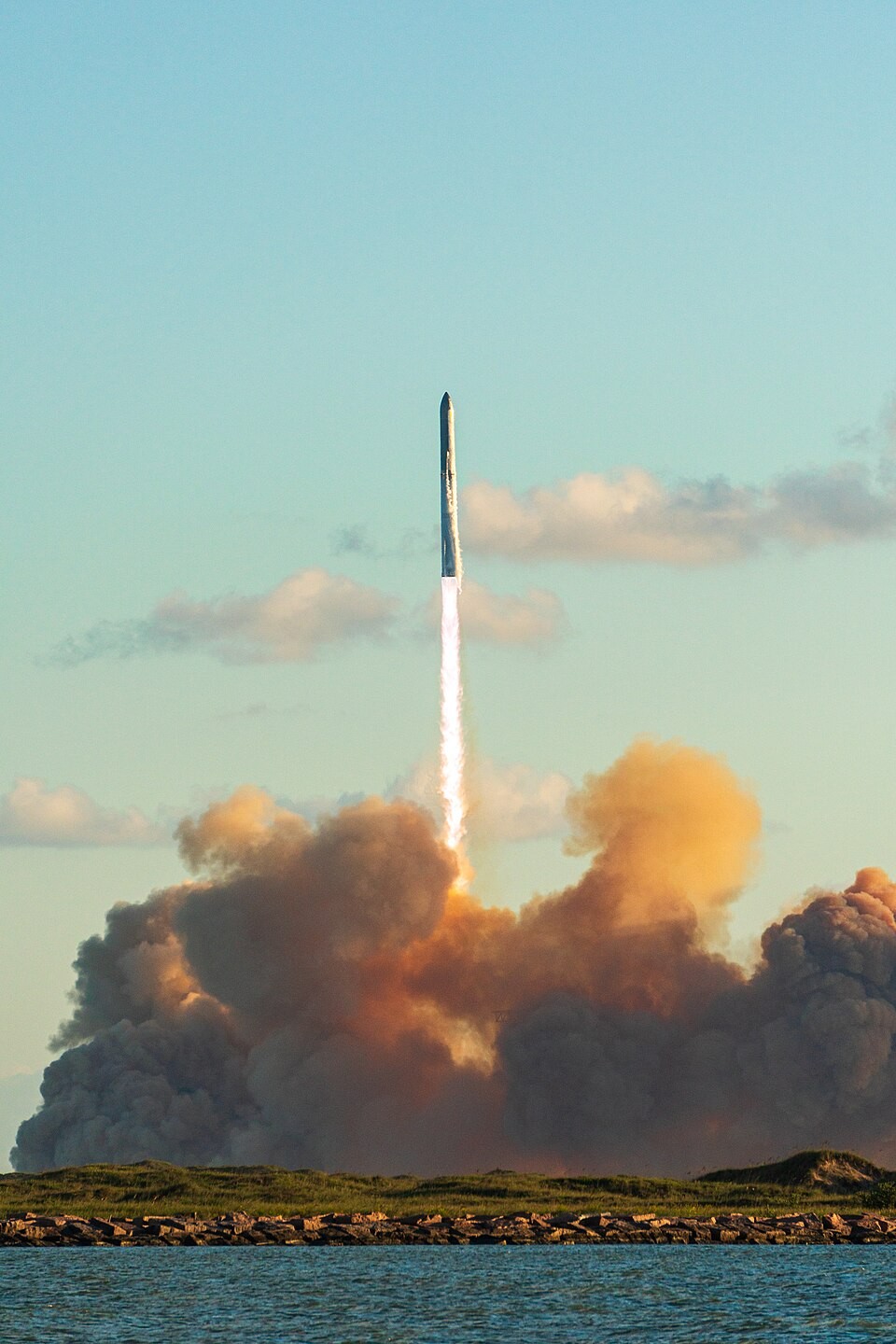
A SpaceX Starship lifts off from Starbase, Texas on a previous test flight; today's Flight 14 followed the same launch profile.

Image source: Wikimedia Commons. Photograph by Shujianyang, CC BY-SA 4.0.


A SpaceX Starship lifted off from Starbase in Boca Chica, Texas at 7:48 AM local time on Monday, September 28, and reached orbit for the first time on its fourteenth flight test. After a clean stage separation and a controlled splashdown of the Super Heavy booster in the Gulf of Mexico, the Starship upper stage completed its first orbital-insertion burn and deployed 26 Starlink V3 satellites into low-Earth orbit on a mission that SpaceX had earlier characterized as a step from developmental flight testing into operational service.

The launch was the first of the Block-3 vehicle series to fly with operational payload, and the first time a Starship vehicle has carried a Starlink batch into orbit. Three of the 26 satellites carry cameras intended to image the Starship heat shield while the upper stage is in orbit, extending the kind of data that an earlier camera-equipped batch gathered during a 2025 reentry test.

The countdown proceeded through propellant load on the booster and the ship, Raptor chill, and a final GO poll at T-30 seconds. Liftoff was at the opening of the day’s launch window. NPR, reporting live, described the 33 Raptor engines on Super Heavy as igniting together at the start of the climb. Max-Q, the moment of peak aerodynamic stress on the vehicle, cleared without incident. About two and a half minutes after launch, Starship separated from Super Heavy in the hot-staging sequence the company has used on the most recent flights, with the booster immediately turning back toward the Gulf of Mexico and the ship’s Raptor engines continuing the climb toward orbit.

Two anomalies shaped the early portion of the flight. First, SpaceX’s mission management decided during the climb that one of the six Raptor engines on the ship had failed during ascent, and the team weighed, for roughly twenty-two minutes, whether to continue to orbit. By the time Starship’s second-stage burns were scheduled to start, SpaceX confirmed it was safe to do so. Second, when Super Heavy began its boostback burn a few minutes after separation, only 26 of the 28 candidate engines relit — a partial relight rather than the full set SpaceX had planned to use. The landing burn that followed was also a partial relight: 11 of 13 engines fired. The booster nonetheless completed its boostback, descent, and landing burn sequence and executed a controlled soft splashdown in the Gulf of Mexico at roughly T+8 minutes, ten seconds after launch. SpaceX had deliberately planned an offshore splashdown for this flight rather than a return-to-launch-site catch, in part because the booster was being used to test upgraded software and hardware before the company re-attempts a tower catch on a later mission.

The ship’s first milestone after separation was a coast phase through the upper atmosphere. At T+25 minutes and 28 seconds the ship began its orbital-insertion burn; nineteen seconds later the burn ended and Starship was in a sustained orbit for the first time in the program’s history. About nine minutes after the insertion burn, the payload deployment sequence started and the 26 Starlink V3 satellites began releasing from the ship over the following half hour. The three camera-equipped satellites will spend their operational lifetime photographing Starship’s heat shield from a vantage point just behind the vehicle’s planned reentry trajectory, providing imagery that SpaceX says it will use to refine its reusable-heat-shield program.

The mission profile extended further than a suborbital hop. SpaceX had originally planned a roughly ten-hour mission with six orbits at an altitude around 170 miles, but reduced the flight plan during ascent to a shorter three-hour profile. The trade reflected, in the company’s judgment, the right margin for a vehicle running one engine short on its upper stage. After roughly nine hours in orbit, the ship is expected to perform a deorbit burn over the Pacific, descend through the atmosphere, and execute a controlled splashdown in the ocean. NPR noted that no earlier Starship flight had reached orbital velocity, which is roughly 17,500 miles per hour; today’s flight is the first vehicle in the line to do so.

Starship Flight 14 is the second flight of a Block-3 vehicle and the first of the year from Starbase. The booster, Booster 21, completed its full-duration static fire at Massey’s Test Site on August 28 after a qualification campaign that included the post-Flight-13 investigation into the landing-burn dynamics and an extended cryogenic proof sequence in mid-summer. The ship, Ship 41, completed a six-engine static fire on August 21 and a single-engine deorbit-burn simulation test two days earlier. Both vehicles were integrated, stacked, and rolled to OLP-2 ahead of the launch attempt.

The flight is also the first operational mission carrying Starlink satellites to use a Starship vehicle rather than a Falcon 9. SpaceX has been the dominant operator in commercial launch for the past several years using Falcon 9, but the larger V3 Starlink satellites only fit inside Starship’s fairing. NPR reported that SpaceX completed the final Falcon 9 launch of a Starlink batch from Florida last month and intends to move V3-class launches to Starship going forward. The shift matters to SpaceX’s plans for the constellation: in filings to the Federal Election Commission ahead of its IPO in June, the company called Starship’s launch cadence and reusability material to its growth strategy.

The flight is also material to NASA’s Artemis program. SpaceX is under contract to develop a Starship-derived Human Landing System for Artemis III, currently targeted for late next year. The Artemis III profile includes docking Starship with an Orion capsule in lunar orbit and transporting astronauts to the surface. NASA’s Administrator, Jared Isaacman, congratulated the SpaceX team on today’s milestone on social media; in earlier remarks, the agency has framed a successful first operational Starship flight as one of the gating milestones for the lunar landing timeline, alongside the unrelated second crewed Orion flight that lifted off in April.

Three of the satellites that lift with Starship today are designed to spend their working lives photographing the heat shield of the very vehicle that released them. That unusual arrangement — test instrumentation riding inside operational payload — has become a theme of the program. Cameras flew on earlier V2 Starlink satellites in 2024 and 2025 for similar purposes; SpaceX said the data from those missions was the basis for several heat-shield design changes that shipped on Block 3. Today’s cameras will, in turn, feed back into Block-4 hardware.

If the Pacific reentry and splashdown at the end of the mission go as planned, Flight 14 closes out a flight that began developmental flight testing and ended with operational payload deployment. The next ship in line, Ship 42, completed chopstick-catch tests at the tower in mid-September and remains weeks from flight readiness; the next booster, Booster 22, is also still in qualification. SpaceX has not announced a date for Flight 15, but company statements earlier in the year suggested it would follow within roughly two months of today’s flight, with a Falcon-class Starlink batch and a Super Heavy tower catch among the items on the next mission’s checklist.


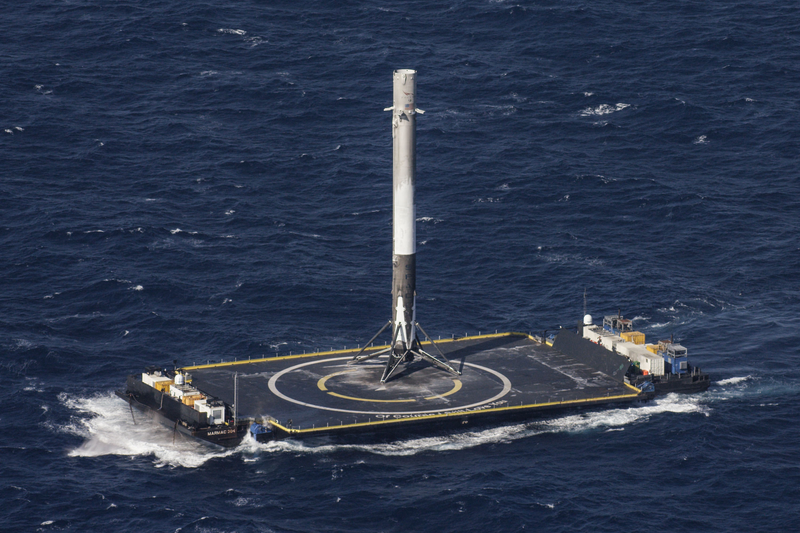
A Falcon 9 first stage stands upright on the deck of an autonomous drone ship in open ocean, seen from the air with tugs alongside.


On 22 August 2026 at 07:25 UTC, a Falcon 9 climbed off Space Launch Complex 4E at Vandenberg carrying 29 Starlink satellites. By the time the second-stage Merlin 1D Vacuum cut off over the south Pacific, the autonomous spaceport drone ship Of Course I Still Love You had caught a Block 5 booster on its ninth flight and pushed the vessel’s successful landing tally to 220 out of 228 attempts (Wikipedia, ASDS landings history, accessed 22 August 2026). The numbers look routine because they are routine. That is the point.

Reusable orbital rockets stopped being an experiment years ago and quietly became a load-bearing column of the global launch industry. The most-flown Falcon 9 first stage, B1067, has now flown 36 missions and is certified to keep going to 40 (Wikipedia, List of Falcon 9 first-stage boosters, accessed August 22 2026). A drone ship named for a science-fiction vessel is on track to record its 230th catch sometime this autumn. The launch industry has changed more in this decade than in the previous five, and the change looks, from one Starlink mission to the next, almost boring.

Cost per kilogram to low Earth orbit is the cleanest single number in the launch industry, and it has collapsed. The Space Shuttle ran near $54,500 per kilogram on the OIG baseline in 2012 dollars (NASA OIG IG-12-002, 2012). Falcon 9’s standard price sits near $67 million for an expended mission of about 22.8 tonnes to LEO — roughly $2,900 per kilogram on the list (SpaceX, Falcon User’s Guide, April 2020; Wikipedia, Falcon 9 Block 5). On a reused mission the airframe cost amortizes across the flight count, and the marginal kilogram price drops further.

The mechanism is not a bigger rocket. It is reuse of the most expensive stage. Industry analyses put the manufacturing cost of a Falcon 9 first stage at roughly 60 percent of the rocket’s total price (Wikipedia, List of Falcon 9 first-stage boosters, citing Everyday Astronaut estimates). Propellant for one Falcon 9 launch is under one percent of the vehicle price on SpaceX’s own figures. When the first stage can be reused, the marginal cost of another flight is dominated by propellant, inspection, and a small amount of refurbishment.

The Tsiolkovsky equation, Δv = v_e × ln(m_0 / m_f), describes how much velocity change a stage can deliver, where v_e is the exhaust effective velocity, m_0 the initial mass, and m_f the burnout mass. The economic equivalent, what rocket accountants sometimes call reuse leverage, looks like cost_per_flight ≈ fixed_cost / flights + marginal. Improvements in the denominator compound quietly.

The recoverable first stage began as a SpaceX research project funded out of company revenue after 2011 (Wikipedia, SpaceX reusable launch system development program). Early Falcon 9 flights tried to land on parachutes; the stages disintegrated on re-entry. The first successful propulsive landing came on Falcon 9 Flight 20 in December 2015, when a Full Thrust first stage set down on Landing Zone 1 at Cape Canaveral. Eighteen weeks later, on 8 April 2016, the same autonomous drone ship Of Course I Still Love You that would later log 220 catches recorded its first stage, the CRS-8 booster. By March 2017 SpaceX had reflown a landed first stage; by October 2017 the cadence was settling in.

Block 5, the current variant, debuted in May 2018 aboard Bangabandhu-1, and from the start it was engineered for at least 10 flights without major refurbishment. The certification staircase since then has been a study in disciplined risk: 10 flights in 2021 (B1051), 15 flights by 2023, then 20, and now 40 per booster. Each step followed a deep-dive inspection of a representative stage — B1058 and B1060 for the 20-flight certification — before SpaceX approved the next tier. B1067, which first flew in 2021, hit 36 flights in 2025 and is now the operational record holder.

Of the 694 Falcon family launches logged by 22 August 2026, 626 were Block 5 missions; 625 succeeded (Wikipedia, Falcon 9 Block 5). There has been one in-flight failure since the 2015 CRS-7 mishap — the Starlink Group 9‑3 second-stage anomaly — for a family success rate of 99.57 percent. Booster recovery is now standard, except when milestones roll over. On 22 August OCISLY hit landing 228, success 220. Just Read the Instructions, used briefly for Cape launches, logged 157. A Shortfall of Gravitas, the Atlantic drone ship, hit 166. The math: 650 successful Falcon 9 first-stage landings, 13 nominal failures, in 663 attempts.

Block 5 is not Block 4 with longer life. It is a structural rewrite aimed at thermal survival and rapid turnaround, and three components did most of the work.

First, the base heat shield at the bottom of the interstage was thickened and mounted on a stronger structure so a returning stage can absorb repeated supersonic heating without cracks propagating into the propellant tanks. Skin temperature during a boost-back re-entry peaks at roughly 1,500 K for a few tens of seconds; the aluminum-lithium alloy tanks survive only a finite number of these cycles, which is why certification life is a count, not a calendar span.

Second, the four hypersonic grid fins at the top of the stage were changed from aluminum to titanium alloy (Ti-6Al-4V) so they no longer deform visibly after each flight and can be reused without machining or replacement.

Third, the four landing legs switched from a deployable hydraulic mechanism with many moving parts to a carbon-fiber composite assembly that folds flush against the stage, removing the pins and seals that had been a top refurbishment item.

The Merlin 1D engine at the heart of the stage had to learn ten flights without major service at the same time. It runs on the gas-generator cycle with a pintle injector — the same architecture as the Apollo Lunar Module descent engine — and feeds from a single-shaft dual-impeller turbopump originally designed by Barber-Nichols. Sea-level thrust is rated at 845 kN, dry mass 470 kg, thrust-to-weight ratio near 184, and chamber pressure about 9.7 MPa. Specific impulse runs around 282 seconds at sea level and 311 seconds in vacuum per the published Falcon User’s Guide (SpaceX, April 2020). Those are modest numbers next to staged-combustion or ion engines, but they are the right trade for a reusable booster that has to be inspected, refurbished, and reflown in weeks.

Re-entry burn and landing burn use three-engine and single-engine restarts, so the Merlin 1D has to reignite in vacuum after separation and then reignite again on the way down. Cold-gas nitrogen thrusters handle fine attitude control between burns, which is what allows a Block 5 to land on a 91-by-52-meter drone ship sitting in swell at the edge of the open Pacific.

Reuse has eaten the launch industry in a way the engineers of the 1970s would have recognized but probably could not have predicted. Within SpaceX, the next step is full reusability with Starship, where the second stage also returns — a much harder problem because orbital velocity is near 8 km/s, more than four times the ~1.7 km/s a returning first stage survives. Outside SpaceX, the cadence pressure is starting to bend competitors: Blue Origin’s New Glenn has demonstrated its first-stage landing; Rocket Lab plans to recover Neutron’s booster; Stoke Space is targeting full reuse of a small launcher; China’s LandSpace has caught fairings and is testing full booster recovery. Reusability is no longer a fringe technology. It is the floor now. B1067 will eventually retire, and SpaceX will already be counting the flights of its replacement.


September 27, 2026

Where Mars got its moons

Posted by


MMX at Phobos


Mariner 9 arrived at Mars on November 14, 1971, the first spacecraft ever to orbit another planet. A planet-girdling dust storm forced the mission to wait, and a planetary scientist named Joseph Veverka suggested putting the cameras on Phobos and Deimos in the meantime. Phobos came into focus on November 29 from 14,440 km, then again on December 1 from 5,720 km. The little 27-kilometer rock was already strange: a near-potato shape scarred by a 9-kilometer crater called Stickney, a long axis pointed permanently at Mars, and a charcoal-black surface that did not match the warm reddish dust it was orbiting (NASA/JPL, 1971–1972).

Two hypotheses have run in parallel since Asaph Hall discovered both moons in August 1877. The capture hypothesis says Phobos and Deimos are asteroids from the outer belt, drawn in by aerodynamic drag through an extended early-Martian atmosphere and circularized into their present orbits (Hunten 1979; Pollack et al. 1979). The color match between Phobos’s surface and the so-called D-type asteroids, dark, organic-rich bodies, has carried that story.

The giant-impact hypothesis argues the moons formed from debris thrown up when a roughly Mars-sized protoplanet slammed into early Mars, much as our own Moon is thought to have formed from a glancing blow on Earth (Craddock 2011; Rosenblatt & Charnoz 2012). If true, Phobos is made from re-accreted Martian mantle mixed with impact glass, with up to ~30% porosity to explain the low density.

The distinction isn’t trivia. If Phobos is a captured D-type, MMX returns a bona fide sample of outer-belt material with all the volatile- and organic-rich implications that follow. If Phobos is impact debris, MMX effectively becomes the first Mars sample return mission, a piece of the early Martian mantle frozen in place because there was never enough gravity to melt it (Burns 1992; Lainey & Jacobson 2017).

The first attempts were Soviet. Phobos 1 launched in July 1988 and died 51 days later of a software bug. Phobos 2 reached Mars in January 1989, swung past Phobos, and went silent 30 m above the surface during its second landing rehearsal, returning 37 images. Phobos-Grunt launched in November 2011 on a Zenit-2, failed to leave Earth orbit, and burned up over the Pacific Ocean, taking its piggybacked Chinese Yinghuo-1 smallsat with it.

Between those failures, orbiters gave us what we had. ESA’s Mars Express has now completed more than 130 dedicated Phobos flybys; Mars Reconnaissance Orbiter (HiRISE) returned the highest-resolution images of the surface, down to ~6 m/px; Perseverance and Curiosity imaged Phobos eclipsing the Sun from the ground. None was a sample return.

JAXA committed. MMX was approved in 2019 with Kawakatsu Yasuhiro as Project Manager, deliberately built on Hayabusa and Hayabusa2 heritage. It launches in JFY 2026 on H3 from Tanegashima. It carries a Coring Sampler, a NASA-built pneumatic sampler, and the DLR–CNES IDEFIX rover, which is to be released from below 100 m altitude and operate for ~3 months. After regolith capture, MMX lifts off Phobos, swings out of orbit, and heads home. The sample capsule lands in Australia’s Woomera desert in JFY 2031 (JAXA, 2026).

Phobos’s specifics dictate the engineering. It is tidally locked to Mars and orbits at 9,376 km from the planet’s center, inside synchronous. Its mass is only 1.064 × 10¹⁶ kg. Surface gravity is 0.0057 m/s² and escape velocity a casual 11.4 m/s. Dust kicked up by landing takes a long time to settle because there is essentially no atmosphere to grab it (Wikipedia, citing Jacobson 2010; Lainey et al. 2024).

The body itself is also a study in low-cohesion regolith. Stickney, the dominant crater, is nearly half the mean diameter of the moon — close to the threshold where a same-sized impactor should shatter the parent rather than scar it. The long, shallow grooves running away from Stickney’s rim are still debated: some teams interpret them as fractures propagating from the basin-forming impact (Asphaug & Melosh 1993), while others argue for ejecta-drape patterns or secondary craters from Mars-thrown debris (Murray & Heggie 2007). Mars Express and MRO photometry has refined the question but not closed it; the grooves sit at the wrong angle to simple Stickney-radial fracture models, leaving loose ends that ground truth will resolve.

Sampling strategy reflects the same facts. The primary sampler is a Coring Sampler (C-Sampler): a titanium-alloy tube pressed against the surface under low main-engine thrust, intended to pull up to a 2-cm core from the uppermost regolith. Secondary is the Pneumatic Sampler (P-Sampler), contributed by NASA: a short burst of nitrogen gas lifts loose regolith into a chamber. Multiple sites will be visited across lit and shadowed hemispheres, with a combined sample target of more than 10 g (JAXA, 2026 mission specification).

In-situ discrimination happens before the sample ever leaves Mars. NASA’s MEGANE instrument (Mars-moon Exploration with GAmma Rays and NEutrons) is a high-purity germanium γ-ray spectrometer paired with a ³He-neutron spectrometer, designed to map iron, silicon, oxygen, hydrogen, thorium, and potassium across Phobos’s surface (NASA / APL, 2024). D-type asteroidal material and basaltic Martian-mantle-derived material produce very different signatures in such an instrument, particularly in the Fe/H and Th/K ratios. Knowing the answer in orbit lowers the risk of returning rock that doesn’t actually answer the central question.

Return physics is unforgiving. The Δv budget to enter Martian orbit from a direct Hohmann transfer is on the order of 1 km/s, plus a few hundred m/s for Phobos orbit acquisition and the touch-and-go capture. Per Tsiolkovsky’s rocket equation: Δv = v_e × ln(m_0 / m_f), with v_e ~ 320 s for the bipropellant thrusters. The mass fraction is what makes the Sample Return Capsule, with its ~10 g payload, only a small fraction of the ~4,200-kg launch stack. The capsule’s heat shield has to survive entry into Earth’s atmosphere at ~12 km/s after a direct Mars return.

H3 is Japan’s first fresh-built orbital launcher since the 1980s. Its LE-9 engines run an expander bleed cycle, each chamber delivering ~1,422 kN of vacuum thrust. H3 sent up Michibiki 7 earlier this month, and MMX is the next major LE-9 passenger on the manifest (JAXA / MHI, 2026).

JAXA’s MMX is going to do something the United States and Russia combined have tried and failed to do three times: land briefly on Phobos, grab a few grams of regolith, and bring that bag of rock back to a clean lab on Earth.

Three outcomes are plausible. If the rocks look like D-type carbonaceous material with deep hydration features, the capture hypothesis wins and Phobos becomes the first outer-belt material ever returned to Earth. If they are dry, fine-grained basalts with high calcium and iron and no hydration, the impact hypothesis wins and we have, in effect, a sample of early Mars. If they are a messy mix, we’ll learn something about Phobos’s regolith history that neither hypothesis prepared us for.

The capsule should come down near Woomera in JFY 2031. JAXA’s Sample Curation Facility at Sagamihara will be where scientists first crack open the sealed container. The instruments they run on that small sample — mass spectrometers, electron microprobes, atom-probe tomographs — will quietly close out a 150-year-old argument about where Mars got its moons.