


A gravity assist is usually described as celestial bookkeeping: a spacecraft borrows a little momentum from a planet and leaves on a better trajectory. NASA’s Psyche mission did that at Mars on May 15, 2026, but its science teams treated the encounter as much more than a navigation event. They pointed the spacecraft’s instruments at a world whose properties are already well measured, then asked whether the hardware returned the answers it should.
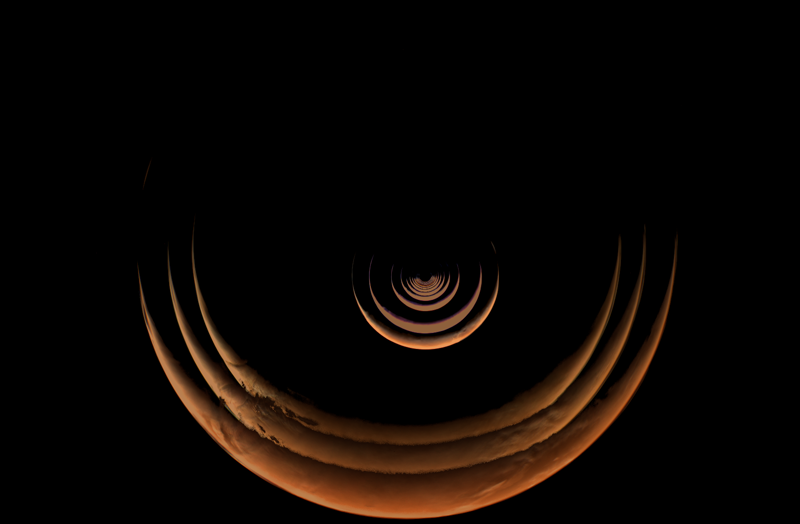
The spacecraft passed 2,864 miles (4,609 kilometers) above the Martian surface. Its cameras watched a thin crescent grow into a detailed globe. Its magnetometer crossed Mars’ bow shock. Its neutron detector registered a rise in particles near closest approach. The resulting data, released in July with a time-lapse video, made Mars a dress rehearsal for a far less familiar target: the metal-rich asteroid Psyche, which the spacecraft is due to reach in 2029, according to the NASA Science flyby report.
Space instruments spend years being designed, calibrated, launched, and monitored, but cruise provides few chances to test them against a large planetary body. Stars can check camera pointing. The solar wind gives a magnetometer a continuous signal. Neither reproduces the rapid changes, bright surfaces, stray light, and particle environment of a close planetary pass.
Mars offered a rare controlled comparison. Orbiters and rovers have observed its surface, atmosphere, and magnetic environment for decades. If Psyche’s instruments measured something wildly inconsistent with that record, engineers would have time to diagnose the discrepancy before asteroid arrival. Agreement is useful too: it confirms that the instrument, onboard electronics, ground pipeline, and scientific interpretation work together after nearly three years in space.
That last point matters because Psyche’s destination is difficult to interpret. The asteroid is often described as metal-rich, but the mission exists because remote observations cannot settle how much metal it contains, how it formed, or whether it preserves material from the interior of an early planet-building body. The spacecraft carries three dedicated science instruments: a multispectral imager, a magnetometer, and a gamma-ray and neutron spectrometer. It will also use radio tracking to map the asteroid’s gravity, as described in NASA’s Psyche mission overview. Mars let the instruments work on the same known target within hours.
Psyche launched in 2023 on a long solar-electric cruise toward the main asteroid belt. Mars was part of the route from the start. Before the encounter, NASA expected the spacecraft to pass about 2,800 miles above the surface at roughly 12,333 mph (19,848 kph). The planet’s gravity would increase the craft’s heliocentric speed and tilt its path toward the asteroid, according to the May 8 NASA mission brief.
The images began well before closest approach. Starting in early May, Psyche’s pair of identical multispectral cameras photographed Mars at a high phase angle, so the sunlit portion looked like a slender crescent. The sequence from May 2 through May 15 shows that crescent expanding as the distance closed. NASA assembled those frames into the growing-crescent composite used with this post.
Near Mars, the cameras resolved the south polar ice cap, wind-marked craters, and Huygens, a large double-ring crater. The team also detected Phobos and Deimos from far away. That was useful practice for a later search for small moons around asteroid Psyche. More quietly, the imaging team tested sensitivity to scattered light and began comparing its pictures with data from existing Mars missions. A camera can produce a sharp image and still mismeasure brightness or color; cross-calibration helps expose that kind of error.
The particle spectrometer faced a different test. It is intended to infer surface composition at the asteroid by measuring gamma rays and neutrons generated after cosmic rays strike the material. At Mars, the 4,609-kilometer altitude was too high for the detector to pick up gamma rays from the surface. The team did expect escaping neutrons, and the instrument recorded a count-rate increase close to the predicted level near closest approach.
The magnetometer had spent cruise measuring the solar wind and occasional coronal mass ejections. Mars provided its first magnetic signature from a celestial body. As Psyche entered the bow-shock region, where the solar wind encounters the obstacle formed by Mars and its induced magnetic environment, the instrument saw a strong increase. The flyby therefore exercised the detector through a rapidly changing field rather than the relatively steady background of interplanetary space.
Navigation also delivered what the science plan needed. The flyby put the spacecraft directly on its outbound course, and the mission expects to resume sustained solar-electric thrusting later in 2026. Arrival remains planned for the summer of 2029.
A gravity assist works because the planet and spacecraft exchange momentum while both orbit the Sun. In a Mars-centered frame, the spacecraft falls in, curves around the planet, and departs with approximately the same hyperbolic excess speed it had on arrival. In the Sun-centered frame, however, the velocity vector has rotated. Adding Mars’ orbital velocity before and after that rotation changes the spacecraft’s speed and direction around the Sun. Mars loses or gains an immeasurably small amount of orbital momentum in return.
The maneuver gave Psyche both energy and geometry that electric propulsion alone would have taken longer to supply. Its Hall-effect thrusters expel ionized xenon and produce low thrust for long periods. That system is efficient, but a planetary flyby can rotate the trajectory quickly without consuming propellant. Precision is unforgiving: a small arrival error changes the bending angle and therefore the outbound path. The close approach matching the planned corridor shows the navigation chain worked from orbit determination through correction maneuvers.
The instrument tests relied on three different physical signals. For imaging, filters divide reflected light into wavelength bands. Variations among bands can distinguish surface materials and reveal how illumination geometry affects the measurement. Mars supplied bright terrain, dark terrain, haze, ice, and a changing phase angle in one encounter.
For the neutron measurement, energetic cosmic rays strike atomic nuclei in the upper surface and create cascades of secondary particles. Some neutrons escape. Their energy distribution depends partly on which elements slowed or absorbed them. Hydrogen, for example, is particularly effective at reducing neutron energy. Gamma rays occur at characteristic energies associated with specific nuclei, but signal strength falls rapidly with distance; Psyche’s altitude explains why neutrons were detectable while Martian gamma rays were not.
Mars has no strong global dipole field like Earth’s. The solar wind interacts with its upper atmosphere and localized crustal magnetism, producing a bow shock upstream of the planet. Crossing that boundary gave the magnetometer an abrupt, recognizable change against which its timing and response could be checked. At asteroid Psyche, any remanent field would bear on whether its material once cooled within a magnetized parent body.
The Mars flyby did not answer the central question about asteroid Psyche. It reduced the risk that, three years from now, the mission will reach its target with a hidden calibration problem or an analysis pipeline that has never handled a fast-changing planetary data set.
That is the practical value of using a familiar world as a test object. The cameras returned surface detail and distant moon detections. The neutron detector saw the expected count increase. The magnetometer identified the bow shock. Each result connects directly to a job the instrument must perform at the asteroid, where there will be no fleet of orbiters and rovers providing an easy reference.
The spacecraft now has its outbound trajectory and a set of measurements the teams can keep analyzing while electric propulsion carries it toward the main belt. When asteroid operations begin in 2029, the first observations will still contain surprises. The basic behavior of the instruments should not be one of them.
 Subscribe to blog posts using RSS








