


A 400-kilogram telescope that reads a glow no human eye can see
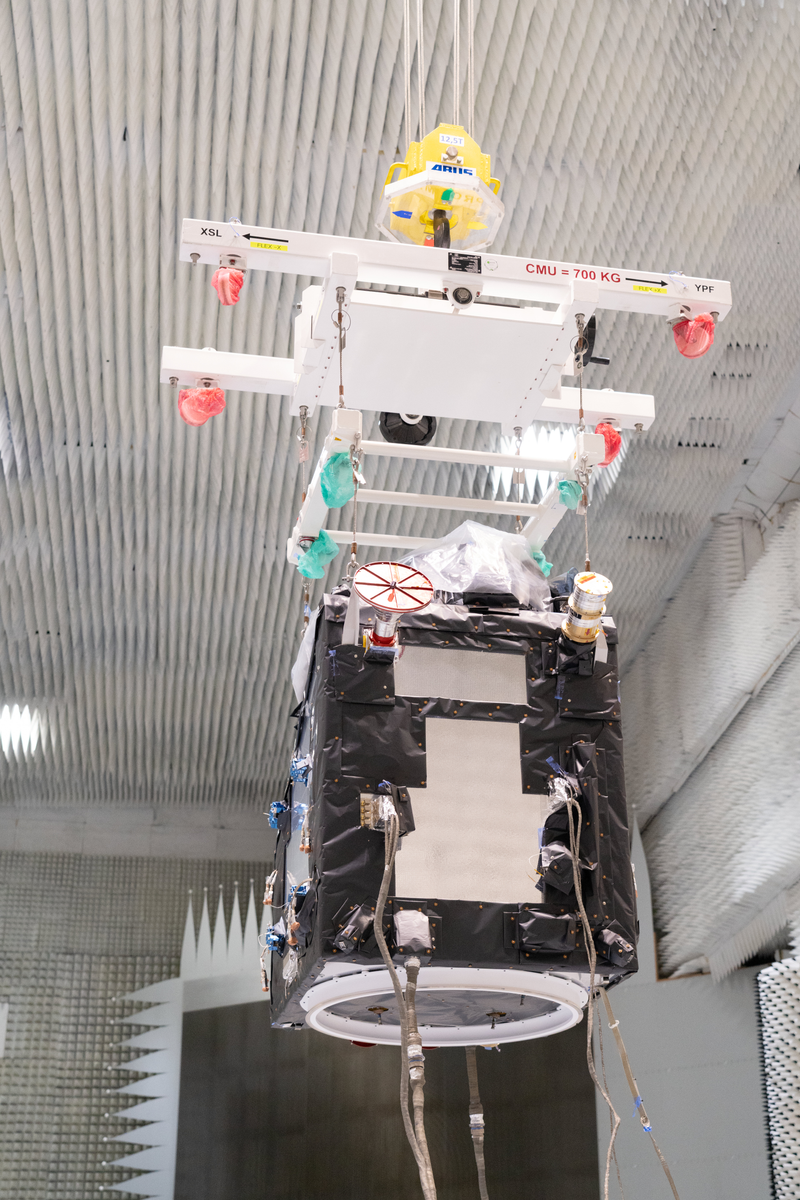
In late August 2026, inside a clean tent at the Ensemble de Lancement Vega in Kourou, French Guiana, technicians finished filling a small Italian-built satellite with 30 kilograms of hydrazine. The spacecraft had crossed the Atlantic once already, aboard the MN Colibri, departing Cannes on 9 July and arriving at Pariacabo harbour on 12 July (Wikipedia, “FLEX (satellite),” August 2026). On 15 September 2026 it leaves the ground on a Vega-C, alongside the Copernicus Sentinel-3C satellite (ESA FLEX facts and figures, 2026). The mission has a 3.5-year design life, an 814-kilometre sun-synchronous orbit, and a 400-kilogram dry mass. Its job is not imaging clouds or measuring sea level. It will stare down at forests and croplands and try to measure a faint red glow that plants produce when they photosynthesise, a signal too dim to see with the eye and almost too dim to see from low Earth orbit.
Roughly 120 gigatonnes of carbon per year move between the atmosphere and terrestrial vegetation through photosynthesis, more than ten times the mass of all the carbon humanity emits from fossil fuels (Le Quéré et al., Earth System Science Data, 2024). Almost every climate projection depends on getting that number right, and the spread across current carbon-cycle models is on the order of ±20 GtC/yr. Sun-induced chlorophyll fluorescence, the 1–2% of absorbed light that leaves re-emit at wavelengths around 685 nm and 740 nm, is a direct optical window onto photosynthetic efficiency, because every absorbed photon ends up in one of three places: photochemistry, heat, or fluorescence (Wikipedia, “Chlorophyll fluorescence,” 2026). In a healthy leaf, roughly 82% of absorbed photons drive carbon fixation; the rest is split between heat and this faint red glow.
Until now, fluorescence has been measured with bench-top instruments or aircraft campaigns like HyPlant flown out of Forschungszentrum Jülich (eoportal, FLEX, 2017). There is no global, repeatable, satellite-derived fluorescence product for the terrestrial biosphere. ESA selected FLEX as the eighth Earth Explorer in November 2015, and the satellite has spent a decade working up to one question: can you read the productivity of a soybean field, a larch forest, and a millet plot, all from 800 kilometres up, using only sunlight the leaf itself emitted back?
The hardware story of FLEX starts in November 2016, when ESA awarded the main instrument contract to Leonardo. In January 2019, Thales Alenia Space in Cannes became prime contractor for both spacecraft and instrument integration. The bus is an evolution of the Myriade family that flew COROT and PARASOL, but the avionics come from the Sentinel-3 line. In orbit the satellite measures 1.5 m × 4.9 m × 1.6 m, mass is 400 kg, end-of-life power is 950 W from a deployable solar array backed by a 57.6 Ah Li-ion battery (ESA FLEX facts and figures). The single instrument, the FLuorescence Imaging Spectrometer (FLORIS), covers 500–780 nm with variable spectral sampling: 0.1 nm in the two telluric oxygen absorption bands (O2-A at 759–769 nm and O2-B at 686–697 nm), 0.5–0.65 nm across the red edge, and 2.0 nm in the photochemical reflectance index band (500–600 nm). Spatial resolution is 300 m on a 150 km swath (eoportal, FLEX).
The clever trick is the tandem formation with Sentinel-3. FLEX orbits 40–100 km ahead of a Sentinel-3 platform, so that OLCI and SLSTR look at the same footprint within 6–15 seconds of FLORIS (eoportal, FLEX). Sentinel-3’s broad-band radiance is used to estimate the reflected sunlight contribution inside the O2-A and O2-B absorption lines, which can otherwise swamp the fluorescence signal at the 1–3 mW m⁻² nm⁻¹ sr⁻¹ level the mission is trying to recover. Two spacecraft, two spectrometers, one number.
Late summer 2026 was the home stretch. By April 2026, the integrated satellite had passed functional and environmental testing at Cannes (ESA, “FLEX shows off,” April 2026). It shipped on the MN Colibri to Pariacabo in early July 2026, was uncrated on 21 July, and was fuelled in late August. The launch is scheduled for 15 September 2026 at 22:21 local time from the ELV pad at the Guiana Space Centre on flight VV30 of the Vega-C, alongside Sentinel-3C (ESA press release N° 35–2026, 20 July 2026).
Vega-C is a four-stage European workhorse: a P120C solid first stage (4,323 kN, 279 s Isp, 141.6 t of HTPB propellant), a Zefiro 40 solid second stage (1,304 kN, 293.5 s Isp), a Zefiro 9 solid third stage (317 kN, 295.9 s Isp), and a storable AVUM+ upper stage (RD-843 engine, UDMH/N₂O₄, 2.42 kN, up to five restarts) (Wikipedia, “Vega C,” 2026). FLEX at 400 kg plus Sentinel-3C at roughly 1,250 kg fits inside the rocket’s 2,300 kg sun-synchronous capability.
The fluorescence signal is small because most absorbed light goes to chemistry and heat. Under steady-state illumination, leaf-level energy partitioning is
Y_PSI + Y_NPQ + Y_F = 1
where Y_PSI is the quantum yield of photochemistry through Photosystem II, Y_NPQ is non-photochemical quenching (heat dissipation via the xanthophyll cycle and PsbS protein), and Y_F is the fluorescence yield. FLEX measures Y_F directly; the carbon flux GPP (gross primary production) is then typically inferred as
GPP ≈ APAR × Y_PSI
with APAR (absorbed photosynthetically active radiation) reconstructed from FLORIS’s PRI and red-edge bands plus Sentinel-3’s OLCI/SLSTR radiances.
The reason the O2-A band (759–769 nm) matters is that molecular oxygen in the atmosphere absorbs sunlight there. Inside that absorption feature, any photons reaching the satellite must have been re-emitted at the surface, by the leaf. The depth of the absorption line in a downward-looking spectrum tells you how much extra radiance fluorescence is adding, after correcting for surface reflectance and atmospheric scattering. The Fraunhofer IOF in Jena built the double-slit assembly that defines FLORIS’s spectral resolution in those bands down to 0.1 nm. The narrower the slit, the cleaner the line-depth measurement, but the weaker the signal-to-noise ratio (Wikipedia, “FLEX (satellite),” 2026).
The 27-day repeat cycle at 814 km and 98.64° inclination matches Sentinel-3A’s ground track, so every 27 days the tandem pair sees the same vegetation at the same local time of day and solar geometry. That is essential for separating fluorescence from bidirectional reflectance effects. The 814 km altitude was chosen to give a 27-day repeat with 14+ orbits per day, and to keep the 300 m pixel footprint compatible with Sentinel-3 OLCI.
The third axis of the engineering is calibration stability. FLORIS is an imaging spectrometer, so pixel-to-pixel and band-to-band gain drift will alias straight into apparent fluorescence trends. On-board calibration uses solar diffuser references plus periodic lunar looks. The Sentinel-3 OLCI instrument flies the same calibration philosophy, which is one reason ESA reused its avionics and reference samples on FLEX.
Once commissioned, FLEX is expected to deliver monthly global maps of sun-induced chlorophyll fluorescence at 300 m × 300 m, the first such dataset produced routinely from orbit (ESA FLEX facts and figures). For plant physiologists, the result will be a four-dimensional look at photosynthetic efficiency, with direct implications for drought monitoring, agricultural yield forecasting, and the calibration of dynamic global vegetation models. For the carbon-cycle community, the value is a top-down constraint on GPP that does not depend on meteorological reanalysis.
If FLEX works, it will retire a long-standing assumption baked into climate models, that the greenness of a canopy, measured by NDVI or similar indices, is a proxy for what the canopy is actually doing. Two fields can look equally green and yet be photosynthesising at very different rates, depending on water stress, nutrient status, and temperature. FLEX will measure the difference. The world has never watched photosynthesis happen from space in real time. In three weeks, it will start to.
 Subscribe to our RSS feed









There are no comments.
Add A Comment