


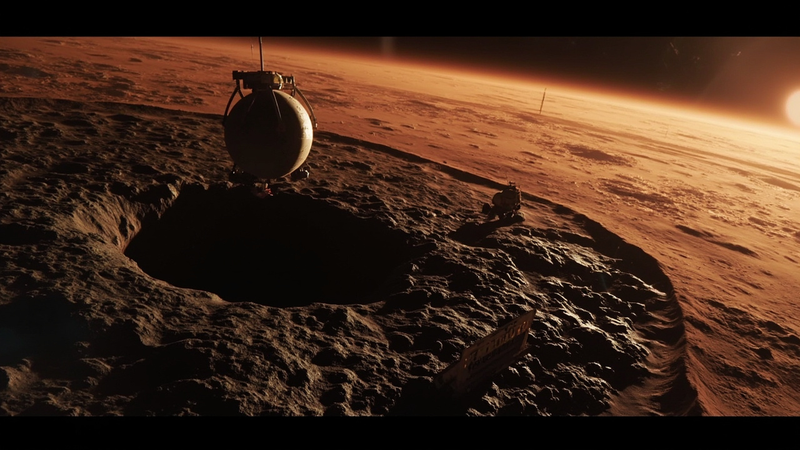
Mariner 9 arrived at Mars on November 14, 1971, the first spacecraft ever to orbit another planet. A planet-girdling dust storm forced the mission to wait, and a planetary scientist named Joseph Veverka suggested putting the cameras on Phobos and Deimos in the meantime. Phobos came into focus on November 29 from 14,440 km, then again on December 1 from 5,720 km. The little 27-kilometer rock was already strange: a near-potato shape scarred by a 9-kilometer crater called Stickney, a long axis pointed permanently at Mars, and a charcoal-black surface that did not match the warm reddish dust it was orbiting (NASA/JPL, 1971–1972).
Two hypotheses have run in parallel since Asaph Hall discovered both moons in August 1877. The capture hypothesis says Phobos and Deimos are asteroids from the outer belt, drawn in by aerodynamic drag through an extended early-Martian atmosphere and circularized into their present orbits (Hunten 1979; Pollack et al. 1979). The color match between Phobos’s surface and the so-called D-type asteroids, dark, organic-rich bodies, has carried that story.
The giant-impact hypothesis argues the moons formed from debris thrown up when a roughly Mars-sized protoplanet slammed into early Mars, much as our own Moon is thought to have formed from a glancing blow on Earth (Craddock 2011; Rosenblatt & Charnoz 2012). If true, Phobos is made from re-accreted Martian mantle mixed with impact glass, with up to ~30% porosity to explain the low density.
The distinction isn’t trivia. If Phobos is a captured D-type, MMX returns a bona fide sample of outer-belt material with all the volatile- and organic-rich implications that follow. If Phobos is impact debris, MMX effectively becomes the first Mars sample return mission, a piece of the early Martian mantle frozen in place because there was never enough gravity to melt it (Burns 1992; Lainey & Jacobson 2017).
The first attempts were Soviet. Phobos 1 launched in July 1988 and died 51 days later of a software bug. Phobos 2 reached Mars in January 1989, swung past Phobos, and went silent 30 m above the surface during its second landing rehearsal, returning 37 images. Phobos-Grunt launched in November 2011 on a Zenit-2, failed to leave Earth orbit, and burned up over the Pacific Ocean, taking its piggybacked Chinese Yinghuo-1 smallsat with it.
Between those failures, orbiters gave us what we had. ESA’s Mars Express has now completed more than 130 dedicated Phobos flybys; Mars Reconnaissance Orbiter (HiRISE) returned the highest-resolution images of the surface, down to ~6 m/px; Perseverance and Curiosity imaged Phobos eclipsing the Sun from the ground. None was a sample return.
JAXA committed. MMX was approved in 2019 with Kawakatsu Yasuhiro as Project Manager, deliberately built on Hayabusa and Hayabusa2 heritage. It launches in JFY 2026 on H3 from Tanegashima. It carries a Coring Sampler, a NASA-built pneumatic sampler, and the DLR–CNES IDEFIX rover, which is to be released from below 100 m altitude and operate for ~3 months. After regolith capture, MMX lifts off Phobos, swings out of orbit, and heads home. The sample capsule lands in Australia’s Woomera desert in JFY 2031 (JAXA, 2026).
Phobos’s specifics dictate the engineering. It is tidally locked to Mars and orbits at 9,376 km from the planet’s center, inside synchronous. Its mass is only 1.064 × 10¹⁶ kg. Surface gravity is 0.0057 m/s² and escape velocity a casual 11.4 m/s. Dust kicked up by landing takes a long time to settle because there is essentially no atmosphere to grab it (Wikipedia, citing Jacobson 2010; Lainey et al. 2024).
The body itself is also a study in low-cohesion regolith. Stickney, the dominant crater, is nearly half the mean diameter of the moon — close to the threshold where a same-sized impactor should shatter the parent rather than scar it. The long, shallow grooves running away from Stickney’s rim are still debated: some teams interpret them as fractures propagating from the basin-forming impact (Asphaug & Melosh 1993), while others argue for ejecta-drape patterns or secondary craters from Mars-thrown debris (Murray & Heggie 2007). Mars Express and MRO photometry has refined the question but not closed it; the grooves sit at the wrong angle to simple Stickney-radial fracture models, leaving loose ends that ground truth will resolve.
Sampling strategy reflects the same facts. The primary sampler is a Coring Sampler (C-Sampler): a titanium-alloy tube pressed against the surface under low main-engine thrust, intended to pull up to a 2-cm core from the uppermost regolith. Secondary is the Pneumatic Sampler (P-Sampler), contributed by NASA: a short burst of nitrogen gas lifts loose regolith into a chamber. Multiple sites will be visited across lit and shadowed hemispheres, with a combined sample target of more than 10 g (JAXA, 2026 mission specification).
In-situ discrimination happens before the sample ever leaves Mars. NASA’s MEGANE instrument (Mars-moon Exploration with GAmma Rays and NEutrons) is a high-purity germanium γ-ray spectrometer paired with a ³He-neutron spectrometer, designed to map iron, silicon, oxygen, hydrogen, thorium, and potassium across Phobos’s surface (NASA / APL, 2024). D-type asteroidal material and basaltic Martian-mantle-derived material produce very different signatures in such an instrument, particularly in the Fe/H and Th/K ratios. Knowing the answer in orbit lowers the risk of returning rock that doesn’t actually answer the central question.
Return physics is unforgiving. The Δv budget to enter Martian orbit from a direct Hohmann transfer is on the order of 1 km/s, plus a few hundred m/s for Phobos orbit acquisition and the touch-and-go capture. Per Tsiolkovsky’s rocket equation: Δv = v_e × ln(m_0 / m_f), with v_e ~ 320 s for the bipropellant thrusters. The mass fraction is what makes the Sample Return Capsule, with its ~10 g payload, only a small fraction of the ~4,200-kg launch stack. The capsule’s heat shield has to survive entry into Earth’s atmosphere at ~12 km/s after a direct Mars return.
H3 is Japan’s first fresh-built orbital launcher since the 1980s. Its LE-9 engines run an expander bleed cycle, each chamber delivering ~1,422 kN of vacuum thrust. H3 sent up Michibiki 7 earlier this month, and MMX is the next major LE-9 passenger on the manifest (JAXA / MHI, 2026).
JAXA’s MMX is going to do something the United States and Russia combined have tried and failed to do three times: land briefly on Phobos, grab a few grams of regolith, and bring that bag of rock back to a clean lab on Earth.
Three outcomes are plausible. If the rocks look like D-type carbonaceous material with deep hydration features, the capture hypothesis wins and Phobos becomes the first outer-belt material ever returned to Earth. If they are dry, fine-grained basalts with high calcium and iron and no hydration, the impact hypothesis wins and we have, in effect, a sample of early Mars. If they are a messy mix, we’ll learn something about Phobos’s regolith history that neither hypothesis prepared us for.
The capsule should come down near Woomera in JFY 2031. JAXA’s Sample Curation Facility at Sagamihara will be where scientists first crack open the sealed container. The instruments they run on that small sample — mass spectrometers, electron microprobes, atom-probe tomographs — will quietly close out a 150-year-old argument about where Mars got its moons.
 Subscribe to our RSS feed









There are no comments.
Add A Comment