


Ten Grams From Phobos: The Landing in Near-Weightlessness
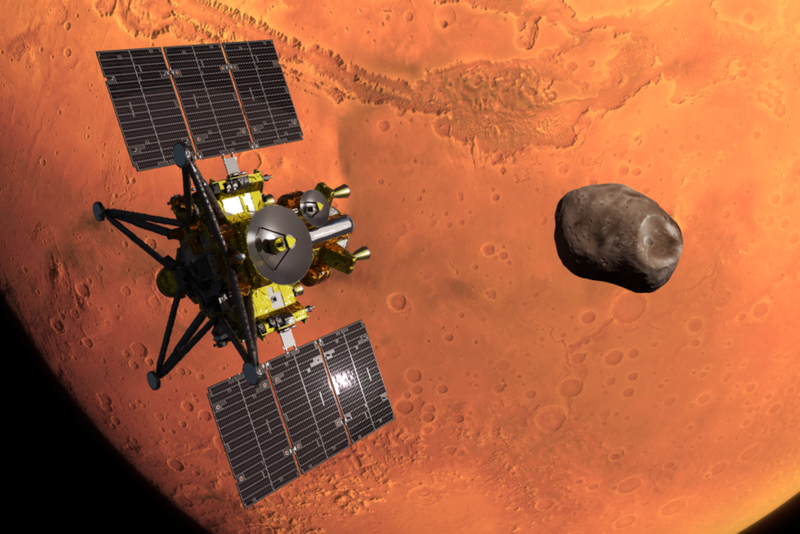
Phobos is a lumpy rock, 25.9 by 22.6 by 18.3 kilometres across, orbiting 9,375 kilometres from the centre of Mars where gravity is 0.0057 m/s², roughly one seventeen-hundredth of what a person feels standing on Earth. It has no air, reflects 7 percent of the light that strikes it, and orbits in 7 hours and 39 minutes, rising in the west and setting in the east twice per Martian day. On 19 October 2026 a Japanese H3-24L rocket lifted off from the Tanegashima Space Center carrying the Martian Moons eXploration spacecraft, MMX, assigned to land on that rock, collect at least ten grams of its dirt, and fly it home (ESA, October 2026; Wikipedia). No mission has ever done either half of that.
Two hypotheses compete for Phobos’s origin. Under the capture hypothesis it is a carbonaceous asteroid that Mars pulled in from elsewhere in the solar system; under the giant impact hypothesis it is debris thrown into orbit by a collision with young Mars, making it a piece of the planet itself. The gap between those stories is the gap between small bodies and planets. Phobos also wears a blanket of material blasted off Mars by impacts, and JAXA estimates it carries more than a hundred times as much Mars-derived material as Deimos (JAXA, October 2026), so its dirt is partly Martian.
The second argument for bringing material home is that Earth owns instruments that cannot fly. ESA’s MMX project scientist Elliot Sefton-Nash calls the returned data and samples “a window to study the evolution of Mars and the Solar System” and notes that once they are here, “our most precise instruments are too large, complex or sensitive to send to space” (ESA, October 2026). Ten grams sounds like nothing, but a few documented grains in a mass spectrometer settle questions orbiters have argued about for decades. There is also a deadline of sorts. Phobos is losing orbit to Mars at about two centimetres a year and will be pulled apart in 30 to 50 million years (NASA, 2023), so its surface is not a permanent archive.
MMX was announced in 2015, cleared for development in 2020, and reached Tanegashima in March 2026 (Wikipedia). It is the largest mission JAXA has flown beyond Earth, and a consortium effort: ESA supplied the transponder and power amplifier and will run ground support from its Estrack stations, while CNES and DLR built the small rover riding between the lander’s legs. The H3-24L stands 63 metres tall and weighs 574 tonnes without payload. The spacecraft is 4,480 kg, split into a propulsion module holding 1,840 kg of propellant, a return module holding 1,190 kg, and the exploration module that lands (Wikipedia). Flight 10 was the H3’s first interplanetary launch, and separation came an hour and eleven minutes after liftoff (NASASpaceflight, October 2026).
Arrival is expected in August 2027, and a month later the spacecraft drops into a quasi-satellite orbit around Phobos, a path that keeps it close to the moon while circling Mars, because the moon is too small to hold a conventional orbit. For the first eighteen months MMX only watches, mapping Phobos, cataloguing candidate landing sites and studying Deimos with a payload ESA counts as eleven science instruments, seven on the main spacecraft and four on the rover (ESA, October 2026). The near-infrared spectrometer from the Paris Observatory targets exactly that question.
Then, around the turn of 2028 and 2029, the mothership drops the rover Idefix (DLR, 19 October 2026). The name comes from Asterix’s dog and was announced at the 2023 Paris Air Show. It weighs 23.47 kg. It falls 40 to 100 metres with no braking, bounces, and must right itself on its four wheels before folding out its solar panels; fail that and the mission is over, since the panels keep its electronics warm. The teams in Toulouse and Cologne never talk to it directly: every command and byte of telemetry goes through MMX and JAXA’s Sagamihara station, twice a day (Wikipedia).
In 2030 MMX lands on Phobos itself, aiming at a box about 20 by 20 metres inside a 300 by 300 metre zone the rover will already have surveyed. The lander carries two samplers, a corer that takes cores a couple of centimetres deep and a pneumatic sampler that lifts loose grains with pressurised gas, and it works both the face looking back toward Mars and the one looking away, because the two are not alike (ESA, October 2026). On the way home it swings past Deimos, releases the sample capsule, and lets it fall to Earth, arriving in Australia in 2031 (Wikipedia). The capsule is roughly 60 centimetres across with a heat shield, because it comes in at interplanetary speed: Hayabusa2 dropped a look-alike canister over Woomera in December 2020 at about 12 km/s, and MMX targets the same range.
Those numbers explain why DLR project manager Markus Grebenstein calls landing and driving on Phobos “uncharted territory for robotics” (DLR, October 2026). Phobos has a mass of 1.06 x 10^16 kg and a surface gravity of 0.0057 m/s², and escape velocity at its surface is only about 11.4 m/s. Leaving Mars altogether is a different order of problem: computed as v_esc(r) = sqrt(2GM_mars/r) at Phobos’s 9,375 km, it takes roughly 3 km/s. There is no atmosphere to brake against, so every metre per second must be cancelled by thrusters, and the ground is barely known: a rubble pile with an estimated 30 percent porosity, a regolith layer at least 100 metres deep, and boulders scattered across it. Gravity varies across Phobos because its mass is lumped unevenly, so a probe cannot simply hover over it. Surface temperatures run from about minus 4 degrees Celsius in sunlight to minus 112 in shadow (Wikipedia), a swing DLR puts above 200 degrees.
The rover is built around that same arithmetic. Each of its four wheels is driven separately, carries nine grousers for grip, and weighs 190 grams after a topology optimisation left it a mesh rather than a solid disc (Wikipedia). Four panels totalling 0.36 square metres should yield at least 60 watt-hours per Phobos day, about 8.6 watts averaged across seven hours of sunlight, so the machine’s working life follows the sun’s schedule. The wheels also roll the rover upright after the drop, and two downward-facing cameras watch the soil move, the only way to learn how regolith behaves under a vehicle. Testing proved awkward: reproducing Phobos’s gravity in a test article would need a rover two thousand times lighter than the real one, so the team simulated the landing and righting sequence instead (Wikipedia). The science payload mixes scales too: MEGANE reads composition with gamma rays and neutrons, LIDAR and OROCHI map the surface, and the rover’s RAX Raman spectrometer fires a green Nd:YAG laser at a 50-micrometre spot, naming minerals from the scattered light it sorts between 535 and 680 nanometres.
The spacecraft reaches Mars in August 2027, the rover reaches Phobos around the end of 2028, the lander follows in 2030, and the sample lands in Australia in 2031. The same months deliver another small-body milestone: ESA’s Hera is on track to reach the Didymos system in November 2026, a month ahead of plan, to survey the scar left by NASA’s DART impact (ESA, 2025). One mission arrives to look, and one is on its way to bring something back. When the ten grams are finally in a laboratory, the argument about whether Phobos is a captured asteroid or a piece of Mars will stop being a debate about models and become a question about atoms.
 Subscribe to our RSS feed









There are no comments.
Add A Comment