


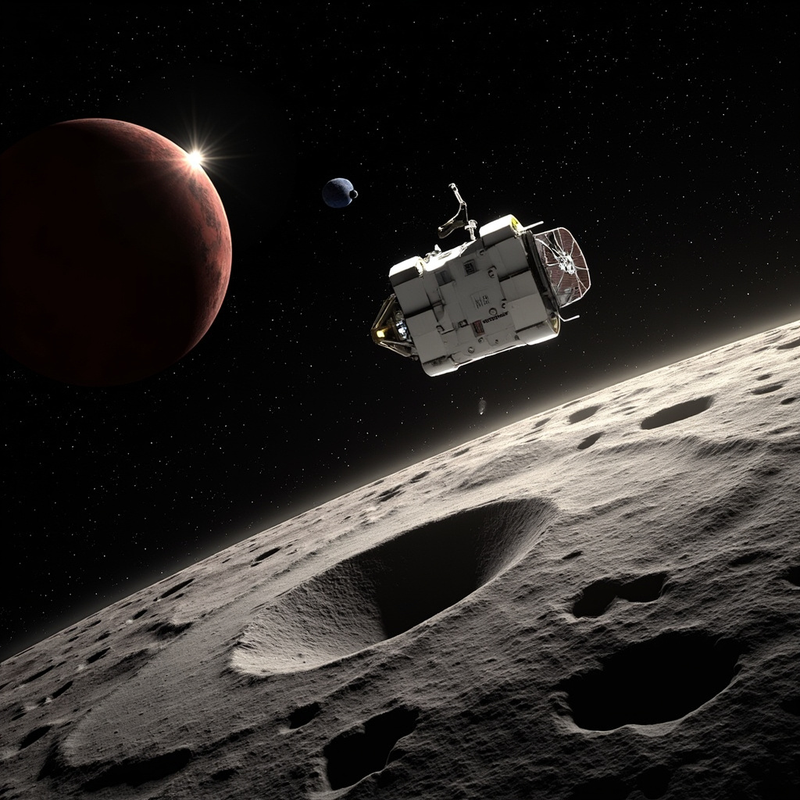
On Sunday morning Japan time, a 4,000-kilogram spacecraft will leave Tanegashima Space Center on Japan’s new H3 rocket and begin a five-year journey to do something nobody has done before: touch a moon of another planet and bring a piece of it home. The mission is the Martian Moons eXploration probe (MMX), and its destination is Phobos, a 22-kilometer rock that swings around Mars three times a day and is slowly falling inward. A small capsule will land in an Australian desert in 2031 carrying at least ten grams of alien dirt that may finally settle a sixty-year argument about where Phobos came from.
That argument is unusually clean for planetary science. Two possibilities fit the observations, and they point in opposite directions. Either Phobos and its smaller sibling Deimos are captured asteroids — dark, carbon-rich bodies pulled in from the outer main belt — in which case they should resemble primitive outer-belt material. Or they are the wreckage of a giant impact on early Mars, a process analogous to how Earth’s own Moon formed, in which case they should be dry, glass-rich, and chemically indistinguishable from Martian basalt. Existing remote sensing cannot break the tie. Phobos is too small and too dark for Earth-based spectroscopy to read its surface cleanly, and the two theories predict mineralogies that differ in subtle ways. Only a sample under a laboratory bench can decide.
That is what JAXA is sending MMX to do. Approved in February 2020 under project manager Yasuhiro Kawakatsu and shipped to Tanegashima in March 2026, the probe lifts off at 04:41 JST on 20 October 2026, 19:41 UTC on the 19th (ESA, 13 October 2026). The probe is built in three modules: a 1,800-kilogram propulsion section carrying about 1,900 kilograms of bipropellant, a 150-kilogram exploration module, and a 1,050-kilogram return module that will eventually fire its own engine, depart Phobos, and re-enter Earth’s atmosphere. The rocket is the H3-24L, the four-solid-booster variant of Japan’s flagship. The H3 failed its first two flights in 2023, and getting it back to operational status was the engineering prerequisite that made MMX possible at all.
Seven instruments ride on the main spacecraft, and four more sit on a small rover called IDEFIX that will be deployed in early 2029. NASA’s contribution is MEGANE, Japanese for “eyeglasses,” a gamma-ray and neutron spectrometer built at the Johns Hopkins Applied Physics Laboratory that reads elements like hydrogen, which cameras cannot see, to determine how much water-bearing material is present. CNES in France built MIRS, a near-infrared spectrometer for mineral identification. JAXA added a LIDAR, a dust counter to look for a hypothesized faint ring of debris around Mars, and a mass spectrometer for the local ion environment. The IDEFIX rover is a joint CNES-DLR build, weighs 25 kilograms on Earth, and will weigh the equivalent of fifteen grams on Phobos (ESA, 13 October 2026).
The path MMX will fly is itself an engineering problem. Phobos is too small for a true orbit — a satellite around the moon would be perturbed away by Mars within days. Instead, MMX will use a quasi-satellite trajectory, a Mars-centered path that lets the spacecraft stay near the moon for a full Martian year. The geometry is governed by the mass ratio between the two, about 1.7 × 10⁻⁷, which is too small to permit a stable bounded orbit around the moon. The same physics that holds objects at the L1 and L2 Lagrange points lets a spacecraft at the right distance and phase angle drift along with the moon indefinitely.
The sampling system is a second engineering story. JAXA is flying two redundant mechanisms. The first is a coring-and-shovel arm of traditional design. The second, called P-sampler, was developed by Honeybee Robotics and is the descendant of a Planetary Society-funded prototype called PlanetVac. Where most regolith samplers depend on a lander’s weight for a percussive motion, P-sampler fires pulses of nitrogen gas to stir the surface into a vortex, then sucks the cloud into a collection chamber, working whether the lander is upright, tilted, or on one footpad. PlanetVac’s path to Phobos is a parable of compounding: a 2013 lab test, a 2018 flight on Masten’s Xodiac rocket in the Mojave, a 2025 demonstration on Firefly’s Blue Ghost lunar lander, and now inclusion on MMX as a primary sample-acquisition method (Planetary Society, 14 October 2026).
The mission timeline runs five years. MMX will arrive at Mars in August 2027, enter a quasi-satellite orbit around Phobos in September, study the moon for roughly eighteen months, release IDEFIX in early 2029, and land in 2030 to collect the sample. The return module will then push off Phobos, swing past Deimos, and head home. The sample capsule is designed to land in the South Australian outback.
What MMX finds is the test. A captured-asteroid Phobos should have the spectral fingerprints of carbonaceous chondrites, with hydrated silicates and organic compounds. An impact-ejecta Phobos should look like a re-melted piece of Martian crust, dominated by olivine and pyroxene in a glassy matrix. Either answer changes planetary science. The capture scenario would re-open the question of how many small moons are interlopers rather than natives. The impact scenario would mean Mars once had a ring system that briefly rivaled Saturn’s. The samples also carry information no remote observation can read: cosmic-ray exposure age, solar-wind noble gases, the isotopic ratios that fingerprint Martian versus asteroidal origin. ESA project scientist Elliot Sefton-Nash put it simply: samples returned to Earth are “the gift that keeps on giving,” because the same ten grams will be analyzed for decades by instruments not yet invented.
That’s why Japan built this spacecraft, and why a rocket that failed its first two flights is about to carry it off the pad. The question of where Phobos came from has been the cleanest unsolved problem in solar-system science for half a century, and MMX is the cleanest possible test of it. Sunday’s launch opens the clock.
 Subscribe to our RSS feed









There are no comments.
Add A Comment