


UK picks ClearSpace for first national satellite deorbit mission
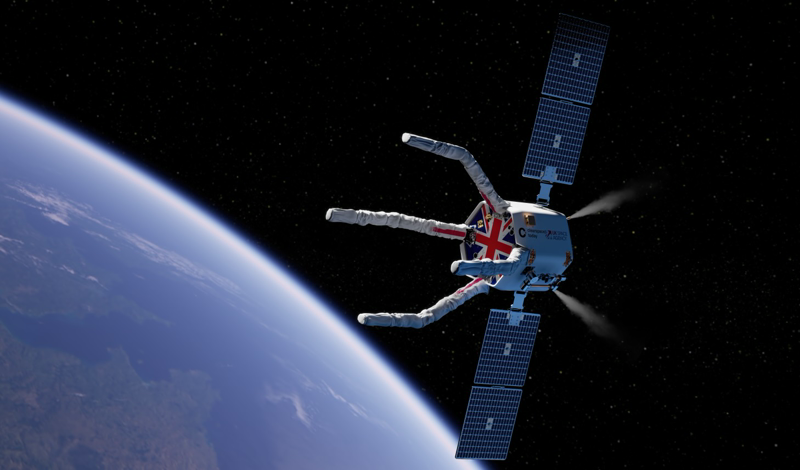
Two days after the UK Space Agency signed a contract worth around eighty million US dollars with the in-orbit services company ClearSpace, the post is still drawing puzzled responses from engineers who have watched ClearSpace miss one launch deadline after another. The October 15 award puts ClearSpace’s UK subsidiary in charge of the country’s first nationally commissioned active debris removal mission, called UK ADR, with the goal of capturing two defunct British satellites in low Earth orbit and pulling them down to burn up on a single flight. The contract is the largest piece of business yet for a company whose European Space Agency mission to grab a single space debris target has slipped from 2025 to 2029, and it lands on a small spacecraft stack whose design is still being finalised.
What the UK Space Agency has bought is a service, not a satellite. The agency will hand ClearSpace a list of two retired UK-licensed payloads, then wait while the company flies a robotic servicer to meet them, grapples each in turn, and drops them into the atmosphere in sequence. The contract covers everything from the design and build of the servicer, through ground test and qualification, to the launch, the rendezvous in orbit, and the final disposal burns. Space Minister Liz Lloyd described the mission as the first time any spacecraft will dispose of more than one satellite in this way, and UK Space Agency officials were careful to frame the work as a building block for a broader in-orbit servicing economy rather than a one-off clean-up job (GOV.UK, October 15 2026).
The deal matters because the amount of junk in low Earth orbit has been climbing faster than any country has been willing to clean up. Hundreds of thousands of tracked objects now whiz around the planet at closing speeds that can exceed seventeen thousand miles per hour, and every newly launched mega-constellation adds more mass to a regime that already bristles with abandoned rocket bodies, dead payloads, and fragments from past collisions. The standard response so far has been passivation, the practice of venting leftover fuel and disconnecting power on a dying spacecraft so it does not explode later, combined with rules that ask operators to remove their own hardware within five years of mission end. Passivation reduces future debris, but it does nothing about the cloud of derelicts already up there. Active debris removal, in which a separate spacecraft goes out and grabs the offending object, has been on every space agency’s wish list since the 1980s and on none of their budgets until very recently. A 2025 update to the UK National Space Strategy named in-orbit servicing, assembly, and manufacturing, abbreviated ISAM, as one of four priority areas, and the ADR mission is the first concrete contract to come out of that policy.
ClearSpace did not win the work uncontested. The UK Space Agency ran a competitive procurement in which three bidders responded: ClearSpace UK, Japan’s Astroscale, and the US-based Starfish Space. Astroscale has already completed a commercial active debris removal demonstration, the ADRAS-J mission that flew up to a Japanese rocket stage in 2024 and is still working through rendezvous operations. Starfish Space has flown the Otter pup-sized servicing vehicle on a 2024 orbital transfer test and is now building a larger vehicle called Bluebonnet. ClearSpace itself has not yet reached orbit on its own propulsion stage, having lost its original 2025 launch slot when the ESA payload it was sent to remove was struck by a fragment in 2023 and had to be swapped out for a different target (Behind the Black, October 16 2026, SatNews, October 15 2026). ClearSpace was nonetheless judged the strongest offer, in part because the capture architecture it has been building for the European Space Agency’s Proba-1 retrieval mission is the closest existing match to what UK ADR needs. The two retired UK satellites that UK ADR will go after have not been identified publicly, but both are non-cooperative, meaning they were never built with a grapple fixture or docking adapter, so the servicer has to deal with whatever geometry it finds.
The price tag, around sixty-one million British pounds, lands at the high end of what an active debris removal demonstration has ever cost. The contract is structured so that the money stretches from the present through a launch window that closes in August 2029, with the bulk of the spending sitting on integration, qualification, and operations rather than on the bus itself. ClearSpace UK’s Managing Director, Rob Atchison, framed the next phase in unusually direct terms, telling reporters that the program would hire engineers across several spacecraft disciplines, and that the team would design, build, and qualify a spacecraft capable of safely approaching an object never meant to be captured and bringing it under control. ClearSpace UK will manage industrial delivery and mission operations, targeting a 2029 launch from Saxavord Spaceport on Unst, a Shetland launch site that received thirty million pounds of UK government money in 2024 to keep Britain’s sovereign launch capability alive (GOV.UK, October 15 2026). If the schedule works, the servicer will share its ride to orbit with other payloads heading to low Earth orbit.
The way the servicer is meant to work is the part that has drawn the most attention from debris-removal engineers. After separating from its launch vehicle, the spacecraft will use autonomous rendezvous and proximity operations, the choreography of thruster firings, sensor reads, and trajectory corrections that brings one spacecraft safely next to another, to match orbits with the first derelict target. Once in close formation, a multi-arm robotic manipulator will reach out and clamp onto whatever structural feature the dead satellite offers, since neither target has a standard grapple point. With the first satellite locked in its arms, the servicer will fire its thrusters in the direction that lowers the combined stack’s perigee, the low point of its orbit, into the upper reaches of the atmosphere. The first derelict is then released onto a decaying trajectory that brings it down within months. The servicer, now lighter and carrying a full tank of propellant by design, raises its orbit back up, repeats the rendezvous with the second target, captures it, and brings it down the same way. The sequence is what makes this mission a world first rather than a duplicate of ClearSpace-1, which is only designed to retrieve one object.
The technologies the mission leans on have been in development for nearly a decade. The capture architecture descends from the design ClearSpace built under an ESA contract first awarded in 2019, which uses four robotic arms that wrap around the target like fingers closing around a pen. The rendezvous and proximity operations software draws on Phase 2 of the UK’s Clearing the LEO Environment with Active Removal study, abbreviated CLEAR, in which ClearSpace partnered with Orbit Fab to study in-space refueling and ran a long autonomous approach sequence in simulation. The refueling capability is what makes the spacecraft useful beyond one mission. UK ADR will fly with a refuellable propellant system the company intends to top up between flights, which is the only way a single bus can plausibly clean up more than a handful of derelicts over its lifetime. The wider ISAM sector the mission anchors includes satellite inspection, life extension through on-orbit refueling, and eventually on-orbit assembly of larger structures, with analysts at the UK Space Agency estimating that the segment could grow into a billion-dollar annual market by the mid-2030s (GOV.UK, October 15 2026, Via Satellite, October 15 2026).
Two years is not a long time to design, build, qualify, and launch a brand-new spacecraft, and the skeptics in the debris-removal community are easy to find. ClearSpace’s earlier deadline slippage, the 2024 management shake-up that pushed OHB into a majority role, and the parallel pressure of an ESA contract for a 2027 proximity-operations demonstration all have to resolve before the UK ADR launch window closes. If the company meets its 2029 target, the mission will hand the UK Space Agency the first operational data set on multi-target active debris removal in orbit and give ClearSpace the flight heritage its future servicing business depends on. If it slips, the contract is structured in phases that protect the UK taxpayer from paying for a bus that never flies, and the second target does not get removed.
 Subscribe to our RSS feed









There are no comments.
Add A Comment