


(image source)
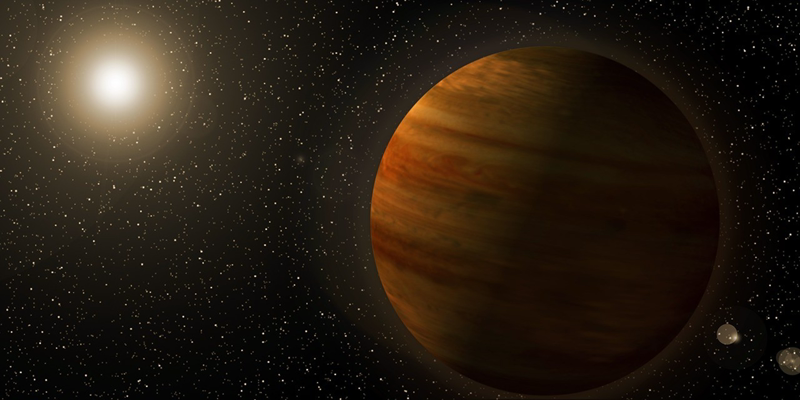
A super-Jupiter twelve times farther than TESS can usually see, hiding in eight years of archived photometry, pulled out by a physics trick first described in 1936. Gaia23bra b is the first world the Transiting Exoplanet Survey Satellite has ever confirmed by gravitational microlensing, and the result quietly resets how a mission is used.
The signal was small. A background star out near the galactic plane brightened slightly as a foreground orange dwarf drifted across our line of sight. ESA’s Gaia spacecraft flagged the brightening in 2023 as a routine gravitational lensing event and dropped it in the alert stream. TESS happened to be staring at the same patch of sky, taking 27-day blocks of images for its usual transit hunt, and captured the same brightening with finer time sampling. Three years later, when Mallory Harris at the University of New Mexico pulled TESS’s archive, she noticed a tiny extra wiggle in the light curve, a five-day deviation that Gaia had missed because Gaia was sampling too sparsely. That wiggle was a planet. The paper went on the arXiv on July 1, 2026, and into The Astrophysical Journal Letters the same day (arXiv:2607.01853).
The headline number is just how far away the host system is. TESS was built to chase transits of bright, nearby stars, with its catalog reaching out to about 150 light-years. Gaia23bra b sits at roughly 40,000 light-years, deep in the galactic plane, on the far side of the galaxy’s disk from us. Detecting a planet there was not in the original mission plan, and that is what makes the result interesting.
Microlensing is the only planet-finding method that depends on distance rather than proximity to Earth. Transits need repeated passes in front of the star, so TESS sticks to bright nearby targets. Radial velocity gets harder as the star gets fainter. Direct imaging works for young planets still glowing from formation heat, typically hundreds of light-years away.
Microlensing needs only one alignment between a foreground star and a more distant background source. The foreground star’s gravity bends the background light into a brief magnifying-glass spike, and any planet orbiting the lens star leaves its own tiny extra spike on top. The alignment never happens twice. As Harris put it, microlensing events “happen once and they’re gone.”
Less than 5% of the more than 6,000 known exoplanets were discovered this way, according to NASA’s Goddard release on the result. Almost all came from ground-based surveys designed specifically for microlensing. The new detection is the first time a survey telescope built for something else has caught a microlensing planet in its own data. TESS has been staring at almost the whole sky on a rolling basis since 2018.
The find points forward to NASA’s next flagship astrophysics mission. The Nancy Grace Roman Space Telescope, currently scheduled for an August 30, 2026 launch from Kennedy Space Center, will spend one of its core surveys staring at the galactic bulge, where the stellar density makes microlensing alignments common. Co-author Michael Fausnaugh of Texas Tech, quoted in the NASA release, calls the TESS detection “a bit like a preview of the microlensing NASA’s Nancy Grace Roman Space Telescope will do.” Roman is projected to find roughly a thousand microlensing planets and a hundred thousand transiting planets across its primary mission.
The trigger was not new TESS data but the existing archive, re-read. Harris and her collaborators at the University of New Mexico, NASA Goddard, Texas Tech, and partner institutions were testing whether TESS’s short-cadence light curves contained enough information to recover microlensing signals at all. TESS full-frame images stack into 30-minute cadence products and 200-second cadence for selected targets, dense enough that a small planet-induced anomaly should be visible if you know where to look.
The team went looking in the eight-year archive for events Gaia had flagged as lensing candidates but could not resolve. Gaia23bra was a textbook case: Gaia saw the main brightening, a roughly 30-day event, but the planet’s signature sat on top as a small, sharp deviation that Gaia’s sparse sampling averaged out.
When Harris pulled TESS data for the same coordinates, the planet’s signature was sitting right there. The deviation lasted about five days and produced a measurable second-order change in the light curve that the team modeled as a second lens, in microlensing jargon, a binary-lens event with a planetary-mass companion. The recovered planet, Gaia23bra b, is roughly 1.6 times Jupiter’s mass on a Jupiter-like orbit around an orange dwarf star about 80% of the Sun’s mass. NASA’s release summarizes it as a “super-Jupiter” in a configuration the mission was not designed to find.
Co-author Diana Dragomir, also at the University of New Mexico, told the NASA press operation that “the discovery implies that there are probably other so-called microlensing planets hiding in TESS’s data that we hadn’t previously thought to look for.” Eight years of TESS full-frame images are now a searchable microlensing archive. More detections are likely; the next round of candidates is still being checked.
The Gaia side of the story closes a separate loop. Gaia finished its extended science mission earlier in 2026, ending a roughly 12-year astrometry run that produced the largest three-dimensional map of the Milky Way. Gaia23bra b is one of the last planets Gaia will help find, and shows how Gaia and TESS were complementary: Gaia’s wide-field coarse cadence for the alerts, TESS’s narrow-field fine cadence for the follow-up.
The underlying physics is the lensing effect Einstein described in general relativity. A massive object between a distant light source and an observer bends the source’s light around itself, producing two distorted images that are usually unresolved, so the source just appears brighter. A planet orbiting the lens acts as a smaller secondary mass that produces its own brief spike on top of the main brightening.
The size of that spike depends on the Einstein radius, scaling with the square root of the lens mass times the distances involved. For a stellar-mass lens halfway across the galaxy and a background source further away, the event lasts weeks, and the planet’s spike shows up over a few days, which is why the TESS team’s detection was a five-day feature on a roughly 30-day main event.
Two practical issues make the detection hard. The first is degeneracy: a single-lens fit can soak up most of the brightening, leaving a small residual that could be a planet, a stellar companion, or noise. Resolving it requires dense photometry where the planet’s signature shows up, which is what TESS provides and Gaia did not.
The second issue is the galactic-plane background. Toward the bulge and inner disk, stars are packed so tightly that a TESS pixel, about 21 arcseconds across, often contains multiple stars whose light blends together. The team’s workaround was to lean on Gaia’s catalog to decompose the TESS photometry into individual stars, then run the microlensing model on the cleaned light curve.
The Roman connection closes this loop. Roman’s Wide Field Instrument has roughly 100 times TESS’s collecting area and a pixel scale around 0.11 arcseconds versus TESS’s 21 arcseconds, which kills the blending problem for the bulge region. Where TESS catches a microlensing planet by lucky overlap, Roman runs a continuous survey of the densest lensing regions. The two missions cover different parts of the galaxy, with TESS’s strength being the rest of the galactic plane where stars are sparser.
The discovery does not change what we know about how planets form. The deeper lesson is that eight years of archived TESS photometry is now a real microlensing dataset, and the analysis pipeline used here is reproducible. Expect follow-up papers searching the TESS archive for additional Gaia-flagged lensing events with high-cadence follow-up available.
The next concrete milestone is Roman’s launch on August 30, 2026, which moves microlensing from the realm of niche ground-based surveys into a flagship-class statistics engine. Roman’s projected yield of around a thousand microlensing planets, paired with TESS’s growing archive of opportunistic microlensing detections, will start to give a real census of planets at Jupiter-like orbital distances across the galaxy. Gaia23bra b is the first data point on the TESS side of that census, and it arrived just in time for the Roman team to use as a worked example in their own planning.
 Subscribe to our RSS feed









There are no comments.
Add A Comment