OrbitalHub

Where curiosity reaches escape velocity.

Domain is for sale. $50,000,000.00 USD. Direct any inquiries to contact@orbitalhub.com.

Archive for the Mars Explorers category

September 28, 2026

A 700-million-dollar antenna at Mars

Posted by


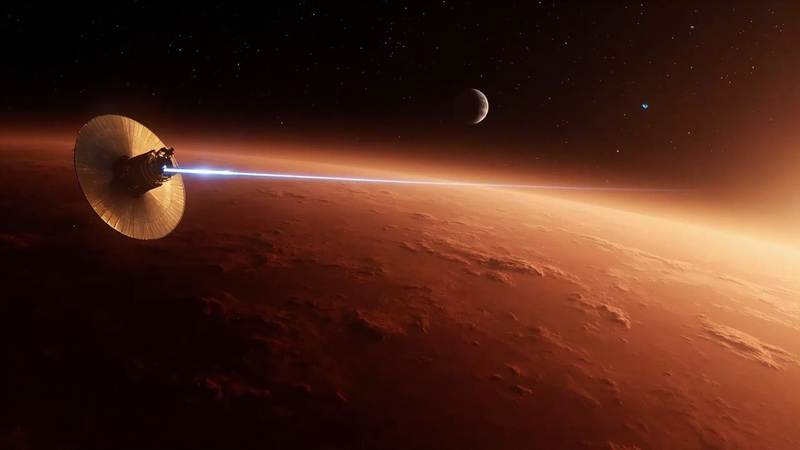
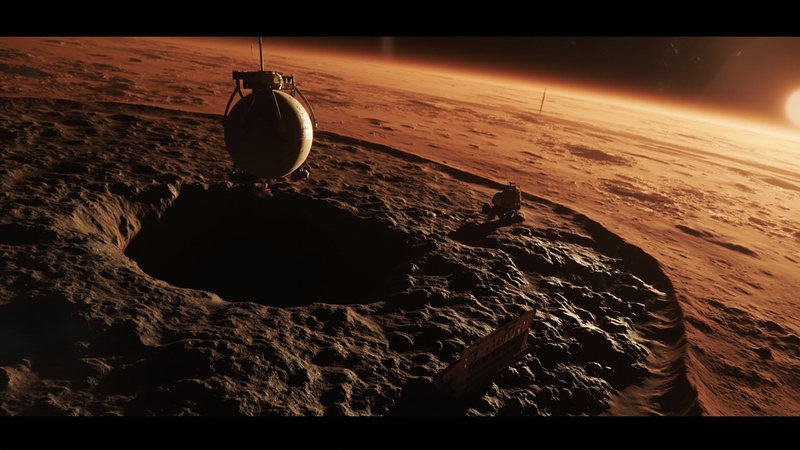
A relay spacecraft with a large dish antenna orbits above the rust-coloured limb of Mars, firing a thin blue beam along the planet's curve, with a small moon in the distance.


For twenty years, every byte of data sent home from the surface of Mars has ridden a UHF radio piggyback on a science orbiter that happened to be passing overhead. On 2 September 2026 NASA ended that arrangement. The agency announced that Blue Origin will design, build, launch, and operate a dedicated Mars Telecommunications Orbiter under a firm-fixed-price contract worth up to $700 million, with delivery by the end of 2028 and full operations at the red planet in 2030 (NASA news release, 2 Sep 2026). For the first time since the cancelled 2005 Mars Telecommunications Orbiter, NASA is buying communications capacity at Mars the way it buys launch services from SpaceX: a fixed commercial price for a working spacecraft, with the operator running the show.

The award is small in dollar terms compared to flagship planetary missions and large in strategic terms. It formalizes the commercial-services model that has reshaped cislunar space and applies it 1.4 astronomical units farther out. It puts the first dedicated deep-space relay at a planet, not at the Moon. And it gives Blue Origin — eight years after New Shepard reached the Kármán line — a planetary-scale role that no other company has held.

Every rover since Sojourner has paid a tax for its bandwidth. The UHF Electra relay on Mars Reconnaissance Orbiter tops out near one megabit per second, and that link is shared with instruments the orbiter was actually launched to run (Edwards et al., 2003). The Deep Space Network’s direct X-band uplink is even thinner — a single HiRISE frame takes 1.5 hours at MRO’s 5.2 Mb/s peak (JPL, “Deep Space Communications,” 2017). Perseverance’s plume telemetry, Ingenuity’s flight logs, the trace-gas measurements from ExoMars TGO — all of it competes for slots in orbits selected to do science, not to be comms towers.

A purpose-built relay changes the calculus. Operators can schedule lander passes against an orbit designed for continuous visibility, freed from the geometry of a science primary mission. Layer a deep-space optical terminal on top — analogous to the Deep Space Optical Communications package Psyche has been flight-qualifying since 2023 — and the link budget explodes. DSOC pushed 267 Mb/s from 31 million kilometers in late 2023 and held a link to 467 million kilometers in July 2024 (JPL, 11 Dec 2023; NASA, 25 Apr 2024).

The second-order effect is what NASA gets to stop doing. SCaN has been forced for two decades to add relay payloads to every Mars science orbiter as a tax for participating. Stripping that out frees mass, power, and cost on the next generation of orbiters — a meaningful simplification when the Mars Sample Return architecture is still being rebuilt and human Mars exploration sits on NASA’s stated timeline.

NASA’s request for proposals went out in May 2026, drawn up under procurement authority inserted by the 2025 One Big Beautiful Bill Act, which explicitly allocated $700 million for the orbiter. The Act’s wording tied the procurement to companies that had previously received Mars Sample Return study money and pitched a telecom element as part of those studies — eight firms in total: Aerojet Rocketdyne, Blue Origin, Lockheed Martin, Northrop Grumman, Quantum Space, Rocket Lab, SpaceX, and Whittinghill Aerospace. The competitive field narrowed quickly. The award names Blue Origin as prime, with no public teaming structure disclosed.

Blue Origin owns the full stack: bus, telecom payload, launch on its own New Glenn 7×2, trans-Mars injection, Mars orbit insertion, and operations. The published draft specification lists an areocentric orbit with a 180 km periareon and 4,500 km apoareon — a high-elliptical geometry that gives long dwell times over a fixed surface region while still clearing the atmosphere at the low end. New Glenn 7×2 has a trans-lunar capacity near 7 metric tons (NASA ELV Performance). The company has flown the vehicle successfully twice and failed once — the pad explosion that took LC-36A offline — so it will need to commission LC-36B or shift to Vandenberg to honor the 2028 commitment.

Behind the announcement is the same calculation that produced Commercial Lunar Payload Services and Human Landing System: in a budget environment where every Mars architecture decision is being fought between sample-return, human-exploration, and science advocates, the cheapest move is to buy the bits and let the science missions keep their mass margins.

The relay orbit is the design lever that makes everything else work. A 180 × 4,500 km areocentric orbit gives roughly 8 to 10 hours of continuous visibility over a fixed surface target per orbital period near 7.5 hours. Compared with the 250 km circular sunsynchronous science orbit flown by MRO, the relay geometry trades observation time for surface dwell time. The radio link uses UHF proximity at 390 to 450 MHz with the CCSDS Proximity-1 protocol stack — identical to what flies on MRO, MAVEN, ExoMars TGO, Curiosity, InSight, and Perseverance. Every Mars asset currently on the surface can fall back to the new relay with no hardware changes (Edwards, 2003).

The free-space loss for the UHF proximity leg is bounded by:

L_fs = (4 * pi * d * f / c)^2

At 400 MHz and a slant range of about 1,000 km, path loss lands near 158 dB — the reason surface antennas are low-gain whips and the orbiter carries the high-gain nadir-pointed Electra package. The Earth-return leg at X-band (8.4 GHz) and Ka-band (32 GHz) from Mars runs at roughly 261 dB and 281 dB of free-space loss. Closing a 1 Mb/s link to a 70 m DSN aperture at X-band requires an EIRP around 38 dBi — achievable with a 1.5 m steerable dish.

The optical path changes the math. At 1.55 μm and 1.4 AU, beam divergence dominates over L_fs. The angular beamwidth of a diffraction-limited 22 cm aperture is:

theta = 1.22 * lambda / D ≈ 8.6 microradians

At Mars-Earth range, that gives a beam footprint on Earth near 1,200 km — the same order as the DSOC ground footprint demonstrated in flight, which is why DSOC paired a 22 cm spacecraft telescope with a 5 m Hale-class ground receiver (JPL DSOC poster, 2014). A relay with both a UHF proximity payload for handoff and an optical Earth-return payload for bulk data could push daily return into the terabit range, an order of magnitude over today’s network.

The contract also stress-tests the fixed-price model at interplanetary distances. NASA’s answer was to make the procurement compatible with commercial commsat buses — Blue Origin is expected to leverage a scaled Blue Ring platform — and to define the service in throughput and availability terms, not hardware specifications. The bet is that a commercial GEO production line can be retooled for an areocentric relay without a bespoke NASA-only factory.

The Mars Telecommunications Orbiter was proposed in 2004, cancelled in 2005, rediscovered in 2018 as NeMO, stalled in 2025, and finally contracted 21 years later. If Blue Origin hits the December 2028 delivery date, its 2030 arrival will coincide with a Mars surface far busier than the one Perseverance and Curiosity see today. Mars Sample Return needs continuous relay coverage during lander choreography. Human Mars missions need guaranteed high-bandwidth links that do not depend on a science orbiter being overhead.

The deeper story is that the relay architecture of the inner solar system is being privatized the way launch has been. The agency that built the Deep Space Network is handing its first dedicated relay at Mars to a commercial prime. The hardware questions are interesting; the procurement question is the one that will define the next twenty years.

 

September 27, 2026

Where Mars got its moons

Posted by


MMX at Phobos


Mariner 9 arrived at Mars on November 14, 1971, the first spacecraft ever to orbit another planet. A planet-girdling dust storm forced the mission to wait, and a planetary scientist named Joseph Veverka suggested putting the cameras on Phobos and Deimos in the meantime. Phobos came into focus on November 29 from 14,440 km, then again on December 1 from 5,720 km. The little 27-kilometer rock was already strange: a near-potato shape scarred by a 9-kilometer crater called Stickney, a long axis pointed permanently at Mars, and a charcoal-black surface that did not match the warm reddish dust it was orbiting (NASA/JPL, 1971–1972).

Two hypotheses have run in parallel since Asaph Hall discovered both moons in August 1877. The capture hypothesis says Phobos and Deimos are asteroids from the outer belt, drawn in by aerodynamic drag through an extended early-Martian atmosphere and circularized into their present orbits (Hunten 1979; Pollack et al. 1979). The color match between Phobos’s surface and the so-called D-type asteroids, dark, organic-rich bodies, has carried that story.

The giant-impact hypothesis argues the moons formed from debris thrown up when a roughly Mars-sized protoplanet slammed into early Mars, much as our own Moon is thought to have formed from a glancing blow on Earth (Craddock 2011; Rosenblatt & Charnoz 2012). If true, Phobos is made from re-accreted Martian mantle mixed with impact glass, with up to ~30% porosity to explain the low density.

The distinction isn’t trivia. If Phobos is a captured D-type, MMX returns a bona fide sample of outer-belt material with all the volatile- and organic-rich implications that follow. If Phobos is impact debris, MMX effectively becomes the first Mars sample return mission, a piece of the early Martian mantle frozen in place because there was never enough gravity to melt it (Burns 1992; Lainey & Jacobson 2017).

The first attempts were Soviet. Phobos 1 launched in July 1988 and died 51 days later of a software bug. Phobos 2 reached Mars in January 1989, swung past Phobos, and went silent 30 m above the surface during its second landing rehearsal, returning 37 images. Phobos-Grunt launched in November 2011 on a Zenit-2, failed to leave Earth orbit, and burned up over the Pacific Ocean, taking its piggybacked Chinese Yinghuo-1 smallsat with it.

Between those failures, orbiters gave us what we had. ESA’s Mars Express has now completed more than 130 dedicated Phobos flybys; Mars Reconnaissance Orbiter (HiRISE) returned the highest-resolution images of the surface, down to ~6 m/px; Perseverance and Curiosity imaged Phobos eclipsing the Sun from the ground. None was a sample return.

JAXA committed. MMX was approved in 2019 with Kawakatsu Yasuhiro as Project Manager, deliberately built on Hayabusa and Hayabusa2 heritage. It launches in JFY 2026 on H3 from Tanegashima. It carries a Coring Sampler, a NASA-built pneumatic sampler, and the DLR–CNES IDEFIX rover, which is to be released from below 100 m altitude and operate for ~3 months. After regolith capture, MMX lifts off Phobos, swings out of orbit, and heads home. The sample capsule lands in Australia’s Woomera desert in JFY 2031 (JAXA, 2026).

Phobos’s specifics dictate the engineering. It is tidally locked to Mars and orbits at 9,376 km from the planet’s center, inside synchronous. Its mass is only 1.064 × 10¹⁶ kg. Surface gravity is 0.0057 m/s² and escape velocity a casual 11.4 m/s. Dust kicked up by landing takes a long time to settle because there is essentially no atmosphere to grab it (Wikipedia, citing Jacobson 2010; Lainey et al. 2024).

The body itself is also a study in low-cohesion regolith. Stickney, the dominant crater, is nearly half the mean diameter of the moon — close to the threshold where a same-sized impactor should shatter the parent rather than scar it. The long, shallow grooves running away from Stickney’s rim are still debated: some teams interpret them as fractures propagating from the basin-forming impact (Asphaug & Melosh 1993), while others argue for ejecta-drape patterns or secondary craters from Mars-thrown debris (Murray & Heggie 2007). Mars Express and MRO photometry has refined the question but not closed it; the grooves sit at the wrong angle to simple Stickney-radial fracture models, leaving loose ends that ground truth will resolve.

Sampling strategy reflects the same facts. The primary sampler is a Coring Sampler (C-Sampler): a titanium-alloy tube pressed against the surface under low main-engine thrust, intended to pull up to a 2-cm core from the uppermost regolith. Secondary is the Pneumatic Sampler (P-Sampler), contributed by NASA: a short burst of nitrogen gas lifts loose regolith into a chamber. Multiple sites will be visited across lit and shadowed hemispheres, with a combined sample target of more than 10 g (JAXA, 2026 mission specification).

In-situ discrimination happens before the sample ever leaves Mars. NASA’s MEGANE instrument (Mars-moon Exploration with GAmma Rays and NEutrons) is a high-purity germanium γ-ray spectrometer paired with a ³He-neutron spectrometer, designed to map iron, silicon, oxygen, hydrogen, thorium, and potassium across Phobos’s surface (NASA / APL, 2024). D-type asteroidal material and basaltic Martian-mantle-derived material produce very different signatures in such an instrument, particularly in the Fe/H and Th/K ratios. Knowing the answer in orbit lowers the risk of returning rock that doesn’t actually answer the central question.

Return physics is unforgiving. The Δv budget to enter Martian orbit from a direct Hohmann transfer is on the order of 1 km/s, plus a few hundred m/s for Phobos orbit acquisition and the touch-and-go capture. Per Tsiolkovsky’s rocket equation: Δv = v_e × ln(m_0 / m_f), with v_e ~ 320 s for the bipropellant thrusters. The mass fraction is what makes the Sample Return Capsule, with its ~10 g payload, only a small fraction of the ~4,200-kg launch stack. The capsule’s heat shield has to survive entry into Earth’s atmosphere at ~12 km/s after a direct Mars return.

H3 is Japan’s first fresh-built orbital launcher since the 1980s. Its LE-9 engines run an expander bleed cycle, each chamber delivering ~1,422 kN of vacuum thrust. H3 sent up Michibiki 7 earlier this month, and MMX is the next major LE-9 passenger on the manifest (JAXA / MHI, 2026).

JAXA’s MMX is going to do something the United States and Russia combined have tried and failed to do three times: land briefly on Phobos, grab a few grams of regolith, and bring that bag of rock back to a clean lab on Earth.

Three outcomes are plausible. If the rocks look like D-type carbonaceous material with deep hydration features, the capture hypothesis wins and Phobos becomes the first outer-belt material ever returned to Earth. If they are dry, fine-grained basalts with high calcium and iron and no hydration, the impact hypothesis wins and we have, in effect, a sample of early Mars. If they are a messy mix, we’ll learn something about Phobos’s regolith history that neither hypothesis prepared us for.

The capsule should come down near Woomera in JFY 2031. JAXA’s Sample Curation Facility at Sagamihara will be where scientists first crack open the sealed container. The instruments they run on that small sample — mass spectrometers, electron microprobes, atom-probe tomographs — will quietly close out a 150-year-old argument about where Mars got its moons.


Perseverance catches Phobos slipping across the Sun on sol 1948. Image: 2026 08 26 perseverance phobos sun transit.


On 12 August 2026, on the 1,948th Martian day of its mission, NASA’s Perseverance rover stopped what it was doing for a few minutes, pointed its Mastcam-Z camera at the Sun, and watched Phobos, the inner of Mars’s two moons, slide across the solar disk. The animation that came back has been colorized to mimic what a person on the Martian surface would have seen looking up through a pair of protective eclipse glasses: a small, dark, lumpy silhouette gliding across a glowing orange Sun, never covering enough of it to qualify as a true eclipse (Sci.News).

A partial transit like this is small in the moment and large in the long run. Perseverance has been recording these crossings since it landed in Jezero crater in February 2021, and the team keeps shooting them because each one is a measurement of where Phobos is, and where it is going. By comparing the recordings taken years apart, scientists can refine the moon’s orbit, watch how the orbit is decaying under Mars’s tidal pull, and update the timeline for the day Phobos will finally break apart at the Roche limit or crash into the planet (Sci.News). The same kind of observation, applied to a star instead of a moon, was how exoplanet hunters in the Kepler and TESS era measured the size and orbital period of worlds around other stars. Phobos in front of the Sun is the equivalent demonstration, just two doors down from Earth.

The other reason the recording matters is that Phobos is one of the few Solar System bodies small and close enough that a single orbiting spacecraft can resolve its shadow path from the surface. The moon is only about 26 by 22 by 18 kilometers across, smaller than many asteroids, and orbits Mars at roughly 6,000 kilometers from the surface. That closeness is also why the transit never becomes a total eclipse: from the Martian surface, Phobos never appears large enough to cover the Sun’s disk, only to carve a moving bite out of it.

The 12 August 2026 observation was Perseverance’s most recent entry in a routine the rover has been keeping for more than four Earth years. The Mastcam-Z instrument, a pair of zoomable color cameras mounted on the rover’s remote sensing mast, has been used on multiple earlier sols to record Phobos and Deimos transits. Each observation produces a short video of frames that the team can stack, time-stamp against the rover’s onboard clock, and compare with prior sessions.

What is new with sol 1948 is mostly cosmetic. The animation was tinted on the ground to simulate the visual impression a human observer on Mars would get looking up through solar-eclipse glasses, the same orange-tinted look eclipse chasers use on Earth. The raw data is still a time series of dark silhouettes moving across a bright source. The team released the public-friendly version after running the standard calibration, and the Sci.News writeup on 24 August pulled it back into the news cycle as part of a steady drip of small Mars-science updates (Sci.News).

Behind the video is the same physics that makes a solar eclipse work on Earth: a foreground object passes between the observer and the Sun, casting a moving shadow. The differences are size and geometry. Phobos is roughly 150 times smaller than Earth’s Moon and sits about 200 times closer to Mars than the Moon does to Earth, so its angular size is far too small to cover the Sun. The Moon’s apparent diameter almost exactly matches the Sun’s during a total solar eclipse on Earth, which is the happy coincidence that makes totality possible. Phobos never gets that close to covering the Sun, so the term “transit” is the right word, with “annular eclipse” reserved for a slightly bigger blocker that still falls short of totality.

Mastcam-Z is the workhorse camera on Perseverance’s mast, sitting about two meters above the Martian surface at the eye level of a roughly 6½-foot-tall person, with the two cameras separated by about 24 centimeters to give stereo vision (NASA Mars 2020 Mastcam-Z page). It was designed primarily to study rocks and soils from a distance, with a zoom range that lets the team build topographic maps of terrain features, and it can record 1600 by 1200 pixel frames at up to about 148 megabits per sol of returned imaging.

The transit record itself is what the orbital dynamicists want. Phobos orbits Mars in 7 hours and 39 minutes, faster than any other moon in the Solar System relative to its parent planet’s rotation, and tidal drag is slowly shrinking that orbit. The standard textbook figure is that the orbital radius is decreasing at roughly two centimeters per year, or about two meters per century, and the projections for when Phobos will either break up into a ring or crash into the surface run from about 30 million to 50 million years out (Wikipedia: Phobos (moon))). Observations like the sol 1948 transit tighten the numbers behind those projections by giving the orbit a fresh astrometric fix.

The geometry also gives a measurement that is hard to get any other way: from a fixed landing site like Jezero, the exact path of Phobos across the Sun depends on where Phobos is in its orbit at a particular second. Cross-referencing that path against time, the rover team can solve for orbital elements that mass and remote sensing measurements cannot constrain.

A subtle point worth flagging is that Perseverance did not move to capture this transit. The rover was wherever it happened to be on sol 1948, and the team aimed the mast at the Sun from there. This matters because location is one of the unknowns in the orbital fit: if Jezero’s coordinates are even slightly off in the Mars-fixed reference frame, every recorded shadow path inherits that error. Years of persistent observations from the same rover at the same site cancel most of that error out.

The 12 August 2026 Phobos transit is a small piece of work by a long-running rover that has already spent more than five and a half years on Mars. The Mars 2020 mission’s headline job, caching samples for a future return mission, is well into its second decade of planning, and Mastcam-Z observations of this kind are now a small but reliable side-product that keeps adding data to the Phobos literature. Expect another of these recordings every few months from Jezero as long as the rover stays healthy, and the public versions appear in the standard NASA Mars 2020 image release channels over time. The longer-running payoff sits in the orbit itself: each transit shaves uncertainty off the prediction for the day Phobos stops being a moon.


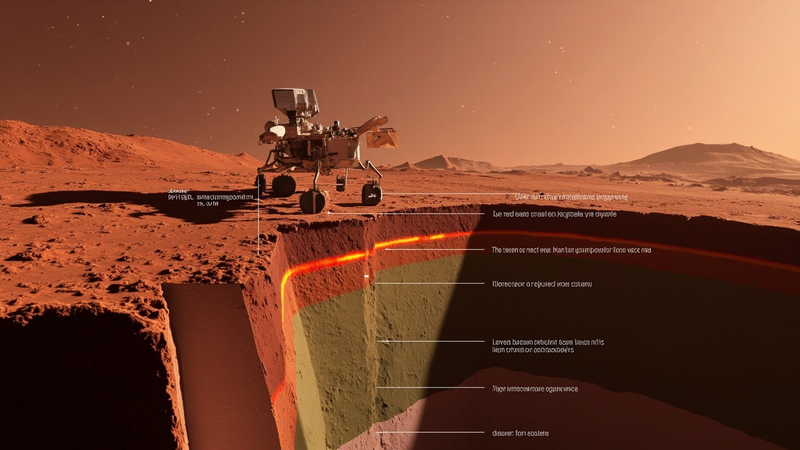
Cross-section of the Martian interior beneath the InSight lander: rust-red regolith above a 24-kilometer-thick basaltic upper crust, a sharp chemical discontinuity shown as a glowing orange line, and an olive-grey ultramafic lower crust descending into the mantle — all under one unbroken stagnant-lid shell.


A seismometer about the size of a basketball, planted on the Martian surface in late 2018, has just handed Earth-bound geophysicists a result that overturns a thirty-year assumption about how rocky planets assemble their crust. Nested inside the tremor record from NASA’s Interior Exploration using Seismic Investigations, Geodesy and Heat Transport (InSight) lander, a team at the University of Oxford has identified a chemical boundary roughly 24 kilometers below the Martian surface that looks suspiciously like the differentiated roots beneath Earth’s volcanic arcs. The implication, published this summer in Nature Astronomy, is that Mars once ran something close to Earth’s transcrustal magmatic systems — without any of the moving plates that geologists have long treated as a prerequisite for that level of crustal complexity (Mackay-Champion et al., Nature Astronomy, 2026).

Why this matters goes well beyond a footnote about Martian geology. If a planet with a single, unbroken lithospheric shell can still drive large, long-lived systems of melt accumulation, crystal settling, and chemical differentiation across its crust, then the basic recipe for building “evolved” crust does not require plate tectonics at all. That has direct consequences for how researchers rank the habitability of rocky exoplanets around other stars: a planet need not have a subdivided, mobile lid to keep its interior hot, recycle volatiles into the crust, and supply surface chemistry for billions of years of geologic time (University of Oxford press release, 24 June 2026).

The story that produced the result starts with InSight’s touchdown in Elysium Planitia on 26 November 2018. The lander deployed SEIS — a three-axis broadband seismometer built by CNES with contributions from IPGP and the Max Planck Institute for Solar System Research, weighing roughly 30 kilograms including its wind and thermal shield — directly onto the regolith using a small robotic arm. For the next four Earth years, until dust on the solar panels throttled power generation and ended nominal operations in late 2022, the instrument listened for marsquakes and the rumble of distant meteoroid impacts, gradually assembling a seismic catalog that geophysicists are still mining (Banerdt et al., Nature Geoscience, 2020). By mission end SEIS had recorded more than 1,300 candidate events distributed across the planet, the bulk of which were the high-frequency surface waves generated when mid-sized space rocks punched through the thin Martian atmosphere and detonated at the surface. What the new study does is take that catalog back to a question that has hung over Mars geophysics since the Viking era: what does the boundary detected by earlier receiver-function analyses, sitting somewhere between 20 and 30 kilometers depth, actually represent? Older interpretations ranged from a layer of frozen groundwater to a contact between volcanic flows and older basement rock. The Oxford group, led by Tobermory Mackay-Champion (now at the University of Bristol) with co-authors Mike Kendall and Jon Wade, reframed the question. They asked whether the discontinuity could be matched by a change in bulk rock chemistry rather than by an abrupt change in porosity or fluid content — and they did it by treating the receiver functions as a chemical assay rather than a structural one.

To answer that, the team assembled hundreds of plausible mineral assemblages — basaltic, andesitic, ultramafic, and exotic carbonatitic end-members — and ran each through thermodynamic equilibrium calculations at Martian crustal pressures and temperatures to determine stable mineralogy. They then predicted the seismic velocities those mineralogies should produce, using the standard relation V_p = sqrt((K + 4*mu/3)/rho) for compressional-wave speed, where K is the bulk modulus, mu the shear modulus, and rho the rock density, and the analogous V_s = sqrt(mu/rho) for shear. Because each mineral has a different temperature- and pressure-dependent stiffness, two compositionally distinct layers can have measurably different Vp/Vs ratios even at the same average density — and that is the lever the new study is pulling. Comparing those predictions with the actual P- and S-wave travel times picked out of marsquake and impact waveforms, the team found that the signal was systematic rather than scattered. The match that best explained the velocities above and below the boundary amounted, in plain terms, to a chemical sandwich. Below roughly 24 km, the seismic properties fit ultramafic assemblages dominated by olivine and low-calcium pyroxene — rocks high in iron and magnesium, low in silica, with densities around 3,200 to 3,300 kilograms per cubic meter. Above the boundary, the velocities matched basalt-like mafic compositions: higher silica, plagioclase-rich, with densities closer to 2,900 kilograms per cubic meter. The transition is on the order of a five to ten percent jump in Vp and a sharper change in Vp/Vs — the exact fingerprint you would expect if a deep cumulate pile sat beneath a more differentiated upper crust (Phys.org coverage of Mackay-Champion et al., 2026).

The way Earth geologists read that pattern is by analogy with what happens beneath active volcanic arcs on our own planet. A magmatic system that persists across the whole thickness of the crust tends to leave a chemical stratigraphy behind in its cooled roots. Dense, primitive cumulates settle out at depth; buoyant, silica-enriched differentiates rise through buoyancy-driven flow. What you end up with is a basalt-rich upper crust sitting on top of an ultramafic residue — exactly the layering the InSight data imply at the Martian mid-crustal discontinuity, except that on Earth the pattern is usually sustained for tens of millions of years by the steady down-going flux of subducting oceanic slabs. On Mars there is nothing sliding under anything.

The constraint that gives the result its bite is horizontal scale. The receiver functions that defined the 24 km boundary stacked across multiple marsquakes recorded at the same lander over several years, with the same converted-phase polarity and amplitude showing up across the catalog, which means the boundary must be laterally continuous over hundreds, possibly thousands, of kilometers across the northern lowlands (Khan et al., JGR Planets, 2023). Combined with the velocity match, the most parsimonious reading is a transcrustal magmatic system of the kind Earth hosts beneath the Andes or the Cascades — but operating within a stagnant lid, where heat is lost by conduction through the lithosphere rather than by advection in subduction zones.

What this changes looking forward is partly about Mars and partly about every rocky world sitting in the temperate zones around other stars. The classical assumption that habitability requires plate tectonics to recycle carbon, water, and other volatiles through a long-lived surface-interior cycle is no longer looking ironclad. A planet can plausibly keep its crust chemically active for billions of years through a different engine — one driven by mantle plumes, heat-pipe volcanism, or stagnant-lid overturn — that does not depend on a moving lid. The next two decades of exoplanet science — the era of the Nancy Grace Roman Space Telescope coronagraph, JWST atmospheric spectra of rocky habitable-zone targets, and eventually thirty-meter-class ground-based reconnaissance that may pick up volcanic outgassing signatures directly — will inherit a rubric where internal dynamics are an axis of habitability, but not the same axis as Earth’s. The next Mars geophysics flagship, be it a network mission like the proposed FSSM/Seismic Mars or a geodetic successor to InSight, will be designed to ask a follow-on question that the single-station SEIS catalog could not: how many such layers are there, and did the chemistry of the upper crust keep evolving through the Hesperian and into the Amazonian, or did the transcrustal engine shut down a billion years ago? Mars, in this reading, looks less like a frozen failed Earth and more like a different successful one — a planet that ran a long-lived chemical factory without ever needing to crack its lid.


September 7, 2026

Mars hides a hot hemisphere

Posted by


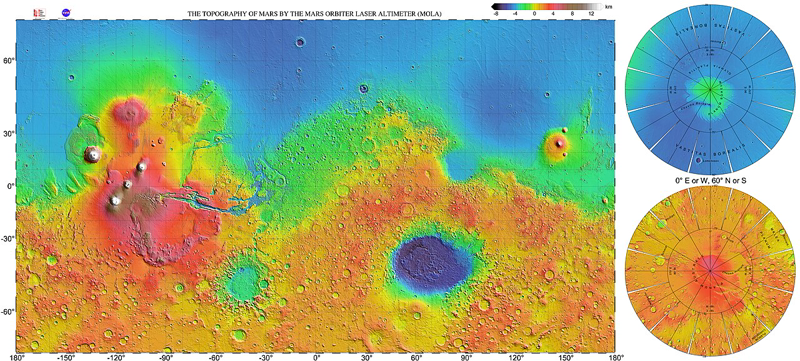
MOLA topographic map of Mars showing the dramatic hemispheric dichotomy: the rugged, elevated southern highlands in reds, oranges and yellows, the smoother, lower northern lowlands in greens and blues, with the Tharsis volcanic bulge on the left and the deep Hellas impact basin visible as a blue depression in the south.


A two-faced Mars has been hiding under its skin for as long as the planet has had a southern half and a northern half. The surface has always advertised the asymmetry: cratered, elevated highlands to the south and smooth, low-lying plains to the north, with a roughly 5 kilometer elevation drop at a boundary that traces most of a great circle around the planet. A study published in Nature on August 27, 2026 now reports that the split goes deeper than anyone had measured, all the way into the mantle. Alexander Berne, formerly at Caltech and now a postdoctoral associate at the University of Arizona, and twelve collaborators used nearly two decades of radio tracking data from three NASA Mars orbiters to infer that the mantle beneath the southern highlands is between 200 and 400 degrees Celsius warmer than the mantle beneath the northern lowlands, and that the contrast is preserved to the present day.

The crustal dichotomy has been one of the most stubborn puzzles in Mars science since the first global topographic maps arrived from the Mars Orbiter Laser Altimeter in the late 1990s. The northern lowlands sit about 5 kilometers lower than the southern highlands on average, and the southern crust is roughly 25 kilometers thicker. Magnetic stripes recorded in the southern crust by Mars Global Surveyor’s magnetometer imply that a once-active dynamo imprinted its field there, while the northern lowlands carry almost no such signature. Seismic waves from marsquakes detected by NASA’s InSight lander between 2018 and 2022 lose energy much more quickly when they travel through the mantle under the southern Terra Cimmeria region than when they pass through Cerberus Fossae in the north. Each of those observations had an individual explanation; what was missing was a single piece of physics that could pull them together.

Tidal tomography is a way to read a planet’s interior by watching how its shape responds to changing gravitational stresses from a partner body. Mars’s orbit is eccentric and its rotation axis is tilted, so the Sun’s tidal pull on the planet varies over the 687-day seasonal cycle. The deformation of the planet under that varying pull depends on the rigidity of the mantle at depth, and a stiffer or softer region flexes by a different amount, leaving a small but measurable fingerprint on the spacecraft flying overhead. Berne and his team analyzed X-band Doppler tracking collected by NASA’s Deep Space Network from Mars Global Surveyor, Mars Odyssey, and Mars Reconnaissance Orbiter over sixteen years and extracted the time-varying component of the Martian gravity field, as described in the Caltech press release. The degree-3 spherical harmonic coefficients of that field, which should be vanishingly small for a spherically symmetric planet, deviated from zero by up to 300 percent, with high statistical significance. A Bayesian Markov-chain Monte Carlo inversion using the semi-analytical code LOV3D translated those gravity deviations into a map of effective shear modulus in the mantle, which in turn implies the temperature contrast.

The map lines up almost perfectly with the surface topography. The team recovered a peak-to-peak variation in mantle shear modulus of 81 percent with a 60 percent uncertainty, with stiffer mantle beneath the northern lowlands, centered near Vastitas Borealis at 45 degrees north, 138 degrees west, and softer mantle beneath the southern highlands, centered near the Hellas basin at 45 degrees south, 42 degrees east. A colder mantle is stiffer, so the inversion translates the stiffness pattern into a present-day temperature anomaly of 200 to 400 degrees Celsius, biased hot to the south. The team also constrained compositional differences: up to 5 percent iron enrichment in the southern mantle relative to the north, a modest but non-negligible contribution that helps the gravity field match without breaking the observed center-of-figure to center-of-mass offset, per Space.com’s coverage. The paper notes that even this 5 percent compositional contribution requires the temperature anomaly; pure composition cannot reproduce the rigidity contrast without violating independent constraints on Mars’s interior structure.

The InSight lander had already left a strong clue, as ScienceDaily summarized. Quality factors, a measure of how much energy a seismic wave loses as it travels through a given region, came in around 500 for events in Terra Cimmeria in the south and between 800 and 2000 for events in Cerberus Fossae in the north. A few hundred kelvin of extra heat in the southern mantle can drive that contrast, and the new tidal tomography result sits right at the temperature the seismic attenuation had implied. Magnetic anomalies in the southern highlands crust also make more sense if the mantle beneath them was unusually hot for part of Mars’s early history: a deep heat source under the south could have driven stronger convection in the underlying outer core, sustaining a localized dynamo that imprinted the crust as it cooled through the Curie temperature before the global field died out around 4 billion years ago. The InSight quality factors are still well above what fully molten rock would produce, so the southern mantle is warm rather than liquid, and three competing explanations remain in play. A giant impact, the so-called Borealis basin formation often invoked to explain the lowlands, would have left the southern mantle iron-enriched relative to the north, consistent with what the team infers, but a single impact is not expected to keep a hemisphere several hundred kelvin hotter than the other for four billion years without help. Spontaneous degree-1 convection would naturally produce a thermal asymmetry but predicts the opposite compositional signature. Thermal insulation by the thick southern crust can sustain the observed temperatures in geodynamic simulations and matches the seismic data, but does not by itself explain why the southern crust is thick in the first place. Berne and his co-authors favor a hybrid story: a giant impact removed or depleted the northern mantle early, leaving the south iron-enriched, and the resulting thicker southern crust then insulated the mantle beneath it long enough for the present-day thermal contrast to survive.

The next probes of this structure will not be landers but gravity missions. Today’s Mars orbiters can resolve degree-3 variations in the time-varying field only because the team pooled two decades of data. A dedicated gravity mission, the Mars-equivalent of GRACE on Earth or GRAIL at the Moon, could resolve similar or finer heterogeneities in a small fraction of the time, and the same technique generalizes to other asymmetric worlds. The authors specifically call out Ganymede, Mercury, Io, and Enceladus as targets where tidal tomography could reveal deep interior structure that no lander has yet touched. The deeper message is that the Martian dichotomy is not just a story about an ancient surface; it is a story about an interior that has remembered its first billion years and is still telling the tale, one radio photon at a time, to anyone with sixteen years of patience to listen.


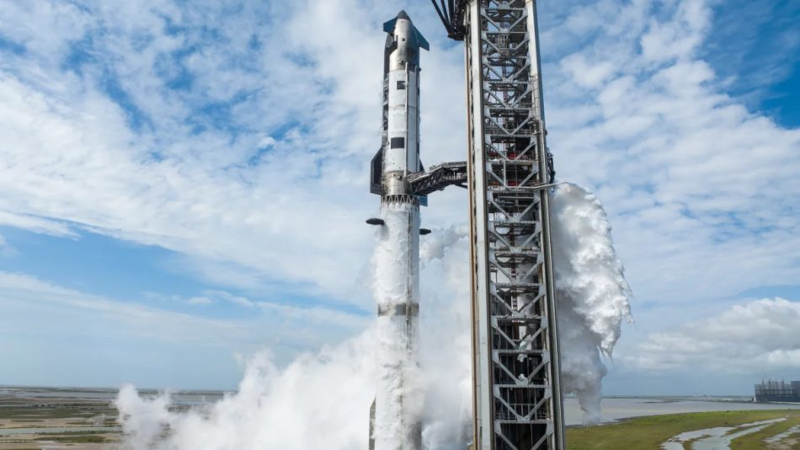
SpaceX has set no earlier than May 19, 2026, for the first flight of Starship in its Version 3 configuration, a significant step in the development of the vehicle that NASA has contracted to land astronauts on the Moon and that SpaceX intends to use for missions to Mars. The upcoming flight, designated Flight 12, will lift off from Starbase in South Texas with a window opening around 5:30 to 6:30 p.m. ET, with a backup opportunity on May 20 if weather or technical issues require it.

The Version 3 configuration represents the most capable iteration of the Starship and Super Heavy system yet built. The vehicle stands approximately 150 meters tall with the upper stage stacked on the booster, making it the largest flying object ever constructed. The Super Heavy booster carries 33 Raptor engines — the full complement — compared to the 33-engine configuration that flew in earlier tests, but V3 introduces upgraded engines with higher thrust output and improved longevity. The upper stage, Ship 39, carries the same engine count as its predecessors but benefits from the thermal protection and reusability improvements that the SpaceX team has refined through the program’s rapid iteration cycle.

On May 11 and 12, SpaceX completed a full launch rehearsal that included propellant loading and a 33-engine static fire of Booster 19 with Ship 39 stacked on top. The test was the first time V3 hardware had been subjected to a full-duration static fire with all engines firing simultaneously, and it verified the vehicle’s readiness for flight conditions. The rehearsal included loading cryogenic propellants — liquid oxygen and liquid methane — into both stages, a process that takes hours and involves managing thermal gradients and boil-off rates that are significantly more complex for a vehicle of Starship’s scale than for any prior rocket.

The May 19 target has been in development for several weeks. SpaceX had originally planned an earlier V3 debut but chose to extend the testing and validation phase after discovering a hardware issue during pre-flight inspections. The conservative approach reflects a pattern the company has followed throughout the Starship program: when something does not look right, the team stops, diagnoses, and fixes rather than proceeding and hoping for the best. The strategy has produced a flight rate that is slower than early projections suggested, but it has also produced a vehicle that, by the time it flies, has been tested against the conditions it will actually face.

Flight 12 will be the first Starship flight of 2026 and the twelfth overall test flight in the program’s history. SpaceX has been flying approximately one Starship mission every few months as the vehicle matures, with each flight serving as both a test of new hardware and a demonstration of capabilities that have been validated in previous flights. The Version 3 hardware will attempt to complete the full mission profile: a full-duration burn of both stages, a controlled descent of the booster back toward the launch site where it will be caught by the mechanical arm system, and an upper stage that will perform a controlled splashdown in the Indian Ocean after completing one or more orbits of Earth.

The vehicle’s role in NASA’s Artemis program gives the program a significance that extends beyond SpaceX’s own ambitions. The Human Landing System contract that NASA awarded to Starship requires the vehicle to demonstrate crewed lunar landing capability before astronauts from the Artemis III mission descend to the lunar surface. That demonstration is years away, but the hardware being tested in the V3 flights is the same hardware that will eventually attempt the lunar descent. Each test flight, even if it ends in a loss of vehicle, produces data that refines the engineering and reduces the risk of the crewed mission later.

The May 19 window is specific enough that it suggests the team has high confidence in the timeline, but not so specific that it implies a guarantee. SpaceX has shown, repeatedly, that it will delay a launch rather than fly a vehicle it has reason to doubt. For a rocket program that has redefined what rapid iteration means in aerospace, the patience to wait for the right conditions is not a contradiction — it is the discipline that makes the iteration sustainable.

Super Heavy’s 33-engine first stage is a study in the engineering trade-offs that define modern launch vehicle design. Each Raptor engine produces a specific thrust at sea level, and the total thrust at liftoff is the sum of all 33 engines burning simultaneously. The challenge is not generating that thrust but managing the physical interactions between engines, the structure, and the propellant flow at the scale Super Heavy requires.

The Raptor engine uses a full-flow staged combustion cycle, which means that all of the fuel and oxidizer are gasified before they enter the combustion chamber. This approach produces very high efficiency — specific impulse in the range of 380 seconds at sea level — but it requires turbomachinery that can handle extreme temperatures and pressures without failing. The engineering challenge is not just the performance but the durability: an engine that will be fired multiple times must maintain its tolerances across many cycles of heating and cooling, which is why the V3 engines include upgrades to materials and cooling passages that extend engine life.

At liftoff, the structural loads on Super Heavy are enormous. The vehicle weighs approximately 4,000 metric tons at full propellant, and the acceleration from zero to thousands of meters per second in a few minutes requires structural integrity in the airframe that can withstand both the axial loads along the body and the bending moments produced by the aerodynamic forces acting along the vehicle’s length. The stainless steel construction that SpaceX chose for Starship is not a cost-cutting measure but an engineering decision that trades away the weight efficiency of carbon composites for the fracture toughness and reusability of a material that can survive the thermal and structural extremes of repeated flights without developing the microcracks that compromise composite structures over time.

The catch mechanism — the mechanical arms at the launch tower that are designed to catch the returning booster rather than landing it on legs — remains one of the more ambitious elements of the Starship reusability architecture. The system requires precise trajectory control during descent, a structure on the booster that can interface with the catcher arms, and software that can execute the maneuver reliably at the end of a ballistic arc. The May 19 flight will be the first V3 attempt at this catch, and whether the system works on the first try or requires iteration will define the timeline for the operational reusability that SpaceX has designed the vehicle around.