OrbitalHub

Where curiosity reaches escape velocity.

Domain is for sale. $50,000,000.00 USD. Direct any inquiries to contact@orbitalhub.com.

Archive for 2026

September 26, 2026

A comet older than the Sun

Posted by


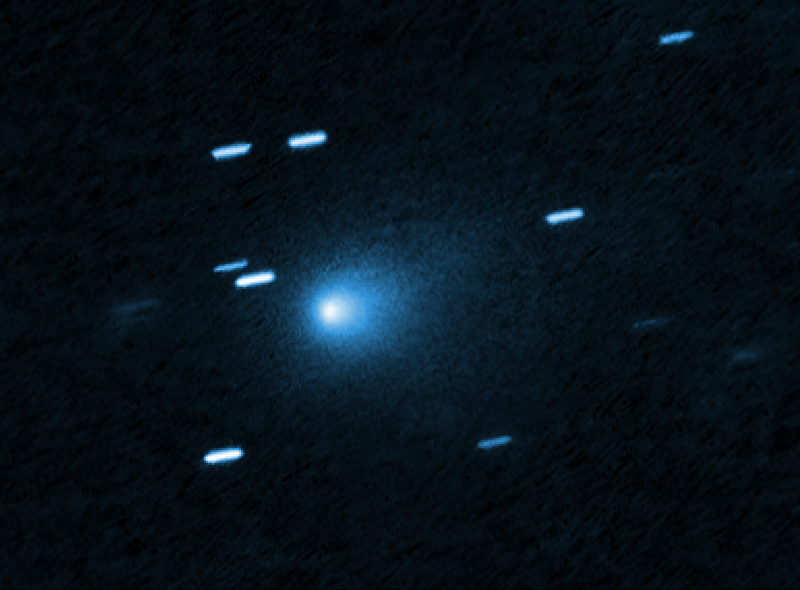
A telescope exposure shows a comet as a compact bright core inside a soft blue coma, while background stars are drawn into short dashes by the tracking.


Look at the image above. A teardrop-shaped cocoon of dust drifts against a backdrop of smeared star streaks. The streaks are not an aesthetic choice; they are the signature of a tracking problem. The Hubble Space Telescope was locked onto the comet and the sky slid behind it, smearing every background star into a line. The dust cloud we are looking at has to be tracked because it is moving fast. 3I/ATLAS, the third confirmed interstellar object ever seen passing through the solar system, was discovered on 1 July 2025 by the ATLAS survey telescope in Rio Hurtado, Chile, and was already 365 million kilometers away when Hubble photographed it on 21 July (NASA, ESA; heic2509).

What makes 3I/ATLAS different from its predecessors, 1I/’Oumuamua in 2017 and 2I/Borisov in 2019, is not its speed. At a hyperbolic excess velocity near 57 km/s, it is comparable to Borisov. The difference is that we have had time and the James Webb Space Telescope. A paper led by Martin Cordiner at NASA Goddard, posted to arXiv in March and published in Nature on 22 June 2026, reports JWST spectra that pin down isotopic ratios in the gas around the nucleus, and those ratios say where the object came from (Cordiner et al., 2026, arXiv:2603.06911).

The first two interstellar visitors were case studies in frustration. ‘Oumuamua showed no detectable coma and accelerated away from the Sun with no visible tail, generating a decade of papers arguing about whether it was a hydrogen iceberg, a fragment of nitrogen ice, or a piece of exotic rock. Borisov behaved more like an ordinary comet but was already past perihelion when discovered and faded fast. Both passed through the inner solar system in weeks, neither caught by an instrument capable of high-resolution infrared spectroscopy.

3I/ATLAS was caught early and held for months. Perihelion came on 29 October 2025 at 1.36 AU, deep enough inside the snow line for volatiles to drive an active coma. JWST observed it with NIRSpec on 6 August 2025 while it was still inbound at 3.32 AU, and again on 22–23 December 2025 as it climbed back out. Program 5094 put the integral-field unit on the target with a 0.1-arcsecond pixel scale, resolving structures about 130 kilometers across inside the coma (Cordiner et al., 2026).

The headline numbers are extreme. The CO₂-to-H₂O ratio at ingress is 7.6 ± 0.3, which sits 4.5 sigma above the trendline for solar-system comets. The CO-to-H₂O ratio is 1.65 ± 0.09. Methane was detected for the first time on an interstellar object, but only on the outbound side, which suggests it lives buried deeper than the more volatile CO and CO₂. The dust spectrum shows a strong 10-micrometer amorphous-silicate feature rather than the crystalline silicates that dominate solar-system comets (Cordiner et al., 2026).

What makes the paper worth reading past the abstract is the isotopic table. The deuterium-to-hydrogen ratio in the water coming off the nucleus is (0.95 ± 0.06)%, more than thirty times higher than in typical solar-system comets and comparable to dense interstellar-medium ices. The ¹²C/¹³C ratio runs 141 to 191 in CO₂ and 123 to 172 in CO, both well above the solar value of about 89 (Cordiner et al., 2026).

In astrophysics, isotopes are clocks. Deuterium is fragile: it is destroyed in stars and rebuilt only by spallation and the Big Bang. A high D/H ratio means the water never spent long inside a hot stellar environment. It was locked in cold ice, somewhere below about 30 K, for most of its existence. The ¹²C/¹³C ratio is a slow clock that runs on stellar nucleosynthesis. Older stellar populations in the galactic disk have more ¹²C because ¹³C is produced by hot CNO burning and mixed in over time. A high ¹²C/¹³C ratio points to material that formed before the disk had been stirred by many generations of stars.

Plug those constraints into a simple galactic-chemical-evolution model and 3I/ATLAS dates itself. The numbers are consistent with formation between roughly ten and twelve billion years ago, when the universe was at its peak rate of star formation, what astronomers call cosmic noon (Cordiner et al., 2026). That is almost three times the age of the Sun. The comet we are watching today was already a respectable lump of ice before the disk of gas that would become our solar system had finished collapsing.

There is one caveat, raised by Maggiolo and colleagues in The Astrophysical Journal Letters. Galactic cosmic rays can rewrite the surface chemistry of an interstellar object over billions of years, converting CO into CO₂ and building an organic-rich irradiated crust roughly fifteen to twenty meters thick. The volatiles we see today may sample that processed shell rather than the pristine interior (Maggiolo et al., 2026, ApJL).

The instrument is NIRSpec on JWST, in integral-field-unit mode. The IFU slices the field into a 30-by-30 grid of 0.1-arcsecond spaxels, each a tiny spectrograph feeding a 0.6-to-5.3-micrometer spectrum through crossed dispersers. The high-resolution gratings G235H and G395H deliver a resolving power near 2,700, enough to separate the vibration-rotation lines of H₂O, CO, CO₂, and their rarer isotopologues, including HDO and ¹³CO₂.

To go from line intensity to abundance requires radiative-transfer modeling. For a spherical, expanding coma with constant velocity, the column density of a species is proportional to its production rate divided by its photodissociation rate times its lifetime, scaled by a Haser-model factor of 1/r where r is the projected distance from the nucleus. The Cordiner team used the Planetary Spectrum Generator to fit line fluxes at multiple spaxels simultaneously, then propagated the uncertainties through the production-rate inversion. The 0.95% D/H ratio is the marginalized posterior after fitting both HDO and H₂O lines at multiple offset positions, and the precision is what makes it significant (Cordiner et al., 2026).

The engineering lesson is that an instrument designed to stare at the first galaxies is also a perfectly serviceable high-resolution infrared spectrometer for a faint, fast, mid-plum comet. JWST’s sunshield keeps the telescope cold enough that its own thermal background does not swamp the molecular lines, the IFU’s fine spatial sampling lets the team disentangle nucleus emission from extended coma, and the orbit at L2 means the same target can be re-observed weeks later with the same geometry.

3I/ATLAS is the first object we have ever measured that we can confidently call older than the solar system. Its isotopes tell us it condensed out of interstellar ices near cosmic noon, that it survived a passage through a planetary system without being torn apart, and that it has spent billions of years coasting through the galaxy getting slowly sandblasted by cosmic rays. It is, in a real sense, a piece of archaeology delivered free of charge to the inner solar system.

Two questions now drive the field. How much of the unusual composition is primordial and how much is the irradiated crust, and how thick is that crust? And harder: are there more like it? LSST at the Vera Rubin Observatory is scanning the southern sky in earnest, and its 3.2-gigapixel camera will catch the next interstellar interloper at a much earlier phase. If the JWST spectrum of this comet is representative, future visitors will be obvious from their CO₂ excess long before a big telescope has to swing.

The interstellar comet has already whipped past Jupiter, in March 2026, and is now climbing out of the solar system toward the constellation Gemini on a hyperbolic escape trajectory. It will not come back. We caught it once. The next one will not surprise us.

Sources: Cordiner, M. A. et al., “Isotopic evidence for a cold and distant origin of 3I/ATLAS,” Nature, published 22 June 2026 (arXiv:2603.06911); NASA/ESA Hubble Space Telescope image heic2509, “3I/ATLAS,” NASA, ESA, D. Jewitt (UCLA), image processing J. DePasquale (STScI), 7 August 2025; NASA Science Mission Directorate, “Comet 3I/ATLAS” page, science.nasa.gov/solar-system/comets/3i-atlas/; Maggiolo, R. et al., “Galactic Cosmic Ray Processing of Interstellar Object Volatiles,” The Astrophysical Journal Letters, 2026.
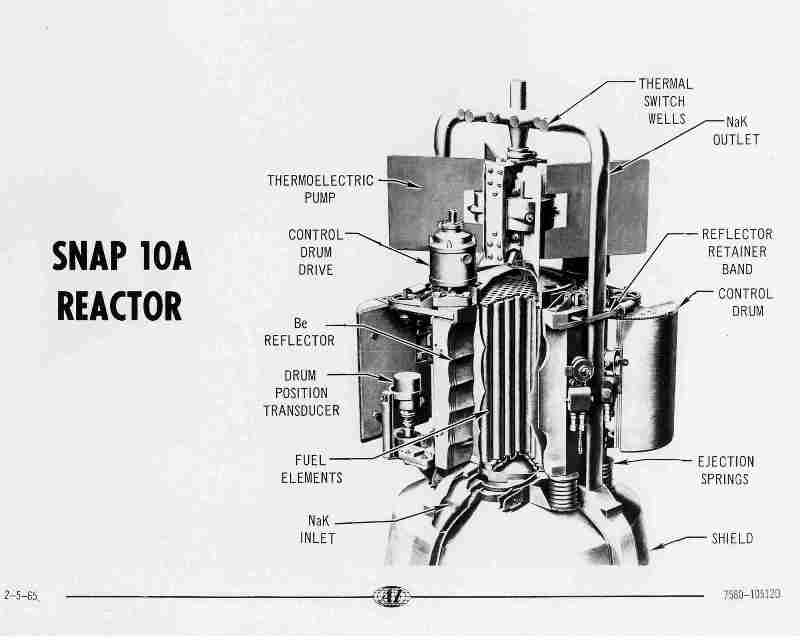


Labeled cutaway diagram of the SNAP-10A reactor, showing the Be reflector, fuel elements, control drum drive, thermoelectric pump, NaK inlet and outlet, and ejection springs, dated 2-5-65


Antares Nuclear, a three-year-old startup in Torrance, California, walked away from a September 14, 2026 award ceremony with what it calls the largest U.S. Department of War contract ever signed specifically for nuclear power in space: $161 million to design, ground-test, and eventually fly a fission reactor on a spacecraft. The Office of the Assistant Secretary of the Air Force for Space Acquisition and Integration structured the Strategic Breakthrough award around two related efforts, a ground demonstration of a reactor called R1-S followed by integration work on an electricity-producing variant called Mark-1 that Antares plans to begin testing in 2027. The company has not yet named a target launch date for R1-S or which mission it would eventually support, but the contract is the clearest signal yet that the U.S. government intends to put a fission reactor in orbit in this decade rather than the next (Defence Blog, September 14, 2026).

The strategic logic is straightforward, and it has very little to do with sending astronauts to Mars. Most satellites today run on solar panels paired with batteries sized for eclipse periods, which sets a hard ceiling on how much power is available onboard and how aggressively a spacecraft can maneuver without draining its reserves. A compact fission reactor gives a satellite continuous high-output power instead of the day-night cycle that solar arrays impose, supporting heavier onboard computers, sustained orbital maneuvers, and payloads such as directed-energy systems or electronic-warfare gear that today’s power budget cannot accommodate at all. Jordan Bramble, Antares’ chief executive and co-founder, framed the award the same way his investors do: “Fission will unlock strategic capabilities that are impossible today.” The Department of War’s appetite for those capabilities is not new, but the budget to actually build toward them has historically been small, scattered across NASA and Defense programs, and constrained by a decades-long absence of any American nuclear reactor actually running in space (Defence Blog, September 14, 2026).

The Antares award is the latest milestone in a sequence that began quietly six years before the contract was signed. On June 4, 2026, the company’s Mark-0 demonstrator reactor completed what is technically known as a zero-power fueled criticality at Idaho National Laboratory’s Reactor and Critical Experiment (RACE) facility, the moment at which a nuclear fission chain reaction becomes self-sustaining. The test, conducted under Department of Energy authorization and with nuclear fuel maker BWX Technologies fabricating the fuel, made Antares the first private company to bring an advanced reactor to criticality under the DOE’s Reactor Pilot Program. It was also the first novel reactor design to achieve criticality at the Idaho site in more than fifty years, according to INL Laboratory Director John Wagner, who emphasized that the Mark-0 test produced essentially no measurable thermal output: proof that the physics worked, not proof that the system could yet generate electricity (Power Magazine, June 2026; U.S. Department of Energy, June 4, 2026).

That single June milestone unlocked everything that followed. Data from the Mark-0 test is being shared with the Department of War’s Project Pele, a long-running program to build a transportable microreactor for forward military bases, and Antares is also a supplier under the U.S. Army’s separate Janus Program, which is installing microreactors at installations including Fort Benning, Georgia. The Space Force award is the third major customer the company has signed, after the Army and the Air Force itself, and Antares says it now holds agreements with NASA and the Defense Innovation Unit as well. Private capital has followed the same trajectory: the company closed a $96 million Series B round in December 2025, raising its total private funding above $600 million by mid-2026 (Defence Blog, September 14, 2026; Power Magazine, June 2026).

The policy backdrop is two documents rather than one. Executive Order 14369, signed in late 2025 and titled “Ensuring American Space Superiority,” directed the federal government to “deploy nuclear reactors on the Moon and in orbit, including a lunar surface reactor ready for launch by 2030” (Executive Order 14369, The American Presidency Project). The implementation memo, National Security and Technology Memorandum-3 (NSTM-3), issued on April 14, 2026, gave NASA and the Department of War thirty days to start parallel reactor competitions: a mid-power fission surface power (FSP) system targeted for the Moon by 2030, and a separate space-based reactor to support nuclear electric propulsion. The Antares award sits inside the second of those two tracks, where the schedule is even tighter: NSTM-3 calls for an American reactor in orbit as early as 2028 (SpaceNews, April 2026).

The hardware Antares is building toward looks much more like a 1965 satellite than a 2026 data center. The R1 microreactor, the commercial product the company’s ground-test reactors are iterating toward, uses tri-structural isotropic (TRISO) fuel, particles of high-assay low-enriched uranium (HALEU) coated in layers of carbon and ceramic, embedded in a prismatic graphite core. Passive sodium heat pipes carry heat from the core to a fin-and-tube primary heat exchanger, and a recuperated nitrogen-closed Brayton cycle converts that heat into electricity at outputs between 100 kilowatts and 1 megawatt depending on configuration. The R1 is rated to operate for six or more years between refueling and is designed to run without a connection to the commercial grid, exactly the operating envelope a spacecraft needs (Power Magazine, June 2026). The conceptual lineage runs straight back to SNAP-10A, the only fission reactor the United States has ever placed in orbit, which launched on April 3, 1965 aboard an Atlas-Agena D from Vandenberg and ran for forty-three days before a non-nuclear voltage regulator failed in its thermoelectric pump. The SNAP-10A core used a similar arrangement of uranium fuel elements, a beryllium reflector, sodium-potassium (NaK) coolant loops, and control drums rotated by an electric drive to manage reactivity (Wikipedia, SNAP-10A).

The diagram above, a 1965 U.S. Department of Energy drawing of the SNAP-10A core, illustrates the conceptual continuity. The beryllium reflector wraps the fuel elements and bounces neutrons back into the chain reaction; the control drums rotate to absorb neutrons and throttle reactor power; the NaK loops carry heat from the core to a thermoelectric pump that converts it directly into electricity without moving parts. Antares has replaced the thermoelectric pump with a closed Brayton cycle and swapped the SNAP-era fuel for HALEU TRISO, but the operating principle, a compact, passively cooled, six-year core with no moving coolant pumps, has not changed (Wikimedia Commons, File:SNAP-10A Reactor.jpg).

What has changed is the supply chain. The 1965 program drew on a single nuclear vendor (Atomics International, a division of North American Aviation) and a single satellite integrator; the 2026 program has at least three parallel microreactor vendors (Antares, plus the BWXT-led Project Pele team and at least one other Army Janus participant), HALEU production being stood up at multiple Department of Energy sites, and TRISO fuel fabrication running commercially at BWX Technologies since October 2025. If Antares meets its schedule, the United States will close a sixty-year gap between SNAP-10A and the next American fission reactor in orbit, and the Mark-1 testing campaign starting in 2027 will tell the industry whether the next one after that flies on a lunar lander or a Space Force satellite.


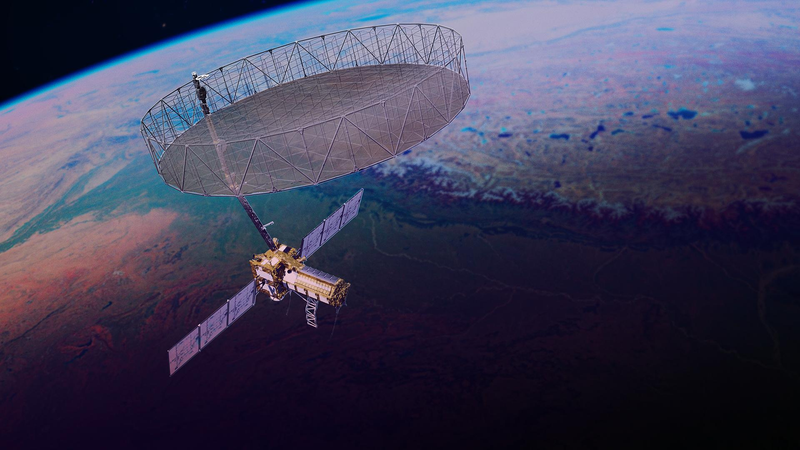
A radar satellite carrying a large drum-shaped mesh reflector on a boom flies above a false-colour landscape of river valleys and lakes.


The GSLV Mk II is not, on paper, the most glamorous rocket in the world. It does not chase Falcon 9 reuse statistics, and it has historically been used for the unglamorous work of dropping navigation payloads into geostationary transfer orbit. On July 30, 2026, at 8:10 a.m. Eastern, an Indian GSLV F-16 lifted off from Satish Dhawan Space Centre on the Palk Strait coast, and for the first time in the vehicle’s history it pointed its cryogenic upper stage south-southwest, toward a 747-kilometer sun-synchronous orbit. The payload was a 2,800-kilogram stack that NASA and the Indian Space Research Organisation (ISRO) had spent eleven years building together. NASA called it the most expensive single instrument it had ever flown; ISRO called it the heaviest foreign payload it had ever launched. Within twenty minutes, both ground stations had signal. The spacecraft, NISAR, was healthy on orbit, and the largest unfurlable radar reflector ever launched was still folded against its side (SpaceNews, July 21, 2026).

Earth-observing radar is not new. The European Space Agency’s ERS-1 flew a C-band synthetic aperture radar in 1991. Japan’s ALOS, Germany’s TerraSAR-X, and the Copernicus Sentinel-1 constellation have, between them, turned interferometric SAR (InSAR) into a routine tool for tracking millimeter-scale ground motion across continents. What NISAR adds is two capabilities stacked together: it is the first civilian radar satellite to carry both an L-band system at 1.257 gigahertz (about 24 centimeters wavelength) and an S-band system at 3.2 gigahertz (about 9 centimeters), sharing one 12-meter mesh reflector and one 9-meter boom (NASA, 2026 mission fact sheet).

That dual-frequency design closes a gap that has bedeviled the field for thirty years. L-band penetrates vegetation and dry soil, so it stays coherent over forests and crops long enough to measure slow tectonic creep. S-band is more sensitive to the top surface, so it tracks flood extent, snow wetness, and crop structure. Flying them together means a single pass produces two interferograms that can be differenced to remove atmospheric phase noise. The mission is set to map nearly all of Earth’s land and ice surfaces twice every twelve days, every cycle of 173 orbits, for at least three years (NASA, 2026).

The cost is real: NASA’s contribution sits at roughly $1.2 billion, ISRO’s share at about 7.88 billion rupees ($91 million) in 2017 terms, though the actual figure is higher now (SpaceNews, July 21, 2026). That is the price of joining two cautious space agencies into one program that survived an antenna repair that required a round-trip shipping container between Bangalore and California.

The GSLV F-16’s profile looked normal on paper: liftoff mass around 420 tonnes, the standard S9.4 cryogenic third stage burning liquid hydrogen and liquid oxygen, a 17-meter payload fairing. What was not standard was the orbit. The Satish Dhawan range usually targets 36,000-kilometer geostationary slots, and the polar corridor is dominated by the smaller, solid-fueled PSLV. Pushing a 2,800-kilogram payload with a stowed 12-meter mesh reflector into a sun-synchronous orbit required every kilogram of performance the cryogenic upper stage could deliver, and a launch window that avoided the eclipse season that would have left the stowed reflector swinging through 200-degree temperature swings during deployment.

The earlier slipped target of March 2025 was abandoned because engineers discovered during thermal-vacuum testing that the reflector’s black structural rods would absorb too much solar heat stowed. NASA shipped the antenna back to Goddard Space Flight Center, where technicians applied strips of reflective tape to the rods, and put it on a C-130 back to India in October 2024 (SpaceNews, December 2024). After that, the schedule bowed to ISRO’s launch cadence: the NVS-02 navigation satellite needed the same pad first, six to eight weeks of pad refurbishment followed, and then a slot had to be picked that would keep the spacecraft out of eclipse for at least the first weeks of its commissioning.

When the rocket climbed off the pad on July 30, it did so against a backdrop few in the West paid attention to. ISRO had lost the EOS-09 radar imaging satellite on a PSLV third-stage failure on May 17, 2026, and the NVS-02 navigation satellite had been stranded in the wrong orbit in January after a propellant valve failed to open. Neither hardware line is shared with GSLV, but the question of process discipline was in the air. The July 21 press conference that confirmed the launch date did not include a single ISRO representative, a fact NASA attributed to the time difference but which industry sources flagged as unusual (SpaceNews, July 21, 2026). Two days after launch, both parties confirmed that the spacecraft was operating normally and that solar array deployment had succeeded.

The most counter-intuitive thing about NISAR is that it is not, strictly, an imaging instrument. A SAR builds an image by emitting a chirped radar pulse, listening to the echo, and using the platform’s forward motion to synthesize an antenna tens of kilometers long. Range resolution comes from the chirp bandwidth (NISAR’s L-band transmits 80 megahertz of bandwidth, giving roughly 2 meters of slant-range resolution; S-band transmits 37.5 megahertz for about 5 meters). Azimuth resolution comes from Doppler processing of the returns along the flight track. The signal is recorded in phase, so a second pass from almost the same position lets you subtract two images and recover ground displacement to the centimeter level. The relation is:

Δr = λ / (4π) * Δφ

where λ is the radar wavelength and Δφ is the wrapped interferometric phase. At L-band, a phase change of one radian corresponds to about two centimeters of line-of-sight motion.

The reflector is the engineering showpiece. Stowed, it fits inside a 1.5-meter collar; deployed, it becomes a 12-meter ribbed disk covered in gold-plated molybdenum wire mesh. The 9-meter boom that holds the feed assembly is built from composite truss segments that unfold in a sequence to avoid contact with the reflector surface; the whole assembly weighs about 145 kilograms. NASA and Astro Aerospace invented a new hinge mechanism because earlier mesh reflectors of this diameter were not designed for the thermal cycling of a sun-synchronous dawn-dusk orbit.

The orbit itself is part of the engineering story. NISAR flies in a 6 a.m. / 6 p.m. ascending-node sun-synchronous configuration, which gives consistent illumination across the 12-day cycle. The exact repeat of 173 orbits in 12 days constrains the swath to about 242 kilometers, which in turn constrains the antenna geometry. The mission team designed a ScanSAR mode in which the radar beam is electronically steered across five sub-swaths in elevation, then assembled into a wide swath at the cost of coarser azimuth resolution. NISAR will operate primarily in this mode.

Finally, the data pipeline. NASA’s Alaska Satellite Facility DAAC will host the L-band data; ISRO’s Bhoonidhi portal will host the S-band data. Both agencies committed to a 24-hour urgent-acquisition capability: within a day of a magnitude-7 earthquake, NISAR could re-point to map the coseismic deformation field over hundreds of kilometers.

If commissioning goes as planned, NISAR will begin science operations in October 2026, after roughly ninety days of radar calibrations, antenna deployments, and orbit trim maneuvers. Early months of data will be dominated by earthquakes, glacier flow, and agricultural calibration campaigns over the US Corn Belt. Within a year, NISAR should be producing the most consistent global interferometric stack ever assembled, a baseline that will outlast Sentinel-1C and ALOS-4.

The broader lesson is older than radar. Eleven years, two agencies, 2,800 kilograms, one reflector, two frequencies. Earth observation at this scale is no longer a single-country program. What NISAR proves is that two different bureaucracies can still agree on what a centimeter means.


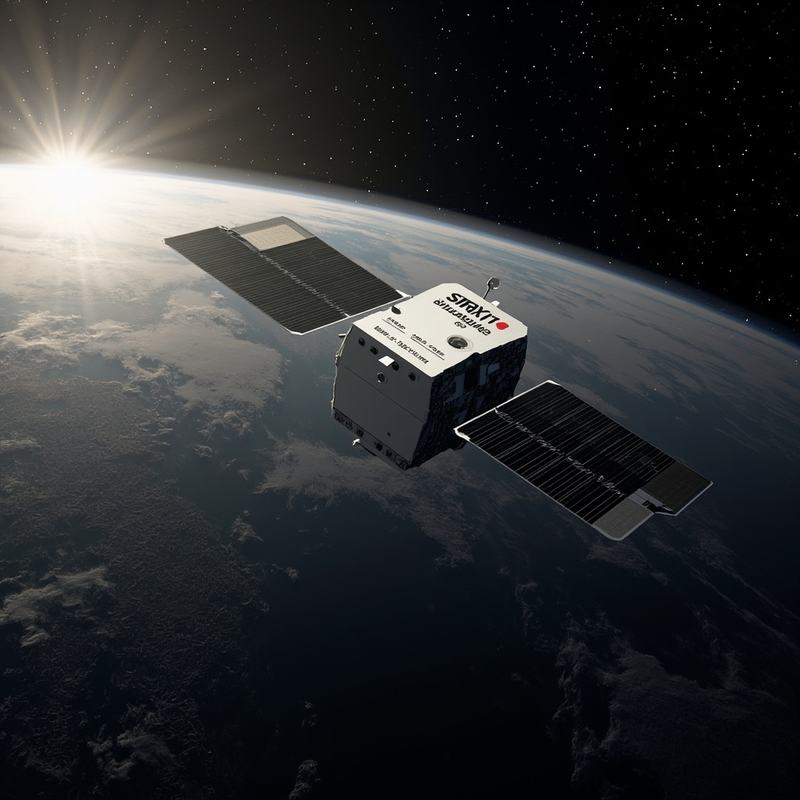
Synspective's StriX-12 synthetic aperture radar (SAR) satellite in low Earth orbit at ~500 km altitude in sun-synchronous orbit, its deployable X-band slot-array antenna extended and two solar arrays deployed, with Earth below rendered in muted grayscale SAR-backscatter tones (urban areas bright, water dark, terrain in mid-tones).

Rocket Lab’s 96th Electron mission, named “Owl By The Dozen,” lifted off from Launch Complex 1 in Mahia, New Zealand, at 3:22 PM New Zealand Standard Time on September 19, 2026, and placed a single Synspective StriX satellite into a precise 572 km sun-synchronous orbit (Rocket Lab, September 19, 2026). One satellite, one mission, one line in the launch log. The line below it matters more. Synspective is no longer a constellation-builder pitching a future roadmap; it is now a constellation-operator pitching capacity to anyone who can sign a contract.


The reason it took twelve satellites to get there is the reason synthetic aperture radar (SAR) was the most expensive way to look down at Earth for most of its history. SAR works through cloud, through rain, and through the polar night — three failure modes that optical imaging cannot survive. The instruments that proved it could be done were government-funded and large: Canada’s RADARSAT-2, Germany’s TerraSAR-X, Europe’s Sentinel-1 family, and the just-launched NASA-ISRO NISAR, which reached orbit in July 2026 on an Indian GSLV with a $1.2 billion NASA contribution (SpaceNews, 2026). Those are flagship observatories, not commercial services. Synspective’s bet since its 2018 founding has been that X-band SAR could be done on a 100-kilogram-class satellite with a foldable planar slot-array antenna that opens to roughly five meters across once on orbit, at one-tenth the mass and one-twentieth the cost of a large SAR satellite (Synspective press release, March 2026). Twelve operational satellites later, that bet is producing 1-3 meter ground-resolution imagery across Stripmap and Sliding Spotlight modes, in any weather, day or night.

The company was founded on February 22, 2018, when Keio University space-policy professor Seiko Shirasaka met small-satellite engineer Motoyuki Arai, who had been running SAR technology development inside Japan’s Cabinet Office ImPACT initiative (Synspective corporate history, 2024). The ImPACT program had spent eight years funding compact SAR architectures through JAXA and the Tokyo Institute of Technology. Shirasaka brought the policy and commercial framing; Arai brought the hardware. StriX-1 reached orbit in September 2022. The four years since have been about factory cadence: StriX-α and StriX-β as demonstrators, then operational satellites through 2024, 2025, and 2026 — StriX-9 in May 2026, StriX-10 in June, StriX-11 on September 15, and now StriX-12 four days later (Synspective press releases, 2026). The cadence is the headline. A constellation that grows by one every few weeks can be refilled, replaced, and reshaped on a commercial timetable.

September 2026 is also the month Synspective changed what it sells. On September 16, the company announced Synspective OMNIA, a program that lets partners — national space agencies, prime contractors, regional governments — lease a dedicated share of StriX capacity, the same way cloud customers lease dedicated server instances rather than renting virtual machines by the hour (Synspective corporate site, September 16, 2026). Two days later, on September 18, the company signed a launch services agreement with Mitsubishi Heavy Industries for two additional StriX satellites on the H3 rocket, the Japanese flagship launcher that has been flying cleanly since its 2023 maiden flight (SpaceWatch Global, September 18, 2026). And on September 19, the Rocket Lab mission placed the latest StriX into the orbit plane Synspective’s operations team had assigned it. Three milestones, one direction: from building capacity to renting it.

The competitive context is unavoidable. Finnish operator ICEYE has built the largest commercial SAR constellation in the world, with more than thirty satellites in orbit and a deep backlog of customer contracts. American operators Capella Space and Umbra are scaling their own X-band fleets, with government and commercial customers on both sides of the Atlantic. Synspective’s pitch is different in two ways: Japanese-government alignment on procurement and export, and a deep partnership with NTT DOCOMO for emergency-response data that gives the company a domestic anchor no foreign operator can match. Publicly announced customers include Nihon Suido Consultants for water-infrastructure monitoring and several ASEAN disaster-management agencies (Synspective press releases, 2021-2026). OMNIA is the formal mechanism that turns those relationships into a product.

What makes a 100-kilogram radar satellite actually useful is the same thing that makes a five-meter antenna possible in a refrigerator-sized box: synthetic aperture. Range resolution is bounded by the bandwidth of the chirped pulse the radar transmits, following Δr = c / (2B), where c is the speed of light and B is the chirp bandwidth. StriX’s published maximum bandwidth at X-band is around 300 MHz, which gives a slant-range resolution near 0.5 meters, equivalent to roughly 0.7 meters on the ground at typical incidence angles (Synspective SAR Data Product Guide v13.0, 2025).

Azimuth resolution is the harder problem, because the synthetic aperture is what lets the small real antenna behave like a much larger one. As the radar moves along its orbital track, it transmits a pulse, listens to the echo, moves on, and repeats. Coherently combining returns accumulated across a synthetic length L_synth produces a synthesized beamwidth θ_synth = λ / (2 L_synth). For StriX’s X-band frequency around 9.65 GHz, λ is approximately 3.1 centimeters; a one-kilometer integration length gives azimuth resolution near 1.5 centimeters in slant range, which projects to the 1-3 meter ground resolution Synspective advertises once geometric corrections are applied (Cumming & Wong, Digital Processing of SAR Data, 2005).

The trade-off between the two acquisition modes is the trade-off between area and detail. In Stripmap, the antenna points at a fixed angle off-nadir and the swath width is set by the elevation beamwidth — typically 10-30 kilometers for StriX at this altitude. In Sliding Spotlight, the antenna steers backwards as the satellite moves forward, lengthening the synthetic aperture and shrinking the pixel size at the cost of a smaller illuminated footprint. StriX’s documented resolution floor sits near 1 meter in Sliding Spotlight and closer to 3 meters in Stripmap (Synspective SAR Data Product Guide v13.0, 2025). A tenfold reduction in swath width buys you a threefold improvement in pixel size, which is roughly the trade-off the operators of every compact SAR constellation have accepted since the late 1990s.

The reason any deployable antenna is needed at all is the fundamental constraint of small satellites. A real-aperture radar’s azimuth resolution is set by the physical length of the antenna along the flight direction. At 572 km altitude and X-band, a 5-meter real antenna gives roughly 60 meters of azimuth resolution — useless for sub-3-meter products. The foldable planar slot-array design lets that 5-meter structure launch inside a 100-kilogram spacecraft roughly the size of a small refrigerator and unfurl once on orbit. The same physical trick that has made commercial SAR affordable is what makes every modern low-Earth-orbit constellation economical: folding space into the rocket fairing, then unfolding it once there.

What changes because of this is the texture of the commercial Earth-observation market. Through 2025, the data vendors in this space sold finished imagery — a one-time product, delivered as a GeoTIFF or a processed surface-change map. With OMNIA, Synspective has moved up the stack to selling committed observation time and the right to task specific satellites, which is closer to selling bandwidth than to selling print. The two H3-launched StriX satellites scheduled for late 2027 will push the operational constellation past fourteen satellites on the way to a planned thirty-satellite fleet. Each additional plane reduces revisit time for any point on Earth from days to hours. Inside Japan, that means faster response to typhoons and landslides; across Southeast Asia, it means disaster-management agencies can ask what a flood looks like right now and get an answer before the clouds clear. The flattening of remote sensing into a utility has been forecast for a decade. The orbit-stop of September 2026 is when that forecast started becoming an operational reality.


September 24, 2026

The 2.5-million-kilometer triangle

Posted by


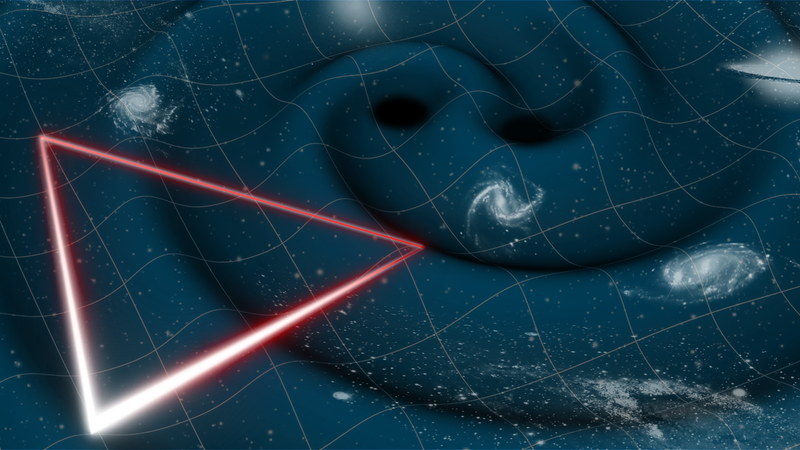
A glowing triangle of laser links hangs against a curved grid of spacetime, drawn down into a dark central well, with spiral galaxies scattered across the background.


In a heliocentric orbit 50 million kilometers behind Earth, three spacecraft will fly in a triangle whose sides are longer than the Earth-Moon distance by almost seven times. At each vertex, a 46-millimetre gold-platinum cube will sit in near-perfect free fall inside a vacuum canister, while a one-watt laser reaches across 2.5 million kilometers of empty space to time-stamp its neighbour. The faintest change in that distance — as small as a few picometres, less than the diameter of a hydrogen atom — is the entire scientific signal. This is ESA’s LISA, the Laser Interferometer Space Antenna, and it is now in industrial construction with a launch set for summer 2035 aboard Ariane 6 (ESA, 2026).

LIGO’s 2015 announcement of a gravitational-wave detection ended decades of physics waiting for direct evidence (LIGO/Virgo, 2016). What gets reported less is the frequency window. Ground interferometers cannot measure below about 10 Hz: seismic noise, thermal creep of mirror suspensions, and shot noise from laser power all crowd out the lower bands. Earth-bound machines hear the final seconds and minutes of stellar-mass black hole mergers. They are deaf to the slow cosmic drum: supermassive black holes millions to billions of solar masses spiralling in over millions of years, white-dwarf binaries in our own galaxy ticking away for the age of the universe, and the primordial ripples left over from inflation or phase transitions (NASA LISA page, 2024).

The 0.1 mHz to 1 Hz band is where most of the gravitational-wave sky lives. LISA is built for exactly that band. It will measure strain noise S_h(f) on the order of 10⁻²⁰ Hz⁻¹/² near 1 mHz — a sensitivity roughly four orders of magnitude beyond anything reachable on the ground. Extreme mass-ratio inspirals (EMRIs), where a stellar-mass object plunges repeatedly through the curved spacetime around a supermassive black hole, will stay in LISA’s band for years of observation. Each such event produces a “treasure map” of the central black hole’s mass, spin, and quadrupole moment, mapping the near-horizon geometry in a way no electromagnetic telescope can match.

The empirical case that gravitational waves existed was settled in 1974. Russell Hulse and Joseph Taylor discovered the first pulsar in a binary system, PSR B1913+16, and over the following decades the binary’s orbital period shrank by exactly the amount general relativity predicts when gravitational radiation carries energy away from the system (Hulse & Taylor, 1975). The 1993 Nobel Prize in Physics marked that indirect detection. Three decades later, LIGO heard two black holes collide directly. Both milestones showed that the waves are real; neither could hear the ones that matter most for cosmology.

ESA has tried to fly a space detector since the 1990s. The earliest LISA design used six spacecraft instead of three. Two after the LISA Pathfinder test mission launched in December 2015, the mission delivered a physics result that pushed the formal adoption over the line. Between February 2016 and July 2017, two free-floating test masses inside Pathfinder’s 38-centimetre cavity kept a relative acceleration below 3 × 10⁻¹⁴ m s⁻²/√Hz at 1 mHz (Armano et al., 2017), and a year later the team reported measurements down to 20 microhertz that exceeded LISA’s planned drag-free requirement (Armano et al., PRL 120, 061101, 2018). ESA’s Science Programme Committee adopted LISA as the L3 mission on 25 January 2024. The agency signed the prime contractor deal with OHB System AG at the Paris Air Show in 2025: an €839 million award and the first time OHB has led an ESA flagship (ESA, 2025).

Industrial work began immediately. Phase 1 design kicked off in January 2025, with a System Preliminary Design Review due in late 2026 and Critical Design Review in late 2030. A 26.1 million euro contract to Thales Alenia Space, signed in May 2026, secured the Cassegrain telescope assemblies — the same optics that will send a 25 picowatt beam across 2.5 million kilometers and capture roughly the same amount of power back.

Funding politics complicated the schedule. The White House FY2026 NASA budget submitted in early 2025 proposed zero funding for LISA, which would have collapsed the U.S. instrument contribution. Congress reinstated an 80.5 million dollar line item for the year. ESA’s response, articulated by Director General Josef Aschbacher, was to begin building European replacements for the NASA-supplied lasers, telescopes, and charge-management devices, an insurance policy rather than a retreat. The LISA Pathfinder science consortium and OHB both work to a 2035 baseline launch.

The single hardest requirement is that each spacecraft must follow its free-falling test mass to within a few nanometres per second. Anything else — the gentlest puff of solar radiation, a photon from Earth’s albedo, the pressure of a passing cosmic ray — would jerk the test mass against the spacecraft wall and overwhelm the signal. The solution is a closed drag-free loop: an inertial sensor monitors the position of the cube relative to the spacecraft, and clusters of cold-gas micronewton thrusters fire to keep the chassis floating around it. Pathfinder demonstrated the thruster at roughly 0.17 microNewton per root hertz of white noise in flight (Armano et al., PRD 99, 122003, 2019), with the residual common-mode noise traced to the feed system rather than the thruster itself.

The strain signal that LISA will record, the dimensionless quantity h = ΔL/L for a passing gravitational wave, sits around 10⁻²¹ for a typical supermassive black hole merger at cosmological distance. Across 2.5 million kilometers, that strain produces an arm-length change of about 2.5 × 10⁻⁹ m, which is picometre territory. The interferometer must distinguish those changes from laser frequency noise, which would otherwise mask the signal because the round-trip light time of about 16.7 seconds means no two spacecraft see identical phase at the same instant.

This is why time-delay interferometry is mandatory. On the ground, equal-arm Michelson geometry cancels laser noise by symmetry. LISA’s arms are unequal and rotating, so the data pipeline algebraically combines six one-way links at given time delays — the familiar α, β, γ, ζ, and “second-generation” combinations — into virtual equal-arm observables whose frequency noise averages to zero to far better than the raw data (LISA Consortium technical notes, 2023). Without that post-processing, even picosecond timing is not enough.

The constellation orbit does the rest. All three craft fly Earth-trailing heliocentric orbits, 20 degrees behind Earth, with the triangle inclined about 60 degrees to the ecliptic. The arms breathe by roughly one to two percent over a year as the spacecraft trace out their cartwheel pattern. That slow modulation is itself a calibration tool, because its signature in the data is known to high precision.

By the mid-2030s LISA should be listening for gravitational waves from systems our species has never directly observed: a million solar mass merger from the early universe, a tight white-dwarf binary in the Milky Way halo, the slow, slow plunge of a small body into a galactic-centre black hole. Each detection will probe spacetime where its curvature is at its strongest and most dynamic. The hardware is large, slow, and quiet by design. Pathfinder showed that the drag-free concept survives the ride. The industrial build now underway will decide whether the triangle closes when it matters most.

Image credit: ESA, CC BY-SA 3.0 IGO (LISA-inspired artwork, hosted by University of Florida PSSL).


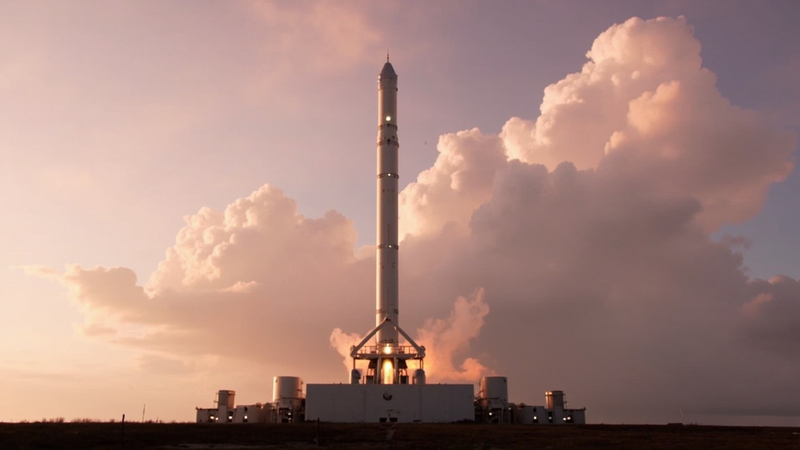
An illustration of a fully stacked Starship and Super Heavy standing on a Starbase launch pad at sunrise, the configuration Ship 41 and Booster 21 will take once stacking for Flight 14 is complete


Twenty-six Starlink V3 satellites are bound for the payload bay of Ship 41 at Starbase, Texas, on a flight that has not yet left the ground. SpaceX is now targeting Monday 28 September 2026 for Starship Flight 14, with the window opening at 7:15 a.m. Central Time, 12:15 UTC, from Pad B. That is the fourth date set for this mission: attempts on 15, 18 and 22 September were each stood down, and the 28 September slot is still pending final regulatory approval. Ship 41 has completed its cryogenic proof testing and its static fire campaign, and Booster 21 has been moved to the pad for stacking. If the count reaches zero, Booster 21 will lift Ship 41 off the pad and, for the first time in the program’s three-year test campaign, hand a Starship upper stage enough velocity to circle the planet. The flight, designated IFT-14, would be the first orbital mission of the world’s largest operational rocket. Every previous Starship test, including the successful Flight 13 on 24 July 2026, was flown on a deliberately suborbital arc that splashed down either in the Indian Ocean or the Pacific (SpaceX, September 2026).

What changes because of this is the shape of the test program itself. For thirteen flights, SpaceX used the upper stage’s engines to push it downrange without ever crossing the orbital velocity threshold of roughly 7.8 km/s. The result was a “passively safe” trajectory that guaranteed reentry and splashdown at a known point even if all vehicle control was lost (Ars Technica, 15 September 2026). To stay on a closed orbit around Earth, Ship 41 will have to perform two burns in space, a coast phase of nearly ten hours, and a controlled deorbit burn at the end of the mission, all while carrying real revenue payload. That last detail is why SpaceX Chief Financial Officer Bret Johnsen told the Goldman Sachs Communacopia and Technology Conference audience on 10 September 2026 that this is “a revenue-generating flight” (TeslaNorth, 10 September 2026). No previous Starship test ever carried satellites that were intended to serve paying customers.

The procurement story behind the announcement starts with Starlink V3 itself. Each V3 satellite adds about 1 Tbps of downlink capacity and 160 Gbps of uplink capacity to the constellation, roughly ten times faster on the downlink and twenty-two times faster on the uplink than a V2 mini Starlink (PCMag via BaseNor, 15 September 2026). Twenty-six of them on Flight 14 will add a combined 26 Tbps of capacity in a single mission, more than ten times what a Falcon 9 V2 mini launch delivers (TeslaNorth, 16 September 2026). V3 satellites are too large to fit inside a Falcon 9 fairing; they can only reach orbit on Starship (SpaceX IPO filing, May 2026; azmth.space, 15 September 2026). The first batch of twenty V3s flew inside Ship 40 on Flight 13 in late July. This is the second and larger batch, with three of the twenty-six modified to carry cameras aimed back at the ship’s heat shield during deployment.

The engineering choices that make the orbit possible begin with Booster 21’s hardware fix. On Flight 13, Booster 20 had successfully used all thirty-three of its Raptor 3 engines during boostback, the first time a Block 3 Super Heavy had done so, before the terminal phase of the landing burn went wrong. Three of the thirteen center engines showed signs of ice clogging and triggered an early shutdown, leaving only eight engines to complete the burn before the booster splashed down hard in the Gulf of Mexico (Tech Times, 16 September 2026). The cause was straightforward. Liquid oxygen, stored at roughly −183 °C, draws moisture into propellant feed lines and filters where it can freeze into crystals. The center engines of the booster feed from a dedicated liquid-oxygen header tank used only during terminal deceleration, and that header tank’s filters were not sized to keep the contamination out under flight loads. Booster 21 carries redesigned filters on the propellant path between the header tank and the center cluster, along with new software for relight reliability (SpaceX, 15 September 2026). A successful landing burn on Flight 14 will be the qualification event for that change before SpaceX attempts the first tower catch of a Block 3 booster on Flight 15.

Ship 41’s heat shield is the second engineering story of the day. SpaceX recovered Ship 40 from the Indian Ocean in early August largely intact, harvested two of its ceramic heat-shield tiles, and plans to refly them on Ship 41 (Ars Technica, 15 September 2026). Three upgrades followed. Stronger retention mechanisms on tiles in regions at highest risk of shedding during ascent. Additional shielding against plasma flow paths behind the tile field. And a curved tile design that has shown it can reduce heating in the gaps between individual tiles. Three of the twenty-six V3 satellites carry cameras pointed back at the ship’s flank during their deployment sequence, so the mission returns not just operational spacecraft but a heat-shield health dataset from inside the bay.

The trajectory is also new. All earlier Starship flights followed ballistic arcs aimed at splashdown zones west of the Bahamas, in the Indian Ocean, or, in the case of the catch attempts, at Starbase itself. Flight 14 will splash Ship 41 down in the Pacific Ocean west of Chile, the geometry forced by a true orbital insertion at 275 km altitude. The booster will attempt a controlled splashdown in the Gulf of America on its own landing burn, not a tower catch (SpaceX, 15 September 2026). SpaceX has not yet received regulatory approval for an upper-stage tower catch in this campaign; that step is reserved for later flights.

The numbers underneath are what make the orbital geometry work. A Block 3 Super Heavy at liftoff carries 3,650 tonnes of methalox propellant across its two stages, with the booster delivering 89.5 Meganewtons of thrust from thirty-three Raptor 3 engines and the upper stage pushing six engines of its own, three of them Raptor Vacuum variants with a vacuum specific impulse of 380 seconds (Wikipedia, SpaceX Starship; SpaceX, 2024). The orbital velocity target of 7.8 km/s, multiplied by the natural logarithm of the mass ratio, gives the rocket equation Δv = v_e * ln(m_0 / m_f) that Tsiolkovsky wrote in 1903 and that every orbital mission since has had to satisfy. For a single-stage-to-orbit architecture, the ratio m_0 / m_f must clear roughly twenty. Two stages let Starship keep both ratios smaller, with Booster 21 shedding its structure shortly after its boostback burn and Ship 41 climbing to operational orbit on its own.

The mission control plan adds one explicit safety gate. Ship 41 will execute the burn to enter orbit only after the flight control team has confirmed “sufficient redundancy on hardware critical” to the later deorbit burn (SpaceX, 15 September 2026). If the ship is not healthy enough to come back down on command, it stays on its initial suborbital trajectory and splashes down in the Pacific regardless. The decision is made in flight, after launch and stage separation, rather than at any point in the ground count.

What’s next is the catch. Musk confirmed in mid-September 2026 that Flight 15 will attempt the first Block 3 booster tower catch, building directly on the Flight 14 landing burn (Starlust, 15 September 2026). From there, SpaceX’s published roadmap points toward higher flight cadences, larger payloads of up to sixty V3 satellites per launch, and the eventual test of orbital propellant transfer, the unproven technology that still gates every Mars mission. Flight 14 is not the destination. It is the flight that would end Starship’s run as a suborbital demonstrator and finally make it what it was always meant to be: a vehicle that goes around.