OrbitalHub

Where curiosity reaches escape velocity.

Domain is for sale. $50,000,000.00 USD. Direct any inquiries to contact@orbitalhub.com.

Archive for 2026


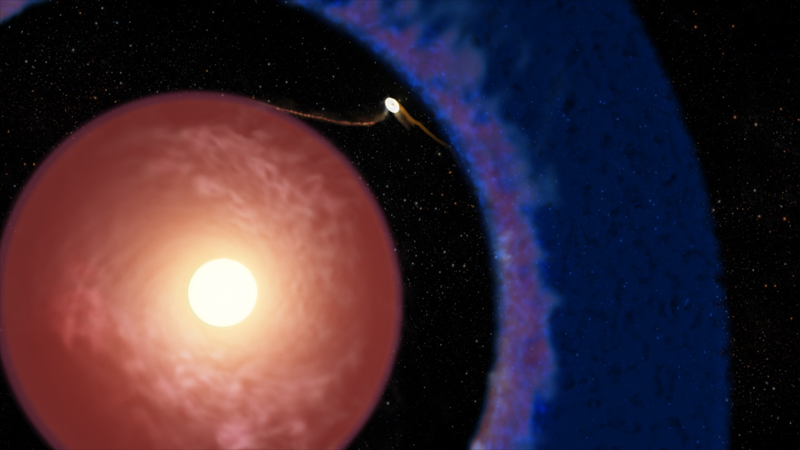
Artist's concept of Elias 2-24 b, the youngest known exoplanet, embedded in a gap of the dusty disk around its host star. The bright object inside the gap is the forming planet, pulling material from the disk edge. Credit: W. M. Keck Observatory / Adam Makarenko. Image source: NASA Science image asset page


Astronomers using archival data from the W. M. Keck Observatory have confirmed a planet that is younger than one million years, making it the youngest known exoplanet by a wide margin. The object, called Elias 2-24 b, sits 55 times farther from its star than Earth is from the Sun and is already about as massive as Jupiter. It is still pulling gas and dust from a dusty disk around its host star, deep inside a gap it has carved in that disk. NASA’s coverage of the announcement and ScienceDaily’s writeup both carried the same artist concept. Every previous record-holder for the youngest planet, including the two worlds orbiting PDS 70 and the two around WISPIT 2, was older than five million years. Elias 2-24 b undercuts that floor by a factor of more than five, and does so at a distance from its star where planet-formation models did not expect anything that large to have assembled yet. Gizmodo’s coverage of the paper flagged the same gap between observation and prediction.

The confirmation matters because it lands directly on a fault line in giant planet formation. Standard models predict that a Jupiter-mass planet at Jupiter’s distance from its star takes roughly five million years to build through the slow accretion of icy solids and gas. The longer the orbit, the longer the formation time, because the feeding zone of solid material is thinner out there. Elias 2-24 b is more than ten times farther from its star than Jupiter is from the Sun. By the textbook timeline, a Jupiter at 55 AU should still be a swarm of icy boulders with at most a thin gas envelope, not a clean planetary-mass object pulling disk material onto itself. Finding one anyway tells the field that at least one of the formation channels (core accretion, gravitational instability, or some hybrid) is faster than the prevailing models allow.

The story behind the detection is a ten-year relay between three observatories and a NASA-funded archive. Around 2016, the Atacama Large Millimeter/submillimeter Array (ALMA) in Chile imaged a sharp concentric gap in the dusty disk around Elias 2-24, a young star about 450 light-years from Earth in the Ophiuchus molecular cloud. Gaps like that one are a familiar sign that an unseen planet is sweeping up material along its orbit. The European Southern Observatory’s Very Large Telescope then picked up a faint infrared point source sitting in the gap, exactly where a planet should be. The catch was that the object was far enough from the star and buried in enough residual disk material that some astronomers argued it could be a background star or a disk feature, not a planet at all. For nearly a decade the question stayed open. Andrea Bernardi, a doctoral candidate at Universidad Diego Portales in Chile, decided to revisit the problem by searching the Keck Observatory Archive, a NASA-funded partnership between Keck and the NASA Exoplanet Science Institute at Caltech/IPAC, for coronagraphic images of the same field. Bernardi’s team found the point source again in Keck data taken in 2018 and 2020, and by stitching the two epochs together they could measure its motion against the background star field. Anything in the foreground should drift with the host star’s proper motion; anything in the distant background should stay put. The faint source moved with Elias 2-24, which closed the case in favor of a planet.

The lead author’s framing in the resulting paper, published in The Astrophysical Journal Letters on 16 September 2026, is that planet-formation theory is missing a process. Lucas Cieza, a professor at the Instituto de Estudios Astrofísicos in Chile and a co-author, put the gap in plain terms. “Our planet-formation models already struggled to explain the previous record holders for the youngest known planet, a four-way tie between two planets orbiting the star PDS 70 and two planets orbiting the star WISPIT 2, which are all more than 5 million years old,” he said. “Elias 2-24 b shows us that even our best planet-formation models are still missing some important processes.” Bernardi’s read was that the detection itself came from combining facilities rather than from any single instrument. “We usually hear about telescopes working separately, but this confirmation was possible only by using multiple telescopes together,” she said. “Elias 2-24 b is at the limit of what current telescopes can detect, but with new instruments like NASA’s Nancy Grace Roman Space Telescope, such detections should become easier.”

The mechanism at work in the disk around Elias 2-24 is the textbook version of how a giant planet interacts with its birth environment, and it is worth slowing down on it for a moment. A protoplanetary disk is a flat, rotating swarm of gas and dust that orbits a young star for the first few million years of its life. A planet that forms inside the disk does not simply sit there. As it orbits, its gravity pulls disk material toward it, but it also shears the disk on either side of its orbit. That shearing opens a low-density annular gap centered on the planet’s orbital radius, with a local pressure bump at the outer edge of the gap where drifting dust and pebbles pile up. The pressure bump is also where the planet’s gravity can grab more material: it acts as a slow conveyor belt feeding the planet from the outside. The result, on the timescales relevant for the system, is a planet whose mass grows as long as the disk is still there, and a gap whose width and depth encode the planet’s gravitational reach. The fact that ALMA saw a deep, well-defined gap at 55 AU, and that the same VLT imaging picked up a point source inside it, is what made the original Elias 2-24 system a planet-formation candidate in the first place. What the new Keck confirmation adds is that the candidate is now locked in by proper-motion evidence across a six-year baseline, not just by the static “is there a thing in the gap” image.

The numbers in the paper come with a real margin of uncertainty, which is worth being honest about. Mass estimates for young planets inferred from brightness are model-dependent because a planet’s luminosity at a million years is set by how much energy it absorbed while accreting, and that depends on the assumed disk conditions. The reported mass range for Elias 2-24 b, between roughly 1.9 and 4.0 Jupiter masses according to a SpaceDaily writeup of the ApJL paper and The Brighter Side’s reporting, comes from comparing the Keck infrared photometry against the ATMO-NEQ-STRONG 2023 atmospheric and evolutionary models. The age of the host star, which is also model-dependent for a pre-main-sequence object, drives most of that mass range. None of that ambiguity changes the headline. The object is a planet, not a background star, and it is younger than one million years by enough margin to clear the previous record by a factor of five.

The next round of discoveries in this regime is likely to come from Roman, NASA’s Nancy Grace Roman Space Telescope, which launched on 30 August 2026 aboard a Falcon Heavy and is now on its way to a Sun-Earth L2 halo orbit. Roman carries a coronagraph that is much more aggressive at suppressing stellar glare than anything currently flying, and the team’s own argument is that the same archival-style imaging technique applied at Roman’s sensitivity should pick up planets that are older but in tighter, more Jupiter-like orbits. Elias 2-24 b is about ten times farther from its host star than a true Jupiter analog would sit. A Roman-class survey that runs the same gap-and-proper-motion playbook across hundreds of nearby young stars could push the record from a single outlier at 55 AU toward a population of newborn Jupiters at 5 AU, which is where the existing formation models assumed the action was happening in the first place. For now, the youngest known planet is a single data point sitting in an unexpected place, and the open question is how many more like it are waiting in the same archive.
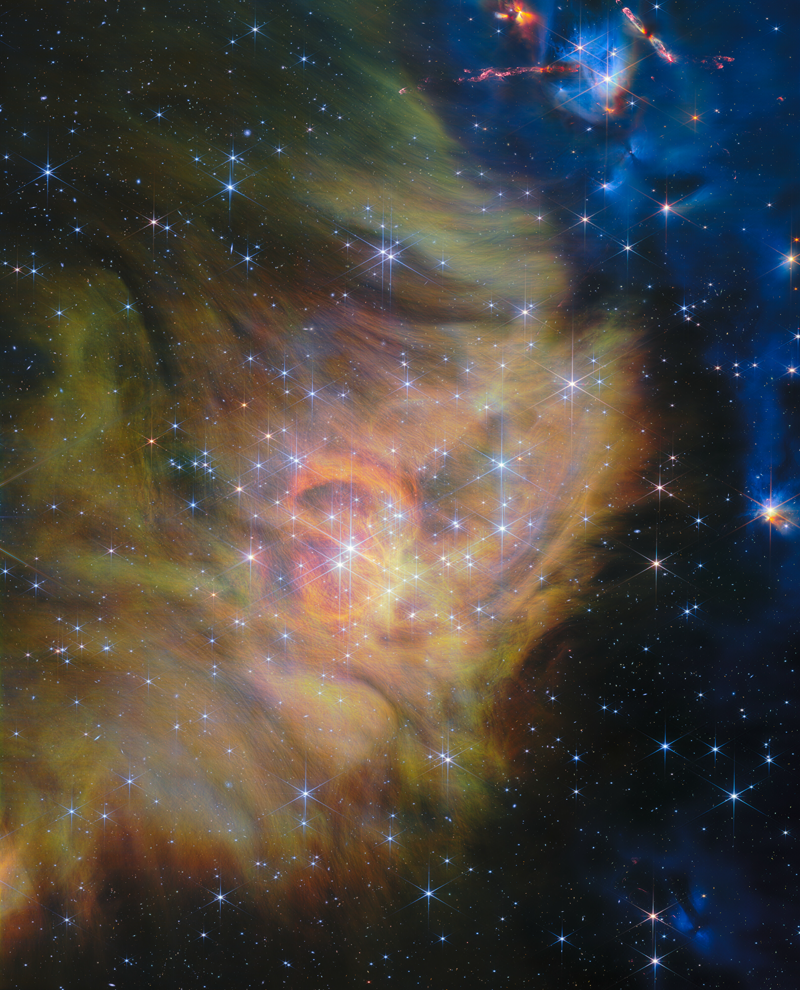


A near-infrared NIRCam mosaic of IC 348 in Perseus: orange and yellow dust lit by embedded young stars, with Webb's six-point diffraction spikes scattered across the field, and a small protostellar jet feature visible in the upper right.


In a star cluster about a thousand light years away, the James Webb Space Telescope has found brown dwarfs that weigh about as much as two Jupiters apiece. That is one fifth of one percent of the Sun’s mass, a figure that used to live exclusively in the planetary regime. The objects sit at the floor of how small a star-formation process is willing to go, and their spectra carry a chemical fingerprint no one had seen outside the solar system before. Researchers are now arguing they deserve their own spectral class.

The story comes from a paper by Kevin Luhman of Penn State and Catarina Alves de Oliveira of ESA, published in The Astrophysical Journal Letters and paired with a NASA/ESA/CSA Webb press release on 15 September 2026. The target is IC 348, a star-forming region in the constellation Perseus, sitting inside the larger Perseus Molecular Cloud about 1,000 light years from Earth. IC 348 is a familiar target for brown dwarf hunters; it has been productive for two decades because it is close enough that its lowest-mass members are bright, and young enough that its brown dwarfs are still warm and easy to detect. The cluster contains roughly 400 stars aged between two and five million years, surrounded by wisps of gas and dust lit up by the embedded young stars.

Why does the bottom of the mass spectrum matter? Stars form when cold clouds of molecular hydrogen collapse under their own gravity. The collapse squeezes the protostellar core until the center gets hot enough to fuse hydrogen into helium, and that nuclear ignition is what defines a star. Below about 8 percent of the Sun’s mass, the core never gets hot enough for sustained hydrogen fusion. Those objects are brown dwarfs, sometimes called “failed stars,” even though most of them briefly fuse deuterium early in their lives. The upper end of the brown dwarf range is reasonably well-defined, in the 60 to 75 Jupiter-mass zone. The lower end is not. Observationally, the population thins out and the objects fade, and the boundary where star formation simply stops producing bound objects is hard to pin down. Webb is well suited to the hunt because brown dwarfs are brightest in the infrared, and Webb is the most sensitive infrared telescope ever flown.

In 2022, Luhman and Alves de Oliveira used Webb to identify three new brown dwarfs in IC 348, with the faintest weighing only three to four Jupiter masses. The new paper pushes deeper. Using Webb’s Near-Infrared Camera (NIRCam) in 2024, the team imaged a wider field in IC 348 and identified thirty-nine new brown dwarf candidates based on color and brightness. They then turned to Webb’s Near-Infrared Spectrograph (NIRSpec) in 2025 to confirm which candidates were genuinely sub-stellar. Nine of the fifteen candidates they followed up spectroscopically turned out to be sub-stellar members of the cluster. The faintest two weigh only about 2 Jupiter masses each, or roughly 0.19 percent of the Sun. That is the lowest mass at which a brown dwarf has been confirmed by spectroscopy, and it shrinks the mass range of confirmed brown dwarfs by a factor of roughly seven.

One of those 2-Jupiter-mass objects also shows excess emission from a circumstellar disk, which is the standard signature of raw material for planet formation. If a brown dwarf near the planetary mass limit has its own protoplanetary disk, the eventual system would be hard to describe with familiar vocabulary. The “star” at the center would weigh only twice as much as Jupiter, and the planets would weigh less than that. The team’s framing in the paper is straightforward: a planetary system whose central object is only twice the mass of Jupiter is within reach of current data, even if the terminology is awkward.

The second headline result is the chemical one. Two of the three brown dwarfs from the 2022 study already showed an unidentified absorption at 3.4 micrometers in their spectra. The new data turned up the same feature in more brown dwarfs, for a total of eleven across the cluster. The team attributes the feature to an aliphatic hydrocarbon, a molecule built only from hydrogen and carbon, and notes that it has not been seen in any atmosphere outside the solar system. Methane, the signature hydrocarbon of cool brown dwarfs and gas-giant planets, is conspicuously absent. Because the 3.4 micrometer band grows stronger as the brown dwarfs get fainter, the researchers argue that the carrier is a natural product of the coolest brown dwarf atmospheres rather than some chance contaminant. They propose defining a new spectral class, “H,” keyed to the presence of the 3.4 micrometer fundamental band. If the community adopts the label, it will sit alongside the existing M, L, T, and Y classes as the spectral type for the bottom of the substellar sequence.

The deeper NIRCam imaging that produced this paper’s mosaic is itself a milestone. The IC 348 image, drawn from Webb observing program 4866, is one of the largest single Webb mosaics released to the public and was featured in NASA’s September 2026 image release channel. A phys.org writeup of the same result underscored the parallel between the brown dwarf discovery and the protostellar outflows in the frame: this single Webb pointing produced both the lowest-mass brown dwarfs yet confirmed and a fresh look at the youngest stars still in the process of forming.

The mosaic itself shows a field of orange and yellow nebulosity across most of the frame, scattered stars crowned with Webb’s six-point diffraction pattern, and in the upper-right corner a compact collection of protostars with bright jets and Herbig-Haro objects. The horizontal jet in the upper right is HH 797, which the imaging resolves into two protostars with nearly parallel outflows. The propeller-shaped object just to its right is HH 211, an outflow that shows narrow jets nested inside broader lobes. Those outflow features are not part of the brown dwarf result, but they sit in the same field and help explain why IC 348 keeps yielding surprises: it is still actively making stars.

The next steps are mostly spectroscopic. Luhman and Alves de Oliveira want higher-resolution JWST spectra of the same objects to nail down which specific hydrocarbon molecule is responsible for the 3.4 micrometer band, and they are calling for atmospheric modelers to explain why methane is missing in objects this cool. The remaining brown dwarf candidates from the NIRCam survey, twenty-four of them, still need spectroscopic confirmation, and at least two of them may sit near one Jupiter mass. If those candidate masses hold up, the brown dwarf mass floor would drop further, and the question of whether star formation can produce planetary-mass objects in isolation, with no host star in sight, would become a routine observational target rather than a curiosity.

The broader context is that Webb has been quietly redrawing the mass sequence at both ends for the last three years. The IC 348 result extends the bottom end downward, while complementary surveys of massive quiescent galaxies are pushing the top end of the stellar initial mass function upward. The combination suggests the mass spectrum of objects that come out of gravitational collapse is broader than the textbook categories, and that the boundaries between star, brown dwarf, and planet are matters of definition rather than physics. A 2-Jupiter-mass object with its own protoplanetary disk, glowing with a hydrocarbon feature found only in itself, is a clean illustration of the problem. Call it a brown dwarf or call it a rogue planet host; either way, Webb just put a number on the smallest thing nature seems willing to make by itself.


October 8, 2026

Bennu formed where fire met ice

Posted by


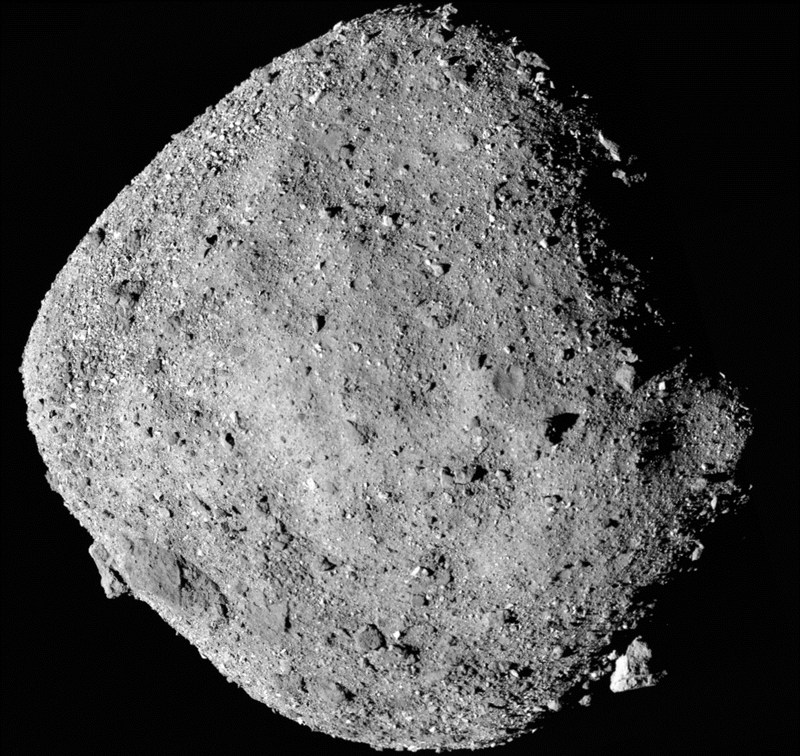
A diamond-shaped asteroid, Bennu, photographed against black space by NASA's OSIRIS-REx spacecraft from a range of 24 kilometres, showing a rubble-pile surface covered in boulders of various sizes


Half a gram of asteroid dust, split among three transition metals, has rewritten where Bennu came from. A team led by Maria Schönbächler at ETH Zurich reports on 23 September 2026 in Science Advances that Bennu, the near-Earth asteroid visited by NASA’s OSIRIS-REx spacecraft between 2018 and 2021, did not assemble in the cold outer reaches of the young solar system the way most researchers assumed. It assembled instead near the water-ice line, in the narrow band where temperatures were cold enough to freeze water vapour into solid ice and warm enough inside to keep it as a gas. The work leans on isotopes of iron, titanium and chromium measured in five Bennu sample portions at ETH’s isotope geochemistry lab, and it points to a culprit for the unusual chemistry: Jupiter, which grew large enough, fast enough, to filter coarse material out of the dust disk before Bennu’s parent body could form.

Source: NASA/Goddard/University of Arizona Bennu mosaic on Wikimedia Commons (public domain).

Bennu’s chemistry has been a quiet puzzle for most of the past decade. Earlier sample studies, including the joint OSIRIS-REx and Hayabusa2 preliminary results, had placed it in a family of carbon-rich objects whose closest meteoritic relatives on Earth are the rare CI chondrites: carbon-rich, water-bearing, and chemically the closest match in the meteorite collection to the Sun’s own composition, with very little thermal alteration since the solar system’s birth. What no one had pinned down was where in the protoplanetary disk that fingerprint had been laid down.

The old model put Bennu-class objects far out in the disk, beyond where most comets form, where accretion was slow and hydrated minerals could survive undisturbed. The new isotope measurements turn that on its head. Iron and titanium are distributed so well throughout the Bennu material that the parent object cannot have been a single coarse clump; it must have been built from fine dust mixed across the disk, with ice acting as a glue that bound fine particles into larger aggregates on the cold side of the water-ice line.

The phrase Schönbächler uses for the result is direct: Bennu is a hybrid. It does not clearly match either the inner or the outer solar system. It bears characteristics of both regions, because it was assembled in the specific transition zone where material from both sides met, according to the ETH Zurich announcement.

To anchor that conclusion, the team compared Bennu against the other carbon-rich sample-return target in the modern catalogue: Ryugu, the asteroid Hayabusa2 visited in 2019. The two objects share an isotopic fingerprint with each other and with the CI chondrites, all distinct from the rest of the meteorite collection and from other sampled asteroids. The authors frame the open question as a population question: if Bennu and Ryugu both formed in the same zone, what is that zone producing that sends objects to near-Earth orbits, and are these two a coincidence or a sample of a broader pattern?

That question hands the baton to the next sample-return missions. China’s Tianwen-2 arrived at the quasi-satellite Kamoʻoalewa this summer and is expected to return a sample in 2027. Japan’s MMX mission, scheduled to launch from Tanegashima in October 2026 on an H3, is set to bring back material from Phobos in 2031; Phobos is itself a possible captured asteroid, and a Phobos sample with a Bennu-like signature would extend the snow-line zone picture to the Mars system. The next-mission parallel was also flagged in Space.com’s coverage.

The water-ice line is not a feature of the finished solar system; it is a feature of the protoplanetary disk, the rotating torus of gas and dust around the young Sun. Inside the line, water vapour stays in gas form. Outside it, water freezes onto dust grain surfaces as ice. In standard models the boundary sits somewhere near the present-day orbit of Jupiter, roughly five astronomical units out, and that distance matters because the disk’s solid inventory changes composition sharply there: inside the line, rocky dust; outside, ice-coated dust; and right at the boundary, a transition layer where ice can sublimate, migrate inward as vapour, and recondense.

The new analysis proposes that this transition layer was the assembly site for Bennu, Ryugu, and the CI chondrites, with Jupiter acting as an active filter rather than background. The gas giant formed within roughly one million years of the Sun’s birth, and its gravitational influence quickly became a barrier in the disk. Coarse, clumpy material could not easily cross Jupiter’s orbital neighbourhood; fine dust could, routing around Jupiter from multiple radial directions and arriving well mixed. The result is an unusually homogeneous feedstock for planetesimals forming in the transition zone near the snow line, and that homogeneity is what the Bennu isotope data see.

The team’s mechanism also explains two aspects of the sample. The first is water. Bennu’s parent body incorporated enough ice that, when it was later broken up and the fragments were warmed by the Sun, hydrated minerals appeared in the regolith in the proportions the OSIRIS-REx analysis measured. Ice from just outside the snow line can sublimate as the disk evolves, drift inward as vapour, and recondense inside the line, so a transition-zone planetesimal ends up with both rocky and icy inputs. The second is the chemical match to the Sun. Fine dust, mixed by the disk’s turbulence and routed around Jupiter, ends up with a bulk composition close to the pre-solar nebula because it has not been sorted into coarse and fine reservoirs. Bennu samples that average composition better than any other available asteroid material.

For the broader picture, the implication is that the asteroid belt is not the only reservoir of primitive material in the inner solar system. Near-Earth asteroids like Bennu and Ryugu may be sampling a specific radial slice of the early disk that the main belt, with its heavy thermal and collisional processing, has blurred out. If planetary migration can scatter snow-line objects into near-Earth orbits, then the Bennu sample is not a quirk of one asteroid but a window onto a specific formation environment that the meteorite collection only hints at.

What is striking about the result is how much depends on a small measurement. The five Bennu sample portions, totalling a fraction of a gram, were analysed for isotopic ratios of three elements at a single laboratory over months. None of that is large-scale geophysics or a flagship space telescope survey. It is the kind of bench-scale work that historically has rewritten meteorite science, and it has now done so for an asteroid whose sample exists on Earth only because a NASA spacecraft flew for two and a half years to a rock the size of a small mountain, picked up its surface with a robotic arm, and parachuted the result home.

The Bennu story is not finished. Sample analysis at laboratories around the world is ongoing, with new allocations going out in waves as the OSIRIS-REx curatorial team works through the 120 grams that came back. Schönbächler and her collaborators flag the open question directly: are other asteroids in the same isotopic family, and how widespread is the snow-line zone fingerprint across the inner solar system? That question will not be answered by Bennu alone. It will be answered by what comes back from Kamoʻoalewa, then Phobos, then whatever the next generation of sample-return missions chooses to visit.

For now, the picture is this: Bennu is chemically the closest match in our sample collection to the mixture of elements the Sun itself inherited. Its formation was not a quiet outer-disk story; it was a product of a specific radial neighbourhood in the young solar system, with Jupiter acting as the gatekeeper that kept coarse material out and let fine dust through. The fact that we have a piece of it in a laboratory in Zurich, three years after it fell out of the Utah sky, is a measure of how much of the early solar system can be reconstructed from a sample small enough to lose between your fingers.


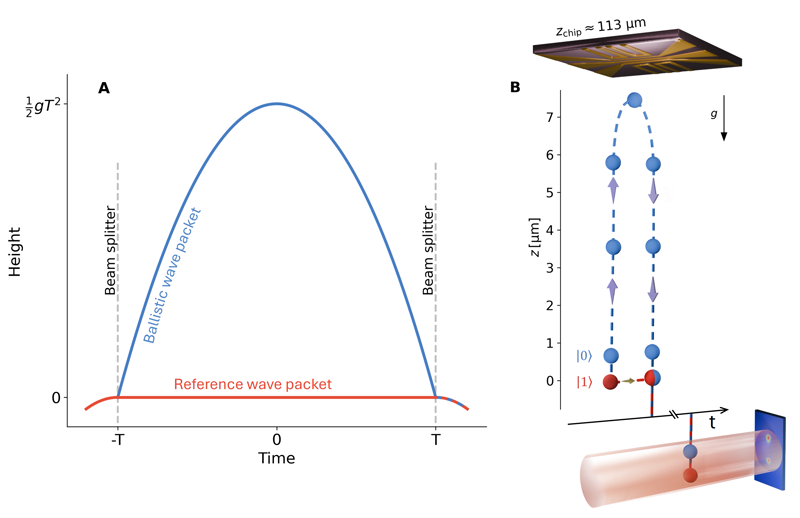
A scientific schematic of the Quantum Galileo Interferometer showing the spacetime trajectories of two wave packets in panel A and the vertical geometry of the atom chip, atom cloud and glass cell in panel B.


In a basement lab at Ben-Gurion University of the Negev, a cloud of about 20,000 rubidium atoms has just answered a question physicists have been asking for nearly a century. Cooled to a few nanokelvin above absolute zero and held still by microscopic wires on a fingernail-sized chip, the atoms were nudged into a quantum superposition in which one half of the cloud rose a few micrometres and fell back under gravity while the other half stayed put. When the two halves were brought back together, the interference pattern between them showed a clean phase shift, and that phase shift matched Einstein’s prediction to within 2.5 percent.

The result, published in Science Advances on 2 September 2026 by Dobkowski, Folman, Penrose, Vedral, Schleich and a dozen other collaborators, is the first direct measurement of the quantum phase accumulated by a freely falling particle. It is also a fresh check on Einstein’s equivalence principle, the assumption that gravity disappears for an observer in free fall. The principle works fine for billiard balls and spacecraft. Until now, no one had checked whether it still works when the falling object is in a quantum superposition of two places at once, which is what the Ben-Gurion group, along with partners at Oxford and Ulm, set out to do. That the check matters at all is because general relativity and quantum mechanics describe the universe with completely different mathematical machinery, and they have resisted every attempt to combine them for almost a century. Most attempts to unify the two assume, implicitly, that the equivalence principle still applies at quantum scales, and this result is the first empirical reason to believe that assumption is correct.

Building the right kind of interferometer took the Folman group years. Ordinary atom interferometers, which have existed since the early 1990s, can compare two paths that both involve motion, one slightly higher than the other or one slightly accelerated with respect to the other. What they cannot do is compare a path that is genuinely free of forces against a path that is held artificially still, which is exactly the situation an equivalence-principle test requires, as Ars Technica reported on 11 September 2026. The team called the new device the Quantum Galileo Interferometer, or QGI, in honour of Galileo’s original observations of free fall, and the underlying method is laid out in detail on arXiv.

Inside a glass cell held under vacuum, a few micrograms of rubidium-87 gas is cooled into a Bose-Einstein condensate, a quantum state in which all the atoms share a single wave function. The condensate floats about 113 micrometres beneath an atom chip, a flat substrate etched with microscopic current-carrying wires that paint the surrounding space with carefully shaped magnetic fields. The chip itself is mounted upside down, with the wires facing the atoms, so the magnetic gradient can levitate the condensate in place. The whole apparatus is small enough to fit on a desk, which is part of why a single lab group could afford to spend years getting it to work, but the measurement it produces has implications for the largest questions in fundamental physics.

The reason it took so long is that interference, the property the experiment depends on, is fragile. Interference only appears when there is no way, even in principle, to tell which path a particle took; any measurement that distinguishes the two paths destroys the quantum superposition and forces the particle to behave like a localised classical object. Wave packets that have fallen under gravity are moving fast, while stationary wave packets are not, and that difference in speed is itself information about the path, so a naive setup would never produce an interference pattern at all. Folman and his colleagues had to design a sequence of pulses that cancels the path information without cancelling the phase information they actually wanted to measure.

Once the atoms are ready, the experiment unfolds in four microwave and magnetic pulses, summarised in Figure 1 of the arXiv preprint. The first pulse puts every atom into a superposition of two spin states: one that feels the magnetic field and one that does not. A magnetic pulse then kicks the magnetically sensitive state upward, launching it on a ballistic arc, while the insensitive state stays put. A second microwave pulse swaps the roles: the rising atom becomes magnetically insensitive and falls freely under gravity, while the stationary atom becomes magnetically sensitive and is held hovering by a field tuned to exactly cancel its weight. A final magnetic pulse acts as a parachute, gently braking the falling atom so it lands back where it started, where the two halves of each atom can interfere. At their farthest apart, the two trajectories were about 7.5 micrometres apart and the longest free-fall time was about two milliseconds. The interference pattern at the end of each run depends on the phase that the falling path accumulated during its trip. The longer the fall, the more phase, and the chirp in those oscillations is the signature the theory predicts. As the team lengthened the fall duration, the measured phase grew in proportion to gT squared, exactly as general relativity predicts for a classical trajectory and as the equivalence principle predicts for a quantum one.

The interpretation is the part that makes the result satisfying rather than just technical. From the perspective of the falling atom, there is no gravity at all: it is in free fall, the way an astronaut is in orbit, and its wave should pick up no extra phase. From the perspective of the laboratory, the same atom is being pulled downward at 9.81 metres per second squared, and its wave should accumulate a phase proportional to gT squared. The two views should agree, and Einstein’s equivalence principle says they do. The QGI measures the lab-frame phase directly and shows that, to within the experiment’s precision, the falling quantum wave accumulates exactly the phase that gravity predicts. As The Brighter Side reported, the measurement is a checkpoint on the boundary between two theories that physicists are still trying to merge. The result does not say which, if either, will eventually have to give way, but it sets a baseline that future versions of the experiment will sharpen.

A first upgrade is already under construction at Ben-Gurion. The next-generation QGI is being designed to put nanodiamonds, particles roughly ten orders of magnitude heavier than rubidium atoms, into the same kind of superposition. Nanodiamonds sit in a mass range where several competing quantum-gravity models and collapse theories make different, falsifiable predictions, and putting a nanodiamond in superposition for any usable time has not yet been achieved. Folman told Ars Technica that his lab is already working on a design that he hopes will let the heavier experiment run within the next four or five years, though he was clear that it is “a very, very challenging project.” If it works, the team would have a direct laboratory test of the boundary between quantum mechanics and gravity in a regime where competing theories actually disagree.

In the meantime, the September result establishes something that has been assumed but not shown. When an atom falls, the quantum phase it picks up is the phase that gravity, applied classically, would predict. The equivalence principle, written down by Einstein in 1907 and tested for classical masses by Galileo, Newton, Bessel and Eötvös, has now been demonstrated, in a single careful experiment, for a particle that is in two places at once. The result does not resolve the long-standing tension between general relativity and quantum mechanics, but it removes one of the most reasonable doubts about how the two might eventually be unified: that the equivalence principle, which is foundational to general relativity, might quietly break at quantum scales. It does not appear to.


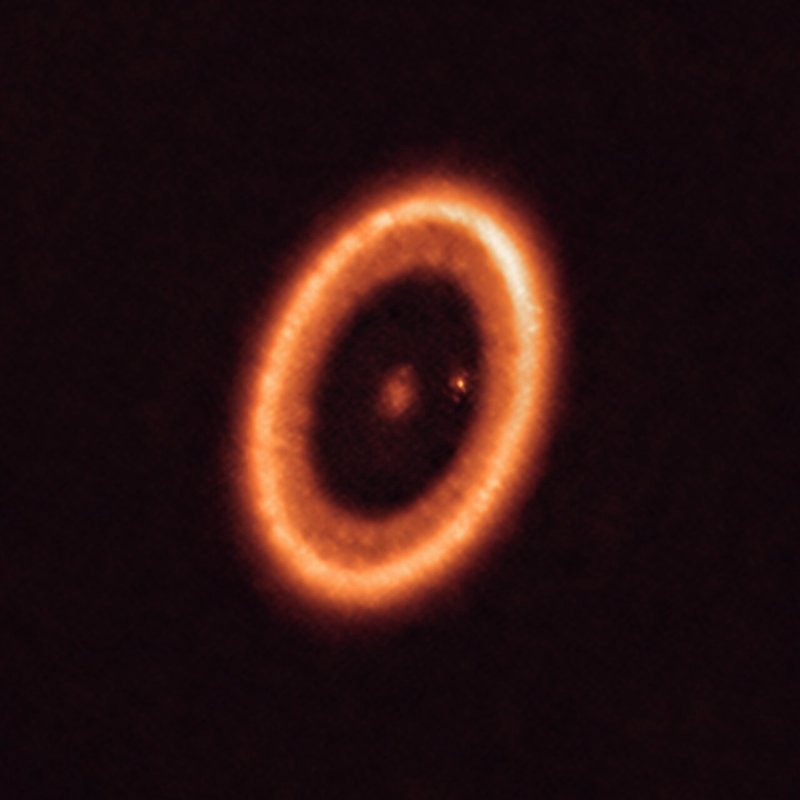
The PDS 70 protoplanetary disk as seen by ALMA, showing the bright orange dust ring and the dark gap carved out by the two forming gas giants PDS 70 b and c, which are visible as small spots inside the gap. The disk's inner regions are where JWST detected water vapor and where the new study suggests exocomets may be delivering additional volatiles. Image: ALMA (ESO/NAOJ/NRAO), via ESO.


The two planets still growing inside the disk of PDS 70 have been some of the most photographed protoplanets in astronomy since the European Southern Observatory’s Very Large Telescope first imaged them in 2018 and 2019. Now the same system is offering up a second story, one that may explain where the water inside that disk came from. A team led by Aline Novais, a post-doctoral researcher in the Department of Physics at Lund University, reports in Nature Communications that PDS 70 shows variable sodium-line absorption matching the spectroscopic fingerprint of icy bodies sublimating as they swing past their star. The result, the authors say, makes PDS 70 the youngest known system in which exocomet activity has been proposed, and the first such case around a star whose temperature is close to the Sun’s. The story has been picked up by Universe Today and The Brighter Side of News.

PDS 70 sits about 370 light-years away in the constellation Centaurus. It is a K7 T Tauri star, slightly cooler and less massive than the Sun, and at roughly 5.4 million years old it has not yet settled onto the main sequence. Its surrounding protoplanetary disk is split by a wide gap, and inside that gap two gas giants, PDS 70 b at about 20.6 astronomical units and PDS 70 c at about 34.5 astronomical units, are still accreting material. The two planets were the first protoplanets ever directly imaged, and they have become a benchmark for what planet formation looks like while it is still happening. The ALMA image of the system, reproduced below, shows the bright orange dust ring and the dark gap carved out by the two forming gas giants (see the ESO image page for full credit and dimensions; the ESO artist animation shows the system in motion). The novelty in the new paper is not about the planets themselves but about what may be moving through the system alongside them, and what those moving bodies might be carrying inward.

The argument hinges on archival spectra. Novais and her co-author Alexandra Stockwell Murphy, also at Lund, went back to 52 high-resolution spectra of PDS 70 taken with the High Accuracy Radial velocity Planet Searcher (HARPS) on ESO’s 3.6-metre telescope at La Silla in Chile. The observations span 22 nights spread across 2018, 2019, and 2020. Most of the action is in 2018, when HARPS collected 18 epochs of data. Across those 18 nights, the team identified 43 variable neutral-sodium (Na I) absorption components moving at radial velocities from roughly minus 25 to minus 115 kilometres per second relative to the star. The lines were clumpy rather than uniform, sometimes covering only a fraction of the stellar disk, and they changed amplitude, number, and velocity from one night to the next. None of those properties fits a stable, smooth disk wind. All of them fit a stream of small bodies releasing sodium-bearing gas as they swing past the star and heat up.

That spectroscopic pattern is the same one astronomers have been cataloguing for decades around Beta Pictoris, the well-known A-type star surrounded by a debris disk where thousands of exocomet transits have been inferred from variable absorption lines. Beta Pictoris is hot, several times more massive than the Sun, and old enough that its inner system has long since been cleared. PDS 70 is young, cool, and still embedded in a gas-rich disk. The new result extends the exocomet phenomenon to a regime where the surrounding architecture is still being built.

The authors are careful about the word “evidence.” The variable Na I lines are consistent with sublimating planetesimals on highly eccentric orbits, but PDS 70 is also known to drive disk winds, and a sufficiently clumpy wind could in principle produce similar absorption. Novais and her colleagues ran a simple wind model and found that the sodium mass in the lines was substantially higher than the wind model predicted, that the velocity changes from night to night were too rapid for a steady outflow, and that the partial-disk coverage required a spatially confined source. The wind scenario could not be ruled out completely, because the star’s mass-loss rate and accretion properties are not well known. The exocomet scenario remains the preferred interpretation but is not yet confirmed. The authors also note that new observations taken in 2026 with the Ultraviolet and Visual Echelle Spectrograph (UVES, programme ID 0116.C-0329, PI A. Novais) show the activity is continuing, and a detailed analysis of that follow-up dataset is in preparation.

If exocomets are the right explanation, the second question is whether they can physically reach the inner disk at the rate the data implies. To test that, the team ran N-body simulations of planetesimals interacting gravitationally with the two known gas giants, and with a hypothetical third planet in a more distant orbit. In the two-planet case, on average 0.47 percent of the test particles crossed the planetary gap into the inner disk per million years; in the three-planet case, the figure rose to 2.9 percent. Translated into a flux, the simulations suggest that for every 10 Earth masses of planetesimals stored beyond the planets, between about 0.047 and 0.29 Earth masses of icy material could be crossing the gap per million years under the assumed configurations. That is a small fraction, but the inner disk has had millions of years to accumulate it.

The water question is what gives the result its broader reach. JWST’s Mid-Infrared Instrument (MIRI) had previously detected spectroscopic emission from gaseous water close to the star, inside the planetary gap. The origin of that water was not clear. Pure gas-phase synthesis in the disk is possible but slow, and the disk is also cool enough in its outer regions for water ice to be abundant on small bodies. The exocomet scenario links the two: comets perturbed inward by the giant planets sublimate as they pass through the inner disk, releasing water and other volatiles. “Our study suggests that comets may be responsible for transporting water to the inner parts of the planetary system, where planets can form, in the same way as in the early Solar System,” Novais said in a press release accompanying the paper. “It is reminiscent of a possible process in the early Solar System, in which comets may have helped to deliver water to the young Earth,” added Stockwell Murphy.

The comparison to the early Solar System is the point that resonates beyond this one system. The leading explanations for Earth’s water include late accretion of water-bearing asteroids, contributions from icy comets, and outgassing from the planet’s interior. None of those channels is easy to observe in action, because they happened more than four billion years ago. PDS 70 is young enough that the same channels may be operating now, and the planets are still growing, so the inner disk’s water reservoir is still being filled. If a Sun-like star can build a wet inner disk by shepherding icy bodies inward, the same process could have operated around the young Sun, and the question of where Earth’s water came from shifts from “which bodies delivered it” to “how much of it was cometary in the first place.”

The authors are clear that the next step is confirmation. The UVES follow-up is one avenue. Another is the ESO Extremely Large Telescope, now under construction in Chile, which will be able to image structures in the PDS 70 disk at much higher spatial resolution and look for individual transiting comets directly. If those observations find the same sodium clouds on the same highly eccentric trajectories, the exocomet interpretation will harden into a detection. For now, the result is a working hypothesis with strong circumstantial support: variable sodium in HARPS, an inner-disk water reservoir seen by JWST, and a dynamical simulation that says yes, the icy bodies in the outer disk can get there. PDS 70 may not be a complete answer to where Earth’s water came from, but it is the first place astronomers have caught the process plausibly underway in a system that looks, in temperature and architecture, uncomfortably like a very young copy of our own.


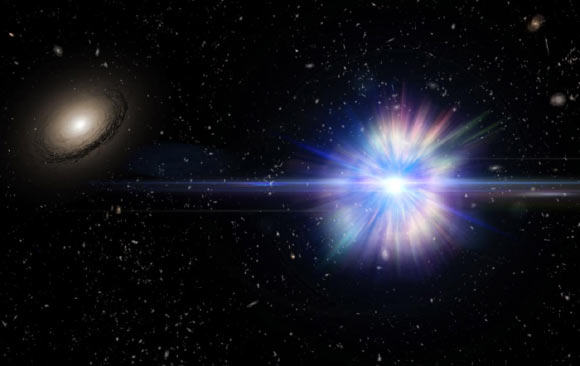
An artist's concept of a Type Ia supernova exploding in the intergalactic space between galaxies within a galactic cluster, used by supernova cosmology programs to standardise the brightness of these explosions across cosmic time. Image credit: Alex Parker / NASA / SDSS.


A decade after Type Ia supernovae earned half of the 2011 Nobel Prize in Physics for revealing that the expansion of the universe is accelerating, the same class of explosion is now driving the sharpest empirical challenge yet to the explanation behind that acceleration. In two companion papers posted to arXiv on 2 September 2026, a team led by University of Queensland PhD candidate Ryan Camilleri has stitched together 2,884 Type Ia supernovae drawn from the Pantheon+ and Dark Energy Survey five-year samples into a single, internally consistent compilation called Unite. When Unite is combined with cosmic microwave background and baryon acoustic oscillation data, the best-fit cosmology is no longer one with a constant dark-energy density. It is a flat universe whose dark-energy equation of state evolves with cosmic time, parameterised by today’s value w0 = -0.86 and a running slope wa = -0.60. That combination fits the combined data noticeably better than the cosmological constant, and the second paper reports that the host-galaxy mass corrections that make the sample consistent push the significance for time-evolving dark energy from 3.4 to 4.0 sigma relative to the older Pantheon+ result.

Why this matters is the size of the cosmological constant in the standard model and the conspicuous lack of a physical explanation for it. The standard Lambda-CDM picture of cosmology, described in detail in the Wikipedia dark-energy entry, treats dark energy as a fixed energy density, the cosmological constant, that fills space uniformly and does not change with cosmic time. That assumption has held up against every supernova sample, every galaxy-cluster count, and every CMB map for nearly three decades. It is also the assumption under which the accelerating expansion discovered in 1998 won a Nobel Prize. A growing body of independent probes, including the Dark Energy Spectroscopic Instrument’s measurement of the sound horizon from over six million galaxies and the second data release of the Dark Energy Survey, has begun to show small but coherent deviations from that picture. A w0-wa cosmology, in which the dark-energy density changes with the epoch, was long considered an unlikely complication that would die with more data. The Unite compilation is the first dataset large and internally consistent enough to push that complication past the four-sigma mark by combining supernovae with the CMB and baryon acoustic oscillations, two of the most precise cosmological probes available.

The story behind Unite runs back through the major supernova cosmology programs of the last fifteen years. Pantheon+ is the spectroscopic Hubble diagram assembled by Scolnic and collaborators from the PanSTARRS, Sloan, SNLS, and several earlier samples, totalling roughly 1,500 light curves; it became the workhorse sample for supernova cosmology after the original Pantheon release in 2018. DES-SN5YR is the Dark Energy Survey’s five-year photometric supernova program, which has now grown to be the largest homogeneous sample of Type Ia light curves from a single survey, with around 1,800 light curves of its own. Camilleri’s group combines the two into a single Hubble diagram by reanalysing Pantheon+ with the methodology that DES had already validated on its own data, then running both through the same bias corrections and selection cuts. The combined sample is 2,884 events with a consistent treatment of light-curve shape, colour, and host-galaxy stellar mass, and the team also redetermines host-galaxy stellar masses on a common framework that covers 98% of the sample. The earlier DES analysis of just the DES sample, reported in 2024, had already shown hints of a time-varying dark-energy equation of state. Unite shows the same hint pointing in a slightly different direction, and at a stronger significance when combined with the other probes. As Tamara Davis, the University of Queensland professor who oversaw the work, put it, two independent measurements now point in the same direction, which is what one looks for when the standard model starts to creak.

The deep dive into why supernova systematics matter so much centres on the host-galaxy mass step. Once a Type Ia supernova’s light curve has been standardised by its shape and colour, its peak brightness still depends, at the level of a few hundredths of a magnitude, on the stellar mass of the galaxy that hosted it. Brighter supernovae prefer galaxies with younger stellar populations, while fainter ones tend to land in older, more massive hosts. If that dependence is ignored, the standardised brightness comes out wrong, and the cosmological fit drifts. Earlier work by Vincenzi and collaborators compared the host-mass estimates used in Pantheon+ and DES-SN5YR, and showed that the choice of host-mass measurement alone contributes enough to the standardised magnitudes to flip the supernova-vs-CMB tension on or off. Lee and colleagues re-measure host masses for almost every supernova in Unite using aperture photometry and SED fitting on a single framework. Their masses differ from the values Pantheon+ released, partly because of a redshift-dependent internal inconsistency inside Pantheon+ that the new measurements expose. When the Pantheon+ subset of Unite is combined with baryon acoustic oscillations and the CMB, swapping in the new masses moves the significance for evolving dark energy from 3.4 sigma to 4.0 sigma. The same pair of papers also incorporates gravitational lensing magnification corrections, which slightly blur the standardisation but do not erase the deviation from a constant dark-energy density.

The combination itself is now decisive in a way that earlier work was not. For a flat universe with a constant equation of state, the SN-only fit returns a matter density of Omega_m = 0.310, very close to the standard value. For a flat universe in which the dark-energy equation of state evolves linearly with redshift (the so-called CPL parameterisation), the combined fit to supernovae, the CMB, and BAO returns Omega_m = 0.305, w0 = -0.86, and wa = -0.60, with a dark-energy figure of merit of 315. That value of w0 is less than -1, which means the dark-energy density was higher in the past than it is today. Wa is also negative, which means the dark-energy density is falling faster than the cosmological constant would imply. The combined dataset prefers this picture at the four-sigma level, and the paper’s own figure of merit shows a roughly 30% reduction in the w0-wa confidence region compared with Pantheon+ alone.

The takeaway is that the supernova case for evolving dark energy is now strong enough to be taken seriously, and the question is what kind of evolving. A dark-energy density that decreases with cosmic time is not the same as modified gravity, a quintessence field, or any of the more exotic options the literature considers, but it is no longer the cosmological constant either. The two independent DESI and supernova measurements, one based on sound waves in the early universe and one based on the brightness of stellar explosions in the late universe, now agree on the direction of the deviation, and the supernova side has just gotten both bigger and more internally consistent. The next year or two of data, from the still-pending third year of DES-SN5YR and from the rest of DESI’s first five-year BAO program, will tell whether the deviation grows or shrinks. If it grows, the 2011 textbook picture of dark energy is going to need a rewrite.