
OrbitalHub

Where curiosity reaches escape velocity.

Domain is for sale. $50,000,000.00 USD. Direct any inquiries to contact@orbitalhub.com.


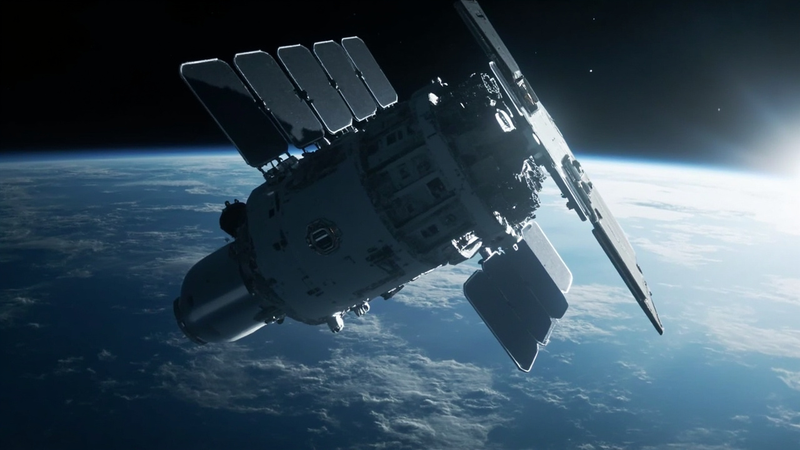
A boxy communications satellite carrying flat panel antennas and solar arrays flies above a cloud-covered Earth.


The launch looked ordinary. On July 16, 2026, at 1:32 p.m. Pacific, a Falcon 9 lifted off from Space Launch Complex 4E at Vandenberg Space Force Base carrying 21 identical flat-panel satellites. The first stage — booster B1103 on its fourth flight — flipped, glided back, and set down on the drone ship Of Course I Still Love You about 8.5 minutes later, logging SpaceX’s 639th successful booster recovery. Routine, until you remember that for nine months before that afternoon, no Tranche 1 satellite of any kind had flown.

The 21 satellites, built by York Space Systems, were the third batch of the U.S. Space Development Agency’s Tranche 1 Transport Layer. They joined 42 others already on orbit. Together those 63 spacecraft form the spine of a network the Pentagon does not quite have a clean phrase for: an internet, of sorts, designed for warfighters, running roughly 1,000 kilometers up in near-polar shells that pass over the equator twice an orbit. By the time the constellation reaches its full Tranche 1 size of 126 satellites, expected by mid-2027, the network will be the largest dedicated military LEO relay ever deployed.

For decades, tactical communications for U.S. and allied forces have run through a handful of heavy, expensive, geostationary satellites. The Advanced Extremely High Frequency (AEHF) constellation carries strategic command traffic in protected, anti-jam channels at $1.8 billion per spacecraft. The Wideband Global SATCOM (WGS) system pipes bulk data to aircraft and ships. Both architectures are excellent when they work. They also depend on a few high-value nodes, parked at fixed slots 36,000 km up, that an adversary can identify, jam, or try to maneuver-kill with a direct-ascent antisatellite weapon.

The SDA’s counter-move borrows a page from commercial internet engineering. Distribute the network across hundreds of small, cheap, replaceable nodes in low orbit, route traffic around any node that gets cut, and refresh the constellation every five years. Multiply the count, distribute the risk, accept a per-satellite ceiling that buys commodity parts rather than bespoke gold boxes. The trade-off is bandwidth per node — geostationary birds carry more — but for tactical purposes where latency and resilience matter more than peak throughput, the math works out differently. The Department of Defense has projected the broader Proliferated Warfighter Space Architecture at roughly $35 billion through fiscal 2029, with about $11 billion already obligated since 2020 (SDA, 2026; GAO-26-107085).

The SDA itself is barely seven years old. Established inside DoD in 2019 to break up a slow, monolithic acquisition culture, the agency set out to demonstrate that a small office in the Pentagon could buy satellites the way a startup buys servers: in tranches, every two years, with each tranche a deliberate step up in capability. Tranche 0, the experimental precursor, flew 28 small satellites between 2023 and 2024 built by York and Lockheed Martin. Those birds proved that optical crosslinks could pass data in low orbit, but a Government Accountability Office report (GAO-26-107085, January 28, 2026) concluded that Tranche 0 never demonstrated an integrated “sensor-to-shooter” loop — partly because the planned capstone demo was reduced after on-orbit calibration ran long.

Still, by the time GAO went to print, the agency had already committed about $9.9 billion in Tranche 1 and Tranche 2 contracts with Lockheed Martin, Northrop Grumman, York, L3Harris, and Sierra Space — roughly fifteen times the Tranche 0 budget of $657 million — before Tranche 0 had fully proven its architecture end-to-end. That decision became the cornerstone of GAO’s headline finding: the risk to delivering missile warning and tracking in Tranche 1 is high.

The first operational Tranche 1 batch, T1TL-A, launched September 10, 2025 with 21 York satellites. T1TL-B followed October 15, 2025 with 21 Lockheed-built satellites. Then the agency paused. Nine months of software fixes, hardware rework, and propulsion diagnostics: a stuck-key scenario in the xenon-feed valve cycling, intermittent glitches in the cryptographic unit, and a series of attitude-control loop instabilities that did not show up on the ground. T1TL-E on July 16 was the resumption, not a clean start. By that afternoon, York had confirmed telemetry from all 21 new spacecraft within five hours of separation; engineers were still working through enabling the optical mesh.

What makes this constellation unusual is the radio underneath it. The rest is plumbing.

Link 16 is the tactical data waveform most Western military aircraft, surface ships, and air-defense batteries already speak. Originally designed for line-of-sight use among fighter jets, it hops pseudorandomly across 51 frequencies in the 969–1,206 MHz L-band at 38,000 hops per second, giving it a built-in jam-resistance that older UHF systems lack. Terrestrial Link 16 is horizon-limited. At typical F-35 cruise altitude, the radio horizon is roughly 800 km, which means a U.S. Navy cruiser off Hainan cannot directly talk to a Patriot battery in Taipei. They need a third party, or a satellite relay.

A relay at 1,000 km altitude can see a circular footprint of radius about 3,300 km. Two or three satellites in polar planes spaced around the globe give near-global skip coverage that does not depend on where the target ships happen to be. The T1TL satellite’s phased-array antennas listen on multiple Link 16 channels simultaneously, retransmitting the digital bits either down to another ground radio or across the next hop.

The crosslinks between the satellites themselves are optical, not radio. Each York-built satellite carries two Mynaric CONDOR Mk3 terminals operating at the 1,550 nm wavelength used by telecom fiber networks. The photon budget over a 5,000 km link works out like this: a 1-watt average laser, a 5 microradian beam divergence, and an 8 cm receiver aperture set a practical on-off-keying rate around 10 Gbps. The Shannon-style capacity ceiling for a wide-deviation DPSK signal at 5 GHz of detector bandwidth and a signal-to-noise of about 18 dB is in the same neighborhood:

C ≈ B * log2(1 + SNR)

With B = 5 GHz and SNR ≈ 18 dB, C ≈ 30 Gbps of theoretical clean-air capacity — the deployed 10 Gbps leaves headroom for pointing loss, atmospheric scintillation on the downlinks, and convolutional coding with 7/8 rate.

Two engineering choices that do not make the press releases deserve a closer look.

In a moving mesh at roughly 7.5 km/s, the optical path between any two satellites changes by tens of meters per second. The crosslink protocol bakes a pseudo-random ranging code into the optical packets so the constellation can resynchronize its symbol clocks to within a few nanoseconds on each handoff. And the routers inside each T1TL satellite run a simple link-state protocol that updates roughly every five seconds; if one node drops out, the network rebuilds its spanning tree in milliseconds. The whole point is that no single loss should matter.

Tranche 1’s remaining satellites will arrive over roughly the next 18 months, with the Tracking Layer — 28 infrared-sensor satellites for hypersonic missile warning — flying in parallel. SDA’s stated initial-operational-capability date is early 2027, though GAO has warned that integration risk may push capability back. The next concrete milestone to watch is the first demonstration in which two Link 16 radios, on either side of the world, exchange a live tactical packet through the optical mesh with humans-in-the-loop on both ends. That has not yet happened on orbit.

Meanwhile, July 16 was a quiet milestone for the architecture. Sixty-three satellites in a near-polar mesh, talking to radios that have been waiting forty years to be heard from space.
 

August 3, 2026

The pad that learned twice

Posted by


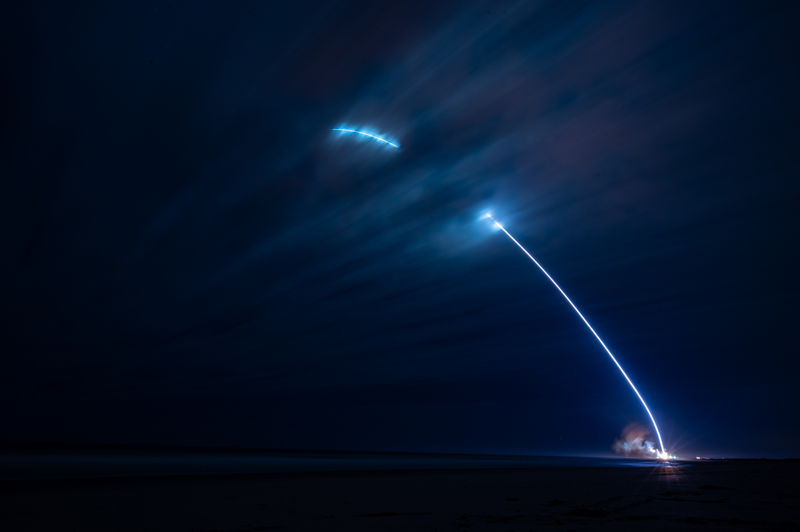
A long-exposure night photograph traces a rocket's ascent as a bright white arc climbing away from a coastal launch pad, with a second detached arc burning higher in the sky.


About 9 p.m. on the evening of May 28, 2026, a fully stacked New Glenn rocket at Launch Complex 36A began its final countdown. The vehicle stood 98 meters tall, taller than the Statue of Liberty on a pedestal, with seven BE-4 engines ringing its base. Around it, the propellant farm that had fueled the booster for its January 2025 maiden flight sat intact. The transporter-erector that had lifted the rocket onto its launch table four weeks earlier stood at the ready. By 9:07 p.m., both were gone.

This was not a launch. It was a hotfire test — the routine procedure in which a fully fueled rocket is ignited while held to the ground, its engines throttling up to validate the full countdown sequence without a real liftoff. Static fires have a good safety record. They are also where the most informative failures happen, because the rocket is fully instrumented and engineers can usually retrieve most of the wreckage.

The pattern is older than the modern launch industry. On September 1, 2016, a Falcon 9 loaded with the AMOS-6 communications satellite detonated at Space Launch Complex 40 during a pre-launch propellant load. The cause was a composite-overwrapped helium pressure vessel inside the second-stage LOX tank; cold helium had pooled liquid oxygen in a buckle in the aluminum liner, the trapped oxygen ignited, and the COPV failed. Total elapsed time from first anomaly to loss of vehicle: 93 milliseconds (SpaceX 2017 final investigation report). SpaceX’s fleet was grounded for four months, and the company rebuilt SLC-40 from its concrete mat upward.

Both events are symptoms of the same era: a commercial orbital industry large enough that ground-test failures are national news, and that schedules them into customer manifests years in advance. The May explosion cost Blue Origin its primary launch table, transporter-erector, one of two lightning towers, and a vehicle weeks away from carrying 48 Amazon Leo internet satellites. It delayed the Blue Moon MK1 lunar cargo lander from late 2026 into early 2027, forced NASA to revisit the Artemis V manifest, and gave Amazon Project Kuiper a fresh reminder that a single launch provider is a single point of failure.

Blue Origin had rolled the New Glenn stack out to LC-36A on May 22, six days after the FAA cleared the rocket to resume flights following an April anomaly on NG-3’s upper stage. According to Blue Origin’s initial public statements, the anomaly originated in the aft section of the first stage — the part that contains the seven BE-4 engines, their turbopumps, and the dense plumbing that feeds liquid oxygen at roughly 90 K and liquefied natural gas at roughly 112 K into the combustion chambers.

Within hours, Blue Origin CEO Dave Limp publicly committed to a return-to-flight target of “before the end of 2026,” and within weeks the company had completed debris clearance. The investigation is still open, but two facts are doing the heavy lifting. First, the BE-4 has been a reliable engine in flight: it has propelled ULA’s Vulcan to four national security missions since March 2025 (with two recent anomalies lying in Northrop Grumman’s GEM-63XL solid boosters, not the BE-4s), and the same engine has now completed three New Glenn flights with three first-stage recoveries on the droneship Jacklyn. Second, NG-3 in April was a reflight of the booster “Never Tell Me The Odds” — the first New Glenn first stage ever to fly twice — and that booster’s engines performed cleanly through ascent and the boost-back burn.

The booster itself, built around a 7-meter composite fairing that dwarfs Falcon 9’s 5.2-meter shell, had landed cleanly on the droneship Jacklyn during both NG-2 in November 2025 and NG-3 in April. Jacklyn is sized for that scale: 116 meters long and 46 meters wide, with a hydraulically actuated landing fixture and a 375-foot Liebherr crane for vertical-to-horizontal breakover. Whatever happened on the pad in May, the engines that actually reach orbit have already shown they can do it more than once.

The BE-4 is what Blue Origin calls a “medium-performing version of a high-performance architecture.” Each engine burns liquid oxygen and liquefied natural gas in an oxygen-rich staged-combustion cycle. A portion of the LOX is burned with a portion of the methane in a preburner to drive a single turbopump that feeds both propellants into the main combustion chamber at roughly 14 megapascals — about twice the chamber pressure of Merlin and roughly half the 26 to 35 megapascals that SpaceX extracts from Raptor’s full-flow staged-combustion cycle (Blue Origin BE-4 specifications, 2024).

What the BE-4 trades in chamber pressure it tries to win back in reusability. The turbopump spins on hydrostatic bearings — thin films of propellant fluid that bear the load between rotating and stationary parts — rather than on ball or roller bearings that wear under every start cycle. A contact-free bearing eliminates the failure mode that has historically dominated rocket turbopumps, where rotor-stator rubbing generates friction heat in a high-energy-density oxygen-rich environment and a single hot particle can ignite adjacent propellant feed lines.

The Tsiolkovsky rocket equation still rules the design: Δv = v_e * ln(m_0 / m_f), where v_e is the exhaust velocity (roughly 3,400 m/s for BE-4 in vacuum). Reaching low Earth orbit requires about 9.4 km/s of Δv, of which gravity and drag losses consume roughly 1.5 to 2.0 km/s, leaving the engines to deliver around 7.5 km/s. A first stage that needs about 3.5 km/s of its own Δv with v_e ≈ 3,400 m/s requires a mass ratio R = exp(3,500 / 3,400) ≈ 2.8, meaning about 64% of the fueled first-stage mass is propellant.

When aft-section failures do occur, the failure modes cluster in a small list. Rotor-stator contact, often initiated by bearing degradation or cavitation-induced vibration, is one. Turbine-blade fracture, which throws high-energy debris into propellant feed lines, is another. Seal failures that allow LOX and LNG to mix at incompatible temperatures, or cavitation instabilities in the inducer stage of the LOX pump, are others. In most paths the first symptom is a vibration signature through the turbopump housing; a properly instrumented static-fire test records it in hundreds of channels at kilohertz sampling rates. Engineers can usually reconstruct the chain of events within weeks — though identifying the root cause that should be redesigned to prevent recurrence is what takes months.

What Blue Origin is now doing at LC-36 is its own engineering story. Rather than rebuild the same transporter-erector, the company is accelerating a horizontal-to-vertical hybrid integration concept originally planned for LC-36B. Stages are mated horizontally inside the adjacent Integration Facility, then rolled to the pad, where a crane performs a vertical “breakover” — the inverse of the operation used to offload a recovered booster from Jacklyn — and lifts the vehicle onto a refurbished launch table. The architecture eliminates the transporter-erector as a single point of failure and gives Blue Origin a common concept of operations across both pads.

The May 28 explosion did not invalidate New Glenn. The vehicle has now completed three flights, two booster recoveries on Jacklyn, and one reflight. The engines that power it have completed dozens of Vulcan flights for the U.S. Space Force. But the incident exposed a single point of fragility that SpaceX had already learned about in 2016: the ground systems beneath a rocket are as important as the rocket itself. Blue Origin’s recovery plan converts the loss of one transporter-erector into a permanent architectural improvement — horizontal mating, vertical breakover, common CONOPS across two pads — that, if it works, will outlast any single vehicle lost on the pad.

For NASA, the lesson is schedulable. Blue Moon MK1 slips to early 2027; Artemis V, which depends on Blue Moon MK2 launching from a recovered New Glenn, slips with it. For Amazon, the first of 24 contracted New Glenn Leo launches slips along the same curve, though Kuiper has Atlas V and Vulcan capacity to bridge the gap. For Blue Origin, the lesson is the one every second-to-fly vehicle has had to learn: the rocket equation forgives inefficiency, but never a customer whose manifest has nowhere else to go.


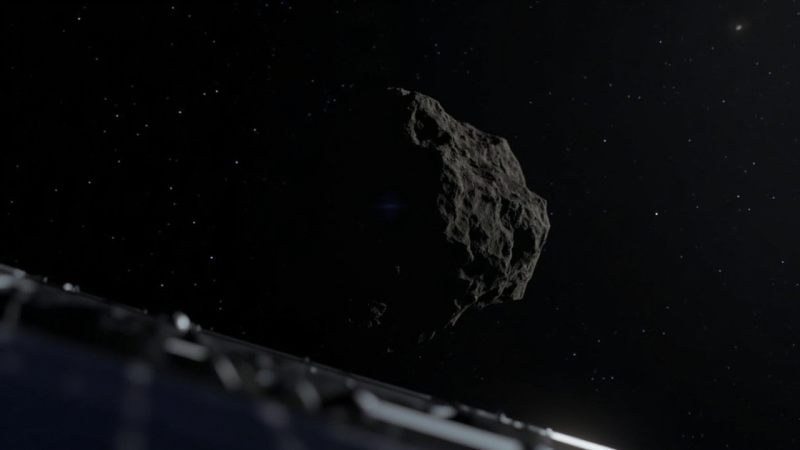
Artist's view of the small, jagged quasi-satellite Kamoʻoalewa, as seen from roughly 20 km during Tianwen-2's approach on July 2, 2026.


A small, jagged rock tumbling through space about 20 million kilometers from Earth just had its portrait taken. On July 6, 2026, the China National Space Administration released the first close-range images of (469219) Kamoʻoalewa, captured by the Tianwen-2 spacecraft from roughly 20 kilometers away on July 2. The pictures are grainy, low-resolution, slightly fuzzy at the edges. They are also the only close-up views humans have ever gotten of Earth’s most stable known quasi-satellite, and they sharpen a debate that has dragged on for nearly a decade about where this object came from. The rock’s elliptical path around the Sun takes it between roughly 0.1 and 0.3 AU closer and farther from Earth’s orbit, depending on where in the multi-decade cycle you sample it. From a ground-based telescope on any given night, Kamoʻoalewa is a faint dot moving against the stars: too small for any existing instrument to resolve as a disk, but bright enough that sensitive CCDs can pin down its spectrum and its rotation period. Both numbers have mattered for the past decade’s argument.

Kamoʻoalewa (a Hawaiian name meaning “oscillating celestial object”) was discovered in 2016 by the Pan-STARRS survey at Haleakalā Observatory in Hawaii (JPL Small-Body Database). Estimates put it somewhere between 16 and 40 meters across, it rotates once every 27 minutes, and it shadows Earth in a peculiar gravitational dance. Not a true moon, but a small body trapped in a 1:1 mean-motion resonance with our planet, looping the Sun in an orbit nearly identical to ours. From Earth’s perspective, the rock traces a slow, bean-shaped path that drifts between leading and trailing horseshoe configurations on timescales of decades. For at least the past hundred thousand years, give or take an order of magnitude, it has been Earth’s quiet companion. At some point it will leave.

For most of that history, nobody could get close enough to study it. Ground-based spectroscopy showed a spectrum that resembled space-weathered lunar regolith, with a weak 1.0 μm absorption band and a steep red slope that closely matched samples returned by Apollo 14 and the Chang’E-5 lander (Zhang et al., Nature Communications, May 2026). That match suggested the asteroid might be a piece of the Moon, blasted off by a relatively recent impact and gently nudged into a co-orbital path. But other groups showed that heavily weathered LL chondrite powder could produce a similar spectrum, and a Flora-family origin in the main belt remained plausible. Without a sample in hand, the question stayed open.

Tianwen-2 launched on May 29, 2025 from the Xichang Satellite Launch Center on a Long March 3B rocket, carrying 11 scientific instruments and a sample-return capsule designed for two distinct collection methods: a Hayabusa-style touch-and-go to grab regolith kicked up by a small thruster pulse, and an anchor-and-attach approach using robotic arms to clamp onto boulders and retrieve larger fragments. The spacecraft’s primary target was Kamoʻoalewa; an extended mission will later send it onward to main-belt comet 311P/PANSTARRS using a lunar gravity assist, with arrival in 2035.

The cruise phase took just over a year. Tianwen-2 first detected Kamoʻoalewa on June 6, 2026 at a range of 30,000 kilometers and refined the asteroid’s ephemeris from kilometer-scale uncertainty down to tens of meters (CNSA, July 2026). By June 19 it had closed to 2,000 km. Two weeks later, the framing camera returned the first resolved frames: a small, asymmetrical, jagged fragment, rotating visibly between exposures. The shape, in early analysis, looks more like a single competent block than the loose rubble pile some pre-arrival models had predicted.

The clincher will be the samples themselves, scheduled for collection later this year and return to a landing site near Jiuquan in late 2027. Tianwen-2 is the third mission in a decade-long run of asteroid sampling attempts, after JAXA’s Hayabusa2 (returned 5.4 g from Ryugu in December 2020) and NASA’s OSIRIS-REx (returned 121 g from Bennu in September 2023). Both of those targets were bigger than this one — Ryugu at about 900 m, Bennu at about 500 m — and both had escape velocities of tens of centimeters per second. Tianwen-2 is operating at a scale where escape velocity drops to a few centimeters per second, which puts the spacecraft closer to the asteroid in gravitational terms than a hang glider is to a hillside.

A new Nature Communications paper from Zhang and colleagues, published May 27, 2026, lays out what Tianwen-2’s near-approach spectroscopy already tells us about composition. The body’s reflectance spectrum matches the Itokawa-like LL chondrite class but with deeper space-weathering features than Hayabusa2 saw on its target. That tilts the evidence away from the lunar-ejecta hypothesis and toward a main-belt origin, but does not settle it. Samples in hand will.

Sampling on a 27-minute rotator is not trivial. A touch-and-go sequence has to compensate for the asteroid’s rotation, surface translation, and the very weak gravitational field — escape velocity from a 27-meter rocky body is on the order of a few centimeters per second. The Tsiolkovsky rocket equation, Δv = v_e * ln(m_0 / m_f), governs the maneuver budget for the descent burn. With a hydrazine thruster exhausting at roughly 2.2 km/s, Tianwen-2 has only a few hundred meters per second of total Δv available for the rendezvous, descent, sampling, and escape sequence combined. Each kilogram of mass the spacecraft sheds by venting or by jettisoning a sampling arm after contact translates directly into extra Δv headroom on the way home.

The anchor-and-attach method sidesteps some of that timing pressure. The arms can latch onto a boulder and ride the rotation with the asteroid for one full spin, giving the sampling drill time to work without the spacecraft having to hover. For both methods, the engineering constraint is the same: a few hundred grams of regolith, in a sealed capsule, must survive the return trip.

After the samples are sealed, Tianwen-2 will swing by the Moon for a gravity assist — adding roughly 1 km/s of heliocentric velocity for a negligible fuel cost — and aim for an Earth return in November 2027. If the capsule lands intact, the lab work begins: isotope ratios, cosmic-ray exposure ages, mineralogy. For the lunar-ejecta camp, the smoking gun would be a sample’s oxygen isotope signature falling outside the range of known meteorites and inside the range of lunar rocks. For the Flora-family camp, the clincher would be cosmic-ray exposure ages older than any plausible lunar crater’s age.

Either answer is interesting. A confirmed lunar origin would make Kamoʻoalewa the first known natural sample of the Moon without ever landing there, and would let planetary scientists calibrate impact-ejection dynamics with real data rather than simulations. A confirmed main-belt origin would rewrite the textbook on how quasi-satellites are captured and how space weathering proceeds on small bodies. By late 2028, with luck and a soft landing in Inner Mongolia, we will know which way the cosmic dice rolled when this little fragment came tumbling into Earth’s neighborhood. Until then, the new images are already doing their job: they have made an abstract orbital curiosity into a place with a shape, a spin, and a surface.





