OrbitalHub

Where curiosity reaches escape velocity.

Domain is for sale. $50,000,000.00 USD. Direct any inquiries to contact@orbitalhub.com.

Archive for 2026


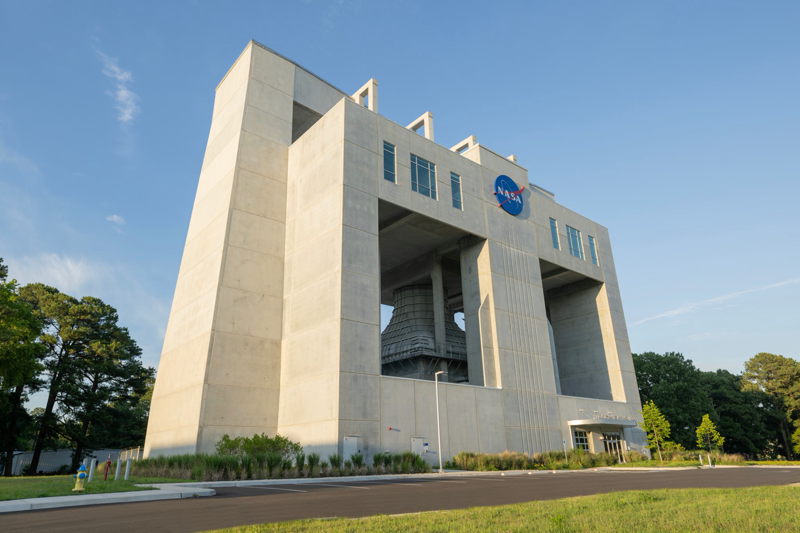
NASA's first new wind tunnel in 40 years opens at Langley. Image: 2026 08 01 flight dynamics research facility.


For more than 100 years, the wind tunnels at NASA’s Langley Research Center have shaped how aircraft fly and how spacecraft return to Earth. On July 31, 2026, the agency opened the Flight Dynamics Research Facility (FDRF), the first major wind tunnel NASA has built in more than 40 years. At 140 feet tall and roughly 25,000 square feet, the new facility in Hampton, Virginia, replaces two of the center’s oldest test rigs, the 1939 12-Foot Low-Speed Tunnel and the 1941 20-Foot Vertical Spin Tunnel, with a single vertical tunnel that can run faster, larger, and more detailed tests than either of its predecessors.

The opening is more than a ribbon-cutting. It is the first time in a generation that NASA has stood up a brand-new wind tunnel at all, and the FDRF arrives at a moment when the agency is preparing to return astronauts to the Moon, send a rotorcraft to Titan, and design aircraft for Mars.

Wind tunnels are the workhorse of every flight program that has ever flown. Before a new aircraft shape, a reentry capsule, or a supersonic body is committed to metal, engineers drop a scale model into a moving column of air and watch how it behaves. The data from those tests feeds the simulations that predict how the full-scale vehicle will handle turbulence, control inputs, parachute deployment, and spin recovery.

Langley in particular has been a center of that work since the NACA era. The 20-Foot Vertical Spin Tunnel was the only operational tunnel of its kind in the Western Hemisphere that could run free-spin tests on dynamically scaled aircraft models, and according to the NASA Langley Research Directorate and the agency’s facility page for the VST, nearly every USAF and USN fighter, trainer, and attack aircraft since World War II has been tested there. The 12-Foot Low-Speed Tunnel, which began operations in 1939, hosted everything from biplane-era stability studies to the X-29 forward-swept-wing demonstrator, the X-31 Enhanced Fighter Maneuverability aircraft, the X-59 quiet supersonic research plane, and the aeroshell for NASA’s Dragonfly rotorcraft now being prepared for a flight to Saturn’s largest moon.

Both tunnels were deactivated last year. Replacing them with a single facility that consolidates the capabilities of two NACA-era buildings is a deliberate move toward a more flexible, more efficient research platform, and a hedge against the maintenance burden of running machines that were already past their design lifetime.

On Friday morning, NASA Administrator Jared Isaacman, Langley Center Director Dr. Trina Dyal, U.S. General Services Administration Administrator Edward C. Forst, and a phalanx of Virginia state and local officials cut the ribbon on the FDRF at NASA Langley. The 140-foot building, the fourth new facility GSA has delivered to NASA under Langley’s 20-year campus revitalization plan, was built in partnership with GSA to replace aging infrastructure with an energy-efficient design that should reduce maintenance costs for the next several decades.

The FDRF’s signature feature is its vertical test section, where air moves upward through a 20-foot-diameter chamber, the largest such chamber ever operated at Langley. A model is dropped into the rising airflow and either flies freely to study stability and control, or is mounted on a rig to measure forces and moments directly. The fan system behind that airflow consists of four 750-horsepower motors, each driving a 14-foot-diameter, eight-bladed carbon fiber fan. Combined, the system can push the wind to 117 miles per hour, roughly twice the top speed of the two facilities it replaces, and enough to lift heavier scale models for free-flight simulations of full-scale vehicles flying at high altitude. That includes reentry capsules coming back from space.

The $57 million facility, per local coverage of the ribbon-cutting, is managed under the Aerosciences Evaluation and Test Capabilities portfolio in NASA’s Aeronautics Division, and its research portfolio is already mapped out. Engineers will use it to validate X-plane designs, study autonomous and drone flight, refine entry, descent, and landing systems for the Artemis program, and gather data for hypothetical Mars aircraft. Six wooden fan blades and the central metal fan hub from the 1939 12-Foot tunnel are on display inside the new control room; the lobby carries a timeline of both legacy facilities, with historic test models flanking the entrance.

A vertical wind tunnel is built around a deceptively simple idea. A model is dropped into a rising column of air, and the lift from that column holds the model aloft in the same way a wing’s lift holds an aircraft in the sky. By adjusting the airspeed and the model’s attitude, researchers can recreate the forces a real vehicle would feel in flight, including the asymmetric, unstable conditions of a stall or spin, without ever risking the full-scale vehicle. The original 20-Foot VST, which was designed to study stall and spin characteristics after deadly postwar accidents, used exactly this approach. Engineers hand-launched models into the rising airstream to evaluate how aircraft behaved when they lost lift.

The FDRF keeps the same physics but scales it up. The 20-foot test section admits more air around each model, which improves data accuracy and allows larger, more detailed test articles. The doubled airspeed means the tunnel can simulate higher-altitude flight regimes, where thinner atmosphere makes aerodynamic testing harder. Carbon fiber fan blades replace the heavier metal blades of the legacy tunnels, so the fan can change airspeed quickly during a free-flight test, a key capability for capturing transient events like a recovery from a spin or the deployment of a drogue chute.

Equipment reuse is part of the engineering story. Many of the major test rigs, instrumentation racks, and data systems from the 12-Foot Low-Speed Tunnel have been repurposed for the FDRF, which reduced both cost and the time needed to bring the new facility online. NASA’s Mike Fremaux, the retired chief engineer for Langley’s Intelligent Flight Systems division, who spent 30 years shepherding the project, frames the continuity in human terms as well: “You can’t have one without the other. Not just the buildings, the fans, and the motors, but also the expertise associated with those facilities.”

The facility will support three broad classes of work. First, atmospheric flight: X-planes, autonomous aircraft, military and commercial airframes, and high-altitude long-endurance drones. Second, planetary atmospheric flight: rotorcraft and fixed-wing concepts for Mars and Titan, where Dragonfly is the lead customer. Third, entry, descent, and landing: full-scale drop tests of capsule shapes returning from lunar and deep-space missions, where the FDRF’s 117 mph ceiling and large test section are uniquely well matched to the problem of stabilizing a vehicle that is descending through a thickening atmosphere.

Langley’s new wind tunnel opens with a workload that ranges from the near-term (X-plane and Artemis entry, descent, and landing) to the speculative (Mars aircraft, Titan rotorcraft). It also points to a longer arc. The 12-Foot tunnel that just closed supported 86 years of work, from biplanes to supersonic demonstrators; the VST that closed alongside it supported nearly every U.S. military aircraft since the 1940s. The 25,000-square-foot FDRF is built to do at least as much. The new control room, the lobby timeline, and the wooden fan blades on display are the agency’s way of saying that the next 86 years start now.

The first FDRF test campaigns are expected to begin in the coming months, with Artemis capsule stability work and Mars aircraft concept studies both on the early schedule.
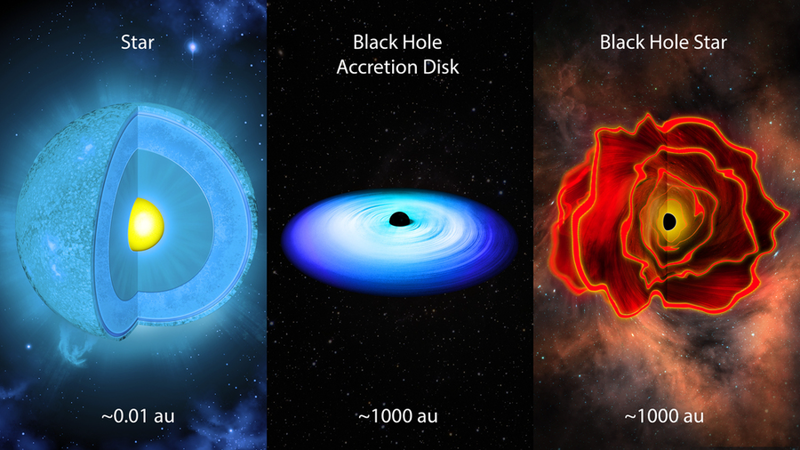


Three-panel schematic comparing a normal star (~0.01 au, blue cutaway sphere with a yellow fusion core), a black hole accretion disk (~1000 au, blue pancake spiral), and a black hole star (~1000 au, an amorphous red cloud with a black central sphere).


Six hundred and sixty million years after the Big Bang, when the universe was barely five percent of its current age, the James Webb Space Telescope picked up a red dot that almost no model on the shelf could explain. It looked, at first glance, like an enormous star. It had the broad emission lines of an active galactic nucleus. Its light vanished entirely below a certain wavelength in a way that almost no known object manages. The brightness sat at roughly 100 billion times the energy output of a star like the Sun, well past anything stellar nucleosynthesis can produce. Astronomers at MIT and collaborating institutions argue in a paper published August 12 in Nature that the source is something not previously classified: a black hole, weighing in at around 100,000 times the mass of the Sun, wrapped in a hydrogen envelope the size of the solar system and shining almost entirely by accretion rather than fusion. The team named it MoM-BH*-1, and the broader configuration a “black hole star.”

The discovery lands in the middle of one of the most active arguments in extragalactic astronomy. JWST has spent the past three years turning up “little red dots” in almost every deep field it images: compact, very red, surprisingly bright sources in the first 1.5 billion years of cosmic time, each one tiny on the sky but radiating as much as a small galaxy. They are catalogued as LRDs. They are extremely common in the early universe and almost vanish by the present day, which is itself a clue that whatever they are, they represent a phase most black holes pass through quickly.

If MoM-BH*-1 is what the MIT team says it is, the LRDs may not be a mixed bag at all. They may mostly be one thing: supermassive black holes at cosmic dawn, growing through super-Eddington accretion inside dense gas cocoons, briefly visible before feedback or mergers dissolve the envelope. That would resolve two puzzles: how billion-solar-mass black holes existed at redshift seven without violating standard accretion physics, and why these sources fade from view by the present, since the dense envelope they need to look “star-like” is a transient early-life configuration rather than a steady state. As Naidu puts it, “every massive black hole may have gone through this phase.” If that holds, the LRD mystery was never about exotic physics. It was about catching black holes mid-birth.

Rohan Naidu, a NASA Hubble Fellow at MIT’s Kavli Institute, was not looking for a black hole star. He was running a JWST survey called Mirage or Miracle (MoM) to figure out which of the bright galaxies at extreme distances were genuinely primordial and which were foreground contaminants masquerading as early-universe sources. As Naidu told MIT News, “what looks like an extremely bright early galaxy, aka a ‘miracle,’ in some cases actually could be a ‘mirage.'” The team picked targets for spectroscopy using NIRSpec, the workhorse near-infrared spectrograph for early-universe follow-up.

One target stood out. Its color was very red, its brightness was off the scale, and its spectrum had a tell-tale shape: an abrupt cut-off blueward of a certain wavelength, then bright emission redward. That cut-off is a Balmer break, which usually appears in the atmospheres of a few-hundred-million-year-old stars, where dense hydrogen absorbs photons just shortward of 3647 angstroms. The team had never seen one this deep. As Naidu put it, it was “the deepest break we have ever observed in any object, ruling out ‘ordinary’ stars as the source.” The spectrum also contained almost no metals, only hydrogen and helium.

The team ran simulations. Could hydrogen alone, without dust, make something this red? Yes, but only if the hydrogen was so dense that it behaved like a stellar surface, a pseudo-photosphere rather than a wispy nebula. That explained the color and the deep Balmer break, but not the brightness. Stars run on fusion, and fusion tops out at a known energy ceiling for a given mass. This source was a hundred billion times brighter than that ceiling.

The fix was to swap the power source. The simulations added a black hole accreting at super-Eddington rates instead of nuclear fusion at the center. The team varied the black hole mass and other parameters until the simulated spectrum and total luminosity matched what JWST saw. The closest match was a black hole of about 100,000 solar masses inside a hydrogen envelope the size of the solar system. The Nature paper lays out the model: the Balmer break and absorption features come from extremely dense, turbulent gas forming a dust-free envelope, and radiation from the black hole dominates almost all the observed light.

The team named the specific source MoM-BH*-1 and proposed “black hole star” as the category. If the interpretation holds, every other LRD in the JWST archives becomes a candidate. Sci.News covered the paper the same day, and phys.org ran a parallel writeup noting that an accompanying paper by Alberto Torralba and colleagues identifies a similar object at “cosmic noon,” roughly three billion years after the Big Bang. TechTimes emphasized the super-Eddington accretion angle, noting that Naidu has proposed that early globular clusters with the right conditions underwent runaway stellar mergers, producing supermassive stars weighing tens of thousands of solar masses.

The spectroscopic work hinges on two features JWST is uniquely equipped to measure: the depth of a Balmer break at very high redshift, and the shape of broad hydrogen emission lines from the inner accretion flow.

A Balmer break is a sharp drop in continuum light at wavelengths shorter than the Balmer limit, the energy required to lift a hydrogen electron from its second shell to a free state. Any gas cool and dense enough to keep hydrogen in its lowest excited state will soak up photons below 3647 angstroms and let longer wavelengths pass; the size of the resulting step tells you how much cool, dense hydrogen sits in front of the light source. At a redshift of about seven, the same break shifts into the near-infrared, into the JWST band, and the depth can be measured precisely with NIRSpec’s multi-object spectroscopy. The MoM-BH*-1 spectrum shows the deepest such break ever recorded at any redshift, which forced the team to a dense hydrogen atmosphere rather than a typical nebular one.

The black hole mass estimate comes from a separate argument. The light is dominated by accretion, not starlight, so the team applied standard active galactic nucleus scaling relations between continuum luminosity and broad-line region radius. The H-beta emission line is multi-peaked and broad, consistent with several thousand kilometers per second in the inner accretion flow, and the width scales with the square root of the black hole mass inside it. Super-Eddington accretion, the only way to push 100,000-solar-mass objects to LRD-like luminosities from small seeds, is the theoretical prediction the team is matching against.

The third piece is the absence of dust. Most red objects in JWST images are red because interstellar dust absorbs blue light. MoM-BH*-1 is red because hydrogen itself is absorbing at the Balmer limit. The Nature paper is explicit: “the redness of the black hole is due to gas, not dust,” which rules out standard dust-reddened active galaxies and puts the object into a small set of dust-free compact sources at cosmic dawn. The structural claim the team is asking the community to test is straightforward: a black hole of roughly 100,000 solar masses, an envelope about the size of the solar system, accreting at super-Eddington rates, lighting up a hydrogen pseudo-photosphere that looks star-like from a distance.

A single observation in JWST’s third year of operations has reframed an open question in extragalactic astronomy. If the Nature paper holds up to scrutiny, the universe’s ubiquitous little red dots are not exotic new objects but a transient phase in the life of every massive black hole: a brief window in which a seed black hole, growing through super-Eddington accretion inside a hydrogen envelope, briefly outshines its host galaxy before feedback or mergers dissolve the cocoon. The MIT team expects JWST’s archive to contain many more MoM-BH* candidates waiting to be confirmed. The next step is spectroscopic follow-up on the brightest LRDs across multiple deep fields, which should settle whether the same dust-free, hydrogen-dominated signature shows up in the rest of the population.


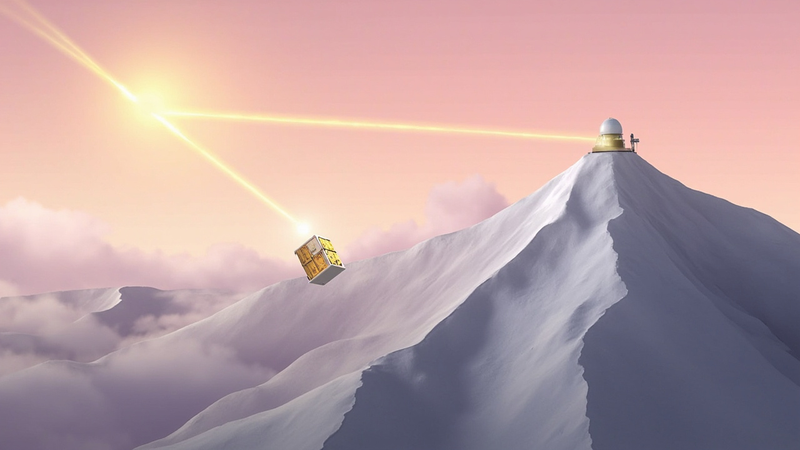
A 6U cubesat in low Earth orbit beaming a golden laser downlink toward a snow-dusted Greek mountain summit where a small optical ground station dome sits at dawn, soft pink and orange sky, the laser a thin visible line connecting them through atmosphere


For decades, the appeal of free-space optical communications from orbit has been obvious. A near-infrared laser beam carries orders of magnitude more spectrum than a comparable radio antenna, the beam is narrow enough to be effectively unjammable, and the photons cost almost nothing to produce. The catch has always been the last 50 kilometres of air. Index-of-refraction turbulence in the lower atmosphere bends the beam by microradians on millisecond timescales, smearing what should be a clean signal into a dancing speckle pattern on the receiver. Satellites have been talking to each other with optical links for years, but the moment a beam has to punch through clouds, fog, and temperature inversion layers, the system has to be either very large or staffed by a small army of optical engineers. On October 8, 2026, a Lithuanian startup called Astrolight, working with two Greek universities and the European Space Agency, showed that a 6U cubesat, a remote-controlled mountaintop terminal, and a piece of software that does not need a human to babysit it can do the job anyway, at 1 Gbps, with link margins to spare.

The piece of hardware in question is ATLAS-1, a laser communication terminal that Astrolight bolted to a nanosatellite called ERMIS-3, which the company says was deployed on a SpaceX rideshare launch (SatNews, October 8 2026). ERMIS-3 is funded through the Greek national space programme and the European Recovery Fund “Greece 2.0” initiative, with the National and Kapodistrian University of Athens running the Department of Aerospace side of the experiment and the Aristotle University of Thessaloniki operating the upgraded optical ground station. Astrolight’s job was the optics: the transmitter on the satellite, the receiver and beacon laser on the ground, and the software that joins them into a closed feedback loop. The ground station sits on Holomondas, a former astronomical observatory in northern Greece that Astrolight retrofitted earlier in 2026 with an 808-nanometre uplink beacon and a C-band optical receiver, and rebranded as OGS-2.5 (Intelligent CIO Europe, May 20 2026).

What the team reported on October 8 is more interesting than “it worked.” The link achieved first light on the satellite’s initial orbital pass over the ground station, transitioned to routine 1 Gbps downlinks within a week, and now runs two pre-scheduled passes per day, one in daylight and one at night, with no on-site operator. Closed-loop tracking held the beam down to elevations below 10 degrees; for passes above 15 degrees, link availability cleared 85%. The terminal re-acquired an interrupted signal in under 10 milliseconds, the speed the U.S. Space Development Agency now demands for inter-satellite optical links (SatNews, October 8 2026). That reacquisition budget is the operational number that matters. A low-Earth-orbit spacecraft flies past any single ground station in seven or eight minutes, and a slow reacquisition means lost megabits. Ten milliseconds is fast enough to hand the link off cleanly between stations on a single pass, which is what the commercial constellations are paying for.

The reason this is different from the inter-satellite optical links that SDA, Mynaric, and Tesat have been flying for several years is that those terminals never have to deal with the atmosphere. A beam from one satellite to another crosses nothing but vacuum, so the engineering reduces to narrow-beam pointing and high-fidelity wavefronts. A downlink to a mountaintop, by contrast, has to survive turbulence cells roughly 10 centimetres across near the ground, scintillation that flips the received power by a factor of three on second-long timescales, and weather. Holomondas sits at roughly 1,000 metres of elevation, which buys it less air column and fewer low-altitude turbulence cells than a sea-level site would. The 808 nm beacon Astrolight installed at the ground station gives the satellite’s coarse-pointing system a bright target to chase before the fine tracker takes over, and the C-band receiver behind it tolerates the same 1550 nm family of wavelengths that terrestrial fibre networks use, which means the same indium-gallium-arsenide photodetectors and erbium-doped fibre amplifiers can be repurposed from telecom inventory (Intelligent CIO Europe, May 20 2026).

The closed-loop trick is what closes the engineering gap. The beacon tells the satellite where the ground station is in inertial space; the satellite’s fast-steering mirror narrows the beam to a few hundred microradians, narrow enough that diffraction alone would put a metre-scale spot on the ground; the ground station’s wide-field detector sees the spot, measures its centroid, and pushes the offset back up the beacon. The whole loop runs at a few hundred hertz, well above the bandwidth of the turbulence that drives the worst scintillation. Once the loop is locked, the received power stabilises, and the link budget, which Astrolight quotes at 1 Gbps nominal and “up to 10 Gbps” headroom for the ATLAS-1 design, becomes a question of how much laser power the satellite can afford to spend per bit. A useful scaling relation is that the required transmit power scales as the square of the range, so a low-Earth-orbit link at 500 km needs roughly 10,000 times less power than a comparable geostationary link at 36,000 km — which is why nobody has ever put a useful optical downlink on a GEO satellite without a relay mirror in between.

The team has not talked publicly about the exact laser power, the modulation format, or the forward-error-correction scheme. Those numbers matter: at 1550 nm, the atmospheric transmission window is wider than at 1064 nm, and the eye-safety limit allows a few hundred milliwatts of average power before a ground telescope becomes a retinal hazard. The published numbers point toward on-off keying rather than the more exotic quadrature-amplitude-modulation formats that ground fibre uses, because residual scintillation still costs several decibels of margin if you try to ride a higher-order constellation through it. The “up to 10 Gbps” claim is therefore best read as a stretch goal in good seeing, not a guaranteed nightly rate.

What changes because of this is the small end of the market. The same architecture — a 1U-to-6U cubesat payload, a 30 centimetre ground receiver, and a software stack that runs itself — fits Earth-observation operators who today are stuck at tens of megabits per second over X-band because their satellite is too small for a steerable parabolic dish. Astrolight’s roadmap includes the ATLAS-2 and ATLAS-X-MINI terminals at 2.5 Gbps, and the larger ATLAS-X destined for ESA’s HydRON multi-orbit optical network in 2028 to 2029 (SatNews, October 8 2026). The company is also building a second optical ground station in Greenland with ESA, partly to chase high-elevation polar passes that Mediterranean sites cannot see, and partly to use the long Arctic nights as natural immunity against daytime turbulence. The first trans-Atlantic optical link from a commercial LEO satellite is no longer a 2030 problem.

The interesting historical echo is that this is, finally, what NASA and ESA have been quietly trying to build since the 1990s. Japan’s KIRARI satellite demonstrated a 1.5 Mbps optical downlink in 2006. The Lunar Laser Communication Demonstration returned 622 Mbps from the Moon in 2013. The European Data Relay System started operational optical service in 2016 at 1.8 Gbps between geostationary relay and LEO. The difference now is that a 6U cubesat, operated by a small team in Vilnius, can do the job, unattended, and the same company’s roadmap reaches deep into ESA’s flagship programmes. The orbit-to-ground bottleneck has been broken at the small end. What comes next is the same trick repeated a thousand times, every time a constellation operator looks at a 1 Gbps optical downlink and realises it no longer needs a ground crew to make it work.


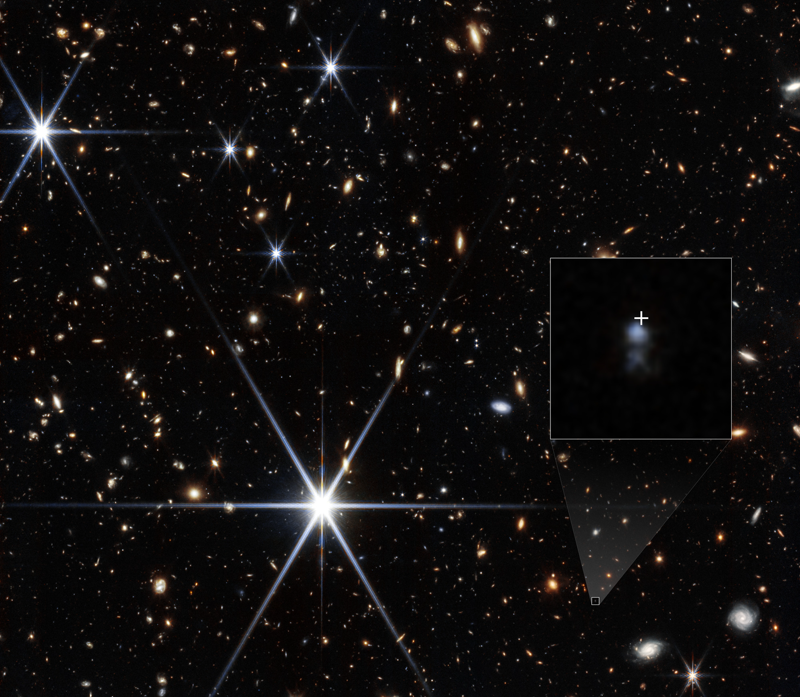
A composite NIRCam image centred on the host galaxy of FRB 20240304B in the constellation Virgo at right ascension 12:11:59 and declination +11:48:46, showing a faint blue dwarf galaxy inside a small inset box with a white cross marking the exact radio position of the burst, set against a crowded field of more distant galaxies and brighter foreground stars with diffraction spikes. Image: NASA Webb release assets at science.nasa.gov/asset/webb/frb-20240304b-nircam-image, credit NASA, ESA, CSA, STScI, Themiya Nanayakkara (USYD); image processing Joseph DePasquale (STScI).


On March 4, 2024, a 64-dish radio array in the South African Karoo picked up a flash that lasted less than a blink. The pulse, named FRB 20240304B and reported on the NASA Webb mission page, arrived at the MeerKAT telescope at 00:50:12.567 UTC with a dispersion measure of 2458 pc cm^-3, a value so high that the signal had clearly travelled through a vast column of ionised gas before reaching Earth. Localising it to within arc-second precision on the sky took another thirty seconds of offline processing. Doing anything useful with that position took the James Webb Space Telescope. In the October 8, 2026 issue of Science, the team led by Manisha Caleb and Themiya Nanayakkara at the University of Sydney report that Webb pinned the burst to a faint dwarf galaxy at a spectroscopic redshift of 2.148 plus or minus 0.001, a record that more than doubles the redshift reach of any previously localised fast radio burst.

The result matters because fast radio bursts, millisecond flashes of coherent radio emission whose origins are still debated, have until now been almost entirely local phenomena by cosmic standards. Of roughly one hundred FRBs with redshifts measured from their host galaxies, the great majority sit at redshifts below 0.5. Pushing that frontier to z = 2.148 means the team can now read the line-of-sight through roughly eighty percent of cosmic history in a single burst. The Macquart relation, which converts an FRB’s dispersion measure into an integrated electron-density estimate along the line of sight, has been constrained almost entirely by nearby events. A single very distant source stretches the calibration into the regime where cosmological ionised gas dominates the budget and where the missing baryons problem, once a curiosity of low-redshift surveys, becomes directly measurable.

To find a host, the team first searched public surveys and ran deep optical and near-infrared follow-up at the Keck and MMT observatories. The host stayed invisible down to five-sigma limiting magnitudes of R = 26.24 and J = 23.38 in the AB system. A faint, distant dwarf at redshift two is dim enough that ground-based eight- and ten-metre telescopes cannot pick it out of the foreground, which is exactly the regime where Webb’s cold infrared sensitivity overwhelms everything else in the astronomer toolkit. The team was awarded Director’s Discretionary Time on the observatory (programme 6779) and turned the Near Infrared Camera onto the field in the F200W and F322W2 filters on 26 December 2024. A candidate host appeared at an offset of about 0.3 arcseconds from the radio position. The Probabilistic Association of Transients to their Hosts (PATH) formalism gave a 97.5 percent posterior probability that the candidate is the real counterpart, with only a 2.4 percent residual chance of an unseen alternative.

The clincher was spectroscopy. Webb’s Near Infrared Spectrograph Integral Field Spectrograph caught strong H-alpha and [O III] lambda 5007 emission lines from the candidate, two of the canonical redshift markers at this cosmic epoch. The measured redshift of 2.148, defined to three decimal places, places the burst firmly in what cosmologists call cosmic noon, the era between roughly two and four billion years after the Big Bang when the cosmic star-formation rate reached its peak. MeerKAT’s dispersion measure had predicted a redshift of 2.8 with a 1.6 to 3.4 range, so the spectroscopic answer was consistent with the radio estimate but on the lower side of its confidence range.

The host galaxy itself turned out to be the bigger surprise. Most FRB host galaxies discovered to date are massive, dusty, vigorously star-forming systems. This host is none of those things. It has a stellar mass of about ten million solar masses, around a thousand times less than the team’s prior expectation, and a star-formation rate of about 0.2 solar masses per year. Its gas-phase metallicity is only ten to twenty percent of solar. By contrast, the FRB with the most well-studied host to date, FRB 20121102A, sits in a galaxy about ten times more luminous. The galaxy is, in the words of lead author Manisha Caleb, “a little dwarf galaxy, although it was actively forming stars.”

That mismatch is where the science gets sharp. There are two leading classes of FRB progenitor model in the current literature. The first invokes the merger of two neutron stars, compact objects whose orbit shrinks over billions of years through gravitational-wave emission until they collide, an end-stage process that should preferentially occur in older galaxies with evolved stellar populations. The second invokes young magnetars, the highly magnetised neutron stars left behind when a massive star ends its life in a supernova, that can power a fast radio burst through starquake-like activity within only millions of years of their birth. A dwarf host at cosmic noon with the metallicity of a primordial starburst fits the second scenario cleanly. The Milky Way’s own Galactic magnetar SGR J1935+2154, located only about ten kiloparsecs away, has produced FRB-like bursts in modern observations, and the metallicity of the new host is in the range where the initial mass function favours the formation of the very massive progenitors that become magnetars.

The team concludes that a neutron-star merger is unlikely to be the source of FRB 20240304B. The energetics back this up: the isotropic-equivalent energy of the burst is around ten to the forty-one erg, on the high end of what is reported for non-repeating FRBs but consistent with the magnetar picture.

FRBs are not just telephone signals from exotic objects, they are probes of everything their light passes through. Each burst carries an imprint of every free-electron it encountered between source and observer, which means a single very distant FRB can trace the cosmic web of ionised matter, the diffuse intergalactic medium, the circumgalactic halos of intervening galaxy clusters, and the warm interstellar medium of the Milky Way itself in one observation. The team’s dispersion-measure analysis for FRB 20240304B found the imprint of two structures along the sightline: an intervening galaxy group at a redshift of 0.3, about 3.5 billion light-years from Earth, and the nearby Virgo Cluster, which lies about 54 million light-years away in the constellation that gives the burst’s host its other nickname. Splitting the dispersion-measure budget across these contributions is what calibrates the Macquart relation across most of cosmic time.

The immediate next step is more of the same. The team estimates that MeerKAT can detect and localise several FRBs per year at redshifts above one, and the upcoming SKA-Mid array, with its order-of-magnitude jump in sensitivity, should push that rate higher. Each new burst becomes a Webb target for spectroscopy, and each new spectrum refines the picture of where and how these energetic flares arise. Whether most FRBs turn out to be magnetars, mergers, or some mixture is still an open question, but the new host galaxy, small, metal-poor, vigorously star-forming, and viewed as it was ten billion years ago, is the kind of place where a magnetar should be living. That is enough, for now, to weight the debate.


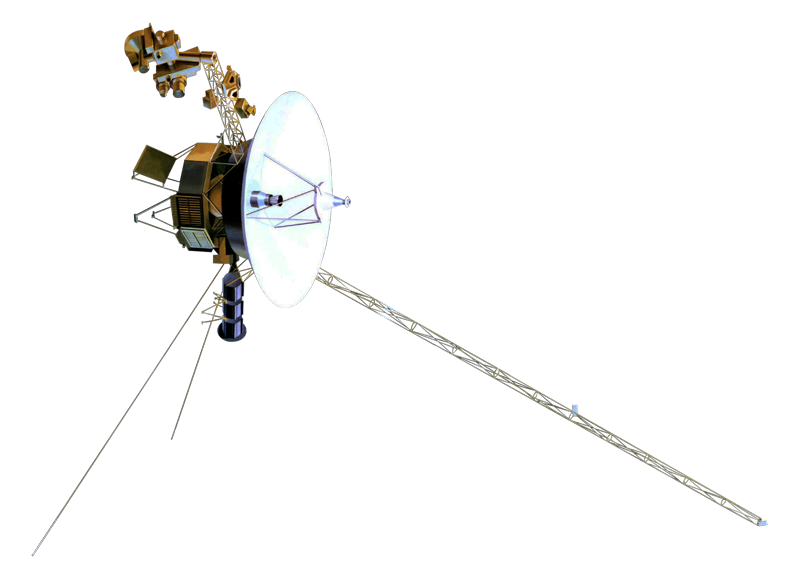
Artist's rendering of the Voyager spacecraft against a black background: a 3.7-meter high-gain dish antenna dominates the center, with the RTG booms extending to the right and the instrument platform on the left. (NASA / Wikimedia Commons)


On August 4, 2026, with a single coordinated command sequence, engineers at NASA’s Jet Propulsion Laboratory switched three power-hungry heaters on Voyager 2 for three lower-power substitutes and turned off a redundant device whose residual heat was already doing the job. The maneuver was nicknamed the “Big Bang” by the mission team because it had to be executed in one uninterrupted block: the probe cannot tolerate a half-finished sequence when the new configuration leaves critical fuel lines running on borrowed thermal margins. Forty-eight years after launch, with plutonium steadily depleting inside its three radioisotope thermoelectric generators, Voyager 2 was running on roughly four watts less available power than it had the year before, and the mission was weeks from a forced instrument shutdown. The swap changed that math. The savings should keep all three of Voyager 2’s remaining science instruments returning data from interstellar space for at least another year before the team has to choose which one to power down next.

Voyager 2 crossed the heliopause in November 2018 and is currently the only spacecraft in the solar system making direct in-situ measurements of the plasma, magnetic field, and energetic particle environment beyond the Sun’s magnetic bubble. Voyager 1 crossed the boundary six years earlier, but Voyager 2 is still returning plasma data that Voyager 1 cannot, because Voyager 1’s plasma science instrument failed in 1980 and was never replaced. The two spacecraft together form humanity’s only working sensor network in the local interstellar medium, and every instrument shutdown is permanent. Once powered off, Voyager’s 1970s electronics cannot be brought back. With Voyager 1 already down to two operating instruments after an unexpected February 2025 power drop forced the LECP shutdown in April of that year, losing a third instrument on Voyager 2 would have left the interstellar mission with a thinner, more asymmetric scientific footprint. The Big Bang also matters as an engineering template. Voyager’s power budget is now so thin that similar swaps will be needed every year or two until the RTGs decay below the threshold needed to run any science instruments at all, which NASA estimates will happen sometime in the 2030s. The procedure the JPL team developed for this swap is the same procedure they will repeat on Voyager 1, and likely on both spacecraft multiple more times before the mission ends.

The Voyager 2 swap was first reported by NASA’s Voyager mission blog on August 4, 2026. The Register’s follow-up the next day added the most concrete engineering detail: a NASA spokesperson told the paper that the swap involved “two heaters and a device that was being kept on since its residual heat was in the right location and it used less power than the actual nearby heater.” The trio was replaced with another three components that together still generated enough heat to keep the fuel lines warm, but at lower wattage. Past swaps on the Voyager spacecraft were usually one-for-one. The Big Bang’s innovation was doing three replacements at once and accepting the temporary thermal risk to the fuel lines in exchange for the combined power savings. Voyager 2 carries a single 70-centimeter titanium tank holding about 100 kilograms of hydrazine at launch, used for attitude control and trajectory correction maneuvers; keeping that fuel from freezing in interstellar space is one of the load-bearing thermal jobs on the spacecraft, and it is the constraint that bounds how aggressively JPL can trade heat-generating components for power savings. Voyager 2’s LECP instrument had already been turned off in March 2025; the plasma science instrument was shut down in September 2024; a third instrument on each Voyager has been off since long before that, leaving three on Voyager 2 and two on Voyager 1. Without the Big Bang, NASA confirmed, another Voyager 2 instrument would have had to be switched off before the end of 2026. With the savings from the swap, that decision has been pushed into 2027 at the earliest. JPL plans to run the same swap on Voyager 1 in the coming months. Voyager 1 is currently farther from Earth than Voyager 2, and both probes are still inside the solar system in the strict astronomical sense, even though both are now in the interstellar medium.

The Voyager power budget is governed by three multihundred-watt radioisotope thermoelectric generators, each containing 24 pressed plutonium-238 oxide spheres. At launch in August 1977, the three RTGs together produced about 470 watts of electrical power. The plutonium-238 half-life is 87.7 years, so the electrical output has dropped by roughly a factor of two over the mission’s lifetime. The probes lose about 4 watts of available power per year, and the drop is accelerating slowly as the thermocouple junctions age and the thermal gradient they exploit shrinks. NASA first began drawing on a backup power reservoir in April 2023; without that step, the mission would have lost at least one more instrument sooner. The thermal architecture is what makes the Big Bang clever. Many components on Voyager 2 give off waste heat as a side effect of operating, and several of those components are physically adjacent to fuel lines, propulsion latches, or science instruments that need to stay above their minimum operating temperatures. Replacing a high-power heater with a lower-power one usually means the heat budget has to be rearranged, but if the old heater was already heating something the new heater does not need to heat, the swap can be near-power-neutral. The Big Bang worked because the three devices that were turned off had already been “ghost heating” their neighbors, with the residual heat in the right place. The three replacements are less powerful individually, but together they keep the fuel lines and adjacent subsystems at the required temperature with a net lower draw from the RTGs. The constraint is sequencing. If the swap had been interrupted partway through, the spacecraft would have been left with an underheated fuel line and an instrument bay that was relying on a component that was about to be turned off. JPL engineers therefore treated the Big Bang as a single atomic operation, sent the entire command sequence as one batch, and then waited more than 23 hours for the signal to reach Voyager 2 and another 23 hours for the engineering telemetry to return confirming the new configuration was stable. The same near-24-hour round trip will apply when the team runs the swap on Voyager 1.

Voyager 2 is now expected to keep all three of its remaining science instruments (the magnetometer, the plasma wave subsystem, and the cosmic ray subsystem) returning interstellar data through at least late 2027, with the team planning to run the same Big Bang swap on Voyager 1 within the next several months. The next decision point is whether the LECP instrument that was shut off on Voyager 1 in April 2025 can be brought back online after that swap, which would give Voyager 1 a third working instrument for the first time in roughly a year. Beyond that, the Voyager power budget will continue to tighten by about four watts per year, and JPL will likely need to run a similar coordinated swap every twelve to twenty-four months until the RTGs decay below the threshold needed for any science operation sometime in the 2030s. The Big Bang is not a permanent fix. It is a way of buying one more year of an interstellar science mission that is now forty-eight years past its design life, using only the hardware that is already aboard the spacecraft.

Source: Wikimedia Commons file page.


A glowing neural network woven through the open pages of a NASA grant proposal, with the James Webb Space Telescope mirror in soft focus behind it, representing the intersection of peer review and super intelligence in American research


Two days before the second Tuesday in October, the same room at the U.S. Institute of Peace that has hosted peace talks for three decades filled instead with research administrators, lab directors, and the kind of people who can tell you the difference between a Bayesian prior and a proposal deadline. The occasion was the White House Office of Science and Technology Policy’s “Science: A New Golden Age Summit,” convened on October 8, 2026 to translate a July report to the President into a coordinated set of federal science bets. NASA showed up with two of them, and neither one was a new telescope.

The first was a quiet institutional commitment: a coordinated metascience program inside NASA’s Science Mission Directorate, with a permanent expansion of dual-anonymous peer review across the directorate’s research solicitations. The second was a fellowship: ten Genesis Mission Fellows, accelerated doctoral students who will be trained simultaneously in super intelligence and in a traditional NASA mission discipline, and placed inside NASA laboratories to work on real flight programs. Both came wrapped in Isaacman’s framing of a “new Golden Age” but, more usefully, both came with concrete structure: a named review mechanism that already exists, and a fellowship template lifted almost verbatim from a graduate research program that has been running since 2019.

Why does the peer-review expansion matter? The short version is that the agency has been running the experiment for six years and is now extending it. Dual-anonymous peer review, the form NASA Science began piloting in 2020 and folded into the Future Investigators in NASA Earth and Space Science and Technology (FINESST) solicitation in 2024, breaks the link between who writes a proposal and who grades it. Proposers rewrite their science cases to remove identifying details — author names, institution, even the kind of instrument references that flag a specific lab. Reviewers see only the science and the budget. The pilot was launched during the first Trump administration and is, in the agency’s own framing on its Dual Anonymous Peer Review page, a structural response to the cognitive biases Tversky and Kahneman laid out in 1974. The new initiative commits the Science Mission Directorate to expanding that practice further, into more of its Research Opportunities in Space and Earth Sciences (ROSES) programs, and to folding the operational lessons into a coordinated metascience capability that can study its own review outcomes in close to real time.

That is a quieter change than a new flagship, but it lands harder on day-to-day science. ROSES is the pipeline through which the bulk of NASA’s external science gets funded: a single solicitation umbrella that issues dozens of individual program elements each year, ranging from astrophysics theory to Earth-system modeling to heliophysics data analysis. If DAPR is the new default for most ROSES elements, then the median funded investigator — the one whose lab, whose postdocs, and whose instrument pipeline are not famous — is suddenly competing on a more level surface than they were a year ago. The biases that DAPR targets are not exotic. They are the usual ones: prestige-by-institution, halo effects from earlier work, name recognition that follows investigators across subfields. None of these are accusations against individual reviewers. They are properties of a system that puts people in front of proposals and asks them to choose.

The fellowship sits at a different altitude. Genesis Mission Fellows will be doctoral students whose training explicitly couples super intelligence — the federal government’s preferred term for advanced AI systems that can plan and reason across long horizons — with a traditional discipline, the way the original FINESST design already pairs a graduate student with a faculty mentor on a single research question. NASA will support ten such students in the first cohort, working on NASA mission areas at NASA laboratories. The fellowship inherits the bones of FINESST, including its structure as a research grant rather than a traditional fellowship and its $50,000-per-year award size, and bolts on the SI training component. The Department of Energy launched a parallel fellowship structure the same day, aimed at the same kind of dual-competency PhD, with the same general design and a 100-PhD-per-cohort scale, which makes the two programs the first coordinated federal attempt to grow a domestic SI-fluent research workforce rather than rent one from outside.

What makes this a coherent story is the compute underneath it. The White House fact sheet accompanying the announcements lists $2.4 billion in industry commitments to the Genesis Mission Consortium for SI compute and tooling: NVIDIA at $1 billion, AMD at $500 million, OpenAI at $200 million, Anthropic and Google at $150 million each, AMP and Emerald AI at $100 million each, and AWS, Armada, Crusoe, and Micron at $50 million each. That pool is the resource the new fellowships will be trained on, and the resource NASA’s metascience effort will be able to use to study its own review process. It is also the lever that the July expansion of the Genesis Mission pulled: the $5 billion federal commitment that pulled fifteen-plus agencies into the consortium, of which NASA’s two October 8 announcements are the first research-training deliverables.

The engineering question that makes or breaks this is whether the training tracks actually produce researchers who can do original work in their discipline, not researchers who can prompt an SI system about it. The federal design here leans on the rotation model: a doctoral student spends time inside a national lab, time inside an industry partner, and time inside the academic department that granted the degree. The expectation is that the rotation through an industry lab forces the AI work to meet engineering constraints — latency, cost, auditability, integration with real instruments — while the academic time forces it to meet peer-reviewed publication standards. The model is closer to the National Science Foundation’s Graduate Research Fellowships in structure than to anything AI-specific, and that is the point. The novel content is the SI training, not the fellowship scaffolding.

There are real risks. DAPR shifts work onto proposers, who have to rewrite their cases to strip identity, and onto panels, who have to learn to read proposals that read like abstracts. If the rewrite costs more time than the bias reduction saves, the program fails on its own terms. The fellowship, meanwhile, depends on industry partners actually opening their labs to doctoral students, and on academic departments accepting an SI training component that is not yet a recognized subfield. Both are bets about institutional behavior, not just about money.

What changes because of this is the federal science workforce itself. A decade from now, the average NASA principal investigator will be someone who competed for funding under DAPR and probably was reviewed by an anonymous panel rather than a familiar program officer. A cohort of researchers who finished their PhDs with hands-on super-intelligence experience inside a national lab will be the ones writing the next generation of mission proposals. Whether that produces better science depends on details that are still being written into the program’s implementation, but the direction is set. NASA has spent sixty-seven years building tools to look outward. Yesterday it turned two of those tools — peer review and graduate training — on its own house.