OrbitalHub

Where curiosity reaches escape velocity.

Domain is for sale. $50,000,000.00 USD. Direct any inquiries to contact@orbitalhub.com.

Archive for 2026

September 20, 2026

McGetchin, the Moon’s newest crater

Posted by


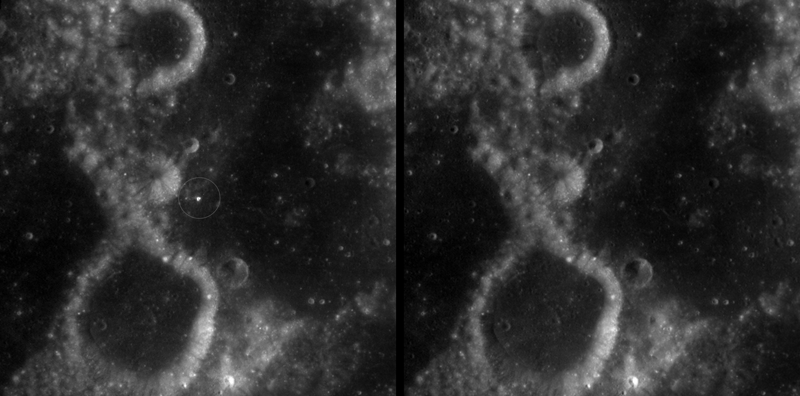
Two side-by-side black-and-white panels of the lunar surface captured by LRO's Wide-Angle Camera. The left panel shows a thin white circle around a small bright spot just right of center; the right panel shows the same area before the impact with no circled feature. The stacked-frame difference image is what tipped off Robert Wagner to the new crater.


On October 24, 2025, Robert Wagner sat down at his computer for a routine data-quality check and found a hole in the Moon that no one knew was there. The bright pixel he traced to the lunar eastern limb has now been confirmed as McGetchin crater, a 222-meter bowl carved into the surface by an impact that hit sometime between April 11 and May 22, 2024. Two papers in Science Advances on September 16, 2026 announce the find and describe what the impact did to the ground around it, and the LROC team has named the feature for Tom McGetchin, the Apollo-era field geologist who helped figure out how impact melts behave. The crater itself is roughly the length of two American football fields across and about 43 meters deep, three times the diameter of the previous record-holding fresh lunar crater spotted from LRO a decade ago.

Why this matters is that the Moon keeps taking hits, and almost no one sees them happen. There is no atmosphere to slow incoming rocks, so a small comet or asteroid fragment the size of a three- to six-story building reaches the surface essentially intact, and the only evidence it leaves is what the next orbital pass can resolve. NASA has been chasing these fresh craters with LRO since the spacecraft reached lunar orbit in June 2009 (NASA Science), and the mission has catalogued at least one thousand new impact craters and flagged a hundred thousand more surface changes from impacts or their ejecta. McGetchin is the largest of the lot, and the find arrived not because anyone was watching for it but because Wagner stacked hundreds of Wide-Angle Camera frames from before and after the impact and let the difference stand out. That methodology turned a routine quality check into a once-per-century discovery.

The story begins with a click on a thumbnail. Wagner is an image-processing specialist who works on the LROC system through Intuitive Machines, the company that has been landing commercial spacecraft on the lunar surface. He was running his usual comparison between a freshly assembled Wide-Angle Camera global map and an older one, looking for change at scales larger than about 50 meters, the size of objects his wide-field system can actually resolve. Wide-Angle Camera pixels are roughly the size of American football fields, so to spot a new feature he has to stack many frames on top of each other and let software subtract everything that did not change. Things that stay the same turn gray, and anything new shows up bright or dark. Most of what the software flags is noise, but the gray-on-gray hack works well enough that, when Wagner scrolled to a tile on the eastern limb, a bright spot circled by a darker halo stopped him cold. “It was by far the most obvious impact debris pattern I’ve ever seen in one of these images,” he said in the NASA release.

After Wagner flagged the spot, the LROC team turned the Narrow-Angle Camera on it. That instrument images the surface at about one meter per pixel, three orders of magnitude sharper than the Wide-Angle Camera, and it gave a clean view of the bowl itself and the ray pattern flung outward by the impact. The crater is roughly circular and 222 meters across, with a clean rim and a darker interior, and the ejecta blanket around it is what registered as the bright halo Wagner had seen from a distance. Independent confirmation came from comparing LROC Narrow-Angle Camera frames acquired on December 5, 2024 and again on March 3, 2025, and from thermographic observations by LRO’s Diviner instrument. The team published its analysis of the impact and its thermal aftermath in Science Advances this week (USRA newsroom); a separate paper in the same issue models the kinetic energy and the regolith disturbance, which Diviner picked up as a roughly 4-mile-wide cold spot about 16 degrees Fahrenheit cooler at night than the surrounding terrain. A follow-up Narrow-Angle Camera pass was later rolled 51 degrees to the east, producing a dramatic oblique view of the new bowl (LROC oblique view M1527218499L,R).

The deep-dive question is what the cold spot tells us about how the surface is changing in real time. Lunar regolith is a layer of loose, jagged grains sitting on top of more coherent bedrock, and over billions of years micrometeorite gardening has ground those grains into a fairly uniform fluff. An impact like McGetchin’s dumps energy into that layer in microseconds, and the explosion excavates a bowl and throws material outward. Some of that material lands around the rim, and when it does it piles up loosely, the way a sandbox pile sits lighter than the sand you started with. Loosely piled regolith does not conduct heat as well as the more compacted original surface, so at night it cools faster and to a lower temperature. Diviner saw exactly that signature, and the cold halo around McGetchin extends about 4 miles in diameter, far past the crater itself. The regolith disturbance has implications for any future rover that drives across the lunar surface: a fluffier surface means different wheel-soil interaction, and the team flagged that directly in the Science Advances paper.

The energy numbers help frame how rare an event this is. Wikipedia), citing the research papers, puts the impact energy at roughly 6.5 × 10^10 kilojoules, and the recurrence interval at about 132 years. NASA’s release phrases it as “once in a century or even longer,” which matches within the usual uncertainty of small-body population models. Either way, the take-away is that LRO has been on station long enough to catch the rare events in the lunar impact rate distribution, not just the everyday ones, and that what Wagner found is statistically one of the largest fresh craters the modern Moon has produced. The mission has been circling the Moon for more than 17 years and has mapped the topography, surface composition, thermal environment, and radiation environment there, and that sustained archive is what made the stacking comparison possible. Without it, the bright spot Wagner spotted would have been indistinguishable from a thousand other random brightness changes in any single Wide-Angle Camera frame.

What this means going forward is that the LROC team plans to keep running these global comparisons on a multi-year cadence and follow up with Narrow-Angle Camera close-ups and Diviner thermography whenever something new shows up. The same method that found McGetchin is now calibrated against a known impact and a known regolith response, so the next rare event should land faster and with less manual work. The Moon’s eastern limb will keep taking hits; the question is whether the next large one is caught the way this one was, by a quality check that turned out to be the headline.

 

September 14, 2026

Three solid stages and a 3D-printed engine

Posted by


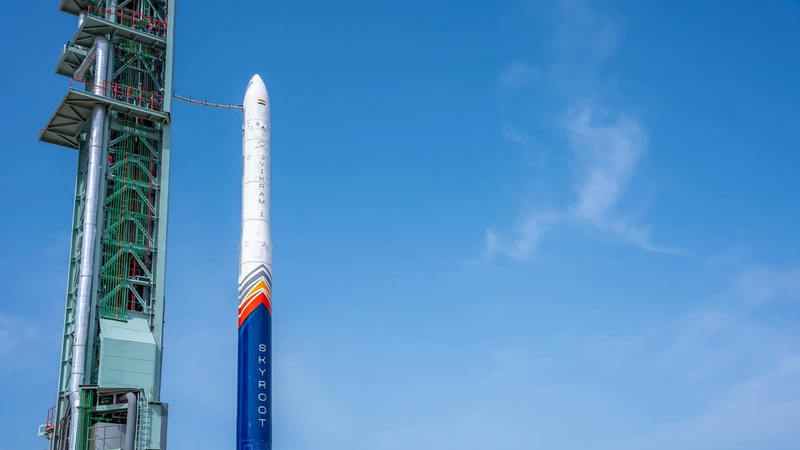
Vikram-1 on the First Launch Pad at SDSC-SHAR before Mission Aagaman. Credit: IANS / Skyroot Aerospace via ETV Bharat.


On July 18, 2026, at 06:35 UTC, a 22-meter rocket lifted off from the First Launch Pad at the Satish Dhawan Space Centre on Sriharikota island. Twelve minutes later, four payloads were floating in a 450-kilometer orbit at a 60-degree inclination, marking the first time an Indian private company had reached orbit under its own name. The rocket was built by Hyderabad-based Skyroot Aerospace, and the mission was named Aagaman, Sanskrit for “arrival.” It gave India a third-country credential — only the United States and China have carried one since 2008.

For two decades, India’s orbital launches have carried the same institutional stamp: the Indian Space Research Organisation, ISRO. PSLV, GSLV, and the upcoming GSLV Mk III have flown from the same two pads at Sriharikota since 1993. When the government created the Indian National Space Promotion and Authorisation Centre, IN-SPACe, in June 2020, the explicit goal was to break that monopoly. Funding followed: India’s private space sector pulled in roughly $353 million from 2020 through 2024, with another $150 million in fiscal 2025, and the startup count climbed from a handful to more than 200 (Financial Express, 2026).

What was still missing was a proof of orbit. Suborbital hops like Vikram-S in November 2022 showed that a private firm could build a rocket and reach space. They did not show that one could deliver a payload to a precise altitude and inclination. Vikram-1 closes that gap. With Mission Aagaman complete, Skyroot joined SpaceX and Rocket Lab in the United States and LandSpace’s Zhuque-2 in China as the only commercial operators to have reached orbit with a privately developed first stage (Reuters, July 18 2026).

The market is large enough to make the milestone more than symbolic. India already runs one of the more aggressive small-satellite launch programs in Asia, and Chandana told CNBC that 70 to 80 percent of Skyroot’s eventual customers will sit outside India, across the United States, Europe, and Southeast Asia. A dedicated small-sat ride at roughly $15,000 per kilogram or less could undercut dedicated Electron and Taurus-Mini flights for payloads under 350 kilograms.

The two founders met at ISRO. Pawan Kumar Chandana had spent six years on Indian launch vehicle programs, mostly at the Vikram Sarabhai Space Centre (VSSC). Naga Bharath Daka had designed avionics modules for flight computers. Both studied at IIT Kharagpur. They left ISRO in 2018, raised about $1.35 million from Myntra founder Mukesh Bansal and CureFit co-founder Ankit Nagori, and registered Skyroot Aerospace on June 12, 2018, two years before any private launch regulation existed.

IN-SPACe arrived in 2020, after Skyroot had already begun carbon-fiber airframe tooling. By 2022 the company launched Vikram-S on Mission Prarambh, a suborbital flight that reached about 89 kilometers and validated roughly 80 percent of the technology stack: the all-carbon composite airframe, the solid propulsion, the thermal protection, and the avionics.

Vikram-1 took another three and a half years. The three solid stages (Kalam-1200, Kalam-250, and Kalam-100, named for missile scientist A. P. J. Abdul Kalam) each had to be static-fired at ISRO’s STEX/VAST complex at Sriharikota. The liquid Orbital Adjustment Module with its Raman engine was hot-tested at the ISRO Propulsion Complex at Mahendragiri under IN-SPACe oversight. Skyroot’s first 100 percent 3D-printed bipropellant injector ran successfully in 2020; a Raman-II hot fire at Mahendragiri ran 10 seconds in July 2023 at a chamber pressure of 8.5 bar.

The launch attempt slipped from 2024 into a 23-day window opening July 12, 2026. Chandana told CNBC-TV18 that “we have done everything that could be done to test Vikram-1 on ground.” On July 18 an automated hold extended the countdown while engineers rechecked navigation parameters; lift-off came at 12:05 PM IST, roughly 35 minutes behind the original schedule. Payload separation finished by T+900 seconds, and Skyroot declared mission success. At least one more developmental flight sits between Aagaman and any commercial manifest.

Vikram-1 is a four-stage rocket, 22 meters tall and 1.7 meters in diameter, the first orbital launcher in India built entirely from carbon-fiber-reinforced polymer (CFRP). The material choice matters because CFRP motor cases weigh roughly 30 to 50 percent less than equivalent steel or aluminum cases at the same burst pressure (Nature 2021, CFRP motor-case studies). For a small launcher, that drop translates directly into payload fraction: every kilogram saved in dry mass leaves room for a kilogram of propellant, and propellant is cheaper to deliver to orbit than structure.

The three solid motors run a typical Indian composite propellant: about 68 percent ammonium perchlorate oxidizer, 18 percent aluminum powder, and 14 percent hydroxyl-terminated polybutadiene (HTPB) binder. The first-stage casing, the Kalam-1200, is the longest monolithic composite motor built at ISRO’s Solid Propellant Space Booster Plant, 11 meters long and 1.7 meters in diameter, loaded with about 30 tonnes of propellant. The case is filament-wound at angles of roughly ±55 and ±20 degrees over the cylinder, transitioning to ±45 and 80 degrees at the domes, an arrangement tuned to balance hoop stress, axial load, and torsional stiffness. Inside the case, an EPDM rubber insulator protects the carbon fiber from 3,000-Kelvin combustion gas. Thrust vector control on the upper solid stages uses a carbon-ablative flex nozzle deflecting the throat a few degrees with hydraulic actuators.

The fourth stage, the Orbital Adjustment Module, is a cluster of four Raman engines burning monomethylhydrazine against nitrogen tetroxide (MMH/NTO), the classic hypergolic storable bipropellant. Hypergolic ignition fires the moment the two liquids touch: no spark, no igniter, no start sequence to fail. That property lets the module relight multiple times during a single mission, which is the whole selling point for rideshare flights where each payload owner wants a slightly different altitude.

The Raman engine uses 100 percent 3D-printed injector and chamber hardware. According to Skyroot, additive manufacturing cuts injector mass by roughly 50 percent and trims part count and lead time by roughly 80 percent compared with machined injector plates. A single laser powder-bed-fusion build produces the injector in one piece, eliminating several hundred discrete passages and brazed joints. That kind of simplification makes a small team viable against larger state programs.

For the sizing math: with a 1,200-kilonewton first stage, a specific impulse near 270 seconds at sea level, and a structural mass fraction in the 0.10 to 0.12 range, the ideal delta-v budget for a 450-kilometer circular orbit at 60-degree inclination comes to about 9.4 kilometers per second. The four stages roughly hit that, leaving a margin near 1.2 kilometers per second for gravity and drag losses, in line with industry norms for small launchers.

The full Vikram family still has to come online: Vikram-2 with its 3D-printed Dhawan cryogenic engine in 2027, then Vikram-3. The team is now 500 engineers, working from a 60,000-square-foot “Max-Q” campus in Hyderabad that the company describes as the largest private rocket development facility in South Asia. Investment caught up in May 2026, when Skyroot became India’s first space-tech unicorn at a $1.1 billion valuation after a $60 million round that included GIC, BlackRock, Sherpalo Ventures, and Playbook Partners.

The wider lesson is structural. India did not get a private space industry by accident; it got one by writing rules, opening access to shared test stands, and waiting long enough for the engineering to mature. The flight on July 18 was a scheduled checkpoint on a plan that started in 2020, not a surprise ending. Other countries will study whether that same sequence (regulator first, infrastructure second, orbital capability third) can run faster in their own markets. That question will probably matter more than Vikram-1 itself.


Perseverance catches Phobos slipping across the Sun on sol 1948. Image: 2026 08 26 perseverance phobos sun transit.


On 12 August 2026, on the 1,948th Martian day of its mission, NASA’s Perseverance rover stopped what it was doing for a few minutes, pointed its Mastcam-Z camera at the Sun, and watched Phobos, the inner of Mars’s two moons, slide across the solar disk. The animation that came back has been colorized to mimic what a person on the Martian surface would have seen looking up through a pair of protective eclipse glasses: a small, dark, lumpy silhouette gliding across a glowing orange Sun, never covering enough of it to qualify as a true eclipse (Sci.News).

A partial transit like this is small in the moment and large in the long run. Perseverance has been recording these crossings since it landed in Jezero crater in February 2021, and the team keeps shooting them because each one is a measurement of where Phobos is, and where it is going. By comparing the recordings taken years apart, scientists can refine the moon’s orbit, watch how the orbit is decaying under Mars’s tidal pull, and update the timeline for the day Phobos will finally break apart at the Roche limit or crash into the planet (Sci.News). The same kind of observation, applied to a star instead of a moon, was how exoplanet hunters in the Kepler and TESS era measured the size and orbital period of worlds around other stars. Phobos in front of the Sun is the equivalent demonstration, just two doors down from Earth.

The other reason the recording matters is that Phobos is one of the few Solar System bodies small and close enough that a single orbiting spacecraft can resolve its shadow path from the surface. The moon is only about 26 by 22 by 18 kilometers across, smaller than many asteroids, and orbits Mars at roughly 6,000 kilometers from the surface. That closeness is also why the transit never becomes a total eclipse: from the Martian surface, Phobos never appears large enough to cover the Sun’s disk, only to carve a moving bite out of it.

The 12 August 2026 observation was Perseverance’s most recent entry in a routine the rover has been keeping for more than four Earth years. The Mastcam-Z instrument, a pair of zoomable color cameras mounted on the rover’s remote sensing mast, has been used on multiple earlier sols to record Phobos and Deimos transits. Each observation produces a short video of frames that the team can stack, time-stamp against the rover’s onboard clock, and compare with prior sessions.

What is new with sol 1948 is mostly cosmetic. The animation was tinted on the ground to simulate the visual impression a human observer on Mars would get looking up through solar-eclipse glasses, the same orange-tinted look eclipse chasers use on Earth. The raw data is still a time series of dark silhouettes moving across a bright source. The team released the public-friendly version after running the standard calibration, and the Sci.News writeup on 24 August pulled it back into the news cycle as part of a steady drip of small Mars-science updates (Sci.News).

Behind the video is the same physics that makes a solar eclipse work on Earth: a foreground object passes between the observer and the Sun, casting a moving shadow. The differences are size and geometry. Phobos is roughly 150 times smaller than Earth’s Moon and sits about 200 times closer to Mars than the Moon does to Earth, so its angular size is far too small to cover the Sun. The Moon’s apparent diameter almost exactly matches the Sun’s during a total solar eclipse on Earth, which is the happy coincidence that makes totality possible. Phobos never gets that close to covering the Sun, so the term “transit” is the right word, with “annular eclipse” reserved for a slightly bigger blocker that still falls short of totality.

Mastcam-Z is the workhorse camera on Perseverance’s mast, sitting about two meters above the Martian surface at the eye level of a roughly 6½-foot-tall person, with the two cameras separated by about 24 centimeters to give stereo vision (NASA Mars 2020 Mastcam-Z page). It was designed primarily to study rocks and soils from a distance, with a zoom range that lets the team build topographic maps of terrain features, and it can record 1600 by 1200 pixel frames at up to about 148 megabits per sol of returned imaging.

The transit record itself is what the orbital dynamicists want. Phobos orbits Mars in 7 hours and 39 minutes, faster than any other moon in the Solar System relative to its parent planet’s rotation, and tidal drag is slowly shrinking that orbit. The standard textbook figure is that the orbital radius is decreasing at roughly two centimeters per year, or about two meters per century, and the projections for when Phobos will either break up into a ring or crash into the surface run from about 30 million to 50 million years out (Wikipedia: Phobos (moon))). Observations like the sol 1948 transit tighten the numbers behind those projections by giving the orbit a fresh astrometric fix.

The geometry also gives a measurement that is hard to get any other way: from a fixed landing site like Jezero, the exact path of Phobos across the Sun depends on where Phobos is in its orbit at a particular second. Cross-referencing that path against time, the rover team can solve for orbital elements that mass and remote sensing measurements cannot constrain.

A subtle point worth flagging is that Perseverance did not move to capture this transit. The rover was wherever it happened to be on sol 1948, and the team aimed the mast at the Sun from there. This matters because location is one of the unknowns in the orbital fit: if Jezero’s coordinates are even slightly off in the Mars-fixed reference frame, every recorded shadow path inherits that error. Years of persistent observations from the same rover at the same site cancel most of that error out.

The 12 August 2026 Phobos transit is a small piece of work by a long-running rover that has already spent more than five and a half years on Mars. The Mars 2020 mission’s headline job, caching samples for a future return mission, is well into its second decade of planning, and Mastcam-Z observations of this kind are now a small but reliable side-product that keeps adding data to the Phobos literature. Expect another of these recordings every few months from Jezero as long as the rover stays healthy, and the public versions appear in the standard NASA Mars 2020 image release channels over time. The longer-running payoff sits in the orbit itself: each transit shaves uncertainty off the prediction for the day Phobos stops being a moon.


ISRO's EOS-05 (GISAT-1A) hyperspectral Earth observation satellite parked at geostationary altitude 36,000 km above the equator, its 700 mm Ritchey-Chrétien telescope pointed nadir at the Indian subcontinent below — visualized as a false-color hyperspectral data cube across VNIR and SWIR bands.


At 02:55 Indian Standard Time on 4 September 2026, the seventeenth operational Geosynchronous Satellite Launch Vehicle — GSLV-F17 — cleared the second launch pad at Sriharikota with a 2,368-kilogram payload, lit its indigenous cryogenic upper stage, and pushed India’s heaviest geostationary passenger into a sub-geosynchronous transfer orbit eighteen minutes later (ISRO mission brochure, August 2026; Wikipedia EOS-05). What makes that routine sentence matter is what the payload is. EOS-05, also known as GISAT-1A, is the first hyperspectral Earth-observing imager ever stationed at geostationary altitude. From roughly 36,000 km above the equator it can sweep the entire Indian landmass every thirty minutes at 42 m resolution and revisit a selected field every five minutes — a cadence no low-Earth-orbit constellation can match for fast-moving hazards.

What changes because of this is the temporal resolution of what India can see. Until now, the country’s civilian Earth-observation stack lived mostly at 600 to 800 km on the IRS series and on a small number of dedicated weather satellites. EOS-05 folds two things into one geostationary platform: near-real-time imaging, and the hyperspectral imaging no civilian operator has flown from GEO before. The combination has no current peer. From 35,786 km, 414 spectral channels are now listening to the subcontinent across visible, near-infrared and short-wave infrared bands, watching floods, fires, crop stress and industrial plumes as they happen rather than as a satellite passes overhead.

The history behind the launch matters. The first GISAT was meant to do exactly this. On 12 August 2021, GSLV-F10 lifted off from the same Sriharikota pad with the 2,268 kg GISAT-1 and its cryogenic upper stage failed to ignite; the satellite burned up over the Bay of Bengal (The Wire, August 2021). ISRO rebuilt the cryogenic engine programme, re-qualified the Cryogenic Upper Stage, and quietly prepared a near-twin spacecraft with refinements drawn from five years of post-failure analysis. EOS-05 carries the same 700 mm Ritchey–Chrétien telescope and I-2K bus as the lost satellite, with upgraded detector thermal control and a more capable onboard formatter. When the same rocket class that failed in 2021 succeeded on 4 September 2026, it completed a five-year recovery that almost no one outside India’s space programme was watching.

What the rocket did after lift-off tells the harder part of the engineering story. GSLV-F17 did not drop EOS-05 at geostationary altitude. It dropped it into a low sub-GTO at around 171 km, a parking orbit deliberately chosen to keep the cryogenic upper stage’s burn time short (Wikipedia EOS-05). From there, the spacecraft used its own apogee motor in three burns over 5, 6 and 7 September to climb to its operational 35,786 km × ~35,786 km geostationary orbit. The two longest burns on 5 and 6 September totalled roughly 5,406 seconds — ninety minutes of cumulative thrust — raising apogee from 20,000 to 31,129 km and then to 35,786 km in stages. This is the standard GEO playbook, but EOS-05 is the heaviest payload GSLV has ever pushed through it.

The optical design is what makes the instrument special. A 700 mm Ritchey–Chrétien primary is small by ground-astronomy standards — Hubble’s mirror is 2.4 m — but it is the largest aperture ISRO has ever flown for Earth observation. From 36,000 km, diffraction-limited resolution scales linearly with aperture and inversely with wavelength, so the trade-off comes down to where you point your photons. EOS-05 splits the available light three ways. The multispectral Visible and Near-Infrared (MX-VNIR) channel uses six broad bands from 0.45 to 0.875 μm and lands at 42 m ground sample distance — the finest spatial resolution any imaging payload has ever delivered from geostationary orbit. The hyperspectral VNIR (HyS-VNIR) channel splits the same window into 158 narrow slices from 0.375 to 1.0 μm at 318 m. The hyperspectral Short-Wave Infrared (HyS-SWIR) channel runs from 0.9 to 2.5 μm across 256 bands at 191 m. Adding 158 and 256 gives 414 hyperspectral channels; with the six multispectral bands stacked on top, the total detector count exceeds 420.

The reason that matters is spectroscopy. A multispectral imager sees colour; a hyperspectral imager sees chemistry. Mineral dust has a different spectral signature than volcanic ash; healthy vegetation has a sharp red-edge near 0.7 μm; a chlorinated industrial plume absorbs differently than a hydrocarbon one. From low Earth orbit, agencies have done this for decades — NASA’s Hyperion on EO-1, ESA’s EnMAP, the Italian Space Agency’s PRISMA hypersatellite — but those satellites revisit a given point every few days at best. EOS-05 is the first time the world has had that chemical sensitivity continuously, watching one continent, refreshed every thirty minutes. A cyclone making landfall on the Odisha coast, a methane plume from a gas flare in Assam, a crop pest outbreak spreading through Punjab — all become things that can be detected within a single orbit of the satellite above.

The engineering trade-offs behind those numbers come down to two constraints. First, photon budget: a 700 mm mirror at 36,000 km gathers roughly the same per-unit-area flux as a small ground telescope, and the satellite stares at any given scene for tens of seconds rather than the milliseconds a LEO sensor collects per pass. The HyS-SWIR bands pay for that penalty with coarser spatial resolution (191 m instead of 42 m) and wider spectral slices. Second, thermal stability: a hyperspectral detector must hold its wavelength calibration to a fraction of a band over hours of stare time, so EOS-05 carries a closed-cycle cooler that pins the SWIR focal plane near 150 K. Without it, the 256 SWIR channels would smear into noise within minutes of eclipse exit.

What this changes is the cadence of Indian disaster response and agricultural monitoring. The Indian National Disaster Management Authority, the Indian Agricultural Research Council, and state forest departments will receive a continuous stream of 42 m imagery refreshed every thirty minutes over the entire country — a temporal density no civilian operator on Earth could match from GEO before this year. The same data feeds weather models through cloud-motion winds and aerosol optical depth retrievals that no other geostationary weather satellite can currently produce, because none of them carry hyperspectral imagers. The six-band MX-VNIR will provide what the older INSAT-3DR can only approximate in coarse thermal IR; the 414 hyperspectral channels will provide what the LEO hyperspectral fleet cannot — continuity.

Two other satellites are still on ISRO’s drawing board for the GISAT series — GISAT-2 and a planned third. For the next few years, EOS-05 will sit alone at 36,000 km, pointing its 700 mm mirror at one subcontinent, and rewriting what Earth observation means when you can watch a country breathe.


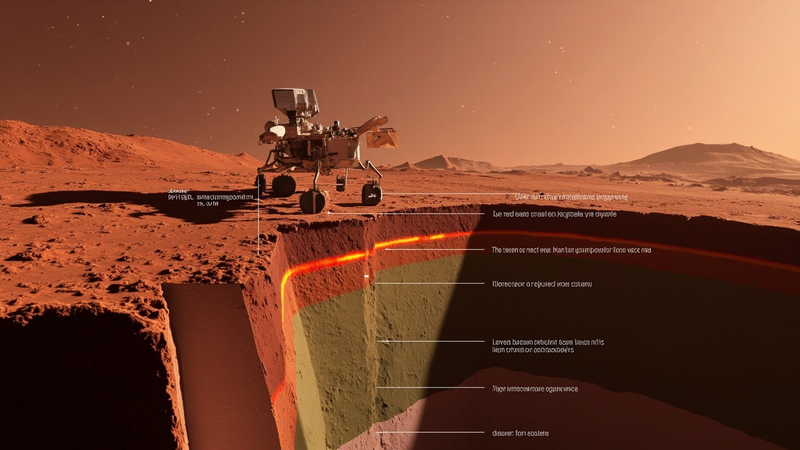
Cross-section of the Martian interior beneath the InSight lander: rust-red regolith above a 24-kilometer-thick basaltic upper crust, a sharp chemical discontinuity shown as a glowing orange line, and an olive-grey ultramafic lower crust descending into the mantle — all under one unbroken stagnant-lid shell.


A seismometer about the size of a basketball, planted on the Martian surface in late 2018, has just handed Earth-bound geophysicists a result that overturns a thirty-year assumption about how rocky planets assemble their crust. Nested inside the tremor record from NASA’s Interior Exploration using Seismic Investigations, Geodesy and Heat Transport (InSight) lander, a team at the University of Oxford has identified a chemical boundary roughly 24 kilometers below the Martian surface that looks suspiciously like the differentiated roots beneath Earth’s volcanic arcs. The implication, published this summer in Nature Astronomy, is that Mars once ran something close to Earth’s transcrustal magmatic systems — without any of the moving plates that geologists have long treated as a prerequisite for that level of crustal complexity (Mackay-Champion et al., Nature Astronomy, 2026).

Why this matters goes well beyond a footnote about Martian geology. If a planet with a single, unbroken lithospheric shell can still drive large, long-lived systems of melt accumulation, crystal settling, and chemical differentiation across its crust, then the basic recipe for building “evolved” crust does not require plate tectonics at all. That has direct consequences for how researchers rank the habitability of rocky exoplanets around other stars: a planet need not have a subdivided, mobile lid to keep its interior hot, recycle volatiles into the crust, and supply surface chemistry for billions of years of geologic time (University of Oxford press release, 24 June 2026).

The story that produced the result starts with InSight’s touchdown in Elysium Planitia on 26 November 2018. The lander deployed SEIS — a three-axis broadband seismometer built by CNES with contributions from IPGP and the Max Planck Institute for Solar System Research, weighing roughly 30 kilograms including its wind and thermal shield — directly onto the regolith using a small robotic arm. For the next four Earth years, until dust on the solar panels throttled power generation and ended nominal operations in late 2022, the instrument listened for marsquakes and the rumble of distant meteoroid impacts, gradually assembling a seismic catalog that geophysicists are still mining (Banerdt et al., Nature Geoscience, 2020). By mission end SEIS had recorded more than 1,300 candidate events distributed across the planet, the bulk of which were the high-frequency surface waves generated when mid-sized space rocks punched through the thin Martian atmosphere and detonated at the surface. What the new study does is take that catalog back to a question that has hung over Mars geophysics since the Viking era: what does the boundary detected by earlier receiver-function analyses, sitting somewhere between 20 and 30 kilometers depth, actually represent? Older interpretations ranged from a layer of frozen groundwater to a contact between volcanic flows and older basement rock. The Oxford group, led by Tobermory Mackay-Champion (now at the University of Bristol) with co-authors Mike Kendall and Jon Wade, reframed the question. They asked whether the discontinuity could be matched by a change in bulk rock chemistry rather than by an abrupt change in porosity or fluid content — and they did it by treating the receiver functions as a chemical assay rather than a structural one.

To answer that, the team assembled hundreds of plausible mineral assemblages — basaltic, andesitic, ultramafic, and exotic carbonatitic end-members — and ran each through thermodynamic equilibrium calculations at Martian crustal pressures and temperatures to determine stable mineralogy. They then predicted the seismic velocities those mineralogies should produce, using the standard relation V_p = sqrt((K + 4*mu/3)/rho) for compressional-wave speed, where K is the bulk modulus, mu the shear modulus, and rho the rock density, and the analogous V_s = sqrt(mu/rho) for shear. Because each mineral has a different temperature- and pressure-dependent stiffness, two compositionally distinct layers can have measurably different Vp/Vs ratios even at the same average density — and that is the lever the new study is pulling. Comparing those predictions with the actual P- and S-wave travel times picked out of marsquake and impact waveforms, the team found that the signal was systematic rather than scattered. The match that best explained the velocities above and below the boundary amounted, in plain terms, to a chemical sandwich. Below roughly 24 km, the seismic properties fit ultramafic assemblages dominated by olivine and low-calcium pyroxene — rocks high in iron and magnesium, low in silica, with densities around 3,200 to 3,300 kilograms per cubic meter. Above the boundary, the velocities matched basalt-like mafic compositions: higher silica, plagioclase-rich, with densities closer to 2,900 kilograms per cubic meter. The transition is on the order of a five to ten percent jump in Vp and a sharper change in Vp/Vs — the exact fingerprint you would expect if a deep cumulate pile sat beneath a more differentiated upper crust (Phys.org coverage of Mackay-Champion et al., 2026).

The way Earth geologists read that pattern is by analogy with what happens beneath active volcanic arcs on our own planet. A magmatic system that persists across the whole thickness of the crust tends to leave a chemical stratigraphy behind in its cooled roots. Dense, primitive cumulates settle out at depth; buoyant, silica-enriched differentiates rise through buoyancy-driven flow. What you end up with is a basalt-rich upper crust sitting on top of an ultramafic residue — exactly the layering the InSight data imply at the Martian mid-crustal discontinuity, except that on Earth the pattern is usually sustained for tens of millions of years by the steady down-going flux of subducting oceanic slabs. On Mars there is nothing sliding under anything.

The constraint that gives the result its bite is horizontal scale. The receiver functions that defined the 24 km boundary stacked across multiple marsquakes recorded at the same lander over several years, with the same converted-phase polarity and amplitude showing up across the catalog, which means the boundary must be laterally continuous over hundreds, possibly thousands, of kilometers across the northern lowlands (Khan et al., JGR Planets, 2023). Combined with the velocity match, the most parsimonious reading is a transcrustal magmatic system of the kind Earth hosts beneath the Andes or the Cascades — but operating within a stagnant lid, where heat is lost by conduction through the lithosphere rather than by advection in subduction zones.

What this changes looking forward is partly about Mars and partly about every rocky world sitting in the temperate zones around other stars. The classical assumption that habitability requires plate tectonics to recycle carbon, water, and other volatiles through a long-lived surface-interior cycle is no longer looking ironclad. A planet can plausibly keep its crust chemically active for billions of years through a different engine — one driven by mantle plumes, heat-pipe volcanism, or stagnant-lid overturn — that does not depend on a moving lid. The next two decades of exoplanet science — the era of the Nancy Grace Roman Space Telescope coronagraph, JWST atmospheric spectra of rocky habitable-zone targets, and eventually thirty-meter-class ground-based reconnaissance that may pick up volcanic outgassing signatures directly — will inherit a rubric where internal dynamics are an axis of habitability, but not the same axis as Earth’s. The next Mars geophysics flagship, be it a network mission like the proposed FSSM/Seismic Mars or a geodetic successor to InSight, will be designed to ask a follow-on question that the single-station SEIS catalog could not: how many such layers are there, and did the chemistry of the upper crust keep evolving through the Hesperian and into the Amazonian, or did the transcrustal engine shut down a billion years ago? Mars, in this reading, looks less like a frozen failed Earth and more like a different successful one — a planet that ran a long-lived chemical factory without ever needing to crack its lid.


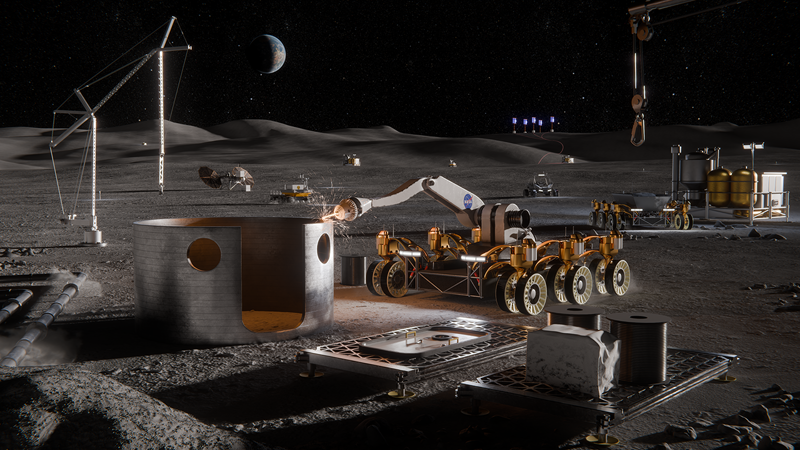
NASA seeks industry help for five Moon Base tech gaps. Image: 2026 09 11 nasa lunar surface tech call.


On September 8, 2026, NASA opened a formal industry solicitation aimed not at the rocket that gets astronauts to the Moon, but at the quiet hardware that has to keep them alive once they are there. The NextSTEP-3 Appendix A solicitation, branded the Lunar Enabling Infrastructure Accelerator, asks U.S. companies, universities, and not-for-profit teams to mature five specific technologies: vertical solar arrays, oxygen extracted from lunar regolith, radioisotope Stirling generators, in-space manufacturing, and innovative nanomaterials, areas that NASA considers the most stubborn gaps on the path to a sustained human presence near the lunar South Pole. The announcement was made under NASA news release RELEASE 26-072, “NASA Calls for Proposals to Accelerate Lunar Surface Technologies”, with proposals due back to the agency by 5 p.m. EDT on October 8, 2026.

The framing matters. NASA is not buying finished hardware with this call; it is buying the demonstrations and the data that show a competing set of approaches can reach Technology Readiness Level 5 to 6, the band where a system has been validated in a relevant environment and is ready to be bolted into a flight article. The agency’s NextSTEP-3 Appendix A program page describes the goal as “closing key technology gaps and maturing competing solutions” so that when NASA does commit to flight hardware, it can do so from a small set of demonstrated options rather than a paper study. The five capability areas named in the final solicitation are the same ones the agency laid out in its June 29, 2026 draft BAA, which followed a May 19 synopsis under procurement identifier 80GRC026R0008, a long drafting cycle by NASA’s usual standards, and a hint that the final wording reflects substantial industry feedback.

The five capability areas, named in the press release, are deliberately heterogeneous: a vertical solar array technology that can provide consistent power generation, management, distribution, and energy storage; in-situ resource utilization oxygen from regolith production to extract usable oxygen molecularly bonded to rock and dust covering the Moon’s surface; a radioisotope Stirling generator, a type of nuclear energy technology that uses heat from fissile materials to produce electric power for operating spacecraft systems in the darkest, dustiest, and most remote places; in-space advanced manufacturing to reduce reliance on resupply missions from Earth and to optimize mission flexibility and resilience on the Moon; and innovative nanomaterials production to advance the commercial availability and quality of nanomaterials that can be used in lunar exploration. Three of the five (oxygen extraction, radioisotope power, advanced manufacturing) were already on NASA’s lunar-technology roadmap before 2024; the vertical solar array and the nanomaterials line are newer entries, which signals the agency is looking outward at commercial capabilities rather than only downward at its own R&D centers.

Why this matters is the gap the announcement is trying to close. The NASA Moon Base reference page describes a near-polar outpost to be built in three phases: robotic exploration through 2029, infrastructure construction by 2032, and long-term astronaut habitation after that. Each phase rests on a different assumption about how much of the base can be supplied from Earth versus produced locally. Artemis IV, currently planned for 2028 per the Aviation Week writeup, is supposed to deliver the first pressurized surface habitat elements. Anything that arrives on that lander, however, still needs power at night, oxygen to breathe, and replacement parts when something breaks, since a single 384-hour lunar night at the pole is too long for any solar+battery architecture to survive without either massive storage mass or a complementary non-solar source. The five capability areas in this solicitation are NASA’s bets on which of those problems get solved by industry in time for the 2028-2032 build-out window.

The story behind the timing is that the broader Artemis program is under budget pressure, and this is the solicitation where NASA is trying to spend smaller amounts of money on a wider set of competing industry approaches rather than continuing to concentrate the work inside a handful of NASA centers. Greg Stover, director of NASA’s Advanced Research and Technology Division, is quoted in the release: “NASA is accelerating the development of key technologies and closing critical gaps needed for long-term human exploration at the Moon. Partnering with industry will strengthen the U.S. industrial base as we mature the capabilities and infrastructure needed for a sustainable lunar presence.” The “U.S. industrial base” phrasing is deliberate; the Appendix A announcement specifies that the solicitation “intends to cultivate U.S.-led capabilities while maintaining full and open competition among private industry, academic institutions, and not-for-profit entities, as well as international partners participating through U.S.-led teams.” International partners are allowed, but only through a U.S. prime, which is the language NASA uses when it wants to widen competition without ceding intellectual property control.

The science and engineering question underneath the solicitation is whether these five capability areas are actually independent or whether they have to mature together. They are not independent. The vertical solar array and the radioisotope Stirling generator are competing answers to the same problem (night-side power at the pole), and a base design that picks one will not need the other at full scale. In-situ oxygen extraction and in-space manufacturing share feedstock: the oxygen a regolith-processing plant pulls out of ilmenite or volcanic glass leaves behind a metal-rich slag that is, in principle, feedstock for additive manufacturing of structural parts. Innovative nanomaterials cut across all three: better cathode materials for the Stirling generator’s thermocouples, lighter radiation shielding for the habitat, higher-strength binders for the regolith-derived construction materials. The solicitation does not formally require joint proposals across areas, but the implicit pressure is on industry teams that can show how their work in one area plugs into the others. NASA may apply insights gained from the resulting contracts, the release notes, with “such as technical data, and demonstration results, to shape future acquisition strategies,” which is unusually candid agency language for “we will pick the winners in a second-round flight buy.”

The five areas also correspond to where the agency’s internal R&D has struggled the most. NASA’s in-house oxygen extraction work, dating back to the canceled Resource Prospector rover in 2018, has consistently run into the problem that the energy needed to crack oxides out of regolith exceeds what a small surface plant can deliver from solar panels alone. Pairing an oxygen plant with a Stirling generator is the obvious answer, but only if the Stirling generator’s heat source can be packaged small enough to land on a Commercial Lunar Payload Services flight. The vertical solar array is NASA trying to specify a different solution: a deployable tower that lifts panels above the dusty surface layer where direct sunlight is available for more hours per day, because traditional rover-deployed arrays have been repeatedly sandblasted by plume ejecta from nearby landings. None of these are problems the 2026 solicitation will solve, but the demonstrations the contracts buy will at least narrow the menu of credible solutions before the agency has to commit to a flight configuration for the 2030s.

The takeaway is that the September 8 solicitation is best read as a procurement shape rather than a flight milestone. NASA is not promising any of the five technologies will reach the Moon before Artemis IV, and it is not committing to a particular contractor; it is signaling that the menu of options will be wide and that the agency plans to make its architecture choices later, from the demonstrated set. Proposals are due October 8, and Aviation Week reports NASA does not plan to hold an industry day exchange, which is a hint that the agency considers the June draft and the August 20 “Responses to Industry Feedback” attachment sufficient background for offerors. If funded contracts cluster around one or two of the five capability areas, that will be the most informative signal, since it will tell observers which of the Moon Base’s hardest problems the agency now thinks an industry team can plausibly solve before the 2032 infrastructure-construction phase begins.