


NASA seeks industry help for five Moon Base tech gaps
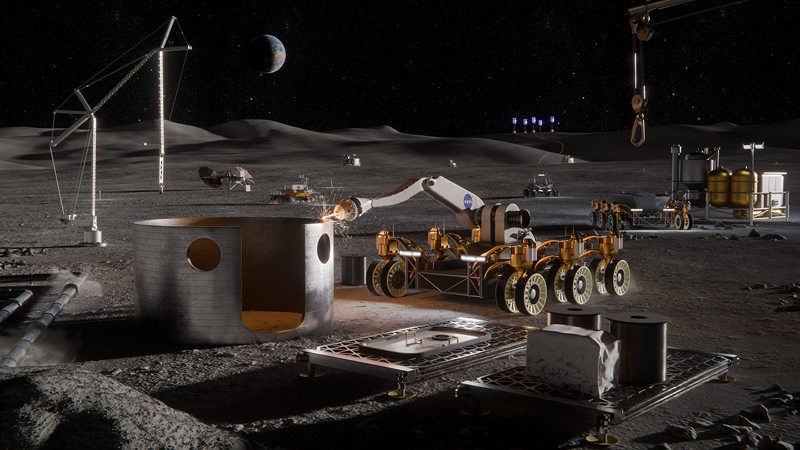
On September 8, 2026, NASA opened a formal industry solicitation aimed not at the rocket that gets astronauts to the Moon, but at the quiet hardware that has to keep them alive once they are there. The NextSTEP-3 Appendix A solicitation, branded the Lunar Enabling Infrastructure Accelerator, asks U.S. companies, universities, and not-for-profit teams to mature five specific technologies: vertical solar arrays, oxygen extracted from lunar regolith, radioisotope Stirling generators, in-space manufacturing, and innovative nanomaterials, areas that NASA considers the most stubborn gaps on the path to a sustained human presence near the lunar South Pole. The announcement was made under NASA news release RELEASE 26-072, “NASA Calls for Proposals to Accelerate Lunar Surface Technologies”, with proposals due back to the agency by 5 p.m. EDT on October 8, 2026.
The framing matters. NASA is not buying finished hardware with this call; it is buying the demonstrations and the data that show a competing set of approaches can reach Technology Readiness Level 5 to 6, the band where a system has been validated in a relevant environment and is ready to be bolted into a flight article. The agency’s NextSTEP-3 Appendix A program page describes the goal as “closing key technology gaps and maturing competing solutions” so that when NASA does commit to flight hardware, it can do so from a small set of demonstrated options rather than a paper study. The five capability areas named in the final solicitation are the same ones the agency laid out in its June 29, 2026 draft BAA, which followed a May 19 synopsis under procurement identifier 80GRC026R0008, a long drafting cycle by NASA’s usual standards, and a hint that the final wording reflects substantial industry feedback.
The five capability areas, named in the press release, are deliberately heterogeneous: a vertical solar array technology that can provide consistent power generation, management, distribution, and energy storage; in-situ resource utilization oxygen from regolith production to extract usable oxygen molecularly bonded to rock and dust covering the Moon’s surface; a radioisotope Stirling generator, a type of nuclear energy technology that uses heat from fissile materials to produce electric power for operating spacecraft systems in the darkest, dustiest, and most remote places; in-space advanced manufacturing to reduce reliance on resupply missions from Earth and to optimize mission flexibility and resilience on the Moon; and innovative nanomaterials production to advance the commercial availability and quality of nanomaterials that can be used in lunar exploration. Three of the five (oxygen extraction, radioisotope power, advanced manufacturing) were already on NASA’s lunar-technology roadmap before 2024; the vertical solar array and the nanomaterials line are newer entries, which signals the agency is looking outward at commercial capabilities rather than only downward at its own R&D centers.
Why this matters is the gap the announcement is trying to close. The NASA Moon Base reference page describes a near-polar outpost to be built in three phases: robotic exploration through 2029, infrastructure construction by 2032, and long-term astronaut habitation after that. Each phase rests on a different assumption about how much of the base can be supplied from Earth versus produced locally. Artemis IV, currently planned for 2028 per the Aviation Week writeup, is supposed to deliver the first pressurized surface habitat elements. Anything that arrives on that lander, however, still needs power at night, oxygen to breathe, and replacement parts when something breaks, since a single 384-hour lunar night at the pole is too long for any solar+battery architecture to survive without either massive storage mass or a complementary non-solar source. The five capability areas in this solicitation are NASA’s bets on which of those problems get solved by industry in time for the 2028-2032 build-out window.
The story behind the timing is that the broader Artemis program is under budget pressure, and this is the solicitation where NASA is trying to spend smaller amounts of money on a wider set of competing industry approaches rather than continuing to concentrate the work inside a handful of NASA centers. Greg Stover, director of NASA’s Advanced Research and Technology Division, is quoted in the release: “NASA is accelerating the development of key technologies and closing critical gaps needed for long-term human exploration at the Moon. Partnering with industry will strengthen the U.S. industrial base as we mature the capabilities and infrastructure needed for a sustainable lunar presence.” The “U.S. industrial base” phrasing is deliberate; the Appendix A announcement specifies that the solicitation “intends to cultivate U.S.-led capabilities while maintaining full and open competition among private industry, academic institutions, and not-for-profit entities, as well as international partners participating through U.S.-led teams.” International partners are allowed, but only through a U.S. prime, which is the language NASA uses when it wants to widen competition without ceding intellectual property control.
The science and engineering question underneath the solicitation is whether these five capability areas are actually independent or whether they have to mature together. They are not independent. The vertical solar array and the radioisotope Stirling generator are competing answers to the same problem (night-side power at the pole), and a base design that picks one will not need the other at full scale. In-situ oxygen extraction and in-space manufacturing share feedstock: the oxygen a regolith-processing plant pulls out of ilmenite or volcanic glass leaves behind a metal-rich slag that is, in principle, feedstock for additive manufacturing of structural parts. Innovative nanomaterials cut across all three: better cathode materials for the Stirling generator’s thermocouples, lighter radiation shielding for the habitat, higher-strength binders for the regolith-derived construction materials. The solicitation does not formally require joint proposals across areas, but the implicit pressure is on industry teams that can show how their work in one area plugs into the others. NASA may apply insights gained from the resulting contracts, the release notes, with “such as technical data, and demonstration results, to shape future acquisition strategies,” which is unusually candid agency language for “we will pick the winners in a second-round flight buy.”
The five areas also correspond to where the agency’s internal R&D has struggled the most. NASA’s in-house oxygen extraction work, dating back to the canceled Resource Prospector rover in 2018, has consistently run into the problem that the energy needed to crack oxides out of regolith exceeds what a small surface plant can deliver from solar panels alone. Pairing an oxygen plant with a Stirling generator is the obvious answer, but only if the Stirling generator’s heat source can be packaged small enough to land on a Commercial Lunar Payload Services flight. The vertical solar array is NASA trying to specify a different solution: a deployable tower that lifts panels above the dusty surface layer where direct sunlight is available for more hours per day, because traditional rover-deployed arrays have been repeatedly sandblasted by plume ejecta from nearby landings. None of these are problems the 2026 solicitation will solve, but the demonstrations the contracts buy will at least narrow the menu of credible solutions before the agency has to commit to a flight configuration for the 2030s.
The takeaway is that the September 8 solicitation is best read as a procurement shape rather than a flight milestone. NASA is not promising any of the five technologies will reach the Moon before Artemis IV, and it is not committing to a particular contractor; it is signaling that the menu of options will be wide and that the agency plans to make its architecture choices later, from the demonstrated set. Proposals are due October 8, and Aviation Week reports NASA does not plan to hold an industry day exchange, which is a hint that the agency considers the June draft and the August 20 “Responses to Industry Feedback” attachment sufficient background for offerors. If funded contracts cluster around one or two of the five capability areas, that will be the most informative signal, since it will tell observers which of the Moon Base’s hardest problems the agency now thinks an industry team can plausibly solve before the 2032 infrastructure-construction phase begins.
 Subscribe to our RSS feed









There are no comments.
Add A Comment