OrbitalHub

Where curiosity reaches escape velocity.

Domain is for sale. $50,000,000.00 USD. Direct any inquiries to contact@orbitalhub.com.

Archive for October, 2026


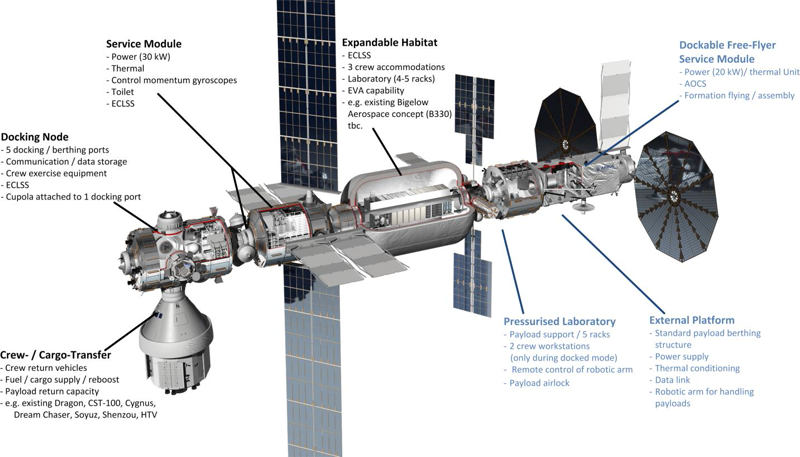
Labeled schematic of the Orbital Hub concept showing the base platform with service module, expandable habitat and docking node alongside the dockable free-flying laboratory with its pressurised lab and external platform

The drawing is the concept schematic from Jahnke et al., taken from the open-access manuscript held in DLR’s electronic library.


On 15 December, ministers from ESA’s member states will gather in Rome to settle how Europe stays in low Earth orbit once the International Space Station is retired. NASA’s part of that timetable is fixed rather than debated: the agency has committed to operating the station through 2030 and has already picked SpaceX to build the vehicle that brings the whole structure down in a controlled manner afterwards, under a contract with a potential value of $843 million (NASA on the US Deorbit Vehicle selection). What is still open is whether Europe buys seats on someone else’s station or builds hardware of its own.

Eight years ago the German Aerospace Center had already drawn that station. The Orbital Hub concept, published in 2018 by Jahnke and colleagues in the system analysis group at DLR’s Institute of Space Systems in Bremen, describes a small modular outpost made of two elements: a base platform holding a permanent crew of three, and a laboratory that flies free of the crew for months at a time (Jahnke et al., Orbital Hub, CEAS Space Journal). The timing makes it more than a museum piece. The paper notes that moving between two crewed orbital platforms has historically taken 10 to 15 years, so a direction chosen in December 2026 is already late for hardware aimed at the 2030s.

ESA put three scenarios to its member states ahead of the November 2025 ministerial. The first leans on commercial stations flown by others, the second buys a limited amount of European hardware for use on those stations, and the third proposes a European-led outpost that accepts contributions from partners outside Europe. In September 2026, ministers meeting at the International Space Summit in Paris endorsed a call to boost European space exploration, naming three priorities: keeping European access to low orbit after the station, a stronger presence on and around the Moon, and using both as staging posts for eventual Mars missions. The argument for the third scenario is that Europe stops being an occasional passenger in someone else’s vehicle and starts owning it and keeping the keys.

Cargo is the unglamorous half of the answer, and it is already under contract. At the same Paris summit, ESA signed a service deal with The Exploration Company worth €760 million for its Nyx capsule, with €310 million set aside for a demonstration flight to the ISS and two optional service missions worth €450 million still to be confirmed. The company covered 40 percent of the demonstration through private investors, with ESA taking the remaining 60 percent under the ALADDIN programme, whose name spells out autonomous docking to an ISS node (ESA on the ALADDIN contract). ESA framed the award as the first and largest capsule transport contract it has handed to a European company, and the agency is now preparing options for ministers to weigh in Rome (ESA media invitation for the December ministerial).

How the DLR concept was built matters as much as what it proposed. The system analysis group started from the science community rather than from hardware, running a workshop to collect research requirements and defining strawman payloads from the result. Those fed concurrent engineering studies in which industry engineers and flown astronauts sat alongside the analysts, refining a first draft design day by day until the requirement set and the layout were consistent. The character of the station comes straight out of that requirement list. One entry states that no spacewalk should be needed for assembly or operation, with EVA reserved for contingency cases alone. Another caps the free-flying element at under 5 metres in diameter, 15 metres long, and below 19,000 kg at launch, the mass a single Ariane 6 flight was assumed to lift.

The base platform carries the people: a service module supplying 30 kW of electrical power, a docking node with five ports, and an expandable habitat built on Bigelow Aerospace’s BA-330 for three crew. The second element, the Free Flyer, holds the more interesting decisions. It is a pressurised laboratory wrapped around an external platform, roughly the size of a Kibo module with its exposed facility, and it flies on its own for about three months before returning to dock for a fortnight of servicing and payload exchange. That separation is the point of the whole design. Crew activity generates vibration and air currents, and a laboratory that leaves the crew behind can hold microgravity quality near one millionth of a g while remaining serviceable by the same people who visit the station. The heritage behind it is deliberate and named in the paper: the pressurised section is based on Columbus with a shortened length, the rendezvous sensors and the reaction control thrusters come from the European ATV cargo ship, and the external truss borrows from Kibo and the ISS structure. A seven degree-of-freedom robotic arm with roots in DLR’s DEOS programme rides a circular rail around that truss to move payloads out of the airlock and onto the platform.

The engineering numbers are where the cost argument hides. Mass across all of the parts came to roughly 60,000 kg, launchable in three flights, with the base platform itself weighing 65 tonnes at 30 kW of power, a little over 15 percent of the station’s in-orbit mass and about a quarter of its electrical budget. The authors compare that to the ISS in 2000, when Zarya, Unity, Zvezda and the first truss element together reached about 60 tonnes with 17 kW, and argue the comparison holds for the functions that matter: crew living, life support, power, attitude control and docking. Propulsion is where the Free Flyer is both clever and awkward. It carries four 400 newton chemical engines and 24 thrusters of 220 newtons each for agility, with tanks for about 760 kg of bipropellant, enough for one complete free-flying phase including rendezvous and docking. The electric system uses RIT ion thrusters in the 10 to 130 millinewton range, and the paper estimates that 660 kg of xenon would cover the vehicle’s 15-year life. Refuelling those high-pressure tanks in orbit is not a solved problem, and the authors say so, offering exchangeable tanks handled by the robotic arm, on-orbit servicing, or shorter free-flying periods as the ways out.

The cost estimate came by analogy first, borrowing the ISS figure of 80 million dollars per tonne and landing on 5.1 billion dollars for the base platform, dropping to 3.5 billion if the habitat module is bought rather than developed. A bottom-up estimate for the first flight hardware put base platform development at about 2,220 million euros and the Free Flyer at 530 million euros, roughly 2.8 billion euros for the pair. The authors then draw the uncomfortable conclusion: that total is more than half of ESA’s entire budget for 2017, which is why they argue the concept cannot be built by Europe alone.

That is the question now in front of ministers. ESA selected Airbus Defence and Space and OHB in late September to run parallel feasibility studies on the third scenario, with six additional industrial and institutional partners the agency did not name (European Spaceflight on the study awards). ESA has asked both consortia to draw on European hardware heritage, including the Columbus module and the European Service Module built for Orion, and to deliver a minimum viable product rather than a full station. A SpaceNews report puts the ceiling at €1 billion for each three-year block of development funding, with development limited to two such periods. Whether the Orbital Hub drawing ever becomes hardware is doubtful: its three-launch layout predates the commercial stations now in the pipeline, and its price tag was set in 2016 euros. What survives is the requirement set it produced, and those are the requirements the current studies keep restating: a small crew, autonomous systems doing the servicing, no routine spacewalks, and hardware that separates crew time from payload quality. Europe has to pick between buying seats and owning a vehicle on 15 December. The blueprint for the vehicle has been sitting on a shelf for eight years.
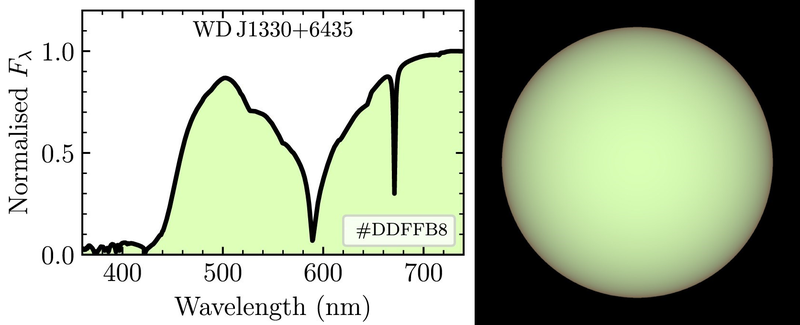


Spectrum and visualisation of WD J1330+6435 showing the absorption features that produce its green colour


A star that would look green if you stood on a planet beneath it sounds like the kind of object that should not exist. The colours a star shows in the night sky are set almost entirely by temperature. Cool stars glow red, stars like our Sun glow white, hot stars glow blue, and the hottest of all glow a faint violet at the edge of vision. Green sits in the middle of the visible spectrum, but stellar blackbody curves tend to slide through it on the way from orange to blue without ever pausing there. For more than a century, the quiet compact rule “stars are red, orange, white, or blue, and that is the list” has been a piece of astronomy no one had to defend, because no counterexample ever showed up.

On 15 October 2026, Mark Hollands at the University of Warwick and three collaborators broke the rule. In a paper titled “Any colour you like: the diverse chromaticities of white dwarfs,” Hollands and his co-authors report the first known star that would actually look green to a human standing underneath it, and at the same time identify what is probably the reddest star on record, a deep salmon-pink white dwarf only 48 light years from Earth that pushes the chromatic boundary in the other direction. A preprint of the paper has been on arXiv since the same day. The work turns on a method that sounds obvious in hindsight but had not been done at scale before: take a high-quality stellar spectrum, feed it through a model of human colour vision, and see what comes out.

The green object is a cool white dwarf called WD J1330+6435, sitting roughly 280 light years away in the constellation Draco. It is about 4,000 degrees Celsius at the surface, which on its own would make it look orange. Instead, in the team’s modelling, it glows a ghostly chartreuse. The reason is chemistry rather than physics in the usual sense. The atmosphere of a cool white dwarf can reach a density close to one gram per cubic centimetre, comparable to water and millions of times denser than the Sun’s photosphere. Under those conditions, trace metals behave very differently than they do in ordinary stellar atmospheres. Sodium, calcium and lithium pulled in from a long-disrupted planetary system absorb light across a much wider range of wavelengths than they would at lower densities. In WD J1330+6435, sodium draws a broad V-shaped valley centred near 600 nanometres that swallows yellow, orange and red. Calcium adds a deep notch at 400 nanometres that takes out some of the blue. Lithium adds a thin gap near 670 nanometres. What survives between those three absorptions is mostly green. Hollands told a University of Warwick press release that the experience of standing beneath such a star would feel like “something out of science fiction,” and that no other star, living or dead, has been credibly reported as green before.

To put that result on a solid footing, the team did not stop at one object. A white dwarf is the exposed core of a Sun-like star that has shed its outer layers. There is no fusion happening any more; the object is a cooling cinder, dense as a planet, slowly dimming over billions of years. The earliest examples astronomers found were the brightest and hottest of the population, glowing white or pale blue, and that is how the whole class got its name. Cooler white dwarfs are dimmer and harder to spot, so for most of the history of the field they have been undercounted. Hollands and his co-authors, Boris Gänsicke and Pier-Emmanuel Tremblay at Warwick plus Detlev Koester, set out to ask a simple question that turned out to have a complicated answer: what colours would white dwarfs actually show if we could see them up close? For the 151 white dwarfs within 20 parsecs, or roughly 65 light years, of the Sun, the team measured a median correlated colour temperature of about 6,800 Kelvin, which is exactly the white of a standard computer display. Most stars, Hollands noted, behave like “perfect radiators,” so their colour is set almost entirely by temperature, and the local sample of white dwarfs obeys that rule on average. The textbook picture that white dwarfs look bluish is, the team argues, a selection effect. Surveys that pick up the faintest sources in the sky are biased toward the hotter, brighter white dwarfs that can be seen from far away. The local sample is dominated by cooler, dimmer ones, and those look, on average, plain white.

Roughly five out of those 151, around three percent, looked nothing like a blackbody. Two glowed yellow and three glowed pink. When the team broadened the search to known white dwarfs across the rest of the sky, the outliers became more vivid. WD J1330+6435 is the chartreuse green star described above. A second star, WD J1011+2845, only 48 light years from Earth in Leo, is the reddest star ever recorded. Its atmosphere has a deep convection zone that has reached the helium-dominated core, lifted carbon up to the surface, and let it form C2 molecules. Those molecules absorb blue, green and yellow so heavily that almost everything that leaves the star is squeezed into wavelengths longer than 600 nanometres, the deep salmon end of the visible spectrum. A third star, WD J2356-2054, looks vivid blue even though its surface temperature is only about 4,000 Kelvin. The mechanism there is different again, hydrogen molecules colliding with helium atoms in the dense atmosphere, and the team flags it as one of the bluest cool stars known. The pattern that emerges is that white dwarfs split into a few colour families tied to what is in their atmospheres: carbon-rich ones lean pink or purple; stars that have swallowed rocky debris from old planetary systems lean yellow, orange or green depending on which metals dominate; mixed hydrogen-helium atmospheres with their own peculiar chemistry tend toward cyan or pale blue. The reason this matters for the rest of astronomy is that the colour is a reading of what the star has eaten. White dwarfs that show metal absorption lines in their atmospheres are, by definition, white dwarfs that have been pulling in the rocky leftovers of their former planetary systems. Polishing the colour, this new paper shows, can pinpoint which elements they have been consuming and how recently. WD J1330+6435 is a fossil of a planetary system that has been mostly devoured, and the green glow is the colour of those remnants, briefly visible in the atmosphere of the star that ate them. The same approach can in principle be extended to the cooler white dwarfs being catalogued by Gaia, which should turn up more coloured outliers in the years ahead. Across the Milky Way’s full census of several billion white dwarfs, the team’s estimate of one unusually coloured star in thirty is a small fraction per object but a very large absolute number. The day Gaia’s pipeline finishes classifying the nearest few hundred cool white dwarfs, several dozen more greens, pinks and blues are likely to come out of the noise. Standing on a planet in the WD J1330+6435 system, looking up at a green sun, would not be science fiction at all. It would simply be Tuesday.


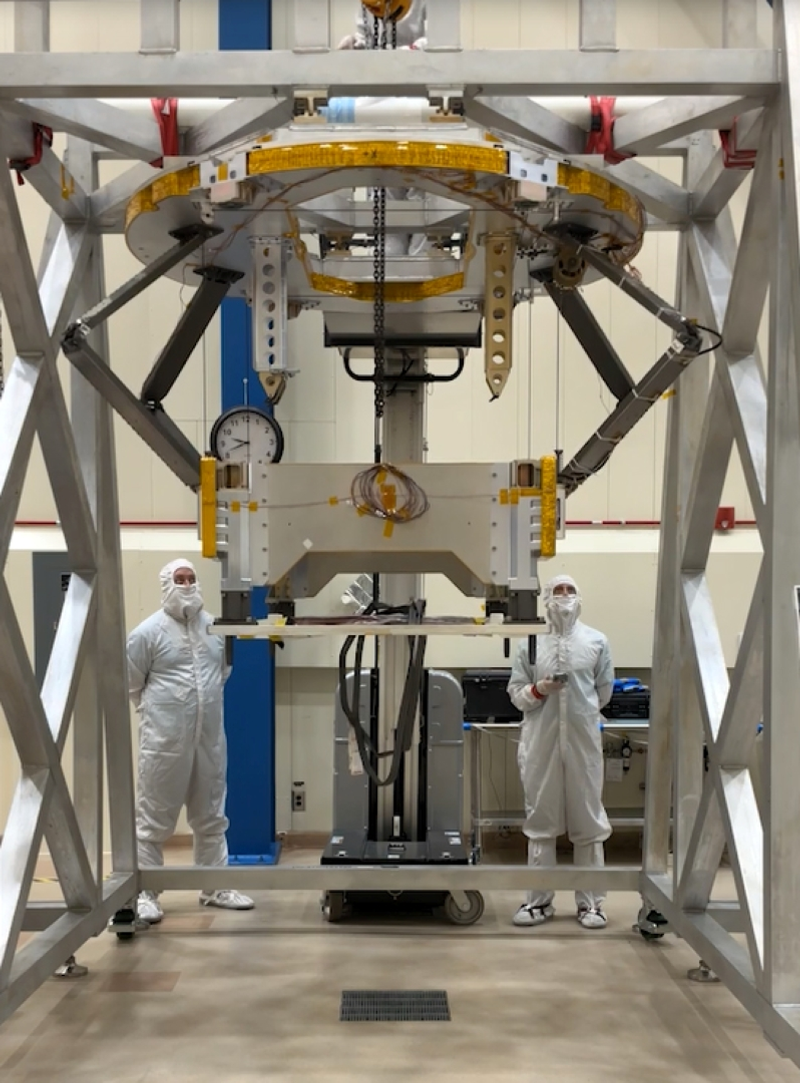
Engineers at Lockheed Martin in Denver monitor a static test of Dragonfly's pose mechanism, the assembly that lowers the rotorcraft clear of its backshell so the rotors can turn before separation during descent at Titan.


In a testbed at the Johns Hopkins Applied Physics Laboratory in Laurel, Maryland, a rotorcraft that has never left Earth crossed a landscape that does not exist. It accelerated over simulated dunes, scanned the ground beneath it, picked out a flat patch, turned, and settled down. On October 23, 2026, NASA described that run as the most thorough rehearsal yet of the moment Dragonfly lifts off for the first time, on Titan in 2034. The test ran in real time on flight-like avionics, with simulated data fed into the navigation cameras, inertial measurement units and lidar the spacecraft will carry (NASA, Oct. 23, 2026). The software did more than fly the vehicle. It searched for a landing site and chose one, and on Titan that choice belongs to the vehicle alone.

Dragonfly is a nuclear-powered octocopter about the size of a small car: roughly 953 kg, 3.85 m across and 1.75 m tall, with four pairs of coaxial 1.35 m blades, a 147 ampere-hour battery and a Multi-Mission Radioisotope Thermoelectric Generator supplied by the Department of Energy through NASA’s radioisotope power program (NASA Dragonfly fact sheet, Sept. 2026). Its five instruments run from a drill that feeds surface material to a mass spectrometer, to a camera suite, a gamma-ray and neutron spectrometer, and a geophysics and meteorology package. Launch is no earlier than 2028, the cruise takes about six years, and the surface mission runs a little over three years.

The world waiting for it is the reason flying makes sense there. Titan’s surface pressure runs about 60 percent above Earth’s, the air is roughly 95 percent nitrogen and 5 percent methane, and the ground sits near -179 degrees Celsius (NASA Titan facts). Sunlight takes about 80 minutes to arrive and lands roughly 100 times fainter than it does at Earth, so solar panels would be close to useless; the radioisotope generator is what keeps the rotors turning. The moon’s pull is weak, with a surface gravity of 1.35 m/s2, about 0.138 times Earth’s (NASA Glenn, 2022). Thick air and weak gravity are the two conditions that turn a spacecraft into an aircraft.

Everything about the recent test follows from that last point. The team fed the flight software simulated sensor data: imagery from the two navigation cameras installed at APL in August 2026, inertial readings, and lidar returns for terrain height and slope (NASA, Oct. 23, 2026). Lidar was the missing piece. The campaign had grown in steps, from spinning a single rotor to a short repositioning flight to a partial scouting flight, and adding lidar finally made a complete first flight reproducible in simulation. A custom camera emulator rendered each synthetic Titan scene on graphics processors with exposure times of roughly 20 to 70 ms, matching what the real cameras will see in flight. Because the run happened on flight-like hardware, the team could watch information move between processes at the millisecond pace it really moves.

Zach Putnam, the mobility subsystem lead engineer at APL, frames the difficulty plainly: “The cool thing about first flight is that it’s our most challenging flight.” It is the case that “uses every piece of flight sensor hardware on the lander” (NASA, Oct. 23, 2026). Leave out a sensor there and you leave out the ability to make a decision.

The part that cannot be rehearsed in software is the moment of release. Dragonfly arrives inside a backshell hanging under a parachute, and has to lower itself clear of that shell before separation, with its rotors already turning. Engineers at Lockheed Martin in Denver, where the cruise stage and entry, descent and landing hardware are being assembled, have been testing that “pose” mechanism: pushing and pulling on it with representative mass to check the loads it must take, lowering it to see how smoothly and quickly it deploys and whether it locks, and tilting the whole rig to reproduce the swing of a backshell beneath a parachute (NASA, Oct. 23, 2026). The pose structure links the backshell to an aluminum interface attached to the lander, and it has to work once, unrepeatably, about 1.6 billion kilometres from home.

That hardware has already been through a strange battery of ground tests. In May and June 2026, engineers suspended the fuselage a few inches above the floor on long bungee cords and measured how vibration at the rotor mounts travelled through the frame, then lowered the vehicle onto protective padding to see how it would sit on its skids. They also pressurized the assembled structure to hunt for gaps, because most planetary hardware is built for vacuum and Dragonfly will sit in air 60 percent denser than Earth’s (NASA Dragonfly blog, July 9, 2026). A slotted foam high-gain antenna, 87.4 cm across, folds onto a motorized arm before each flight so it cannot resonate against the vehicle.

The physics of the machine is worth doing roughly, because it explains how a tonne of hardware can hover on another world. Hover needs thrust equal to weight, T = m * g, so 953 kg on Titan asks for about 1.29 kN. Spread across eight rotor discs of 1.35 m diameter, the total swept area is roughly 11.4 m2, giving a disk loading near 112 N/m2. With air density around 5.7 kg/m3, worked out from Titan’s pressure and temperature and about 4.6 times the density of air at sea level, the induced velocity v_i = sqrt(σ / (2ρ)) comes out near 3.1 m/s. The same machine in Earth’s air would need about 6.8 m/s, so ideal hover power P = T * v_i falls from roughly 8.7 kW to about 4.0 kW. Dense air is a gift: the rotors push against more mass of gas for the same thrust. Real numbers run higher once profile drag and rotor efficiency are counted, and the electrical budget comes from a generator and a 147 ampere-hour battery, which leaves no room for waste.

None of that saves a vehicle that cannot decide for itself. Signals from Titan take the better part of an hour and a half to reach Earth, which is why NASA’s engineers talk about autonomy as a requirement rather than a feature; the rule Putnam repeats is that “everything we do on Titan has to happen autonomously” (NASA, Oct. 23, 2026). So the next round of tests is as much about failure as about flight. The team will run the first flight on the actual flight system instead of the testbed, fly other profiles, and deliberately inject faults to see whether the vehicle notices and recovers on its own.

Spread across 2026 and 2027, that work is the quiet way a 2034 landing gets decided. Dragonfly will spend its first years on Titan moving between dune fields and impact craters, drilling and analyzing samples for the chemistry that runs ahead of life rather than life itself (NASA Dragonfly fact sheet, Sept. 2026). If the autonomy holds and the pose mechanism behaves in flight, the thing that looked like an oversized drone in a Maryland clean room becomes the first powered aircraft to work on another world, and the missions designed after it will look different for that reason.


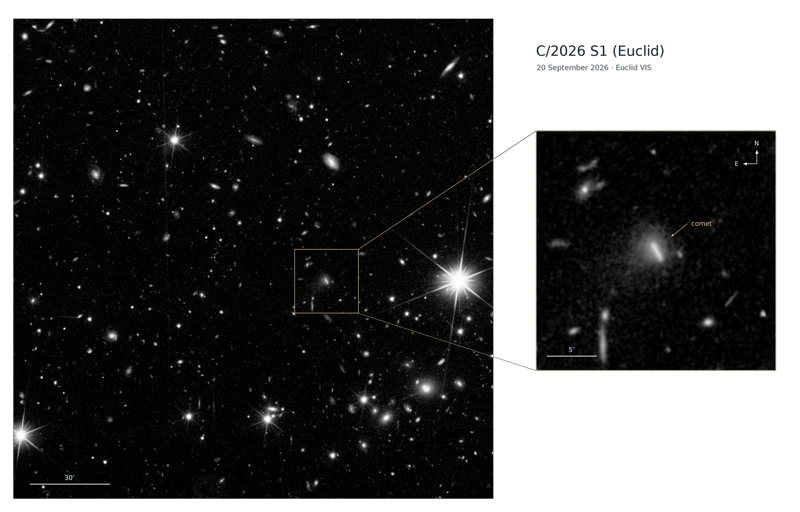
Wide Euclid VIS field on the left with a marked box around the discovery position, and an enlarged panel on the right showing the fuzzy comet labelled "comet" with a five-arcsecond scale bar


A comet is a bad neighbour for a telescope built to stare at distant galaxies. Fixed light holds still inside an exposure. Comets do not. They smear a short streak across the detector, drag stray light into frames that were supposed to be empty, and complicate somebody’s photometry. Euclid was built to do the opposite. ESA’s dark Universe mapper sits at the second Sun-Earth Lagrange point and spends its nights holding position on patches of sky far beyond the Milky Way, measuring the shapes of galaxies with a precision the atmosphere never allows from the ground.

On 8 October 2026, the Minor Planet Center confirmed an object nobody had reported before, found by that telescope. C/2026 S1 (Euclid) is the first new comet Euclid has ever discovered, according to the agency’s announcement of the discovery.

There is a practical reason to care that a Solar System object turned up in a deep-space survey. Euclid’s science case rests on cleanly separating fixed sources from everything else. A comet trail crossing a galaxy image is a contaminating streak that has to be identified and masked, and a mask applied carelessly biases the weak lensing measurement the entire mission is built around. Every moving thing in the field gets accounted for, whether the team set out to look for it or not. There is also an older reason. Comets are leftovers from the Solar System’s formation, around 4.6 billion years old, arriving from the Kuiper Belt and the distant Oort Cloud. They have been altered very little since they formed, so the ices and dust they carry are a sample of the raw material that built the planets, including much of the water that ended up on Earth.

The detections came out of Euclid’s Deep Field North, in the constellation Draco, across a run of images taken between 16 and 24 September 2026. That field was chosen partly because it overlaps a region the now-retired Spitzer Space Telescope surveyed in infrared, a detail Universe Today reported on the discovery. Euclid caught the object in five separate fields of view, two to four exposures each, for 16 exposures in total.

Mikko Pöntinen, a PhD student at the University of Helsinki, wrote the software that caught it. He developed a moving-object detection tool to search Euclid images for small Solar System bodies, and it flagged a streak smeared across several frames. Predicting where the object ought to turn up next, he located it again in other image sets. Closer inspection turned up a fuzzy envelope around the point source, the signature of something actively shedding dust and gas rather than a solid rock. Pöntinen and the Solar System Objects Science Working Group of the Euclid Consortium checked the position against catalogues of known comets and asteroids. No match. He reported the observations to the Minor Planet Center, the global clearing house that collects reports from observers, confirms discoveries, computes orbits and assigns designations. Ground-based astronomers picked up the alert and contributed follow-up, and on 8 October the centre confirmed it as a comet. The designation C/2026 S1 follows standard convention, with the S marking a September discovery and the comet named for the telescope that found it.

At roughly 1.3 billion kilometres from Earth, the comet sits about where the Sun would be if you placed it halfway between the orbits of Jupiter and Saturn. Its orbit is the odd part. Most small bodies travel close to the plane the planets occupy. This one does not. It approaches from high above, and ESA describes the path as one that will take thousands of years to complete. The orbital period will be refined once more data has been collected. That geometry explains how the discovery happened at all, and it happened partly by luck. Euclid deliberately avoids the band of sky lying along the Solar System plane, where dust scatters sunlight into the optics and wrecks deep exposures. Finding new Solar System objects is harder for this telescope than for almost any other in service. Archive Scientist Bruno Altieri said very few comets are expected to turn up in Euclid data, and called the capture a happy coincidence of the comet’s orbit and the telescope’s scanning pattern across those particular days. Project Scientist Valeria Pettorino added that while this comet is not a suitable target for ESA’s planned Comet Interceptor mission, the discovery and the alert that followed give the two mission teams a real case study in how they would coordinate.

Two design decisions shaped what was possible. The first is Euclid’s observing strategy. It works step-and-stare: settle on a target, take the exposures, slew to the next position, do not come back. Each piece of sky gets visited once. For a fixed galaxy that is fine. For a moving comet it means a discovery has to be stitched together from unrelated snapshots taken at different points in the orbit, and confirmed by prediction rather than by simply looking again at the same spot. The five-field, 16-exposure recovery is a reconstruction from fragments. The second is scale. The visible imager is a mosaic of 36 CCDs, each with more than 4000 pixels a side, giving roughly 600 megapixels total, and it covers about half a square degree at a time, the area of two and a half full moons, across wavelengths from 550 to 900 nanometres, as ESA describes the instrument. The consortium specifies the field of view as 0.57 square degrees sampled at 0.1 arcseconds across a 609-megapixel array. Those numbers matter for the detection, because a comet at that distance is not a bright object. It registered as a faint smudge in a frame built to see galaxies looking back close to ten billion years. There is a third reason the find matters beyond curiosity. Comets and asteroids crossing Euclid’s fields are contaminating data as well as discoveries. The team’s job is to identify every moving object, work out where it should have been, and subtract it. Doing that well enough to also notice a fuzzy envelope around one of them is the same detection pipeline doing two different jobs at once.

Euclid has been working at L2 since 2023, partway through a planned six-year survey of roughly a third of the sky, and it is expected to measure more than a billion galaxies. It found a comet anyway. Not because it was hunting one, and not because dark Universe observatories are good comet hunters, but because a PhD student’s software was watching for streaks in the data as routine housekeeping. More finds like it are plausible. The consortium team already had to detect known comets in Euclid frames before this one turned up, and every streak lifted out of a galaxy image is a streak somebody examined closely. The orbital period of C/2026 S1 is still open pending more measurements, and there is a fair chance the follow-up community revises the initial description before the numbers settle.

The discovery will be archived under a name that will not change: C/2026 S1, the first comet Euclid found, in a survey pointed deliberately away from it.

Image: Comet C/2026 S1 (Euclid) in Euclid VIS data, 20 September 2026. Credit: ESA/Euclid/Euclid Consortium.


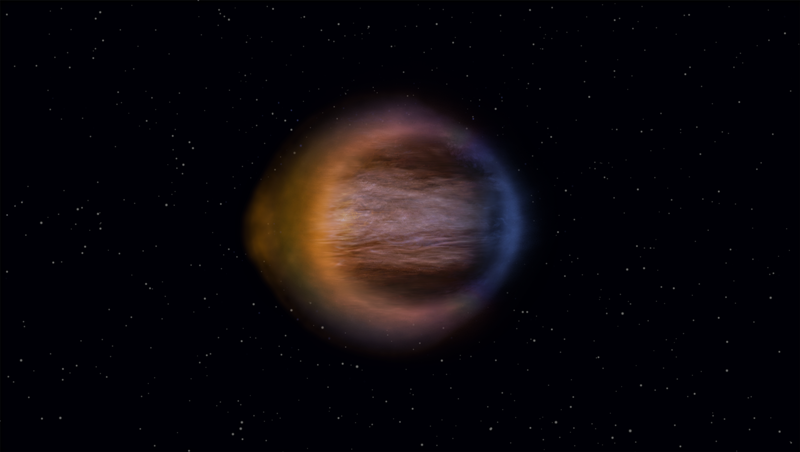
Webb maps the lopsided atmosphere of WASP-17b. Image: 2026 10 19 wasp 17b lopsided atmosphere.


Astronomers working with the James Webb Space Telescope have produced the first three-dimensional map of an exoplanet’s atmosphere, and the planet they picked turned out to be a great choice. WASP-17b, a hot Jupiter about 1,300 light-years from Earth, has an atmosphere that is roughly circular but stretched out on one side, like an egg pulled gently at the pole. The team, led by Lili Alderson of Cornell, reports the result in Nature Astronomy on 14 October 2026 (Alderson et al., Nature Astronomy, 14 October 2026). The paper is more than a portrait of a single weird world. It demonstrates a new technique, called transmission strings, that turns Webb’s eclipse observations into a latitude-by-latitude picture of a planet’s limb. With that picture in hand, the team can finally check, observation by observation, what hot Jupiter circulation models have been predicting for two decades.

Hot Jupiters are easy to find and brutally hard to characterize. They are gas giants the mass of Jupiter or a few times over, parked in orbits of just a few days around their host stars, with equilibrium temperatures above 1,500 K. Because they transit, you can split their light into a spectrum and read the chemistry of the atmosphere from the depths of absorption lines. That part is mature. What has been hard is geometry: a transmission spectrum averages over the entire thin ring of atmosphere that the planet shows us at transit, and the average smears together the cool morning limb and the hot evening limb, the equator and the poles, and any place on the planet where the chemistry is different from the rest. For most hot Jupiters, you get one spectrum and the knowledge that it hides a lot of weather underneath. Alderson and her colleagues, working with Bristol astrophysicists Hannah Wakeford and David Grant, who developed the technique, figured out how to extract more.

The trick is in how Webb watches a planet disappear behind its star. As the planet slides into eclipse, different parts of its atmosphere are hidden at different times, and the light curve that Webb records during that slide is sensitive to where on the limb the atmosphere is hot, cold, cloudy, or clear. Alderson’s team had previously used that approach to measure global temperature maps, but the transmission-strings method goes further: instead of treating the limb as a single ring, it breaks the ring into angular slices, runs the eclipse light curve through a model that knows how a transit signal changes as the star progressively covers different pieces of the planet, and asks which slice is bright in which wavelength. The output is a map of the limb in temperature and chemistry, around the full circumference of the planet, with separate measurements for the equator, the poles, and everything in between. The phrase “transmission strings” comes from the way those angular slices line up along the limb, like beads on a string.

WASP-17b is a long way from a typical hot Jupiter target. Discovered in 2009, it was the first exoplanet found with a clearly retrograde orbit, meaning it swings around its star in the opposite direction from the star’s spin. It is also one of the puffiest planets on the books, with roughly half Jupiter’s mass stuffed into nearly twice Jupiter’s radius, putting it among the most extreme low-density worlds confirmed to date. That puffiness makes its atmosphere large and easy to probe, and its F-type host star gives Webb a bright, clean signal. It has also been a workhorse for Webb’s exoplanet team: in March 2023, the telescope watched WASP-17b for several eclipses using three instruments at once, NIRISS, NIRSpec, and MIRI, covering wavelengths from 0.6 to 12 microns, under the DREAMS survey run by Webb’s Telescope Scientist Team. That same dataset, used by Grant and colleagues to find the first evidence of quartz clouds in an exoplanet atmosphere in 2023 (ESA/Webb, WASP-17 b transmission spectrum, October 2023) and by Gressier and colleagues to measure a supersolar metallicity in the dayside in 2024, became the input for the new limb map.

The result, when the team unfolded the data, was the egg shape that the press releases kept reaching for. The atmosphere is circular at the equator, where a banded jet stream carries material from the planet’s blistering dayside around to its permanently frozen nightside. As the limb is traced up toward the poles, the atmosphere gets lopsided. One side, the evening side, where gas has just finished its rapid eastward journey from the dayside, is hotter; the other side, the morning side, where gas has crossed the long dark face of the planet and cooled, is colder. The team puts the temperature difference at 650 K between morning and evening limb at the equator, consistent with the predictions of circulation models (Alderson et al., 2026, Nature Astronomy). That confirmation matters because, until now, hot Jupiter circulation models were a chain of inferences: people used eclipse and phase-curve data to infer the dayside temperature, used that to constrain the nightside, used the difference to infer the wind speed. Transmission strings lets you measure the morning-to-evening contrast directly, which is the comparison the models need to be tested against.

Alderson was careful to note that the measurement is exactly what theory predicted. The morning-evening contrast, she told reporters, lands almost exactly where hot Jupiter circulation models say it should, bang-on the trend (Cornell Chronicle, October 2026). That kind of confirmation is rare and welcome in a field where surprises are more common than agreements. The paper also reports detections of water and carbon dioxide in the limb spectrum at high signal-to-noise, and a transition in atmospheric structure between equator and pole, which suggests that the equatorial jet does not just transport heat but also reshapes where the gas rises and falls. As Alderson put it in the same press cycle, the work demonstrates that planets are three-dimensional objects whose atmospheric behavior, as they orbit their stars, matches what general circulation models predict (Cornell Chronicle, October 2026).

WASP-17b has, in some sense, been preparing for this paper for years. The 2023 quartz-cloud finding showed the planet’s atmosphere was chemically interesting, not just hot. The 2024 supersolar-metallicity work pinned down the bulk composition. The 2026 paper, by Alderson and her colleagues, is the moment where the meteorology of WASP-17b becomes something you can put on a wall. Among the more than 6,000 confirmed exoplanets, WASP-17b is now the benchmark for three-dimensional atmospheric characterization, the place future transmission-strings results will be compared against. The technique does not require any new hardware: any transiting exoplanet with a good Webb eclipse light curve is a candidate, and there are dozens already in the archive.

There are also genuine limits to read into the result. The map is one snapshot of one planet at one phase of its orbit, taken in March 2023, and 650 K is a large number but it is also a number that depends on which latitudes the model chose to slice at. The team is already applying the method to other hot Jupiters in the DREAMS survey and beyond, and the next round of papers will start to reveal whether the morning-evening contrast varies from planet to planet in the way general circulation models expect, or whether some worlds break the pattern in instructive ways. What the Webb team has, for the first time, is a tool that lets them ask those questions in three dimensions rather than averaging them away.


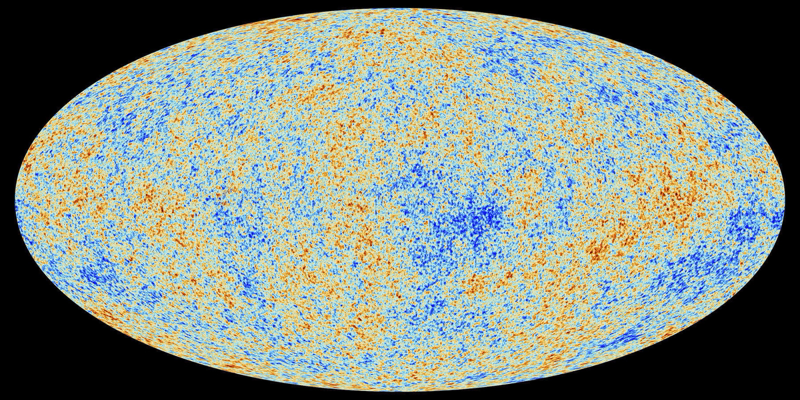
Full-sky map of cosmic microwave background temperature fluctuations from the Planck satellite, in a Mollweide projection, showing a mottled pattern of blue and orange spots against black.

Image: Planck map of cosmic microwave background temperature fluctuations across the full sky. Credit: ESA and the Planck Collaboration, CC BY 4.0, via Wikimedia Commons.


The universe is full of missing mass and nobody has the faintest idea what it is made of. Roughly five-sixths of all matter is dark, and the only handle cosmologists have on it is its gravity, which is an awkward position to be in when one candidate answer is something as ordinary as a black hole. It is a stranger position still when the candidate in question is not ordinary at all. A scattering of black holes with masses in the trillions of Suns would be invisible to any telescope and would sit far outside any galaxy, and until recently nobody had found a way to rule them out. A paper accepted by Physical Review Letters finds one, and it does the job using the oldest light in the universe as the instrument.

These hypothetical objects have a name: stupendously large black holes, or SLABs, for a category of primordial black holes heavier than roughly 100 billion Suns. The name was coined by Bernard Carr, Florian Kuhnel and Luca Visinelli, whose 2021 review of the observational constraints on such objects noted how thin the coverage was. Between 10^12 and 10^18 Suns there were, they wrote, no published constraints on a SLAB population at all. That gap mattered, because the range from about 10^14 to 10^19 Suns sits in an awkward sweet spot. Such an object is too heavy to sit comfortably inside a galaxy, which rules out nothing, while being light enough that simple arguments about disrupting dwarf galaxies or heating surrounding gas do not settle the question. Carr and colleagues judged that a population of primordial black holes in that band could still hold a meaningful fraction of the dark matter while remaining hidden. No such object has ever been found. According to Space.com, the heaviest black hole anyone has confirmed so far may weigh only about 36 billion Suns, which leaves a gap of several orders of magnitude between what has been seen and what the arguments had to cover.

The new result comes from Christopher Gerlach, Yann Gouttenoire, Antonio Iovino and Nicholas Leister, working at the Mainz Institute for Theoretical Physics and at New York University Abu Dhabi. Their paper, Closing the Mass Window for Stupendously Large Black Holes, was accepted by the journal on 9 September 2026 and is scheduled to appear in print on 26 October. The argument is indirect and rather elegant. Rather than trying to find the black holes, the team asks what the universe would have looked like if they had been there.

The trick is that a population of discrete objects does not behave like a smooth fluid of particles. If dark matter consisted of particles spread evenly at the moment the universe became transparent, the primordial density field would be smooth everywhere, with ripples that grew in a well-behaved way as the universe expanded. A population of individual black holes is lumpy by construction. The gaps between them depend on where they happen to fall, and that statistical unevenness writes itself into the earliest perturbations in the universe. Cosmologists call this contribution isocurvature, and the microwave background constrains it hard. Gerlach put the intuition plainly when he spoke to Space.com about the result. If dark matter is packed into a handful of gigantic objects, “the universe becomes grainy on very large scales,” and the grain is something we can look for.

Formally, what the team computed is the isocurvature power spectrum that a monochromatic, non-spinning population of primordial black holes would have produced, and then how far that spectrum overshoots the tightest available bounds. The bounds came from a general analysis of isocurvature modes in the CMB and the baryon acoustic oscillation signal, computed with the CLASS and MontePython codes by Buckley, Fernandez and their collaborators. Planck’s own three-point limits on how much of the primordial fluctuation can be isocurvature rather than the usual adiabatic kind were used as an independent check, and they reach the same conclusion. At the largest of the three wavelengths probed, the isocurvature fraction of the primordial fluctuation is capped at about 2.5 percent. A population of black holes each weighing 100 billion Suns or more overshoots that cap across the entire band of interest, and it does so under the more conservative of the two truncation assumptions the authors tested, so the result does not hinge on a technicality.

One boundary deserves flagging. The exclusion runs up to about 10^19 Suns and then stops abruptly, and the reason is not that the constraint weakens but that the objects stop being possible. A primordial black hole that heavy would have had to form before recombination, and anything heavier could not have been made in the early universe at all. The paper also notes that the same range of masses was closed independently and shortly before it was submitted, by an analysis of Lyman-alpha absorption data. A different line of work, published in the Journal of Cosmology and Astroparticle Physics this year, attacks astrophysical SLABs from an unrelated direction: their shadows would be wide enough to appear as dark patches against the microwave background itself, which rules out anything above 10^17 Suns within the last scattering surface and caps the dark matter fraction they could supply at roughly one part in a hundred thousand. Two separate techniques, the same conclusion.

Read carefully, the result is a statement about proportion rather than existence. Gerlach’s group is not claiming that stupendously large black holes cannot exist, only that they cannot make up a significant share of the dark matter. That is still a meaningful narrowing, because the class was a live candidate, and it arrives with consequences in two other directions. The same calculation strengthens the case that the nanohertz gravitational wave background reported by pulsar timing arrays cannot be sourced by primordial black hole mergers. It also challenges scenarios that attribute the surprisingly massive early galaxies seen by the James Webb Space Telescope to primordial black holes seeding density fluctuations.

The forward-looking part is more interesting than the demolition. The paper points at next-generation microwave background instruments, LiteBIRD and the Simons Observatory, as the experiments that will tighten these bounds further, and it flags two ideas for the heaviest masses where the microwave background runs out of leverage: ringdown gravitational wave signals from the formation of very massive primordial black holes, and strong gravitational lensing of the microwave background itself. The team is also turning its attention to the opposite end of the mass range, asking whether the tiny asteroid-mass black holes that remain an allowed candidate can be shut out as a major constituent of dark matter. For now one candidate is gone. The list of things that could be filling the universe’s missing mass is a little shorter, and the sky’s oldest light did the removing.