OrbitalHub

Where curiosity reaches escape velocity.

Domain is for sale. $50,000,000.00 USD. Direct any inquiries to contact@orbitalhub.com.


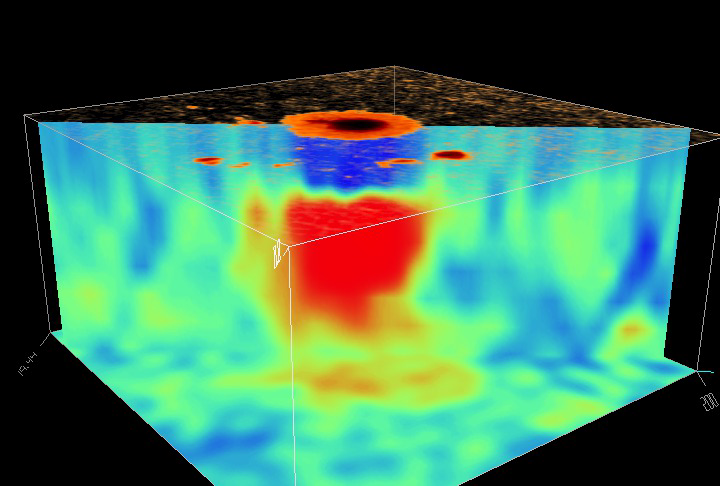
A 3D helioseismic cutaway of a sunspot: the dark sunspot visible on the top surface sits over a red region of altered acoustic power below, with subsurface flows in blue and green running through the convective volume, derived from SOHO/MDI data by Kosovichev and colleagues.


A sunspot is the last thing to show up. Long before a dark patch breaks through the Sun’s visible surface, the magnetic field that will produce it has already been gathering underneath, and the first reliable hints of its arrival are not in light but in sound. Waves travelling through the Sun’s interior are subtly bent and absorbed as that rising magnetic field pushes through them. Until recently those changes were too small to read reliably. On 14 August 2026, a team led by New Jersey Institute of Technology undergraduate Jonas Tirona reported in the Journal of Geophysical Research: Machine Learning and Computation that a Transformer model they call EarlyDetect can pick out those faint acoustic fingerprints about 9.24 hours before the corresponding sunspots are visible. NASA’s COFFIES team press release confirms the result, and the same paper sits on arXiv as 2601.13144 for those who want to read the full text.

Forecasting storms on Earth usually means watching for the ingredients of a storm and giving people time to react. The same logic is starting to govern space weather, the stream of high-energy radiation and charged particles the Sun sends our way when active regions erupt. Solar flares and coronal mass ejections can disable satellites, disrupt radio communications, and put astronauts at risk, which is why NASA’s Moon to Mars program and NOAA’s Space Weather Prediction Center track every visible sunspot the moment it darkens on the disk. Predicting where and when the next sunspot group will emerge, rather than just classifying one that is already there, has been a long-standing gap in operational forecasting. The current approach relies on human analysts at NOAA and the US Air Force characterizing regions that are already on the disk and estimating their odds of producing a flare. It is reactive by construction. EarlyDetect, if it can be made operationally reliable, would be the first step toward a forecast that announces an active region before it has even arrived.

The team built the model around a sliding-window Transformer architecture, the broad family of neural networks that underpins large language models, and trained it on observations from NASA’s Solar Dynamics Observatory, which has been staring at the Sun continuously since 2010. The Helioseismic and Magnetic Imager aboard SDO records full-disk images at 617.3 nm (the Fe I absorption line) every 45 seconds; from those, the researchers assembled hourly maps of acoustic power over the disk and overlaid them with magnetic field measurements. They then searched for the characteristic dip in acoustic power that happens when a magnetic field rising through the convective zone begins to disturb the normal pattern of solar oscillations. The Transformer, sliding a fixed-size window across a long stream of these hourly maps, picked up the dips and learned to associate them with the appearance of a visible sunspot a few hours later. Once trained, the model was tested against a held-out set of active regions it had never seen. Average lead time was 9.24 hours; the model outperformed both a baseline Transformer and a long short-term memory network that the same group had been developing earlier.

What surprised the team was how much standard preprocessing worked against them. Researchers often smooth acoustic time series to filter out noise and make the underlying trends easier to see, but the cleaned-up signal made the model worse. Tirona and his colleagues Irina N. Kitiashvili at NASA Ames and Alexander G. Kosovichev at NJIT argued in the paper that the temporal smoothing layers averaged away the faintest high-frequency dips the model was supposed to find. The faint signals turned out to be carrying the early warning. Kosovichev compared the effect to hearing a slight change in rhythm within a very noisy orchestra; the louder instruments had to be removed for the quieter beat to count, and Tirona put it more bluntly: noise-cancelling filters, which usually help, were detrimental in almost every case in this specific application. The detection itself relies on an older idea: that the Sun rings like a bell, and you can listen to its hum to learn what is happening inside. Helioseismology, the same field that mapped the rotation of the solar core and the structure of sunspot magnetic fields decades ago, supplies the raw material the Transformer chews on. A helioseismic cutaway of a sunspot’s subsurface structure is visible in the NASA SVS visualization by Kosovichev and colleagues; acoustic waves bounce between the surface and deeper layers of the convection zone, and when a magnetic flux tube pushes up from below, it bends the wave paths and changes how much energy reaches the surface in any given frequency band. Visually, the sunspot at the surface gets all the attention, but the subsurface acoustic distortion has been there for hours, waiting to be read.

The team did not stop at the paper. They released the Solar Active Region Emergence Dataset (SolARED), a curated set of SDO observations of labelled active region emergence events, plus the Solar Active Region Portal at NJIT, an interactive platform for downloading and exploring them. Mengjia Xu, the principal investigator, called SolARED the first public dataset of its kind and positioned it as a shared resource for both the machine learning and heliophysics communities to develop and test new approaches. That kind of release is what turns a single result into a research program. The caveats still matter. Detecting that an active region is about to emerge is not the same as predicting that it will erupt; many active regions, even large ones, never produce a major flare or coronal mass ejection, and the lead time of 9.24 hours is statistical, not deterministic. The paper tested against held-out active regions rather than in real time, so operational performance on live data is still an open question, and the SciTechDaily writeup notes Tirona’s own caution that the model is not yet operational and can still produce false alarms or predictions that arrive too late.

The next milestone is a real-time test. EarlyDetect trained on historical data; running it on the SDO feed as observations arrive, and proving that the 9.24-hour average translates into useful forecasts on individual events, is the open problem. The data and code being public should mean other teams can run that test without waiting for the NJIT group to do it themselves. NASA’s COFFIES program, which funded the work alongside NJIT’s Grace Hopper AI Research Institute, has been working since 2020 to bridge heliophysics theory and the kind of high-cadence data work that machine learning was built for. The 14 August paper is the first concrete demonstration that the bridge can carry weight in both directions.
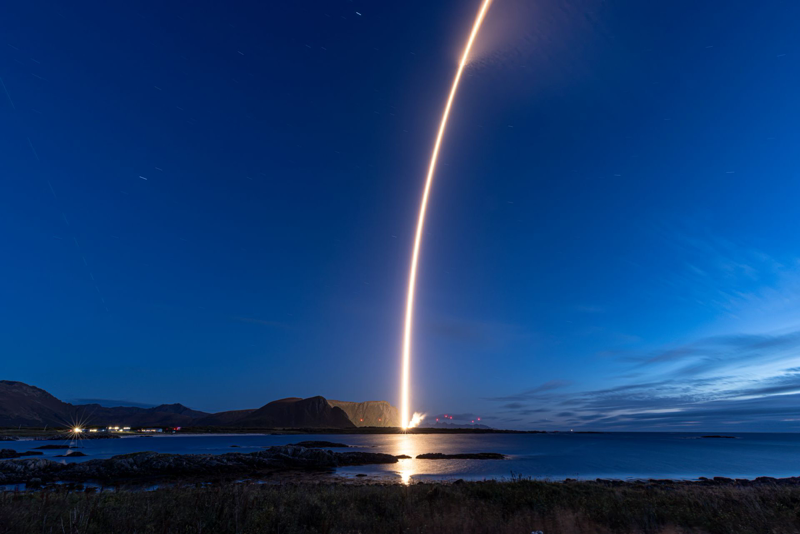


A bright rocket exhaust trail curves upward from a launch site beside a dark, calm sea and mountainous shoreline under a blue evening sky.

Image source: Isar Aerospace’s mission page. The image is a launch photograph supplied by Isar Aerospace; the official mission page identifies the flight and company source.


On the evening of 5 September, a narrow white line rose from the coast of northern Norway and bent across the darkening sky. It was the exhaust trail of Spectrum, a 28-metre rocket built by German startup Isar Aerospace. The vehicle left Andøya Spaceport at 22:12 CEST on the mission called Onward and Upward, then completed the sequence that a small launcher must get right: clear the pad, survive maximum aerodynamic pressure, separate its stages, restart the upper stage, and build enough horizontal speed to stay above Earth.

This time, it worked. Isar said the mission deployed its payloads into orbit on Spectrum’s second flight, making the company the first commercial space company from Europe to successfully deliver satellites to orbit. The distinction needs a little care. European rockets have launched from sites outside continental Europe for decades, especially from Europe’s Spaceport in French Guiana. This flight was about a privately developed European launcher operating from European soil. Isar Aerospace’s mission release describes the result and the company is still checking the status of the satellites with its customers.

That makes the photograph at the bottom of this post useful in a plain way. It shows the launch as a bright trail reflected in the sea, with the shoreline and mountains reduced to silhouettes. The image does not show the satellites or the rocket in orbit. It shows the first few minutes of a supply chain that ends there, far above the frame.

Launch capacity is the part of the space business that is easiest to underestimate. Designing a satellite is one problem; finding a rocket, a launch slot, the right orbit, and a place in the payload queue is another. A working small launcher gives customers a different schedule and a different set of possible inclinations. It also gives a government another option when access to space is treated as infrastructure rather than a one-off science project.

For Europe, the argument is also about control. The continent has major spacecraft manufacturers and a large scientific programme, but launch services have been concentrated in a small number of systems and locations. A rocket that is designed, assembled, tested, and launched by a European company does not remove every dependence on international supply chains. It does provide another route to orbit, and it lets European institutions buy a service from a newer supplier while the vehicle is still being qualified.

ESA supported the flight through its Boost! programme, while the payload selection came through the German Space Agency at DLR’s Microlauncher Competition. That connection matters because the first customers were not all large commercial operators. They included educational institutions and startups that needed a relatively inexpensive chance to put hardware in orbit. The launch therefore tested two things at once: the rocket’s flight system and the market around it.

The flight followed a difficult first attempt. Spectrum’s first test flight in March 2025 lasted 30 seconds, according to ESA’s pre-launch briefing. The vehicle cleared the launch pad, but it did not proceed to orbit. For a new launcher, that short flight is still useful data, but it leaves the next mission with a very specific burden: the company must demonstrate that it understood what happened and changed enough of the vehicle or its operation to make the next attempt meaningful.

The second flight was designated a qualification mission, not simply a repeat demonstration. ESA described it as an attempt to prove the Spectrum launch system in the context of the European Launcher Challenge, which requires selected launch-service providers to achieve an orbital launch no later than 2027. Isar’s own account says the vehicle passed maximum aerodynamic pressure, completed main-engine cutoff and stage separation, ignited its second stage, crossed the Kármán line at 100 kilometres, jettisoned the fairing, reached orbital velocity, completed its circularization burn, and separated the spacecraft.

Those milestones are a chain, not a checklist of independent tricks. The first stage must produce thrust while steering through a thickening aerodynamic environment. At maximum dynamic pressure, the vehicle feels the combined effect of air density and speed, so the guidance system cannot treat the rocket as if it were moving through a vacuum. Once the first stage has done its work, separation has to happen cleanly, and the second stage must ignite without upsetting the trajectory. A launcher can survive an engine problem and still fail to deploy a payload if the upper stage cannot finish the job.

Spectrum uses liquid oxygen and propane, with a multi-ignition second-stage engine, according to Isar’s vehicle description. The company lists a payload capacity of up to 1,000 kilograms to low Earth orbit. That number is a capability claim for the launch vehicle, not the mass carried on this mission. This flight carried five CubeSats and one non-separable experiment, the six passengers described by ESA before launch.

The physics behind orbital launch is less about reaching a particular altitude than reaching sideways fast enough. A satellite in low Earth orbit is continually falling toward Earth, but its horizontal velocity makes the ground curve away beneath it. The rocket spends much of its flight building that velocity while gravity pulls down and the atmosphere pushes back. The upper stage then uses a precisely timed burn to raise and circularize the trajectory. Crossing 100 kilometres is a useful boundary for describing spaceflight, but it is not the same as achieving an orbit that can carry a satellite for long.

Propellant choice shapes the engineering trade. Liquid oxygen is the oxidizer; propane is the fuel. The combination can be stored as a liquid at temperatures and pressures that fit a practical launch system, while the engine still needs turbomachinery, ignition hardware, cooling passages, valves, and controls capable of handling rapid changes in flow. Isar says the propellants offer a high density-specific impulse among carbon-based fuel options. That is a design advantage, not a promise that the rocket will have lower total environmental impact in every comparison.

The other design choice is industrial. Isar says Spectrum vehicles 3 through 7 are already in production and that a new 40,000-square-metre facility near Munich is intended to support production of up to 40 launch vehicles per year. These are plans and production targets, not a flight cadence already demonstrated. The difference is important. A rocket company can prove a vehicle once and still fail to create a dependable service if manufacturing, testing, range operations, and customer integration cannot keep pace.

Isar is also building a launch complex in Nova Scotia, Canada, for mid- to high-inclination orbits used by Earth-observation and communications missions. That site would complement Andøya rather than replace it. Different launch locations open different orbital geometries, but they also multiply the work: regulations, range safety, ground equipment, weather planning, logistics, and local operations all have to be made routine.

The next test is repetition. One successful orbital flight changes the conversation, but it does not yet establish a launch service with predictable timing and recovery from ordinary problems. Spectrum’s second flight showed that a European startup could move from a 30-second first test to payload deployment on the next attempt. The company now has to show that this was the beginning of a production programme rather than the high point of a long development cycle.

For the customers waiting on small satellites, the practical result is simple: there is now another European launcher with an orbital success on its record. The hard part starts after the photograph. Isar must turn a successful qualification flight into vehicles that can be built, tested, licensed, and launched often enough for customers to plan around them.


September 7, 2026

Mars hides a hot hemisphere

Posted by


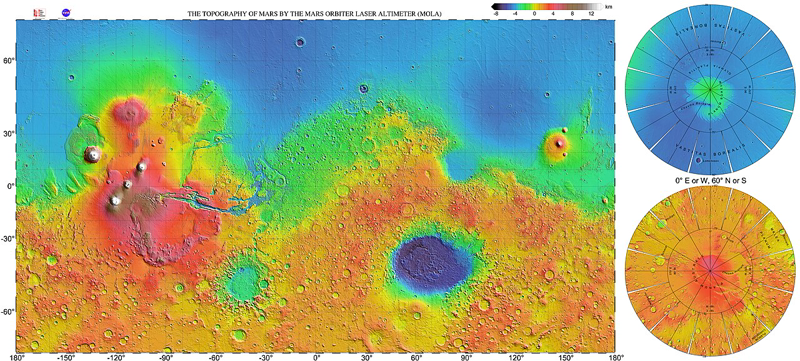
MOLA topographic map of Mars showing the dramatic hemispheric dichotomy: the rugged, elevated southern highlands in reds, oranges and yellows, the smoother, lower northern lowlands in greens and blues, with the Tharsis volcanic bulge on the left and the deep Hellas impact basin visible as a blue depression in the south.


A two-faced Mars has been hiding under its skin for as long as the planet has had a southern half and a northern half. The surface has always advertised the asymmetry: cratered, elevated highlands to the south and smooth, low-lying plains to the north, with a roughly 5 kilometer elevation drop at a boundary that traces most of a great circle around the planet. A study published in Nature on August 27, 2026 now reports that the split goes deeper than anyone had measured, all the way into the mantle. Alexander Berne, formerly at Caltech and now a postdoctoral associate at the University of Arizona, and twelve collaborators used nearly two decades of radio tracking data from three NASA Mars orbiters to infer that the mantle beneath the southern highlands is between 200 and 400 degrees Celsius warmer than the mantle beneath the northern lowlands, and that the contrast is preserved to the present day.

The crustal dichotomy has been one of the most stubborn puzzles in Mars science since the first global topographic maps arrived from the Mars Orbiter Laser Altimeter in the late 1990s. The northern lowlands sit about 5 kilometers lower than the southern highlands on average, and the southern crust is roughly 25 kilometers thicker. Magnetic stripes recorded in the southern crust by Mars Global Surveyor’s magnetometer imply that a once-active dynamo imprinted its field there, while the northern lowlands carry almost no such signature. Seismic waves from marsquakes detected by NASA’s InSight lander between 2018 and 2022 lose energy much more quickly when they travel through the mantle under the southern Terra Cimmeria region than when they pass through Cerberus Fossae in the north. Each of those observations had an individual explanation; what was missing was a single piece of physics that could pull them together.

Tidal tomography is a way to read a planet’s interior by watching how its shape responds to changing gravitational stresses from a partner body. Mars’s orbit is eccentric and its rotation axis is tilted, so the Sun’s tidal pull on the planet varies over the 687-day seasonal cycle. The deformation of the planet under that varying pull depends on the rigidity of the mantle at depth, and a stiffer or softer region flexes by a different amount, leaving a small but measurable fingerprint on the spacecraft flying overhead. Berne and his team analyzed X-band Doppler tracking collected by NASA’s Deep Space Network from Mars Global Surveyor, Mars Odyssey, and Mars Reconnaissance Orbiter over sixteen years and extracted the time-varying component of the Martian gravity field, as described in the Caltech press release. The degree-3 spherical harmonic coefficients of that field, which should be vanishingly small for a spherically symmetric planet, deviated from zero by up to 300 percent, with high statistical significance. A Bayesian Markov-chain Monte Carlo inversion using the semi-analytical code LOV3D translated those gravity deviations into a map of effective shear modulus in the mantle, which in turn implies the temperature contrast.

The map lines up almost perfectly with the surface topography. The team recovered a peak-to-peak variation in mantle shear modulus of 81 percent with a 60 percent uncertainty, with stiffer mantle beneath the northern lowlands, centered near Vastitas Borealis at 45 degrees north, 138 degrees west, and softer mantle beneath the southern highlands, centered near the Hellas basin at 45 degrees south, 42 degrees east. A colder mantle is stiffer, so the inversion translates the stiffness pattern into a present-day temperature anomaly of 200 to 400 degrees Celsius, biased hot to the south. The team also constrained compositional differences: up to 5 percent iron enrichment in the southern mantle relative to the north, a modest but non-negligible contribution that helps the gravity field match without breaking the observed center-of-figure to center-of-mass offset, per Space.com’s coverage. The paper notes that even this 5 percent compositional contribution requires the temperature anomaly; pure composition cannot reproduce the rigidity contrast without violating independent constraints on Mars’s interior structure.

The InSight lander had already left a strong clue, as ScienceDaily summarized. Quality factors, a measure of how much energy a seismic wave loses as it travels through a given region, came in around 500 for events in Terra Cimmeria in the south and between 800 and 2000 for events in Cerberus Fossae in the north. A few hundred kelvin of extra heat in the southern mantle can drive that contrast, and the new tidal tomography result sits right at the temperature the seismic attenuation had implied. Magnetic anomalies in the southern highlands crust also make more sense if the mantle beneath them was unusually hot for part of Mars’s early history: a deep heat source under the south could have driven stronger convection in the underlying outer core, sustaining a localized dynamo that imprinted the crust as it cooled through the Curie temperature before the global field died out around 4 billion years ago. The InSight quality factors are still well above what fully molten rock would produce, so the southern mantle is warm rather than liquid, and three competing explanations remain in play. A giant impact, the so-called Borealis basin formation often invoked to explain the lowlands, would have left the southern mantle iron-enriched relative to the north, consistent with what the team infers, but a single impact is not expected to keep a hemisphere several hundred kelvin hotter than the other for four billion years without help. Spontaneous degree-1 convection would naturally produce a thermal asymmetry but predicts the opposite compositional signature. Thermal insulation by the thick southern crust can sustain the observed temperatures in geodynamic simulations and matches the seismic data, but does not by itself explain why the southern crust is thick in the first place. Berne and his co-authors favor a hybrid story: a giant impact removed or depleted the northern mantle early, leaving the south iron-enriched, and the resulting thicker southern crust then insulated the mantle beneath it long enough for the present-day thermal contrast to survive.

The next probes of this structure will not be landers but gravity missions. Today’s Mars orbiters can resolve degree-3 variations in the time-varying field only because the team pooled two decades of data. A dedicated gravity mission, the Mars-equivalent of GRACE on Earth or GRAIL at the Moon, could resolve similar or finer heterogeneities in a small fraction of the time, and the same technique generalizes to other asymmetric worlds. The authors specifically call out Ganymede, Mercury, Io, and Enceladus as targets where tidal tomography could reveal deep interior structure that no lander has yet touched. The deeper message is that the Martian dichotomy is not just a story about an ancient surface; it is a story about an interior that has remembered its first billion years and is still telling the tale, one radio photon at a time, to anyone with sixteen years of patience to listen.


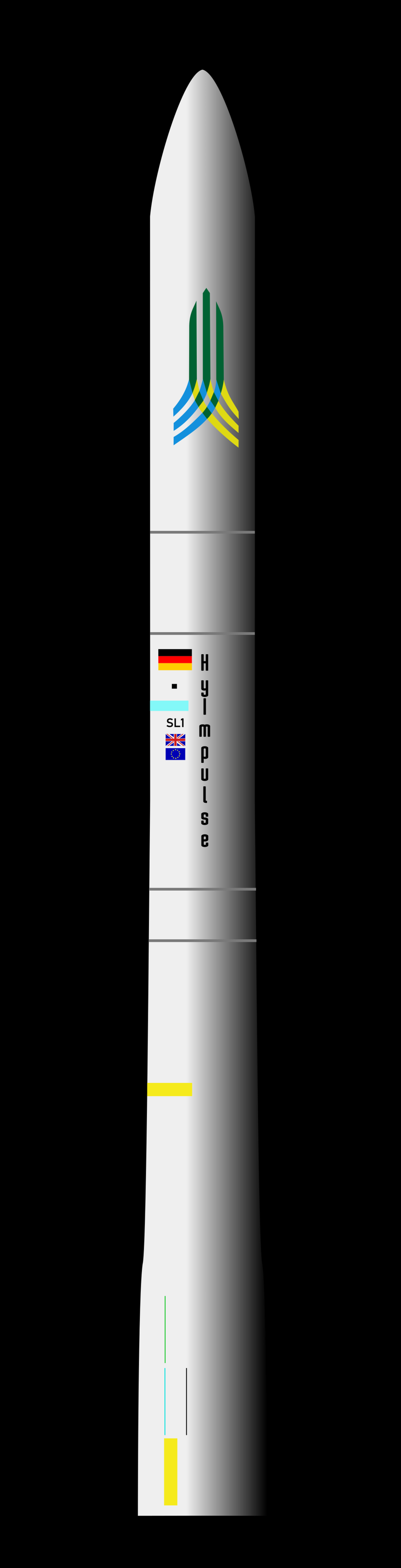
Artist's impression of HyImpulse's SL1 three-stage orbital rocket, with the HyImpulse logo and SL1 designation on the first stage. Image: HyImpulse, via Wikimedia Commons under CC BY-SA 4.0 (https://commons.wikimedia.org/wiki/File:Artists_Impression_of_the_SL1_from_HyImpulse.png).


On 2 September 2026, the German small-launch startup HyImpulse announced that it had closed a Series A extension of more than €50 million, lifting its lifetime equity and grant total to roughly €125 million and growing its commercial order book to over €350 million. The round was jointly led by JOIN Capital, a Berlin-based early-stage venture firm, and Ace Capital Partners, an Israeli aerospace and defence investor, neither of which had participated in the company’s initial €15 million Series A in October 2025. CEO Christian Schmierer framed the raise as Europe’s bid to build an “independent” small launcher: “While providers such as SpaceX offer a scheduled bus service to space, our solutions allow us to develop a flexible taxi service so that our customers can choose individual launch solutions and flexibly plan their schedules” (SpaceNews, European Spaceflight).

The funding matters because HyImpulse is the only European launch startup flying on a hybrid-propulsion architecture, and the first in the world with a published roadmap to put a paraffin-fuelled vehicle into orbit. Its suborbital SR75 has flown once, from the Koonibba Test Range in South Australia on 3 May 2024, and is preparing for a commercial re-flight from SaxaVord Spaceport in Shetland before the end of the year. Its larger orbital rocket, the SL1, has not yet flown but is now scheduled to attempt a maiden launch in 2027, a target the company has consistently described as a stretch goal contingent on further capital. The €50 million buys time on both fronts.

The company’s place in Europe’s launcher debate is awkward. Continent-wide, Ariane 6 and Vega C already provide operational access to space for medium and small payloads, with Ariane 6 capable of carrying over 21 tonnes to low Earth orbit and Vega C rated for up to 2,300 kilograms (European Spaceflight). At the bottom of the mass range, the SL1 is sized for payloads of up to 600 kilograms, small by European standards but large for the kind of responsive, single-customer rides that the global small-launch market has been chasing for a decade. The gap Schmierer is pointing at is real: European providers accounted for less than one per cent of all global launches in 2024, and ArianeGroup’s flagship is optimised for institutional rides, not the weekly cadence a single small-sat operator might want. Whether a hybrid rocket fills that gap, or duplicates it, is the question HyImpulse’s next eighteen months will answer.

HyImpulse was founded in March 2018 as a privately financed spin-off from the German Aerospace Center’s Institute of Space Propulsion at Lampoldshausen, the same facility where the V-2 and early post-war European rocket engines were tested (Wikipedia, DLR). The headquarters sit in Neuenstadt am Kocher in Baden-Württemberg, between Frankfurt and Stuttgart, and the team has grown out of the Lampoldshausen hybrid-motor programme that produced the research the company was built to commercialise. The German government separately committed €95 million in additional funding in late 2024 to support HyImpulse alongside two rival small-launch startups, Isar Aerospace and Rocket Factory Augsburg (European Spaceflight). The new equity raise sits alongside that public funding and brings HyImpulse’s total disclosed war chest close to €125 million in equity and grants combined.

The SR75 is a single-stage suborbital rocket. On its 3 May 2024 flight, named “Light this Candle”, the SR75 launched from the Koonibba Test Range in South Australia, reached an apogee of 50 kilometres, deployed parachutes, and was recovered intact (Southern Launch, ESA Multimedia). The Australian Space Agency called the launch one of the largest commercially launched rockets in Australian history at the time. The mission was supported through ESA’s Boost! programme, which is designed to fund commercial space transportation services in Europe. A second flight from SaxaVord Spaceport in Shetland, planned before the end of 2026, will mark the first launch from European soil under the company’s new agreement with the Scottish spaceport (BBC).

The SL1 is where the technology bet gets serious. The three-stage vehicle stands 33 metres tall, carries a payload fairing 2.2 metres in diameter, and has a lift-off mass of about 54 tonnes (HyImpulse SL1). Each stage burns the same propellant combination as the SR75 (aerospace-grade paraffin wax and liquid oxygen) through clusters of HyPLOX 75 turbopump-fed engines. The first stage carries eight of the engines, the second four, and the third one. According to the company, the SL1’s payload performance was boosted in 2024 to 600 kilograms to low Earth orbit, up from earlier estimates of 500 kilograms to a 400-kilometre sun-synchronous orbit (European Spaceflight – SL1 design update). The vehicle is designed for high flight cadence: the company states it is targeting up to 12 launches per year initially, with a goal of 50 per year by 2030, and turnaround times as short as three weeks between flights.

Hybrid propulsion is the architectural choice that distinguishes the SL1 from every other orbital launcher in development. A hybrid motor stores its fuel as a solid (paraffin in this case, a low-melting-point wax) and pumps its oxidiser as a liquid (cryogenic LOX) into the combustion chamber. The two never mix on the pad, which makes the rocket far safer to handle than a solid or bipropellant liquid stage: a hybrid cannot detonate, can be shut down by closing the oxidiser valve, and stores fuel at ambient temperature. The trade-off has historically been low regression rate and combustion instability, both of which constrain the achievable thrust-to-weight ratio. Paraffin wax partially solves the regression problem because it sublimes and vaporises under heat, exposing fresh surface area more quickly than a rubbery solid fuel like HTPB. The DLR research programme at Lampoldshausen spent more than a decade working on paraffin-LOX combustion, which is the line of work HyImpulse’s founders continued after spinning out (DLR electronic library). The published performance estimates, very high specific impulse comparable to LOX-kerosene bipropellant engines, depend on those gains holding up at full scale. The SR75 proved the motor at suborbital scale; the SL1 will test it at orbital scale.

Whether the SL1 reaches orbit on its first attempt in 2027 is the single question that matters for HyImpulse. The company has booked a €350 million order book, but orders are commitments, not revenue, and small-launch startups have a long history of paper demand evaporating after a failed first flight. The SaxaVord SR75 flight, if it succeeds in the December quarter, will mark the first time a European commercial operator has flown a hybrid rocket from European soil. The SL1 maiden flight, whenever it lands, will be the first attempt to put a paraffin-fuelled orbital launcher on a real flight profile. Both milestones are tractable engineering problems rather than physics ones; whether HyImpulse reaches them on schedule will depend on how fast the new €50 million lets it close the gap between a motor that has flown suborbitally and a launch system that can deliver a payload to orbit. The runway just got longer.


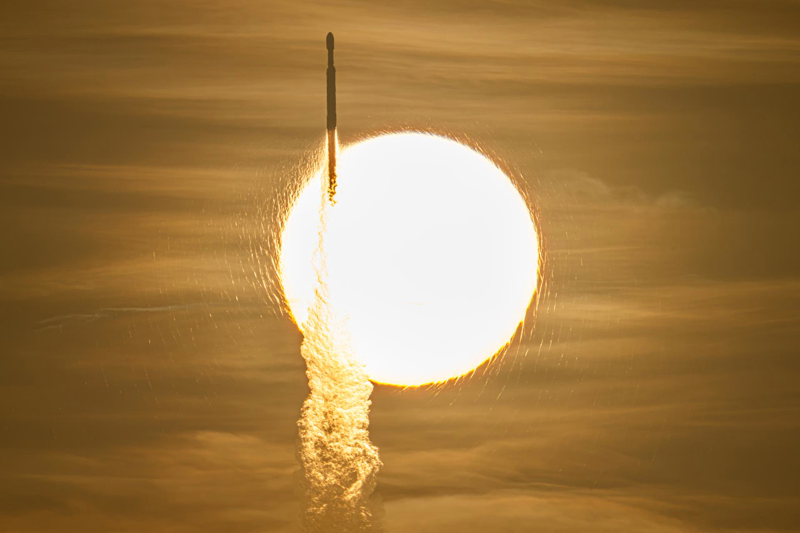
A SpaceX Falcon Heavy with NASA's Roman Space Telescope transiting the rising Sun, captured by photographer John Kraus during the August 30, 2026 launch from Kennedy Space Center Launch Complex 39A. (NASA/John Kraus source image)


A SpaceX Falcon Heavy climbed off Launch Complex 39A at 7:26 a.m. EDT on Sunday, August 30, 2026, with NASA’s Nancy Grace Roman Space Telescope pinned under its shroud. About seven minutes later, the ground team at Goddard Space Flight Center received the first telemetry, and 31 minutes after liftoff the second stage separated cleanly from the observatory. Photographers caught the moment the rocket transited the rising Sun (Figure 1), the exhaust plume drawing a line straight through the disk as the booster climbed through the morning sky over Kennedy Space Center. Roman is now on a three-month cruise to a halo orbit around the second Sun-Earth Lagrange point, about 1.5 million kilometers from Earth, where it will start a five-year infrared survey of the universe that NASA Administrator Jared Isaacman said was delivered “ahead of schedule and on budget”.

The launch marks the start of an observatory that has been on the astronomy community’s wish list since 2010. Roman will look for the same physics the Nancy Grace Roman mission was conceived to probe: dark energy, dark matter, and planets in other star systems. Three of the things it does best, drawing on a 2.4-meter primary mirror donated by the National Reconnaissance Office in 2012 and an infrared camera that the same NASA press release puts at 300 megapixels, have not been done by any previous space telescope in this combination.

The headline number is the field of view. Roman’s Wide Field Instrument images 0.28 square degrees per pointing, more than a hundred times the sky area Hubble’s cameras can capture in a single exposure. Roman is expected to survey the same area roughly a thousand times faster than Hubble, according to NASA’s press kit, which is what enables a five-year mission that returns 1.4 terabytes of data every day, a rate NASA calls the highest of any astrophysics mission. The WFI also runs 18 4K-scale infrared detectors, each about the size of a saltine cracker, which gives the instrument enough resolution to both find exoplanets via gravitational microlensing and map the same patches of deep field at multiple wavelengths.

The trade-off is one the Wide Field Infrared Survey Telescope (WFIRST) study teams accepted as long ago as 2012, when the National Reconnaissance Office offered two spare 2.4-meter reconnaissance telescopes to NASA. The optics have the same diameter as Hubble but a much shorter focal length, so the optical design supports a wide field of view, per the Wikipedia summary of the AFTA-era concept. That same optical design is what makes the coronagraph possible. The Coronagraph Instrument will demonstrate starlight suppression at the part-per-billion level, the kind of technology that a future Habitable Worlds Observatory would need to actually image Earth-like planets rather than infer them from transits.

The mission sits in a quiet but real moment for cosmology. The original WFIRST concept was the top recommendation of the National Research Council’s 2010 Decadal Survey, and Congress funded it across multiple administrations despite at least one cancellation attempt. The 2026-08-30 launch closes that arc.

Sunday’s countdown ran cleanly. The Falcon Heavy lifted off at 11:26:04 UTC from Pad 39A, per the Wikipedia entry’s launch parameters, separating the observatory 31 minutes into the flight. The ground controllers at Goddard received the first telemetry packet seven minutes after launch, and the booster recovery proceeded normally, with the two side boosters returning to the Cape for refurbishment. About an hour and 23 minutes after liftoff, the spacecraft confirmed that its solar panels and the lower instrument sun shade had deployed.

The Near Space Network’s ground stations and relay satellites carried the first part of the flight, and about 70 minutes in the Deep Space Network took over, picking up Roman’s signal first at the Canberra Deep Space Communication Complex in Australia and then handing off to Madrid and Goldstone, according to NASA’s August 30 press release. Roman’s high-gain antenna, the deployable aperture cover, the first mid-course correction and the Coronagraph Instrument’s power-on are queued up over the next several days. The Wide Field Instrument will activate a few weeks into the mission.

The mission is the fourth primary payload SpaceX has launched for NASA on a Falcon Heavy, according to the same release, and the agency moved the date up to fit the telescope’s early completion. After the in-space commissioning window, NASA expects the first science images in early 2027. The institute partners listed in the press release include the Space Telescope Science Institute (STScI) in Baltimore, NASA’s Jet Propulsion Laboratory, Caltech/IPAC in Pasadena, BAE Systems, L3Harris and Teledyne, with contributions from ESA, JAXA, the French CNES and the Max Planck Institute for Astronomy.

Roman shares most of its optical structure with an older mission. The 2.4-meter primary, the same diameter as Hubble’s, was originally built by Harris Corporation for a reconnaissance satellite and was offered to NASA in 2012 for the WFIRST-AFTA study. The optical design is a three-mirror anastigmat with an f/7.9 focal ratio and a wavelength range of 0.48 to 2.30 micrometers, spanning visible blue into near-infrared, per the Wikipedia infobox on the telescope. That range covers most of the light that escapes from distant galaxies, so a wide-field infrared survey has the same statistical power per square degree that Hubble got with smaller exposures.

The Wide Field Instrument is the instrument that actually does the survey. Its focal plane is a 4×4 array (with two corners intentionally blank) of 18 H4RG-10 mercury-cadmium-telluride detectors built by Teledyne, as described in the mission history. The detectors deliver 300.8 megapixels at 0.11 arcsecond resolution. The filter wheel carries eight science filters plus one wide band and two slitless spectroscopy elements (a grism and a prism), which means the same exposure can be used for photometry or for low-resolution spectra.

The Coronagraph Instrument is the new piece. It operates between 575 and 825 nanometers, with two deformable mirrors and a focal-plane mask to suppress starlight. The instrument targets a 1e-9 contrast ratio, the most aggressive starlight suppression NASA has flown, with the goal of imaging Jupiter-like planets at angular separations as small as 0.15 arcseconds from their host stars. The early-2010s orbit trade study left L2 as the eventual choice for thermal stability and a calmer radiation environment, per the mission history. Communications run over S-band for command and Ka-band for science downlink at 290 Mbit/s.

The first science images arrive in early 2027, after about three months of calibration and instrument commissioning at L2. Astronomers will get their first look at the three Core Community Surveys (the High-Latitude Wide-Area, High-Latitude Time-Domain, and Galactic Bulge Time-Domain Surveys), which were selected by the Roman Observatory Telescope Allocation Committee in April 2025. Citizen scientists and machine-learning pipelines will help triage the 1.4 terabyte per day stream that NASA expects once the mission is operational, since no human team can read that volume in real time.

NASA’s Roman team has set hard follow-up milestones: deployable aperture cover, high-gain antenna and the first mid-course correction are due in the first week; the Coronagraph Instrument’s power-on is the early-September checkpoint; the Wide Field Instrument activates a few weeks into the cruise. Watching those deployments land is the first thing to look for in the coming weeks, with first light as the second.