OrbitalHub

Where curiosity reaches escape velocity.

Domain is for sale. $50,000,000.00 USD. Direct any inquiries to contact@orbitalhub.com.

September 20, 2026

McGetchin, the Moon’s newest crater

Posted by


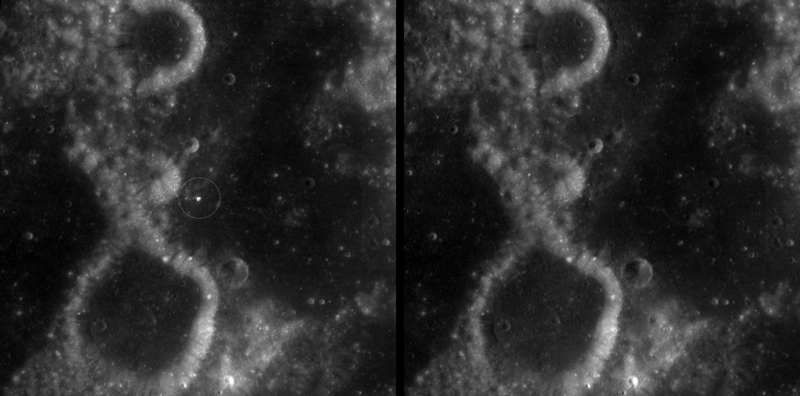
Two side-by-side black-and-white panels of the lunar surface captured by LRO's Wide-Angle Camera. The left panel shows a thin white circle around a small bright spot just right of center; the right panel shows the same area before the impact with no circled feature. The stacked-frame difference image is what tipped off Robert Wagner to the new crater.


On October 24, 2025, Robert Wagner sat down at his computer for a routine data-quality check and found a hole in the Moon that no one knew was there. The bright pixel he traced to the lunar eastern limb has now been confirmed as McGetchin crater, a 222-meter bowl carved into the surface by an impact that hit sometime between April 11 and May 22, 2024. Two papers in Science Advances on September 16, 2026 announce the find and describe what the impact did to the ground around it, and the LROC team has named the feature for Tom McGetchin, the Apollo-era field geologist who helped figure out how impact melts behave. The crater itself is roughly the length of two American football fields across and about 43 meters deep, three times the diameter of the previous record-holding fresh lunar crater spotted from LRO a decade ago.

Why this matters is that the Moon keeps taking hits, and almost no one sees them happen. There is no atmosphere to slow incoming rocks, so a small comet or asteroid fragment the size of a three- to six-story building reaches the surface essentially intact, and the only evidence it leaves is what the next orbital pass can resolve. NASA has been chasing these fresh craters with LRO since the spacecraft reached lunar orbit in June 2009 (NASA Science), and the mission has catalogued at least one thousand new impact craters and flagged a hundred thousand more surface changes from impacts or their ejecta. McGetchin is the largest of the lot, and the find arrived not because anyone was watching for it but because Wagner stacked hundreds of Wide-Angle Camera frames from before and after the impact and let the difference stand out. That methodology turned a routine quality check into a once-per-century discovery.

The story begins with a click on a thumbnail. Wagner is an image-processing specialist who works on the LROC system through Intuitive Machines, the company that has been landing commercial spacecraft on the lunar surface. He was running his usual comparison between a freshly assembled Wide-Angle Camera global map and an older one, looking for change at scales larger than about 50 meters, the size of objects his wide-field system can actually resolve. Wide-Angle Camera pixels are roughly the size of American football fields, so to spot a new feature he has to stack many frames on top of each other and let software subtract everything that did not change. Things that stay the same turn gray, and anything new shows up bright or dark. Most of what the software flags is noise, but the gray-on-gray hack works well enough that, when Wagner scrolled to a tile on the eastern limb, a bright spot circled by a darker halo stopped him cold. “It was by far the most obvious impact debris pattern I’ve ever seen in one of these images,” he said in the NASA release.

After Wagner flagged the spot, the LROC team turned the Narrow-Angle Camera on it. That instrument images the surface at about one meter per pixel, three orders of magnitude sharper than the Wide-Angle Camera, and it gave a clean view of the bowl itself and the ray pattern flung outward by the impact. The crater is roughly circular and 222 meters across, with a clean rim and a darker interior, and the ejecta blanket around it is what registered as the bright halo Wagner had seen from a distance. Independent confirmation came from comparing LROC Narrow-Angle Camera frames acquired on December 5, 2024 and again on March 3, 2025, and from thermographic observations by LRO’s Diviner instrument. The team published its analysis of the impact and its thermal aftermath in Science Advances this week (USRA newsroom); a separate paper in the same issue models the kinetic energy and the regolith disturbance, which Diviner picked up as a roughly 4-mile-wide cold spot about 16 degrees Fahrenheit cooler at night than the surrounding terrain. A follow-up Narrow-Angle Camera pass was later rolled 51 degrees to the east, producing a dramatic oblique view of the new bowl (LROC oblique view M1527218499L,R).

The deep-dive question is what the cold spot tells us about how the surface is changing in real time. Lunar regolith is a layer of loose, jagged grains sitting on top of more coherent bedrock, and over billions of years micrometeorite gardening has ground those grains into a fairly uniform fluff. An impact like McGetchin’s dumps energy into that layer in microseconds, and the explosion excavates a bowl and throws material outward. Some of that material lands around the rim, and when it does it piles up loosely, the way a sandbox pile sits lighter than the sand you started with. Loosely piled regolith does not conduct heat as well as the more compacted original surface, so at night it cools faster and to a lower temperature. Diviner saw exactly that signature, and the cold halo around McGetchin extends about 4 miles in diameter, far past the crater itself. The regolith disturbance has implications for any future rover that drives across the lunar surface: a fluffier surface means different wheel-soil interaction, and the team flagged that directly in the Science Advances paper.

The energy numbers help frame how rare an event this is. Wikipedia), citing the research papers, puts the impact energy at roughly 6.5 × 10^10 kilojoules, and the recurrence interval at about 132 years. NASA’s release phrases it as “once in a century or even longer,” which matches within the usual uncertainty of small-body population models. Either way, the take-away is that LRO has been on station long enough to catch the rare events in the lunar impact rate distribution, not just the everyday ones, and that what Wagner found is statistically one of the largest fresh craters the modern Moon has produced. The mission has been circling the Moon for more than 17 years and has mapped the topography, surface composition, thermal environment, and radiation environment there, and that sustained archive is what made the stacking comparison possible. Without it, the bright spot Wagner spotted would have been indistinguishable from a thousand other random brightness changes in any single Wide-Angle Camera frame.

What this means going forward is that the LROC team plans to keep running these global comparisons on a multi-year cadence and follow up with Narrow-Angle Camera close-ups and Diviner thermography whenever something new shows up. The same method that found McGetchin is now calibrated against a known impact and a known regolith response, so the next rare event should land faster and with less manual work. The Moon’s eastern limb will keep taking hits; the question is whether the next large one is caught the way this one was, by a quality check that turned out to be the headline.
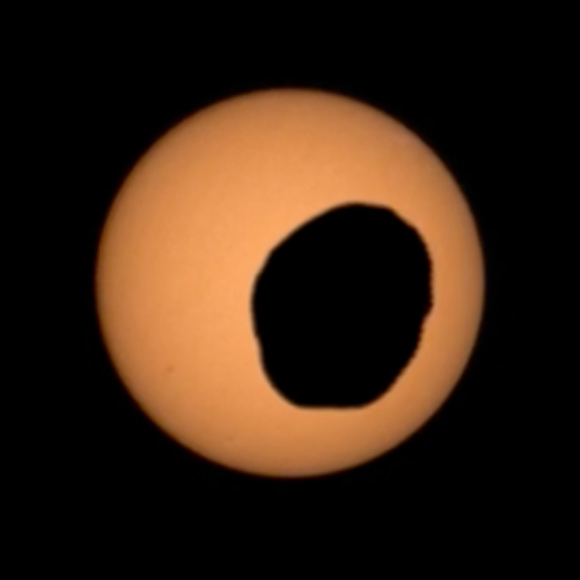


Perseverance catches Phobos slipping across the Sun on sol 1948. Image: 2026 08 26 perseverance phobos sun transit.


On 12 August 2026, on the 1,948th Martian day of its mission, NASA’s Perseverance rover stopped what it was doing for a few minutes, pointed its Mastcam-Z camera at the Sun, and watched Phobos, the inner of Mars’s two moons, slide across the solar disk. The animation that came back has been colorized to mimic what a person on the Martian surface would have seen looking up through a pair of protective eclipse glasses: a small, dark, lumpy silhouette gliding across a glowing orange Sun, never covering enough of it to qualify as a true eclipse (Sci.News).

A partial transit like this is small in the moment and large in the long run. Perseverance has been recording these crossings since it landed in Jezero crater in February 2021, and the team keeps shooting them because each one is a measurement of where Phobos is, and where it is going. By comparing the recordings taken years apart, scientists can refine the moon’s orbit, watch how the orbit is decaying under Mars’s tidal pull, and update the timeline for the day Phobos will finally break apart at the Roche limit or crash into the planet (Sci.News). The same kind of observation, applied to a star instead of a moon, was how exoplanet hunters in the Kepler and TESS era measured the size and orbital period of worlds around other stars. Phobos in front of the Sun is the equivalent demonstration, just two doors down from Earth.

The other reason the recording matters is that Phobos is one of the few Solar System bodies small and close enough that a single orbiting spacecraft can resolve its shadow path from the surface. The moon is only about 26 by 22 by 18 kilometers across, smaller than many asteroids, and orbits Mars at roughly 6,000 kilometers from the surface. That closeness is also why the transit never becomes a total eclipse: from the Martian surface, Phobos never appears large enough to cover the Sun’s disk, only to carve a moving bite out of it.

The 12 August 2026 observation was Perseverance’s most recent entry in a routine the rover has been keeping for more than four Earth years. The Mastcam-Z instrument, a pair of zoomable color cameras mounted on the rover’s remote sensing mast, has been used on multiple earlier sols to record Phobos and Deimos transits. Each observation produces a short video of frames that the team can stack, time-stamp against the rover’s onboard clock, and compare with prior sessions.

What is new with sol 1948 is mostly cosmetic. The animation was tinted on the ground to simulate the visual impression a human observer on Mars would get looking up through solar-eclipse glasses, the same orange-tinted look eclipse chasers use on Earth. The raw data is still a time series of dark silhouettes moving across a bright source. The team released the public-friendly version after running the standard calibration, and the Sci.News writeup on 24 August pulled it back into the news cycle as part of a steady drip of small Mars-science updates (Sci.News).

Behind the video is the same physics that makes a solar eclipse work on Earth: a foreground object passes between the observer and the Sun, casting a moving shadow. The differences are size and geometry. Phobos is roughly 150 times smaller than Earth’s Moon and sits about 200 times closer to Mars than the Moon does to Earth, so its angular size is far too small to cover the Sun. The Moon’s apparent diameter almost exactly matches the Sun’s during a total solar eclipse on Earth, which is the happy coincidence that makes totality possible. Phobos never gets that close to covering the Sun, so the term “transit” is the right word, with “annular eclipse” reserved for a slightly bigger blocker that still falls short of totality.

Mastcam-Z is the workhorse camera on Perseverance’s mast, sitting about two meters above the Martian surface at the eye level of a roughly 6½-foot-tall person, with the two cameras separated by about 24 centimeters to give stereo vision (NASA Mars 2020 Mastcam-Z page). It was designed primarily to study rocks and soils from a distance, with a zoom range that lets the team build topographic maps of terrain features, and it can record 1600 by 1200 pixel frames at up to about 148 megabits per sol of returned imaging.

The transit record itself is what the orbital dynamicists want. Phobos orbits Mars in 7 hours and 39 minutes, faster than any other moon in the Solar System relative to its parent planet’s rotation, and tidal drag is slowly shrinking that orbit. The standard textbook figure is that the orbital radius is decreasing at roughly two centimeters per year, or about two meters per century, and the projections for when Phobos will either break up into a ring or crash into the surface run from about 30 million to 50 million years out (Wikipedia: Phobos (moon))). Observations like the sol 1948 transit tighten the numbers behind those projections by giving the orbit a fresh astrometric fix.

The geometry also gives a measurement that is hard to get any other way: from a fixed landing site like Jezero, the exact path of Phobos across the Sun depends on where Phobos is in its orbit at a particular second. Cross-referencing that path against time, the rover team can solve for orbital elements that mass and remote sensing measurements cannot constrain.

A subtle point worth flagging is that Perseverance did not move to capture this transit. The rover was wherever it happened to be on sol 1948, and the team aimed the mast at the Sun from there. This matters because location is one of the unknowns in the orbital fit: if Jezero’s coordinates are even slightly off in the Mars-fixed reference frame, every recorded shadow path inherits that error. Years of persistent observations from the same rover at the same site cancel most of that error out.

The 12 August 2026 Phobos transit is a small piece of work by a long-running rover that has already spent more than five and a half years on Mars. The Mars 2020 mission’s headline job, caching samples for a future return mission, is well into its second decade of planning, and Mastcam-Z observations of this kind are now a small but reliable side-product that keeps adding data to the Phobos literature. Expect another of these recordings every few months from Jezero as long as the rover stays healthy, and the public versions appear in the standard NASA Mars 2020 image release channels over time. The longer-running payoff sits in the orbit itself: each transit shaves uncertainty off the prediction for the day Phobos stops being a moon.


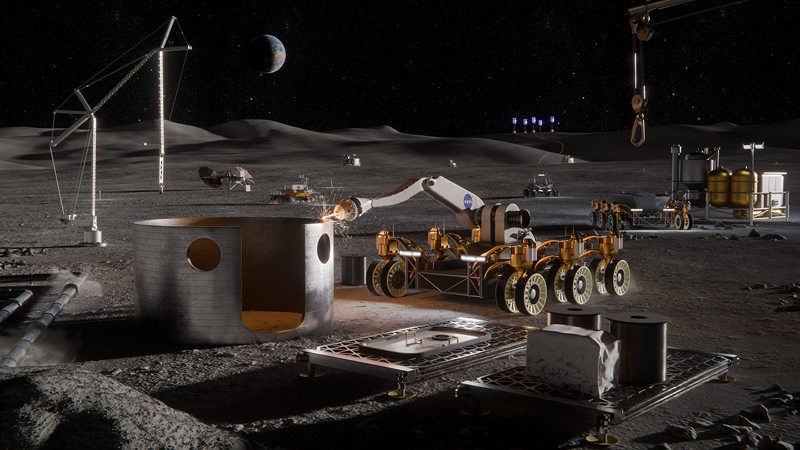
NASA seeks industry help for five Moon Base tech gaps. Image: 2026 09 11 nasa lunar surface tech call.


On September 8, 2026, NASA opened a formal industry solicitation aimed not at the rocket that gets astronauts to the Moon, but at the quiet hardware that has to keep them alive once they are there. The NextSTEP-3 Appendix A solicitation, branded the Lunar Enabling Infrastructure Accelerator, asks U.S. companies, universities, and not-for-profit teams to mature five specific technologies: vertical solar arrays, oxygen extracted from lunar regolith, radioisotope Stirling generators, in-space manufacturing, and innovative nanomaterials, areas that NASA considers the most stubborn gaps on the path to a sustained human presence near the lunar South Pole. The announcement was made under NASA news release RELEASE 26-072, “NASA Calls for Proposals to Accelerate Lunar Surface Technologies”, with proposals due back to the agency by 5 p.m. EDT on October 8, 2026.

The framing matters. NASA is not buying finished hardware with this call; it is buying the demonstrations and the data that show a competing set of approaches can reach Technology Readiness Level 5 to 6, the band where a system has been validated in a relevant environment and is ready to be bolted into a flight article. The agency’s NextSTEP-3 Appendix A program page describes the goal as “closing key technology gaps and maturing competing solutions” so that when NASA does commit to flight hardware, it can do so from a small set of demonstrated options rather than a paper study. The five capability areas named in the final solicitation are the same ones the agency laid out in its June 29, 2026 draft BAA, which followed a May 19 synopsis under procurement identifier 80GRC026R0008, a long drafting cycle by NASA’s usual standards, and a hint that the final wording reflects substantial industry feedback.

The five capability areas, named in the press release, are deliberately heterogeneous: a vertical solar array technology that can provide consistent power generation, management, distribution, and energy storage; in-situ resource utilization oxygen from regolith production to extract usable oxygen molecularly bonded to rock and dust covering the Moon’s surface; a radioisotope Stirling generator, a type of nuclear energy technology that uses heat from fissile materials to produce electric power for operating spacecraft systems in the darkest, dustiest, and most remote places; in-space advanced manufacturing to reduce reliance on resupply missions from Earth and to optimize mission flexibility and resilience on the Moon; and innovative nanomaterials production to advance the commercial availability and quality of nanomaterials that can be used in lunar exploration. Three of the five (oxygen extraction, radioisotope power, advanced manufacturing) were already on NASA’s lunar-technology roadmap before 2024; the vertical solar array and the nanomaterials line are newer entries, which signals the agency is looking outward at commercial capabilities rather than only downward at its own R&D centers.

Why this matters is the gap the announcement is trying to close. The NASA Moon Base reference page describes a near-polar outpost to be built in three phases: robotic exploration through 2029, infrastructure construction by 2032, and long-term astronaut habitation after that. Each phase rests on a different assumption about how much of the base can be supplied from Earth versus produced locally. Artemis IV, currently planned for 2028 per the Aviation Week writeup, is supposed to deliver the first pressurized surface habitat elements. Anything that arrives on that lander, however, still needs power at night, oxygen to breathe, and replacement parts when something breaks, since a single 384-hour lunar night at the pole is too long for any solar+battery architecture to survive without either massive storage mass or a complementary non-solar source. The five capability areas in this solicitation are NASA’s bets on which of those problems get solved by industry in time for the 2028-2032 build-out window.

The story behind the timing is that the broader Artemis program is under budget pressure, and this is the solicitation where NASA is trying to spend smaller amounts of money on a wider set of competing industry approaches rather than continuing to concentrate the work inside a handful of NASA centers. Greg Stover, director of NASA’s Advanced Research and Technology Division, is quoted in the release: “NASA is accelerating the development of key technologies and closing critical gaps needed for long-term human exploration at the Moon. Partnering with industry will strengthen the U.S. industrial base as we mature the capabilities and infrastructure needed for a sustainable lunar presence.” The “U.S. industrial base” phrasing is deliberate; the Appendix A announcement specifies that the solicitation “intends to cultivate U.S.-led capabilities while maintaining full and open competition among private industry, academic institutions, and not-for-profit entities, as well as international partners participating through U.S.-led teams.” International partners are allowed, but only through a U.S. prime, which is the language NASA uses when it wants to widen competition without ceding intellectual property control.

The science and engineering question underneath the solicitation is whether these five capability areas are actually independent or whether they have to mature together. They are not independent. The vertical solar array and the radioisotope Stirling generator are competing answers to the same problem (night-side power at the pole), and a base design that picks one will not need the other at full scale. In-situ oxygen extraction and in-space manufacturing share feedstock: the oxygen a regolith-processing plant pulls out of ilmenite or volcanic glass leaves behind a metal-rich slag that is, in principle, feedstock for additive manufacturing of structural parts. Innovative nanomaterials cut across all three: better cathode materials for the Stirling generator’s thermocouples, lighter radiation shielding for the habitat, higher-strength binders for the regolith-derived construction materials. The solicitation does not formally require joint proposals across areas, but the implicit pressure is on industry teams that can show how their work in one area plugs into the others. NASA may apply insights gained from the resulting contracts, the release notes, with “such as technical data, and demonstration results, to shape future acquisition strategies,” which is unusually candid agency language for “we will pick the winners in a second-round flight buy.”

The five areas also correspond to where the agency’s internal R&D has struggled the most. NASA’s in-house oxygen extraction work, dating back to the canceled Resource Prospector rover in 2018, has consistently run into the problem that the energy needed to crack oxides out of regolith exceeds what a small surface plant can deliver from solar panels alone. Pairing an oxygen plant with a Stirling generator is the obvious answer, but only if the Stirling generator’s heat source can be packaged small enough to land on a Commercial Lunar Payload Services flight. The vertical solar array is NASA trying to specify a different solution: a deployable tower that lifts panels above the dusty surface layer where direct sunlight is available for more hours per day, because traditional rover-deployed arrays have been repeatedly sandblasted by plume ejecta from nearby landings. None of these are problems the 2026 solicitation will solve, but the demonstrations the contracts buy will at least narrow the menu of credible solutions before the agency has to commit to a flight configuration for the 2030s.

The takeaway is that the September 8 solicitation is best read as a procurement shape rather than a flight milestone. NASA is not promising any of the five technologies will reach the Moon before Artemis IV, and it is not committing to a particular contractor; it is signaling that the menu of options will be wide and that the agency plans to make its architecture choices later, from the demonstrated set. Proposals are due October 8, and Aviation Week reports NASA does not plan to hold an industry day exchange, which is a hint that the agency considers the June draft and the August 20 “Responses to Industry Feedback” attachment sufficient background for offerors. If funded contracts cluster around one or two of the five capability areas, that will be the most informative signal, since it will tell observers which of the Moon Base’s hardest problems the agency now thinks an industry team can plausibly solve before the 2032 infrastructure-construction phase begins.


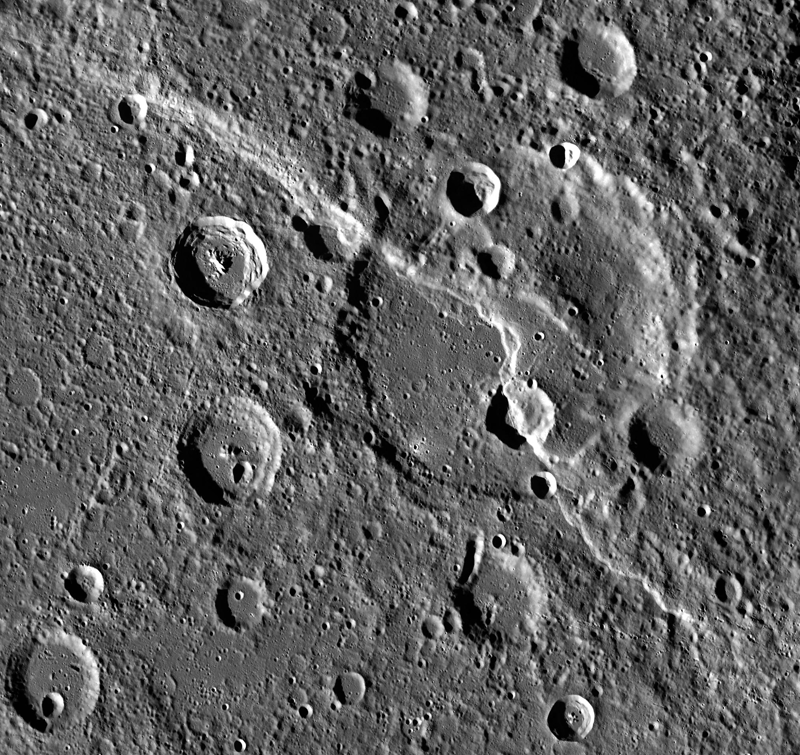
The lobate scarp Carnegie Rupes cuts across a heavily cratered plain on Mercury, with the rim of the small crater Duccio visible where the cliff slices through it. The ridge is roughly 270 kilometres long and rises several kilometres above the surrounding volcanic plain, and it formed as the planet's interior cooled and its outer shell shortened. Image: NASA / JHUAPL / Carnegie Institution, MESSENGER spacecraft, PIA19279, full resolution on Wikimedia Commons.


A fresh look at Mercury’s wrinkled face suggests the innermost planet is a tighter squeeze than anyone had measured. A team led by Gaku Nishiyama at the German Aerospace Center (DLR) reports on 10 September 2026 in Geophysical Research Letters that Mercury’s radius has shrunk by somewhere between 6.9 and 11.6 kilometres (about 4.3 to 7.2 miles) since the planet finished forming, up to 30% more shrinkage than the previous best estimate. The new number does not mean Mercury suddenly started cooling faster. It means the team has been able to count landforms that earlier surveys could not see, in places that earlier surveys did not look. (Phys.org, Space.com)

The cooling and contraction of a rocky planet are not abstract. They leave a written record on the surface. As the hot interior of a world like Mercury gives up heat to space, its iron core and silicate mantle both contract, and the cold brittle outer shell has to buckle and shorten to keep covering the smaller interior. On Mercury that shortening shows up as long curving cliffs called lobate scarps and as the smaller, bunched-up wrinkles that run across the volcanic plains. Each of those structures corresponds to a known amount of horizontal shortening, and the cumulative shortening of all of them tells you how much the planet’s radius has changed.

The problem is that some of those wrinkle ridges are buried under rubble. Mercury is the most heavily cratered surface in the Solar System besides the Moon, and each impact spreads a blanket of broken rock over a wide area. Where the surface is rough, the short scarps get masked by impact debris and are no longer visible from orbit. Earlier global surveys counted only the ridges they could see in smooth volcanic plains and used that visible population to estimate the global total. Nishiyama’s team did something different: they overlaid Mercury’s contraction-related fault map with a high-resolution surface roughness map, found that the roughest patches are systematically missing the scarps the smoother patches have, and used that correlation to estimate how much contraction the rough terrain is hiding.

The corrected total is 4.3 to 7.2 km of radial contraction, depending on how the unmapped regions are extrapolated. The upper end is about 30% larger than the previous widely cited figure, and the lower end is broadly consistent with the older estimate. Either way, the planet’s interior has gone through more total cooling than the existing record implied. That matters for what scientists think is going on inside Mercury today. A planet that has lost more heat over its lifetime is consistent with an iron core that has fewer light elements mixed into it, or with a higher starting temperature, or both. Lead author Nishiyama, in statements accompanying the paper release published via the American Geophysical Union’s media release, lays the implications out plainly: “More shrinking means Mercury could have a larger metal core, less light elements like silicon mixed into the metal core, or a higher starting temperature.” (Time)

The story behind the paper is at least as interesting as the headline number, because the data set the team used is mostly the same one that supported the earlier, smaller contraction estimate. NASA’s MESSENGER spacecraft orbited Mercury from 2011 until it ran out of fuel in 2015, and its Mercury Dual Imaging System returned the global monochrome and colour mosaics that almost every modern Mercury paper still leans on. The MESSENGER Laser Altimeter (MLA) produced a topographic map of the northern hemisphere but could not see all the way to the south. The team behind the new paper combined MESSENGER imagery with a recent roughness map derived from those same images, cross-checked with the older Byrne et al. 2014 estimate from Carnegie Institution and Smithsonian, and identified which kinds of terrain were systematically underrepresented in the historical contraction count.

The surface structures this work is about are dramatic at human scale even if they are subtle in orbit. The Wikipedia entry for Carnegie Rupes, a textbook lobate scarp in Mercury’s northern volcanic plains, describes an escarpment about 267 kilometres long with several kilometres of vertical relief. The image NASA’s MESSENGER spacecraft captured of that scarp cutting through the small crater Duccio (PIA19279, public domain, NASA / Johns Hopkins Applied Physics Laboratory / Carnegie Institution) is reproduced below. The curving bright ridge in the middle of the frame is the scarp itself. Each kilometre of vertical throw on a scarp like that one corresponds to a known amount of horizontal shortening, and the cumulative throw across thousands of such features is what gets converted, at the end, into a single radius change for the whole planet.

The instrument that will close the question is now on its way. ESA’s BepiColombo mission, launched in October 2018 and scheduled to enter orbit around Mercury in late 2026, dropped its cruising platform on 3 September 2026 after a flyby and is closing in for orbit insertion in November. It carries the BepiColombo Laser Altimeter (BELA), a German-Swiss instrument led by the same DLR group that authored the contraction paper. BELA is designed to map Mercury’s topography from the equator to the south pole at roughly ten times the vertical resolution of MESSENGER’s MLA, and Nishiyama is a member of the BepiColombo science team. He has been explicit about what the new data will buy. “Future data from laser altimetry on BepiColombo will collect more information on planetary contraction by measuring topography more precisely,” he said in the paper’s release materials, and the broader BepiColombo topographic record will let the team test whether the corrected 6.9 to 11.6 km figure is the final answer or itself an underestimate. (Phys.org)

The deeper question, beyond Mercury’s own radius, is what kind of planet Mercury is. It is the smallest planet in the Solar System by radius, the second-densest after Earth, and the only one with a fully liquid iron core that generates an active magnetic field. Its high density combined with its low mass implies an oversized metal core, and the surface contraction is one of the cleanest windows into how that core has been cooling for the past 4.5 billion years. A planet that has lost more heat than its visible faults suggest is a planet whose interior has been more efficient at giving up its primordial warmth. For models of planetary dynamos, of core composition, and of the thermal history of rocky worlds in general, that 30% revision is a meaningful step.

The lesson is also methodological. Planetary geologists working on Mars, the Moon, and the icy satellites of the outer planets face the same problem of counting only the faults that happen to be visible on the surface. Mercury’s case, where the obscuring layer is impact debris rather than vegetation or ice, is unusually clean. The team’s correlation between contraction feature density and surface roughness gives them, and anyone who follows them on other worlds, a concrete way to estimate how much of a planet’s tectonic record is hidden in plain sight. That kind of correction does not invalidate the earlier surveys; it shows that those surveys were working from the right kind of data and the right kind of reasoning, but with incomplete coverage.

By the end of November 2026, BELA will start returning the topographic map that turns Nishiyama’s 6.9 to 11.6 km range into a single number with much smaller error bars. If the BepiColombo topographic record confirms the upper end of the contraction range, the standard thermal-history models for Mercury will need to be revised in much the same way the contraction estimate itself just was. If it confirms the lower end, the new paper becomes a careful quantification of how much a single observational bias was understating a real measurement. Either way, the figure that planetary scientists will quote for Mercury’s shrinkage from now on is not the number they were quoting last week.


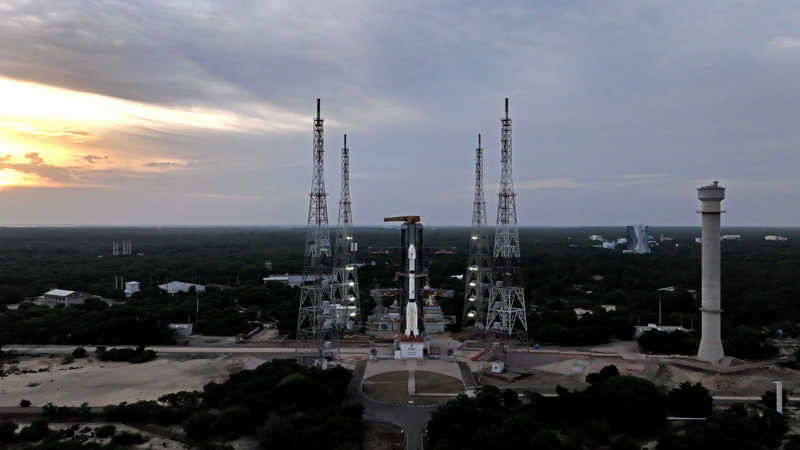
GSLV-F17 on the Second Launch Pad at Satish Dhawan Space Centre at dusk, with the four lightning towers and the umbilical tower flanking the 51.7 m rocket and the cryogenic upper stage visible at the top.


A 51.7-metre rocket lifted off in the dark hours of Friday morning at Sriharikota, on India’s southeast coast, and put a roughly 2,367-kilogram Earth-observation satellite into a Sub-Geosynchronous Transfer Orbit. ISRO’s GSLV-F17 mission was scheduled for 2:55 am IST on 4 September 2026 from the Second Launch Pad at Satish Dhawan Space Centre (ISRO mission page), and the launch itself went according to plan. What made it more than routine was that EOS-05 is the country’s first imaging satellite to operate from a geosynchronous perch, and it flew on a launcher that India’s space agency has spent more than two decades trying to make reliable.

The Geostationary Imaging Satellite programme goes back nearly a decade, to an earlier concept called GISAT-1 that was meant to give India a continuous, fixed-eye view of the subcontinent from 36,000 km up. The original GISAT-1 launch in 2020 was called off because of a technical issue with the cryogenic stage, and a second attempt the following year failed to ignite the cryogenic engine in flight. That delay had already pushed India’s geosynchronous imaging ambition by roughly five years before EOS-05 picked up the work as a direct replacement, with design updates informed by the failure analysis (TechTimes coverage). This time the cryogenic stage behaved. The third stage, designated CUS15, burned for about 814 seconds with the indigenous CE-7.5 engine, which ISRO developed to replace a Russian KVD-1 design after the Missile Technology Control Regime complications of the early 2000s (CE-7.5 Wikipedia entry). The launch matters because India’s earth-observation fleet has until now operated almost entirely from low Earth orbit, where a satellite passes over any given patch of ground for only a few minutes per orbit. From 36,000 km up, EOS-05 will sit over a fixed longitude and stare down at the same region continuously, day and night, gathering visible, near-infrared and shortwave-infrared imagery across roughly the whole visible disc (Wikipedia: EOS-05). That is a qualitatively different tool. A polar-orbiting imager gives you high spatial resolution at the cost of infrequent revisits; a geostationary imager gives you continuous revisits at coarser spatial resolution. EOS-05 is aimed at the second regime, with a 700 mm Ritchey-Chrétien optical telescope tuned for agricultural monitoring, cyclone tracking, and rapid disaster mapping over India, its 7,500-kilometre coastline and the surrounding maritime zones (Times of India mission summary).

This was the 19th flight of the GSLV and only the fifth to use the Mk II configuration with the indigenous cryogenic upper stage, which is the part of the rocket that has historically given ISRO the most trouble. The Mk II stands 51.7 metres tall, weighs 420.5 tonnes at lift-off, and uses a stack of three stages wrapped by a four-metre composite ogive fairing. The first stage is the S139 solid core with four L40H liquid strap-ons clustered around it; the second is the GL40HT liquid-propellant stage; and the third is the cryogenic CUS15 (ISRO mission brochure summary). That third stage is what makes GSLV comparable to other medium-lift geosynchronous launchers in the world: liquid hydrogen and liquid oxygen are notoriously hard to handle because they sit at around -253 °C, which is why cryogenic upper-stage development is often the single largest non-recurring engineering cost for any space agency building a geosynchronous launcher.

The mission was also a deliberate break from a difficult 18 months for the Indian launch programme. PSLV, the workhorse polar-orbit rocket, suffered consecutive failures in May 2025 and again in January 2026, and the investigations into both kept most of ISRO’s launch manifest on the ground (Indian Express on the PSLV investigations). NDTV called GSLV the “Naughty Boy” of the Indian fleet in its post-launch coverage, an affectionate reference to the launcher’s long history of partial failures and stand-downs (NDTV: How ISRO’s ‘Naughty Boy’ Rocket Delivered A Big Win For India). Putting EOS-05 into a precise Sub-GTO is exactly the kind of success that rebuilds confidence launch by launch; ISRO Chairman V. Narayanan confirmed after the mission that the cryogenic upper stage had performed as designed and that the satellite’s Liquid Apogee Motor would now do the work of raising the orbit to its final geosynchronous station.

The CE-7.5 engine that powered that critical third stage is itself the product of a long-running technology development programme. It is a regeneratively cooled, fuel-rich, staged-combustion-cycle engine, which is the same thermodynamic cycle used by the Space Shuttle’s RS-25 main engines (CE-7.5 details). The engine is about 2.14 m long and 1.56 m in diameter, runs at variable thrust, and has a specific impulse of around 454 seconds in vacuum. Staged combustion is the most efficient chemical cycle in practical use, because the propellants are partially burned in a preburner before the main chamber, which extracts more energy from the same mass of fuel. The trade-off is that the engine is harder to build and to test; the preburner runs at extremely high pressures and temperatures, and any leak of the hydrogen-rich preburner gas into the wrong part of the engine can damage it. That is why ISRO’s early GSLV flights used the Russian-supplied KVD-1 instead, which uses a simpler gas-generator cycle at the cost of lower efficiency. By replacing the Russian engine with a domestic one, ISRO removed a long-standing supply-chain risk and aligned the upper stage with India’s existing manufacturing base. It also brought the GSLV’s payload capacity to geosynchronous transfer orbit up to roughly 2,500 kg, which is enough for EOS-05 and for the heavier navigation and communications payloads ISRO has planned for the rest of the decade. The fact that EOS-05 was the first GEO imaging payload to fly on it is not coincidental; ISRO held the satellite back until it had a launcher it trusted enough to put an irreplaceable asset on.

For the broader commercial and strategic picture, EOS-05 also closes a gap that India’s civilian and military users have lived with for years. The Indian National Satellite System’s INSAT fleet has carried transponders for communications and weather imaging for decades, but it has not had a dedicated hyperspectral imager staring down from geostationary orbit. Hyperspectral means the imager splits incoming light into many narrow bands, which lets it distinguish, say, healthy crops from drought-stressed ones in ways that a conventional three-band imager cannot. Continuous coverage from geosynchronous orbit, in turn, lets disaster managers watch a cyclone’s eye wall reorganise in near-real-time or track the spread of a flood across a state hour by hour. The payload does not replace India’s existing low-Earth-orbit earth-observation satellites, which still do most of the heavy lifting on high-resolution mapping. It complements them.

The next test will be whether the satellite reaches its final station and powers up its instruments cleanly. ISRO’s GSLV-F15 in January 2025 placed a navigation satellite into GTO correctly but the satellite’s own Liquid Apogee Motor failed due to an oxidiser valve malfunction, leaving that spacecraft stuck in a transfer orbit (NDTV: What Back-to-Back PSLV Failure Means For ISRO). EOS-05 has the benefit of a fresh cryogenic upper-stage performance record and of a launch-to-orbit precision that should let its own propulsion system do less work. If all goes well, the satellite should be operational at its assigned geostationary slot above the equator within a few months, and India’s weather, agriculture, and disaster-management agencies will have their first continuous watch over the subcontinent.


September 9, 2026

BepiColombo drops its ride to Mercury

Posted by


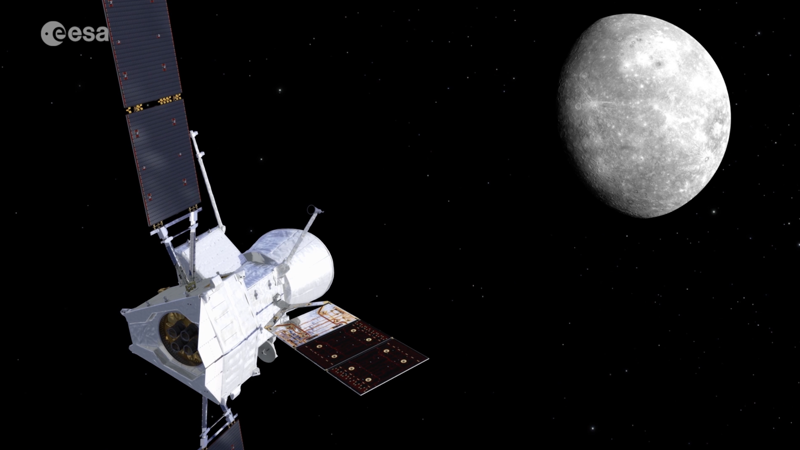
The BepiColombo composite spacecraft - ESA's Mercury Planetary Orbiter (MPO) at the base with its single solar array extended, JAXA's Mio (Mercury Magnetospheric Orbiter) sheltered inside the white MOSIF sunshield on top, and the Mercury Transfer Module's large rectangular solar wing visible behind the stack - approaches a half-lit Mercury against a black starfield. Credit: ESA / ESA Multimedia image (24 June 2026).


On Thursday afternoon at 14:00 CEST, a stack of four spacecraft modules that left Earth on an Ariane 5 in October 2018 will, very briefly, become three and then two. ESA’s Mercury Transfer Module is scheduled to detach from BepiColombo’s two science orbiters as the mission’s controllers at the European Space Operations Centre in Darmstadt look on, with the first signal from the freed composite expected back on Earth by 15:53 CEST if everything goes to plan (ESA, 27 August 2026). After eight years and nine gravity assists, the part of the spacecraft that made the trip possible is no longer needed, and the part that has to do the science is, ungainly and for the first time, on its own.

Getting to Mercury is the kind of orbital mechanics problem where the obvious solution is forbidden. Falling toward the Sun does not slow a spacecraft down; it speeds it up, pulled by solar gravity, so the usual chemical-brake trick used at Mars is not enough to be captured into orbit around the smallest planet. BepiColombo has to match Mercury’s velocity almost exactly, and that takes far more energy than reaching even the distant gas giants. The mission’s answer was to spend years bleeding speed against an ion engine instead of staging a single dramatic burn, and the upcoming separation is the moment the engine is, finally, switched off and thrown away. As ESA’s mission manager Santa Martinez put it to Euronews on 1 September, “Mercury is a challenging destination. It’s very difficult to reach, it’s very difficult to operate there.”

Why a separation matters this much, and why the next two months are unusually tense, comes down to what changes about the spacecraft on Thursday. For the cruise the four modules sat one on top of the other inside a tight stack, with their instruments and cameras physically blocked from space by the boxy MTM at the base. Once the MTM floats off, the upper composite begins an entirely new mission with an entirely new thermal and radiation budget. Solar flux near Mercury is roughly ten times what it is near Earth, and the MTM had been there partly to shield the orbiters during the inner solar system transit. The flight director, Ignacio Tanco, has described the moment to Euronews as working “with a very hot pizza oven running right on your back” and “on a knife edge,” because the MPO’s solar panels have to be tilted within fractions of a degree of the Sun. Push them slightly away and the spacecraft starts losing power; angle them slightly closer and they start to bake. There is no second chance to find the right pointing before the thermal balance tips.

The spacecraft itself carries a long memory. BepiColombo launched on Ariane flight VA245 from Kourou on 20 October 2018 and reached escape velocity the same day, then spent almost exactly eight years climbing and falling through the inner solar system using four QinetiQ T6 ion thrusters on the MTM, with a maximum combined thrust of about 290 millinewtons, the most powerful ion engine array ever operated in space. The cruise used one Earth flyby in April 2020, two Venus flybys in October 2020 and August 2021, and six Mercury flybys between October 2021 and January 2025, the last of which imaged the permanently shadowed north polar craters Prokofiev, Kandinsky, Tolkien and Gordimer. The mission’s overall cost is estimated at 1.65 billion euros, and the arrival has already slipped about eleven months from its original December 2025 date because of a power-related anomaly that limited the available thrust before the fourth Mercury flyby in September 2024. On 15 June 2026 at 13:24 UTC the MTM’s solar electric propulsion was switched off for good, and from then on the mission is ballistic: BepiColombo is, in engineering language, “weakly captured” by Mercury’s gravity and following a free-falling trajectory through space.

What happens after 3 September is a sequence of three distinct steps rather than one event. From the separation through late November, the MPO and Mio remain mechanically and electrically joined, with the Magnetospheric Orbiter Sunshield and Interface (MOSIF) still attached, and the two orbiters fly free of the propulsion module for the first time in their lives. Then, between late November and early December 2026, a series of chemical thruster burns raises the orbit’s apocentre and lets Mercury’s gravity do the rest, putting the composite into polar orbit. Once captured, MPO and Mio separate from each other and head to their distinct orbits, MPO in a lower polar orbit for surface and interior science and Mio in a higher polar orbit at 590 by 11,640 kilometres for magnetospheric work. Engineers then spend roughly four months commissioning instruments on both orbiters, and only in April 2027 does the dedicated science campaign begin. The waiting list, when it eventually opens, is unusually long. Mercury’s iron core makes up roughly sixty percent of the planet’s volume, and the mission’s principal question is why a planet that small should pack such a dense metallic interior, and what that interior is doing to the unexpectedly long-lived magnetic field that makes Mercury (along with Earth) the odd rocky planet out. The two orbiters will “taste” the planet’s tenuous exosphere of hydrogen, helium, oxygen, sodium, potassium and calcium at the same time that MPO maps the surface, measuring surface temperatures down to a few hundred metres per pixel and sounding the crust with the RIME ice-penetrating radar that was deployed once in 2023 and has waited seven years to be used on Mercury. Separation on Thursday is the first of a small handful of moments that decide whether any of that science happens, and it is the one the ESA team can already see clearly. After MTM separation, mission controllers listen for the post-separation acquisition of signal and then go through the first health checks. If the composite is in the expected attitude, the high-gain antenna locking on Earth, and the temperatures inside the expected range, MPO and Mio spend the next three months coasting together in what ESA calls a Mercury approach configuration, conservatively waiting for the November capture window. The MTM, the workhorse that brought them there, has no attitude control after separation, so ESA’s flight dynamics manager Frank Budnik has been clear that “you cannot control it, you cannot manoeuvre it,” and the module will begin to tumble away in its own orbit past Mercury rather than around it. After eight years, the most powerful ion engine array ever flown is, for a few million kilometres at least, just a derelict tumbling through interplanetary space with the Sun in its face and no way to turn around.