


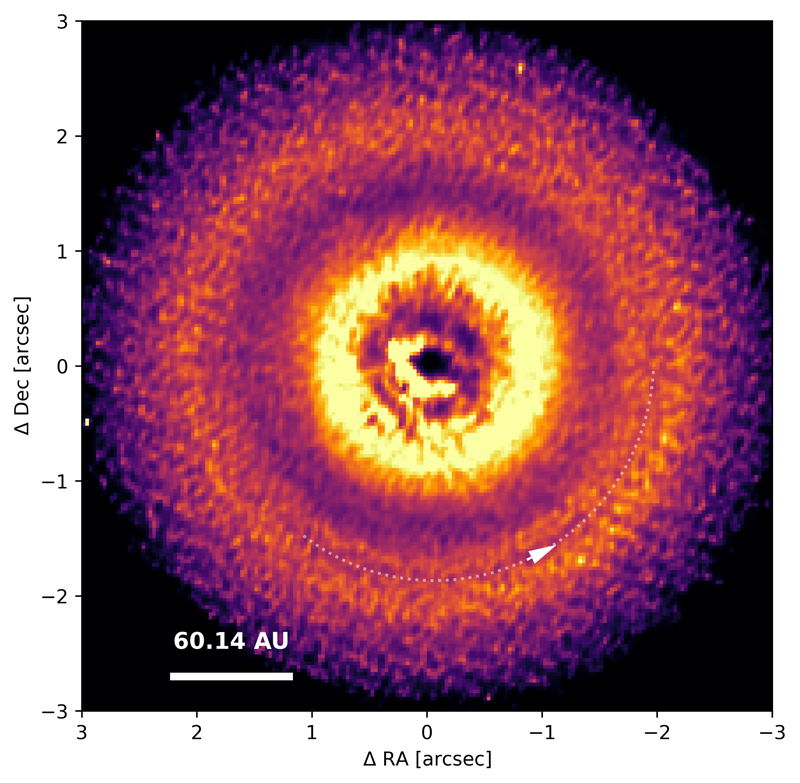
At 60.14 parsecs from Earth, a red dwarf no bigger than Jupiter hosts the most-photographed protoplanetary disk in the night sky. TW Hydrae, or TW Hya, has been a fixture of circumstellar astronomy since the 1980s, because its nearly face-on geometry makes its rings, gaps, and shadows easier to see than almost any other system. On July 27, 2026, a team led by Yu-Chia Lin of the University of Arizona submitted the deepest look yet at this benchmark disk: a four-filter JWST/NIRCam coronagraphic campaign spanning 1.87 to 4.44 microns. The result, published in arXiv:2607.23992 and accepted for The Astronomical Journal, does not yet reveal a hidden planet. What it does is reshape the geometric picture of the disk itself, with tentative but consistent evidence that the outer disk of TW Hya bends out of the plane traced by the inner disk.
Protoplanetary disks are the construction sites of planetary systems. Their rings, spirals, and shadows are the indirect signatures of forming worlds, and reading them correctly requires a precise model of how the disk sits on the sky. A warped geometry implies either an unseen inclined companion tugging the inner disk, a misalignment between the host star’s rotation axis and the disk’s angular momentum, or a past gravitational encounter that left the outer disk bent. For TW Hya specifically, where observers have spent decades trying to identify the planet or planets responsible for the system’s famous moving shadows, a confirmed warp would shift the conversation away from “is the disk flat” and toward “what is bending it.”
The JWST result is also a methodological milestone. Coronagraphic imaging of a face-on disk near the diffraction limit of a 6.5-meter mirror is technically punishing, because the coronagraphic mask hides the inner disk and point-spread-function residuals can masquerade as faint disk structures. Lin and colleagues addressed both problems with a custom PSF-subtraction routine (HPFRDI), a deconvolution algorithm tuned to the NIRCam PSFs, and an MCMC geometric fit with a non-trivial noise model. The same pipeline, applied to other nearby disks in the JWST cycle, is now an off-the-shelf tool.
The TW Hya system has been studied in enough wavelengths to fill a textbook chapter. The first clear evidence for an inner cleared region came from Hubble in the 2000s, when a near-infrared image revealed a dark gap at roughly the orbital distance of a Saturn-mass planet. Subsequent ALMA observations resolved the dust continuum and showed the gap was real, not an artifact of scattered-light modeling. The system also exhibits a moving shadow pattern, first characterized by Debes et al. and refined over multiple epochs since then, with the shadow’s apparent drift suggesting a precessing inner disk that casts a rotating silhouette onto the outer regions.
Against this backdrop, the JWST team designed a four-coronagraph campaign in NIRCam filters F187N, F200W, F356W, and F444W. F187N is a narrow-band Pa-alpha filter designed to catch hydrogen recombination emission; it produced a non-detection of the disk. F200W, F356W, and F444W caught the disk in scattered light. The team stacked two epochs in F200W and two in F444W, then ran the result through HPFRDI to subtract the stellar PSF and the coronagraphic mask transmission, then through a deconvolution code called winnie (200 Richardson-Lucy iterations for the F200W stack, 129 for F444W, with a forward-modeled synthetic disk as the stopping criterion).
The resulting images show what previous instruments could only hint at. The disk’s nearly face-on geometry means that even small inclination differences between inner and outer regions are detectable when the data are deep enough. An MCMC fit to the deconvolved F200W image, splitting the disk into inner (0.675 to 1.44 arcsec) and outer (1.44 to 2.98 arcsec) annuli, yields inclination values that overlap but tend to differ at the 1-sigma level, with the outer annulus showing a broader, asymmetric posterior. Position angle drifts slightly between inner and outer fits. The team’s cautious language is “tentative evidence consistent with a disk warp,” but the trend is the same direction across both parameters.
The companion search sets the deepest mass limits yet on potential planets in the gap region: no new point sources detected in the F444W data, reaching approximately 0.4 Jupiter masses at 1 arcsec (60 AU) under clear-atmosphere assumptions, and sub-Jupiter masses beyond 2 arcsec when local extinction is accounted for. The dust gaps in TW Hya are either being carved by planets smaller than Jupiter, or by a process that does not require a planet at all.
The disk’s near-face-on orientation makes it both a gift and a problem. With the disk inclined at only ~8.74 degrees from our line of sight, scattered-light rings and gaps are not foreshortened, so the structure stays visible across the entire field. The cost is that any inclination variation produces a small but detectable effect on the projected geometry. The team formalized this by computing brightness variance as a function of trial inclination and position angle, weighted by an empirical variance model derived from the data itself. The relationship between log-mean intensity and log-variance was fit with a second-order polynomial with R-squared of 0.98, giving the MCMC walker a well-behaved likelihood surface.
The deconvolution step matters more than is obvious. A Richardson-Lucy algorithm with too few iterations leaves the disk blurry; with too many, it amplifies noise and produces a fake central peak. The team’s solution was synthetic injection and recovery: they simulated a face-on disk with the same noise properties, ran the same pipeline, and used the residual statistics to choose iteration counts that recovered radial profiles without over-fitting the core. This kind of forward-modeled stopping criterion is becoming standard practice in high-contrast imaging, but it is unusual to see it documented so carefully in a peer-reviewed publication.
The detection of the bifurcation at 120 AU is a structural find rather than a kinematic one. The team did not measure orbital velocities, so they cannot say whether the bifurcation is a single spiral arm unwinding from a planet, dust streams from a recent collision, or a shadow projected by the inner disk onto a slightly tilted outer disk. They explicitly list all three in their discussion. The 2-degree logarithmic spiral pitch is most easily explained by gravitational interaction with a planet, but a planet of the mass implied by the spiral pitch (around 1 Neptune mass, depending on disk viscosity assumptions) would, if present at 120 AU, sit at the very edge of what JWST can detect in this dataset. The detection limits at F444W do not quite reach there, which the team acknowledges.
JWST’s coronagraphic modes, combined with careful reference-star differential imaging and iterative deconvolution, are now routinely producing sub-arcsecond views of nearby disks that were not feasible with HST or ground-based adaptive-optics instruments. The team’s PSF library (built with STPSF, the successor to WebbPSF) and their MCMC geometric fit are reusable for the next round of JWST disk-imaging programs.
TW Hya, after 40 years of study, has revealed another layer of structure to a team willing to push JWST’s coronagraphic modes to their limits. The headline result is geometric: a tentative radial warp between inner and outer disk, captured across three near-infrared filters and quantified with an MCMC fit that distinguishes real inclination drift from noise. The structural result, a confirmed bifurcation at 120 AU along a 2-degree logarithmic spiral, adds a specific observational target for any future search for the disk’s hidden planets. The companion search, which sets 0.4 Jupiter-mass limits at 60 AU, rules out a gas-giant explanation for the gap-clearing but leaves room for smaller worlds.
The paper is Lin et al. 2026, accepted for The Astronomical Journal, arXiv:2607.23992, with figures in the HTML build at arxiv.org/html/2607.23992v1. For the moving shadow history that frames the warp hypothesis, see Debes et al. 2023 in The Astrophysical Journal. The next step is a coordinated multi-epoch program: re-imaging TW Hya at F200W and F444W every six to twelve months would test whether the inferred warp precesses on a timescale consistent with a misaligned inner disk, and a single deep ALMA cycle at matched resolution would pin down whether the gas disk shares the same geometric tilt as the dust. The disk is closer than any other, so any future detection will be the cheapest JWST cycle to write and the most consequential for planet-formation theory.
 Subscribe to our RSS feed









There are no comments.
Add A Comment