


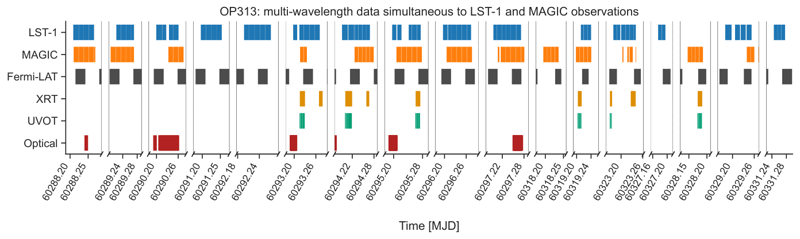
The source flagged on December 10, 2023 looked ordinary at first: a flat-spectrum radio quasar in the constellation Canes Venatici, sitting just shy of a redshift of 1, where most extragalactic work stops being feasible. Within four nights of follow-up, the prototype Large-Sized Telescope (LST-1) on La Palma had pulled it out of the background with a statistical significance of 12 standard deviations, and a few nights later the MAGIC telescopes at the same observatory confirmed the detection at 6 standard deviations. The result, published in August 2026 in Astronomy & Astrophysics by the CTAO LST and MAGIC collaborations, makes OP 313 the most distant active galactic nucleus ever detected at very-high-energy gamma rays (above 100 GeV) and only the tenth flat-spectrum radio quasar (FSRQ) ever caught at those energies (Abe et al. 2026, A&A).
Blazars are what happens when a supermassive black hole happens to be pointing one of its relativistic jets almost directly at Earth. The jet accelerates particles to extreme energies, and the blazar we see is the Doppler-boosted glow of that jet. The lower-energy bump of that glow peaks somewhere in the optical or X-ray range, and a second, much higher-energy bump sits in the gamma-ray range. For BL Lacertae objects, the second bump can be tracked cleanly all the way up to tens of tera-electron-volts with imaging atmospheric Cherenkov telescopes (IACTs). For FSRQs, where the jet is embedded in bright gas clouds and a dusty torus, that same very-high-energy glow is much harder to produce and gets eaten on the way out.
The “eaten on the way out” part is what makes OP 313 a hard target. Every gamma-ray photon at, say, 300 GeV that leaves an FSRQ has to traverse roughly seven billion light-years of space to reach us, and along the way it can pair-produce on infrared and optical background photons left behind by every star that has ever lived. That fog, the extragalactic background light (EBL), gets thicker as you look deeper into the universe, and very-high-energy photons from distant blazars usually arrive at Earth with their high-energy tail statistically removed. OP 313 at z=0.997 sits deep enough in this fog that detecting its very-high-energy emission at all was the main challenge; using it to constrain the fog itself is the secondary prize (phys.org news writeup, 24 August 2026).
The detection was triggered by a high state reported by the Fermi-LAT and optical monitoring networks in late November 2023. Once the daily Fermi analysis (the FLaapLUC pipeline) flagged the rising flux, two follow-up alerts went out on December 10, and both LST-1 and MAGIC began observing that same night. Between December 10 and December 19, LST-1 accumulated 14.6 hours of good-weather data and detected the source at 12.0 standard deviations above ~10 GeV, the highest single-instrument significance the campaign produced. The MAGIC stereo system collected 10.4 hours during the same flare window and confirmed the detection at 6.0 standard deviations. Follow-up in January 2024, when the source had dropped back into a low state, returned only upper limits, consistent with a flaring source that had settled back down (Abe et al. 2026, A&A).
The paper’s value goes beyond confirming one more extragalactic source. OP 313 had been observed before in the very-high-energy range by MAGIC alone and produced only upper limits, so the new detection, which doubled as a first-light demonstration for the LST-1 prototype that will seed the Cherenkov Telescope Array Observatory (CTAO) in the Northern Hemisphere, slots the source into the small club of VHE-detected FSRQs (TeVCat catalogue for OP 313). The previous record-holder at this kind of energy was a different FSRQ called PKS 0346-27, at redshift 0.991. Pushing that mark to 0.997 by no more than a sliver of z amounts to several extra billion years of lookback time at this distance, where each tick of z adds roughly a billion light-years of optical depth through the EBL.
The detection also slots into a wider multimessenger story. In May 2012, the IceCube Neutrino Observatory at the South Pole recorded a high-energy track-like event whose reconstructed direction was consistent with the position of OP 313. The neutrino was not temporally coincident with the gamma-ray flare, so this paper cannot claim a coincident detection; but the fact that the same source is now visible at the highest gamma-ray energies, in the same sky region IceCube flagged, raises the long-term odds of catching a genuine neutrino-blazar coincidence during a future high state (LAPP press release, 2024).
LST-1 is the first of four Large-Sized Telescopes planned for the northern Cherenkov Telescope Array Observatory (CTAO) array, situated next to MAGIC at the Roque de los Muchachos Observatory on La Palma in the Canary Islands. Its 23-metre segmented mirror dish and its 1,855-pixel camera of high-quantum-efficiency photomultiplier tubes give it a low energy threshold of roughly 20 GeV, low enough that any VHE source that drifts overhead is within reach. MAGIC, the older neighbour, is a stereo pair of 17-metre dishes; together they cross-check each other’s energies and directions, which is why the LST-1 paper and its Table 1 quote both sets of numbers.
Detecting OP 313 was a threshold problem on both instruments. LST-1 reached 12.0 sigma in the December window but with an analysis threshold of about 60 GeV, where the gamma/hadron separation is intrinsically harder for a single dish; the per-cent signal-to-background level reflects that the measurement is background-limited near threshold. MAGIC, with stereoscopic reconstruction, ran warmer at a threshold of about 70 GeV and reached 6.0 sigma, but its higher absolute flux above 100 GeV put it above background-systematic-limit. The two spectra agree, within their stated uncertainties, on a simple power law with no strong sign of intrinsic curvature (Abe et al. 2026, A&A HTML).
A common background light hides in those measurements. The cumulative infrared-to-ultraviolet glow of every star that has ever existed, the EBL, attenuates very-high-energy photons in a way that grows with redshift. To turn the OP 313 detection into an EBL measurement, the team fit the joint Fermi-LAT and LST-1 spectrum with a spectral model multiplied by exp(-α τ), where τ is the optical depth predicted by a reference EBL model (Saldana-Lopez et al. 2021) and α is a free scaling factor. They then constrained α by likelihood ratio testing. The result: α(95%) < 1.14 from the LAT plus LST-1 dataset, and tighter upper limits in the optical band, with the most stringent constraint coming between about 0.325 and 1.069 micrometres, the so-called Cosmic Optical Background. At 0.6 micrometres, the upper limit lands at 6.72 nanowatts per square metre per steradian (statistical, 95%), or 8.74 with energy-scale systematics included (Abe et al. 2026, A&A).
OP 313 has a separate history worth noting. Originally catalogued as a variable star in 1959 (the OP 313 designation is a positional reference), it was later identified with a flat-spectrum radio source (B2 1308+326) and reclassified as a quasar at z ≈ 0.997. The early literature sometimes labelled it a BL Lacertae object; current multi-wavelength studies favour the FSRQ classification because its emission lines and broad-line-region signatures are visible when the source is in a high optical state (Wikipedia – B2 1308+326, companion A&A study, March 2026).
OP 313 is now the highest-redshift AGN detected at very-high-energy gamma rays, the tenth FSRQ caught at those energies, and a useful lever on the optical part of the extragalactic background light. LST-1’s first confirmed contribution to extragalactic astronomy came with the same paper that moved the VHE distance record. The CTAO Consortium plans to complete the northern array over the next several years; with four LSTs at low threshold and several mid-sized telescopes at higher energies, the arrival-time window for catching the next record-breaker will keep getting shorter.
 Subscribe to our RSS feed









There are no comments.
Add A Comment