OrbitalHub

Where curiosity reaches escape velocity.

Domain is for sale. $50,000,000.00 USD. Direct any inquiries to contact@orbitalhub.com.

Archive for November, 2026


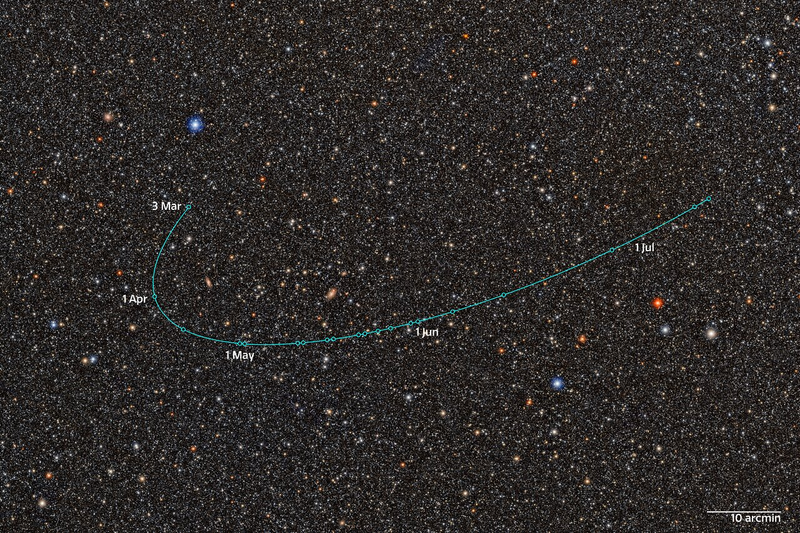
Composite of Rubin's detections of the dwarf planet candidate 2026 ED138 between 4 March and 11 July 2026, tracing the object's path through the outer Solar System with each imaged position marked by a teal circle (NSF-DOE Vera C. Rubin Observatory/NOIRLab/SLAC/AURA, image processing by M. Jurić, D. de Martin and M. Zamani).


On 27 October 2026 the Minor Planet Center issued a circular announcing a new arrival in the outer Solar System: the object 2026 ED138, currently about 47 au from the Sun and brighter than almost anything else catalogued that far out. The unusual part is the method. Nobody was at a telescope. The detection came out of software comparing survey images, and the circular announcing it carried 74 observations strung across a decade with residuals of a tenth of an arcsecond. The object had been on camera since 2016, sitting in a crowded stretch of the Milky Way’s plane, and nobody had noticed.

Beyond Neptune lies a population that would not be there if the Solar System had been built and then left alone. The Kuiper belt holds tens of thousands of icy bodies, most on near-circular orbits close to the plane of the ecliptic. Those are called cold classical objects, and they sit roughly where the protoplanetary disk left them. A minority tilt and stretch their orbits instead. Those are called hot, and they are the ones Neptune scattered when the giant planets migrated outward, which makes their inclinations a fossil record of that migration. The Minor Planet Center’s orbit for ED138 gives a semi-major axis of 42.95 au, an eccentricity of 0.142, an inclination of 24.47 degrees and a Tisserand parameter of 5.3. That inclination puts it squarely in the hot population, and it is currently near aphelion at 49 au. Neptune has been near this object.

To count as a dwarf planet rather than a large asteroid, a body has to be round, which means its own gravity has to beat down the rigidity of its material. The International Astronomical Union recognizes five: Pluto, Ceres, Eris, Haumea and Makemake. Rubin’s Solar System team puts ED138’s diameter between 600 and 1,500 kilometres, which would place it among the largest candidates ever found beyond Neptune (NOIRLab, October 2026). That diameter is inferred from brightness rather than measured, and the difference decides whether this is a planet.

How it turned up matters more than the announcement. On the evening of 13 October, Matthew Holman, a Rubin Operations team member at the Center for Astrophysics | Harvard & Smithsonian, ran 2026 survey data through a search code written with CfA colleague Kevin Napier. The code takes billions of individual moving-object detections, compares them, and picks out the sets that belong to the same object. ED138 came out of that run. Holman’s first reaction, as he described it, was “excited disbelief” (NOIRLab, October 2026). Objects that large are rare, so he went straight to work checking whether he or the code had erred.

Mario Jurić, Rubin’s Solar System lead scientist at the University of Washington, went looking for more. Sifting through the observatory’s catalogues and images, he turned up 20 further detections reaching back to 4 March 2026. All told the Simonyi Survey Telescope saw ED138 30 times on 20 nights between 4 March and 11 July. The next step was precovery, pulling the object out of old archives where nobody had thought to look: frames from the Dark Energy Camera on the Victor Blanco 4-m telescope at Cerro Tololo, run through the Asteroid Institute’s ADAM precovery service, extended the trail back to 2016. The Minor Planet Center’s current orbit solution reaches further still, to March 2010, using 89 observations across an arc of 5,959 days and eight oppositions, with an RMS residual of 0.07 arcseconds. Jurić and Holman presented the result at the 58th Annual Division for Planetary Sciences meeting in Spokane, and MPEC 2026-U85 went out the same day.

The decade of silence has little to do with faintness. ED138 sits close to the galactic plane, where the sky is thick with stars, and to most telescopes it was simply lost among the background sources (NOIRLab, October 2026). What changed is how Rubin looks. The LSST Camera is a 3.2-gigapixel focal plane built from 189 science CCDs in 21 rafts of nine sensors each, and it reads out in two seconds, about two orders of magnitude faster than a conventional astronomical camera (Brookhaven National Laboratory). Data comes off it at roughly 11 trillion bits per hour, so a ten-hour night of raw camera output runs to about 14 terabytes. The Simonyi Survey Telescope behind it has an 8.4-metre primary and a 3.42-metre convex secondary, feeding a 3.5-degree field that covers about 10 square degrees in one exposure (NOIRLab). The survey takes an image every 40 seconds and will do so for ten years. Software differences each exposure against a static model of the stars and hunts for what is left over and has moved. Repeating the same field thousands of times turns the sky into a film, and moving objects are what change between the frames.

The second half of the problem is turning brightness into size. The standard relation for a small body is D = 1329 / sqrt(p) * 10^(-H/5) km, where D is the diameter, p the geometric albedo and H the absolute magnitude. The Minor Planet Center lists ED138’s H as 2.93 and its phase slope G as 0.15, and the object sits near magnitude 20 at opposition. Substituting gives D = 344 / sqrt(p) km, so a 600-kilometre diameter requires an albedo near 0.33 while a 1,500-kilometre diameter requires one near 0.05. Both are plausible for icy bodies, and that ambiguity is the difficulty: a single measurement of reflected light cannot separate a large dark object from a smaller bright one. Infrared settles it. At 47 au the equilibrium temperature works out to T = 278 / sqrt(p * D) * sqrt(40/r) K, which for a 900-kilometre body of albedo 0.15 comes to about 22 K. At that temperature nitrogen ice has largely sublimated away while methane and carbon monoxide hold on, so the ratio of thermal emission to reflected light fixes the albedo and the spectrum fixes the composition. No infrared follow-up has been scheduled yet, and the Centre lists the object as receding from Earth at 13.8 km per second, so whoever takes that measurement will be chasing it.

One detail in the orbit deserves a pause. ED138’s perihelion fell on 4 February 1926. It has not been this close to the Sun in a hundred years and will not be again until 2207. Everything known about it comes from light that left it far beyond Neptune, spread thin enough that a single telescope sees a moving dot. Rubin’s answer is not a bigger telescope but ten years of smaller ones, and the survey has barely started. In April 2026, before the formal ten-year run began, Rubin’s Solar System team submitted more than 11,000 new asteroids to the Minor Planet Center, about 380 of them trans-Neptunian objects, and called the batch “the tip of the iceberg” (NOIRLab, October 2026). ED138 was already in the data collected before the survey started. The sky has been recording itself for billions of years. The new part is that someone finally built a camera fast enough to read the frames back.
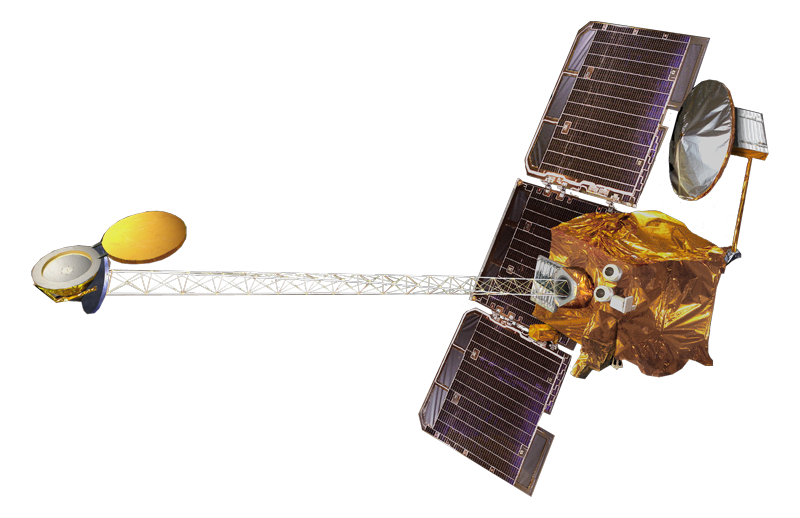


A model of the Mars Odyssey orbiter, showing the gold-foil-wrapped spacecraft bus, its solar array panels, the high-gain dish antenna and the long boom ending in the round Gamma Ray Spectrometer sensor head (NASA/JPL via Wikimedia Commons)


On 24 October 2001, a spacecraft fired its main engine and dropped into orbit around Mars (Wikipedia on the mission history). Twenty-five years on, the same machine is still flying, and its job has changed far more than its hardware. NASA’s 2001 Mars Odyssey was built to map what the Martian surface is made of, and it still does that work. It is also, in NASA’s accounting, the longest-running spacecraft still in orbit around a world beyond Earth (NASA on the mission record). It was, for much of the 2000s and 2010s, the switchboard through which almost every rover on Mars reached Earth, and that role has since shrunk to something much smaller. In the relay statistics NASA publishes for the Mars Relay Network, Odyssey carries the smallest data volume of any active orbiter, and most of its daily passes over the rovers go unused for relay (NASA on the Mars Relay Network).

The spacecraft is still useful, and its reduced role shows how thin the communications layer around Mars exploration has become. Every image captured on the Martian surface since 2004 has reached Earth through an orbiter, because a rover on the ground loses line of sight to Earth for about twelve hours a day and would need a dish and far too much power to close the link itself. Until June this year the network had five orbiters, including NASA’s MAVEN, which went quiet on 6 December 2025. A review board convened in February found it unrecoverable, so NASA declared the mission over on 3 June 2026 and the remaining orbiters took up its traffic (NASA on the end of the MAVEN mission). The load has since concentrated elsewhere: ESA’s ExoMars Trace Gas Orbiter sent an average of 2,228.1 megabits per day between February and May 2026 and the Mars Reconnaissance Orbiter 850.6, against 107.3 for Odyssey, which flew two to four passes a day over the rovers and used zero to one of them for relay. Odyssey also came close to not getting this far. The FY2026 request from the White House proposed ending it outright, alongside termination plans drawn up for 19 flying missions, and Congress restored 10.6 million dollars for it in the appropriations minibus passed in January, after the House voted 397 to 28 and the Senate 82 to 15 (The Planetary Society on the FY2026 budget).

Odyssey was a salvage job. It flew as the orbiter half of Mars Surveyor 2001 after the lander meant to accompany it was cancelled in the reorganization that followed the 1999 losses of Mars Climate Orbiter and Mars Polar Lander (a summary of the mission record), and it launched on 7 April 2001 at 11:02 a.m. EDT on a Delta II from Cape Canaveral (NASA on the Mars Odyssey mission). It reached Mars seven months later and then spent about eleven weeks bleeding off energy against the upper atmosphere instead of firing its engine to circularize the orbit, a maneuver that saved roughly 200 kilograms of propellant and made it possible to launch on a smaller Delta II. By February 2002 it was in a near-polar, sun-synchronous orbit about 400 kilometres above the surface and taking science. Within four months of reaching that mapping orbit the Gamma Ray Spectrometer had detected hydrogen buried across the high latitudes. Reading that hydrogen as frozen water was an inference at the time, argued from where thermal models said ice ought to be stable, and it took a different spacecraft to settle the question: Phoenix went north in 2008, landed where Odyssey’s maps pointed, and dug up water ice (Wikipedia on the mission history). The thermal camera THEMIS then built the global maps of surface minerals that landing-site selection for every rover since has leaned on, with more than a million images to its credit (NASA on 25 years of the mission), and the same spacecraft handled the great majority of the data sent home by Spirit and Opportunity. Its own instruments did not all survive. The radiation experiment MARIE was knocked out by the Halloween 2003 solar particle events, and the Gamma Ray Spectrometer’s sensor head died in 2009, leaving THEMIS and the neutron detectors from the GRS package as the working instruments. The spacecraft lost its last reaction wheel redundancy in December 2013, which means a further wheel failure would push attitude control onto the thrusters and into propellant that is already scarce (NASA on the Planetary Mission Senior Review).

What keeps Odyssey flying is careful accounting of what it has. The spacecraft carries no fuel gauge, so engineers measure the hydrazine by heating the two propellant tanks and timing how long they take to reach a given temperature, on the reasoning that a nearly empty tank heats faster than a full one. That method produced two alarming readings: about 5 kilograms of hydrazine in the summer of 2021 and 2.8 kilograms in January 2022, the latter implying the orbiter would run dry within a year. Engineers at JPL and Lockheed Martin ruled out a leak, then found the real cause, heaters on a fuel line between the tanks that were warming them faster than the model allowed for. The corrected figure, about 4 kilograms, was published in March 2023 with the conclusion that the mission could fly at least through the end of 2025 (NASA on the Odyssey fuel supply). Propellant is a finite resource because the spacecraft needs it continuously. Three reaction wheels spin up to point the instruments at the ground, and each one builds momentum that has to be unloaded by firing the thrusters in small bursts. The bus is a 725-kilogram box a little over two metres long, with a RAD6000 processor at its heart, a radiation-hardened version of the PowerPC chip once used in most Macintosh computers, working from 128 megabytes of RAM (NASA on the technical specifications).

Odyssey’s remaining life now turns on an arithmetic nobody can read off a gauge. NASA’s 2025 Planetary Mission Senior Review put usable propellant at 3.2 kilograms, with an uncertainty of plus or minus 2.0 kilograms, and calculated that the tenth extended mission needs 1.3 kilograms to reach fiscal 2028 in the absence of a safe mode event (a summary of the Senior Review propellant figures). The same review was told that Odyssey had recently handled 14 percent of Perseverance’s relay sessions and 13 percent of Curiosity’s, and noted that THEMIS is the only infrared camera now orbiting Mars, with a global catalogue of alluvial fans already turning up 175 newly identified examples (the Senior Review panel evaluation). By April 2026 the spacecraft had completed more than 105,000 orbits and 219,000 hours of operation (a summary of the mission record), and it had passed 100,000 orbits and 1.4 million images back in June 2024 (NASA on the 100,000th orbit). On 26 October 2026 it was still sending telemetry to NASA’s Deep Space Network, two days past its quarter-century at Mars. Whether it flies much past that depends on a tank-heating measurement repeated every few months, and on a Congress that had to be persuaded the mission was worth 10.6 million dollars.


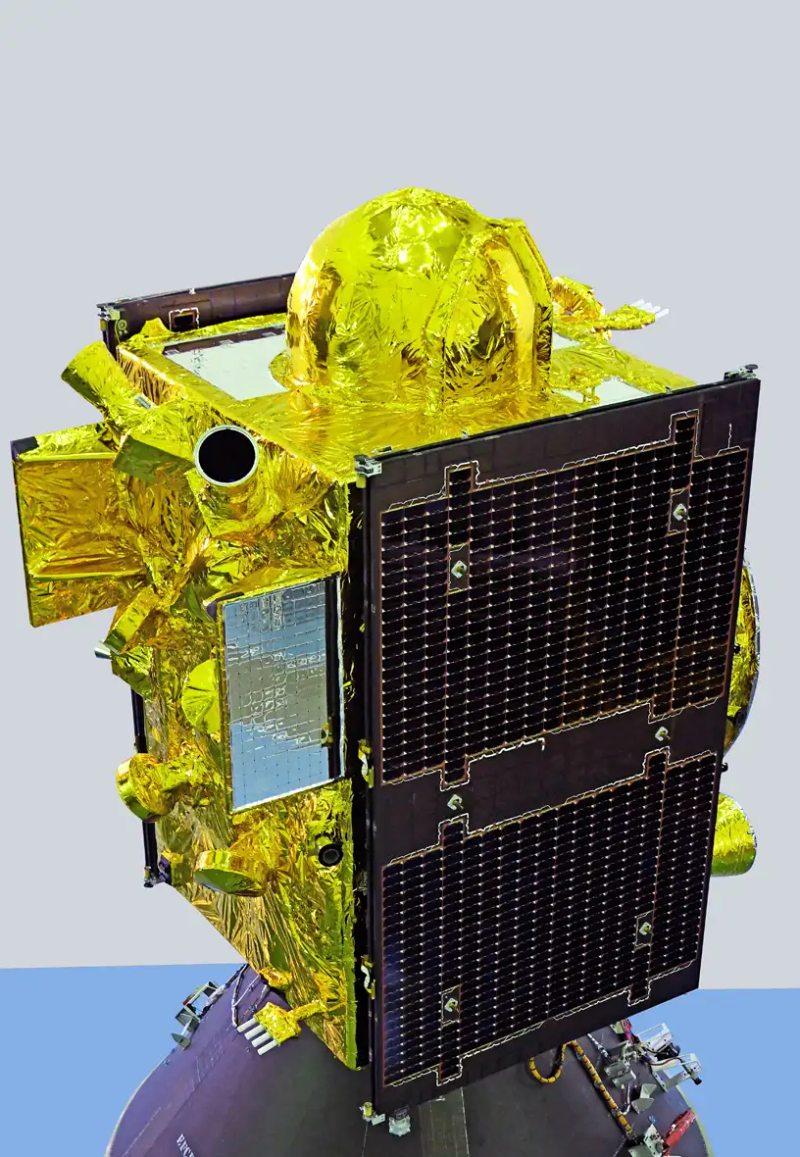
NVS-03 photographed before launch, its navigation payload wrapped in gold multi-layer insulation beneath twin solar wings (ISRO)


At 11:51 pm on a Friday night in October, the floodlights at India’s Second Launch Pad at Satish Dhawan Space Centre turned a strip of coastal Andhra Pradesh into a stage for a job that sounds mundane and is anything but: telling a phone where it is. The Geosynchronous Satellite Launch Vehicle lifted off carrying 2,250 kilograms of navigation satellite and dropped it into a long elliptical orbit roughly eighteen minutes later. That spacecraft is NVS-03, the third of ISRO’s second-generation navigation satellites, and it puts India’s homegrown positioning system back to the bare minimum of four working spacecraft. Four is not a margin. It is the floor (ISRO, Oct. 2026).

The system is called NavIC, Navigation with Indian Constellation, and for most of its life the satellites wore an older name: IRNSS, the Indian Regional Navigation Satellite System. The program traces back to the Kargil War of 1999, when the United States cut off civilian GPS access to the combat area. India’s answer was to build and own a regional navigation system rather than depend on someone else’s permission to use one: seven spacecraft and the ground stations to run them.

ISRO’s services page puts the performance plainly: position accuracy better than 20 metres and timing better than 50 nanoseconds, both at twice the standard deviation, across the Indian landmass and a ring extending 1,500 kilometres beyond the border. Two services ride on those signals: the open Standard Positioning Service for civilian users, and an encrypted Restricted Service reserved for strategic users. The signals interoperate with GPS, GLONASS, Galileo and BeiDou. One older satellite, IRNSS-1A, now pushes safety-of-life alerts to fishing crews along the coast, where no cell tower reaches (ISRO, Oct. 2026).

Then the fleet fell apart. Nine first-generation satellites went up between 2013 and 2018, and the hardware that followed was less kind. Imported atomic clocks failed on the older spacecraft, and NVS-02 never reached its final orbit after launch. With the operating constellation down to three, NavIC was running below the four-satellite minimum it needs to deliver positioning, navigation and timing at all, and one more failure would have taken the service out (The Hindu, Oct. 31, 2026).

GSLV-F18 went up on a schedule that mattered as much as the rocket. The vehicle, the 20th flight of the GSLV, stacks three stages about 50 metres tall: a solid-fuel core wrapped by four liquid strap-on boosters, a liquid second stage, and a cryogenic upper stage burning liquid hydrogen and liquid oxygen. Lift-off came at 23:51 IST; about thirteen minutes later the vehicle was travelling at 7.1 kilometres per second with the cryogenic stage performing as planned (India Today, Oct. 30, 2026). The spacecraft then does the rest itself, raising itself to geostationary altitude on its own apogee engine and drifting into its slot in the sky.

The industrial story behind those dates is as telling as the flight. The launch campaign took 47 days, the four L40 strap-on boosters were ready in a record 37 days, and the mission came 56 days after the previous GSLV flight, EOS-05 on September 4. Thomas Kurian, the project’s mission director, put it plainly: “We completed the launch campaign in just 47 days and achieved this GSLV launch within 56 days of the previous launch” (ANI, Oct. 31, 2026). Repairing a broken constellation is mostly a question of industrial rhythm.

What NVS-03 carries matters more than the launch that delivered it. Its navigation payload now broadcasts three bands instead of two: the existing L5 signal at 1176.45 MHz and S-band signal at 2498.028 MHz, plus a new L1 signal at 1575.42 MHz (ISRO, Oct. 2026). That last one is a compatibility decision rather than a physics decision. L1 is the frequency that commercial GPS receivers and the chipsets inside ordinary phones already listen for, so a NavIC signal there can be picked up by hardware already in people’s pockets. Without it, every NavIC receiver has to be something different.

The spacecraft also carries a rubidium atomic clock developed in India for navigation use at ISRO’s Space Applications Centre, alongside clocks bought from abroad (The Hindu, Oct. 31, 2026). The earlier IRNSS spacecraft depended on imported Swiss-made atomic clocks, and several of those units failed in orbit. ISRO chairman V. Narayanan said after the launch that one of the homegrown clocks had now been placed in orbit successfully, and that the launch left NavIC “restored to the minimum operational configuration with 4 satellites” (ANI, Oct. 31, 2026).

The constellation is a lesson in geometry, because a clock on its own does nothing for a receiver on the ground. NavIC splits seven spacecraft between two kinds of orbit. Three sit in geostationary orbit, at 32.5 degrees east, 83 degrees east and 129.5 degrees east; four ride inclined geosynchronous orbits of 29 degrees, two in each of two planes whose tracks cross the equator at 55 degrees east and 111.75 degrees east (ISRO, Oct. 2026). A satellite parked directly above the region it serves gives a receiver a narrow spread of elevation angles, flattening the geometry in the vertical direction where errors are largest. The inclined satellites swing well north and south of the equator, restoring the missing angle. Two-dimensional positioning wants three satellites with a usable spread, three dimensions want four, and that is where NavIC was pinned after the failures.

Timing does the rest of the work, and the arithmetic is unforgiving: a receiver measures pseudorange by timing the flight of a signal, and light covers about 30 centimetres in a nanosecond, so the 50-nanosecond timing specification ISRO publishes is the same order of error as 15 metres of range. A 20-metre position error is a clock error wearing a different hat. Only atomic oscillators can hold that budget for a decade in vacuum, which is why the imported clocks failing on the older satellites was a hole in the constellation, not a nuisance.

The ionosphere adds a delay to every signal that varies with solar activity and with the square of frequency, and the cure has been available for decades: broadcast on two frequencies and subtract. NavIC’s L5, S and L1 bands give a receiver two measurements of the same delay, and ISRO publishes the NeQuick-N ionospheric model alongside the signal interface documents so corrections can be computed anywhere in the region. The L1 signal will also let NavIC feed the assisted-GNSS machinery built into mobile networks, specified in the 3GPP standards, which is why NavIC will eventually appear in a phone’s status bar.

The system also thinks about bookkeeping: NavIC’s clock counts from midnight on 22 August 1999, a week-number rollover arrived on 6 April 2019 and burned receivers that had not been updated, and the constellation now runs in its second epoch (ISRO, Oct. 2026).

NVS-04 and NVS-05 are already queued, and Akashvani’s pre-launch note described them as the launches that would fully stabilise the constellation. Until all seven spacecraft are in place, Narayanan said, NavIC will not be integrated into consumer mobile phones. The system already tracks around 10,400 locomotives and 64,000 fishing vessels in real time, with about 1.5 million tracking devices fitted across vehicles (The Hindu, Oct. 31, 2026).

So the twentieth GSLV flight of October 2026 was a repair job of the best kind: it lifted a service back to the minimum specification, carried a clock India can now build for itself, and put a signal on a frequency where the hardware already exists. A constellation is not a capability on the day it launches; it is a capability on the day it still works after the third failure, the imported clock dies, and the country has to send up a replacement.


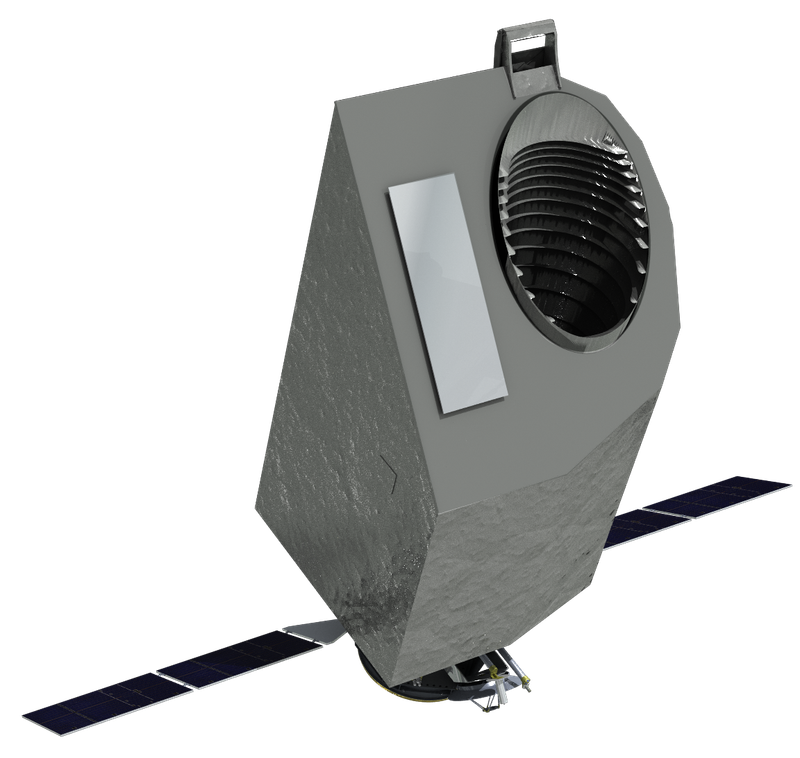
Artist's rendering of NASA's Ultraviolet Explorer spacecraft in flight above Earth.


On October 27, 2026, NASA confirmed the Ultraviolet Explorer, or UVEX, after it cleared Key Decision Point C, a formal technical and programmatic review, committing the agency to a launch by January 2031 at a total lifecycle cost of $590 million (NASA, October 2026). Nothing has been built yet. The mirrors are still drawings and the detectors are still wafers. But a program that clears KDP-C has a budget, a schedule and an obligation to deliver.

What NASA has committed to is the first major ultraviolet space mission in two decades (SRI International, October 2026) and the first deep map of the entire sky in ultraviolet light, built from repeated visits over a two-year prime mission and reaching fifty to a hundred times deeper than the survey it inherits (Kulkarni et al., arXiv:2111.15608).

The ultraviolet is not a wavelength anyone misses until they try to work without it. Earth’s atmosphere is opaque below roughly 300 nanometres, so seeing it at all requires a space telescope, and the roster of great ultraviolet observatories is short. The last of them was GALEX, the Galaxy Evolution Explorer, launched on a Pegasus XL in April 2003 and decommissioned in June 2013 (NASA/JPL). It paired a 50-centimetre modified Ritchey-Chrétien telescope with a circular field 1.24 degrees across, splitting the beam through a dichroic into near and far ultraviolet channels read by microchannel plate detectors (Morrissey et al., 2004), one of which failed in 2009 and never came back.

What followed was not ultraviolet. Rubin, Euclid, Roman and SPHEREx map the sky in visible and infrared light, and every one of them leaves the ultraviolet gap sitting where GALEX left it. Filling that gap is harder than it looks, because ultraviolet astronomy runs into three difficulties with nothing to do with each other: the photons are scarce, the mirrors cannot be made of glass, and the detectors age.

UVEX is a Caltech mission with a NASA budget. Fiona Harrison, the Harold A. Rosen Professor of Physics at Caltech, is principal investigator; UC Berkeley’s Space Sciences Laboratory manages the project; Northrop Grumman builds the spacecraft; and the ultraviolet detectors come from NASA’s Jet Propulsion Laboratory and SRI International (Caltech, October 2026). The observatory was selected in February 2024 as a Medium-Class Explorer mission with a two-year lifetime, at about $300 million excluding launch and a 2030 launch (NASA, February 2024).

Two numbers moved since then. The price is now $590 million, close to double, and the launch deadline shifted to January 2031. NASA published no line-item account of the increase, so the fair reading is that the hardware grew more expensive faster than the schedule grew long. The ambition did not shrink, which is presumably why the review passed.

The science programme rests on three pillars. The first is low-mass, low-metallicity galaxies, which hold about half the mass in the local universe and are the closest analogues available to the first galaxies (Kulkarni et al., arXiv:2111.15608). The second is time-domain astronomy: the imagers will watch for change, and the long-slit spectrograph will swing toward new transients within hours, chasing supernovae and the kilonovae that follow neutron-star mergers. “With UVEX, we will now be able to follow up on gravitational-wave events in ultraviolet light,” says Mansi Kasliwal, who directs Caltech’s Palomar Observatory and sits on the UVEX team (Caltech, October 2026).

The third pillar is a particular kind of star. Blue stripped stars are massive stars whose hydrogen-rich outer layers have been torn away by an orbiting companion, exposing the interior, and they are hard to find because the giveaway is a slow change in their ultraviolet light. “We will be able to see what’s inside the stars,” says UVEX team member Kareem El-Badry (Caltech, October 2026). Scanning the sky over and over should turn up hundreds.

The hardware is where the difficulty sits. UVEX carries one instrument: a 75-centimetre effective aperture in an all-reflective three-mirror anastigmat feeding an ultraviolet instrument module (Kulkarni et al., arXiv:2111.15608). No glass anywhere, since ordinary optical glass absorbs ultraviolet hard, so the coatings on every mirror decide whether you get a working telescope or an expensive tube. The optical design is fast, at f/2.7, which sounds reckless until you work out the numbers: at 200 nanometres the diffraction limit of a 75-centimetre aperture is θ = 1.22 * λ / D, about 0.07 arcseconds, while the point-spread function runs around 2 arcseconds and the pixels are 2.25 arcseconds across (uvex.caltech.edu). UVEX is therefore sampling-limited rather than diffraction-limited, on purpose: each pixel holds roughly thirty resolution elements, and that is what buys sky coverage.

At the instrument module entrance, a dichroic splits the beam into far-ultraviolet and near-ultraviolet channels imaged simultaneously, 1390 to 1900 angstroms and 2030 to 2700 angstroms, each focal plane a three-by-three array of 4k by 4k CMOS detectors (Kulkarni et al., arXiv:2111.15608). The science case targets a two-year survey depth fainter than AB 25.8 in both bands, reached by stacking repeated visits to the same sky (uvex.caltech.edu). Multiply collecting area by solid angle, the quantity that sets how much sky a survey covers per second of exposure, and the gain shows up immediately. UVEX’s 0.44 square metres across 12 square degrees gives roughly 1.6 times 10 to the minus 3 square metre steradians; GALEX’s 0.20 square metres across 1.2 square degrees gives about 7 times 10 to the minus 5. The étendue is some twenty-two times larger, before the detector gains.

The detectors are the part that has taken longest. GALEX read photons with microchannel plates, which amplify electrons down a channel wall and carry that amplification’s noise with them. UVEX’s detectors are silicon: back-illuminated CMOS made sensitive to ultraviolet light by a thin implant just beneath the illuminated surface that suppresses the recombination which would otherwise destroy charge before it reaches the pixel, and by metal-dielectric bandpass filters deposited on the sensor window to reject out-of-band light (Hennessy et al., SPIE 2023). Delta-doped sensors with antireflective coatings are two to three times more efficient than the far- and near-ultraviolet detectors on GALEX (Nikzad, February 2026). JPL and SRI build the parts, the same lineage that put CMOS imagers on the Parker Solar Probe (SRI International, October 2026).

Why silicon works in this band comes down to energy bookkeeping. A 150-nanometre photon carries about 8.3 electronvolts, E = hc / λ, against a silicon band gap of 1.12 electronvolts, so one ultraviolet photon can liberate roughly seven electron-hole pairs. Below about 150 nanometres the Earth scatters essentially no light into the beam, which is why that band is called solar blind; the residual background comes from zodiacal light and geocoronal emission that the bandpass filters exist to cut. Even so, the spacecraft will not fly in low Earth orbit. UVEX goes into a 13.7-day lunar resonance orbit, the kind NASA called a “Goldilocks orbit” when it chose the same path for TESS, swinging from about 104,000 kilometres to about 396,000 kilometres (NASA Goddard, 2013; Kulkarni et al., arXiv:2111.15608). Staying clear of the Van Allen belts matters for a silicon detector, because energetic protons displace atoms in the lattice and dark current climbs for the rest of the mission.

None of this is guaranteed by a review. KDP-C commits NASA to build; the price has already moved once and Explorer schedules have slipped before. But the direction is set. When UVEX starts returning data in the 2030s, the ultraviolet sky stops being a set of targeted observations of objects somebody already knew about and becomes a systematic map, far deeper than anything preceding it, alongside Rubin, Euclid and Roman in the optical and infrared. The team argues that the archive is worth more than any single target: a deep ultraviolet map of the whole sky keeps paying out for decades after the people who built it have moved on. The prime mission is two years. The stars it will find and the explosions it will catch in the act will take the rest of the century to work through.


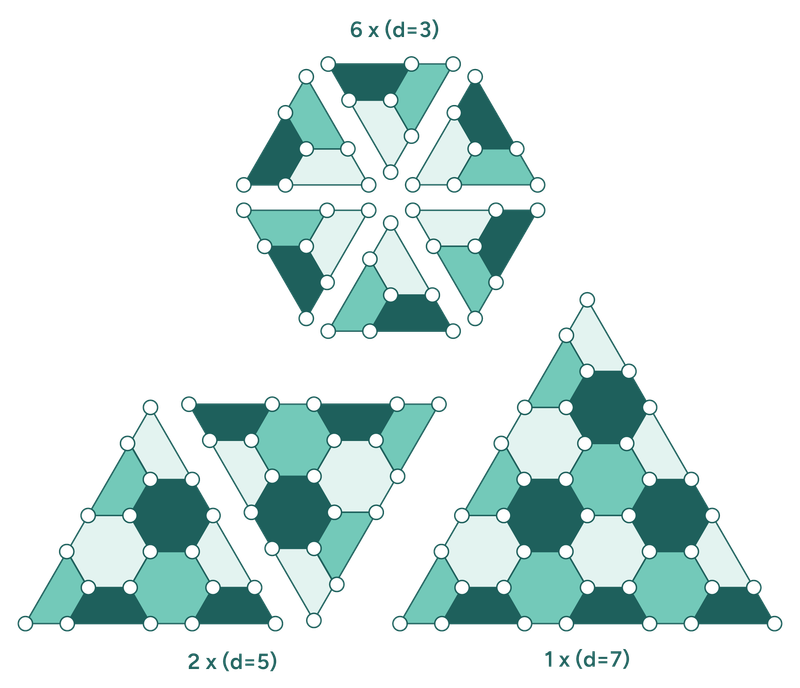
The triangular color code at three code distances, with physical qubits drawn as white circles on a honeycomb lattice


A quantum computer’s problem is not speed. It is that a qubit is a poor place to keep information. Every gate carries a chance of flipping, rotating or leaking the state it touches, and a useful algorithm might ask for a million gates in a row. The field measures progress in operations without error, not operations per second: a “megaquop” is a run of more than a million quantum operations in which the machine is right every time. On 19 October 2026, Quantinuum reported that its Helios trapped-ion processor had come within a factor of five of that bar, with a logical error rate of five per million operations (Quantinuum, 19 October 2026). Underneath that number sat a harder claim: each time the team built a bigger error-correcting code, the failure rate fell by about twelve.

The obstacle is that you cannot check a quantum state the way you check a classical bit. Measuring it destroys it, so copying information for safekeeping is not available. The 1990s answer was to encode one logical qubit across many physical qubits and measure special combinations of them, called stabilizers, whose values stay predictable unless something has gone wrong. When a stabilizer reads oddly, the pattern of oddities says which physical qubit misbehaved and how, and a classical decoder works backward to undo the most likely error chain. Redundancy cuts both ways: encoding a qubit this way manufactures fresh opportunities for failure, so protection can cost more than it saves. The threshold theorem says there is a critical physical error rate p_th below which adding protection wins, and for topological codes the payoff is exponential: p_L ∝ (p/p_th)^((d+1)/2), where d is the code distance, a rough count of how many simultaneous errors a logical qubit survives. What decides whether this is useful is Λ ≡ p_th/p, the suppression factor.

For most of the field’s history the honest answer to “what is Λ?” was “a bit above two.” Google Quantum AI’s surface-code work on the Willow processors put a distance-7 code below threshold with Λ above two, and simulation of the same setup returned Λ = 2.25 (Google Quantum AI, Nature, 2024). But a factor of two is a shallow slope, and distance is expensive: a surface code of distance d consumes 2d²−1 physical qubits. Before Willow, no processor had definitively demonstrated below-threshold performance at all.

What Quantinuum announced changes the shape of that arithmetic. The technical details appeared on 16 October 2026 as a preprint titled “Quantum error correction well below the color code threshold” (Lavasani et al., arXiv:2610.24077). The code is a triangular color code: a self-dual CSS topological code on a honeycomb tiling of an equilateral triangular surface, with qubits on the vertices and each face carrying both an XX-type and a ZZ-type stabilizer generator. Its block parameters, [[(3d²+1)/4, 1, d]], mean a distance-3 block needs 13 physical qubits, distance 5 needs 37, distance 7 needs 73.

The code and the hardware fit each other. A color code is self-dual, so the logical Hadamard and phase gates are transversal: the same operation applied to every physical qubit lands exactly on the encoded qubit. Because it is a CSS code, and trapped-ion hardware can connect any pair of ions on demand, the logical CNOT is transversal too, putting the whole Clifford group within reach without the lattice-surgery machinery other code families require.

The measurements were taken on Helios, which holds 98 trapped barium-137 ions. The team ran memory experiments at distances 3, 5 and 7, fitting six, two and one blocks into each shot to keep the qubit count roughly constant. Each shot ran twenty rounds of stabilizer measurements before a logical readout. The per-round failure rate came out at 5.5e-4 for distance 3, 3.8e-5 for distance 5 and 5e-6 for distance 7, with a fitted suppression factor of Λ = 12. The logical two-qubit Clifford error fell from 7e-4 at distance 3 to 7e-5 at distance 5, a suppression factor of 9.

In September, the company had demonstrated the Helix code, reaching a per-qubit memory error of 4.6e-5 per round with no post-selection (Quantinuum, September 2026). Helix spends 10 physical qubits per logical qubit but has a shallower slope; the color code spends up to 37 and has a steeper one. Robin Blume-Kohout, co-director of the quantum performance lab at Sandia National Laboratories and uninvolved in the work, read the result differently: a logical qubit nearly a hundred times better than the physical qubits it is made of. In his words, it goes a long way to “retire one of the field’s central technical risks” (Quantinuum, 19 October 2026).

The hard part was leakage. A barium ion’s qubit lives in a pair of hyperfine levels, and six nearby levels offer somewhere else to go. Leaked population stays there until a mid-circuit reset, and meanwhile a gate acting on a leaked qubit spreads the problem to its neighbours, so one leak can cascade into a logical failure.

The hardware fix is a mid-circuit repump scheme. Narrow-linewidth, state-selective optical transitions move leaked population into three 2D5/2 states, then drive it up to 2P3/2, which decays mostly back to the 2S1/2 ground state. Each cycle returns nearly half of what is left, so leakage falls geometrically; three cycles measured a suppression of 6.5×. The cost is worth admiring: the repump adds no gate and no time to the circuit, because the optical pumping runs in parallel with ground-state cooling and ion transport during qubit sorting. On its own it cut the observed logical error rate by 4× at distance 3 and 8× at distance 5.

The circuit fix rebuilds the stabilizer measurement as a SWAP-based leakage-reduction unit the team calls SWAP-superdense. Data qubits are swapped out for fresh ancillas before each measurement, so a qubit that has leaked gets measured and reset instead of poisoning its neighbours. The trap’s all-to-all connectivity turns the swap into a software-level relabeling of qubits, which also shortens the syndrome-extraction depth by one.

Then there is the decoder, which has to keep pace with the machine in real time. Tesseract, the team’s primary decoder, finds the most likely error chain and comes close to optimal, but it is too slow to run while the hardware is still going. So they trained two neural decoders, a three-dimensional convolutional network and a round-token transformer that encodes each round of syndrome data as a token, on data from an emulator of Helios alone, then applied them to the hardware without fine-tuning, with comparable performance. Their inference latency runs to a few hundred microseconds, an order of magnitude faster than the syndrome extraction rate (Lavasani et al., 2026). A decoder that cannot keep up is a decoder that cannot be used.

What remains is mostly engineering, which is the good kind of remaining. A distance-7 block already consumes 73 of the machine’s 98 ions, so the next step is a bigger trap. A universal machine still has to run the T gate, which the color code cannot do transversally and which arrives instead through magic-state injection, demonstrated with the same code in 2025. The arithmetic that worried people for a decade, the question of how many physical qubits it takes to hold one good logical qubit, now looks tractable in a way it did not a month ago. The slope got steeper by a factor of twelve while the hardware underneath it did not change at all. The machine is the same 98 ions it was in September; what changed is the code wrapped around it, and the code is the part engineers can keep improving.


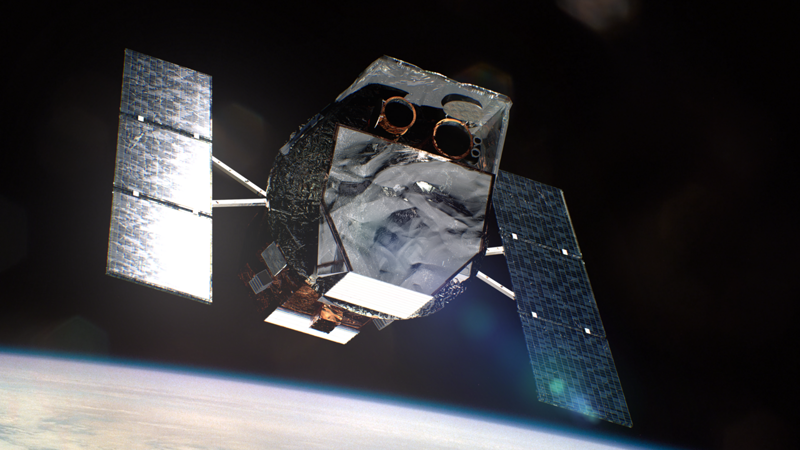
NASA's Neil Gehrels Swift Observatory in orbit above the limb of Earth, its two long blue solar arrays extended on either side of a silver foil-wrapped bus with the cylindrical barrels of the three telescopes visible on the upper face, against the blackness of space (NASA/Goddard Space Flight Center/Chris Smith, public domain, via Wikimedia Commons)


Early on Wednesday morning a dead space telescope will come apart over the Pacific. NASA’s Neil Gehrels Swift Observatory is expected to enter Earth’s atmosphere at roughly 3:30 a.m. Eastern time on 4 November, nearly 22 years after a Delta II launcher put it into orbit, and the US Space Force prediction NASA is quoting comes with an uncertainty of 11 hours. Most of the 3,200-pound spacecraft will burn up on the way down, though Space.com reports that the X-ray and optical telescope’s innards might survive. The odds of a fragment hurting anyone are about 1 in 2,100, and because Swift flew in a low orbit, anything that makes it through can only fall between 20.6 degrees south and 20.6 degrees north of the equator. It will not be steering itself, cannot be commanded, and has no engine to point at the atmosphere differently. It is falling the way a stone falls.

What Swift did was hard to do and harder to replace. It was a three-instrument observatory, a Burst Alert Telescope, an X-ray Telescope and an Ultraviolet/Optical Telescope, built to catch gamma-ray bursts, the most violent explosions in the universe, which flare and fade in seconds and happen about once a day. Because a burst is over almost before most telescopes can react, Swift was designed to point itself, slewing to a new target on its own and switching between instruments fast enough to catch the fading afterglow. It found more than 2,000 of those bursts over its life, and it was usually the fastest thing in the sky at pointing somewhere new. In July it caught a wandering black hole tearing apart a star well outside its galaxy’s bright core, briefly outshouting the entire host galaxy in the ultraviolet. Lynn Cominsky of Sonoma State University, who has worked on the mission for decades, described the change it made to the field this way: time-domain astronomy became a rich field.

It launched on 20 November 2004 as part of NASA’s medium-class Explorer programme, a mission built for two years of prime science and operated from Penn State in State College, with a main ground station at Malindi in Kenya run by the Italian Space Agency. It was renamed in 2018 for Neil Gehrels, the principal investigator who died in early 2017. Its record is long. It saw the naked-eye burst GRB 080319B in March 2008 from 7.5 billion light-years away, and in April 2009 caught GRB 090423 at 13.035 billion light-years, the most distant cosmic explosion known at the time. It caught the ultraviolet glow of the kilonova from the 2017 gravitational wave event, saw GRB 221009A in October 2022, the brightest and among the closest bursts ever recorded, and found hydroxyl on the interstellar comet 3I/ATLAS in 2025. A second gyroscope failure had already cost it a long stretch in safe mode in 2024, fixed by software in April that year.

The end was not a hardware failure so much as a change in the sky above it. Every spacecraft in low Earth orbit is slowly dragged down by the thin air it flies through, and the rate depends on how much the Sun has heated and inflated the upper atmosphere. The current solar cycle peaked in 2025, and the extra particles streaming outward from the Sun have left the atmosphere puffier than expected. Swift lost altitude faster than its models allowed, and the fix was as old as orbital mechanics: point less at the Sun and spend less power. NASA switched instruments off, loosened the requirement that the solar arrays stay within ten degrees of the Sun, and cut the average cross-sectional area Swift presented to the airflow to about 30 percent of normal. That bought months. It also cost the telescope its eyes when its science was most wanted. By January 2025, most of NASA’s models had Swift re-entering by summer 2026.

In September 2025 NASA gave a $30 million contract to Katalyst Space Technologies of Arizona to build a machine that could catch a satellite nobody had designed to be caught. The plan was a servicing spacecraft called LINK, carrying three robotic arms on a split Stewart platform, each fitted with lidar and three-degree-of-freedom grippers that would grab ground-handling flanges on Swift’s bus. The servicing craft would then push the joined pair upward with ion thrusters to around 600 kilometres, where the drag would be far weaker. There was no docking port to plug into and no grappling fixture to latch onto, so the grippers had to find something on the spacecraft never meant to carry them. Katalyst had roughly a year to design, build, test and fly it. LINK launched on 3 July 2026 on a Pegasus XL air-dropped from Northrop Grumman’s Stargazer aircraft over Kwajalein Atoll in the Marshall Islands, released at about 40,000 feet. It was the last Pegasus launch ever planned.

Three weeks in, on 25 July, LINK lost attitude control and began tumbling at about nine degrees per second. Two of its three reaction wheels were not operable and its cold gas thrusters were degraded. The team got the spin down to 1.47 degrees per second by 5 August using less than 100 grams of propellant out of the 60 kilograms the craft launched with, and uploaded a new attitude controller on 11 August to work around the damage. It was not enough. On 19 August NASA and Katalyst announced that LINK would not capture or boost Swift, though it would still fly close rendezvous passes. It came within 12 to 15 kilometres of Swift and re-entered the atmosphere on 25 September. Katalyst did not receive the final payment on the contract. NASA’s administrator Jared Isaacman framed the decision as one worth making anyway: move quickly and take smart risks when the potential return is worth it. The astrophysics division director Shawn Domagal-Goldman said the team had known the odds going in: We knew this was a high-risk, high-reward mission. LINK’s principal investigator Kieran Wilson was blunter about the cause, describing his power systems team as overly stretched in too many different directions, and saying they simply did not have enough time or people to test with the care the work needed.

Swift spent what was left of its life doing science. Two of its three instruments came back on in late August, the Burst Alert Telescope having stopped in April, and the observatory went on to observe hundreds of targets, from the wreckage of stellar explosions to active black holes in distant galaxies and comets in our own solar system. Then the drag won. On 20 October, at 275 kilometres, Swift could no longer hold a stable attitude and dropped into safe mode, and the operations team at Penn State sent the command that ended the mission. NASA formally terminated operations on 23 October. The spacecraft kept its orbit for a few more weeks, descending with no engine, no fuel and no one able to change it.

The archive is what remains, and it is substantial. NASA says Swift detected and tracked more than 2,000 gamma-ray bursts, and Cominsky says the mission produced a data set of over 1,750 bursts with enough detail to keep producing papers for years. The gap is on the observing side. Fermi’s field of view is broader than the Burst Alert Telescope’s, but it cannot pin down a burst to a precise position, and the other large observatories take too long to re-plan and re-point. After Swift, only Hubble covers part of the ultraviolet, and NASA’s Ultraviolet Explorer will not arrive until the 2030s. There is no replacement in orbit.

The lesson of the way this ended is not simply that spacecraft fall. The failure was in a machine built to catch something that could not be caught safely, on a schedule set by the Sun rather than by a programme. NASA said it would learn from the attempt, and it may. A servicing craft that can approach a satellite nobody designed for servicing is a capability that gets reused. But the clock on this particular telescope was always solar. Swift ran for two decades because the atmosphere let it, and it dies because the atmosphere stopped caring. It is a piece of falling metal and a set of numbers on a disk, and the numbers will outlive the metal by a long time.