OrbitalHub

Where curiosity reaches escape velocity.

Domain is for sale. $50,000,000.00 USD. Direct any inquiries to contact@orbitalhub.com.

Archive for November, 2026


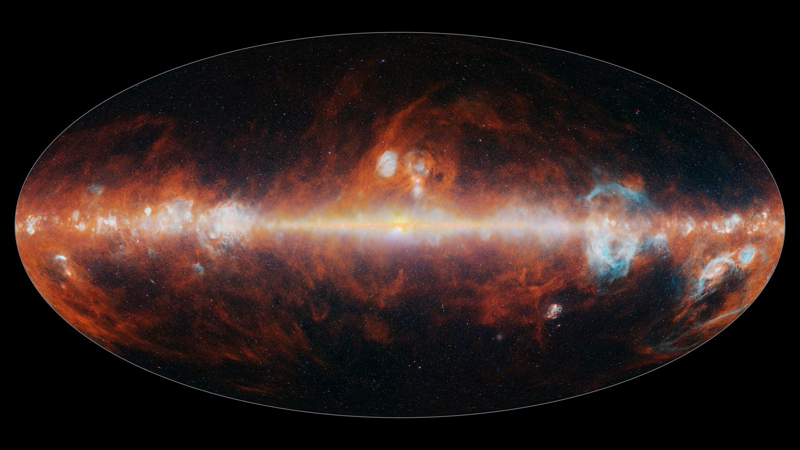
SPHEREx's first all-sky map in 102 infrared colours, showing hot hydrogen gas in blue and cosmic dust in red with the Milky Way running across the middle


Some instruments are pointed at things. SPHEREx is not. The NASA spectrophotometer named for the history of the universe, the epoch of reionization and interstellar ices sweeps the whole sky in a fixed pattern, forever, and whatever falls into its field of view during that sweep gets measured. Nobody has to schedule it. Nobody has to file a target-of-opportunity request. The telescope simply keeps accumulating spectrophotometry of every bright thing in the sky, and the accumulating is the point (the SPHEREx instrument paper). It launched on a Falcon 9 from Vandenberg on 11 March 2025, sharing a ride with NASA’s PUNCH mission, and began surveying in May of that year (NASA’s Scientific Visualization Studio on the launch).

That passive design produced the result that a team of astronomers reported on 29 October. A nova in the southern constellation Vela, which had erupted in June 2025 and blazed to naked-eye brightness, left behind a shell of dust that cooled by roughly half its temperature over the following year. The only instrument that caught that shell cooling was a survey telescope busy looking at the entire sky at once, with no idea this particular nova existed (Astronomer’s Telegram 18127 on dust in the nova V572 Velorum).

The nova in question is V572 Velorum, also called Nova Velorum 2025. Australian observers John Seach and Andrew Pearce found it independently on 25 June 2025 at visual magnitude 5.7, and it peaked at magnitude 4.8 on 27 June (Astronomer’s Telegram 17601). The story gets stranger from there. SPHEREx had already been recording that patch of sky on 20 June 2025, five days before anyone on Earth noticed the nova, and the earlier detection is what made a clean timeline possible (Astronomer’s Telegram 17601). Gamma rays from it were also picked up in the days after the eruption by the Fermi Large Area Telescope (Astronomer’s Telegram 17252).

What made V572 Vel worth this much attention was its history before the explosion. OGLE photometry of the field, running since 2017, caught the progenitor throwing repeated outbursts between 2017 and 2024, some lasting more than thirteen days and others only three or four, which is the signature of an SU UMa-type dwarf nova (Astronomer’s Telegram 17253). A classical nova whose progenitor is itself a recurrent dwarf nova is rare to the point of being a curiosity. Two others are known, V1213 Cen and V392 Per, and V572 Vel is the third (Astronomer’s Telegram 17253). The progenitor reached magnitude 17.17 in the I band during a long outburst in February 2025 and was never detected in quiescence at all, staying fainter than magnitude 20.1 (Astronomer’s Telegram 17253).

The dust itself showed up the way it usually does, as an absence. The AAVSO light curve shows the nova plunging from about magnitude 5.5 to about magnitude 12 and recovering, a sudden fading that astronomers read as the signature of grains condensing in the ejecta, because dust absorbs the light of the hot central source and reradiates it in the infrared (Astronomer’s Telegram 18127). Two epochs of SPHEREx data then turned that qualitative hint into a measurement. The first spectrum, covering 0.75 to 2.36 microns and accumulated between 178 and 225 days after the eruption, was fit with a blackbody at roughly 1030 K, implying a dust mass near 10^-9 solar masses for a carbonaceous grain composition. The second spectrum ran from 0.75 to 5 microns, taken between 334 and 393 days after the eruption, and put the dust at about 480 K with a mass near 10^-8 solar masses. Over about a year the shell cooled by roughly 550 K while the amount of dust in it grew by a factor of ten, which fits the standard picture of a nova ejecta that expands and cools while continuing to form grains (Astronomer’s Telegram 18127).

The reason a space telescope was needed sits in the wavelength coverage. SPHEREx records spectra from 0.75 to 5.0 microns, and roughly 2.7 microns falls inside a strong water vapour band in Earth’s atmosphere, with another absorption near 4.3 microns from carbon dioxide, so ground-based observatories work around those regions rather than through them. For a dust shell sitting at 480 K the rising long-wavelength tail of the spectrum is exactly what constrains the temperature, and that is the part of the spectrum the ground cannot see. Cool it below about 580 K and its blackbody peak moves past 5 microns, which is the regime where a space-based survey is the only practical option. Getting there also takes a specific instrument design: six 2K by 2K mercury cadmium telluride detector arrays behind linear variable filters, giving the telescope 102 spectral channels across its band (the SPHEREx instrument paper, the SPHEREx project site). The scale of that survey is set by NASA to cover more than 450 million galaxies and more than 100 million stars in the Milky Way over two years of observing (NASA’s SPHEREx mission page). The instrument trades resolution for coverage, settling at a resolving power near 40 in the short-wavelength half of its range and near 120 in the long half (the SPHEREx instrument paper), which is too coarse to identify individual emission lines cleanly. The report says the spectra show emission from hydrogen, helium and oxygen, and possibly coronal lines, though the authors are careful to note that the resolution cannot confirm the latter (Astronomer’s Telegram 18127).

This is not an isolated case of a survey telescope producing science it was not built for. The same reasoning drove a separate effort that used NEOWISE infrared light curves to find slow-burning stellar outbursts and then pulled SPHEREx spectra down for eight of them, which turned up two new FU Orionis type events and one classical nova that optical surveys had missed entirely (Karambelkar and colleagues on SPHEREx as a frontier for infrared transients). And on the same day as the V572 Vel report, a completely different nova was caught in the act of making dust by a ground-based near-infrared camera on a 1.3 metre telescope at the MDM observatory, which watched the nova’s colour redden from about J minus H of zero to about 0.7 magnitudes while its J magnitude faded from 8.45 to 10.59 across seven epochs of monitoring (Astronomer’s Telegram 18129 on dust forming in the nova V488 Sge). One dust-forming nova was tracked from orbit and the other from a mountain, and both come at the same question of how much material a nova actually injects into the interstellar medium.

What the archive approach really changes is the cost of getting there. Targeted infrared follow-up has to be scheduled, has to win telescope time, and covers whatever slice of the sky its instrument can reach. A survey that measures everything has already measured the nova before anyone thought to ask, and the resulting time series comes for free with the calibration already done. The catch is real and the report says so: a survey spectrum at this resolution tells you the shell is there and how hot it is, but confirming the suspected coronal lines needs higher-resolution follow-up spectroscopy from the ground. SPHEREx can tell you that a nova formed dust and how that dust cooled. Deciding exactly what is glowing in the innermost ejecta is still someone else’s job.

Image: SPHEREx’s first all-sky map in 102 infrared colours, from observations made between May and December 2025. Hot hydrogen gas appears blue and cosmic dust red. Credit: NASA/JPL-Caltech, via JPL on SPHEREx’s first all-sky map.
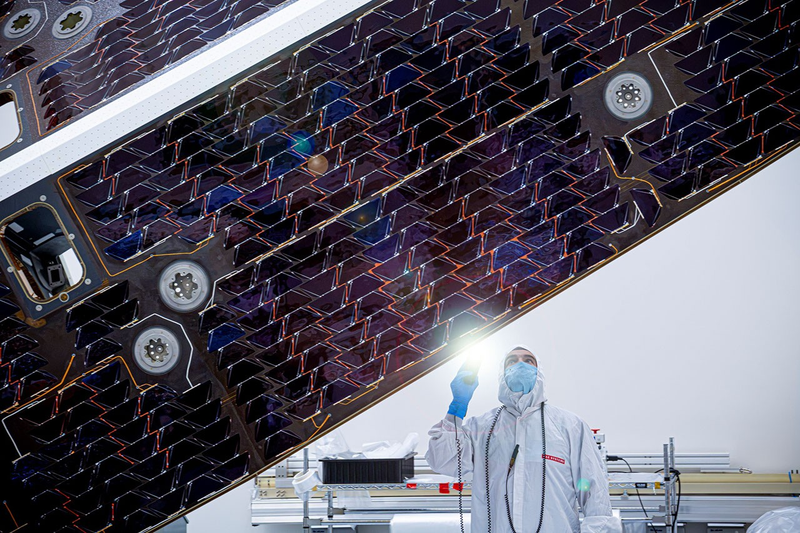


A technician in a clean suit holds a lamp against the solar-cell-covered sunshade of NASA's NEO Surveyor spacecraft in a BAE Systems clean room in Boulder, Colorado


In a clean room in Boulder, Colorado, a technician in a white coverall held a lamp up against six metres of dark solar cells and checked them for defects. The panel is the largest single structure NASA will fly to hunt for asteroids, and it has to do two jobs that pull against each other: block the Sun so the telescope behind it can get cold enough to work, and catch the Sun to make the power that runs everything else. On 26 October 2026, NASA said the sunshade for the Near-Earth Object Surveyor mission had finished its solar-cell integration and passed functional and performance testing of the array (NASA, 26 October 2026). Nearly every advantage of hunting asteroids from space rests on this one piece of hardware.

Asteroids are dark. Their surfaces reflect something like 5 to 30 percent of the light that hits them, and a ground-based optical telescope sees that reflected light, which means it sees the sunlit face of an object, and only when that face happens to be pointed our way. Anything approaching from near the Sun presents an unlit face against a glare-blasted sky. On 25 July 2019 a 100-metre asteroid called 2019 OK passed 65,000 km from Earth’s surface, about a fifth of the way to the Moon. It was first spotted by the Southern Observatory for Near-Earth Asteroids Research in Minas Gerais, Brazil, about a day before the flyby. Pan-STARRS and ATLAS had in fact photographed it in the weeks beforehand, but the rock crawled so slowly that their software did not recognise it (ESA, August 2019). An object of that size strikes Earth on average once every 100,000 years.

That near miss landed in a policy argument that has run for two decades. The George E. Brown, Jr. Near-Earth Object Survey Act of 2005 directs NASA to detect more than 90 percent of all near-Earth objects larger than 140 metres by 2020 (U.S. Congress, 2005). Researchers estimated that only about 40 percent of that population had been found, and the shortfall is not for want of telescopes. The Catalina Sky Survey and Pan-STARRS use 1- to 2-metre mirrors at visible wavelengths and turn up between 2,500 and 3,000 new near-Earth objects a year, but only about 450 of them are in the large-object range that matters (Mainzer and Masiero, 2023). A 140-metre impactor carries the equivalent of roughly 200 megatons of TNT.

The difficulty with ground surveys is the sky itself. Within a few tens of degrees of the Sun, daylight and twilight wash everything out, and that is exactly where the objects on the most circular, Earth-like orbits tend to sit. NASA’s Wide-field Infrared Survey Explorer changed the arithmetic for a while. WISE launched in December 2009 with a cryogenically cooled 40-centimetre telescope and four infrared bands at 3.4, 4.6, 12 and 22 microns. Its hydrogen cryogen ran out in September 2010, the mission continued four more months on the two shortest bands, and the spacecraft was put into hibernation in February 2011 having detected more than 158,000 minor planets, including over 34,000 new discoveries (NEOWISE, IPAC/Caltech). It came back in 2013, worked until July 2024, and burned up in November 2024. What it could never do was look toward the Sun, because its short sunshade and low orbit kept its field of regard away from the region NEO Surveyor was built to cover.

So the replacement is being assembled the long way round, one industrial contract at a time. Applied Aerospace built the sunshade structure in Stockton, California. SolAero Technologies covered it with 864 interconnected solar cells in Albuquerque in January 2026, the assembly then went through environmental testing in a commercial thermal vacuum chamber in El Segundo in March, and it reached BAE Systems Space & Mission Systems in Boulder in May, ahead of schedule (NASA, 26 October 2026). The structure stands 20 feet, roughly 6 metres, tall and is 8 feet wide at the base, formed from two flat panels joined at a 23.5-degree angle. Coarse Sun sensors and temperature sensors have since been integrated onto it, and the array can produce up to 2 kilowatts, enough to charge the batteries that run the spacecraft.

That shade exists for one specific number. NEO Surveyor’s telescope is a 50-centimetre three-mirror anastigmat with a 1.68 by 7.08 degree field of view and no central obscuration, feeding two infrared channels through a germanium beamsplitter. The short channel, NC1, spans 4 to 5.2 microns and is there to find stars, which is how the mission knows where it points; the long channel, NC2, spans 6 to 10 microns and is where the science happens, because a near-Earth asteroid at 200 to 300 kelvin radiates most of its heat in that range. Each focal plane is a four-by-one array of 2048 by 2048 pixel mercury cadmium telluride detectors, and the pair builds a 16-megapixel mosaic of the sky (Mainzer and Masiero, 2023).

Staying useful at that wavelength is a thermal problem with a hard threshold. The detectors have to stay below 40 kelvin or their dark current swamps the faintest signal the survey will ever look for, and the telescope itself has to hold below 57 kelvin. Heat arrives from four directions: the Sun, the roughly 300 kelvin spacecraft bus, the electronics that read out the arrays, and the zodiacal dust glow of the solar system, which is the background the mission must see through. The sunshade kills the first. A shield underneath the instrument catches radiation from the spacecraft bus. Three radiators coated in high-emissivity black paint on the back of the telescope dump the rest into deep space, and the chain runs passively, with no cryogen tank and no cryocooler. The design comes straight from Spitzer.

Everything about that shade is aimed at one number: 45 degrees, the closest NEO Surveyor will look toward the Sun. A 6.15-metre sunshade buys that inner edge of the sky, and it is a geometric trade rather than a free win, because the panel that blocks sunlight also throws a shadow across the field. The survey’s field of regard runs from 45 to 120 degrees in longitude from the Sun and stops at plus or minus 40 degrees of ecliptic latitude, with the instrument able to point anywhere from 45 to 125 degrees out, including both ecliptic poles (Mainzer and Masiero, 2023). The spacecraft sits in a halo orbit around the Sun-Earth L1 point, which keeps a large arc of Earth’s orbit in view, including the near-Sun regions ground observers cannot reach. L1 was picked over L2 because the Moon intrudes less on the field of regard there and the high-gain antenna does not have to ride on the sunshade.

From that perch the telescope does the same thing every night for years. A visit is six 30-second exposures stepped about 10 arcseconds in a rough hexagon, stacked into a 180-second frame, and each patch of sky is covered four times over six to nine hours. The detectors are collecting photons 56.7 percent of the time; the rest goes to camera readout, to slews between pointings, and to daily housekeeping. Across the five-year baseline survey that adds up to roughly 630,000 visits. At IPAC/Caltech, a pipeline descended from the ones built for WISE and the Zwicky Transient Facility links those detections into tracklets and ships them to the Minor Planet Center two or three times a day, typically within 72 hours of the last observation in a set (Mainzer and Masiero, 2023). Main-belt asteroids outnumber the near-Earth ones by roughly a thousand to one near the ecliptic, so the filtering is the hard part.

The scale of the payoff is the reason the shade was worth building bigger than the telescope. NEO Surveyor must find two thirds of all potentially hazardous asteroids larger than 140 metres within its five-year baseline survey, and reach the 90 percent completeness the 2005 law asked for if it can stay in business for 12 years. That should mean between 200,000 and 300,000 new near-Earth objects down to sizes of about 10 metres, plus thousands of comets, and a far sharper estimate of how often Earth actually gets hit. The spacecraft launches no earlier than September 2027 (NASA/JPL). The structure that makes all of it possible has already been built, tested and delivered early.


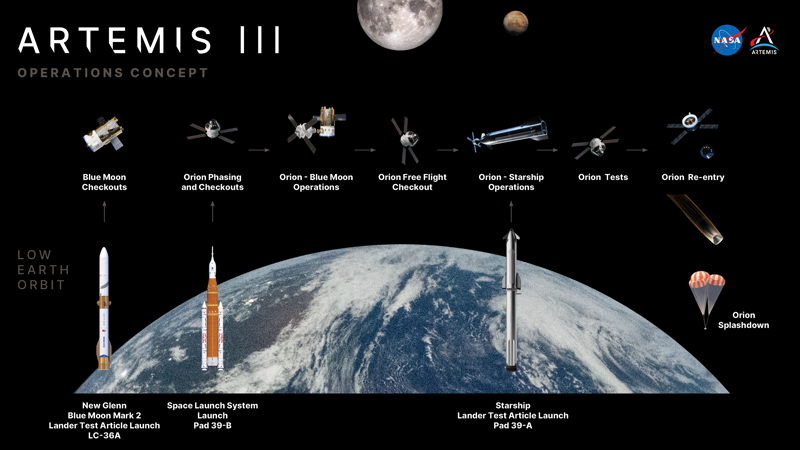
NASA's Artemis III operations concept graphic showing New Glenn launching the Blue Moon Mark 2 lander test article, the Space Launch System launching from pad 39B, and Starship launching a lander test article from pad 39A, with the sequence of Orion docking checks through splashdown in low Earth orbit.


Getting American astronauts back to the lunar surface now depends on three rockets that mostly do not look alike, and on the fact that all three are changing at once. On 23 October 2026, at a press conference at Kennedy Space Center, NASA laid out how Artemis III will be flown, and the answer was a rehearsal, not a landing. Four astronauts will launch on the Space Launch System in 2027, dock with a test Blue Moon lander and a test Starship in Earth orbit, and come home. The landing itself moves to Artemis IV in 2028, and the first crew on the surface since Apollo 17 will ride on whichever of the two commercial landers proves ready first (NASA’s release on the revised plan).

That rework set off a hardware sprint across three launch pads. Each vehicle is getting a new upper stage, a new engine, or a whole new configuration, and the changes are not interchangeable. SLS is losing the upgrade it was supposed to get and gaining a different one. Starship is getting a docking adapter, a tanker fleet and an upper stage for its own lander. New Glenn is getting a bigger first stage, a rebuilt pad and a four-launch plan that was not in the original design. Side by side, the three are three answers to one question: how do you get a crew to the Moon and back without flying the same hardware twice?

The reordering also exposes an uncomfortable schedule. NASA Administrator Jared Isaacman announced the new sequence roughly a month before Artemis II lifted off in April 2026, and officials now describe Artemis III as an Earth-orbit test in mid-2027, with Artemis IV and Artemis V both aimed at landings in 2028 (SpacePolicyOnline on the schedule). The South Pole remains the destination, justified by water ice thought to be accessible in permanently shadowed terrain, though the agency concedes it needs more data from robotic landers before committing. The suits are being built by Axiom Space. One detail is significant: the docking test happens in low Earth orbit rather than near the Moon, letting NASA learn the hard parts of rendezvous while a crew is still a quick flight from the splashdown.

The Space Launch System is the odd one out, the only one of the three being simplified. NASA’s original plan was a Block 1 rocket with the Interim Cryogenic Propulsion Stage for the first missions, then a Block 1B with Boeing’s larger Exploration Upper Stage and a Block 2 with new solid boosters. That ladder was dropped in February 2026; the agency settled on a standardized configuration and picked ULA’s Centaur V as the upper stage to replace the interim stage from Artemis IV onward (Space.com on the upper-stage selection). Centaur V has flown on Vulcan since 2024 and holds roughly twice the propellant of the interim stage, and NASA is working with ULA on an extended version for the low-lunar-orbit role the new architecture calls for (Ars Technica on the revised architectures). For Artemis III itself, SLS will fly without a propulsion stage at all, using a non-propulsive spacer instead, since the mission never leaves Earth orbit.

Starship’s contribution to the same plan is the most expensive one, and the most contested. Under the revised concept, tanker variants of Starship fill a depot ship in low Earth orbit, the lander and Orion dock there, and the lander performs the burn that sends the combined stack toward the Moon (NASA’s release on the revised plan). How many tankers that takes is the argument. At a NASA Aerospace Safety Advisory Panel meeting, panel member and former astronaut Charlie Precourt put the estimate at around 22 flights, noting the large number of firsts stacked against Artemis IV. Elon Musk responded that the real figure would be closer to six to eight (Ars Technica on the tanker estimate). The gap is not just numerical. It depends on how much cryogenic methane and liquid oxygen boil off in orbit and how efficiently the transfer works, neither yet demonstrated. Even at a twice-weekly launch rate by the end of 2027, Ars Technica’s analysis puts the time to fuel a single depot at roughly three months.

New Glenn is the third rocket, and it is carrying the most physical damage. On 28 May 2026, a static fire at Cape Canaveral destroyed a fully stacked New Glenn and much of Launch Complex 36. Blue Origin traced the anomaly to the main liquid oxygen valve on one of the seven BE-4 engines in the first stage, with the root cause still open at the time of reporting, and began rebuilding the pad in June with a public target of returning to flight before the end of 2026 (KeepTrack on the LC-36 explosion and recovery). The rebuilt pad, LC-36A, flies the current 7×2 configuration, while LC-36B is being built for the heavier 9×4. New Glenn has flown three times, its third on 19 April 2026 ending with the loss of the payload, and its November 2025 ESCAPADE booster reused on that attempt. All of that sits underneath a lander campaign that needs the rocket to fly four times.

The engineering behind the new variants is where the three programs diverge most sharply. New Glenn 9×4 replaces the current 7×2 with nine BE-4 engines on the first stage and four BE-3Us on the upper stage, carries a fairing widened from 7 metres to 8.7 metres, and lifts roughly 70 metric tons to low Earth orbit against 45 tons for the original configuration, with the engine upgrades phased in starting with the third mission (Space.com on the 9×4 variant). Starship’s lunar lander and its depot ship shed hardware rather than adding it: neither re-enters Earth’s atmosphere, so both drop the heat shield and the fins, and the lander keeps six Raptor engines for ascent and landing while separate high-thrust engines in the mid-body burn gaseous oxygen and methane to avoid blasting the regolith (Wikipedia on the Starship HLS vehicle family). Blue Moon takes the opposite approach, keeping liquid hydrogen and liquid oxygen with a solar-powered system that holds propellant near 20 kelvin to fight boiloff, which matters for a lander meant to sit on the Moon rather than leave (Wikipedia on the Blue Moon lander family). And beneath all of it, the crew rocket changes hands: from Artemis V, NASA plans to transfer SLS production and launch operations to Deep Space Transport LLC, a Boeing and Northrop Grumman joint venture, hoping commercial customers spread the cost (Wikipedia on Deep Space Transport LLC).

The three vehicles have also started flying. Starship reached orbit for the first time on 28 September 2026 on flight test 14, deploying 26 operational Starlink V3 satellites after one of the six second-stage engines shut down early, which cut the planned six-orbit profile short but not the orbit itself (SpacePolicyOnline on the first orbital flight). For Artemis III, the sequence runs to a 14-day nominal mission: New Glenn goes first with the Blue Moon test article, SLS launches the crew next, and Starship flies on about flight day six to dock on day eight, with the Blue Moon docking on day three at roughly 273 miles (Space.com on the concept of operations).

What ties the three together is the 2028 landing, and what separates them is how each program pays for it. Blue Origin chose the conservative route, deferring in-orbit propellant transfer and instead flying three transfer stages built from existing Mark 1 and Mark 2 hardware ahead of the Blue Moon Mark 2 Alpha lander, which assembles in Earth orbit and departs for an elliptical polar orbit around the Moon. That is four New Glenn launches with no spacecraft-to-spacecraft refueling, on a booster whose pad was vaporized in May. SpaceX chose the opposite, betting that orbital refueling works well enough that a handful of tanker flights will cover the lander, a bet its own safety advisory board thinks is off by more than a factor of three. NASA bought optionality by choosing neither, flying both dockings in Earth orbit in 2027 and deciding the landing provider from what the data shows. The next real milestone is not a landing but a docking, and the hardware that has to make it work is still in pads and test stands.

NASA’s Artemis III operations concept graphic, showing the three launch vehicles and the docking sequence in low Earth orbit.


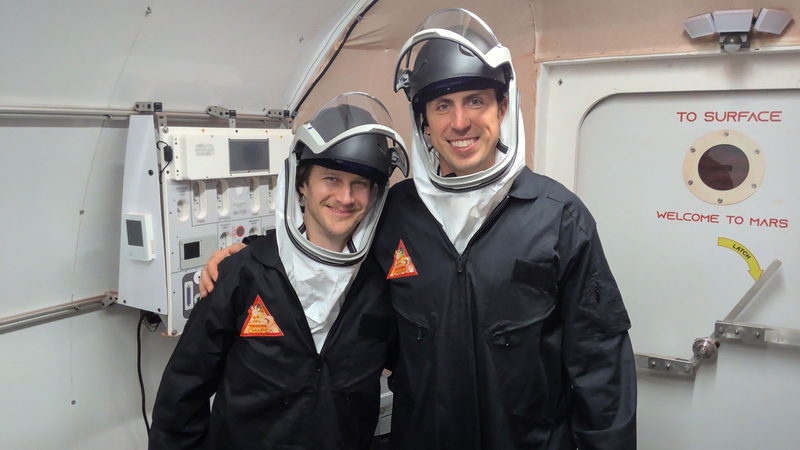
Two CHAPEA Mission 2 crew members in pressure suits and open helmets stand beside the habitat's surface hatch, marked "TO SURFACE" and "WELCOME TO MARS."


On Saturday afternoon four people will step through a door in a hangar at NASA’s Johnson Space Center in Houston and see daylight for the first time since October 2025. The door is marked “TO SURFACE” above a round porthole, with “WELCOME TO MARS” painted underneath. Ross Elder, Ellen Ellis, Matthew Montgomery and James Spicer passed through it on Oct. 19, 2025, and they have been on Mars since, in a 1,700-square-foot habitat printed out of concrete and surrounded by red soil and a fake cliff line (NASA, October 2026).

The spacecraft is not there, and neither are radiation, three-eighths gravity or the perchlorate dust that would coat a real outpost. What the hangar does provide is harder to model: four people in a small volume, a finite pantry, equipment that fails on a schedule, and a radio link to Earth that never answers fast enough to be called a conversation. NASA’s Crew Health and Performance Exploration Analog, or CHAPEA, exists to put those stressors under a roof where instruments can watch them. The second crew walks out on Oct. 31, 2026, and spends the two weeks after that in post-mission evaluation and debriefing before going home (NASA, October 2026).

Analog research is old business. The longest confinement experiment ever conducted is MARS-500, a psychosocial isolation study run from 2007 to 2011 by Russia, the European Space Agency and China at the Institute of Biomedical Problems in Moscow, where six crew lived 520 days inside a sealed mock-up (ESA/Roscosmos). Antarctic stations and NASA’s Human Exploration Research Analog cover other corners of the same map. What CHAPEA adds is latency, and latency is the one stressor no polar station can offer.

The physics is unremarkable. Earth and Mars are separated by between roughly 55 million and 401 million km, so a radio signal crosses that gap in about three minutes at closest approach and as many as 22 minutes at the farthest point. A question asked over breakfast comes back after breakfast is over (NASA, 2025). NASA’s technical memorandum on the state of communication-delay research states the operational figure: Mars missions will meet a 22-minute one-way, 44-minute round-trip delay at maximum distance from Earth, and the agency’s Human Systems Risk Board has already assessed the risk that comes with losing live ground support (NASA TM-20250003885). CHAPEA enforces that delay on a schedule, and partway through the mission the crew worked through a simulated two-week blackout with no contact with Earth at all.

NASA picked its second crew with roles that mirror a real flight: Elder as commander, Ellis as medical officer, Montgomery as science officer, Spicer as flight engineer (NASA, October 2026). The year arrived in milestones the agency marked in public: photographs at 100 and 300 days, an update at 200 days on what half a year of isolation had taught the team, and a statement at 365 days that the crew would exit on schedule (NASA/JSC, 2026). Inside, the workload was NASA’s whole point: simulated spacewalks in pressure suits, crop stations growing peppers and tomatoes, geological sample handling, habitat maintenance, blood draws, medical monitoring and daily exercise. Principal investigator Grace Douglas said she was “extremely proud of the crew for their commitment and achievements over the last year” (NASA, October 2026).

The agency put real engineering into the box. The structure was printed by ICON with its Vulcan construction system using Lavacrete, a proprietary cementitious mix, and designed by Bjarke Ingels Group, whose architects called the habitat Mars Dune Alpha. The layout runs on a gradient of privacy: four private crew quarters at one end, workstations, a medical station and food-growing stations at the other, shared space between them, under an arching shell that changes ceiling height from room to room. Lighting, temperature and sound are adjustable and the furniture moves, so the crew can tune the environment instead of living inside a fixed set of moods (ICON, 2021; NASA, 2026). In floor area that is 158 square metres for four people, roughly 39 each, and every bit of it holds sleeping, food growing, exercise, medicine, repair and work. The reason to print rather than launch the structure is the reason Martian outposts would be printed at all: building materials are cheap in orbit and ruinously expensive to fly, while regolith is simply where you are standing. NASA’s own argument is blunt: additive construction would remove the need to launch large quantities of building material on multiple flights (NASA, 2026).

By NASA’s own assessment, the least realistic part of the simulation is the part that matters most when something breaks. The communication-delay memorandum surveyed two decades of research and found a “general lack of fidelity in studies of mission-critical tasks, including problem solving, emergency response, maintenance, and complex procedure execution,” which the authors attribute to analog missions putting safety and mission objectives ahead of fidelity (NASA TM-20250003885). The same review argues for countermeasures aimed at the problem: training that includes communication delay, and tools for asynchronous collaboration, where a crew writes its plan down, sends it, and works the answer instead of waiting for it. It also flags a gap that matters for the Moon rather than Mars, since one-way delays of 3 to 14 seconds are possible on lunar missions and almost nobody has studied them under conditions that resemble actual operations (NASA TM-20250003885).

Suit work is where a Mars mission burns its budget, and the analog crew spent hours on the version of it a real crew would do differently. A 2026 study in Frontiers in Psychology put 14 participants through simulated surface extravehicular activities on an integrated virtual-reality and treadmill rig, then made geological sample identification harder. Subjective workload rose, cognitive performance fell, physiological responses shifted and performance on core EVA tasks dropped (Anderson et al., 2026). The result is narrow, and it is the kind of number a mission designer wants: the deciding variable is not the suit, it is how hard the geology is while the suit is on.

None of this makes the analog optional. An ESA topical team that surveyed the field concluded that analogs remain the only way to study mental and social variables under conditions close to a real mission, and it catalogued what they cannot do: they do not reproduce hypogravity or radiation, they cannot be left unsupervised, and their culture of safety distorts the emergency behaviours researchers most want to observe (De la Torre et al., 2024). The practical consequence is that CHAPEA produces bounds rather than answers, which is why a third and final one-year run is already scheduled. One crew is one crew, and a second run partly exists to find out whether the first was typical.

On Saturday the crew gets its own data back, and the instruments start working. The next two weeks of evaluation and debriefing will tell NASA how the year actually felt, and the answers feed the agency where it is about to spend real money: the food system, the mass and volume budgets of future vehicles, and the resource trades that decide how much hardware a crew can carry. As Michael Stenger, chief scientist for NASA’s Human Research Program, put it, the point is to “translate the knowledge from these experiences to Moon Base and beyond” (NASA, October 2026). For a crew that one day lands on Mars, that translation comes down to waiting. The radio lag, the missing spare part, the long silence between one decision and the next are not side effects of the mission. They are the mission, and until Saturday four people had not been allowed to find out what that does to them.


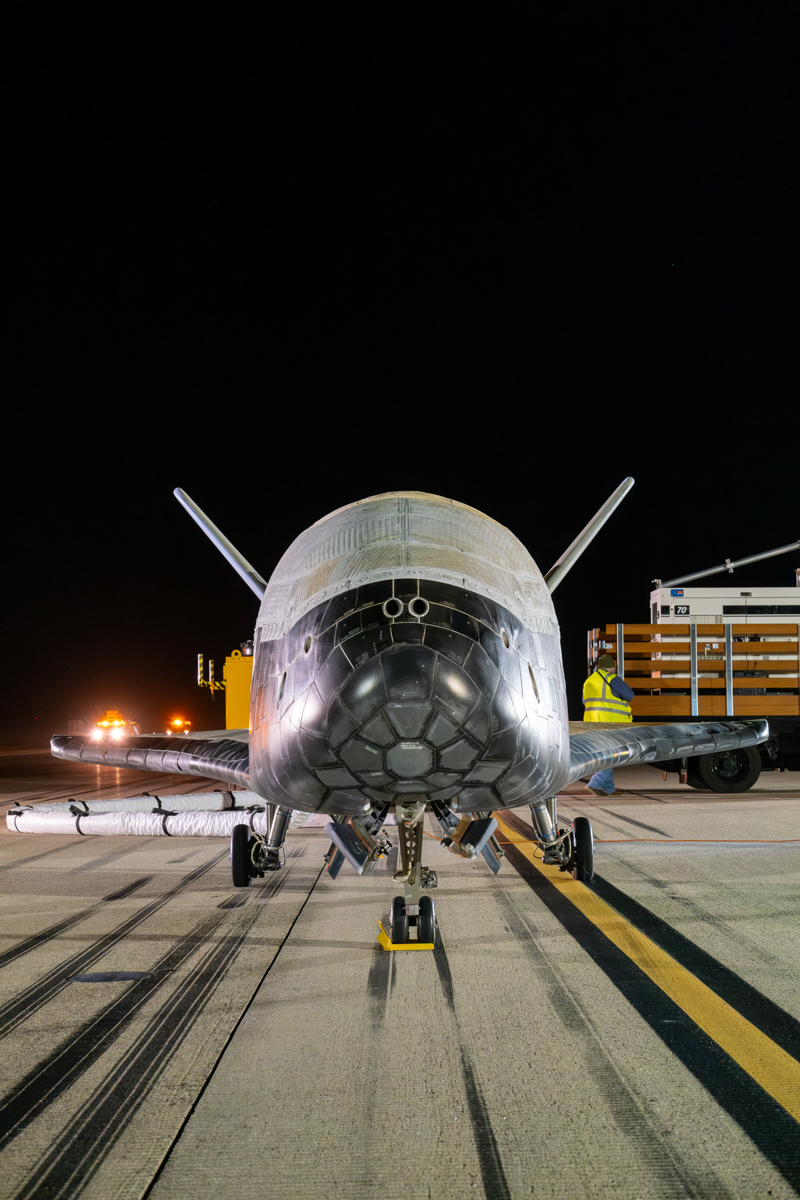
The X-37B spaceplane sits on the runway at Vandenberg Space Force Base after landing from its seventh mission in March 2025, the American vehicle whose design the Chinese Shenlong closely resembles (U.S. Space Force/Alexander Veloz via Wikimedia Commons)


Some photographs carry more information than their subjects were ever meant to give up. On 26 October the Defense Intelligence Agency released the third edition of its unclassified survey of threats in space (The Defense Watch on the DIA 2026 report), and on page 53 of the 130-page document sits a picture of a Chinese spaceplane in orbit that nobody outside a small circle of intelligence analysts had seen at full resolution (DIA press release for the 2026 edition). The shot was taken by a commercial Earth observation satellite, a WorldView-3 operated by Maxar Technologies, the company now known as Vantor, on 28 May 2024 while the craft was on the long middle leg of its third flight (Wikipedia on the Chinese reusable experimental spacecraft mission history). What the image gives up is the vehicle’s shape: a delta-winged body, doors along the flank for a payload bay, a dark heat shield across the belly, and a service module at the rear with solar arrays on short outriggers (Ars Technica on the Shenlong photograph).

That photo was not a leak and it was not a spy agency going public with something it had been sitting on. In 2024 a US Space Force officer disclosed at a conference in South Korea that an American-owned commercial satellite had imaged the Chinese craft, and a lower resolution version of the picture circulated afterwards (Wikipedia on the Chinese reusable experimental spacecraft mission history). The agency has now released the whole thing, credited to Maxar, inside a document whose stated purpose is to inform public debate rather than to leak anything (DIA press release for the 2026 edition). There is an argument that publishing it makes the vehicle more useful to adversaries than it already was. There is also an argument that a program developed in near total silence is a program nobody can write norms around, and that the public photograph is the first step toward treating it as an ordinary vehicle rather than a rumour.

What the image shows is a machine built along the lines of the X-37B, the uncrewed spaceplane the US Space Force flies, and the resemblance runs deeper than the outline. The American vehicle lifts off vertically inside a conventional rocket’s payload shroud, works as a satellite once in orbit, then reentres and lands by itself on a runway to be refurbished for another flight (Ars Technica on the Shenlong photograph). The Chinese craft does the same, on a Long March 2F from Jiuquan, landing back at an airbase in the Gobi. The difference is what the vehicle is for, and that is where the language gets careful. The report’s own framing is that spaceplanes are reusable and have enhanced maneuverability, which makes them more suitable for certain missions than ordinary satellites, and it names two Chinese programs, Shenlong and Tengyun (Ars Technica on the Shenlong photograph). A separate Secure World Foundation fact sheet is blunter about the limits of the alarm, concluding that the vehicle has close to zero feasibility as an orbital weapon for striking ground targets and has never approached a non-Chinese object, which reads as a technology demonstrator rather than a warhead (Secure World Foundation fact sheet).

The flight record is what makes the picture interesting rather than merely striking. The first prototype went up in September 2020 and came back down two days later. The second flight launched in August 2022 and stayed up for 276 days, and during that mission it moved around a small companion satellite, holding roughly a kilometre of separation and at one point coming within about 100 metres of it, which observers read as a rendezvous before the smaller object was released again. The third flight, launched in December 2023 and still up when the Maxar camera caught it, lasted the better part of nine months and involved the spaceplane releasing and then interacting with another object. A fourth mission launched from Jiuquan on 7 February 2026 and was still in orbit when the report came out (Leonard David on the DIA report’s spaceplane flight history). By the end of that third flight the vehicle had logged a cumulative year and a half in orbit, and it was manoeuvring around objects it had deployed itself rather than flying a solo mission, which is the difference between a test article and a working spacecraft (Wikipedia on the Chinese reusable experimental spacecraft mission history).

The technique behind the picture deserves more attention than it gets. The field has a name, non-Earth imaging, and it works because the geometry occasionally lines up: an Earth observation satellite pointed at a piece of ground passes close enough to another spacecraft to photograph it as it goes by, at relative speeds measured in kilometres per second (Ars Technica on the Shenlong photograph). Commercial operators such as Maxar have turned that into a service, and government analysts buy it. The cost of the observation is the orbital mechanics of the chance encounter, not a dedicated spy platform, which is why a picture of a classified Chinese vehicle exists at all. For comparison, the X-37B has a published specification that no one outside the Space Force could match: more than 29 feet long, a wingspan near 15 feet, and orbital speed of roughly 17,400 mph (Popular Science on the DIA spaceplane photograph). The Shenlong’s dimensions remain unpublished, and the vehicle’s actual payload is classified on both sides.

The larger document puts the spaceplane in a wider argument about where the competition is heading. China’s launch cadence has gone from 22 launches in 2016 to 93 in 2025, and the number of satellites it puts into orbit each year has grown from 40 to 384 over the same period, a rate increase running alongside the national LEO megaconstellations Beijing is building (The Defense Watch on the DIA 2026 report). Alongside the reusable spaceplane work sits a much more explicitly aggressive portfolio: satellites with robotic arms, a demonstration of moving a dead navigation satellite into a graveyard orbit, a test of refuelling in geostationary orbit, and a series of inspector craft that have closed to within ten kilometres of other nations’ spacecraft in that orbit (The Defense Watch on the DIA 2026 report). The report’s sharpest new judgment is on directed energy: China already fields several ground-based laser systems of varying power that can disrupt, degrade or damage satellites in low Earth orbit, and by the late 2020s may field space-based directed energy systems along with more powerful ground systems able to threaten satellites in higher orbits (The Defense Watch on the DIA 2026 report). It is a projection, stated as a possibility, and the underlying intelligence is not published.

None of that changes the photograph. What the public now has is a clear look at a vehicle that has flown four times, spent 276 days on its longest completed mission so far, and demonstrated close approach manoeuvres with its own deployed satellites, while the X-37B on the American side has flown eight times and at one point extended a record of 908 days in orbit (Wikipedia on the X-37B flight record). What the reader does not have is a mission statement from Beijing, a set of dimensions for the Chinese craft, or confirmation of what the fourth mission is doing right now. The next useful pieces of information would be a landing date for the flight launched in February, the next edition of this assessment, and any Chinese statement of purpose for a program that has now been photographed in public twice.


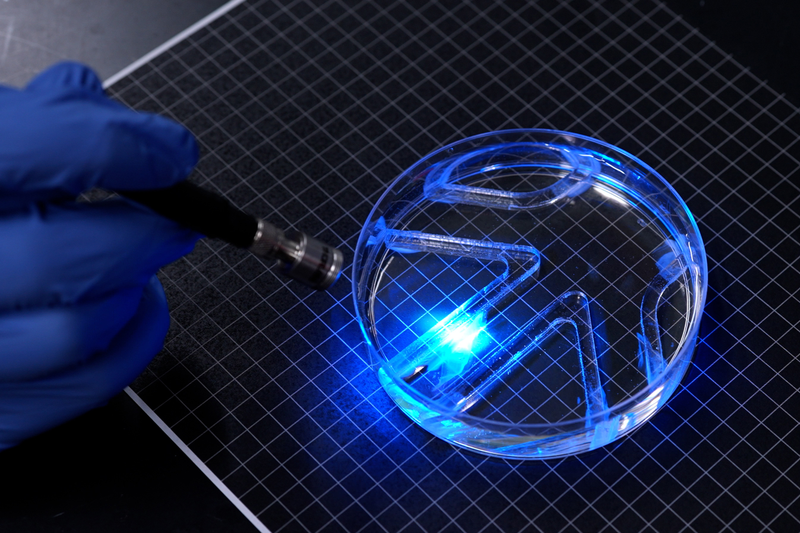
A blue light illuminates a thin gel film with two muscle-lined fins in a petri dish of water at MIT, the actuator that swims by contracting cells engineered to respond to light.


In a petri dish at MIT, a blue light moves and a small shape follows it. The object is a rectangle of gel the size of a stick of gum, with two flaps that beat when the light touches them. Each flap is lined with muscle cells grown from a mouse cell line and engineered so that a flash of blue light makes them contract. The gel film is half a millimetre thick; the living layer on it is thinner than a strand of hair. The machine swims about four body lengths per minute, a pace MIT’s news office compared to a cow shark’s cruise and well below an Olympic swimmer’s 65 body lengths per minute (MIT News, 29 September 2026). It is the first genuinely two-dimensional muscle-powered robot, and the work appeared on 28 September 2026 in Advanced Functional Materials (Bawa et al.).

The idea of a robot powered by living muscle is not new; making it useful is. Engineered muscle has driven grippers, walkers, a human-tissue hand and swimmers, and in nearly every case the muscle has been the limiting component. Cardiac muscle, the easiest to grow flat, cannot be switched off, is not built for frequencies much above 3 Hz, and because neighbouring heart cells are electrically coupled you cannot recruit one region without its neighbours. Skeletal muscle offers what a robot wants: on-off control, local spatial control, and bandwidth from below 1 Hz to above 10 Hz. It also arrives with a manufacturing problem: skeletal muscle is cultured as a three-dimensional lump, and a lump big enough to push anything means millions of cells.

Most engineered C2C12 muscle tissues produce under 1 millinewton of active force, with stresses below 2 millinewtons per square millimetre. A group using a self-training rig for muscle rings recently reached 7.05 millinewtons, and their biohybrid swimmer covered 467 millimetres per minute, or 15.6 body lengths per minute, the fastest locomotion yet reported from a skeletal-muscle robot (Nature Communications, 2026). Those muscles are thick, mechanically trained, and awkward to build.

Ritu Raman’s group at MIT had already shown a way around the manufacturing problem. In March 2025 the lab stamped a hydrogel disk with grooves in two orientations, seeded muscle cells into them, and let them fuse into fibres that pulled in more than one direction at once, an artificial iris. It was the first muscle-powered machine to generate force along several axes at once, and the stamping method can print patterns on a tabletop 3D printer. What it could not do was move. That tissue shifted about 100 micrometres, tiny from a robotics standpoint.

The new work attacks force and endurance rather than patterning. Bawa and colleagues started with the skeleton, since a thin muscle sheet is only as good as its substrate. Cells were seeded onto gelatin methacrylate at 80,000 per square millimetre, then allowed to fuse into contractile fibres. The substrate was a film 7 millimetres wide and 15 long, half a millimetre thick, patterned with square-bottomed microgrooves. Three groove sizes were tried: 12.5, 25 and 200 micrometres. The narrowest matched the roughly 12-micrometre diameter of a single myoblast, so cells could neither spread nor fuse comfortably inside them; the widest gave the fibres no reason to line up. The middle size won, cutting the angular scatter of the fibres by an order of magnitude relative to wavy or flat surfaces.

Stiffness mattered as much as shape. The earlier iris work sat on fibrin, an ultra-soft gel that shrank under the tension the muscle generated, and fibrin above about 8 milligrams per millilitre will not dissolve in culture medium, capping substrate stiffness at under 0.25 kilopascals. Gelatin methacrylate has no such ceiling, so the team made it at 5, 7.5 and 10 weight percent. The stiffest recipe that still held the tissue together won: 7.5 weight percent produced thin-film forces of 2.9 plus or minus 0.6 millinewtons, against 1.7 plus or minus 0.8 on the 5 percent gel and 0.36 plus or minus 0.19 on fibrin, with the cleanest fibre alignment on the stiffest surfaces.

Then they did what any muscle does in a gym and forgot to do in a dish: they trained it. Repeated pulses of blue light, the 470-nanometre wavelength that opens the channelrhodopsin-2 calcium channel in the cells, raised the force the tissue could hold. The group then built the machine: two independent fins, each a gel film lined on both sides with muscle, so lighting one fin strokes that side alone and lighting both produces a symmetric flap. In a dish of water with a maze cut into the floor, a hand-held light source steered the robot around the obstacles. Speed rose with light pulse frequency, and the machine turned in place at up to 1,200 degrees per minute.

A thin sheet works where a thick one would not because of where the force goes. Muscle contraction pulls on the substrate below it, and the pair behaves like a bimetal strip: the gel carries the load in shear, the cell layer in tension. That works only if the cells stay attached: adhesion improves with a stiffer gel, but the tissue itself would rather have something softer, so the design point sits in a narrow window. The team computed the stress in the gel from the shear modulus measured at 1 hertz, the area under the muscle, the film thickness and the contraction displacement, then fed a 5 percent contractile strain into a model, the value typically reported for untethered three-dimensional C2C12 tissue.

The payoff is efficiency. Force per unit volume decides how much tissue a job needs, and these thin films deliver about 20 times the force density of earlier three-dimensional muscle actuators, with forces roughly 10 times higher than previous flat skeletal-muscle devices. Endurance improved more dramatically. Earlier two-dimensional muscles tethered to a rigid backing lost their shape within ten minutes of being freed, while the optimized designs kept actuating untethered for more than 30 days, an improvement of some 4,500 times in useful lifetime.

Control is the other reason to want muscle, and it comes down to the channelrhodopsin-2 in the cells. Blue light opens the channel, calcium floods in, and only the illuminated region contracts, so a machine with two fins has two independently addressable muscles. How fast it swims is a question about fluid mechanics. At this scale the swimmer lives in the drag-dominated regime, where thrust comes from pushing water backwards over and over and resistance grows with the square of speed, F = 0.5 * rho * C_d * A * v^2, so every stroke spends energy a motor and propeller would spend more efficiently.

What happens next is mostly engineering, and the same lab has started on the pieces: separate work there, published in Advanced Science in late 2025, builds hydrogel tendons that couple muscle to a rigid skeleton. For the swimmer, the next steps are a better body shape and a light source small enough to ride along instead of a hand holding it over the dish.

That last part is the real limit. The bot needs light to be commanded and culture medium to keep its cells alive, so the maze run was piloted by a person rather than a controller. But the ratio the work establishes is the durable part: a patterned cell layer a few tens of micrometres thick, delivering millinewton-scale force from a film you could print. If that holds, actuators stop being components you buy and start being things you grow.