OrbitalHub

Where curiosity reaches escape velocity.

Domain is for sale. $50,000,000.00 USD. Direct any inquiries to contact@orbitalhub.com.

Archive for November, 2026


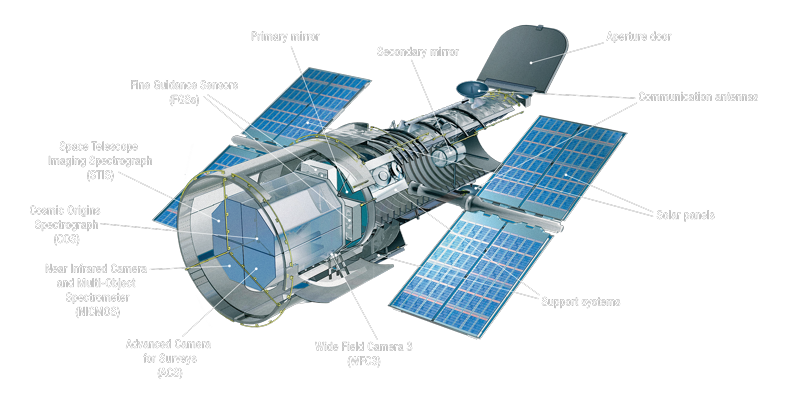
The Hubble Space Telescope floating free above Earth's curved horizon, its foil-wrapped tube and open aperture door catching sunlight against black space.

Image: the Hubble Space Telescope in orbit after the final servicing mission, its open aperture door facing the viewer and the solar array wings extended. Credit: NASA, via Wikimedia Commons.


The Hubble Space Telescope has been falling toward Earth for years, one imperceptible nudge at a time. It has no propulsion system of its own to push back, and it spends every orbit dragging against the thin upper atmosphere, losing altitude a little faster each time. There is no engine to fire and no thruster to spare. The telescope was built to be serviced by hand, and for the last seventeen years nobody has done it. On 29 October, NASA asked the commercial space industry to tell it how to fix that (NASA’s announcement of the Request for Information). Responses are due at 3 p.m. Eastern time on 30 November, and the agency is asking about three things: putting Hubble into a higher orbit, servicing it to extend what it can do, or guiding it down in a controlled way when the science finally runs out.

The case for acting is not sentiment, though the scientists who want Hubble kept alive are certainly articulate about it. An uncontrolled reentry of a spacecraft this size is a public safety question. NASA puts the likely date of Hubble’s uncontrolled arrival at 2033 or 2034, and says a mission would need to happen by 2032 to make a difference (NASA on commercial servicing of Hubble). That is a hard wall with a date on it. The probability of an uncontrolled reentry in 2033 works out to roughly 1 in 330 for casualties, averaged across the whole band of latitudes the telescope’s 28.5 degree inclination sweeps, against a NASA safety standard of 1 in 10,000 (TechTimes on the casualty risk). Over the emptiest stretches of the South Pacific the odds fall to something like 1 in 31,000, which is still not nothing. Hubble was never designed to be landed. NASA had assumed a space shuttle would retrieve it, and when the shuttle fleet retired, that assumption quietly expired. The telescope itself is the size of a large school bus, weighing 27,000 pounds with a 2.4 metre primary mirror and a solar array generating more than 5,200 watts (NASA’s Hubble by the Numbers).

What makes the timing unusual is that Hubble has already had this conversation once. NASA ran a similar Request for Information in December 2022 and received eight responses, and the agency did not pursue any of them. Two of the companies involved, Astroscale and Momentus, proposed a partnership in which a Momentus orbital service vehicle launched on a small rocket would approach Hubble, attach using docking hardware Astroscale was developing, raise the orbit by 50 kilometres and then detach to go on removing debris in nearby orbital shells (SpaceNews on the Astroscale and Momentus concept). NASA was careful to say the responses were information rather than proposals, and that any company might take on the work with no exchange of funds, as a demonstration rather than a procurement. Nothing came of it. Administrator Jared Isaacman had advocated for a SpaceX Crew Dragon mission to boost Hubble before he took the job, and NASA studied that proposal without pursuing it.

The circumstances have shifted in ways worth setting apart from the political argument. The shuttle fleet that serviced Hubble is long gone, so NASA has no vehicle of its own to send. Meanwhile the commercial market that the 2022 solicitation was testing has had three more years to mature, and companies like Northrop Grumman now fly an orbital servicing vehicle that docks with commercial satellites in geostationary orbit and moves them to higher slots (The Register on NASA’s Hubble options). Isaacman has said the equation has changed as those capabilities matured, that an uncontrolled reentry is not acceptable, and that a funded visit should prioritise extending the observatory’s science return (NASASpaceflight on Isaacman’s remarks). He has also said he expects the request to draw interest from robotics companies rather than from anyone planning to fly astronauts to a telescope in a 28.5 degree orbit (Ars Technica on NASA’s Hubble request).

One piece of the hardware makes the capture problem more tractable than it sounds. When Atlantis visited in May 2009 for the fifth and final servicing mission, it installed the Wide Field Camera 3 and the Cosmic Origins Spectrograph, which gave the telescope the ultraviolet reach it has today, and replaced its gyroscopes and batteries (ESA on Servicing Mission 4). Engineers also fitted a Soft Capture and Rendezvous System to the aft bulkhead, a ring-like device with structures and targets that lets a future vehicle capture the telescope and guide it into a safe controlled reentry, whether that vehicle is crewed or robotic (ESA/Hubble on the Soft Capture Mechanism). The docking port a servicing robot can grab, built seventeen years before anyone needed it, turns the hardest part of the job into the easiest part. The capture is still harder than a routine docking, because Hubble’s own orbit offered no safe haven at the space station, and in 2009 Endeavour stood ready on an adjacent pad as a rescue mission for the entire duration of the flight.

The observatory is not in the condition it was in when it was last visited. Hubble now runs on two of its six gyroscopes, flying in single-gyro mode, a change that has cut its usable observing time by roughly 12 percent and limited which targets it can track (NASASpaceflight on Hubble’s systems). A servicing mission that restored gyroscopes, upgraded the batteries and gave the telescope a few more years of full-rate pointing would be worth doing for the astronomers even if the orbit question went unsolved. The case for keeping it alive, though, runs the other way. NASA is reporting that Hubble’s observing time remains oversubscribed seven to one even at reduced capability, and that no replacement is expected before the 2040s, when the Habitable Worlds Observatory might fly (The Register on NASA’s Hubble options). The successor has a different and complementary job from the ultraviolet and visible-light survey work Hubble has been doing since the shuttle released it from Discovery in April 1990, 332 nautical miles up (NASA on Hubble’s deployment). ESA, which built Hubble’s flexible roll-out solar arrays and holds 15 percent of its observing time as its share of the partnership, put the telescope’s original working altitude at around 600 kilometres (ESA’s Hubble overview). The Habitable Worlds Observatory, by contrast, is a much larger infrared, optical and ultraviolet observatory whose central aim is hunting for biosignatures in the atmospheres of worlds around other stars, with a main objective of directly imaging 25 potentially habitable candidates (NASA on the Habitable Worlds Observatory).

Two things will decide whether this goes anywhere. The first is whether a commercial company can make a number work on a piece of government hardware that nobody has tried to dock with in orbit, at a scale larger and more awkward than the satellites the servicing industry was built for. The second is time. A response submitted by 30 November still leaves years of development and launch ahead of it, and NASA has already said a mission has to happen by 2032 to beat the reentry forecast, a schedule that assumes a company that has never done this before moves at a pace the space industry has not always managed. The window for a crewed visit has closed. Whatever saves Hubble now has to be a robot.
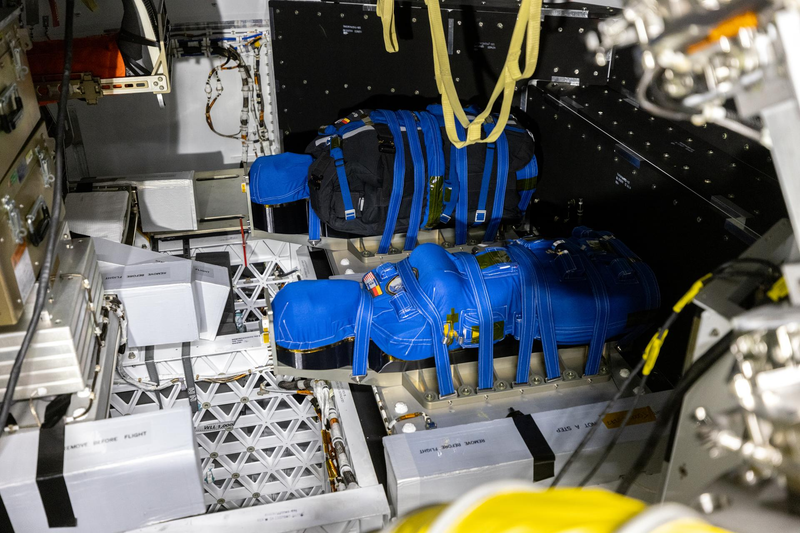


The Matroshka AstroRad Radiation Experiment phantoms Helga and Zohar are installed in the passenger seats of the Artemis I Orion crew module at NASA's Kennedy Space Center, each torso packed with radiation detectors


Two mannequin torsos were strapped into the passenger seats of an Orion spacecraft at Kennedy Space Center in Florida in August 2022, and for 25 days they flew out past the Moon and back. They had no skin, no blood and no nerves. What they carried was the densest survey ever flown of what ionizing radiation does to a human body outside low Earth orbit: thousands of detectors buried in slices of tissue-equivalent material built to mimic bone, organ and skin, plus more than ten thousand small crystals logging every particle that passed through them (IFJ PAN, October 2026). The flight ended in December 2022; the readout is still running. A paper in Radiation Measurements published this past September put the smallest of those crystals, chips of lithium fluoride a few millimetres across, to work on a question that sounds simple and is not: how much radiation does a person actually absorb near the Moon, compared with a person working a few hundred kilometres up over the equator? The Moon is the worse place, and by a smaller margin than intuition insists.

Three particle populations decide what a crew receives. Galactic cosmic rays are the steady background, mostly protons with a thin tail of heavy nuclei at energies past 10^20 eV. Solar energetic particles arrive in bursts after a flare, mostly protons in the tens of megahelectronvolt range. The Van Allen belts hold geomagnetically trapped protons that dominate the radiation budget in low Earth orbit, then vanish as soon as a spacecraft climbs out of them. The three behave very differently against shielding. A few centimetres of water knocks down most of a solar energetic particle and does nothing useful against a galactic cosmic ray, which carries enough energy to cross metres of metal, plastic and water while showering secondary particles.

The useful question is not how much radiation exists but how much a body in a specific place collects. Inside the space station, the earlier Matroshka experiment found the dose piled into shallow tissue near the surface, where low-energy trapped protons dumped their energy early (IFJ PAN, 2026). NASA caps an astronaut’s career effective dose from spaceflight at 600 mSv and selects crews so their lifetime risk of radiation-induced death stays low (NASA-STD-3001, Volume 1). Every millisievert on that ledger is an engineering problem paid for in kilograms.

Artemis I was the first chance to measure any of it with a body in the room. Orion launched on 16 November 2022, flew past the Moon on 21 November at 130 kilometres and again on 5 December at 128 kilometres, and splashed down off San Diego on 11 December (Nature, December 2024). The Matroshka AstroRad Radiation Experiment, led by the German Aerospace Center with NASA and the Israel Space Agency, carried two headless female phantoms built from 38 slices of tissue-equivalent material. Helga flew bare, Zohar wore a prototype vest called AstroRad, and both torsos held more than 12,000 detectors between them (ESA, August 2026).

The first results, published in Nature in 2024, showed how much the spacecraft shapes the environment: dose rates inside Orion varied by a factor of four between the most and least shielded positions, and rotating the capsule during the inner-belt pass halved the dose rate as the thick axis swung into the proton plane (Nature, December 2024). Total absorbed dose across the mission reached 13.47 mGy at the least shielded location, and the two belt crossings still contributed up to 23 percent of that. No solar particle event occurred during the flight, and the only other change was the Moon itself, whose bulk blocked about a third of the cosmic ray flux during the close passes.

Two papers this year fill in the rest. A Science Advances study in August modelled the August 1972 solar storm, which fell between the Apollo 16 and Apollo 17 missions, and found the AstroRad vest could cut effective dose by 58.2 percent, worth up to 193 days of deep space exposure (ESA, 2026). Then in September, Pawel Bilski and colleagues at the Institute of Nuclear Physics of the Polish Academy of Sciences reported the first quantitative use of fluorescent lithium fluoride track detectors from the lunar flyby (Bilski et al., 2026). The crystals are millimetre-scale chips grown by the Czochralski method, pulled slowly from a melt of purified lithium fluoride. Ionizing radiation leaves defects in the lattice that act as color centers, and under blue light those centers re-emit red fluorescence. Under a microscope, a heavy particle appears as a scratch in the crystal marking where energy was deposited.

Reading the pictures was easy. Extracting numbers was not, because cosmic rays arrive from every direction, so tracks wander out of the focal plane and blur into a background glow the camera collects with the sharp segment. Highly ionizing particles cut continuous lines, weakly ionizing ones leave dotted chains, and both change the fluorescence intensity that carries the ionization density. After corrections to subtract that background, the lithium fluoride results land within 15 percent of conventional etched track detectors across the overlapping energy range, and they pick up tracks below those detectors’ threshold (Bilski et al., 2026). The Krakow group also supplied nearly 600 thermoluminescent detectors, chips that store absorbed energy in the lattice and release it as light when heated.

The result underneath the instrument work is the headline: the dose inside the phantoms near the Moon came out essentially uniform, where the station data had been lumpy (Bilski et al., 2026). Trapped protons in low Earth orbit stop at different depths in a body, so they pile dose into the outer tissue. Galactic cosmic rays carry enough energy to cross a whole torso and deposit only a fraction of it along the way, so their dose spreads out almost evenly. The Van Allen contribution disappears near the Moon and the galactic contribution replacing it is larger, so the total goes up; the two effects partly cancel, and the margin is not the jump the geometry of the belts suggests. Dose equivalent still has to be computed with radiation weighting factors, H = sum_R w_R D_T,R, where protons count as one and alpha particles and heavy nuclei count as twenty, because heavy nuclei deliver a disproportionate share of biological damage per unit of absorbed dose (NASA-STD-3001, Volume 1). By that measure a crew on a lunar mission would spend a small fraction of a career’s allowance.

What the uniform dose map changes is design. If the dose is flat, shielding the skin buys little and every kilogram has to go somewhere with real mass: a storm shelter, a water-walled bunk or a berm of regolith on the surface. If the dose is lumpy, as it is in low Earth orbit, the same shelter can be tens of centimetres of structure parked behind the seats. The Moon is also a useful if temporary shield for the rest of the sky: during the Artemis I flybys it cut the cosmic ray dose by about a third simply by being in the way, one more argument for keeping habitats and crewed vehicles apart.

None of this replaces a crewed measurement. Artemis II carried four astronauts around the Moon in April 2026, the first people to leave low Earth orbit since Apollo 17 (NASA), and the missions behind it will wear the dosimeters these crystals have just calibrated. The value of the two papers this year is that they turn a vague dread into a number with an uncertainty attached, the only form in which radiation risk can be engineered against.


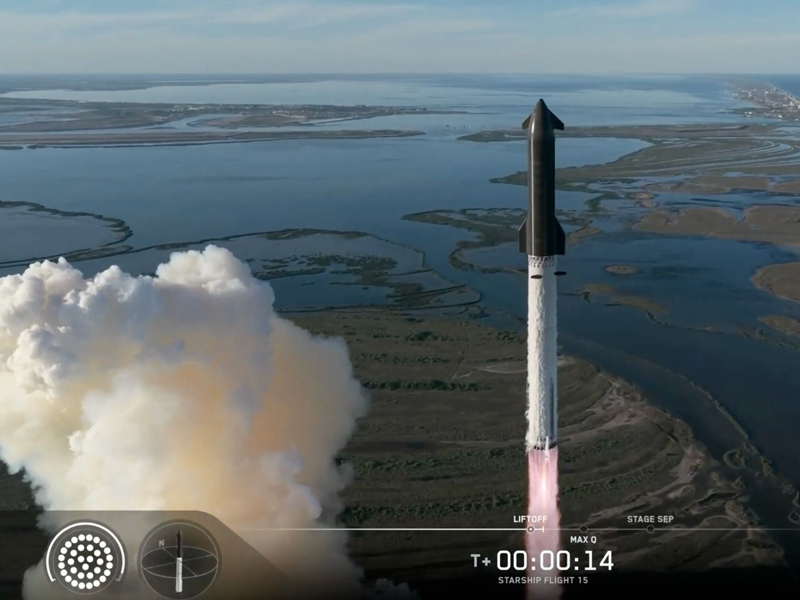
Starship climbing away from the Starbase launch pad on 13 November 2026, the flight computer overlay showing liftoff and the staging timeline.

Flight 15 clears the tower with the vehicle’s own telemetry laid over the image.


Friday night, for the first time, SpaceX tried to bring both halves of an orbital rocket home with the mechanical arms of a launch tower. About six and a half minutes after Starship lifted off from Starbase in South Texas, the catch was called off with the booster already on its way back to the tower it had just left. Super Heavy Booster 22 was falling back, engines lit, when the order came through to divert it into the Gulf of Mexico instead of a catch between the arms. The booster splashed down, and the double catch became a single catch: Ship 42 kept climbing, reached orbit, and is now on the first day of a coast that ends with a return to the same tower at about 21:20 UTC on Saturday. SpaceX’s own account of the decision ran to one sentence, posted a couple of minutes later: Super Heavy has diverted to an offshore splashdown in the Gulf. No cause was given. Dan Huot, the company’s spokesperson, said only that the team would dig into what caused the abort during the booster’s flight back to the tower.

A wave-off is not a failure, and SpaceX has one built into the flight plan on purpose. Every booster that flies carries the option of returning to the tower or coming down in the water, and that second option has already saved a vehicle once. On Flight 6 in November 2024 the tower took damage during liftoff and the booster was diverted to an ocean splashdown instead of attempting a catch on hardware that might have been damaged. The company had caught three Super Heavy boosters before Flight 15, all of them first generation vehicles, and had reflown two of them. It had never caught an upper stage. Flight 15 was the first attempt at a Block 3 booster return, and Block 3 has a poor record so far: the boosters on Flights 12 and 13 were both lost during landing attempts, and on Flight 14 the company skipped the catch entirely and put Booster 21 down in the Gulf. The half of the double catch that did not happen was also the harder half to pull off, on a booster generation that had never been caught.

Flight 15 lifted off at 22:47 UTC on Friday, two minutes into a 75 minute window, pushing more than 18 million pounds of thrust from 33 Raptor 3 engines. The stack passed Max Q a minute in, shut down most of those engines a little after two minutes, and left Ship 42’s own engines to take over the push, clearing the upper stage in the hot staging that follows. One booster engine failed to relight for the boostback burn, which the flight record scores as a partial success. The booster was still tracking back toward Starbase when the catch was called off. Long range cameras caught the Super Heavy coming down under a shroud of steam, then in a fireball as residual propellant ignited, and the vehicle made a controlled splashdown off the Texas coast. The ship had its own longer day ahead of it. It shut its six engines down a little over eight minutes in and coasted on a suborbital trajectory while controllers checked it over. At the 26 minute mark it fired a single Raptor for about 20 seconds, enough to push itself into a 275 km orbit, the second orbit Starship has ever reached. Starlink deployment began at the 35 minute mark and ran for roughly 40 minutes, and by early Saturday SpaceX confirmed that all 26 Starlink V3 satellites were in orbit. Each one adds a terabit of capacity according to SpaceX’s own mission outline, so the batch is worth about ten Falcon 9 flights of V2 Mini satellites, and the ship has roughly 21 hours of coasting ahead of it before a deorbit burn.

The most interesting engineering on Flight 15 is hidden in the payload. Three of the 26 Starlink V3s flying on Ship 42 carry cameras, and during deployment the ship rotates slowly so one of those satellites can turn around and photograph the heat shield tiles on the upper stage’s belly. Those images decide whether the ship gets to come home at all. SpaceX has said this flight’s tiles carry extra retention hardware in the areas most likely to shed during ascent, that it has closed some of the flow paths where plasma could slip behind the tiles, and that a large part of the shield now uses a curved tile design that has shown lower heating in the gaps between tiles. One of the tiles was installed by Mr. Beast, the YouTube streamer, which says something about how the programme now reaches an audience well beyond the launch site. Whatever the cameras find, the ship does not get to argue with it.

The catch itself is mechanical and unforgiving. The booster comes home on three engines, and the arms close below it. The ship has to come home at orbital speed, survive reentry on the same heat shield, then flip from a belly first attitude to tail first in the seconds before the landing burn. The published timeline puts the landing burn at 22 minutes and 32 seconds after liftoff, with three engines dropping to two and then one as the vehicle descends between the arms. Three checkpoints sit between orbit and the deorbit burn: one over Hawaii about an hour and a half in, one off Chile near the middle of the coast, and a last one over Hawaii roughly twenty hours after launch. Miss any of them and the ship comes down in a pre-cleared zone instead, with the Gulf held open for a late reentry failure. The FAA licence issued on launch day covers the return of both stages, including the ship’s flight back over populated areas.

Saturday’s real test is the ship, which has to survive reentry and hit a tower that has never caught anything larger than a booster, at about 21:20 UTC, a little over 22 hours after liftoff. The other thing worth watching is what SpaceX eventually says about Friday. The company’s record on booster aborts mixes hardware trouble, such as the tower damage on Flight 6 and the engine failures on Flights 12 and 13, with deliberate go or no-go calls. An automatic abort that fires without a published explanation is a reasonable thing to be sceptical about on a vehicle generation whose boosters have never been caught. Booster 22 came down in the Gulf instead, which is the cheap outcome. The expensive one is still ahead, and it is the part nobody has done before.


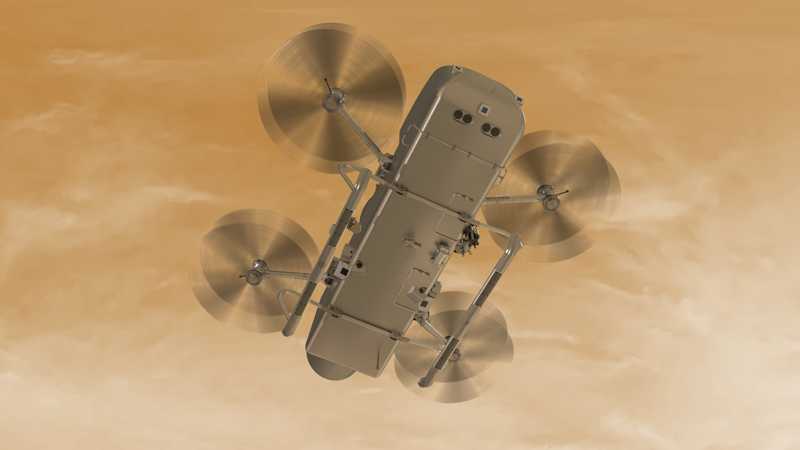
The Dragonfly rotorcraft resting on the orange dune surface of Titan, its octagonal body casting a long shadow across the gravel.

Image: NASA’s Dragonfly rotorcraft on the surface of Titan. Credit: NASA/Johns Hopkins APL, via Wikimedia Commons.


You will probably never stand on Titan. You will certainly never fly over its dunes in the way a helicopter flies over a desert on Earth, because the atmosphere is thick and orange and the gravity is a fraction of what you are used to, and nothing about the place is hospitable. But your name can go. NASA is inviting the public to have their names written onto a microchip that will be carried aboard Dragonfly, the rotorcraft now being assembled at the Johns Hopkins Applied Physics Laboratory in Laurel, Maryland, for a mission to Saturn’s largest moon (NASA’s announcement of the name campaign). People who sign up also receive a personalised digital boarding pass commemorating their place on the list. The window closes at 11:59 p.m. EST on 15 January 2027 (Johns Hopkins APL on the passenger list).

That deadline is a strange thing to set for a spacecraft that will not launch until 2028 and will not arrive at Saturn until 2034. It is also rather the point. A boarding pass for a flight that departs in seven years is not a ticket you will use. It is a token, and its value is symbolic rather than practical, which is exactly what makes the campaign worth running in the first place.

Dragonfly is the first aircraft to fly on another world. NASA describes it as a first-of-its-kind rotorcraft that will move between sites across Titan’s surface, and it is the fourth mission in the agency’s New Frontiers programme, selected in 2019 and managed from Marshall Space Flight Center, with Elizabeth Turtle of APL as principal investigator (NASA’s Dragonfly mission page). The mission profile is long. Dragonfly launches in 2028, arrives in 2034, and then flies for roughly three and a third years, making a flight every one or two Titan days, with each of those flights lasting about sixteen Earth days. The gap between Titan days is the kind of detail that only matters if you are planning to sample a place where the weather changes faster than your fuel.

The vehicle itself is more compact than its mission. It weighs 1,900 pounds, or 875 kilograms, measures 12.5 feet across in both length and width, stands 5.5 feet tall, and carries eight sets of 53-inch coaxial blades (NASA on Dragonfly’s specifications). That eight-rotor arrangement is what allows an octagonal body to fly: one pair can always be turning while the craft sets down on a leg, and the symmetry means it does not need to be kept level in the way a conventional helicopter would. The rotors make noise only in the sense that they displace Titan’s thick nitrogen atmosphere, which is otherwise almost uncannily still.

Power is the quiet constraint on everything else. Sunlight at Saturn is roughly a hundredth of what it is at Earth, so solar panels are not an option, and Dragonfly carries a Multi-Mission Radioisotope Thermoelectric Generator, the same class of device that keeps Curiosity and Perseverance alive on Mars, backed by a 134 ampere-hour battery for the hours when the generator is carrying less of the load. The generator converts the slow decay of plutonium-238 into heat and then into current, and it will do that for years without moving, refuelling or being inspected. It is the reason the vehicle can cross 115 kilometres of Titan in a primary mission that will visit 20 to 30 separate sites, moving tens of miles in under an hour rather than creeping between them the way a rover must.

What Dragonfly is actually looking for is not life. Zibi Turtle, the mission’s principal investigator, puts it plainly: the mission is not about detecting life, it is about investigating the chemistry that came before biology here on Earth. Titan is the useful place to do that because it is chemically strange in the specific ways that matter, with rivers and lakes of liquid methane, thick organic haze, and a surface that is a mixture of water ice and hydrocarbon dust rather than rock and soil. The question Dragonfly carries is whether the same chemistry that ran on early Earth had anywhere else to run, and how far it got. Instruments aboard the rotorcraft will analyse the chemistry of surface samples directly: a mass spectrometer to characterise the organic compounds present, a gamma-ray and neutron spectrometer to measure elemental composition at the surface, and a camera suite to map landforms and processes at several scales. Planned targets include the dune fields and the 100-kilometre Selk crater.

Flying is what makes that possible. Titan’s dense, calm atmosphere and low gravity mean a rotorcraft can cross terrain that would stop a wheeled vehicle cold, and it can revisit sites as the seasons change them. The trade is patience: the mission schedule is built around a solar day on Titan, a sixteen-day cycle that determines when the vehicle can fly and when it must sit still and wait out the weather.

The hardware is further along than it was a few months ago, which makes the campaign feel less like a thought experiment. In late June, the team at APL handed over the fuselage, a structure a little under 13 feet long, so that the next phase of spacecraft integration could begin ahead of schedule, and the work of populating it started in early July (NASA’s Dragonfly blog on the rotorcraft taking shape). The frame carries the features that make the vehicle recognisable, including the landing skids, the cap over the power source and the arms that will hold the rotors. In May the team integrated the high-gain antenna, a 34.4-inch disc that operators use to talk to the craft and pull down its data, mounted on a motorised arm that raises it when the vehicle is stationary and folds it into a locking mechanism before each flight. The craft has also been hung from four bungee cords above the floor of an APL clean room for ground vibration testing, so that engineers can watch how vibration from the rotors travels through the body and whether it interferes with the equipment inside.

None of that would be possible without the transport, and the transport is the reason the campaign was worth running now. NASA has flown names on spacecraft before. A disc of names flew on Curiosity, and names also went up on Kepler, on the Pluto-bound New Horizons probe, and on the Mars orbiter MAVEN (collectSPACE on the tradition of flying names aboard NASA spacecraft). The practice has run for decades and has never stopped being slightly absurd, a piece of the public folded into the payload so that the mission is shared by people who will never see it work. What is new with Dragonfly is the scale of the sharing. One rotorcraft, one microchip, a list of names that could run to millions, and a vehicle that will spend three years moving across a moon in the outer solar system.

The people behind it are unembarrassed about the sentiment. Nicky Fox, associate administrator for NASA’s Science Mission Directorate, says “NASA’s Dragonfly mission will simply blow your mind”, and Turtle says “we want everyone to share in this adventure”. The campaign closes on 15 January 2027, and after that the names are sealed into a chip that will wait on the ground for another year before it rides to Saturn on a rocket, then wait in space for six more years, then be carried down through an atmosphere of liquid methane and nitrogen by a machine that has never existed before. Nobody who signs up will see any of it. They will have been on board, in the only sense available to them.


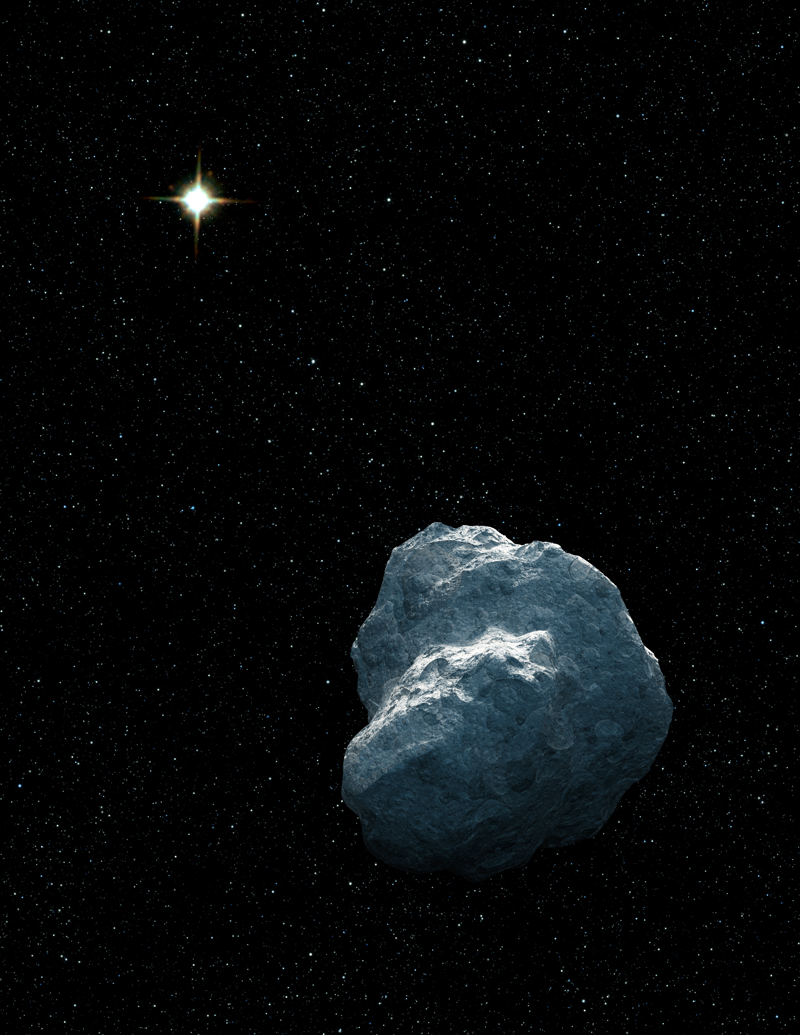
An artist's concept of a single small rocky world lit from one side against a black starfield.

Image: an artist’s concept of a trans-Neptunian object, a small and faint icy body orbiting the Sun beyond Neptune. Credit: NASA, ESA, Leah Hustak (STScI), via Wikimedia Commons.


There is a size of telescope that can look at a planet and a size that can look at a firefly on the Moon. The Webb and Hubble combination that has just found 27 previously unknown objects beyond Neptune is the second kind. One of the new bodies is about 10 kilometres across, roughly the length of six city blocks, sitting tens of astronomical units from the Sun where the light that reaches it has been stretched and dimmed almost to nothing (NASA’s release on the discovery). Most of these things are more than 100 million times fainter than anything you can see with your unaided eye. The survey team’s own way of putting it: one object is as hard to spot as a small swarm of fireflies on the Moon, seen from Earth.

What makes the result more than a photography trick is what the researchers did with the objects once they had them. These are trans-Neptunian objects, the frozen planetesimals that orbit past Neptune and that never went on to become anything larger. They come in two flavours that astronomers sort by the shape of their orbits. The dynamically cold ones sit on tidy, nearly circular paths close to the plane of the solar system, and they formed where they now are, roughly 25 astronomical units out. The dynamically hot ones have been flung onto stretched, tilted orbits and were probably born further out, around 45 astronomical units, before the giant planets shuffled around during the early solar system. The question that has haunted the field for years is whether collisions have been grinding these small objects down over four billion years, scrubbing their surfaces and leaving them unable to tell you anything about how planets form.

The answer the new data gives is no, and the way it says no is quietly strange. Webcam-sized detectors and clever stacking get you part of the way. Webb’s near-infrared camera looked at the same patch of sky at three separate epochs, five days apart, and the team stacked and co-added the frames to dig faint moving specks out of the background, then trained a machine learning network to sift out the false positives that the stacking process creates (Eduardo and colleagues on the luminosity function). The depth they reached was a 40 percent detection threshold at magnitude 28.8 in the infrared, which the paper calls the deepest solar system survey carried out to date. Hubble was not a passenger on that trip. It supplied visible-light imaging of the same field so that the infrared detections could be recovered at optical wavelengths and given colours, since colour is how you read off what a surface is made of.

What the colours showed is the part that has the astronomers talking. The small cold objects came out occupying a narrow band of colours, consistent with a single sequence already established for larger cold objects, with no sign of the pattern breaking at smaller sizes. The excited objects showed a broader spread of colours, matching the several distinct compositional families seen among their bigger relatives (Morgan and colleagues on the colour measurements). In other words, the tiniest bodies still carry the chemical signature of the place they were born, roughly four and a half billion years after the fact. Anastasia Morgan, a PhD candidate at Northern Arizona University who led the colour work, described them as somehow “remembering” and preserving the history of how they were made. The paper’s own conclusion is that the characteristic colour distribution of these objects extends to smaller sizes than anyone had previously studied, which points to a primordial origin rather than to size-dependent collisional processing.

The size distribution carries the same message from a different direction. The number of objects as a function of brightness fits a single power law with a slope of 0.29, and the cold and hot subsamples are consistent with each other. That is a slightly awkward result for anyone hoping the two populations formed in genuinely different places under different conditions, because it suggests the planetesimal formation process turned out to be largely indifferent to whether the surrounding disk was hot or cold, dense or fluffy. Marielle Eduardo, a PhD candidate at the University of Victoria who led the size work, put it as the process being insensitive to disk conditions and producing similar planetesimal sizes either way. The scenarios under test are the ones that have been winning ground for a decade, streaming instability followed by pebble cloud collapse, in which aerodynamic drag concentrates pebbles into self-gravitating clumps that collapse into planetesimals of roughly 100 kilometres in size. The low densities, high binary fractions and compositional similarities that have long supported that picture all remain in place.

There is one genuine puzzle, and the team is not pretending otherwise. The models predicted more of these small objects than were found. Fewer tiny bodies than expected is not what a collision-dominated picture would predict, since grinding should have produced plenty of leftovers. That leaves two readings the authors put forward: either there really are fewer collisions out there than the models assume, or these objects have some way of holding on to their original surfaces despite being hit. Both would be a surprise, and both would need more data to settle. The survey itself was not designed to last. Three epochs of a patch of sky a fraction of a square degree across is a small sample of a very large population, and the machine learning filter that made the discovery possible also discards real objects along with the false ones, a loss the authors track and try to correct for.

What all of this leaves is a set of small, cold, apparently unaltered leftovers that still remember where they formed. That is a better set of fossils than the field had a week ago, and it is the kind of result that tends to be dull for exactly one afternoon and then interesting for a decade. The next step is not hard to guess and it is slow: more field, more epochs, more of the faintest end of the distribution, until the count of objects smaller than ten kilometres stops depending on how the data are cut. The fireflies are still there. They were always there. The difficulty has been that nothing human-made was pointed at the right patch of sky for long enough to notice them, and that Webb and Hubble, pointed together at the same three square arcminutes of nothing in particular, finally were (Phys.org coverage of the findings).


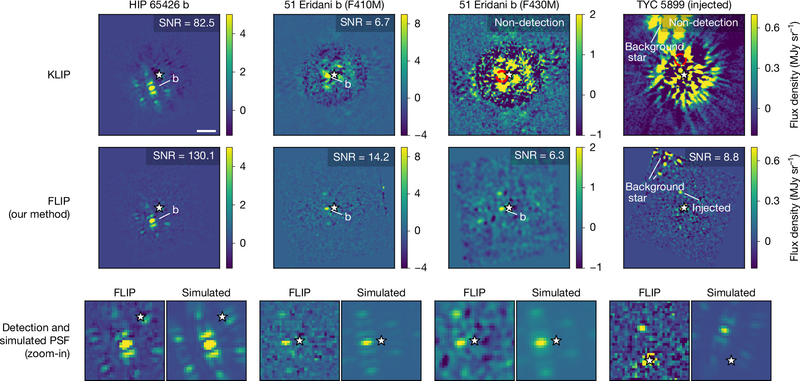
JWST NIRCam coronagraphic images of four target stars processed with the standard KLIP method (top row) and the new FLIP physics-based model (middle row), with zoomed detections below.


Somewhere in the archive of the James Webb Space Telescope sits a picture of a planet the standard analysis pipeline could not see. The planet is 51 Eridani b, a hot gas giant roughly three times the mass of Jupiter, about 96 light-years from Earth, orbiting a star only around twenty million years old (Chauvin et al. 2015). Webb observed it at 4.10 and 4.30 microns. In the longer band, where carbon dioxide in its atmosphere absorbs, the published analysis came back empty (Balmer et al. 2025). The planet’s light was in the detector data all along, buried in the scattered light of the star, and the subtraction method the field had used for two decades could not lift it out.

Then a doctoral student at Northwestern University built a physical model of the telescope and let it fit itself to the real observations. Subtract the synthetic starlight and 51 Eridani b was there, at 6.3 sigma, in a band where it had never been seen.

Direct imaging studies a planet’s own light rather than inferring it from a dimming star, and it is the hardest kind of observation in astronomy. Even the brightest young giants run about a hundred-thousandth as bright as their hosts in the near-infrared, a contrast of roughly 10^-5, and the next generation of space observatories aims for 10^-10, enough to photograph an Earth analog around a Sun-like star (Nature, Nov. 2026). Webb’s answer is a coronagraph, a mask inside the instrument that blocks starlight before it reaches the detector. Blocking is not removing. What leaks past is a field of speckles shaped by every micron of surface error, thermal wobble and misalignment in the optics.

The standard answer has been to observe a different star of similar type and brightness and use that image as a reference. Karhunen-Loeve image processing, known as KLIP and introduced by Soummer and colleagues in 2012, builds principal components from a library of reference frames and projects the science image onto them, discarding the directions that hold only star-like structure (Soummer et al. 2012). It has been the workhorse of direct imaging ever since, with one structural weakness: reference and science images are never identical. As Jason Wang, the Northwestern physicist who co-led the new work, put it, “We try to make telescopes extremely stable, but there are extreme engineering challenges that we haven’t quite solved yet” (Northwestern, Nov. 2026).

Those instabilities are mundane and unforgiving. Webb’s cryocoolers hold the near-infrared instrument near 40 kelvin, and their little motors shake the mirrors. A thermal change can expand a mirror by a picometer, enough to reorganize the speckle pattern completely. The telescope drifts in pointing too, so the star sits in a slightly different place behind the coronagraph mask each time. Such mismatches set the floor on how faint a planet you can detect, and that floor belongs to the subtraction method rather than to the detector or the optics.

The team, led by astronomy graduate student Rodrigo Ferrer-Chavez with Jason Wang, Katherine Bouman of Caltech, William Freeman and Brandon Feng of MIT, and Laurent Pueyo and Marshall Perrin of the Space Telescope Science Institute, named their method FLIP: Physics-based Learning for Imaging Planets (Nature, Nov. 2026). Where KLIP combines images taken at different times, FLIP simulates what the telescope did. It starts from STPSF, the open-source optical model the Space Telescope Science Institute maintains for predicting Webb’s point spread function, rewritten in PyTorch so that it is differentiable. That lets the software compute analytic gradients through the simulation and optimize it directly against real detector data.

The model carries roughly a million free parameters, in four families: the star’s flux and position behind the mask, the optical path difference before the mask, the optical path difference after it, and the response of each detector pixel. The first two capture pointing error and mirror misalignment, the third captures instrument-specific phase errors, the fourth soaks up pixel effects the optics cannot explain. The optimization runs in two stages. Stage one calibrates the full model against a reference star, where no planet can hide, repairing inaccuracies in the nominal optics. Stage two then tunes a reduced set of parameters on the science image itself, recovering whatever changed since calibration. On a single NVIDIA A30 GPU, stage one takes ten to fifteen minutes and stage two ten to thirty (Nature, Nov. 2026).

The gains were not marginal. On HIP 65426 b, the first exoplanet Webb ever photographed directly, the signal-to-noise ratio rose from 82.5 to 130.1, a factor of 1.6. On 51 Eridani b at 4.10 microns it went from 6.7 to 14.2, a factor of 2.1. In the 4.30-micron band it went from a non-detection to a 6.3-sigma detection, the first image of the planet where carbon dioxide absorbs. That band is out of reach from the ground because Earth’s own atmosphere absorbs there, so this is an independent look at a planet whose carbon dioxide was inferred from the ground (Northwestern, Nov. 2026). The clearest gain came on a star with no known planets. TYC 5899 was observed four months after the reference stars a self-referenced survey used to build its speckle library, a drift that should have wrecked the subtraction. FLIP recovered an injected fake planet KLIP could not see, and delivered roughly fifteen times better sensitivity at half an arcsecond and five times better at one arcsecond. It also beat the team’s estimate of the best KLIP could achieve given realistic drift.

Two details deserve attention. The first is how the optimization knows when to stop. Push a flexible model against real data long enough and it starts eating the planet you are hunting, so the team injects synthetic planets at several separations, tracks their signal-to-noise against iteration count, and halts when those curves plateau, around eleven thousand iterations (Nature, Nov. 2026). The second is the honest cost. FLIP subtracts some of the planet’s own signal along with the starlight, losing between 5 and 60 percent depending on separation, against a comparable range for KLIP. It has also not reached the floor set by photon noise alone. The authors are explicit that no observation hit that limit, that the models cannot yet attach uncertainties to the drift terms they solve for, and that the detector model needs work before it can handle the deepest exposures of bright stars.

The method does not need a new telescope to matter. It extends to Webb’s Mid-Infrared Instrument, where thermal background rather than contrast sets the floor, and to ground-based telescopes, where data volumes are severe but the photon limit is worth chasing at short wavelengths, where the extremely large telescopes could otherwise reach only for temperate terrestrial planets around low-mass stars. More consequential is the error budget of the Habitable Worlds Observatory, whose picometre-level stability requirement, one hundred to a thousand times tighter than Webb’s, is a main reason its design is so hard. If processing can absorb part of that instability, the requirement shrinks and the observatory gets cheaper to build. The Nancy Grace Roman Space Telescope, launched on 30 August 2026 with the Roman Coronagraph Instrument aboard, is the obvious place to test that: it was designed in part as a pathfinder for this class of hardware (JPL).

For thirty-five years the field has treated the stability limit as a property of the telescope. This result suggests it is substantially a property of the software, and that a fair amount of astronomy is sitting in archives waiting for better subtraction.