OrbitalHub

Where curiosity reaches escape velocity.

Domain is for sale. $50,000,000.00 USD. Direct any inquiries to contact@orbitalhub.com.

Archive for 2026


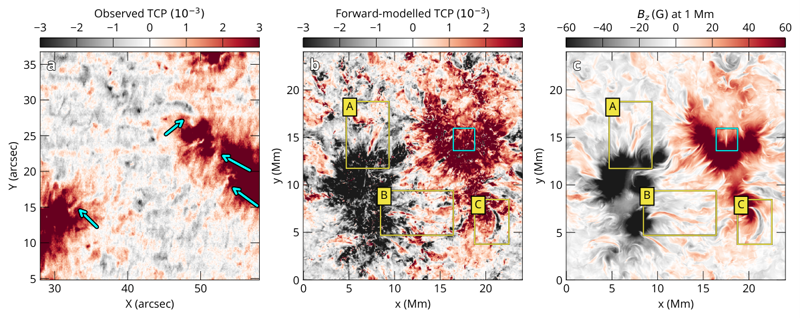
Three panels comparing the observed total circular polarization map of a quiet-Sun region from SUNRISE III, the same quantity forward-modelled from a MURaM-ChE simulation, and the simulated vertical magnetic field one megametre above the solar surface, with three tracked features labelled A, B and C.

Figure adapted from Ondratschek et al. 2026 (arXiv 2609.20933), reused under CC BY-SA 4.0.


Most of the Sun is uneventful, and that is exactly the problem. Sunspots get the headlines, flares get the coverage, and the rest of the surface, the part astronomers call the quiet Sun, gets treated as background scenery. Yet a magnetic field still threads every one of those quiet patches, and it has to carry energy upward into a corona that reaches temperatures above a million kelvin. A balloon-borne telescope that spent six and a half days above the Arctic Circle in July 2024 has now delivered the sharpest look yet at what that field is doing in the places nobody was looking. Three papers published this summer describe a magnetic canopy over a quiet region that is nothing like the simple expanding arch that textbook models have assumed for decades. The canopy turns out to be full of narrow threads, some of them running against the grain of the surrounding field, and a companion simulation says those threads are twisted ropes of magnetic flux, the same kind of structure that powers flares.

Why the quiet Sun earns this much attention comes down to area and plumbing. Quiet-Sun regions cover most of the solar disk, so whatever they do, they do almost everywhere. Their magnetic fields are weak, an order of magnitude below the values in active regions, which is why ground-based telescopes struggle to measure them: atmospheric turbulence blurs exactly the fine structure that matters. The chromosphere, the thin atmospheric layer sitting on the visible surface, is also where the Sun’s energy problem lives. Something has to move energy from a surface too cool to power the corona into a corona with temperatures above a million kelvin, and the candidate answers all involve magnetic fields that are far more tangled than a smooth model would suggest. Spicules, the narrow jets that shoot up from the surface, have been promoted in recent years as the main carriers of mass and energy into the upper atmosphere, yet their magnetic field strength has never been pinned down with confidence. As Universe Today notes in its coverage of the papers, the true strength inside those jets had resisted measurement. If the quiet Sun turns out to be full of twisted flux ropes, then the same structures that set off flares in active regions are threaded through places the Sun barely seems to be doing anything at all.

The instrument that cracked this open was built by people who wanted a telescope with a mirror no space agency was likely to fund. Sunrise III is a one-metre solar telescope hung under a helium balloon that floated at roughly 35 kilometres, above nearly all the air that distorts solar observations from the ground. It lifted off from the Esrange Space Center near Kiruna in Sweden on 10 July 2024 at 6:24 in the morning CEST, after several weather delays, and over the next six and a half days it tracked westward along the Arctic Circle and across the Atlantic while the Sun never set (Max Planck Society launch release). The observatory weighed about three and a half tonnes, the balloon expanded to around 130 metres across, and the instruments aboard returned roughly 200 terabytes of data, enough to resolve structures as small as 50 kilometres on the solar surface (NAOJ on the first images). Four space probes and ten ground telescopes watched the Sun at the same time as part of a coordinated campaign. The payload was an international suite, including SCIP, the Sunrise Chromospheric Infrared spectroPolarimeter, a near-infrared instrument built and led by Japan’s National Astronomical Observatory of Japan, which measures the full polarization state of several spectral lines at once and can follow the magnetic field continuously from the photosphere up through the chromosphere (NAOJ release on the results).

Three papers from that flight appeared in the Astrophysical Journal Letters over the summer, released together by NAOJ and the National Institute for Natural Sciences, with Masahito Kubo of the NAOJ SOLAR-C project, Yoshihiro Naito of the Graduate University for Advanced Studies, and Yukio Katsukawa of the NAOJ solar science observatory named as the contact authors. Kubo and colleagues report on a quiet region near disk centre, mapped in a single uninterrupted scan of 107 minutes with a field of view 58 arcseconds on a side and a polarimetric precision of three to four hundredths of a percent of the continuum (Kubo et al. 2026). Their maps show elongated thread-like magnetic structures above the internetwork, the darker lanes between the bright network lanes, and no obvious counterpart directly below them in the photosphere. The threads are narrower than an arcsecond, which on the Sun is a distance of roughly 700 kilometres, and their line-of-sight field strength under the weak-field approximation comes out 10 to 20 gauss weaker than the canopy around them. In the clearest cases the polarity of a thread is the opposite of the canopy it sits inside.

The other two papers deal with the rest of the puzzle. Ondratschek and colleagues, working with a chromospheric extension of the MURaM magnetohydrodynamic model built at the Max Planck Institute for Solar System Research, fed the observed magnetic map into a three-dimensional radiative simulation and reproduced the fine structure in the synthetic polarization signal (Ondratschek et al. 2026). In the model, the opposite-polarity features appear about a megametre above the surface, running for two to seven megametres with widths near one megametre, and they belong to twisted flux ropes that persist through most of a 21-minute sequence. Naito and colleagues looked instead at the solar limb, where off-limb spicules can be seen against the sky, and measured their fields directly (Naito et al. 2026). Their line-of-sight values reach 20 gauss and stay roughly constant over the first three arcseconds above the limb, then spread out to about 40 gauss between three and six arcseconds, and the way the line profiles change shape with height says the wider number is really a statement about how deeply the line-forming layer can see into a forest of overlapping spicules rather than a measure of any one jet.

The measurement behind all of this is old physics applied with new precision. A magnetic field splits the wavelengths of a spectral line into components, and the polarization of those components, described by the four Stokes parameters, encodes the field’s strength and direction. Because Ca II 854.2 nanometre light forms in the chromosphere and Fe I 846.8 nanometre light forms in the photosphere, observing at both wavelengths shows how the field changes with height. What a balloon buys is the freedom to do that without the atmosphere smearing the finest structures, and the numbers reflect it: a ten-second dwell at each slit position and a polarimetric noise floor of a few hundredths of a percent is enough stability to invert a single line for a magnetic field and trust the result. The MURaM-ChE model then handles interpretation, taking a three-dimensional field configuration, computing what an observer would actually measure, and matching that synthetic signal against the real one.

What the three papers together say is that the Sun’s least active regions are not simple. The magnetic field above them is organized into tight, twisted substructures that can carry the opposite polarity to their surroundings, embedded in the apparently ordered canopy that springs from the network. That has a direct consequence for solar physics beyond the quiet Sun, because twisted flux ropes are the structures that reconnect and release energy, and they are usually associated with flares in active regions. Finding them in the quiet Sun suggests the inventory of twisted field on the disk is much larger than anyone assumed, and that small-scale reconnection may be an ordinary part of the quiet atmosphere rather than an exceptional event. The instruments also have limits worth naming: six and a half days is a short window, the balloon could observe only a narrow band of wavelengths compared with a space telescope, and one field of view cannot map the whole Sun. Still, the data volume will keep feeding the community for years, and the next step is a dedicated space observatory built for the same job, SOLAR-C, which NAOJ already runs as a project and which can watch the same tangled field for months instead of days.




A New Glenn booster rises past its lightning towers at Cape Canaveral in November 2025, venting cryogenic hydrogen as the first stage lights seven engines.


There is a 1.37-million-square-foot factory going up in Cape Canaveral that Blue Origin says will turn out as many as 150 upper stages a year once it opens next summer. There is also a wrecked launch complex four miles north where a New Glenn rocket used to stand, because a pre-launch static fire in May tore the vehicle apart and took much of the pad with it. Both facts landed in the same week. On Friday, 16 October 2026, the company announced the factory, two additional launch pads, two more landing ships for booster recovery and a payload processing building it is putting up with the US Space Force (Blue Origin, 16 October 2026).

The gap between those two stories is the most honest description of the American launch business in 2026. Blue Origin has flown New Glenn three times. The first flight, on 16 January 2025, reached orbit with the Blue Ring Pathfinder test payload. The second, that November, sent NASA’s ESCAPADE probes toward Mars and returned the first stage to a landing ship for the first time. The third, in April 2026, reused a booster for the first time and deposited an AST SpaceMobile satellite into an orbit its owner did not want. The fourth vehicle was sitting on the pad for a static fire when it came apart, and the damage to 36A has pushed the company’s return-to-flight target from the end of this year toward, in Ars Technica’s read, the first months of 2027 (Spaceflight Now, 16 October 2026; Ars Technica, 16 October 2026).

Cadence is the metric that decides whether a rocket is a curiosity or a business, and it is the only one Blue Origin has been talking about publicly for years. The economics are unforgiving in a specific way. A first stage costs hundreds of millions to build and throws away most of its value on a single burn unless it flies again. Refurbishment cost, not manufacturing cost, is what drives price per kilogram down once a vehicle family reaches flight rate. Falcon 9 crossed that line years ago. New Glenn has not crossed it once, and every dollar Blue Origin is spending in Brevard and Orange counties is an argument that it expects to.

The reason to believe the spending is serious is the market underneath it. SpaceX has stopped selling commercial rideshare on Falcon 9 in order to put its capacity behind Starship, and satellite operators are already struggling to buy Falcon launches beyond 2028 (CNBC, 16 October 2026). Venture capital firms counted $92.5 billion going into the commercial space sector in the first three quarters of 2026, and the Air Force has told Congress it faces a surge in demand for heavy lift that it cannot currently meet. Blue Origin is one of very few vehicles in the world that can put 45 metric tonnes into low Earth orbit, and the only American one besides Falcon Heavy.

The announcement was also, underneath the concrete and steel, a bet on a specific vehicle. Blue Origin is not scaling the rocket it has. Two of the new pads are expected to serve the 9×4 variant, which mounts nine first-stage engines instead of seven and is designed to carry more than 70 tonnes to orbit, over 20 tonnes to trans-lunar injection and a payload inside a fairing 8.7 metres across. The Rocket Park expansion exists specifically to build those upper stages, at a rate that implies a fleet of roughly 150 flights a year, which is more launches in a year than the entire United States has flown in the last two decades.

What sets a ceiling on all of this is paperwork rather than metallurgy. Blue Origin’s Federal Aviation Administration launch licence, VOL 24-133, authorises up to 12 New Glenn flights a year from Space Launch Complex 36, a number set by the environmental assessment the Air Force completed in 2016. Blue Origin has asked for 50, and the agency’s draft assessment for the increase, released in September under docket FAA-2026-9841, is now in public comment. The proposed action is broader than a count. It covers the static fire engine testing that precedes each campaign, the downrange landings on ocean platforms, the recovery of payload fairings and the temporary airspace closures that a launch demands (FAA, September 2026). Comments close on 30 October; a virtual public meeting was held on the evening of 22 October.

That is where the engineering gets interesting. New Glenn is a two-stage vehicle with an optional third, burning liquid oxygen and liquid hydrogen, and that propellant choice is what makes the numbers hard. Reaching low Earth orbit takes roughly 9.4 kilometres per second of delta-v, and the rocket equation, Δv = v_e * ln(m_0 / m_f), punishes any attempt to get there with a high exhaust velocity. Hydrogen delivers one of the best specific impulses of any chemical propellant and one of the worst densities, about 71 kilograms per cubic metre against roughly 820 for kerosene, so the tanks are enormous and the vehicle is 98 metres tall. Staging is how the logarithm gets beaten, and recovering the first stage is how you stop paying for it twice.

Adding two engines to the base, from seven to nine, is the other half of the answer. More sea-level thrust does not change the exhaust velocity; it changes how much of the vehicle can be payload before the engines run dry. Between the 7×2 and the 9×4, Blue Origin trades a pair of engines and some structural mass for 25 additional tonnes to orbit. Whether that trade closes depends on what the new engines cost to build and refurbish per flight, which is the number Blue Origin has not published and every customer is quietly modeling for themselves.

The rest of the machinery is ordinary until you count it. Two extra landing ships exist because a downrange stage return cannot be improvised; once the booster commits, the sea platform has to be there. The Space Force payload building, with four bays, exists so that four spacecraft can be processed at once instead of one. Blue Origin says it has now spent more than $3 billion in Florida, employs over 5,000 people there and buys from 500 state suppliers across more than 20 sites, and it is building its own fairings and recovering them for refurbishment (Blue Origin, 16 October 2026). Each of those is a small line item. Together they are the difference between a rocket company and a launch provider.

The honest question is which constraint binds first. Blue Origin could have every pad, ship and factory it has ordered by 2028 and still be flying at single digits if the vehicle keeps having bad days, because the May explosion cost it a rocket, a pad and roughly a year. It could also fly cleanly and still be throttled by an environmental assessment that has to weigh one launch a week against a coastline. The company is betting that both can be solved in parallel, and that whoever is first to fly weekly has the market locked for a decade. In late 2026 that bet is still unproven, and the factory going up in Cape Canaveral is a statement of intent rather than a result.


A long-exposure photograph of a SpaceX Falcon 9 climbing through the pre-dawn sky from Cape Canaveral, the exhaust plume forming a bright diagonal streak through scattered cloud above silhouetted palm trees. Source: SpaceX, via the Bandwagon-5 mission page. Full-size file: https://sxcontent9668.azureedge.us/cms-assets/assets/20261020_CC_Band_5_DSC_0759_desktop_81035d0e4c.jpg


At 7:04 a.m. EDT on Tuesday, October 20, a Falcon 9 lifted off from Space Launch Complex 40 at Cape Canaveral carrying 32 payloads. The one that mattered most to the company flying it was its own hardware. Starfall, a broad, uncrewed reentry capsule, went up for the second time in its life and left the rocket last, separating from the second stage two hours and 48 minutes after liftoff, once the commercial satellites were gone (Space.com). By 8:45 a.m. EDT SpaceX had confirmed every customer payload was deployed (Spaceflight Now). What the company did not say, and has not said since, is what Starfall carried, how long it stayed up, or what happened on the way down. The same company that publishes booster flight counts to the digit has treated this vehicle with the discretion usually reserved for something it does not want competitors reading.

The most detailed public description of the capsule is not a SpaceX document. It is the environmental assessment the company filed with the Federal Aviation Administration in May to get permission for the flight, and that document treats Starfall as infrastructure rather than as a spacecraft demonstration. The filing gives two reasons for the program: moving urgent cargo point to point, and building an orbital manufacturing economy by selling time in microgravity and vacuum with a ride home, what the assessment calls safe return from orbit as a service at scale. Each unit is a short cylinder about 0.75 meters tall and 3.1 meters across, roughly 2,100 kilograms empty, rated to carry 1,000 kilograms of payload down to the surface, for about 3,100 kilograms with a load aboard. A graphic shown in SpaceX’s initial public offering roadshow material appears to depict a satellite bus with slots for as many as four capsules, labelled for manufacturing in orbit (Spaceflight Now on the June debut). Whether that bus ever flies is a different question from whether the capsules do. The permission itself is small: the assessment covers two reentries into a Pacific recovery zone, which means the flights that have happened are the entire scope of what SpaceX currently has authorization for. A service business needs a licensing footprint built well ahead of the first customer invoice, and there is no public sign of that footprint yet.

The manner of the June debut is the best explanation for the current reticence. SpaceX kept the payload off the public manifest until close to flight, shared a rendering rather than hardware photography, and cut its public timeline after the booster landing so that neither the upper stage nor the capsule appeared in the broadcast. When deployment was confirmed that morning, the company had not disclosed how many capsules were aboard. On October 20 the capsule again rode to orbit among dozens of unrelated smallsats, again last to separate, again without a stated payload. Two flights in, the public record describes the vehicle’s architecture in detail and its missions not at all.

The ride itself was routine by SpaceX standards and the manifest was not. The launch had been scrubbed the previous morning over weather in the booster recovery zone, and the 45th Weather Squadron gave the Tuesday window a 90 percent chance of acceptable conditions. The rocket flew southeast, and booster B1085, on its nineteenth flight, came down on the droneship A Shortfall of Gravitas about nine minutes after liftoff. Twenty of the thirty-one commercial payloads were manifested by Exolaunch, among them four radio-frequency monitoring satellites for HawkEye 360, four communications satellites for the Finnish firm Iceye, and six navigation satellites for Xona Space Systems. Planet flew an Earth-observation satellite called Pelican-12. Portal Space Systems used the ride to demonstrate Starburst-1, a 260 kg spacecraft with room for a 50 kg customer payload, with commercial flights advertised from 2027, a mix the company describes on its Bandwagon-5 mission page as cubesats and microsats (Spaceflight Now).

The most interesting neighbor on that manifest was Varda’s W-Series 7 capsule, about three times smaller than Starfall, carrying a cancer drug called Protac to test whether microgravity produces crystal forms with better solubility. The flight was Varda’s ninth capsule launched despite the number in its name, following W-8 and W-9 on the Transporter-18 mission earlier in October. Two returning capsules on one rocket, one of them operated by a startup that has been doing this routinely while SpaceX works quietly on its own, tells you something about where the industry actually sits. Bandwagon is the quieter of SpaceX’s two rideshare programs. Transporter has flown eighteen missions, and the first in January 2021 delivered 143 payloads in a single launch, a record that still stands.

The design is where the vehicle stops looking like a spacecraft and starts looking like a product, and the constraints live there too. According to the FAA assessment, Starfall carries no main propulsion system. It has an attitude control system that uses inert gas to orient the craft, which means it can point itself but cannot perform a deorbit burn, so it cannot shorten its own stay in orbit or choose where it comes down (Spaceflight Now). With no engine to light, the only brake available is atmosphere, which makes the capsule’s blunt shape less a styling choice than the thing that lets it survive the trip: a wide body presents a lot of area to slowing air, and the assessment notes the capsules can fly either a low Earth orbit or a suborbital profile, on a Falcon 9 or on Starship. Orbital energy sets the heat load, so the shape that handles the steepest possible reentry is the one that can also handle the shallowest. The capsule is built in two pieces that separate after reentry: an aluminum top plate partially wrapped in thermal protection material, about 1,400 kilograms, and a carbon-fiber heat shield of roughly 700 kilograms holding two large compressed nitrogen bottles of 151 liters each plus several smaller auxiliary bottles. Lifting the top plate exposes the parachute, and there are three of them, a drogue, a pilot and a main, attached at four reinforced points. Recovery happens in the Pacific, the same ocean used for Dragon. The June flight reportedly validated the capsule’s autonomous guidance before a targeted splashdown (SatNews).

Two flights is a test program, not a service. What SpaceX has not established is the cadence, the price, or whether any paying customer has boarded, and the absence of a named payload on the second flight suggests the answer to the last question is still no. The competitors are not standing still: Varda has flown nine capsules and is running pharmaceutical experiments on them, and Portal is building a vehicle that does the same orbital delivery job for small payloads. What would move Starfall from demonstration to business is not a third flight but the paperwork that follows one, since the current authorization covers exactly two reentries. Until SpaceX files for more and names a customer, the accurate description of the capsule is the one the company keeps declining to give.


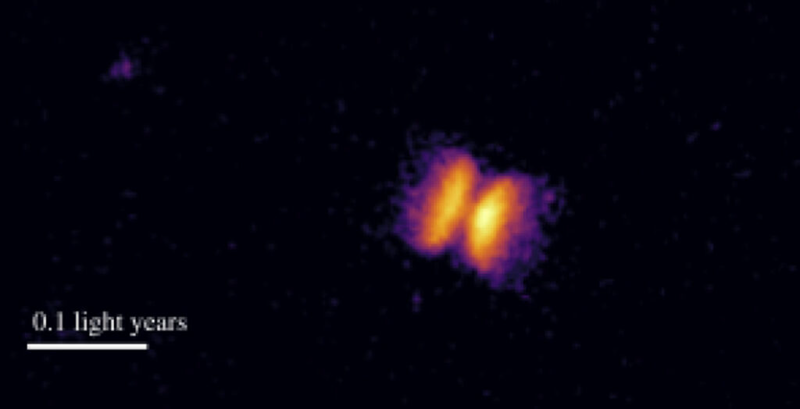
V445 Puppis: the Milky Way's only helium nova, finally exposed after 25 years in the dust. Image: 2026 07 25 v445 puppis helium nova bullets.


A white dwarf does not need to do anything dramatic to set the record books of stellar astrophysics. It only needs to wait. For V445 Puppis, the wait ended this week when a team led by John Mills at the University of Warwick finally traced the system back to its ingredients: a compact stellar corpse pulling material from a rare stripped helium star. The RAS press release for the Royal Astronomical Society’s National Astronomy Meeting in Birmingham described the result, and it pinned down what astronomers have wondered about since November 2000, when a point of light in the constellation Puppis brightened and then vanished behind its own debris.

The eruption produced a bipolar outflow stretching more than 1.5 trillion kilometers, with clumps of gas clocked at roughly 8,900 kilometers per second, about 3% of the speed of light, racing through the ejecta. The press release calls them “bullets” and notes that nothing of their kind has ever been seen in any other nova.

Almost every nova we know about is hydrogen-rich. A white dwarf siphons gas from a Sun-like companion, the stolen layer gets compressed and hot, and a thermonuclear runaway on the white dwarf’s surface flashes the system into view. The whole cycle takes a few weeks to a few years, then the dwarf goes back to feeding. Helium novae are different in a way that sounds like physics trivia but is genuinely awkward for the textbooks: the accreting layer contains almost no hydrogen at all. The fuel has been swapped out, and only a handful of candidates in the Milky Way match that description. V445 Puppis, the only one currently confirmed, is essentially the only laboratory on hand for studying what such an explosion actually looks like before, during, and after.

That matters because helium novae are one of the proposed pathways to Type Ia supernovae. White dwarfs that keep accreting material approach the Chandrasekhar mass limit, where the star can no longer support itself against electron degeneracy, and the result is one of the most important kinds of explosion in observational cosmology. Type Ia supernovae are the standard candles behind the 1998 discovery of the accelerating expansion of the universe, the work honored by the 2011 Nobel Prize in Physics. Understanding their progenitors is one of the standing problems in stellar astrophysics, and helium novae sit on one of the more plausible candidate routes.

The same logic explains why a 25-year wait is not the embarrassment it sounds like. The eruption’s own dust disk made any direct view of the central binary impossible through optical and ultraviolet light, and the only way to see through was to wait for the obscuring veil to thin enough for a new generation of instruments. That window has now opened.

V445 Puppis erupted in late November 2000 and was classified almost immediately as a nova, although the spectrum looked strange from the start. There was helium, carbon, and a long list of heavier elements, but essentially no hydrogen, the element that defines nearly every other nova on record. For the next 25 years the system sat inside a thick dust torus, bright in the infrared from the re-radiated light of the eruption but stubbornly opaque at the wavelengths where stellar spectra carry information about the two stars at its center.

The new result came from a deliberate effort to combine four observatories. Mills pulled infrared images from the European Southern Observatory’s Very Large Telescope, optical images from the Hubble Space Telescope’s Wide Field Camera 3, long-term spectroscopy from the Southern African Large Telescope, and photometric monitoring from NASA’s TESS satellite. The four cover the infrared through visible bands, plus time-resolved brightness measurements that make it possible to extract the orbital period. John Mills’ research page at the University of Warwick describes the same approach in his group’s broader work on hot and cool binaries.

With the dust clear enough, the spectrum showed strong ionized helium lines consistent with material actively falling back onto the white dwarf. The brightness curve gave an orbital period of 3.7 days, about twice the value the most widely cited prior estimate had produced. A 2023 paper in The Astrophysical Journal Letters, “V445 Puppis: Dustier than a Thousand Novae,” had estimated the eruption threw off between 0.01 and 0.1 solar masses of gas, which would actually mean the white dwarf is losing mass over repeated eruptions rather than approaching a Type Ia explosion. The 3.7-day orbit and the active accretion add two more data points to that open debate.

Embedded inside the bipolar outflow, the Hubble imaging also resolved distinct compact knots of gas, possibly oxygen-rich, moving at speeds comparable to the fastest ejecta ever measured in a classical nova. The RAS announcement explicitly notes that no analogous structures have been observed in any other nova, which is why Mills flagged the origin of the bullets as the unresolved problem in the talk.

The work was reported at NAM 2026 in Birmingham on Wednesday 22 July 2026, in a talk titled “Long-term evolution of the helium nova V445 Puppis and the emergence of the underlying binary.” As of this writing the results have not yet gone through formal peer review, a point Universe Magazine’s coverage makes explicit, but the data sources themselves are public and the orbital measurement should be straightforward to confirm.

A classical nova does not destroy the white dwarf; the explosion only blows off the freshly accreted surface layer. The energy budget is well understood: hydrogen-rich material piles up under degenerate conditions, the base reaches roughly 10 million K, and a CNO-cycle hot layer drives the runaway. The peak luminosity is comparable to a small star, which is why distant novae can briefly outshine the combined light of their host galaxies.

Helium novae follow the same broad pattern with hydrogen-poor fuel, and the mechanics are fuzzier because so few examples exist. The white dwarf in V445 Puppis cannot be accreting hydrogen-rich gas, which is what motivates the “stripped helium star” companion model, a star that has already lost its hydrogen envelope through prior interaction. The models get the orbital period, the spectral lines, and the mass loss to line up at least approximately, although the geometry of how the white dwarf pulls material off its donor’s outer layers is still being worked out.

The bullet problem is the genuinely new piece. A 2009 infrared study had identified clumps moving at 6,700 km/s in a narrow hourglass-shaped outflow, with knots at 8,450 km/s. Mills’ combined analysis finds similar speeds and identifies discrete oxygen-rich clumps at roughly 8,900 km/s, fast enough to cross the Earth-Moon distance in under five minutes. The knots are not fast enough to be a separate explosion, but they are too fast to be passive material carried by a slow wind, which is why the team assumes some kind of post-eruption engine. So far none of the obvious candidates, including a re-ignition on the white dwarf surface and gravitational rebound, cleanly fits both the timing and the composition.

The imaging pipeline is the more straightforward part. Hubble’s WFC3 narrow-band filters F502N, F680N, and FQ727N isolate the emission from ionized oxygen, nitrogen, and sulfur separately, which is what made the oxygen identification possible. Combining frames from two different epochs (2013 and 2015) let the team measure proper motion of each knot directly.

After more than two decades behind a self-built dust wall, V445 Puppis is now visible as what it has been all along: a white dwarf feeding helium-rich gas from a rare stripped companion. The 3.7-day orbital period replaces the older 1.87-day estimate, the dust mass loss points toward a white dwarf that is being drained rather than grown by each eruption, and a catalog of fast oxygen-rich knots has no clean explanation yet.

The next obvious step is a longer TESS baseline plus higher-cadence UV spectroscopy with HST. If the binary truly is no longer accreting efficiently, the 2023 dust-mass argument gains weight and the path to a Type Ia supernova through this channel looks harder than it did five years ago. If the bullets can be linked to a specific instability, the same mechanism probably applies to a few helium-rich extragalactic novae that have otherwise looked like clean hydrogen-poor events. Either way, V445 Puppis has stopped being a curiosity and started being a test.


Layered beige Martian rocks at the Jawbone Canyon site in Gale crater, photographed by NASA's Curiosity rover on Sol 4391 (December 12, 2024), showing the stacked wind ripple laminations interpreted as supercritical climbing wind ripple strata.


Somewhere around 3.6 billion years ago, on what was probably an unremarkable afternoon, a sandstorm rolled into Gale crater on Mars. It may have lasted only hours. By the next day, the wind was back to normal and the surface was a sunlit desert again. No one saw it. Nothing else on the planet recorded it. But the storm left a physical imprint, and NASA’s Curiosity rover drove past that imprint on December 12, 2024, on its 4,391st Martian day, and photographed it (NASA Science Photojournal, July 20 2026).

The imprint is now the cover paper of the July 1, 2026 issue of the journal Geology. A team led by Steven Banham of Imperial College London describes millimeter-thick, crinkly laminations inside a rock the rover team nicknamed “Jawbone Canyon,” in the Mirador formation on the lower slopes of Mount Sharp. The structures are supercritical climbing wind ripple strata: a class of wind-deposited layering so rare on Earth that sedimentologists have only documented it in a handful of modern and ancient settings, and never before on another planet (Banham et al. 2026, Geology 54(7):611, DOI 10.1130/G54158.1).

Mars climate science has long had a sandstorm problem. Orbital cameras have shown that dust devils and regional dust storms lift fines off the surface today. Climate models assume that early Mars had a thicker atmosphere capable of moving sand. But the physical evidence for sustained sand-moving winds on ancient Mars has been almost entirely indirect: cross-bedded sandstones that record long-term wind patterns, dune fields that froze into rock, ventifacts worn by saltation.

Those records cannot resolve a single weather event. A climbing wind ripple is the signature of a wind strong enough, lasting long enough, and carrying enough sand that the ripples could not migrate as fast as new sand arrived. The crests piled up on the stoss side instead of sliding down the lee side. Each millimeter-thick lamina is the trace of a burst of sand transport; the climb angle records how fast sediment accumulated relative to how fast the bedform moved. The team measured angles of 10 to 18 degrees, values the paper says can only be produced by storms lasting minutes to hours, not by seasonal winds over thousands of years.

That makes the Jawbone Canyon outcrop the first direct physical evidence of a sandstorm on Mars. The paper’s wording is measured: “These climbing ripple sets occur in a thin succession, which suggests that they record a broader sustained event, such as a sandstorm or gale, lasting several hours or more.” The phrase is doing real work, because the alternative explanations had to be ruled out one by one. The central argument is a negative: ordinary wind regimes cannot deposit climbing ripples of these thicknesses at these angles, so whatever made them had to be stronger than everyday wind.

A secondary argument reaches further. Banham notes in the paper and in press interviews that the modern Martian atmosphere, at roughly 6 millibars of mean surface pressure, is too thin to drive saltation at the scale required to build these structures (Astrobiology.com, April 4 2026). The deposits imply that the atmosphere three and a half billion years ago was denser than today’s. The exact density is not pinned down, but the qualitative conclusion is clear: the air on early Mars was heavy enough to push sand in ways the present-day air cannot.

The find was not part of any planned observation. Curiosity’s science team operates in shifts, and one of the standing tasks is to scan the black-and-white navigation panoramas taken at the end of each drive for anything anomalous. Banham and his collaborators, including Linda Kah of the University of Tennessee, Joel Davis of Imperial College London, Sanjeev Gupta, Gerhard Paar, and several JPL-Caltech sedimentologists and mission scientists, noticed unusual textures in those panoramas as the rover approached the Mirador formation. They targeted the rocks with the higher-resolution Mastcam, and at full resolution the laminations resolved into the climbing ripple patterns.

Banham described the find as serendipitous: “We weren’t really looking for these deposits, and then lo and behold, we drove around the corner and found them. We were lucky that we had just the right people on shift that recognized them.” The rock itself is modest in size, roughly a meter wide and 20 centimeters high, with six discrete packages of ripple layers stacked through its thickness. The laminae dip toward the north, which means the wind that built them came from the south. Similar climbing ripples were later identified at a nearby site the team named Dry Lake, and the paper argues that the deposits formed near the margin of a larger dune field or in a wind-scoured depression where airflow patterns concentrated sand accumulation.

The discovery is also a vindication of the Mastcam team’s instinct to keep taking high-resolution follow-up imagery of “unusual” textures. Climbing ripples this small could have been mistaken for noise in lower-resolution data, or simply dismissed as weathered outcrop. The fact that a thin succession of six packages survived in one place for over three billion years, exposed at the surface for the rover to roll up to, is its own piece of good fortune.

The terminology is precise. In sedimentology, ripples are small bedforms, typically a few centimeters tall and tens of centimeters in wavelength, that form when wind or water flows over a bed of loose sand and organizes it into regular undulations. In a normal subcritical regime, sand grains saltate up the windward (stoss) face and avalanche down the leeward (lee) face, and the ripple migrates downwind without growing vertically. In a supercritical regime, the wind is strong enough and the sand supply is high enough that grains accumulate faster on the stoss face than they can slide off the lee face, so the ripple climbs. The climb angle is set by the ratio of vertical accumulation to horizontal migration; a 10-degree angle corresponds to roughly six times as much vertical deposition as horizontal migration.

Climbing ripples have been documented in a small number of terrestrial settings: deep-sea turbidity currents, certain wind-blown dune margins, and a few fluvial flood deposits. They are rare because the conditions that produce them are themselves unusual. On Mars, no one had ever identified them, in part because orbital images cannot resolve millimeter-scale laminae and in part because no previous rover had driven through sedimentary terrain with both the imaging resolution and the science team bandwidth to spot them.

The Banham paper lays out the diagnostic criteria: millimeter-scale lamina thickness, climb angles between 10 and 18 degrees, preserved stoss-side grainflow cross-stratification, and lateral continuity across the outcrop face. All four appear at Jawbone Canyon. The team estimates that a single 50-millimeter-thick layer could have formed in 6 to 20 minutes under storm conditions; the full succession of six packages therefore records on the order of an hour or two of sustained sand transport (Daily Galaxy, July 17 2026).

Curiosity has been on Mars for more than thirteen years. In that time it has found evidence of ancient lakes, rivers, groundwater, organic molecules, and a past climate that was at least intermittently habitable. What it had not found, until now, is direct evidence of an ancient sandstorm. The Jawbone Canyon outcrop fills that gap with a single rock roughly the size of a kitchen table.

The immediate payoff is a new constraint on early Mars atmospheric density: the air had to be thick enough to drive saltation at storm intensities. The longer-term payoff is a search template. Banham has said the next thing he wants the team to find is raindrop impact marks, craters in fine sediment left by rain, which would settle a separate debate about whether early Mars ever saw liquid rain rather than only snow and surface runoff. “It would be magic if we found those,” he said. The climbing ripples are not the last stop on Curiosity’s geology to-do list. They are evidence that the rover is still, after 4,391 sols, finding things on Mars that no one had asked it to look for.


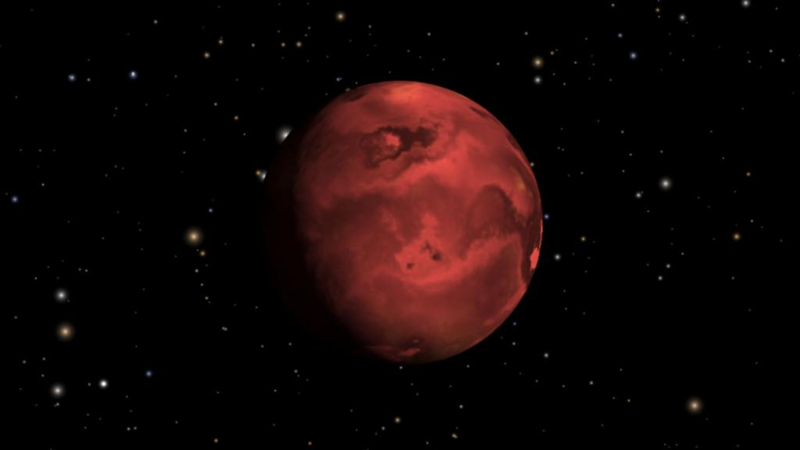
NASA illustration of HD 3167 b, a glowing red-orange rocky super-Earth set against a starry background. The planet's dayside surface is rendered as molten silicate, illustrating the lava-world class the new JWST observation now extends to lower irradiation than any previous atmosphere detection.

Image credit: NASA.


The James Webb Space Telescope, the NASA/ESA/CSA observatory at the Sun-Earth L2 point, has caught an exoplanet doing something a planet that close to its star really should not be able to do. HD 3167 b is a rocky world roughly one and a half times the size of Earth, and it zips around a K-type star in the constellation Pisces once every 0.96 Earth days. At that distance, the dayside should be glowing red-hot bare rock, the kind of surface where silicates are molten and any gas should have been stripped away by stellar wind and high-energy photons long ago. Instead, the dayside is noticeably cooler than the theoretical maximum, and a new analysis of a JWST secondary eclipse says the most likely reason is an atmosphere. It is the coldest lava world with evidence of an atmosphere on record, and the first result from a survey of ten such worlds led by astronomer Megan Weiner Mansfield. The team’s writeup, as covered by Space.com, lays out what makes the detection hard to explain any other way.

That word cool does not mean comfortable. The planet’s equilibrium temperature sits at about 1786 K, somewhere between a slow oven and molten glass. Lava worlds previously caught with atmospheres have all been hotter than roughly 2200 K. HD 3167 b is hot enough that the rock on its star-facing side is almost certainly molten, and cool enough that something other than bare rock is controlling its dayside temperature.

The result, published in The Astrophysical Journal Letters, comes from a single JWST observation using the Mid-Infrared Instrument’s Low Resolution Spectrometer, the team that has been doing most of the heavy lifting on small rocky exoplanets for the last two years. The team watched HD 3167 b slip behind its host star, a maneuver called a secondary eclipse, and measured how much mid-infrared light disappeared. They measured the white-light eclipse depth at 38 plus or minus 11 parts per million. That number is more than five standard deviations shallower than a dark bare rock with no heat redistribution would produce at this distance from the star. The only good explanations are an atmosphere that reflects some incoming starlight back into space, an atmosphere that moves heat from the day side to the night side, or some combination of the two.

The lead author is Brandon Park Coy, a graduate student at the University of Chicago working in planetary scientist Edwin Kite’s group. Kite is the second author and a co-author on a long line of papers trying to figure out which rocky exoplanets hold onto their air. The HD 3167 b paper, described in a University of Chicago news release, is the first published result of a survey that Megan Weiner Mansfield, who did her PhD at Chicago and is now at the University of Maryland, is running. The program is looking at ten lava worlds with JWST and asking a single question. Below what temperature do rocky planets start losing their atmospheres, and above what temperature do they keep them? The published sample so far suggested a gap. Ultra-hot lava worlds such as 55 Cancri e kept their air. Cooler rocky worlds, the ones too cold to be lava worlds at all, often did not. The boundary lived somewhere in the middle, and nobody had measured it.

HD 3167 b sits right at that boundary. Its dayside is too cool for a bare rock, so it has an atmosphere. Its equilibrium temperature is far below the ultra-hot threshold, so it is the first cool end of the population in question. The boundary should sharpen from a guess into a measured curve as the program keeps adding worlds to the sample.

The detection technique itself is worth slowing down on. A secondary eclipse is the small dip in light that happens when a planet passes behind its star as seen from Earth. The dip is small because the planet is much cooler than the star and emits much less light at the wavelengths being observed, but it is measurable, and the depth of the dip tells you how much of the observed light is the planet’s own thermal emission. Doing this in mid-infrared light, around 15 micrometers for this observation, is what lets JWST see the heat of a planet whose dayside is below 2000 K. The same measurement in visible light would be much less informative, because at those wavelengths the planet contributes essentially nothing.

Why does the dayside being cooler than the maximum matter? On a bare rock world with no atmosphere, the side facing the star absorbs starlight, heats up, and re-radiates that heat as infrared light. The temperature that produces is set by the rock’s reflectivity and the distance to the star, and it is the highest possible dayside temperature for that orbit. Add an atmosphere, and two things change. First, the atmosphere can carry heat from the day side to the night side, evening out the temperature. Second, clouds or hazes can reflect some starlight back into space before it ever reaches the surface, lowering the dayside temperature below the bare-rock maximum. Venus is the textbook example of the first effect, with almost no temperature difference between its equator and poles or between its day and night sides. Earth is the textbook example of the second effect. HD 3167 b is showing one or both on a world whose dayside is liquid rock.

What the atmosphere is actually made of, the team is careful to say, is not known. The single JWST spectrum is not precise enough to pick out individual molecules. The paper notes that the dayside emission spectrum is compatible with a silicate-rich composition consistent with vaporized rock, but also with heavier gases like carbon dioxide, carbon monoxide, or water. Picking among those will take follow-up spectroscopy, ideally with JWST’s Near-Infrared Spectrograph, which covers a different wavelength range. The team is also hoping that the rest of the ten-planet program will start to fill in a statistical picture, where several planets measured the same way start to show consistent or inconsistent composition patterns.

The planet itself is also interesting in detail. Its host star, HD 3167, is a K-type main-sequence star slightly smaller and cooler than the Sun, and the planet was first spotted in 2016 in data from the Kepler space telescope’s extended K2 mission, then confirmed by Vanderburg and collaborators in a dedicated follow-up. Like most ultra-short-period rocky worlds, it is tidally locked, with one side permanently facing the star and the other side in permanent night. The new paper refines the planet’s radius to roughly 1.6 Earth radii and confirms the bulk density is slightly lower than a pure Earth-composition planet would suggest, consistent with the planet having a substantial gas layer on top of the rock.

For the broader exoplanet field, the result is a small but real data point in a much larger argument. Most rocky exoplanets found so far, the ones that orbit small cool stars and sit at Earth-like distances, do not have atmospheres. JWST has now measured enough of them to know that, and that has driven a lot of the conversation about whether Earth-like planets are rare or common. Lava worlds are the opposite case. They are easy to observe because they are hot, and the evidence so far is that most of them have something on top of the rock. HD 3167 b extends that trend. It does not change the picture for habitable-zone rocky worlds, but it does sharpen the boundary case where atmospheres start to fail.

There is one quote in the paper and its accompanying press release that captures why a team would spend JWST time on a planet that cannot possibly host life. Lava worlds are useful because they let you watch the processes that matter for all rocky worlds at the extreme end of their temperature range. A planet that is too hot for life can still tell you something about how its rock interacts with its air, how heat moves around, and how clouds form. None of that is unique to lava worlds. All of it shows up in the physics of habitable worlds too. The difference is that on a lava world you can measure it directly, and on a habitable world you mostly have to guess.