OrbitalHub

Where curiosity reaches escape velocity.

Domain is for sale. $50,000,000.00 USD. Direct any inquiries to contact@orbitalhub.com.


NASA dixit:

“The SpaceX Dragon cargo craft arrived at the International Space Station April 20, delivering almost 5,000 pounds of scientific experiments and supplies for the Expedition 39 crew. Dragon was launched atop the commercial company’s Falcon 9 rocket April 18 from Space Launch Complex 40 at the Cape Canaveral Air Force Station, Fla., on the third commercial resupply mission to the station for SpaceX. After a two-day rendezvous to catch up to the orbital laboratory, Dragon was grappled by Expedition 39 Commander Koichi Wakata of the Japan Aerospace Exploration Agency and NASA Flight Engineer Rick Mastracchio and berthed to the Earth-facing port of the Harmony module using the station’s Canadian-built robot arm, where it will remain until it departs the outpost on May 18 for a parachute-assisted return to Earth and a splashdown in the Pacific west of Baja California.”

Credit: NASA


04-19-14

SpaceX-3 Launch

Posted by


NASA dixit:

“Approximately 2.4 tons of NASA science investigations and cargo were launched to the International Space Station aboard SpaceX’s Dragon spacecraft. The launch aboard the company’s Falcon 9 rocket took place from Space Launch Complex 40 at Cape Canaveral Air Force Station in Florida on Monday, April 18 at 3:25 p.m. EDT. Dragon’s cargo will support more than 150 experiments that will be conducted during space station Expeditions 39 and 40. Dragon is scheduled to depart the space station May 18 for a splashdown in the Pacific Ocean west of Baja California, bringing with it about 3,500 pounds of science and research, hardware, crew supplies and spacewalk tools from the space station.”

Read more about SpaceX…


04-14-14

SpaceX-3 Launch Postponed

Posted by


NASA dixit:

“The SpaceX-3 launch to the International Space Station was scrubbed April 14, 2014 due to a helium leak on the Falcon 9 first stage. The next launch opportunity would be Friday, April 18 at 3:25pm EDT if the issue can be resolved.”

Credit: NASA/SpaceX


Credits: NASA


The adventure started on October 4, 1957, when the former Soviet Union successfully launched the first artificial satellite, Sputnik-1, using a rocket that was a modified Intercontinental Ballistic Missile (ICMB). Even if the political implications at that time were very important, as the launch ignited the Space Race within the Cold War, we can argue that the scientific accomplishments were more significant.


These accomplishments relied upon the theoretical work of scientists like Hermann Oberth and Konstantin Tsiolkovsky.


What followed this event, as mentioned above, was a race.


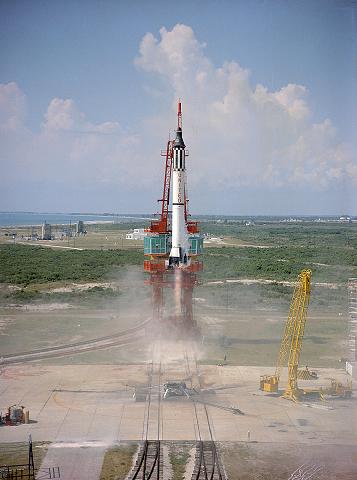
Explorer-1, the first American artificial satellite, was launched on January 31, 1958. Yuri Gagarin was the first human in outer space and the first to orbit the Earth on April 21, 1961. He was followed closely by Alan Shepard, who became the first American to travel into space onboard the Freedom-7 capsule, on May 5, 1961.


On August 19, 1964, the first geostationary communication satellite, Syncomm-3, was placed in orbit over the International Date Line. Syncomm-3 was used to relay the television coverage of the 1964 Summer Olympics in Tokyo, Japan, to the United States. The first to propose the concept of a communication satellite was Arthur C. Clarke, who in October 1945 published an article in the British magazine Wireless World that described the fundamental concepts behind the development of artificial satellites used to relay radio signals.


The first space station, Salyut-1, was launched on April 19, 1971. Even if the space station had a short operational life, as it re-entered the Earth atmosphere on October 11, 1971, it tested elements of the systems required on a space station and conducted scientific research and experiments. The construction of the first international research facility in Earth orbit, the International Space Station (ISS), began in 1998. The station is still under construction and it will be operational until at least 2015.


Where are we now, after 53 years of exploration of the space in the proximity of Earth? Since the launch of Sputnik on October 4, 1957, some 4,600 launches have orbited more than 6,000 satellites. All of these activities have created a cloud of orbiting particles around Earth. This new environment is referred to as space debris or orbital debris. Even if most of these particles are small in size (less than 1 cm), they are a source of great concern as the kinetic energies associated with impacts at orbital velocities, which are in the range 8-10 km/s or 28,800-36,000 km/h, are very high. It has been estimated that the total mass in orbit is 5,800 tons.



12-16-10

Orbital’s Space Plane

Posted by


Credits: Orbital Sciences Corporation


Orbital Sciences Corporation is proposing a blended lifting body vehicle that will launch atop an expendable launch vehicle in response to NASA’s Commercial Crew Development-2 contract solicitation. The proposed configuration will provide safe and affordable transportation services to and from the International Space Station. The vehicle will carry a crew of four astronauts, and will reenter the Earth’s atmosphere and land on a conventional runway similar to a Space Shuttle.


The launch vehicle proposed for the launch stack is the United Launch Alliance Atlas V rocket. Orbital’s press release mentions that the whole configuration is flexible enough to accommodate other launch vehicles as well.


Orbital is leading a team of world-class space system manufacturers. The pressurized crew compartment will be provided by Thales Alenia Space, the human-rated avionics will be the responsibility of Honeywell and Draper Laboratory, and the United Launch Alliance will supply the launch vehicle. Northrop Grumman will be the airframe structures designer.


Credits: NASA/CSA


Canadian astronaut Chris Hadfield will take command of the station during the second half of his third space mission. Hadfield will launch aboard a Soyuz rocket in December 2012, and spend six months on the station as part of the crew of Expedition 34/35. He will return to Earth in a Soyuz capsule in June 2013.


Hadfield is the only Canadian to board the Russian Mir space station, in 1995, during his first space flight, while he served as Mission Specialist 1 on STS-74. He is also the first Canadian mission specialist and the first Canadian to operate the Canadarm in orbit.


His second space flight was onboard STS-100, where he served as Mission Specialist 1. STS-100 was the International Space Station assembly flight 6A, which delivered and installed the Canadarm-2 on the station. During this mission, Hadfield performed two spacewalks.


Chris Hadfield also served as Director of Operations for NASA at the Yuri Gagarin Cosmonaut Training Centre in Star City, Russia; as Chief of Robotics for the NASA Astronaut Office at the Johnson Space Center in Houston, Texas; as Chief of International Space Station Operations; and as the Commander of NEEMO 14, a NASA undersea mission to test exploration concepts living in an underwater facility off the Florida coast.


The official announcement was made by the Canadian Space Agency. Chris Hadfield’s biography is also available here.





