OrbitalHub

Where curiosity reaches escape velocity.

Domain is for sale. $50,000,000.00 USD. Direct any inquiries to contact@orbitalhub.com.

Archive for the Space Exploration category

August 15, 2015

1999 JD6 a.k.a. 85989

Posted by


Wikipedia dixit:

“(85989) 1999 JD6 is an Aten asteroid, near-Earth object, and potentially hazardous object in the inner Solar System that makes frequent close approaches to Earth and Venus. […] Although 1999 JD6 in its current orbit never passes closer than 0.047 AU to Earth, it is listed as a potentially hazardous object because it is large and might pose a threat in the future. The asteroid is well-observed, having been observed over 1,500 times over a length of over 25 years, and was assigned a numeric designation in August 2004.”

NASA JPL:

“Radar data of asteroid 1999 JD6 revealed the object is a contact binary consisting of two lobes. The data was collected over seven and a half hours on July 25, 2015, when the asteroid was about 4.5 million miles (7.2 million kilometers) from Earth.”

Video credit: NASA JPL


August 12, 2015

Ceres 3D Tour

Posted by


Wikipedia dixit:

“Ceres is the largest object in the asteroid belt, which lies between the orbits of Mars and Jupiter. Its diameter is approximately 945 kilometers (587 miles), making it the largest of the minor planets within the orbit of Neptune. The thirty-third largest known body in the Solar System, it is the only one within the orbit of Neptune that is designated a dwarf planet by the International Astronomical Union (IAU). Composed of rock and ice, Ceres is estimated to comprise approximately one third of the mass of the entire asteroid belt. Ceres is the only object in the asteroid belt known to be unambiguously rounded by its own gravity. From Earth, the apparent magnitude of Ceres ranges from 6.7 to 9.3, and hence even at its brightest, it is too dim to be seen with the naked eye, except under extremely dark skies.

Ceres was the first asteroid discovered, by Giuseppe Piazzi at Palermo on 1 January 1801. It was originally considered a planet, but was reclassified as an asteroid in the 1850s when many other objects in similar orbits were discovered.

Ceres appears to be differentiated into a rocky core and icy mantle, and may harbor a remnant internal ocean of liquid water under the layer of ice. The surface is probably a mixture of water ice and various hydrated minerals such as carbonates and clay. In January 2014, emissions of water vapor were detected from several regions of Ceres. This was unexpected, because large bodies in the asteroid belt do not typically emit vapor, a hallmark of comets.

The robotic NASA spacecraft Dawn entered orbit around Ceres on 6 March 2015. Pictures with a resolution previously unattained were taken during imaging sessions starting in January 2015 as Dawn approached Ceres, showing a cratered surface. Two distinct bright spots (or high-albedo features) inside a crater, incorrectly reported as observed in earlier Hubble images, were seen in a 19 February 2015 image, leading to speculation about a possible cryovolcanic origin or outgassing. On 3 March 2015, a NASA spokesperson said the spots are consistent with highly reflective materials containing ice or salts, but that cryovolcanism is unlikely. On 11 May 2015, NASA released a higher resolution image showing that, instead of one or two spots, there are actually several.”

Video credit: NASA JPL


August 3, 2015

Flight over Atlantis Chaos

Posted by


ESA dixit:

“Explore the Atlantis Chaos region of Mars, in the Red Planet’s southern hemisphere. The video showcases a myriad of features that reflect a rich geological history. The tour takes in rugged cliffs and impact craters, alongside parts of ancient shallow, eroded basins. See smooth plains scarred with wrinkled ridges, scarps and fracture lines that point to influence from tectonic activity. Marvel at ‘chaotic’ terrain – hundreds of small peaks and flat-topped hills that are thought to result from the slow erosion of a once-continuous solid plateau. This entire region may once have played host to vast volumes of water – look out for the evidence in the form of channels carved into steep-sided walls.”

Credit: ESA/DLR/FU Berlin (CC BY-SA 3.0 IGA)


August 1, 2015

Mars’ Ancient Ocean

Posted by


NASA dixit:

“Mars bears ample evidence of a wet past, but scientists debate just how much water the planet has lost over time. Now, isotopic measurements by researchers at NASA’s Goddard Space Flight Center reveal that an ocean covered approximately twenty percent of early Mars.”

Credit: NASA Goddard


July 25, 2015

Soyuz TMA-17M Launch and Docking

Posted by


NASA dixit:

“Expedition 44 Soyuz Commander Oleg Kononenko of the Russian Federal Space Agency (Roscosmos), NASA Flight Engineer Kjell Lindgren and Flight Engineer Kimiya Yui of the Japan Aerospace Exploration Agency launched on the Russian Soyuz TMA-17M spacecraft on July 23, Kazakh time from the Baikonur Cosmodrome in Kazakhstan to begin a six-hour journey to the International Space Station and the start of a five-month mission. They docked their craft to the Rassvet module on the Russian segment of the complex.”

Credit: Roscosmos/NASA


December 19, 2014

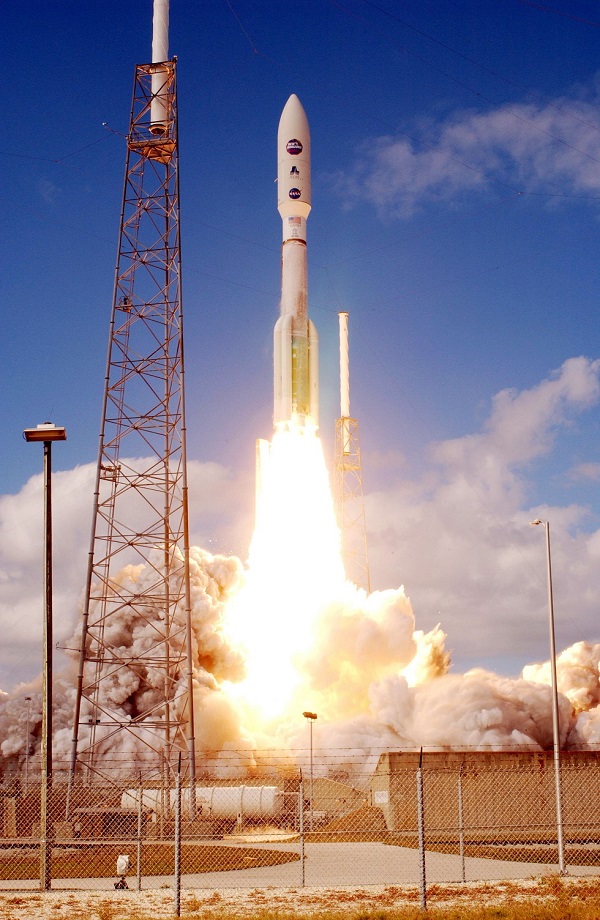
Atlas V To Carry Cygnus To ISS

Posted by
Credits: NASA


Orbital Sciences Corporation has announced that Atlas V will be the launch vehicle that will help the company fulfill its Commercial Resupply Services (CRS) commitment to NASA. Orbital’s Antares will undergo an upgrade of the main propulsion system.


From the December 9, 2014 press release:


“Orbital Sciences Corporation […] today announced new details in its plans to resume cargo flights to the International Space Station (ISS) and to accelerate the introduction of an upgraded Antares launch vehicle. In formulating its go-forward plans, the company’s primary objective is to fulfill its commitment to NASA for ISS cargo deliveries with high levels of safety and reliability and minimum disruption to schedules. As previously announced, these plans are expected to allow Orbital to accomplish all remaining cargo deliveries under its current Commercial Resupply Services (CRS) contract with NASA by the end of 2016 and with no cost increase to the space agency.


The company’s go-forward plans for the CRS program and Antares launch vehicle include these major elements:

Atlas V Launch: Orbital has contracted with United Launch Alliance for an Atlas V launch of a Cygnus cargo spacecraft from Cape Canaveral, Florida, in the fourth quarter of 2015, with an option for a second Atlas V launch in 2016 if needed. The Atlas rocket’s greater lift capacity will allow Cygnus to carry nearly 35% more cargo to the ISS than previously planned for CRS missions in 2015.

Antares Propulsion Upgrade: The company has confirmed its ability to accelerate the introduction of a new main propulsion system for the Antares rocket and has scheduled three additional CRS launches in the first, second and fourth quarters of 2016 using the upgraded vehicle. The greater payload performance of the upgraded Antares will permit Cygnus spacecraft on each of these missions to deliver over 20% more cargo than in prior plans. With necessary supplier contracts now in place, the first new propulsion systems are expected to arrive at the Antares final assembly facility at Wallops Island, Virginia in mid-2015 to begin vehicle integration and testing.

Wallops Launch Site Repairs: The Mid-Atlantic Regional Spaceport (MARS) has assessed the clean-up, repair and reconstruction work necessary to return the Wallops launch complex to operational status. Current plans call for repairs to be substantially completed by the fall of 2015, with recertification taking place before year end.


The flexibility of Orbital’s Cygnus cargo spacecraft to accommodate heavier cargo loads, together with the greater lift capacity of the Atlas V and upgraded Antares vehicles, will allow the company to complete all currently contracted ISS deliveries in four missions instead of the five previously planned flights over the next two years. In addition, the company’s revised approach is not expected to create any material adverse financial impacts in 2015 or future years as Orbital carries out the CRS cargo delivery and Antares propulsion upgrade programs.”






