OrbitalHub

Where curiosity reaches escape velocity.

Domain is for sale. $50,000,000.00 USD. Direct any inquiries to contact@orbitalhub.com.


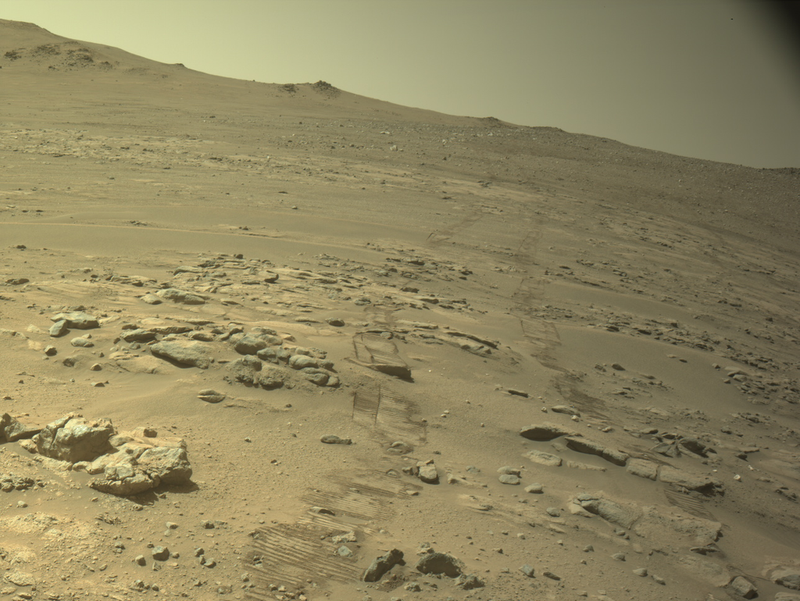
Perseverance sets the off-world driving record on Mars. Image: 2026 10 17 perseverance driving record.


On 11 October 2026, NASA’s Perseverance rover rolled past a line nobody had crossed before. After 299.6 feet (91.31 meters) of driving on its 2,006th Martian day, the rover’s odometer read 28.10 miles (45.22 kilometers), nudging it 0.04 miles past the 28.06-mile (45.16-kilometer) total that Opportunity, its predecessor, had built up across nearly fifteen years of service on Mars. The new figure makes Perseverance the farthest-driven vehicle ever operated on the surface of another world, with margin enough that the gap will only widen as the rover keeps climbing the western rim of Jezero Crater. The number is small in absolute terms, a Sunday stroll in a city park would cover more ground, but on Mars the steps add up slowly, and the record has stood since 2018.

The reason this matters has less to do with the odometer than with what the odometer is measuring. Setting a distance record on another planet is not a vanity project. It is a budget statement: how much ground a mission can cover in a fixed number of sols, how many distinct outcrops the science team can visit, and how many rock and regolith samples the rover can collect before its hardware gives out. Perseverance has collected twenty-nine samples already, from an ancient lakebed at the bottom of Jezero, from a delta fan built by a long-vanished river, and now from the rim itself, where the geology changes character. Each new mile opens another valley, another ridge, another chance to find traces of ancient water chemistry that a stationary lander would never see. The original mission specification called for no more than 12.4 miles of driving. The team has now more than doubled the contract.

This is the fourth chapter in a thirty-year American experiment in mobile Mars geology, and each rover in the sequence has reset what counts as routine. Sojourner, the microwave-oven-sized cart that landed with Mars Pathfinder in 1997, rolled about 330 feet (100 meters) during an 83-sol mission before its solar panels gave up. Spirit and Opportunity arrived in 2004 with ninety-sol prime missions, and Opportunity, in particular, refused to stop. It crossed the first extraterrestrial marathon in 2015, logged 5,111 sols of operation, and racked up the 28.06-mile total that Perseverance just surpassed. Spirit covered 4.8 miles before getting stuck in soft soil and succumbing to a Martian winter in 2010. Curiosity, which landed in Gale Crater in 2012, is still working and has logged more than 23.65 miles (38.07 kilometers). The pattern is the same each time: longer missions, longer drives, and a better understanding of what the rovers can be trusted to do on their own. Perseverance also has the lunar record in its rear-view mirror, having already overtaken the 22.2 miles covered by the Apollo 17 astronauts in 1972 and the 24.2 miles racked up by the Soviet Union’s Lunokhod 2 rover in 1973.

The deeper reason Perseverance is pulling away is software. A navigation system called AutoNav lets the rover think while it drives, building a three-dimensional map of hazards on the fly and picking its own path between waypoints chosen by rover planners on Earth. The version flying on Perseverance is orders of magnitude sharper than the original AutoNav that flew on Spirit and Opportunity: where Sojourner evaluated the path ahead with twenty measurement points, Perseverance processes six hundred thousand of them each time it looks. Roughly ninety percent of Perseverance’s total driving distance has come under AutoNav, compared with about five percent for the earlier generation. The rover has covered as much as 1,351 feet (412 meters) in a single sol under AutoNav, a figure that would have been unthinkable during the Opportunity era. Steven Lee, the project manager for Curiosity and Perseverance at NASA’s Jet Propulsion Laboratory, called the milestone a privilege to be part of, noting that the original mission specification capped driving at 12.4 miles and that all mobility systems remain in good shape for many more years of record-setting. Mark Maimone, deputy team chief for robotic operations, said the team is not finished improving Perseverance’s driving: newer software teaches the rover to minimize steering, roll more, and cross-check its position against orbital maps mid-drive. The next engineering target is glare in the navigation cameras, which still forces the rover to stop driving by mid-afternoon whenever the Sun is ahead, and teaching it to look past those artifacts would give every future Mars rover a longer working day. NASA Science blog (12 Oct 2026), NASA JPL news (11 Oct 2026)

The science payoff from the extra mileage is already showing up. The record-breaking sol took place inside a strip of terrain nicknamed Lac de Charmes on the western rim of Jezero, an area of the crater wall the science team picked specifically because the rocks there are some of the oldest Perseverance will ever see, pieces of crust old enough that their Earthly equivalents have been erased by erosion and plate tectonics. Mars has no plate tectonics, so the equivalent record is still readable on the surface. The rover is heading toward an outcrop named Idubi, where it will look for evidence of ancient hydrothermal systems, the kind of mineral-rich, hot-water environments that on this planet often host the most interesting microbial communities. The earlier leg of the mission already produced one potential biosignature, at a rock called Cheyava Falls in the ancient river delta, and Lac de Charmes is a chance to test whether similar chemistry shows up in a completely different part of the crater. NASA approved Perseverance’s first mission extension this month, a commitment that will carry the rim work through roughly the end of 2028 and, after Lac de Charmes, toward Rainbow Falls, a 328-foot-wide (100-meter-wide) block of ancient crust that was shoved into place by the same impact that created Jezero in the first place. The image that the team released to mark the milestone is a navigation-camera frame from the record sol: a stretch of rocky Martian ground under a dusty sky, with fresh rover tracks curving off into the distance. It is a working picture, the kind of frame the navigation team uses to plot the next day’s drive, not a glamour shot from Mastcam-Z, and that feels right for what is being celebrated. As long as the wheels turn and the software holds up, the number on the dashboard will keep climbing, and the science team will keep pulling rocks out of rocks that have been sitting on the surface of Mars for four billion years. NASA Science blog (12 Oct 2026), NASA Mars 2020 mission page, NASA Photojournal PIA26812 (13 Oct 2026), Sci.News (Oct 2026)
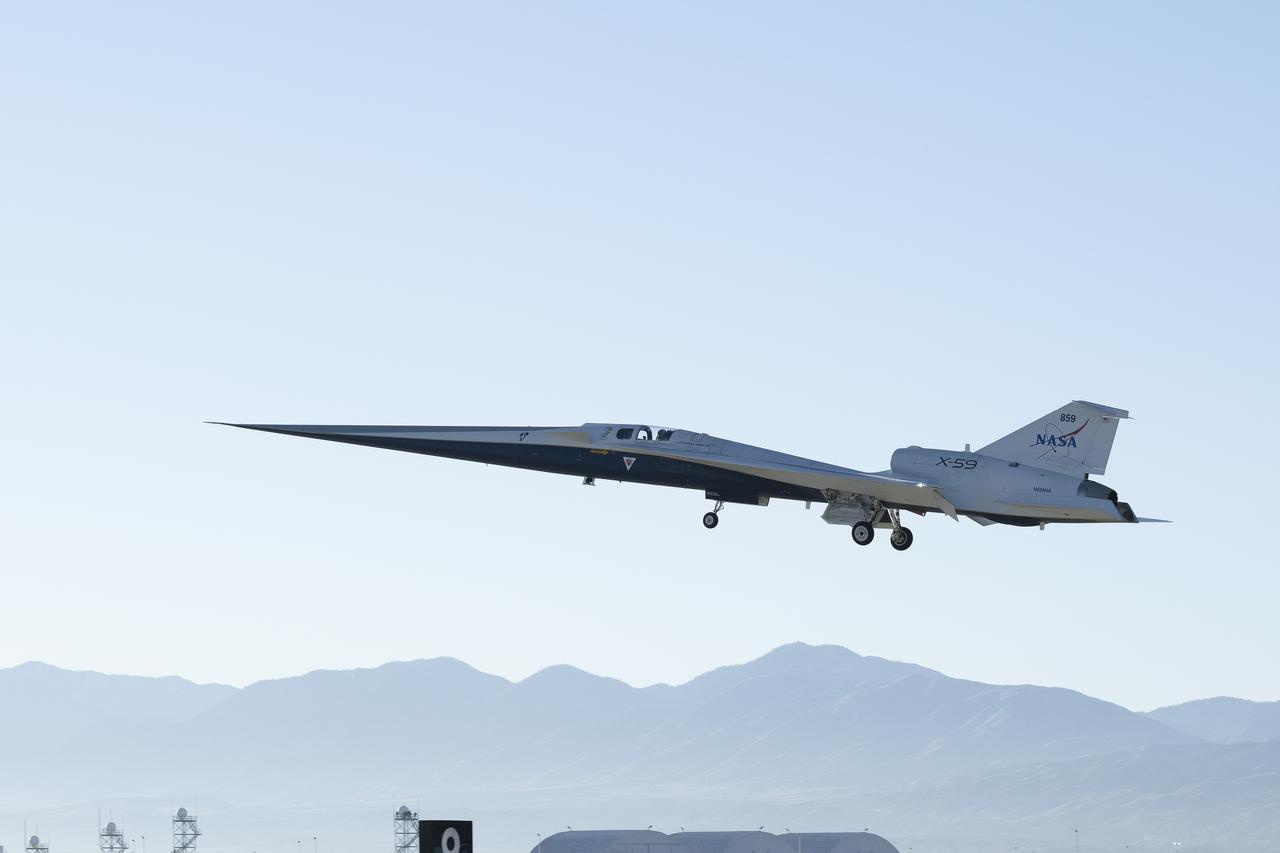


NASA's X-59 quiet supersonic research aircraft taxis under its own power at Lockheed Martin Skunk Works in Palmdale, California, ahead of the September 2026 flight envelope expansion campaign.


In the last week of September, NASA’s X-59 Quesst flew six times in four days. Two flights on September 22, then two more on the 24th, then two more on the 25th. The previous best was four, so the team didn’t just break its own record; it lapped it. One of those flights also pushed the aircraft to Mach 1.53, roughly 1,010 miles per hour, the fastest the X-59 has gone in the year since Lockheed Martin’s Skunk Works rolled it out of the Palmdale paint shop (NASA Quesst blog, October 2 2026). The run brought the program’s total to 38 test flights, and the aircraft is now in a scheduled three-week maintenance stand-down before the next phase of envelope expansion.

The X-59 is, on paper, the most unassuming supersonic jet ever built. It has no forward windshield. It is shaped like a long black arrow with a 33-foot nose spike, the cockpit pushed so far back that the pilot flies by reference to an external vision system, a four-camera array feeding a single high-resolution display. The whole point of the thing is what it does not do: it is designed so that the shock waves it generates at cruise do not coalesce into a single audible boom when they reach the ground. NASA wants the on-the-ground signature to come in around 75 effective perceived noise decibels, a level the agency compares to a car door closing two houses down (NASA, Quesst: The Vehicle; Lockheed Martin X-59 product page).

The reason that number matters has very little to do with engineering aesthetics and everything to do with regulation. Civil supersonic flight over land is, with limited exceptions, banned in the United States under FAA rules that trace directly back to the sonic boom problem. The Concorde, which flew at Mach 2.02 over the ocean and on a few chosen overland corridors at subsonic speeds, retired in 2003 partly because its boom made overland expansion politically impossible. Twenty-three years later, no commercial airliner has flown faster than sound over the contiguous United States. The X-59 is NASA’s bet that a different shape can produce a different shock structure, and that if the shock structure is quiet enough, regulators will eventually rewrite the rule.

The hardware story begins in February 2016, when NASA awarded Lockheed Martin a preliminary design contract under the Low-Boom Flight Demonstrator program. In April 2018, the agency converted that study into a $247.5 million build contract, the largest single X-plane procurement in a generation. Skunk Works in Palmdale, California, did the structural work. NASA Langley ran an 8%-scale model through three weeks of wind-tunnel testing in late 2017, sweeping angle of attack out to 50° and 88° at low speed to map the static margin and dynamic response of the unusually long forebody. The critical design review closed in September 2019, construction crossed the halfway line in late 2020, and the aircraft was rolled out, fully painted, in January 2024 (Lockheed Martin X-59 Quesst, Wikipedia; NASA Quesst gallery).

The first flight came on October 28 2025, subsonic, out of Armstrong Flight Research Center at Edwards Air Force Base in the Mojave. The aircraft stayed subsonic through the early envelope, and on April 3 2026 the team flew wheels-up for the first time, reaching 20,000 feet and roughly 460 mph. The first supersonic run came on June 5 2026, and a week later, on June 12, the X-59 reached its design cruise point of Mach 1.4 at 55,000 feet. What the late-September record set adds on top of those milestones is volume: not a single new speed or altitude, but the demonstrated ability to turn an experimental one-off into something that flies like a working test article, twice a day, on back-to-back days.

The underlying physics the aircraft is built to exploit is called Mach cutoff shaping, and it is older than the X-59 by several decades. A supersonic aircraft generates two main shock waves, one from the nose, one from the tail, and in a conventional shape those shocks hit the ground as two closely spaced impulses that the ear fuses into a single boom. The trick is to design the airframe so that the upper-frequency components of the pressure signature are refracted upward by the natural temperature gradient of the lower atmosphere, never reaching the surface. The rule of thumb is that a ray of the shock will be turned away from the ground if the local sound speed increases faster than the local Mach number falls as the ray climbs. In practice, that means the X-59 has to be flown within a tight band of altitude and speed; outside that band, the rays bend back down and the boom returns.

The airframe itself encodes the same idea geometrically. The 33-foot nose is shaped to spread the nose shock over a longer distance, lowering its peak overpressure. The planform is built around a long, thin fuselage with a single low-sweep wing and a horizontal tail deliberately set high enough to keep the tail shock from merging with the wing shock. Wind-tunnel Schlieren imaging in 2018 confirmed the resulting pressure signature on the ground: a rise time of about 6 milliseconds and a peak overpressure of about 0.5 pounds per square foot, low enough that listeners describe the event as a thump rather than a bang (Sonic boom, Wikipedia, Mach cutoff references; CNN, August 6 2026).

The reason nobody has been able to demonstrate this in commercial service yet is the public response. A 75 EPNdB thump is in the same A-weighted decibel range as a dishwasher running in the next room, but supersonic cruise would put that thump over populated areas that have never heard anything louder than a turboprop. To find out what people actually think, NASA plans community overflight tests in 2026 and 2027, dropping F/A-18 Hornets into shallow dives from 50,000 feet to reproduce the X-59’s signature without the X-59, then asking residents to rate the noise. The agency needs that data to take to the International Civil Aviation Organization’s Committee on Aviation Environmental Protection, which sets the supersonic noise standard, and to the FAA, which would have to amend 14 CFR Part 91 to permit overland cruise. Without that amendment, an aircraft that thumps instead of booms is still illegal to fly over Denver.

The next three weeks of maintenance, after the record run, are scheduled around exactly that preparation. When the X-59 returns to the air, the team plans to expand the flight envelope further before the first community-response flights. Whether the data ultimately change ICAO and FAA rules is not a question the engineers can answer; they can only build the airframe that makes the question worth asking. The September record tells you how far that build has come: from a concept on a Lockheed whiteboard a decade ago, to an aircraft that can fly two missions a day for three days in a row, faster than any civil airplane has flown over the United States in a generation.


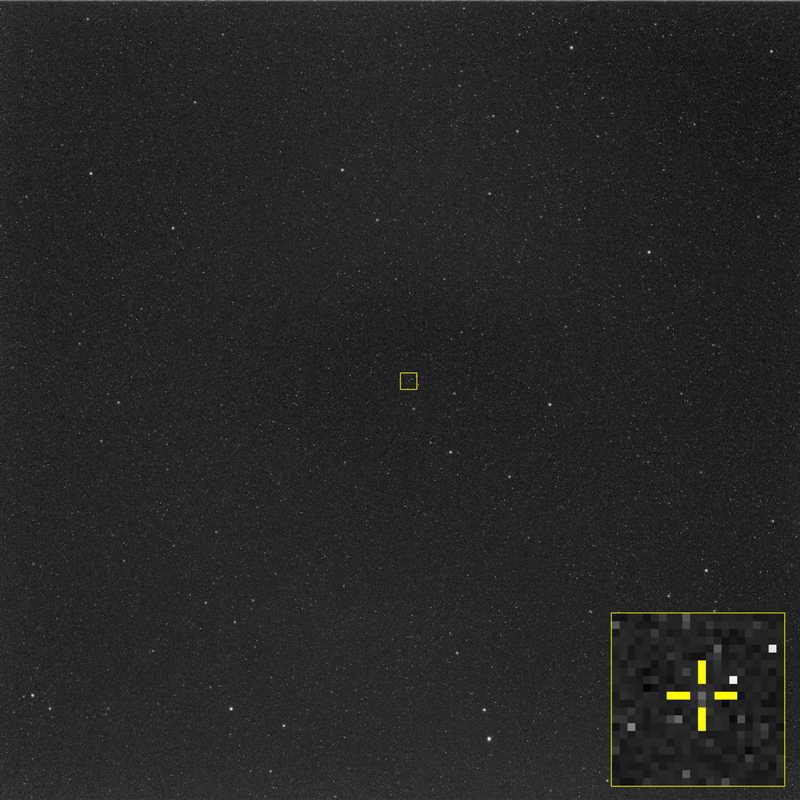
Hera's first glimpse of Didymos, captured by the Asteroid Framing Camera on 7 October 2026 from 236,500 km. Didymos appears as a single bright pixel among a field of background stars. Image: ESA; full-resolution asset at esa.int, via the ESA Hera mission overview.


Two years after it left Cape Canaveral on a Falcon 9, the European Space Agency’s Hera spacecraft turned its main science camera toward the place it has been chasing across the inner solar system and saw, for the first time, what it came to see. Didymos appeared as a single bright pixel in a 1020-by-1020 image, surrounded by background stars that the camera was tracking to subtract out. The asteroid was 236,500 kilometers away at the time, far enough that the image looked almost like a software test pattern. The date was 7 October 2026, exactly two years after launch. The first braking maneuver, BRM-1, is scheduled for 15 October 2026, the mission’s 12 km/s relative velocity has been bleeding away in tiny burns, and full arrival at the binary system is planned for next month, almost a month earlier than the original timeline. The image, published by ESA in early October 2026, is the first resolved optical sighting of the asteroid whose small moonlet Dimorphos NASA hit with the DART impactor four years ago, and it is the start of the science campaign the whole mission was built around, covered in a fresh Universe Today feature by David Dickinson and in ESA’s own early-arrival announcement.

The reason Hera is going to Didymos is the question DART left open. In September 2022, NASA crashed a refrigerator-sized kinetic impactor into Dimorphos at roughly 6.6 kilometers per second, in the first deliberate attempt by any space agency to change the trajectory of a celestial body. The impact shortened Dimorphos’s 11 hour 55 minute orbit around its parent by about 32 minutes, a much larger change than the pre-impact models had predicted. The extras came from ejecta, the spray of rock and dust thrown off the surface at the moment of contact, which acted like an unpropelled rocket exhaust pushing the moonlet the other way. The pre-impact momentum budget was therefore incomplete, and the right number to plug into a future deflection plan depends on details that ground-based telescopes could not measure: the mass of Dimorphos before the hit, the size and depth of the crater DART carved, the porosity of the surface, the density of the interior. Hera’s job is to measure all of these, with enough precision that the next time the world considers deflecting a real asteroid, the engineers will know what the impact will do.

Hera almost did not happen. The original plan, in the early 2010s, was a joint ESA-NASA mission called AIDA, in which NASA would supply DART and ESA would supply an orbiter called AIM that would arrive at Didymos first and watch the impact happen in real time. ESA cancelled AIM in 2016 because the agency’s member states would not underwrite the cost, and for several years the only follow-up to DART was a network of ground-based observatories that the LICIACube flyby camera and Hubble time had to substitute for. ESA’s member states eventually funded a stripped-down replacement called Hera in 2019, and the agency awarded the prime contract to OHB in Bremen, with a launch contract to SpaceX. The spacecraft left Earth on 7 October 2024 from Cape Canaveral’s SLC-40, riding a Falcon 9 first stage, booster B1061-23, that had already flown 22 missions and was expended to give Hera enough energy for a direct transfer, as documented in the mission’s Wikipedia timeline.

The cruise was longer than a Mars transfer and shorter than a trip to a comet. Hera flew by Mars on 12 March 2025, using the planet’s gravity to bend its trajectory and align it for the Didymos encounter, and took the opportunity to image the smaller Martian moon Deimos from a few hundred to a thousand kilometers away, the closest observations of that body since Viking 2 in 1977. Those images later fed a Nature Astronomy study in 2026 arguing that Deimos is a rubble-pile body reshaped by an oblique impact of a 320-meter asteroid, useful as a sanity check on the radar instruments aboard the Juventas CubeSat. Through 2025 and the first half of 2026, the spacecraft’s flight dynamics team used Hera’s Asteroid Framing Camera, a pair of baffle-protected 1020-by-1020 monochrome sensors built by Jena-Optronik in Germany, to practice the eventual arrival on two main-belt asteroids, Otero and Kellyday, that happened to be near the spacecraft’s line of travel. Tracking Otero for three hours and the much fainter Kellyday in July 2025 taught the team how to keep a tiny, slowly-moving point of light centered in a camera designed to image objects thousands of times closer, in the camera test ESA reported in August 2025. In October 2025, with the cruise going smoothly, ESA announced that the arrival had been pulled forward by a month. In March 2026, Hera performed its largest single deep-space maneuver, burning 123 kilograms of hydrazine for a 367 m/s change in velocity. In June and July 2026 the flight software was upgraded, the asteroid phase began.

The arrival sequence itself starts with the first pixel and ends with a network of small spacecraft hovering above a pair of dark, fast-spinning rocks. On 2 October 2026, controllers executed a short test burn to verify the braking configuration. BRM-1, the first real braking maneuver, is set for 15 October 2026, two days after the publication of this post, and a series of further burns will put Hera into orbit around Didymos. From orbit, the spacecraft will map both bodies in detail. The Asteroid Framing Camera, working alongside the Thermal Infra-Red Imager TIRI and the Planetary Altimeter PALT, will return global shape models of Didymos at a few-meter resolution and a 10-centimeter view of the DART impact site, the first close-up of the crater NASA made. The HyperScout-H visible and near-infrared mapper will look for compositional fingerprints across the surface. A Radio Science Experiment will track Hera’s orbit closely enough to pin down the gravity field of the binary, which is the cleanest way to get the mass of Dimorphos and therefore the cleanest measurement of the momentum DART actually transferred.

The CubeSats will do the part of the science Hera cannot do from a safe orbit. Juventas, built by GomSpace in Luxembourg, carries a low-frequency radar called JuRa, a laser altimeter, and a gravimeter, the first radar sounder ever aimed at an asteroid’s interior, and the data it returns will tell the team whether Dimorphos is a uniform rubble pile, a fractured monolith, or a coherent body with a deep layer of regolith over a denser core. If conditions allow, Juventas will also touch down on the surface and use its accelerometers to measure the mechanical response of the regolith, the first in-situ measurement of asteroid surface stiffness. Milani, built by Tyvak International in Italy, is a hyperspectral imager that will survey the surface mineralogy of both bodies and characterize the dust around the binary. Both CubeSats will be released after Hera is in a stable orbit and will operate on their own for a few months before their trajectories carry them away. Once the science is done, the plan is to repurpose the mission as a software laboratory for autonomous deep-space operations, running new code on the spare core of the spacecraft’s LEON3 processor and using the binary system as a long-duration test bench.

The reason the planetary defense community is watching this closely is that the DART impact was a real-world test of a method that only existed in textbooks before 2022, and the textbooks are being rewritten. If Hera measures a momentum transfer close to the simple mass-times-velocity prediction, the kinetic-impactor method works about as well as the engineers hoped, and a future asteroid on an Earth-crossing orbit could be pushed off course with a single heavy spacecraft launched a few years in advance. If the momentum transfer is much larger, the ejecta boost is doing more of the work than the impactor itself, and the design of a real deflection mission should emphasize surface coupling rather than impactor mass. The point of Hera is to give the answer in numbers that can be written into a flight plan. Didymos, a 780-meter rock discovered by the Spacewatch survey in 1996 with a 151-meter moonlet found seven years later, is the laboratory. The first photograph of it from the spacecraft built to study it is, on its own, just a single bright pixel. The work begins now.


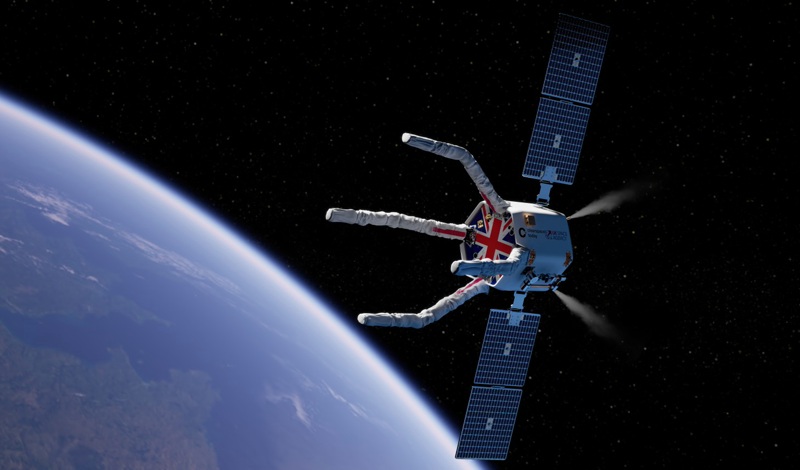
A ClearSpace rendering of the servicer spacecraft planned to grab and deorbit two U.K.-licensed satellites.


Two days after the UK Space Agency signed a contract worth around eighty million US dollars with the in-orbit services company ClearSpace, the post is still drawing puzzled responses from engineers who have watched ClearSpace miss one launch deadline after another. The October 15 award puts ClearSpace’s UK subsidiary in charge of the country’s first nationally commissioned active debris removal mission, called UK ADR, with the goal of capturing two defunct British satellites in low Earth orbit and pulling them down to burn up on a single flight. The contract is the largest piece of business yet for a company whose European Space Agency mission to grab a single space debris target has slipped from 2025 to 2029, and it lands on a small spacecraft stack whose design is still being finalised.

What the UK Space Agency has bought is a service, not a satellite. The agency will hand ClearSpace a list of two retired UK-licensed payloads, then wait while the company flies a robotic servicer to meet them, grapples each in turn, and drops them into the atmosphere in sequence. The contract covers everything from the design and build of the servicer, through ground test and qualification, to the launch, the rendezvous in orbit, and the final disposal burns. Space Minister Liz Lloyd described the mission as the first time any spacecraft will dispose of more than one satellite in this way, and UK Space Agency officials were careful to frame the work as a building block for a broader in-orbit servicing economy rather than a one-off clean-up job (GOV.UK, October 15 2026).

The deal matters because the amount of junk in low Earth orbit has been climbing faster than any country has been willing to clean up. Hundreds of thousands of tracked objects now whiz around the planet at closing speeds that can exceed seventeen thousand miles per hour, and every newly launched mega-constellation adds more mass to a regime that already bristles with abandoned rocket bodies, dead payloads, and fragments from past collisions. The standard response so far has been passivation, the practice of venting leftover fuel and disconnecting power on a dying spacecraft so it does not explode later, combined with rules that ask operators to remove their own hardware within five years of mission end. Passivation reduces future debris, but it does nothing about the cloud of derelicts already up there. Active debris removal, in which a separate spacecraft goes out and grabs the offending object, has been on every space agency’s wish list since the 1980s and on none of their budgets until very recently. A 2025 update to the UK National Space Strategy named in-orbit servicing, assembly, and manufacturing, abbreviated ISAM, as one of four priority areas, and the ADR mission is the first concrete contract to come out of that policy.

ClearSpace did not win the work uncontested. The UK Space Agency ran a competitive procurement in which three bidders responded: ClearSpace UK, Japan’s Astroscale, and the US-based Starfish Space. Astroscale has already completed a commercial active debris removal demonstration, the ADRAS-J mission that flew up to a Japanese rocket stage in 2024 and is still working through rendezvous operations. Starfish Space has flown the Otter pup-sized servicing vehicle on a 2024 orbital transfer test and is now building a larger vehicle called Bluebonnet. ClearSpace itself has not yet reached orbit on its own propulsion stage, having lost its original 2025 launch slot when the ESA payload it was sent to remove was struck by a fragment in 2023 and had to be swapped out for a different target (Behind the Black, October 16 2026, SatNews, October 15 2026). ClearSpace was nonetheless judged the strongest offer, in part because the capture architecture it has been building for the European Space Agency’s Proba-1 retrieval mission is the closest existing match to what UK ADR needs. The two retired UK satellites that UK ADR will go after have not been identified publicly, but both are non-cooperative, meaning they were never built with a grapple fixture or docking adapter, so the servicer has to deal with whatever geometry it finds.

The price tag, around sixty-one million British pounds, lands at the high end of what an active debris removal demonstration has ever cost. The contract is structured so that the money stretches from the present through a launch window that closes in August 2029, with the bulk of the spending sitting on integration, qualification, and operations rather than on the bus itself. ClearSpace UK’s Managing Director, Rob Atchison, framed the next phase in unusually direct terms, telling reporters that the program would hire engineers across several spacecraft disciplines, and that the team would design, build, and qualify a spacecraft capable of safely approaching an object never meant to be captured and bringing it under control. ClearSpace UK will manage industrial delivery and mission operations, targeting a 2029 launch from Saxavord Spaceport on Unst, a Shetland launch site that received thirty million pounds of UK government money in 2024 to keep Britain’s sovereign launch capability alive (GOV.UK, October 15 2026). If the schedule works, the servicer will share its ride to orbit with other payloads heading to low Earth orbit.

The way the servicer is meant to work is the part that has drawn the most attention from debris-removal engineers. After separating from its launch vehicle, the spacecraft will use autonomous rendezvous and proximity operations, the choreography of thruster firings, sensor reads, and trajectory corrections that brings one spacecraft safely next to another, to match orbits with the first derelict target. Once in close formation, a multi-arm robotic manipulator will reach out and clamp onto whatever structural feature the dead satellite offers, since neither target has a standard grapple point. With the first satellite locked in its arms, the servicer will fire its thrusters in the direction that lowers the combined stack’s perigee, the low point of its orbit, into the upper reaches of the atmosphere. The first derelict is then released onto a decaying trajectory that brings it down within months. The servicer, now lighter and carrying a full tank of propellant by design, raises its orbit back up, repeats the rendezvous with the second target, captures it, and brings it down the same way. The sequence is what makes this mission a world first rather than a duplicate of ClearSpace-1, which is only designed to retrieve one object.

The technologies the mission leans on have been in development for nearly a decade. The capture architecture descends from the design ClearSpace built under an ESA contract first awarded in 2019, which uses four robotic arms that wrap around the target like fingers closing around a pen. The rendezvous and proximity operations software draws on Phase 2 of the UK’s Clearing the LEO Environment with Active Removal study, abbreviated CLEAR, in which ClearSpace partnered with Orbit Fab to study in-space refueling and ran a long autonomous approach sequence in simulation. The refueling capability is what makes the spacecraft useful beyond one mission. UK ADR will fly with a refuellable propellant system the company intends to top up between flights, which is the only way a single bus can plausibly clean up more than a handful of derelicts over its lifetime. The wider ISAM sector the mission anchors includes satellite inspection, life extension through on-orbit refueling, and eventually on-orbit assembly of larger structures, with analysts at the UK Space Agency estimating that the segment could grow into a billion-dollar annual market by the mid-2030s (GOV.UK, October 15 2026, Via Satellite, October 15 2026).

Two years is not a long time to design, build, qualify, and launch a brand-new spacecraft, and the skeptics in the debris-removal community are easy to find. ClearSpace’s earlier deadline slippage, the 2024 management shake-up that pushed OHB into a majority role, and the parallel pressure of an ESA contract for a 2027 proximity-operations demonstration all have to resolve before the UK ADR launch window closes. If the company meets its 2029 target, the mission will hand the UK Space Agency the first operational data set on multi-target active debris removal in orbit and give ClearSpace the flight heritage its future servicing business depends on. If it slips, the contract is structured in phases that protect the UK taxpayer from paying for a bus that never flies, and the second target does not get removed.


October 17, 2026

JAXA’s MMX is finally going to Phobos

Posted by


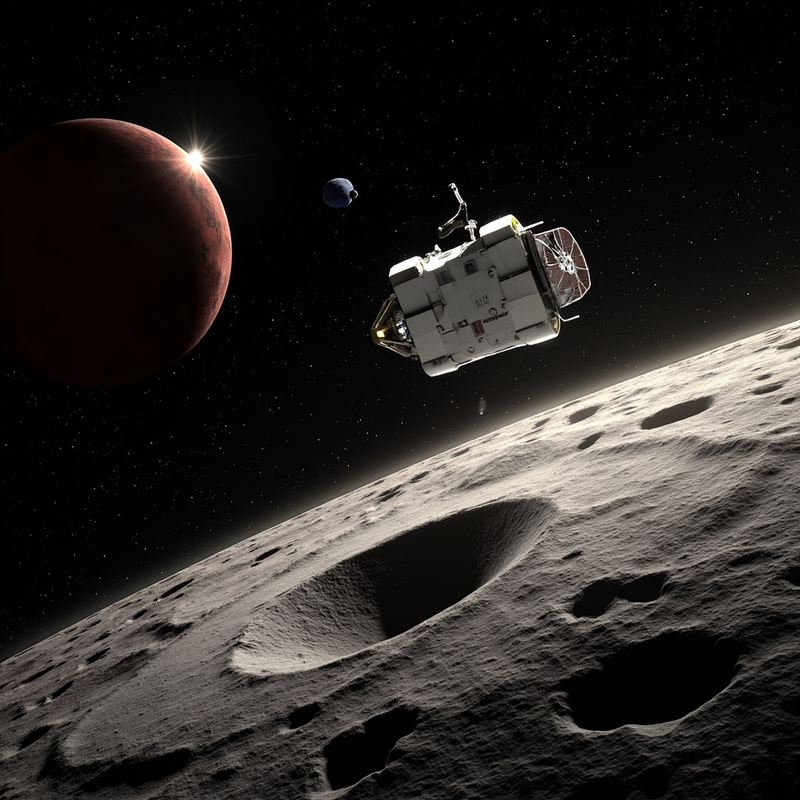
JAXA's MMX spacecraft approaching Phobos — a gray cratered body with the large Stickney crater dominating the foreground, the spacecraft three-quarter view with its high-gain antenna pointed at distant Earth, the red disk of Mars in the background, and the smaller moon Deimos as a tiny point of light nearby.

On Sunday morning Japan time, a 4,000-kilogram spacecraft will leave Tanegashima Space Center on Japan’s new H3 rocket and begin a five-year journey to do something nobody has done before: touch a moon of another planet and bring a piece of it home. The mission is the Martian Moons eXploration probe (MMX), and its destination is Phobos, a 22-kilometer rock that swings around Mars three times a day and is slowly falling inward. A small capsule will land in an Australian desert in 2031 carrying at least ten grams of alien dirt that may finally settle a sixty-year argument about where Phobos came from.


That argument is unusually clean for planetary science. Two possibilities fit the observations, and they point in opposite directions. Either Phobos and its smaller sibling Deimos are captured asteroids — dark, carbon-rich bodies pulled in from the outer main belt — in which case they should resemble primitive outer-belt material. Or they are the wreckage of a giant impact on early Mars, a process analogous to how Earth’s own Moon formed, in which case they should be dry, glass-rich, and chemically indistinguishable from Martian basalt. Existing remote sensing cannot break the tie. Phobos is too small and too dark for Earth-based spectroscopy to read its surface cleanly, and the two theories predict mineralogies that differ in subtle ways. Only a sample under a laboratory bench can decide.

That is what JAXA is sending MMX to do. Approved in February 2020 under project manager Yasuhiro Kawakatsu and shipped to Tanegashima in March 2026, the probe lifts off at 04:41 JST on 20 October 2026, 19:41 UTC on the 19th (ESA, 13 October 2026). The probe is built in three modules: a 1,800-kilogram propulsion section carrying about 1,900 kilograms of bipropellant, a 150-kilogram exploration module, and a 1,050-kilogram return module that will eventually fire its own engine, depart Phobos, and re-enter Earth’s atmosphere. The rocket is the H3-24L, the four-solid-booster variant of Japan’s flagship. The H3 failed its first two flights in 2023, and getting it back to operational status was the engineering prerequisite that made MMX possible at all.

Seven instruments ride on the main spacecraft, and four more sit on a small rover called IDEFIX that will be deployed in early 2029. NASA’s contribution is MEGANE, Japanese for “eyeglasses,” a gamma-ray and neutron spectrometer built at the Johns Hopkins Applied Physics Laboratory that reads elements like hydrogen, which cameras cannot see, to determine how much water-bearing material is present. CNES in France built MIRS, a near-infrared spectrometer for mineral identification. JAXA added a LIDAR, a dust counter to look for a hypothesized faint ring of debris around Mars, and a mass spectrometer for the local ion environment. The IDEFIX rover is a joint CNES-DLR build, weighs 25 kilograms on Earth, and will weigh the equivalent of fifteen grams on Phobos (ESA, 13 October 2026).

The path MMX will fly is itself an engineering problem. Phobos is too small for a true orbit — a satellite around the moon would be perturbed away by Mars within days. Instead, MMX will use a quasi-satellite trajectory, a Mars-centered path that lets the spacecraft stay near the moon for a full Martian year. The geometry is governed by the mass ratio between the two, about 1.7 × 10⁻⁷, which is too small to permit a stable bounded orbit around the moon. The same physics that holds objects at the L1 and L2 Lagrange points lets a spacecraft at the right distance and phase angle drift along with the moon indefinitely.

The sampling system is a second engineering story. JAXA is flying two redundant mechanisms. The first is a coring-and-shovel arm of traditional design. The second, called P-sampler, was developed by Honeybee Robotics and is the descendant of a Planetary Society-funded prototype called PlanetVac. Where most regolith samplers depend on a lander’s weight for a percussive motion, P-sampler fires pulses of nitrogen gas to stir the surface into a vortex, then sucks the cloud into a collection chamber, working whether the lander is upright, tilted, or on one footpad. PlanetVac’s path to Phobos is a parable of compounding: a 2013 lab test, a 2018 flight on Masten’s Xodiac rocket in the Mojave, a 2025 demonstration on Firefly’s Blue Ghost lunar lander, and now inclusion on MMX as a primary sample-acquisition method (Planetary Society, 14 October 2026).

The mission timeline runs five years. MMX will arrive at Mars in August 2027, enter a quasi-satellite orbit around Phobos in September, study the moon for roughly eighteen months, release IDEFIX in early 2029, and land in 2030 to collect the sample. The return module will then push off Phobos, swing past Deimos, and head home. The sample capsule is designed to land in the South Australian outback.

What MMX finds is the test. A captured-asteroid Phobos should have the spectral fingerprints of carbonaceous chondrites, with hydrated silicates and organic compounds. An impact-ejecta Phobos should look like a re-melted piece of Martian crust, dominated by olivine and pyroxene in a glassy matrix. Either answer changes planetary science. The capture scenario would re-open the question of how many small moons are interlopers rather than natives. The impact scenario would mean Mars once had a ring system that briefly rivaled Saturn’s. The samples also carry information no remote observation can read: cosmic-ray exposure age, solar-wind noble gases, the isotopic ratios that fingerprint Martian versus asteroidal origin. ESA project scientist Elliot Sefton-Nash put it simply: samples returned to Earth are “the gift that keeps on giving,” because the same ten grams will be analyzed for decades by instruments not yet invented.

That’s why Japan built this spacecraft, and why a rocket that failed its first two flights is about to carry it off the pad. The question of where Phobos came from has been the cleanest unsolved problem in solar-system science for half a century, and MMX is the cleanest possible test of it. Sunday’s launch opens the clock.


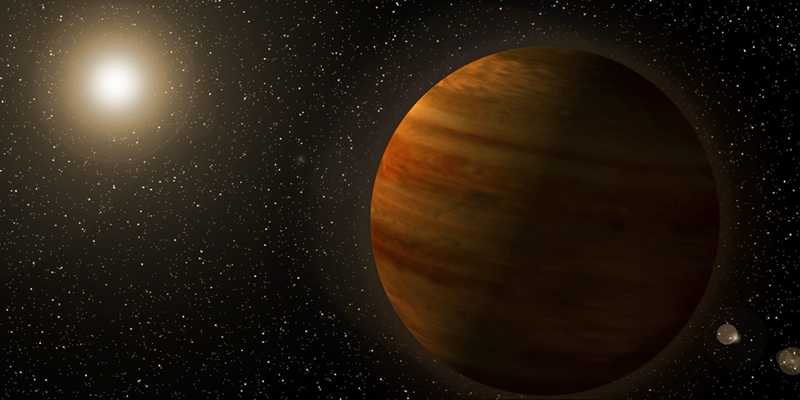
Artist's concept of the super-Jupiter Gaia23bra b, a banded gas giant orbiting its orange dwarf host star at a Jupiter-like distance. Image credit: NASA's Goddard Space Flight Center.

(image source)


A super-Jupiter twelve times farther than TESS can usually see, hiding in eight years of archived photometry, pulled out by a physics trick first described in 1936. Gaia23bra b is the first world the Transiting Exoplanet Survey Satellite has ever confirmed by gravitational microlensing, and the result quietly resets how a mission is used.

The signal was small. A background star out near the galactic plane brightened slightly as a foreground orange dwarf drifted across our line of sight. ESA’s Gaia spacecraft flagged the brightening in 2023 as a routine gravitational lensing event and dropped it in the alert stream. TESS happened to be staring at the same patch of sky, taking 27-day blocks of images for its usual transit hunt, and captured the same brightening with finer time sampling. Three years later, when Mallory Harris at the University of New Mexico pulled TESS’s archive, she noticed a tiny extra wiggle in the light curve, a five-day deviation that Gaia had missed because Gaia was sampling too sparsely. That wiggle was a planet. The paper went on the arXiv on July 1, 2026, and into The Astrophysical Journal Letters the same day (arXiv:2607.01853).

The headline number is just how far away the host system is. TESS was built to chase transits of bright, nearby stars, with its catalog reaching out to about 150 light-years. Gaia23bra b sits at roughly 40,000 light-years, deep in the galactic plane, on the far side of the galaxy’s disk from us. Detecting a planet there was not in the original mission plan, and that is what makes the result interesting.

Microlensing is the only planet-finding method that depends on distance rather than proximity to Earth. Transits need repeated passes in front of the star, so TESS sticks to bright nearby targets. Radial velocity gets harder as the star gets fainter. Direct imaging works for young planets still glowing from formation heat, typically hundreds of light-years away.

Microlensing needs only one alignment between a foreground star and a more distant background source. The foreground star’s gravity bends the background light into a brief magnifying-glass spike, and any planet orbiting the lens star leaves its own tiny extra spike on top. The alignment never happens twice. As Harris put it, microlensing events “happen once and they’re gone.”

Less than 5% of the more than 6,000 known exoplanets were discovered this way, according to NASA’s Goddard release on the result. Almost all came from ground-based surveys designed specifically for microlensing. The new detection is the first time a survey telescope built for something else has caught a microlensing planet in its own data. TESS has been staring at almost the whole sky on a rolling basis since 2018.

The find points forward to NASA’s next flagship astrophysics mission. The Nancy Grace Roman Space Telescope, currently scheduled for an August 30, 2026 launch from Kennedy Space Center, will spend one of its core surveys staring at the galactic bulge, where the stellar density makes microlensing alignments common. Co-author Michael Fausnaugh of Texas Tech, quoted in the NASA release, calls the TESS detection “a bit like a preview of the microlensing NASA’s Nancy Grace Roman Space Telescope will do.” Roman is projected to find roughly a thousand microlensing planets and a hundred thousand transiting planets across its primary mission.

The trigger was not new TESS data but the existing archive, re-read. Harris and her collaborators at the University of New Mexico, NASA Goddard, Texas Tech, and partner institutions were testing whether TESS’s short-cadence light curves contained enough information to recover microlensing signals at all. TESS full-frame images stack into 30-minute cadence products and 200-second cadence for selected targets, dense enough that a small planet-induced anomaly should be visible if you know where to look.

The team went looking in the eight-year archive for events Gaia had flagged as lensing candidates but could not resolve. Gaia23bra was a textbook case: Gaia saw the main brightening, a roughly 30-day event, but the planet’s signature sat on top as a small, sharp deviation that Gaia’s sparse sampling averaged out.

When Harris pulled TESS data for the same coordinates, the planet’s signature was sitting right there. The deviation lasted about five days and produced a measurable second-order change in the light curve that the team modeled as a second lens, in microlensing jargon, a binary-lens event with a planetary-mass companion. The recovered planet, Gaia23bra b, is roughly 1.6 times Jupiter’s mass on a Jupiter-like orbit around an orange dwarf star about 80% of the Sun’s mass. NASA’s release summarizes it as a “super-Jupiter” in a configuration the mission was not designed to find.

Co-author Diana Dragomir, also at the University of New Mexico, told the NASA press operation that “the discovery implies that there are probably other so-called microlensing planets hiding in TESS’s data that we hadn’t previously thought to look for.” Eight years of TESS full-frame images are now a searchable microlensing archive. More detections are likely; the next round of candidates is still being checked.

The Gaia side of the story closes a separate loop. Gaia finished its extended science mission earlier in 2026, ending a roughly 12-year astrometry run that produced the largest three-dimensional map of the Milky Way. Gaia23bra b is one of the last planets Gaia will help find, and shows how Gaia and TESS were complementary: Gaia’s wide-field coarse cadence for the alerts, TESS’s narrow-field fine cadence for the follow-up.

The underlying physics is the lensing effect Einstein described in general relativity. A massive object between a distant light source and an observer bends the source’s light around itself, producing two distorted images that are usually unresolved, so the source just appears brighter. A planet orbiting the lens acts as a smaller secondary mass that produces its own brief spike on top of the main brightening.

The size of that spike depends on the Einstein radius, scaling with the square root of the lens mass times the distances involved. For a stellar-mass lens halfway across the galaxy and a background source further away, the event lasts weeks, and the planet’s spike shows up over a few days, which is why the TESS team’s detection was a five-day feature on a roughly 30-day main event.

Two practical issues make the detection hard. The first is degeneracy: a single-lens fit can soak up most of the brightening, leaving a small residual that could be a planet, a stellar companion, or noise. Resolving it requires dense photometry where the planet’s signature shows up, which is what TESS provides and Gaia did not.

The second issue is the galactic-plane background. Toward the bulge and inner disk, stars are packed so tightly that a TESS pixel, about 21 arcseconds across, often contains multiple stars whose light blends together. The team’s workaround was to lean on Gaia’s catalog to decompose the TESS photometry into individual stars, then run the microlensing model on the cleaned light curve.

The Roman connection closes this loop. Roman’s Wide Field Instrument has roughly 100 times TESS’s collecting area and a pixel scale around 0.11 arcseconds versus TESS’s 21 arcseconds, which kills the blending problem for the bulge region. Where TESS catches a microlensing planet by lucky overlap, Roman runs a continuous survey of the densest lensing regions. The two missions cover different parts of the galaxy, with TESS’s strength being the rest of the galactic plane where stars are sparser.

The discovery does not change what we know about how planets form. The deeper lesson is that eight years of archived TESS photometry is now a real microlensing dataset, and the analysis pipeline used here is reproducible. Expect follow-up papers searching the TESS archive for additional Gaia-flagged lensing events with high-cadence follow-up available.

The next concrete milestone is Roman’s launch on August 30, 2026, which moves microlensing from the realm of niche ground-based surveys into a flagship-class statistics engine. Roman’s projected yield of around a thousand microlensing planets, paired with TESS’s growing archive of opportunistic microlensing detections, will start to give a real census of planets at Jupiter-like orbital distances across the galaxy. Gaia23bra b is the first data point on the TESS side of that census, and it arrived just in time for the Roman team to use as a worked example in their own planning.