OrbitalHub

Where curiosity reaches escape velocity.

Domain is for sale. $50,000,000.00 USD. Direct any inquiries to contact@orbitalhub.com.


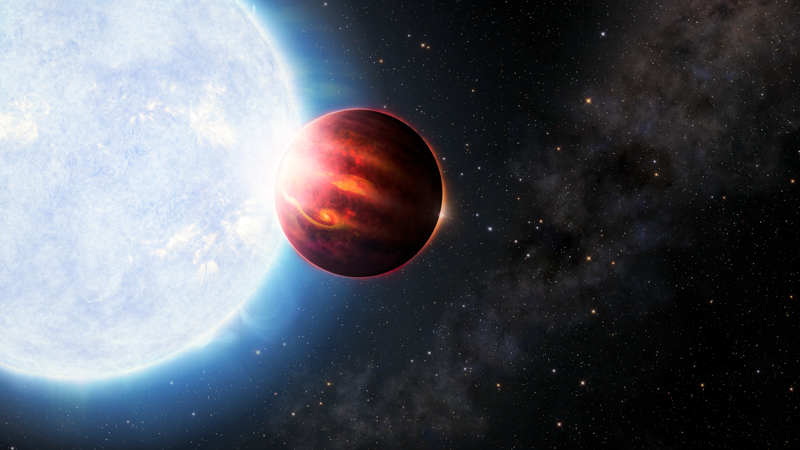
WASP-189b echoes the chemistry of its host star. Image: 2026 10 16 wasp 189b magnesium silicon.


Almost 320 light-years away, in the direction of the constellation Libra, a giant planet swings around its star in just under three days, glowing red and orange because the side that faces the star is hot enough to vaporize rock. WASP-189b is the textbook example of a class that astronomers call ultra-hot Jupiters, planets that look like Jupiter in size and bulk composition but orbit so close to their stars that their dayside temperatures climb above 2,500 kelvin, well past the vaporization point of minerals such as magnesium, silicon, and iron. New observations of WASP-189b with the Immersion Grating Infrared Spectrograph (IGRINS), mounted on the Gemini South telescope in Chile, have produced the first simultaneous measurement of gaseous magnesium and silicon in any exoplanet atmosphere, and the ratio between the two elements in the planet turns out to match the ratio in its host star. The result, published by Jorge Antonio Sanchez of Arizona State University and an international team in Nature Communications on 18 February 2026 and highlighted in a NOIRLab press release on 13 October 2026, is the first direct evidence for a long-standing assumption that astronomers have used since exoplanet science began (Sanchez et al. 2026, Nature Communications; NOIRLab press release noirlab2609).

The assumption in question is simple to state and powerful in practice. Planets form from the same protoplanetary disk of gas and dust as their host star, and the chemistry of that disk is set by the chemistry of the parent molecular cloud. The expectation, therefore, is that the relative proportions of the major rock-forming elements in a planet should match the relative proportions of those same elements in the star. In the Solar System this expectation has been borne out within a factor of about two for the rocky planets, and the small departures from a perfect match are useful constraints on the violent early history of the inner Solar System. For every other planetary system astronomers can detect, the question had to be inferred. Stellar spectra are easy to come by, because stars are bright, but exoplanet spectra are not, because exoplanets are faint, sit right next to a much brighter source of light, and are usually moving quickly through the background. Until the new WASP-189b measurement, no team had ever detected two rocky-element species in a single exoplanet at the same time, so the assumption that exoplanet chemistry tracks stellar chemistry was reasonable but unverified (SciTechDaily; ScienceDaily).

Why the magnesium-to-silicon ratio, in particular? The two elements sit at the heart of rock-forming mineralogy. Magnesium and silicon together build the silicates that make up most of Earth’s mantle, the olivine and pyroxene minerals that dominate the rocky bodies of the inner Solar System, and the iron-magnesium-silicate matrix that is the default material from which any rocky planet is expected to condense. The Mg/Si ratio of a planet, more than its absolute abundance of either element, sets the dominant mineral phases it can carry, which in turn control how easy it is for a planet to retain plate tectonics, generate a magnetic dynamo, and outgas volatiles that contribute to oceans and atmosphere. The same ratio in a star, measurable from high-resolution stellar spectra, has therefore been used for two decades as a proxy for the mineralogy of any rocky planets in that system, even ones whose spectra are beyond current reach. The WASP-189b result is the first observational check on that proxy, and it passes (NOIRLab Nuggets: Decoding Planet Origins with Gemini).

WASP-189b is a useful target for this measurement for a reason that has nothing to do with its bulk composition and everything to do with its orbit. The host star, catalogued as HD 133112, is a hot blue-white A-type star about 2.7 times the mass of the Sun. The planet is tidally locked, with the same hemisphere permanently facing the star, and its 2.7-day orbit takes it through a particularly favorable alignment called secondary eclipse, when the planet passes behind the star as seen from Earth. During secondary eclipse the planet’s own emission drops out of the combined spectrum and the star’s emission drops in, and a careful subtraction of one from the other yields the planet’s dayside spectrum in isolation. The IGRINS spectrograph, built by a consortium led by the University of Texas at Austin, Korea Astronomy and Space Science Institute, and the Korea Institute of Science and Technology, was a visiting instrument on Gemini South from 2022 to 2023 and was chosen because its near-infrared coverage and spectral resolving power are high enough to separate the planet’s individual atomic and molecular lines from the much brighter signal of the host star. The team collected a series of transit and eclipse observations of WASP-189b with IGRINS at Gemini South, then used high-resolution cross-correlation techniques to extract the magnesium and silicon lines from the planet’s contribution. The matched Mg/Si ratio was the central result (Sanchez et al. 2026, Nature Communications).

The instrumentation choice was a constraint as much as a convenience. Ground-based telescopes can deliver the spectral resolution that this kind of work requires only in narrow wavelength windows where Earth’s atmosphere happens to be transparent, and the near-infrared windows around 1.5 and 2.3 micrometers are the most productive because they sit in absorption bands of gaseous magnesium and silicon at the temperatures found in ultra-hot Jupiter atmospheres. The IGRINS spectrograph covers both windows simultaneously, which is what made the simultaneous detection possible. A more common approach in the field is to use a space telescope such as Hubble or JWST, but the trade-off is that those instruments do not have the same spectral resolving power and cannot easily separate the planet’s line from the star’s line for atomic species at high temperature. The success of the IGRINS run on Gemini South, and the fact that the instrument’s successor IGRINS-2 has now been commissioned as a facility-class instrument on Gemini North in Hawaiʻi, is a sign that high-resolution ground-based spectroscopy is on its way to becoming a standard tool for this kind of measurement, with more targets and more elements in the coming years.

A practical consequence of the result is that the long list of rocky exoplanet host stars whose Mg/Si ratios have already been measured, mostly by ground-based stellar surveys, can now be used with more confidence to predict the mineralogy of any rocky worlds in those systems. The assumption is no longer just a reasonable extrapolation from Solar System chemistry. It is a tested prediction, validated for one of the hottest and most alien gas giants in the catalogues, and almost certainly applicable, to a close approximation, to cooler and more temperate planets that no instrument yet exists to measure directly. For astrobiologists in particular the result closes a methodological gap: the standard practice of using a star’s elemental makeup to estimate the geochemistry of its planets, and through that the suitability of those planets for plate tectonics, magnetic fields, and long-term habitability, is now backed by direct observation rather than by an unverified assumption.

The IGRINS-2 commissioning on Gemini North, and the parallel development of other high-resolution spectrographs for the upcoming extremely large telescopes, suggest that the WASP-189b measurement is the first of a series rather than a one-off. The next steps are likely to involve measuring additional ultra-hot Jupiters with comparable precision, extending the technique to cooler gas giants and Neptune-class planets where the chemistry is more complex, and eventually applying the same kind of cross-correlation analysis to rocky planets around small stars, where the same Mg/Si assumption will need to be tested under different conditions. None of that happens quickly, and the WASP-189b result will remain the cleanest single demonstration of the principle for some time, but the door it opens is the same one that exoplanet science has been pushing on for the past two decades: turning stellar spectra, which are easy to obtain, into statements about planetary interiors, which are not.



The IonQ trapped-ion system architecture, where surface-code syndromes from a chain of barium ion qubits are routed to a classical decoder that has to keep pace with each gate cycle


On 22 September 2026, IonQ researchers posted a paper that quietly removes one of the most stubborn bottlenecks in quantum computing. Nicolas Delfosse, Min Ye, and Andrii Maksymov showed that a real-time decoder for fault-tolerant quantum error correction can run end-to-end on a single commercial CPU — specifically a 12-core Apple M4 Max laptop chip (arXiv:2608.25027). The benchmark held 408 logical qubits alive across more than a million T gates while adding only 0.02 percent of “stretch” time on top of the quantum run. Until now, every credible demonstration of a useful fault-tolerant quantum computer assumed a fleet of FPGAs, custom silicon, or beefy GPU clusters babysitting the qubits in real time. IonQ just argued, with measurements, that one is enough.

That claim matters more than it sounds. Quantum error correction has been the field’s longest-running promise and its largest engineering gap. A physical qubit loses coherence in microseconds; without constant repair, no useful computation finishes. The standard fix — a surface code — spreads each logical qubit across hundreds or thousands of physical qubits, measures parity checks (“syndromes”) between them, and feeds the syndrome stream to a classical decoder that has to guess which physical qubit flipped and push a correction back before the next gate fires. The classical side has to keep up. If decoding lags behind the quantum cycle, the quantum computer idles. If decoding fails, the logical qubit decays. This real-time constraint has shaped every architecture choice since Peter Shor introduced the first quantum code in 1995 and John Preskill coined the term fault tolerance four years later.

What IonQ did, in plain engineering terms, was throw out the assumption that fault tolerance requires exotic hardware. The team benchmarked a decoder on a workload they call MegaQuOp: roughly a million quantum operations, the threshold at which any algorithm starts to do something useful. Their dual-decoder architecture runs simultaneously on the memory blocks where logical data lives and on magic-state factories where the resource states that produce T gates are distilled. On a trapped-ion machine with a 1–5 millisecond cycle time — slower than superconducting systems but far cleaner per operation — the decoder finished its work in tens of microseconds per round, leaving the qubits essentially idle for the rest of the cycle.

The benchmarks themselves were a tour of the workloads any fault-tolerant computer will face. One was a measurement-induced phase transition circuit: 40 layers of random two-qubit gates compiled into Clifford and T gates at an average cost of 538 T gates per random gate, producing more than a million T gates across 102 logical qubits (arXiv:2608.25027, Tables I–IV). Another was a single sixth-order Trotter step of a disordered Heisenberg model: 64 sites on 102 logical qubits, then 266 sites on all 408. These are not synthetic stress tests; they map onto the early problems a useful quantum computer will tackle — chemistry, materials, condensed-matter simulation. Running them in real time, on commodity silicon, is the kind of result that moves a roadmap from “lab demo” to “engineering project.”

The decoder IonQ used is a variation on the minimum-weight perfect-matching (MWPM) algorithm that has dominated surface codes since Daniel Gottesman published the foundational results in 1997. Each syndrome measurement is a small piece of evidence about where an error happened; the decoder has to connect those pieces into consistent error chains and infer the most likely physical failure. The classical challenge is that the matching problem scales superlinearly with the number of qubits and gates, and the latencies required are measured in microseconds, not milliseconds. The way IonQ kept it tractable was to use a fast, sparse-graph formulation and to split the workload between two decoders running in parallel — one for memory, one for factory — so neither saturates the CPU. The result is a workload that fits comfortably on a 12-core laptop, with cores to spare.

This is also why the “single CPU” claim is not a marketing trick. The alternative — running the decoder on a rack of FPGAs, or on a dedicated ASIC, or on a GPU cluster — has been the design choice at IBM, Google, and Quantinuum. Each approach works in a lab. Each one also adds cost, power, and integration risk at exactly the moment the industry is trying to scale from hundreds to thousands of logical qubits. IonQ is betting that trapped-ion hardware, with its longer cycles and cleaner qubits, lets a conventional CPU do the work that other architectures have had to throw specialized hardware at. If the bet holds, the unit economics of a fault-tolerant machine shift sharply: the classical co-processor stops being a separate procurement line and starts being a server in the rack.

The result lands inside IonQ’s broader architectural plan, the Walking Cat scheme for fault-tolerant trapped-ion computing. Walking Cat is the company’s response to one of the hardest problems in the field: ion traps do not scale the way superconducting lattices do, because all the ions in a trap see the same control fields. Walking Cat threads the qubits through a chain of zones — memory, factory, measurement — moving them physically between regions while the controller keeps the surface code coherent. A lightweight decoder that fits on a CPU is a precondition for that scheme, because every zone transition generates syndromes that have to be processed before the next move. The 408-qubit benchmark is, in effect, the first measurement that says this scheme is implementable at scale.

What changes because of this. The next twelve months in fault-tolerant quantum computing will look different than the last twelve. Demonstrations that used to require a roomful of custom electronics will fit on a workstation; university groups will be able to reproduce them without privileged access to ASIC foundries. For IonQ, the result is a public milestone on the path from 256 physical qubits to “industrial-scale platforms controlling thousands of qubits,” to use the wording of the company’s 22 September announcement. For the field, it is one of those rare engineering results that removes a future constraint rather than adding one. Quantum error correction is no longer waiting for hardware. It is waiting for algorithms — and that, finally, is the right order of operations.


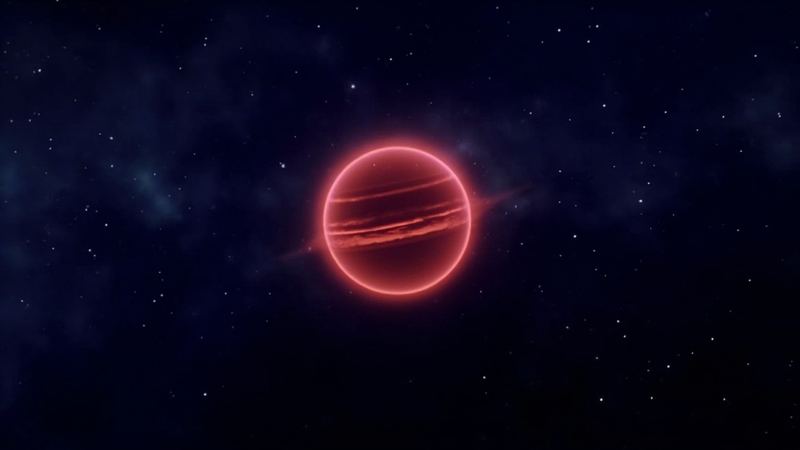
A faint, dark, isolated Y-dwarf brown dwarf glowing dim red-brown against a sparse starfield, with translucent water-ice cloud bands swirling over its banded atmosphere, representing WISE 0855-0714 drifting alone 7.4 light-years from the Sun.


Somewhere in the constellation Hydra, about 7.43 light-years from the Sun, an object slightly larger than Jupiter and roughly twice Jupiter’s mass sits at 265 kelvins and slowly rotates, surrounded by water-ice clouds. It is the coldest known brown dwarf, a failed star with no fusion at its core, and on a single clear orbit of the James Webb Space Telescope, a team led by Brittany Miles of the University of Arizona’s Steward Observatory pointed the Near-Infrared Spectrograph at it for eleven straight hours. The result, announced on 8 October 2026 and accepted for publication in The Astrophysical Journal, is the first direct evidence that water clouds thicken and thin on a body outside the solar system. The air is moving. The weather is real. We can now watch it.

Brown dwarfs have always been a category problem. Too massive to be planets — at least thirteen Jupiter masses is the conventional lower bound — and too small to clear their neighborhoods, they are also too small to ignite steady hydrogen fusion. They glow with the residual heat of their formation, dimming visibly year over year as they radiate it away. A young T-type brown dwarf can sit at 1,500 K and look vaguely like a hot Jupiter. A middle-aged one in the L-T-Y sequence cools through a thousand kelvins and changes chemistry, with silicate and iron clouds raining out of its atmosphere at successive temperature plateaus. By the time an object reaches the Y class, somewhere below 500 K, water has frozen into clouds at the level of the photosphere, and the chemistry has become alien enough that it overlaps with what a cold, isolated gas-giant planet would look like. WISE J085510.83-071442.5, the object that Kevin Luhman first identified in the WISE survey in 2013, sits so far down the cooling track that its own temperature is below the freezing point of water. That is why astronomers care about it. It is the closest analog to a free-floating giant planet that we can see in detail (Luhman 2014, ApJ 786, L18).

The new work leans on that proximity. With a parallax of 439.0 ± 2.4 milliarcseconds measured against background quasars (Luhman & Esplin 2014), WISE 0855 is the fourth-closest stellar system to the Sun, after Alpha Centauri, Barnard’s Star, and Luhman 16. At 2.278 parsecs it is close enough that JWST can collect a medium-resolution spectrum, R ≈ 1,000, with high signal-to-noise in fifteen-minute slices across an entire rotation. The team obtained 32 such spectra, one every fifteen minutes for eleven hours, watching the same atmospheric column long enough to track features as they came in and out of view. The result is not a static spectrum. It is a movie with chemical resolution.

What they saw falls into two distinct layers. In the upper atmosphere, between roughly 1 and 4 bar of pressure, the water-ice cloud opacity oscillates. Some rotation phases show deeper, thicker clouds; others show clearer air, with the underlying gas-phase water absorption features rising into view. Below that, near 70 bar, the abundances of carbon monoxide and, in particular, phosphine (PH₃) vary in a way that does not match a quiet atmosphere. The team interprets the deeper signal as convective dredging: parcels of gas from well below the photosphere are rising, cooling, and being mixed into the visible layers, carrying with them the products of high-pressure chemistry. Phosphine, in particular, is hard to make in a cold, hydrogen-rich atmosphere at equilibrium; seeing it vary is a fingerprint of disequilibrium mixing, the same vertical transport that drives Earth’s weather but in a gas made mostly of molecular hydrogen and helium.

Why this matters is partly a question of what the older instruments could not do. Pre-JWST photometry of WISE 0855 measured the total brightness changes as the object rotated, but photometry collapses everything — clouds, chemistry, temperature — into a single flux number. NIRSpec at R ≈ 1,000 resolves individual molecular lines, so a cloud’s signature can be told apart from a chemistry change by the wavelength dependence. A water-ice cloud dims more in the continuum than in a line core; phosphine varies in a sharp, narrow band near 4.3 μm. That wavelength-resolved time series is what turns “the brightness is changing” into “the air is moving,” and only JWST has the combination of light grasp, wavelength coverage, and stability to make the measurement.

The broader payoff is the bridge the result builds between solar-system science and exoplanet science. Jupiter, the only other place where we can stare at water-ice clouds for a full rotation, has its own meteorology, and the cloud structures are different in kind — banded, with sharp shear zones and lightning-driven convection. The brown-dwarf version is slower, colder, and chemically simpler, but the physics overlaps. Carbon monoxide and phosphine chemistry in hydrogen-rich air follows the same quench kinetics, the same vertical-mixing timescales, the same temperature-dependent pathways. Modeling tools built for Jupiter’s atmosphere can be ported across. As the team puts it, the cloud-thickness modulation they see in WISE 0855 sits at pressures close to the photosphere, while the CO and PH₃ modulation sits much deeper; the two signals decouple, which they would not if a single effect were driving both. The weather is layered, the way weather here is layered.

There is a second, quieter implication. Brown dwarfs are not the only objects at this effective temperature. The directly imaged giant planets around HR 8799, β Pictoris, and a handful of other young A-stars sit at L-to-T spectral types, with brightness temperatures around 1,000 to 1,500 K. The colder, free-floating Y-dwarfs like WISE 0855 are the only objects old enough and cool enough to make the photospheric chemistry fully settled, and that makes them the closest natural laboratory for what an isolated Jupiter-mass planet would look like after it stops glowing from formation heat. The same NIRSpec time-series technique, applied to a young, hot Jupiter, will not work — the contrast against the host star is too steep — but applied to a Y-dwarf, it works because the dwarf is its own light source. If the team can repeat the measurement on a slightly warmer or slightly cooler Y-dwarf, they can map how the cloud layer’s vertical position and the convective mixing depth depend on effective temperature. That is a phase diagram of substellar weather waiting to be filled in.

For the moment, the headline is small and concrete: on one eleven-hour night, JWST watched water clouds form and dissipate on an object only 7.43 light-years away. The first exoplanet weather report, in the strict sense, is in. The next step is repetition across the Y class, where a small population of cold brown dwarfs within 20 parsecs is already known and the JWST time-allocation committee is more than willing to spend hours on them. The fields that should move fastest are the cloud microphysics of water ice in hydrogen-rich gas and the rate at which disequilibrium chemistry can reshuffle carbon and phosphorus through an atmosphere with no stellar irradiation to drive it. Both questions have been waiting, in a sense, for a Webb that could simply sit on one cold dot for half a night and watch. That wait is over.


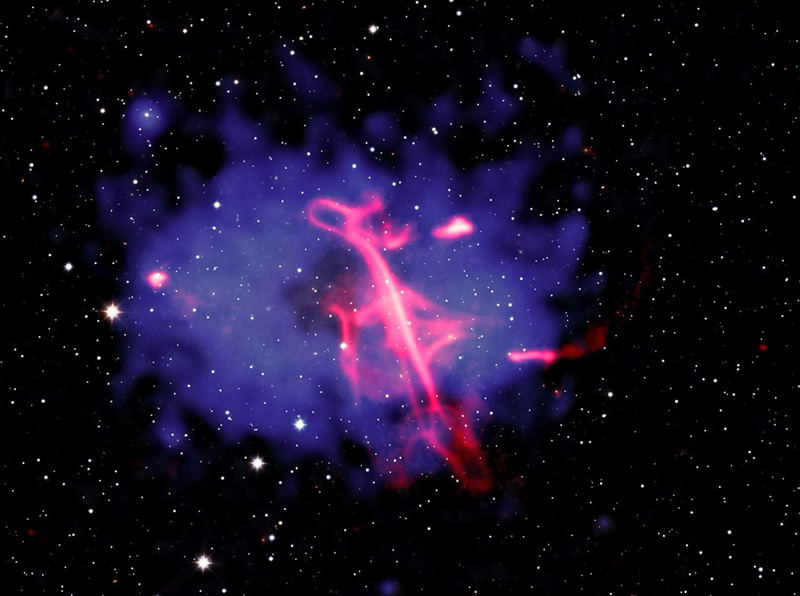
Chandra hears a treble clef in a galaxy cluster. Image: 2026 10 17 chandra treble clef radio phoenix.


When a radio source was first catalogued three decades ago as VLSS J0318.9+5755, it looked ordinary enough: a faint filament at low galactic latitude, originally mistaken for a pulsar and shelved. Then a team led by Andrea Botteon at Italy’s National Institute for Astrophysics (INAF) took a closer look with the LOFAR Two-metre Sky Survey, and the source turned out to be doing something the radio sky almost never shows. Curling from top to bottom in a single continuous line, it traces out a shape that looks, unmistakably, like a treble clef. In a paper published Wednesday in Astronomy & Astrophysics, the team combined new radio observations with NASA’s Chandra X-ray Observatory and the German-built SRG/eROSITA X-ray telescope to trace the formation to two events that happened hundreds of millions of years apart: an old outburst from a supermassive black hole, then a galaxy cluster collision that re-energised the fossil plasma. The NASA press release that landed on 14 October 2026 calls the shape a case of pareidolia – the human habit of seeing familiar patterns in random data – which is fair, since the resemblance is the most striking thing about it but says nothing about the physics that built it.

The reason the Treble Clef took so long to pin down is geography, not distance. The source sits at galactic latitude b ≈ 0.5°, almost directly behind the plane of the Milky Way. Stars, dust, and gas in our own galaxy block the optical light from anything that lies in that band, and the same obscuration makes it hard to identify the host. Optical surveys simply cannot reach that patch of sky, which is why this strip of celestial real estate has its own name among extragalactic astronomers: the Zone of Avoidance. Surveys that look through other parts of the electromagnetic spectrum have no such problem. X-rays punch through the galactic gas easily, and radio waves ignore it almost entirely, so a combination of LOFAR for the radio skeleton and Chandra and eROSITA for the hot intracluster medium turns out to be exactly the right pair of tools for the Treble Clef. Once that combination was applied, the source fell into place.

What the data shows is a textbook example of a radio phoenix. A radio phoenix is fossil plasma – relativistic electrons and magnetic fields that were puffed out by a previous activity, lost most of their energy through synchrotron and inverse-Compton cooling, and went dark at radio wavelengths. They sit in clusters for tens to hundreds of millions of years as invisible reservoirs of stored energy, and then something comes along to re-energise them. In the Treble Clef, that something is the merger of two galaxy clusters. The collision drove through the intracluster gas and generated shock waves, the same kind of weak shocks that are responsible for sonic booms from supersonic aircraft. When those shock fronts swept over the fossil plasma cloud, they re-accelerated the electrons and the cloud lit back up at radio wavelengths. The Treble Clef is the fossil turned visible again, and the merger shock is the trigger.

The host cluster, named after its coordinates in the VLSS catalogue, sits in the Zone of Avoidance but is otherwise a perfectly ordinary massive merging cluster. The Chandra and eROSITA X-ray observations show a roughly oval cloud of multimillion-degree gas, hundreds of galaxies, and a complex dynamical state. To pull the merger signature out of the X-ray image, the team used a residual technique: they subtracted the symmetric, oval-shaped hot gas that any relaxed cluster would have, and looked at what was left. The leftover emission was brightest at the left and right edges of the cluster and faintest in the middle, exactly what you would expect if the collision had been along the left-right axis. That residual image is what the new Chandra composite is built around. The radio image, taken from LOFAR’s LoTSS and LoLSS surveys plus new uGMRT follow-up, was then laid on top in red. The X-rays go in blue and purple, the infrared background from the United Kingdom Infrared Telescope goes in white, and the result is the magenta-on-blue image released on 14 October.

The shape itself is not a symbol that the universe was trying to draw. The vertical stroke of the clef is a long filament of old radio plasma that points roughly along the merger axis, and the loops at the bottom are short curls drawn into the plasma by gas motions in the merging intracluster medium. As the two clusters passed through each other, their gravitational potentials dragged the intracluster gas into a turbulent, asymmetric state, and the turbulence carved the curled loops out of what would otherwise have been a fairly straight filament. The resemblance to a treble clef is incidental. What is not incidental is that the structure is a remarkably clean laboratory for a specific question in plasma astrophysics: how do fossil relativistic plasmas respond to weak shocks, and what does the answer tell us about the energy budget of merging clusters.

The spectrum of the radio source tells its own story. Between 400 and 650 MHz, the radio spectrum is extremely steep, with a spectral index steeper than α = 4 in places, which means the source is unusually dim at high frequencies and bright at low frequencies. That is exactly the signature of an old, revived plasma cloud rather than a fresh injection from an active galactic nucleus. A new outburst from a supermassive black hole would have a flatter spectrum and would not be confined to a single, coherent filament. The steepness, combined with the morphology, is what convinced the team that this is a phoenix and not something else.

For the broader study of cluster mergers, the Treble Clef is interesting for two reasons. The first is that it sits in the Zone of Avoidance, where systematic surveys of radio halos and phoenixes have been patchy because optical and near-infrared work is hard. Adding a clean, well-characterised example to the catalogue is a reminder that the radio sky keeps surprises waiting behind the Milky Way. The second is that the paper reports a tentative radio halo near the cluster centre, the diffuse radio glow that is the canonical signature of a recent merger, which would make this cluster a textbook laboratory for studying the link between mergers, turbulence, and particle re-acceleration. The Botteon team plans to follow up with high-resolution, very-low-frequency observations using LOFAR 2.0, the upgraded array now being commissioned in Europe, which will resolve the curled loops at sub-arcsecond scales and constrain how the plasma is being re-accelerated.

The short version is that a source first catalogued in the 1990s as a faint low-frequency radio blip, almost written off as a pulsar, turned out to be a clean case study of how a galaxy cluster merger can light up the fossil plasma from an old black hole outburst. Chandra and eROSITA saw the cluster, LOFAR and uGMRT drew the clef, and the team from INAF put the story together. The clef shape is the eye-catcher, but the physics it illustrates is the real story, and the cluster is now on the short list for the next generation of low-frequency radio follow-up.


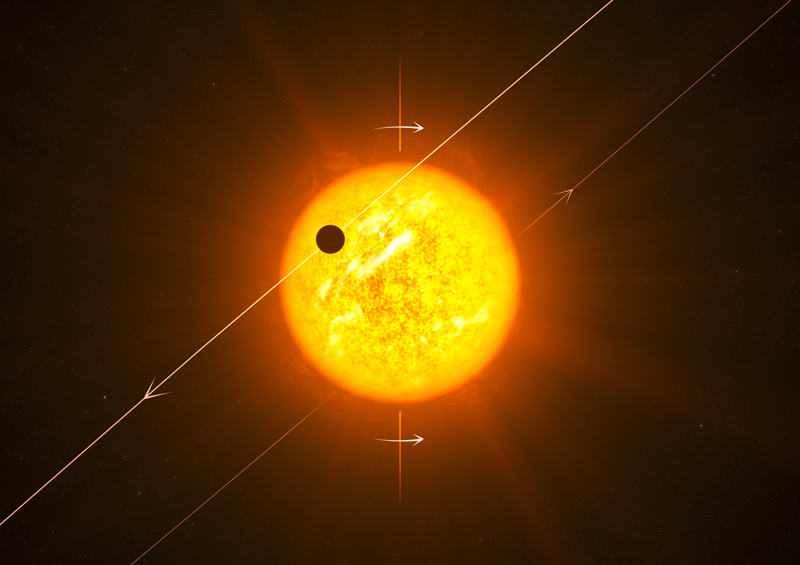
Artist's impression of an exoplanet on a retrograde orbit, with a planet transiting the disk of its host star along a tilted orbital plane. Image credit: ESO/L. Calçada.


For most of the history of exoplanet science, planets that orbit their host stars in the wrong direction were curiosities reserved for the rare hot-Jupiter systems where gravitational chaos had clearly been at work. A team led by doctoral student Yann Carteret at the University of Geneva has now reported the first retrograde planet ever found around a small, cool red dwarf star, and the result has no obvious explanation. The planet, GJ 3090 b, is a sub-Neptune 73 light-years away in the southern constellation Phoenix, and it traces an orbit that runs opposite to the rotation of its host. For an M-dwarf system, that is new ground.

Why this matters comes down to a single number. The angle between a planet’s orbital plane and the equator of its star, called Psi by the people who measure these things, sits at roughly 136 degrees for GJ 3090 b. Anything over 90 degrees counts as retrograde. In our own Solar System, that angle is between three and seven degrees for every planet, and Mercury nudges a little higher but stays comfortably prograde. The handful of other misaligned systems spotted over the last fifteen years each had a massive companion on hand, another giant planet or a stellar partner whose gravity could tilt or flip a smaller neighbor’s orbit after the fact. GJ 3090 does not. The second planet in the system is too small to do that kind of work, and there is no sign of a stellar companion. Whatever put this world on its current path had to do so without the usual accomplices, which means the textbook explanations of misaligned hot Jupiters do not apply. The find, published in Astronomy & Astrophysics, forces the field to consider mechanisms that would otherwise be filed under unlikely.

The story begins with TESS, NASA’s Transiting Exoplanet Survey Satellite, which flagged GJ 3090 b’s shadow back in one of its southern-sector campaigns. A transit is the easy part. The hard part is figuring out which way the planet is moving when it crosses the star, because that is what tells you whether the orbit is prograde or retrograde. The team watched five separate transits with the NIRPS infrared spectrograph, an instrument built in Geneva and installed on ESO’s 3.6-metre telescope at La Silla Observatory in Chile. NIRPS is tuned to the near-infrared, which is exactly the part of the spectrum where a cool, dim red dwarf like GJ 3090 puts out most of its light, and where telluric absorption from Earth’s own atmosphere is least annoying.

What the team was after is a phenomenon called the Rossiter-McLaughlin effect. As a star rotates, the hemisphere spinning toward Earth is slightly blueshifted, and the hemisphere spinning away is slightly redshifted, from the regular Doppler motion of the stellar surface. When a planet transits, it blocks a small patch of that rotating surface. If the planet moves across the star in the same direction as the star’s spin, the planet first covers a blue patch and the star appears briefly redder, then it covers a red patch and the star appears bluer, leaving a characteristic bump-dip pattern in the radial-velocity curve during the transit. For GJ 3090 b, the team saw the order reversed on every one of the five transits, with the red patch covered first. The orbital obliquity they derived is 136 degrees, in line with the inverted transit shape, and consistent across nights. There is no ambiguity left in the geometry, and that is what makes the result clean.

The science and engineering of the result sit at the same intersection that has made red dwarfs the most-studied stellar hosts over the past decade. M dwarfs are smaller and cooler than the Sun, so a sub-Neptune-sized planet produces a deeper transit signal and a larger radial-velocity wobble per unit mass than the same planet would around a Sun-like star, but the wobble from a 2.2-Earth-radius, 4.5-Earth-mass world with a 2.9-day period is still small and the transit still short. NIRPS’s design wavelength range of roughly 0.95 to 1.8 micrometres lines up with the infrared peak of a cool red dwarf, and its stability across a single transit, and across five transits taken on different nights, is what allowed the team to distinguish a genuine 136-degree obliquity from a smaller angle buried in noise. Carteret and his co-authors, including Léna Parc and Vincent Bourrier at UNIGE, point out that GJ 3090 b is now the smallest exoplanet to have its orbital obliquity mapped around any M dwarf. The technical milestone is as important as the discovery itself, because it means the technique works on the kinds of planets that are most common in the galaxy.

What remains genuinely puzzling is the missing companion. In every previously known misaligned multiplanet system, the configuration can be traced to gravitational interactions with a much larger body, either a second giant planet in the same system or a binary star whose orbital plane pulled things off course over hundreds of millions of years. GJ 3090 has a second planet, but it is not massive enough to do that kind of work, and there is no sign of a stellar companion. The team’s favoured hypothesis is a primordial disk flip, the idea that after the original protoplanetary disk dissipated, a second, misaligned disk of gas and dust fell onto the star from the surrounding interstellar medium. If that second disk arrived at the right angle, the planets that formed inside it would inherit its orientation rather than the star’s. There is precedent in so-called Peter Pan disks, which survive far longer than standard disk-evolution models predict, around other young stars. GJ 3090 b might be a snapshot of what happens when one of those long-lived disks finally does form planets, and the planets turn out to be running around the wrong way, in the wrong direction.

The takeaway is that this is the kind of measurement that quietly resets how a discovery category gets built. Until now, retrograde exoplanets were a hot-Jupiter phenomenon with a tidy dynamical explanation. Now there is a sub-Neptune on a 2.9-day orbit around a small red dwarf, and the dynamical explanation has fallen away. NIRPS will keep taking data, and the same technique can be applied to any of the dozens of transiting M-dwarf planets already on the books. Carteret’s team plans to extend the survey, and at least one follow-up is already in the queue. Whether GJ 3090 b turns out to be a one-off oddity or the first example of a new population of backwards travelers around small stars is the question that the next year or two of observations will answer.


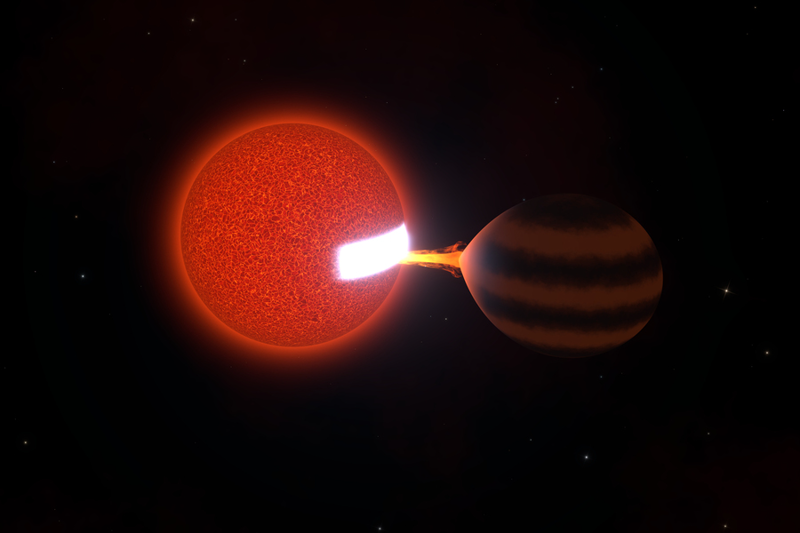
Artist's impression of ZTF J0440+2325, with a brown dwarf (right) orbiting a red dwarf (left) every 86 minutes and 39 seconds; material overflowing the brown dwarf's Roche lobe streams across the inner Lagrange point and strikes the red dwarf's surface, heating a white hot spot that produces the triangular light curve seen in the Zwicky Transient Facility data. Image: Aaron Householder (MIT); full-resolution asset at MIT News, via the article on the discovery at news.mit.edu/2026/astronomers-catch-star-slowly-snacking-on-brown-dwarf-1005.


Roughly 300 light-years from Earth, in a part of the Milky Way that no catalogue has bothered to name, two objects circle each other every 86 minutes and 39 seconds. One is a small star, a red dwarf about 85 times the mass of Jupiter. The other is a brown dwarf about 25 times Jupiter’s mass, an object too heavy to be a planet yet too light to fuse hydrogen the way stars do. They orbit so close together that the entire configuration would fit inside the diameter of the Sun. And the smaller one has been quietly leaking material onto the larger one, at a rate slow enough that the larger object will be feeding on its neighbour for billions of years. The system, named ZTF J0440+2325, is described in a paper appearing today in Nature Astronomy by Aaron Householder, Kevin Burdge, and collaborators at MIT and partner institutions, and reported in a parallel MIT News feature by Jennifer Chu. It is the first confirmed case of stable, long-lived mass transfer from a substellar object onto a main-sequence star, and it pulls a tidy assumption about what happens to planets and brown dwarfs that end up too close to a star.

The tidy assumption is the swallow-engulfment model. When a planet, a brown dwarf, or any other substellar object drifts close enough to its host star, the standard picture is that the host tidally strips or disrupts it on a short timescale. The engulfed material gets swallowed and incorporated into the star, the companion disappears, and the binary turns into a single object with a slightly higher mass. This is the fate that astronomers have routinely inferred from observations of close white-dwarf and neutron-star binaries, and it is the fate that theory predicts for the Earth when the Sun leaves the main sequence in five billion years and expands into a red giant. The brown dwarf in ZTF J0440+2325 was supposed to be on the same conveyor belt, dragged inward by tidal friction and consumed on a timescale of thousands to millions of years. Instead, it is doing something much slower and stranger. It is leaking material onto its companion at a rate of about one hundred-thousandth of an Earth mass per year, a number the team works out in the Nature Astronomy paper using the photometric wobble of the binary and the assumption that the donor is overflowing its Roche lobe along the L1 Lagrange point. That is about 40 million dump trucks of material per year by the team’s own analogy, a quantity that sounds large but is a tiny fraction of the brown dwarf itself. The star will not run out of food before the Galaxy ages out from under it.

What the team saw first was the triangular waveform. The Zwicky Transient Facility, a wide-field optical time-domain survey that uses a camera on the 48-inch Samuel Oschin Telescope at Palomar Observatory in California, had been picking up a strange light curve from a star in Taurus for several years. Supernova light curves are bell-shaped: gradual rise, peak, gradual fade. Buried in the ZTF archive was a signal that did not look like a bell at all. It looked like a triangle, repeating on a period of about 87 minutes, with no counterpart at other wavelengths and no obvious explanation. Burdge, an assistant professor of physics at MIT who had been searching the ZTF data for periodic variables, noticed it during a search for a different kind of system. He originally suspected a “black widow binary,” the colloquial name for a millisecond pulsar that is slowly eroding a low-mass stellar companion with its particle wind and radiation. In a black widow, the optical light curve wobbles because the companion is being whipped around the much heavier neutron star, and the orbit usually shows a clean Doppler signature of that motion. The ZTF light curve did not wobble in the same way, which is what tipped the team off that the two objects were not a David-and-Goliath pair but a more balanced system in which neither dominates. Householder, a graduate student in MIT’s Department of Earth, Atmospheric and Planetary Sciences, reanalysed the ZTF photometry and combined it with follow-up time-series spectroscopy. The wobble was small, the spectrum showed hydrogen and helium emission lines characteristic of an M dwarf, and the orbital fit locked the masses at roughly 85 and 25 Jupiter masses. The orbit fit inside the Sun.

The simulation work clinched the picture. Once the team had a mass, a radius, and an orbital geometry, the next question was whether the brown dwarf was overflowing its Roche lobe, the teardrop-shaped region of space around a body in a binary inside which material is bound to that body. If the brown dwarf were inside its Roche lobe, no mass transfer would be possible; the two objects would simply orbit forever without exchanging material. If the brown dwarf were overfilling the lobe, material would spill through the L1 point and rain down on the companion’s surface. The team ran a set of smoothed-particle hydrodynamics simulations with the measured masses, the measured orbital separation, and a brown-dwarf radius tuned to match the photometric brightness. The simulated test particles do not orbit the brown dwarf indefinitely; they stream across the L1 point and pummel the surface of the red dwarf at high speed. The team describes the geometry as more like an asteroid hitting the Moon than the usual accretion disk around a black hole or a neutron star, where material spirals inward through a flattened disk before settling onto the central object. In ZTF J0440+2325, the brown dwarf is too small for its own gravity to capture the inflowing material into a disk, so the stream lands directly on the surface and heats a roughly circular hot spot at the impact point. That hot spot is what produces the triangular waveform. As the brown dwarf orbits, the hot spot rotates in and out of view, and the system brightens when the hot spot faces Earth and dims when it faces away. The peak of the triangle is the moment of direct face-on view, when the impact fireball is brightest.

The mass-transfer rate is low enough that the system is genuinely stable on astrophysical timescales. Most binary mass transfer is unstable on some level: the donor shrinks as it loses mass, the orbit responds by widening or shrinking in ways that either accelerate or choke off the transfer, and the system either spirals toward a common-envelope merger or settles onto a longer-period detached configuration. What the simulations show for ZTF J0440+2325 is the rarer case in which the mass-loss timescale of the brown dwarf and the angular-momentum loss timescale of the orbit are tuned just right that the rate stays roughly constant for hundreds of thousands of years and may hold for the entire remaining lifetime of the brown dwarf, on the order of billions of years. The brown dwarf, as a substellar object, cannot fuse hydrogen and so does not have a main-sequence lifetime in the usual stellar sense, but it has a thermal-cooling timescale, and the team argues that the binary will outlive that timescale many times over. The brown dwarf will not be eaten quickly. It will be eaten slowly, continuously, and quietly, and the Galaxy will be a different place by the time the meal is finished.

What the team plans to look for next is more of the same. The triangle-shaped light curve is a distinctive signature, and the ZTF archive contains years of survey photometry that have not been systematically searched for it. The paper names a second candidate, ZTF J1444+4820, with an even shorter 67-minute period and a similar wobble signature. If that system confirms, the slow-eating configuration stops being a one-off and becomes a routine endpoint of binary evolution when the masses and separation land in roughly the right place. The triangular waveform, the small wobble, and the absence of a Doppler signature that would betray a heavy compact object are the three ingredients of the search. The same configuration, in principle, applies to small stars and giant planets, and the team plans to look for those as well. The conventional picture of close planetary companions has to share the page with a quieter alternative: a slow, steady meal that outlasts planets.