OrbitalHub

Where curiosity reaches escape velocity.

Domain is for sale. $50,000,000.00 USD. Direct any inquiries to contact@orbitalhub.com.


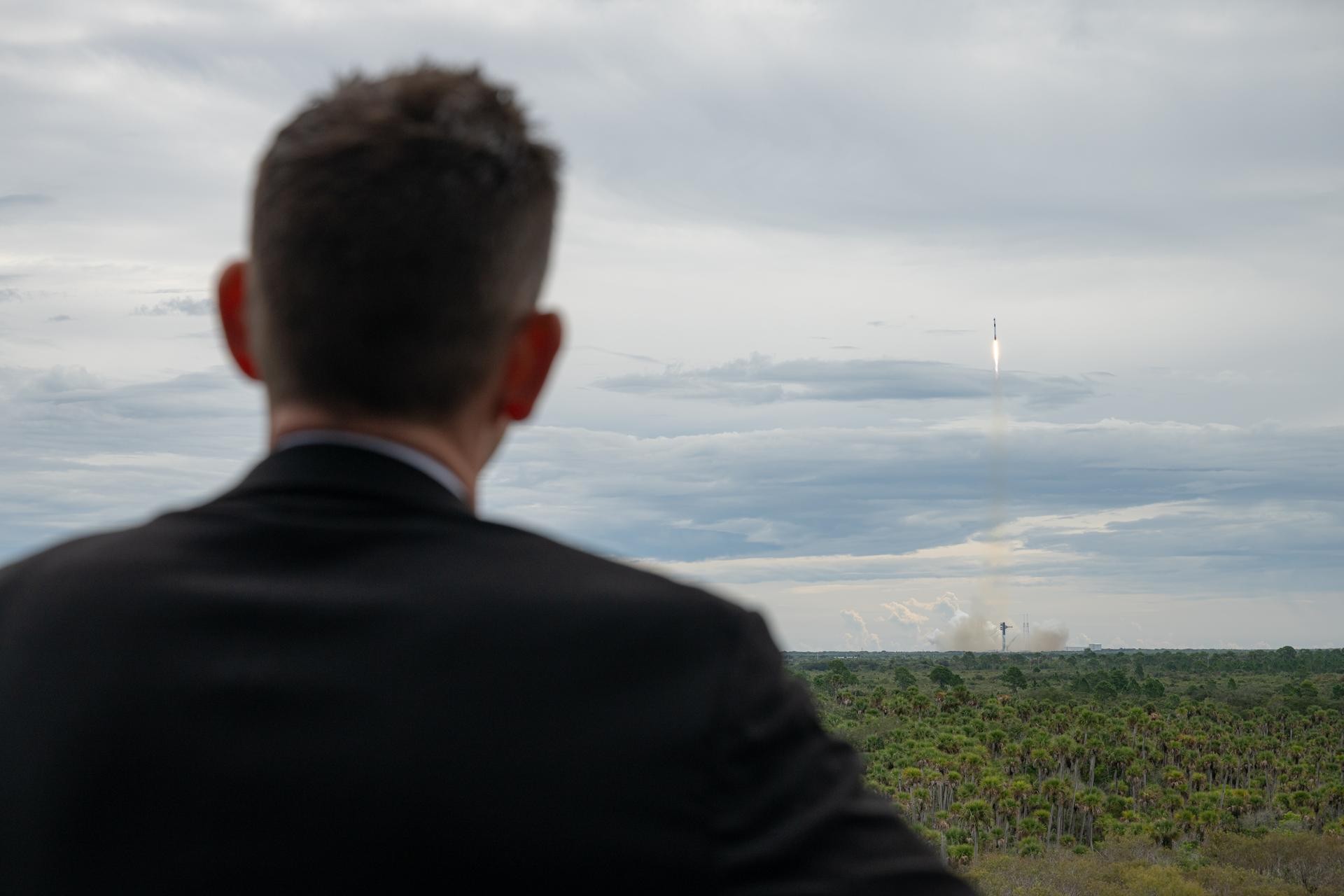
A NASA official watches as a SpaceX Falcon 9 climbs into cloudy skies over Cape Canaveral on October 1, 2026, carrying the four Crew-13 astronauts toward the International Space Station.

Image source: NASA Image and Video Library. Photograph by NASA/Joel Kowsky, public domain.


A SpaceX Falcon 9 lifted off from Space Launch Complex 40 at Cape Canaveral Space Force Station at 11:10 AM Eastern time on Thursday, October 1, carrying four astronauts on NASA’s Crew-13 mission to the International Space Station. About seven hours and fifty minutes after launch, Crew Dragon Grace is expected to dock autonomously to the forward port of the station’s Harmony module at approximately 7:00 PM Eastern. NASA’s launch-day release described the planned transit as a record-setting flight duration for any U.S. spacecraft heading to the station.

The four crew members are Jessica Watkins and Luke Delaney of NASA, Joshua Kutryk of the Canadian Space Agency, and Sergey Teteryatnikov of Roscosmos. Watkins commands the mission and is flying her second spaceflight, becoming the first NASA astronaut to fly twice on a SpaceX Dragon. Delaney pilots in his first spaceflight; Kutryk and Teteryatnikov are mission specialists, each also on a first flight. The launch was originally targeted for September 12 and was delayed by a propellant oxidizer leak discovered on the Dragon before that attempt. The crew entered final quarantine on September 17 and waited out the slip until the October 1 window, which weather officials rated at 70 percent go.

This is the thirteenth NASA Commercial Crew rotation flight, and the twenty-first time a Crew Dragon has carried a crew to orbit. The mission will run approximately six months, ending with a Pacific Ocean splashdown no earlier than March 2027. Once aboard, the four crew members will join Expedition 75 alongside Anil Menon of NASA and Pyotr Dubrov and Anna Kikina of Roscosmos, who are already on the station. After a brief handover, NASA’s SpaceX Crew-12 mission — astronauts Jessica Meir and Jack Hathaway of NASA, Sophie Adenot of ESA, and Andrey Fedyaev of Roscosmos — will return to Earth, restoring the station to a seven-person complement.

The crew backgrounds are deliberately diverse. Watkins is a geologist who previously flew on SpaceX Crew-4 in 2022; her second flight makes her the first NASA astronaut to ride a Dragon twice. Delaney is a former U.S. Navy aviator; Kutryk is a Royal Canadian Air Force fighter pilot; Teteryatnikov is a Russian submariner. Kutryk’s flight is a small but real first: he is the first Canadian to fly as part of NASA’s Commercial Crew Program. The earlier Canadian on a Dragon was Mark Pathy, who flew privately on Axiom Mission 1 in 2022.

NASA announced the crew assignments on April 23, 2026. The pairing of an experienced commander with three first-time flyers, including two from agencies that have not previously flown on Commercial Crew, is consistent with how NASA has used early-rotation flights to broaden the program. A Roscosmos backup crew member, Harutyun Kviryan, was assigned to the mission and remains in crew-support rotation on the ground.

The science planned for the six-month expedition leans heavily on microgravity biology. The crew will work with human stem-cell-derived tissues, an area of research NASA has invested in heavily in the last several expedition cycles, with the goal of building disease models and pharmaceutical testbeds that are hard to assemble on Earth. The crew will also work with a mostly autonomous plant-growth system to test crop production outside dedicated growth facilities — an effort aimed at the longer question of feeding crews on deep-space missions. Two additional threads continue work from earlier expeditions: studies of how blood-flow regulation responds to microgravity, and a hand-held diagnostic device intended to give crews more autonomy on long flights.

The mission comes at a transitional moment for the U.S. human-spaceflight program. NASA’s commercial crew cadence has settled into a roughly twice-yearly rhythm, and Crew-13 is the third operational mission of 2026. At the same time, the agency is preparing for the next test of its deep-space crewed vehicle: Orion, which flew its second crewed mission in April. Crew-13’s fast rendezvous profile reflects improvements in Dragon’s on-orbit phasing software and ground-control procedures; the previous record for a U.S. crewed launch-to-ISS-docking transit was set on Crew-4 in 2022 at roughly seventeen hours.

The launch comes three days after SpaceX’s first orbital Starship flight on September 28. NASA’s launch administrator, Jared Isaacman, framed the back-to-back events in his remarks at Kennedy Space Center. He called Crew-13 “another demonstration of America’s unmatched capability in human spaceflight,” and credited the agency and SpaceX teams for the launch. Dr. Lori Glaze, NASA’s associate administrator for the Human Spaceflight Mission Directorate, tied the mission into the broader exploration narrative: the ISS is “sustaining our presence in Earth’s orbit and sharpening the tools we’ll take forward to the Moon and Mars.”

Docking is scheduled for 7:00 PM Eastern. NASA’s live arrival coverage begins at 5:20 PM Eastern for the rendezvous, docking, and hatch-opening sequence, after which the four astronauts will change out of their spacesuits, transfer cargo, and open the hatch into Harmony. The handover period between Crew-13 and Crew-12 is expected to run roughly a week, with Crew-12’s return targeted for later in October.

The Crew Dragon capsule flying this mission is named Grace. That name is not on NASA’s standard naming rotation for Crew Dragon; it was applied for this specific vehicle. The choice has not been widely discussed publicly, but the spacecraft’s flight record makes the name appropriate: Grace flew this mission after a propellant leak in late August forced a multi-week delay, and the recovery from that delay is what the crew and ground teams are credited with in NASA’s launch-day release.

Once Crew-13 is aboard, the station will continue its mixed program of microgravity research, maintenance spacewalks, and visiting-vehicle traffic through the spring of 2027. NASA’s next crewed flight of any kind is expected to be the second lunar-flyby mission of the Orion program, currently in late-stage processing at Kennedy. Crew-14, the next operational Crew Dragon rotation, has not yet been publicly assigned.
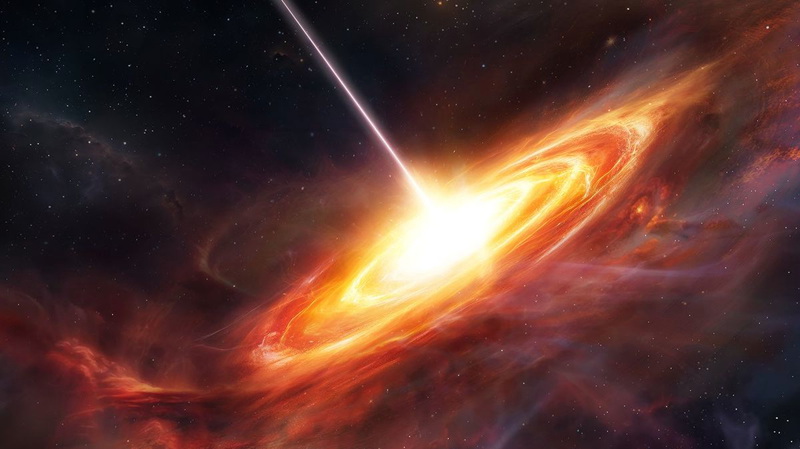


Artist's concept of a quasar: a brilliant white core surrounded by a glowing spiral disk of gas and dust, with a narrow jet of light extending upward.


On 6 July 2026, a team led by the European Space Agency reported that Euclid, a wide-field infrared space telescope launched in July 2023, had catalogued 31 of the oldest quasars ever documented. Two of them broke the redshift record outright. The most distant, named EUCL J172902.75+641018.1, sits at a redshift of z = 7.77, meaning the light that just reached us left when the universe was about 670 million years old, roughly 5 percent of its current age. The runner-up, EUCL J125308.55+705432.3, clocks in at z = 7.69. Both names and numbers come straight from the ESA release and the new paper in Astronomy & Astrophysics, led by Daming Yang of Leiden University, also covered by Universe Today and Astronomy magazine.

For scale, the previous redshift record for a quasar was z = 7.64, set in 2021. Euclid broke that bar twice in the same data set.

Quasars are not just bright. They are unreasonably bright. They run on the gravitational energy of matter falling onto supermassive black holes at the centers of galaxies. The disk of in-falling gas and dust is heated by friction and tidal forces to millions of degrees, and radiates more energy than every star in the surrounding galaxy combined. When you find a quasar at z > 7, you are not just finding a bright dot. You are finding evidence that a black hole of a billion solar masses or more already existed when the universe was younger than its present-day span allows for under the simplest models of growth.

That is the source of the quiet excitement around this kind of result. The “seed” black holes that became today’s supermassive monsters must have formed quickly and grown fast. Finding them when they were already radiating as quasars places hard constraints on the formation channels that can deliver a million- to billion-solar-mass object so early. Every additional z > 7 quasar adds a new anchor point.

The second reason this matters is methodological. Euclid was not designed to chase the earliest quasars. It was selected and built to image billions of galaxies across most of the sky, in order to chart the effect of dark energy on the universe’s expansion rate. That the same data set, plus a relatively small amount of follow-up spectroscopy, turned up the two most distant quasars ever found is the kind of bonus payload a wide-field survey delivers almost by accident. NASA, which contributed the near-infrared detectors and sits on the science team, is framing these finds as a preview of what its Nancy Grace Roman Space Telescope will do at higher resolution when it launches later this decade.

Euclid launched on a SpaceX Falcon 9 from Cape Canaveral on 1 July 2023. It settled into a halo orbit around the second Sun-Earth Lagrange point, about 1.5 million kilometers from Earth, where its thermal environment stays stable. The mission carries two instruments: a visible-light imager (VIS) and a near-infrared photometer and spectrometer (NISP). For the quasar hunt, what matters is NISP’s three near-infrared filters (Y, J, H), which together reach out to about 2 micrometers.

The trick for finding high-redshift quasars is simple in principle. As the universe expands, light from distant objects is stretched to longer wavelengths. A quasar that emitted visible light when the cosmos was 670 million years old arrives at Earth as near-infrared light. By selecting sources that are bright in the infrared Y, J, and H bands but vanishingly faint in visible light, you isolate candidate ancient quasars from the much larger population of nearer, red stars.

That is exactly what Euclid’s early data sets (the Early Release Observations from May 2024 and the Quick Data Release 1 in March 2025) have been collecting since routine science operations began in late 2023. The new study, summarized in the ESA release, started with a much larger pool of candidates drawn from these releases, then narrowed them down using ground-based spectroscopy at facilities including Keck, Magellan, and the Large Binocular Telescope, plus archival data from other observatories. Of the candidates that survived the cuts, 31 sit at high enough redshift to count as the oldest known quasars, and 12 of those are older than 770 million years post-Big-Bang. Two fall inside the first 670 million years.

The two record-holders are ten to a hundred times fainter than the famous z = 7.5 quasars found by ground-based surveys in the past decade, which is precisely the reason they had escaped detection until now. Euclid’s wide area is what makes it possible to find rare needles in a haystack: a small telescope pointed at a tiny patch of sky cannot see them, but a one-square-degree imager can sweep enough volume to make faint objects common enough to catch.

Redshift is a direct measurement of how much the universe has expanded since the light left its source. The relationship is not linear, because cosmic expansion accelerates, but a useful short-hand for objects at cosmological distances is: divide the speed of light by the Hubble constant to get a rough distance, then correct for expansion. For z = 7.77, the light-travel time works out to a little over 13 billion years. The physical distance to the quasar today is much larger, because the intervening space has been stretching the whole way.

For a supermassive black hole to power a quasar at that brightness so early, models generally require the seed object to be either a roughly ten-thousand-solar-mass “direct collapse” black hole, or a stellar-mass seed that has been fed at the maximum possible rate (the Eddington limit, where radiation pressure balances gravity and accretion cannot go faster). Real observations keep finding that black holes at z > 7 sit at or near the Eddington limit, which is itself a clue about how gas gets delivered to them in the early universe.

Euclid’s near-infrared setup is what unlocks the detection. At a redshift of 7.77, the rest-frame ultraviolet emission lines that astronomers use to identify quasars (such as the Lyman-alpha line at 121.6 nanometers) are stretched to roughly 1.06 micrometers, well within NISP’s range. The visible-light emission is redshifted beyond 0.6 micrometers and falls into NISP’s J and H bands. Euclid takes both visible and near-infrared images of every part of its survey, which means the same patch of sky has both the color information needed to flag candidates and the morphological information needed to distinguish a point-like quasar from an extended host galaxy.

The catalog is preliminary. Of the 31 confirmed quasars, roughly the top third have detailed spectroscopic measurements already, and the remainder are still awaiting deeper spectra. The lead author, Daming Yang at Leiden University, expects follow-up observations with JWST to push the redshift record further and to measure the masses of the central black holes directly.

Quasars at z > 7 are also useful as back-lights. Light from a background quasar passing through foreground gas clouds leaves absorption lines imprinted on the quasar spectrum, which is how astronomers map the gas between galaxies. Euclid has found many back-lights that future quasar-absorption-line studies will use.

The bigger picture is that Euclid is roughly three years into its nominal six-year mission. The dark energy mapping it was built for, which will use weak gravitational lensing and baryon acoustic oscillations to pin down the equation-of-state of dark energy, is the headline science. The early-universe quasars are a side benefit. We have about three more years of survey data to go before the nominal mission end, and the team’s spectroscopy is still catching up to the imaging. The second Euclid data release is scheduled for late June 2026 and the first full public catalog in October 2026, which means the survey area that the next quasar search can draw from roughly doubles.

Euclid is now an established finding machine. Whatever the next catalog delivers, it will be the result of more pixels across more sky, not a change in strategy.


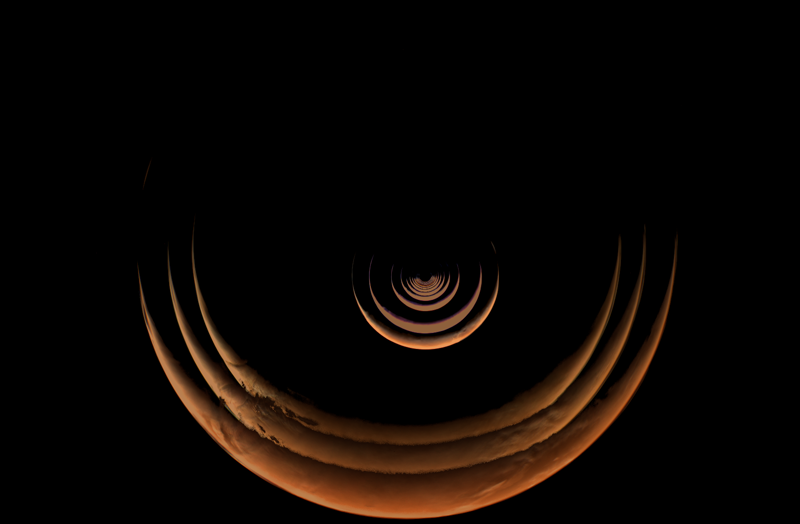
A composite of orange Mars crescents grows outward against black space as Psyche approaches the planet.


A gravity assist is usually described as celestial bookkeeping: a spacecraft borrows a little momentum from a planet and leaves on a better trajectory. NASA’s Psyche mission did that at Mars on May 15, 2026, but its science teams treated the encounter as much more than a navigation event. They pointed the spacecraft’s instruments at a world whose properties are already well measured, then asked whether the hardware returned the answers it should.

The spacecraft passed 2,864 miles (4,609 kilometers) above the Martian surface. Its cameras watched a thin crescent grow into a detailed globe. Its magnetometer crossed Mars’ bow shock. Its neutron detector registered a rise in particles near closest approach. The resulting data, released in July with a time-lapse video, made Mars a dress rehearsal for a far less familiar target: the metal-rich asteroid Psyche, which the spacecraft is due to reach in 2029, according to the NASA Science flyby report.

Space instruments spend years being designed, calibrated, launched, and monitored, but cruise provides few chances to test them against a large planetary body. Stars can check camera pointing. The solar wind gives a magnetometer a continuous signal. Neither reproduces the rapid changes, bright surfaces, stray light, and particle environment of a close planetary pass.

Mars offered a rare controlled comparison. Orbiters and rovers have observed its surface, atmosphere, and magnetic environment for decades. If Psyche’s instruments measured something wildly inconsistent with that record, engineers would have time to diagnose the discrepancy before asteroid arrival. Agreement is useful too: it confirms that the instrument, onboard electronics, ground pipeline, and scientific interpretation work together after nearly three years in space.

That last point matters because Psyche’s destination is difficult to interpret. The asteroid is often described as metal-rich, but the mission exists because remote observations cannot settle how much metal it contains, how it formed, or whether it preserves material from the interior of an early planet-building body. The spacecraft carries three dedicated science instruments: a multispectral imager, a magnetometer, and a gamma-ray and neutron spectrometer. It will also use radio tracking to map the asteroid’s gravity, as described in NASA’s Psyche mission overview. Mars let the instruments work on the same known target within hours.

Psyche launched in 2023 on a long solar-electric cruise toward the main asteroid belt. Mars was part of the route from the start. Before the encounter, NASA expected the spacecraft to pass about 2,800 miles above the surface at roughly 12,333 mph (19,848 kph). The planet’s gravity would increase the craft’s heliocentric speed and tilt its path toward the asteroid, according to the May 8 NASA mission brief.

The images began well before closest approach. Starting in early May, Psyche’s pair of identical multispectral cameras photographed Mars at a high phase angle, so the sunlit portion looked like a slender crescent. The sequence from May 2 through May 15 shows that crescent expanding as the distance closed. NASA assembled those frames into the growing-crescent composite used with this post.

Near Mars, the cameras resolved the south polar ice cap, wind-marked craters, and Huygens, a large double-ring crater. The team also detected Phobos and Deimos from far away. That was useful practice for a later search for small moons around asteroid Psyche. More quietly, the imaging team tested sensitivity to scattered light and began comparing its pictures with data from existing Mars missions. A camera can produce a sharp image and still mismeasure brightness or color; cross-calibration helps expose that kind of error.

The particle spectrometer faced a different test. It is intended to infer surface composition at the asteroid by measuring gamma rays and neutrons generated after cosmic rays strike the material. At Mars, the 4,609-kilometer altitude was too high for the detector to pick up gamma rays from the surface. The team did expect escaping neutrons, and the instrument recorded a count-rate increase close to the predicted level near closest approach.

The magnetometer had spent cruise measuring the solar wind and occasional coronal mass ejections. Mars provided its first magnetic signature from a celestial body. As Psyche entered the bow-shock region, where the solar wind encounters the obstacle formed by Mars and its induced magnetic environment, the instrument saw a strong increase. The flyby therefore exercised the detector through a rapidly changing field rather than the relatively steady background of interplanetary space.

Navigation also delivered what the science plan needed. The flyby put the spacecraft directly on its outbound course, and the mission expects to resume sustained solar-electric thrusting later in 2026. Arrival remains planned for the summer of 2029.

A gravity assist works because the planet and spacecraft exchange momentum while both orbit the Sun. In a Mars-centered frame, the spacecraft falls in, curves around the planet, and departs with approximately the same hyperbolic excess speed it had on arrival. In the Sun-centered frame, however, the velocity vector has rotated. Adding Mars’ orbital velocity before and after that rotation changes the spacecraft’s speed and direction around the Sun. Mars loses or gains an immeasurably small amount of orbital momentum in return.

The maneuver gave Psyche both energy and geometry that electric propulsion alone would have taken longer to supply. Its Hall-effect thrusters expel ionized xenon and produce low thrust for long periods. That system is efficient, but a planetary flyby can rotate the trajectory quickly without consuming propellant. Precision is unforgiving: a small arrival error changes the bending angle and therefore the outbound path. The close approach matching the planned corridor shows the navigation chain worked from orbit determination through correction maneuvers.

The instrument tests relied on three different physical signals. For imaging, filters divide reflected light into wavelength bands. Variations among bands can distinguish surface materials and reveal how illumination geometry affects the measurement. Mars supplied bright terrain, dark terrain, haze, ice, and a changing phase angle in one encounter.

For the neutron measurement, energetic cosmic rays strike atomic nuclei in the upper surface and create cascades of secondary particles. Some neutrons escape. Their energy distribution depends partly on which elements slowed or absorbed them. Hydrogen, for example, is particularly effective at reducing neutron energy. Gamma rays occur at characteristic energies associated with specific nuclei, but signal strength falls rapidly with distance; Psyche’s altitude explains why neutrons were detectable while Martian gamma rays were not.

Mars has no strong global dipole field like Earth’s. The solar wind interacts with its upper atmosphere and localized crustal magnetism, producing a bow shock upstream of the planet. Crossing that boundary gave the magnetometer an abrupt, recognizable change against which its timing and response could be checked. At asteroid Psyche, any remanent field would bear on whether its material once cooled within a magnetized parent body.

The Mars flyby did not answer the central question about asteroid Psyche. It reduced the risk that, three years from now, the mission will reach its target with a hidden calibration problem or an analysis pipeline that has never handled a fast-changing planetary data set.

That is the practical value of using a familiar world as a test object. The cameras returned surface detail and distant moon detections. The neutron detector saw the expected count increase. The magnetometer identified the bow shock. Each result connects directly to a job the instrument must perform at the asteroid, where there will be no fleet of orbiters and rovers providing an easy reference.

The spacecraft now has its outbound trajectory and a set of measurements the teams can keep analyzing while electric propulsion carries it toward the main belt. When asteroid operations begin in 2029, the first observations will still contain surprises. The basic behavior of the instruments should not be one of them.


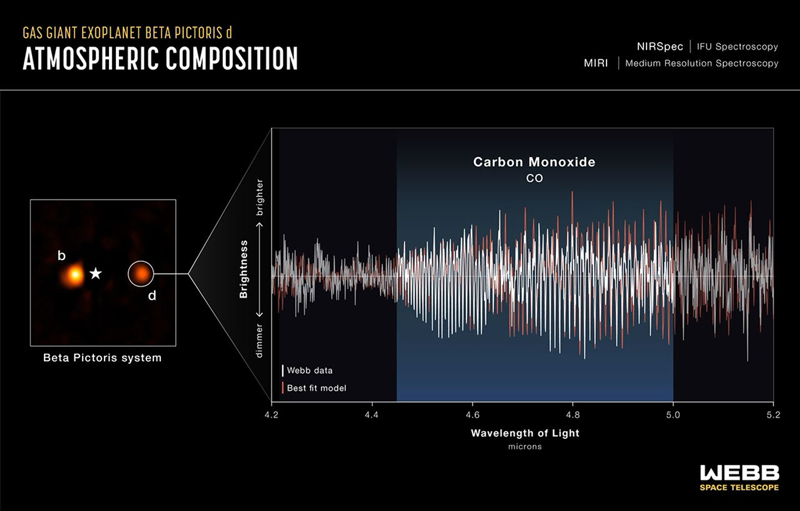
Reconstructed NIRSpec IFU image of the Beta Pictoris system showing Beta Pictoris b to the left of the masked star and the newly discovered Beta Pictoris d to the right, with a spectrum tracing the carbon monoxide absorption that revealed the planet.


The Beta Pictoris system has been studied for more than forty years, and on Wednesday, July 15, 2026, it gave up another secret. Two independent teams, one using the James Webb Space Telescope and the other the European Southern Observatory’s Very Large Telescope, announced at the same time that they had discovered Beta Pictoris d, a cold gas giant orbiting at roughly the distance of Neptune. The discovery is a notable one for two reasons. It is the faintest exoplanet ever imaged directly from Earth, and it is the first planet ever confirmed primarily by reading its atmospheric chemistry with a spectrograph instead of by spotting it as a bright dot next to a star (NASA Webb announcement).

What sounds like a technical footnote is, in practice, a new way of finding planets. It opens up categories of systems that direct imaging has never been able to reach.

For most of the history of exoplanet science, “discovered” meant “transited in front of its star” or “wobbled its star with its gravity.” Direct imaging, where you take a picture and see the planet next to its star, has always been the most visually satisfying method, but also the hardest. It only works for planets that are far from their stars, large, and young enough to still be glowing with heat from formation. Most of the directly imaged catalog so far has been self-selected from that narrow slice of parameter space.

Beta Pictoris d is technically in that slice: it is young, large, and far out. But it is also faint to an unusual degree, about 100 times fainter than Beta Pictoris b, the much more famous planet in the same system, and the youngest of the two previously known planets (Sci.News, July 15, 2026). It also sits inside one of the brightest debris disks in the sky, which scatters starlight in every direction and makes conventional imaging almost useless.

What Webb did was different. Rather than trying to suppress the disk light with a coronagraph and then see the planet, the team used NIRSpec’s Integral Field Unit, which captures a spectrum at every pixel of an image at once. They were not trying to find a planet. They were re-observing Beta Pictoris b to refine its atmosphere. The new planet appeared as an unexpected series of absorption lines, a “barcode” of carbon monoxide, where the smooth disk spectrum was supposed to be (NASA Webb announcement).

The implication is straightforward. If you can identify a planet by its chemical fingerprint, you can find planets in places where direct imaging fails. The “dusty graveyard” environment around young stars, which until now has been a dead zone for planet detection, becomes a place to look.

Beta Pictoris has been an unusual system since 1984, when the IRAS satellite picked up an infrared excess around a young A-type star 63 light-years away in the constellation Pictor. The first direct image of its disk, taken a few years later, was one of the first clear pictures of another solar system in the process of forming. Two giant planets were eventually confirmed: Beta Pictoris b, one of the first exoplanets ever directly imaged, with a 22-year orbit at 9.8 astronomical units and a mass of 9 to 13 Jupiters; and Beta Pictoris c, discovered in 2019, closer in at 2.7 AU with about 8 Jupiter masses and a roughly 1,200-day period (Sci.News).

A third planet had been predicted, on theoretical grounds, to exist somewhere between the inner system and the inner edge of the debris disk. The disk has an unusually sharp inner boundary, and the simplest way to carve such a boundary is with an unseen giant planet shepherding the dust. But for more than a decade, no one could find it.

That is where the two teams come in. Aidan Gibbs and Jean-Baptiste Ruffio at UC San Diego, with collaborators, used JWST’s NIRSpec IFU to study Beta Pictoris b. They were not searching for anything new. As Ruffio put it later, “There was an unexpected bright source of light within the Integral Field Unit imaging, but we’ve learned not to trust bright blobs in images.” The spectrum is what gave it away. The peaks and troughs of carbon monoxide, water vapor, and methane absorption matched a planetary atmosphere, not a disk artifact. Two epochs of NIRSpec plus follow-up with JWST’s MIRI confirmed it. Mass estimates from atmospheric models put Beta Pictoris d at 2 to 4 Jupiters, with a likely semi-major axis above 30 AU (Gibbs et al. 2026, ApJL 1006, L11).

The second team, led by Ben Sutlieff at the University of Edinburgh with Markus Bonse at ESO, did not use Webb at all for the initial detection. They used the ERIS instrument on the Very Large Telescope in Chile, looking at Beta Pictoris b for time-domain monitoring. They saw the new planet close to b, and then went back through the ESO archive, where they found the same faint source in data going back 11 years, sometimes hiding in the glare of b. As Jayne Birkby of Oxford put it, “Beta Pictoris d, it seems, has been playing a game of hide-and-seek with us for over a decade and only now can we say ‘found you!'” (Watchers.news report on the VLT archival recovery).

The two papers appeared in the same issue of the Astrophysical Journal Letters, dated July 15, 2026. They were coordinated, though not collusive. The Webb team’s spectroscopy and the VLT team’s imaging arrived at the same answer from independent directions, which is the kind of cross-confirmation exoplanet scientists like to see.

The reason the spectroscopic approach worked comes down to the difference between continuum light and line emission. Direct imaging, in its classical form, relies on detecting the planet’s broadband thermal glow against the suppressed starlight. That glow is faint to begin with and is further washed out by the dust disk. Spectroscopy is different. Molecular absorption lines, particularly of carbon monoxide in the 4.3 to 5 micron band where NIRSpec operates at moderate resolution, are narrow features that sit on top of a smooth continuum. The disk’s scattered light has very little structure in that band. The planet’s atmosphere, if it has CO, contributes a recognizable signature.

The trick the Webb team used was forward modeling. They took a grid of cool planetary atmosphere models with different temperatures, surface gravities, and compositions, and slid each one across the IFU data cube. Where the model and the data lined up in wavelength and velocity space, that was a detection. The radial velocity measurement was the clincher: an object orbiting Beta Pictoris should show a specific line-of-sight speed that a stationary disk feature or background star would not (Gibbs et al. 2026).

The same approach works, in principle, for any star with a debris disk. And debris disks are common: Spitzer surveys and now JWST itself have cataloged hundreds of them. A generation of planet searches that wrote those disks off as obstacles may have been discarding exactly the systems where this method works best.

There is a limitation. The spectroscopic technique does not give you a planet’s radius, since forward-model fitting suppresses the broadband continuum to isolate the molecular features. Beta Pictoris d has a mass and an atmospheric inventory, but not yet a measured size. A radius will come from follow-up photometry or coronagraphy.

Beta Pictoris d is interesting on its own terms: a cold gas giant at roughly the orbital distance of Neptune in a 23-million-year-old system, almost where disk dynamics had predicted. It completes a planetary system that has been the textbook example of planet formation for two generations.

The bigger lesson is methodological. Webb’s spectroscopy-first approach worked because the team was willing to look for a signal that was not the planet’s brightness but its chemistry. That is a small change in technique and a large change in reach. The next several years of JWST observing time are likely to see this pattern repeated, with planets surfacing in disks where nobody had bothered to image carefully before.

The team plans to refine the orbit, temperature, and atmospheric composition. Beta Pictoris is one of the closest young systems we have, and the third planet, the one that has been hiding for a decade, is finally on the books.


September 29, 2026

First radio detection from an exoplanet

Posted by


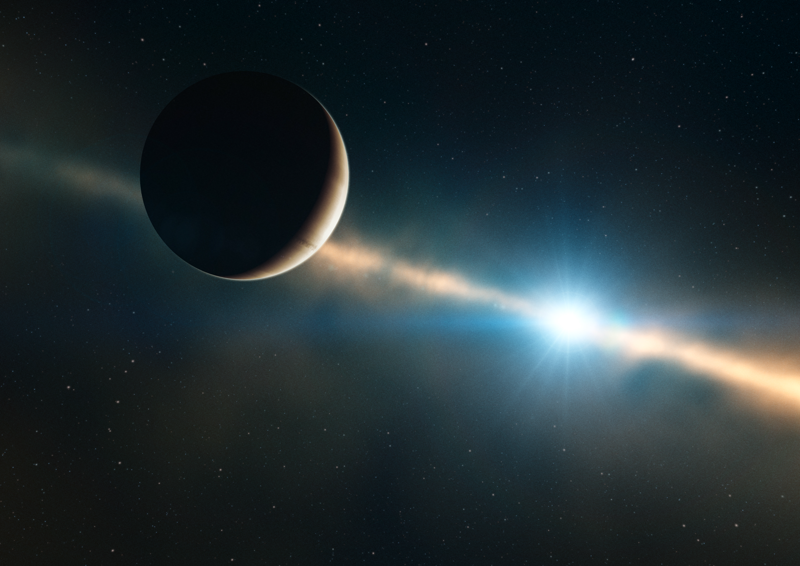
An artist's impression shows the gas giant Beta Pictoris b in the foreground as a thin crescent against a bright star, with the edge-on debris disk of the Beta Pictoris system stretching diagonally across the frame. ESO credit.


On 15 September 2026, a graduate student at the Harvard and Smithsonian Center for Astrophysics posted a 32-page preprint to arXiv announcing the first radio detection from a planet outside our solar system. The team, led by Kevin Ortiz Ceballos with co-author Edo Berger at Harvard and Yvette Cendes at the University of Oregon, had used the MeerKAT radio array in South Africa to pick up rapid, repeating, and strongly circularly polarized bursts coming from Beta Pictoris b, a 12-Jupiter-mass gas giant orbiting its host star at roughly ten astronomical units (Ortiz Ceballos et al. 2026, arXiv:2609.16720). The signal, picked up at frequencies between 0.85 and 3.5 gigahertz, was coherent, variable on timescales of seconds, and beamed. The most plausible source was auroral electron-cyclotron-maser emission generated in the planet’s own magnetosphere. From the highest observed frequency, the team inferred a magnetic field of at least 1.25 kilogauss at the emission site, the first direct magnetic-field measurement ever made on an exoplanet.

This matters for a reason that has nothing to do with technosignatures or aliens, even though those were the first things many readers searched for in the headlines. A planet’s magnetic field controls how its atmosphere weathers the wind of charged particles blowing off its host star. Earth has held onto its atmosphere for billions of years in part because its 0.5-gauss dipole field deflects the solar wind. Mars, with no global field to speak of, lost most of its. Measuring magnetic fields on exoplanets is therefore a prerequisite to asking whether any of them could be habitable, and until last week, every attempt to do so directly had failed.

The reason the failure rate was so high starts with the difference between magnetic activity on a star and magnetic activity on a planet. Both produce radio emission, and stars, especially young and magnetically active ones, are much louder than the planets that orbit them. Pinning a radio signal to a planet rather than its star requires angular resolution finer than the orbital separation, and Beta Pictoris b is the best natural laboratory available. Its host, Beta Pictoris, is an A6V star about 19.6 parsecs away in the constellation Pictor, magnetically quiet, with an upper limit of roughly 0.3 kilogauss on its dipole field. The planet itself sits about ten astronomical units out and reaches a peak angular separation near 0.55 arcseconds over its 24-year orbit, wide enough for a long-baseline radio interferometer to disentangle. The MeerKAT array in the Karoo desert is a 64-dish precursor to the Square Kilometre Array, and its sensitivity at decimetre wavelengths is the highest of any currently operating radio telescope in the southern hemisphere. The team observed Beta Pictoris four times between February 2025 and May 2026, twice in the L band between 0.856 and 1.712 gigahertz and twice in the S band between 1.75 and 3.5 gigahertz. The first epoch was a wide survey for quiescent radio emission from brown-dwarf and exoplanet analogues. It found a source. A nine-hour follow-up confirmed it, and subsequent S-band campaigns with the array split into two sub-bands pinned the emission to the planet’s coordinates relative to background quasars (Astrobiology.com summary, Sept 24 2026).

Two properties of the signal cinched the identification. First, it was highly circularly polarized, with the strongest S-band burst roughly 70 percent polarized in one handedness and the L-band bursts showing variable handedness between epochs. Coherent radio emission with that level of polarization and rapid time variability is the signature of the electron-cyclotron maser instability, a process in which electrons spiralling in a magnetic field release their kinetic energy as electromagnetic waves at the local cyclotron frequency. Incoherent gyrosynchrotron emission, the alternative mechanism, produces only modest circular polarization and cannot generate brightness temperatures above about 10^8 kelvin. The team’s brightest L-band burst of 307 microjanskys at 1.28 gigahertz, if it came from a region the size of the planet, would correspond to a brightness temperature above 6 times 10^10 kelvin. Second, the upper edge of the emission frequency mapped directly to the magnetic field strength at the source. For fundamental electron-cyclotron-maser emission, the cyclotron frequency is about 2.8 gigahertz per kilogauss, and the team observed emission extending all the way to 3.5 gigahertz, the top of their S-band coverage, which requires a field of at least 1.25 kilogauss at the emission site (Live Science, Sept 23 2026). That is roughly 290 times stronger than Jupiter’s surface field of 4.3 gauss and about 2500 times stronger than Earth’s, and it is consistent with the predictions of energy-flux dynamo scaling for a young, hot, super-Jupiter. The host star cannot produce it: its measured upper limit is a quarter of a kilogauss, and A stars do not generally host kilogauss surface fields anyway. The mechanism is the same one that powers Jupiter’s aurorae, scaled up. Jupiter’s aurorae, the brightest in the solar system after the Sun’s, are driven partly by the interaction of its magnetic field with the solar wind and partly by the tidal stripping of its volcanic moon Io, which loads the magnetosphere with plasma. Beta Pictoris b has no Io and probably no moon, but it orbits a young A star that is itself a few hundred times more luminous than the Sun and emits a correspondingly stronger wind. Charged particles streaming from the star are funneled along the planet’s magnetic field lines into the polar regions of its upper atmosphere, where they radiate. The result is the same pattern seen in brown-dwarf ultracool dwarfs that host similar kilogauss fields: coherent radio bursts at the rotation period, with circular polarization that flips sign depending on the orientation of the magnetic axis. The team also notes that previous weak X-ray emission attributed to the star may in fact originate from the planet, which would put Beta Pictoris b on the same radio-to-X-ray correlation as ultracool dwarfs and brown dwarfs, a unified scaling law that has held up across more than two orders of magnitude in magnetic field strength.

The implications extend beyond Beta Pictoris. Suzanne Aigrain of Oxford, who was not involved in the study, told Live Science that the detection “hopefully paves the way for many more,” and that future instruments will be able to make similar measurements for smaller planets (Live Science, Sept 23 2026). The Square Kilometre Array, currently under construction in South Africa and Australia, will be roughly an order of magnitude more sensitive than MeerKAT, and its low-frequency coverage will reach further into the parameter space where cooler, lower-mass planets generate their radio emission. By the end of the decade, magnetic-field measurements on Neptune-mass planets around nearby M dwarfs may be routine, and the question of which of those planets can hold onto an atmosphere will be answerable from observation rather than from theory. The preprint is not yet peer-reviewed, and the authors are careful to point out that no radio detection has previously been unambiguously localized to an extrasolar planet rather than its host star, with the previous tentative cases including the 2023 YZ Ceti bursts unable to fully exclude a stellar origin. The Beta Pictoris result rules that out by combining milliarcsecond astrometric localization with the polarization and timing structure, and Wired’s coverage flags the same caveat (Wired, Sept 24 2026). For now, the preprint remains the first clean detection, and a proof of concept for a method that will dominate exoplanet characterization once the SKA comes online. The image below shows the system as ESO imagined it before this result, with the planet a dark crescent in front of the bright star and the debris disk crossing edge-on. What the picture cannot show is what the MeerKAT data now adds: a kilogauss magnetic field wrapped around that crescent, the first one ever measured on a world beyond our Sun.


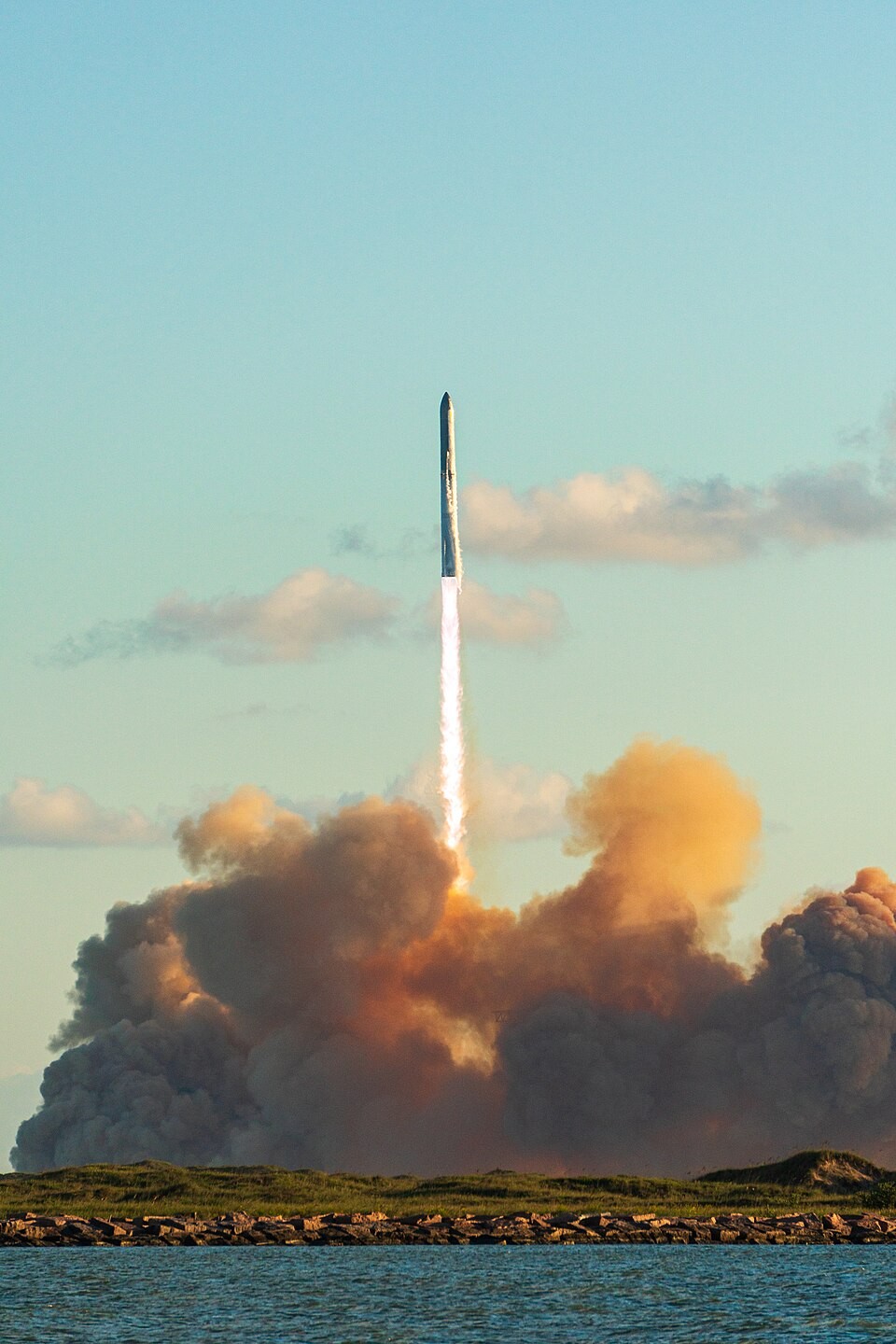
A SpaceX Starship lifts off from Starbase, Texas on a previous test flight; today's Flight 14 followed the same launch profile.

Image source: Wikimedia Commons. Photograph by Shujianyang, CC BY-SA 4.0.


A SpaceX Starship lifted off from Starbase in Boca Chica, Texas at 7:48 AM local time on Monday, September 28, and reached orbit for the first time on its fourteenth flight test. After a clean stage separation and a controlled splashdown of the Super Heavy booster in the Gulf of Mexico, the Starship upper stage completed its first orbital-insertion burn and deployed 26 Starlink V3 satellites into low-Earth orbit on a mission that SpaceX had earlier characterized as a step from developmental flight testing into operational service.

The launch was the first of the Block-3 vehicle series to fly with operational payload, and the first time a Starship vehicle has carried a Starlink batch into orbit. Three of the 26 satellites carry cameras intended to image the Starship heat shield while the upper stage is in orbit, extending the kind of data that an earlier camera-equipped batch gathered during a 2025 reentry test.

The countdown proceeded through propellant load on the booster and the ship, Raptor chill, and a final GO poll at T-30 seconds. Liftoff was at the opening of the day’s launch window. NPR, reporting live, described the 33 Raptor engines on Super Heavy as igniting together at the start of the climb. Max-Q, the moment of peak aerodynamic stress on the vehicle, cleared without incident. About two and a half minutes after launch, Starship separated from Super Heavy in the hot-staging sequence the company has used on the most recent flights, with the booster immediately turning back toward the Gulf of Mexico and the ship’s Raptor engines continuing the climb toward orbit.

Two anomalies shaped the early portion of the flight. First, SpaceX’s mission management decided during the climb that one of the six Raptor engines on the ship had failed during ascent, and the team weighed, for roughly twenty-two minutes, whether to continue to orbit. By the time Starship’s second-stage burns were scheduled to start, SpaceX confirmed it was safe to do so. Second, when Super Heavy began its boostback burn a few minutes after separation, only 26 of the 28 candidate engines relit — a partial relight rather than the full set SpaceX had planned to use. The landing burn that followed was also a partial relight: 11 of 13 engines fired. The booster nonetheless completed its boostback, descent, and landing burn sequence and executed a controlled soft splashdown in the Gulf of Mexico at roughly T+8 minutes, ten seconds after launch. SpaceX had deliberately planned an offshore splashdown for this flight rather than a return-to-launch-site catch, in part because the booster was being used to test upgraded software and hardware before the company re-attempts a tower catch on a later mission.

The ship’s first milestone after separation was a coast phase through the upper atmosphere. At T+25 minutes and 28 seconds the ship began its orbital-insertion burn; nineteen seconds later the burn ended and Starship was in a sustained orbit for the first time in the program’s history. About nine minutes after the insertion burn, the payload deployment sequence started and the 26 Starlink V3 satellites began releasing from the ship over the following half hour. The three camera-equipped satellites will spend their operational lifetime photographing Starship’s heat shield from a vantage point just behind the vehicle’s planned reentry trajectory, providing imagery that SpaceX says it will use to refine its reusable-heat-shield program.

The mission profile extended further than a suborbital hop. SpaceX had originally planned a roughly ten-hour mission with six orbits at an altitude around 170 miles, but reduced the flight plan during ascent to a shorter three-hour profile. The trade reflected, in the company’s judgment, the right margin for a vehicle running one engine short on its upper stage. After roughly nine hours in orbit, the ship is expected to perform a deorbit burn over the Pacific, descend through the atmosphere, and execute a controlled splashdown in the ocean. NPR noted that no earlier Starship flight had reached orbital velocity, which is roughly 17,500 miles per hour; today’s flight is the first vehicle in the line to do so.

Starship Flight 14 is the second flight of a Block-3 vehicle and the first of the year from Starbase. The booster, Booster 21, completed its full-duration static fire at Massey’s Test Site on August 28 after a qualification campaign that included the post-Flight-13 investigation into the landing-burn dynamics and an extended cryogenic proof sequence in mid-summer. The ship, Ship 41, completed a six-engine static fire on August 21 and a single-engine deorbit-burn simulation test two days earlier. Both vehicles were integrated, stacked, and rolled to OLP-2 ahead of the launch attempt.

The flight is also the first operational mission carrying Starlink satellites to use a Starship vehicle rather than a Falcon 9. SpaceX has been the dominant operator in commercial launch for the past several years using Falcon 9, but the larger V3 Starlink satellites only fit inside Starship’s fairing. NPR reported that SpaceX completed the final Falcon 9 launch of a Starlink batch from Florida last month and intends to move V3-class launches to Starship going forward. The shift matters to SpaceX’s plans for the constellation: in filings to the Federal Election Commission ahead of its IPO in June, the company called Starship’s launch cadence and reusability material to its growth strategy.

The flight is also material to NASA’s Artemis program. SpaceX is under contract to develop a Starship-derived Human Landing System for Artemis III, currently targeted for late next year. The Artemis III profile includes docking Starship with an Orion capsule in lunar orbit and transporting astronauts to the surface. NASA’s Administrator, Jared Isaacman, congratulated the SpaceX team on today’s milestone on social media; in earlier remarks, the agency has framed a successful first operational Starship flight as one of the gating milestones for the lunar landing timeline, alongside the unrelated second crewed Orion flight that lifted off in April.

Three of the satellites that lift with Starship today are designed to spend their working lives photographing the heat shield of the very vehicle that released them. That unusual arrangement — test instrumentation riding inside operational payload — has become a theme of the program. Cameras flew on earlier V2 Starlink satellites in 2024 and 2025 for similar purposes; SpaceX said the data from those missions was the basis for several heat-shield design changes that shipped on Block 3. Today’s cameras will, in turn, feed back into Block-4 hardware.

If the Pacific reentry and splashdown at the end of the mission go as planned, Flight 14 closes out a flight that began developmental flight testing and ended with operational payload deployment. The next ship in line, Ship 42, completed chopstick-catch tests at the tower in mid-September and remains weeks from flight readiness; the next booster, Booster 22, is also still in qualification. SpaceX has not announced a date for Flight 15, but company statements earlier in the year suggested it would follow within roughly two months of today’s flight, with a Falcon-class Starlink batch and a Super Heavy tower catch among the items on the next mission’s checklist.