OrbitalHub

Where curiosity reaches escape velocity.

Domain is for sale. $50,000,000.00 USD. Direct any inquiries to contact@orbitalhub.com.


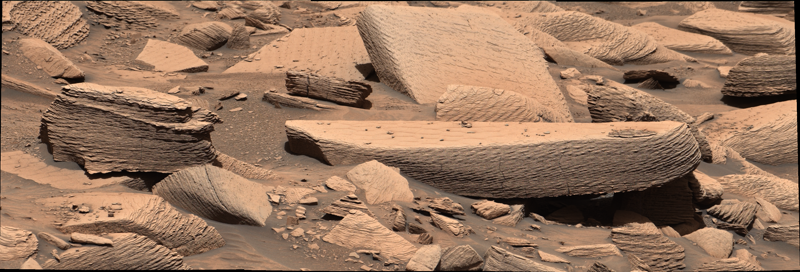
Layered beige Martian rocks at the Jawbone Canyon site in Gale crater, photographed by NASA's Curiosity rover on Sol 4391 (December 12, 2024), showing the stacked wind ripple laminations interpreted as supercritical climbing wind ripple strata.


Somewhere around 3.6 billion years ago, on what was probably an unremarkable afternoon, a sandstorm rolled into Gale crater on Mars. It may have lasted only hours. By the next day, the wind was back to normal and the surface was a sunlit desert again. No one saw it. Nothing else on the planet recorded it. But the storm left a physical imprint, and NASA’s Curiosity rover drove past that imprint on December 12, 2024, on its 4,391st Martian day, and photographed it (NASA Science Photojournal, July 20 2026).

The imprint is now the cover paper of the July 1, 2026 issue of the journal Geology. A team led by Steven Banham of Imperial College London describes millimeter-thick, crinkly laminations inside a rock the rover team nicknamed “Jawbone Canyon,” in the Mirador formation on the lower slopes of Mount Sharp. The structures are supercritical climbing wind ripple strata: a class of wind-deposited layering so rare on Earth that sedimentologists have only documented it in a handful of modern and ancient settings, and never before on another planet (Banham et al. 2026, Geology 54(7):611, DOI 10.1130/G54158.1).

Mars climate science has long had a sandstorm problem. Orbital cameras have shown that dust devils and regional dust storms lift fines off the surface today. Climate models assume that early Mars had a thicker atmosphere capable of moving sand. But the physical evidence for sustained sand-moving winds on ancient Mars has been almost entirely indirect: cross-bedded sandstones that record long-term wind patterns, dune fields that froze into rock, ventifacts worn by saltation.

Those records cannot resolve a single weather event. A climbing wind ripple is the signature of a wind strong enough, lasting long enough, and carrying enough sand that the ripples could not migrate as fast as new sand arrived. The crests piled up on the stoss side instead of sliding down the lee side. Each millimeter-thick lamina is the trace of a burst of sand transport; the climb angle records how fast sediment accumulated relative to how fast the bedform moved. The team measured angles of 10 to 18 degrees, values the paper says can only be produced by storms lasting minutes to hours, not by seasonal winds over thousands of years.

That makes the Jawbone Canyon outcrop the first direct physical evidence of a sandstorm on Mars. The paper’s wording is measured: “These climbing ripple sets occur in a thin succession, which suggests that they record a broader sustained event, such as a sandstorm or gale, lasting several hours or more.” The phrase is doing real work, because the alternative explanations had to be ruled out one by one. The central argument is a negative: ordinary wind regimes cannot deposit climbing ripples of these thicknesses at these angles, so whatever made them had to be stronger than everyday wind.

A secondary argument reaches further. Banham notes in the paper and in press interviews that the modern Martian atmosphere, at roughly 6 millibars of mean surface pressure, is too thin to drive saltation at the scale required to build these structures (Astrobiology.com, April 4 2026). The deposits imply that the atmosphere three and a half billion years ago was denser than today’s. The exact density is not pinned down, but the qualitative conclusion is clear: the air on early Mars was heavy enough to push sand in ways the present-day air cannot.

The find was not part of any planned observation. Curiosity’s science team operates in shifts, and one of the standing tasks is to scan the black-and-white navigation panoramas taken at the end of each drive for anything anomalous. Banham and his collaborators, including Linda Kah of the University of Tennessee, Joel Davis of Imperial College London, Sanjeev Gupta, Gerhard Paar, and several JPL-Caltech sedimentologists and mission scientists, noticed unusual textures in those panoramas as the rover approached the Mirador formation. They targeted the rocks with the higher-resolution Mastcam, and at full resolution the laminations resolved into the climbing ripple patterns.

Banham described the find as serendipitous: “We weren’t really looking for these deposits, and then lo and behold, we drove around the corner and found them. We were lucky that we had just the right people on shift that recognized them.” The rock itself is modest in size, roughly a meter wide and 20 centimeters high, with six discrete packages of ripple layers stacked through its thickness. The laminae dip toward the north, which means the wind that built them came from the south. Similar climbing ripples were later identified at a nearby site the team named Dry Lake, and the paper argues that the deposits formed near the margin of a larger dune field or in a wind-scoured depression where airflow patterns concentrated sand accumulation.

The discovery is also a vindication of the Mastcam team’s instinct to keep taking high-resolution follow-up imagery of “unusual” textures. Climbing ripples this small could have been mistaken for noise in lower-resolution data, or simply dismissed as weathered outcrop. The fact that a thin succession of six packages survived in one place for over three billion years, exposed at the surface for the rover to roll up to, is its own piece of good fortune.

The terminology is precise. In sedimentology, ripples are small bedforms, typically a few centimeters tall and tens of centimeters in wavelength, that form when wind or water flows over a bed of loose sand and organizes it into regular undulations. In a normal subcritical regime, sand grains saltate up the windward (stoss) face and avalanche down the leeward (lee) face, and the ripple migrates downwind without growing vertically. In a supercritical regime, the wind is strong enough and the sand supply is high enough that grains accumulate faster on the stoss face than they can slide off the lee face, so the ripple climbs. The climb angle is set by the ratio of vertical accumulation to horizontal migration; a 10-degree angle corresponds to roughly six times as much vertical deposition as horizontal migration.

Climbing ripples have been documented in a small number of terrestrial settings: deep-sea turbidity currents, certain wind-blown dune margins, and a few fluvial flood deposits. They are rare because the conditions that produce them are themselves unusual. On Mars, no one had ever identified them, in part because orbital images cannot resolve millimeter-scale laminae and in part because no previous rover had driven through sedimentary terrain with both the imaging resolution and the science team bandwidth to spot them.

The Banham paper lays out the diagnostic criteria: millimeter-scale lamina thickness, climb angles between 10 and 18 degrees, preserved stoss-side grainflow cross-stratification, and lateral continuity across the outcrop face. All four appear at Jawbone Canyon. The team estimates that a single 50-millimeter-thick layer could have formed in 6 to 20 minutes under storm conditions; the full succession of six packages therefore records on the order of an hour or two of sustained sand transport (Daily Galaxy, July 17 2026).

Curiosity has been on Mars for more than thirteen years. In that time it has found evidence of ancient lakes, rivers, groundwater, organic molecules, and a past climate that was at least intermittently habitable. What it had not found, until now, is direct evidence of an ancient sandstorm. The Jawbone Canyon outcrop fills that gap with a single rock roughly the size of a kitchen table.

The immediate payoff is a new constraint on early Mars atmospheric density: the air had to be thick enough to drive saltation at storm intensities. The longer-term payoff is a search template. Banham has said the next thing he wants the team to find is raindrop impact marks, craters in fine sediment left by rain, which would settle a separate debate about whether early Mars ever saw liquid rain rather than only snow and surface runoff. “It would be magic if we found those,” he said. The climbing ripples are not the last stop on Curiosity’s geology to-do list. They are evidence that the rover is still, after 4,391 sols, finding things on Mars that no one had asked it to look for.
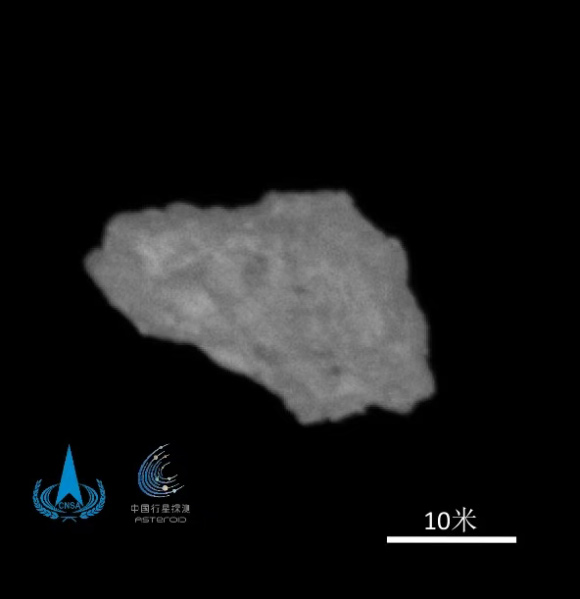


Tianwen-2's first close-up of the quasi-moon asteroid 469219 Kamoʻoalewa, captured from about 20 km on 2 July 2026; a 10-metre scale bar is included in the lower right.


A small, elongated rock against a black sky, with a 10-metre scale bar tucked into the lower-right corner. That is the entire first portrait of asteroid 469219 Kamoʻoalewa, returned on 2 July 2026 by China’s Tianwen-2 probe from a distance of about 20 kilometres. The picture is rough, but it is enough. Kamoʻoalewa is roughly the size of a small office building, and until now the only data astronomers had on its surface came from telescopes on the ground and from a few passes of the James Webb Space Telescope. Now a spacecraft is sitting in front of it, and the first thing that picture reveals is that the rock looks nothing like the Moon, which is what a five-year-old theory said it should look like (SpaceNews, Sci.News).

Kamoʻoalewa is one of seven known quasi-satellites of Earth, meaning its orbit around the Sun closely tracks ours even though it is not gravitationally bound to the planet. From our moving viewpoint it appears to loop around the Earth like a slow second moon, but the similarity is an illusion of perspective (Wikipedia). For most of the past decade the working hypothesis has been that Kamoʻoalewa is a chunk of the Moon’s far side, blasted into space by an impact and later nudged into an Earth-like orbit. The red colour of its reflectance spectrum, measured from telescopes in 2021, looked more like heavily weathered lunar silicates than like any common type of near-Earth asteroid (Space Daily).

That hypothesis is now under coordinated pressure from three independent lines of work: a population model published in Astronomy & Astrophysics, a reanalysis of the spectrum in Nature Communications, and the new JWST observations led by Benjamin Sharkey at the University of Arizona. Tianwen-2’s image does not settle the question, but it shows that the spacecraft can find, track and image a target only tens of metres across, which is the prerequisite for the sample return that will settle it. The mission is China’s first attempt at an asteroid sample return, and the spacecraft is built to bring roughly 100 grams of material home in late November 2027 (Sci.News, SpaceNews).

Tianwen-2 launched from the Xichang Satellite Launch Center on 29 May 2025, riding a Long March 3B/G2 rocket. CNSA disclosed little about the cruise until the spacecraft was already at its target. Independent tracking by AMSAT-DL in Europe picked up the probe’s signal as it approached the asteroid and showed a series of engine burns (SpaceNews). On 6 June 2026 the spacecraft first detected Kamoʻoalewa. The next day it executed a capture manoeuvre at 30,000 km to match the asteroid’s orbital plane. By 19 June it had closed to 2,000 km. On 2 July it settled into a 20 km station-keeping point and took the picture (Sci.News, SpaceNews).

CNSA announced the arrival on 6 July 2026. The agency’s statement stressed that the optical navigation data reduced uncertainty in the asteroid’s predicted position from hundreds of kilometres, based on ground observations alone, down to the kilometre scale. The 20 km point is the start of close-proximity science operations, including global mapping and selection of the sampling site. Departure from Kamoʻoalewa is planned for April 2027, with the reentry capsule delivering samples in late November 2027 (SpaceNews).

Kamoʻoalewa was discovered on 27 April 2016 by the Panoramic Survey Telescope and Rapid Response System, Pan-STARRS, at Haleakala Observatory in Hawai’i. Its name is a Hawaiian phrase that translates roughly to “oscillating celestial fragment” (Sci.News, Wikipedia). Ground-based estimates put its diameter between 40 and 100 metres. The Tianwen-2 image, with its 10-metre scale bar, suggests a diameter of just over 20 metres. That matches the JWST-based estimate from Sharkey’s team, published as a preprint in late June 2026, which puts the mean diameter at 18 plus or minus 2 metres and the rotation period at about 27.9 minutes (SpaceNews, arXiv:2606.24017).

Granvik, an astronomer at the University of Helsinki and Luleå University of Technology, told SpaceNews that the first image “basically confirms” the high geometric albedo implied by Sharkey’s JWST work, and that this reflectivity is not compatible with the low-to-moderate albedo of lunar material. “So it seems that Kamoʻoalewa is of asteroidal origin,” Granvik said (SpaceNews).

The lunar-fragment hypothesis was a coherent story built from two indirect clues, not from direct evidence. The 2021 spectroscopic study led by Benjamin Sharkey found that Kamoʻoalewa’s reflectance was unusually red and resembled heavily weathered lunar silicates more than common near-Earth asteroid types. A 2024 Nature Astronomy paper led by Yifei Jiao then proposed a specific source: the 22-kilometre-wide Giordano Bruno crater on the lunar far side, whose estimated age and impact physics could produce fragments of the right size and send some into co-orbital space (Space Daily).

Three recent studies each chip away at that picture. The first is a population model by Marco Fenucci and colleagues in Astronomy & Astrophysics. The team modelled both ordinary near-Earth asteroids delivered from the main belt and fragments produced by the Giordano Bruno impact. Their estimate produced 1.23 plus or minus 0.13 Kamoʻoalewa-like objects from the main-belt population, compared with 0.042 from Giordano Bruno ejecta. That is more than an order of magnitude in favour of a main-belt origin, although the calculation is a population argument, not a parent-body match (Space Daily).

The second is a May 2026 Nature Communications paper led by Pengfei Zhang. The team reanalysed the absorption feature and found it consistent with LL chondrites, the stony meteorites associated with asteroids like Itokawa. In laboratory tests, highly space-weathered LL-chondrite powder reproduced Kamoʻoalewa’s reflectance spectrum even though solid pieces did not. They proposed an origin in the Flora asteroid family, followed by extensive weathering of fine surface material (Space Daily).

The third is Sharkey’s new JWST observations, taken in February 2026 and supported by Large Binocular Telescope measurements in April. The infrared spectrum is much less red than the 2021 ground-based result. The authors say the colours resemble several silicate asteroid classes, including S, V, or E-types, more than weathered lunar material. The albedo and absorption features may fit an oldhamite-bearing, enstatite-rich composition. The preprint’s best-fit geometric albedo is 0.59, with model fits as low as 0.36 still working, which is far too bright to match lunar highland or mare material (arXiv:2606.24017, TechTimes).

None of these three studies identify the same asteroid analogue. What they share is that none of them require Kamoʻoalewa to be lunar rock. Tianwen-2 will be the tiebreaker. Its 11 science payloads include cameras, laser ranging, spectrometers, sounding radar and particle analyzers, plus the DIANA dust analyzer contributed by Italy (SpaceNews). For sampling, the spacecraft carries three redundant techniques: hovering, touch-and-go, and anchoring plus attachment, with the last dependent on whether the surface can support it. The anchoring approach is unusual; it would require the spacecraft to grip a body that is only tens of metres across. After the sample heads home, the main spacecraft is to continue onward to the active main-belt comet 311P/PANSTARRS, where it would carry out the first close investigation of an active main-belt object (SpaceNews).

The first Tianwen-2 picture of Kamoʻoalewa establishes that the spacecraft has reached its target and can resolve an object barely wider than a tennis court at 20 km. It does not yet say where the asteroid came from. Between now and the late-2027 sample return, the most consequential measurements will be multispectral imaging at lower altitudes and the choice of sampling site. Laboratory work on the returned grains can compare mineralogy, elemental ratios and isotopes with Apollo and Luna samples on one side and with LL chondrites on the other. A lunar match would have to overturn the new statistical and spectral arguments against it. A chondritic match would mean an ordinary asteroid had acquired a lunar disguise through long space weathering, which would be its own kind of finding (Space Daily).

The next milestone in the timeline is the move from 20 km station-keeping into closer mapping. The first attempt at sample collection is expected in 2027. Granvik’s reading of the new albedo, Fenucci’s population model, Zhang’s LL-chondrite fit and Sharkey’s JWST spectrum together point the same direction, but they do not yet reach the Moon. That is what the sample return is for.


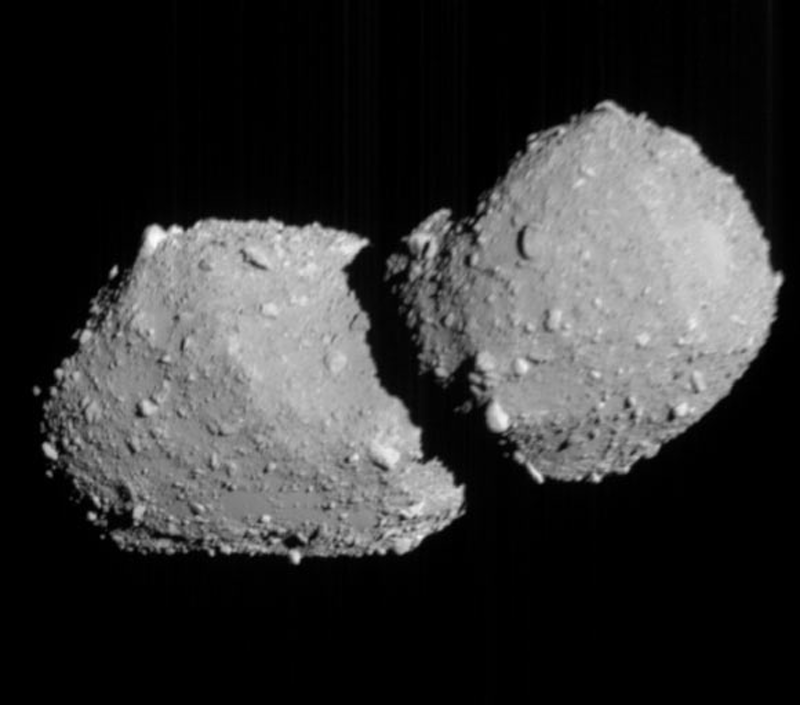
ONC-T image of asteroid Torifune captured by Hayabusa2 on July 5, 2026, showing the two-lobed contact-binary shape from a distance of roughly 800 kilometers.


On the evening of July 5, 2026, a 600-kilogram box of solar panels and instruments zipped past a peanut-shaped rock 450 meters across at roughly five kilometers per second. The flyby lasted about as long as the time it took you to read this sentence. The spacecraft was JAXA’s Hayabusa2, on a deliberate dash past near-Earth asteroid 98943 Torifune, also known by its provisional designation 2001 CC21. By the time anyone on Earth saw a single pixel of the encounter, the spacecraft was already several thousand kilometers beyond the asteroid, never to swing back (JAXA, July 6, 2026).

That brevity is the point. Torifune is the first of three asteroid encounters the extended Hayabusa2 mission is supposed to make before the probe reaches its true final target, the tiny 11-meter asteroid 1998 KY26, in 2031. The spacecraft is a sample-return craft that has already done its main job. Every extra maneuver now is rehearsal for an encounter that will be the most technically punishing of the mission (The Planetary Society, July 7, 2026).

Two reasons. First, Torifune is a contact binary, a body made of two lobes stuck together like a snowman, and those shapes are common in the small-body population but hard to study up close. Ground-based radar and adaptive-optics images suggested it was elongated; until last week no spacecraft had ever confirmed the structure with its own camera.

Second, the flyby is a deliberate dress rehearsal for planetary defense. JAXA wanted to demonstrate the kind of precision terminal guidance a kinetic impactor mission like NASA’s DART would need, where the spacecraft picks a small, faint, irregularly shaped target and threads a narrow approach corridor without hitting it. Torifune is the right kind of object: small, dim, and only clearly resolved a few days before closest approach. The mission team could not plot the final approach trajectory until the very end, because Torifune is faint enough that its exact orbit was uncertain until then (The Planetary Society, July 7, 2026).

If you are trying to design a spacecraft that bumps a city-block-sized rock off course, this is the kind of practice you want.

Hayabusa2 launched in December 2014 on an H-IIA rocket and arrived at asteroid Ryugu in mid-2018. Over the next eighteen months it dropped a pair of tiny hopping rovers, lowered the German-French MASCOT lander onto the surface, fired a 2-kilogram copper projectile into Ryugu to expose fresh sub-surface material, and scooped up samples. The return capsule landed at Woomera, Australia, in December 2020. Inside, scientists found water-bearing minerals, organic molecules, and grains that had escaped billions of years of space weathering. The samples are still being analyzed and are among the cleanest primitive materials anyone has yet returned from a carbon-rich near-Earth asteroid (Sci.News, July 8, 2026).

Most sample-return missions end there. Hayabusa2 did not. After releasing its sample capsule, the main spacecraft fired its ion engines and began a new trajectory. The extended mission has two goals: a high-speed flyby of Torifune in 2026, two Earth gravity assists in 2027 and 2028, and a final rendezvous with 1998 KY26 in 2031 (ISAS, mission page).

The Torifune encounter happened on July 5 at 18:30 JST, give or take one second. The spacecraft passed about 800 meters from the asteroid’s center, well outside the body but close enough that its three imaging instruments could resolve surface detail. ONC-T, the visible-light Optical Navigation Camera, started tracking Torifune on June 20 and continued to use the asteroid as an optical navigation reference right up to closest approach. About an hour before the flyby, the spacecraft also switched on NIRS3, a near-infrared spectrometer that hunts for water and hydroxyl signatures; TIR, a thermal infrared imager; and LIDAR, which bounces a laser off the surface to measure distance (JAXA, July 6, 2026).

Closest approach came and went. Hayabusa2 could not look back. JAXA confirmed the spacecraft was healthy at 18:35 JST, five minutes after the flyby, and the first images and thermal maps arrived within a day (Sky & Telescope, July 6, 2026).

The visible-light image showed what ground-based observers had suspected. Torifune is two distinct lobes joined at a narrow neck, the textbook shape of a contact binary formed when two smaller asteroids collided gently and stuck rather than bouncing apart. At about 450 meters across, it is in the same size class as the near-Earth asteroid Apophis and roughly an order of magnitude larger than the object that exploded over Chelyabinsk in 2013 (The Planetary Society, July 7, 2026).

The naming fits. JAXA chose “Torifune” through a public contest; it is short for Ame-no-Torifune, a Japanese deity associated with safe, steady, high-speed travel. You can see why the mission team liked it.

A flyby at five kilometers per second does not leave much margin for error. A small miscalculation in the closest-approach distance translates into several hundred meters of horizontal miss, easily enough to fly by the wrong side of the asteroid. There is no second chance. Hayabusa2 had to arrive at a precise point in space at a precise time, then keep going.

The spacecraft used a hybrid optical and radio navigation scheme. ONC-T took repeated images of Torifune against the background star field, and the team on the ground measured the asteroid’s apparent position to refine the predicted encounter point. Combined with deep-space network Doppler and ranging data, this let mission control update the trajectory within the last few days before closest approach. JAXA has not published the final navigation error budget, but the fact that ONC-T returned sharply focused images from 800 meters suggests the geometry worked (JAXA, July 6, 2026).

The thermal imager, TIR, observed Torifune in the 8 to 12 micrometer band, the thermal infrared where a sunlit asteroid radiates most of its heat. The brightness temperature, divided by the solar illumination, lets you back out the surface’s thermal inertia, a property set by regolith grain size, packing, and whether the surface is bare rock or blanketed in dust. For a small contact binary, the thermal data is the only way to learn what the surface is made of, because visible and near-infrared spectroscopy during a flyby captures too little reflected sunlight to break out mineral absorption signatures cleanly.

LIDAR is simpler but just as important. It rangefinds the surface with a 1.064-micrometer pulsed YAG laser, accurate from 30 meters out to 25 kilometers. During the Torifune encounter it produced a continuous altitude profile in the final minutes before closest approach, doubling as both a navigation input and a shape model. Combined with the ONC-T silhouette from a known viewing angle, the LIDAR track pins down the asteroid’s three-dimensional shape far better than the optical images alone (JAXA, July 6, 2026).

The instrument suite is what the spacecraft will carry into the 1998 KY26 encounter in 2031. KY26 is a different problem. At roughly 11 meters across, it is small enough that Hayabusa2 will not simply fly past; the extended mission plan calls for an actual orbit insertion and an attempted landing. The asteroid’s rapid rotation period, on the order of a few minutes, will make that landing extremely difficult, and the extended mission team is using Torifune to validate the optical and thermal mapping pipeline they will need for the harder job.

Hayabusa2 has now visited three asteroids across two missions. The first primary mission gave the world its best sample of a carbon-rich near-Earth asteroid. The extended mission is a chain of progressively harder technical demonstrations, and the Torifune flyby is the one with the lowest stakes but the cleanest test of the navigation approach JAXA wants to use in 2031. More data will downlink over the coming weeks.

Two years from now, the spacecraft will swing past Earth for a gravity assist. Three years after that, in 2031, it will arrive at a rock smaller than a house and try to land on it. Last week’s flyby is the first of the milestones the extended mission still owes the public. JAXA hit the geometry and returned a clean, recognizable image. The data will inform how we eventually deflect a real asteroid.


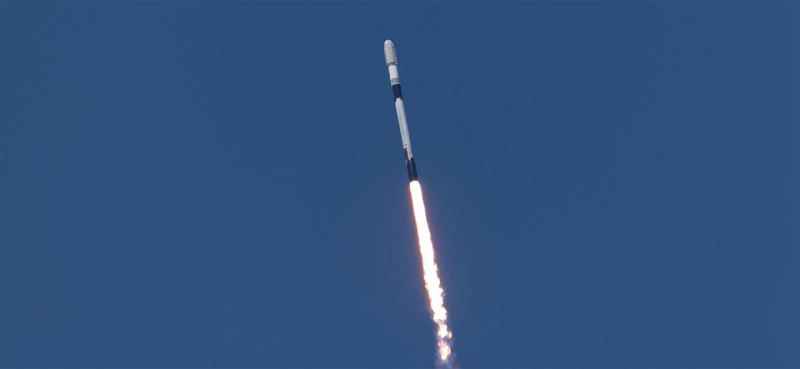
Falcon 9 ascends against a deep blue sky over Vandenberg, the bright plume trailing straight down from the booster as it climbs out of the lower stage of the atmosphere.


A Falcon 9 lifted off from Space Launch Complex 4E at Vandenberg Space Force Base at 11:32 a.m. PT on Thursday, October 1, 2026, carrying 130 satellites and hosted payloads into a sun-synchronous orbit on SpaceX’s eighteenth dedicated rideshare mission. It was one of three Falcon-family flights SpaceX flew that day, sandwiched between the Crew-13 astronaut launch from Florida in the morning and a National Reconnaissance Office Falcon Heavy from the Cape that night, and the size of the manifest made it the most diverse single launch of the year so far.

Transporter missions are SpaceX’s standing answer to the question “where do smallsats go?” The SmallSat Rideshare Program sells slots on quarterly Falcon 9 flights to SSO for as little as $350,000 per payload for up to 50 kg, with the cadence locked far enough in advance that customers can plan a satellite around a specific quarter instead of buying a dedicated rocket. The eighteenth such mission brought the program’s all-time tally past 1,800 payloads delivered to orbit, per SpaceX’s official mission page, a number that captures how the commercial smallsat industry is built as much on shared buses and shared launches as on the satellites themselves.

The first stage that flew Transporter-18 had already done this twice. It was the booster’s twenty-fifth flight, with a previous log that included NROL-126, Transporter-12, SPHEREx, NROL-57, USSF.366, and fourteen Starlink flights. Seven minutes and thirty-two seconds after liftoff it touched down on Landing Zone 4 at Vandenberg, returning to the same pad complex from which it had departed a few minutes earlier, in the kind of same-pad turnaround that has become routine for the West Coast booster fleet. Residents of Santa Barbara, San Luis Obispo, and Ventura counties may have heard one or more sonic booms as the booster came back through the denser lower atmosphere.

Inside the fairing, the manifest ran from cubesats to hosted payloads to two reentry vehicles and four orbital transfer vehicles that will deploy 41 of the 130 payloads at a later time. That architecture is the quiet structural innovation of recent rideshare flights: instead of forcing every customer into the same orbital plane on the same timeline, SpaceX has absorbed the role of mission manager. The OTV providers (D-Orbit, Exolaunch, Maverick Space Systems and others) now offer “deploy on a different day, at a different altitude” as a service to the payload builders. The Falco trade Via Satellite’s coverage of Transporter-18 describes a manifest where, for example, Tomorrow.io’s two weather satellites and Satellogic’s four optical Earth observation satellites ride along on the same Falcon 9 but can be dropped into different local times of day on station by their respective OTVs.

Several of the 130 payloads were firsts for their operators, which is what made Transporter-18 worth covering as a single story rather than as a pile of separate launches. Planet Labs flew the prototype satellite for Project Suncatcher, the joint effort with Google to test how Google machine-learning models and Google Tensor Processing Units behave when run in orbit rather than on the ground. Planet was the largest single customer on the flight, and in addition to the Suncatcher prototype it also flew the second Tanager methane-tracking satellite (Tanager being the methane mapper Planet developed with the CarbonMapper coalition), plus 18 SuperDove imagers manifested by SEOPS. StarCatcher flew Protostar, billed as a first-of-its-kind power-beaming node designed to demonstrate transferring electrical power between two free-flying spacecraft using optical links; a separate payload from Cowboy Space called Reason-1 is testing high-power laser energy transfer from low Earth orbit down to a ground receiver. Two demonstrations of moving watts around with light, on the same rocket, a few hours after the first ground-to-orbit ML inference test.

Starfish Space sent its first Otter servicing vehicle. It will run a NASA mission under the Small Spacecraft Propulsion and Inspection Capability acronym (SSPICY), and the flight is the company’s first operational satellite. CesiumAstro sent Element, its first full satellite built on the company’s own phased-array antennas, software-defined radios and onboard processors; Unseenlabs sent a pair of next-generation radio-frequency monitoring satellites, one to add capacity to its first-generation constellation and a BRO (BRO-32) to expand RF detection coverage across sea, land and space. Dhruva Space integrated LEAP-2, its second commercial mission, hosting multiple in-orbit demonstration payloads including units from Sodern ArianeGroup and the India-based Satleo Labs TAPAS-1.

The mission also carried two reentry vehicles from Varda Space Industries, continuing the company’s program of returning pharmaceuticals manufactured in microgravity, and the eight-satellite IRIDE Eaglet II cluster for Italy’s national Earth observation constellation. Constellation refreshes dominated the rest of the manifest: four ICEYE synthetic-aperture radar satellites, four Satellogic optical satellites, five Sateliot IoT nodes, two GHGSat methane monitors manifested by SFL Missions, and Tomorrow.io’s two weather satellites. According to the SpaceWatch.Global launch report and the NASASpaceFlight mission preview, the deployment sequence began at T+54 minutes and 22 seconds with the NASA-manifested Sprite cubesat and ran for the next hour through 89 individually sequenced deployments, with SpaceX confirming the deployment sequence had concluded at 3:41 p.m. ET.

What makes Transporter-18 worth thinking about beyond the manifest is the layering of three different kinds of space activity on the same rocket. There are constellation refreshes, which are now a steady, repetitive part of the smallsat industry the way cellular tower upgrades are a steady part of the telecoms industry. There are first-of-kind demonstrators: the Project Suncatcher ML-in-orbit prototype, the StarCatcher and Cowboy Space optical power-beaming tests, the Starfish Otter servicing mission. Their operational lifetimes may or may not turn into recurring revenue depending on what the data shows. And there are hosted payloads and secondary slots that let a university lab or a small country’s space agency get a satellite into orbit for the price of a rideshare ticket, which is what turns a quarterly launch cadence into infrastructure for everyone who builds the future of space hardware.

The next Transporter flight will not be far behind. Rideshare customers now plan their satellites around a known quarterly cadence from Vandenberg and the Cape, and a mission profile with 130 payloads, an OTV captain, and a twenty-fifth-flight booster is no longer an exception to the rule. It is what a normal Falcon 9 launch looks like in late 2026, and the question worth watching is not whether the next rideshare can carry this much, because the manifest will only grow. It is whether the long tail of secondary payloads can keep its quality bar as the cadence accelerates, and whether the experimental demos like Suncatcher and Protostar turn into recurring programs that share the same quarterly rocket on its own.


October 2, 2026

China catches a rocket out of the sky

Posted by


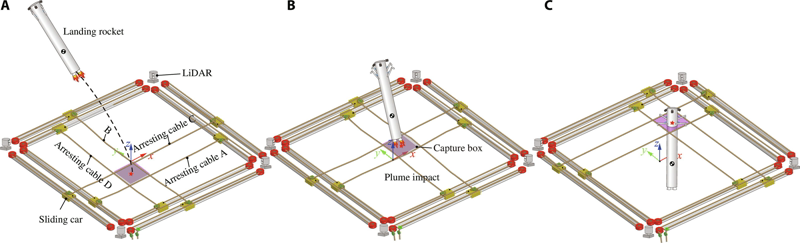
Diagram of the cable-net recovery system's three phases — following, entering, and capturing — as published in a peer-reviewed journal article on the technique.


At 04:15 UTC on July 10, 2026, a 70-meter Chinese rocket climbed off the pad at the Wenchang Commercial Space Launch Site on Hainan island, lit seven kerosene engines, and headed southeast over the South China Sea. Roughly ten minutes later, the upper stage was still climbing toward orbit, and the booster had already turned around, fallen back through the sensible atmosphere, and snagged itself on a grid of tensioned steel cables strung across a ship called Linghangzhe. The booster came to rest hanging in mid-air over the deck, engines off, plumes of evaporating kerosene streaming off the warm tank. CASC, the state-owned China Aerospace Science and Technology Corporation, called the mission a “complete success.” It is the first time any Chinese rocket has been recovered after reaching orbit, and the first time any operator anywhere has used a net to do it.

Reusability is the lever that turned SpaceX from an upstart into the dominant launch provider of the 2020s. A Falcon 9 booster that lands is a booster that flies again, and that one engineering change drives launch prices down by roughly an order of magnitude. China has watched that happen from the outside. Until last Friday, no Chinese rocket had ever returned to Earth intact after reaching orbit, which put a hard ceiling on how fast Beijing could build megaconstellations, crewed lunar hardware, or any of the other things reusable boosters make cheap.

The Long March 10B test changes that. It is also the third booster-recovery club to form on the planet, after SpaceX (Falcon 9 in 2015, Starship in 2024) and Blue Origin (New Glenn in late 2025). The catch is that China got there using a method neither of the other two has flown: catching the descending booster on a net, mid-air, instead of either landing it on legs or snatching it out of the air with a launch-tower arm like Starship does. If that approach scales, it shifts the trade-off between payload mass and reusability in a way the rest of the industry will have to think about.

Friday’s flight was the maiden launch of the Long March 10B, a two-stage medium-lift rocket built by the China Academy of Launch Vehicle Technology (CALT), a subsidiary of CASC. The booster is 5 meters in diameter and runs seven YF-100K engines burning kerosene and liquid oxygen. Unlike the older Long March workhorses, its upper stage burns methane and liquid oxygen, the same propellant combination SpaceX’s Raptor uses. The rocket was designed from the start to be recoverable.

The recovery hardware lives mostly on the ship, not the rocket. Linghangzhe (Navigator) carries a four-legged frame over which a tensioned cable grid is stretched. As the booster descends, four titanium grid fins steer it through the hypersonic and supersonic phases of reentry, the same aerodynamic trick Falcon 9 uses. Near the surface, the booster sheds its grid fins and extends small hooks that snag the cable grid. The cables carry the booster’s weight and arrest its downward velocity, and the engines shut down as it comes to rest suspended over the deck. CASC says the flight validated “multiple engine restarts with high-altitude ignition, high-precision navigation and control, and the first capture and recovery using a net system on a sea-based platform.”

While the booster was being caught, the upper stage kept climbing. About ten minutes after launch, it delivered a payload designated CX-26, built by China Satellite Network Group, into a roughly 800-kilometer low Earth orbit. Chinese officials have not publicly described the satellite’s mission, which is consistent with most classified or pre-operational Chinese payloads. SpaceNews reported that the payload may in fact be TJS-26A (Tongxin Jishu Shiyan-26A), a classified communications technology test satellite, but that identification has not been confirmed by CASC.

The flight is a stepping stone in a wider Long March 10 program. The Long March 10A, which shares the same first stage as the 10B, is intended as China’s next crewed launcher for low Earth orbit and is meant to evolve out of the older CZ-2F and CZ-7 families. A larger three-core Long March 10 will be the rocket that flies the Mengzhou crewed spacecraft toward the Moon. Data from the 10B’s recovery, and from its methane upper stage, feeds directly into both. China launched a scaled-down CZ-10A first stage in February 2026 to test the Mengzhou capsule’s launch abort system, and that booster performed a controlled splashdown about 200 meters from its recovery platform in the South China Sea. Friday’s net catch is the next step on that ladder.

Two design choices drive the net approach.

The first is mass. A Falcon 9 booster carries four deployable landing legs and four larger grid fins, plus the hardware to lock each leg into place. Mass saved is mass that can be payload. The 10B trades legs for hooks, which weigh very little, and offloads the heavy catch structure (frame, cables, winches, the frame’s support legs on the ship) to the boat. CASC’s own statements imply this is the main reason a 10B in reusable mode can still deliver 16 metric tons to a 200-kilometer low orbit, versus a single-use rocket of similar class.

The second is tolerance. A ship in the open ocean moves with the swells. A booster falling at terminal velocity has seconds to hit a moving target. The cable grid spans most of the frame, so the booster does not need to land on a small pad or balance on a single tower catchpoint the way Starship does at Boca Chica. The grid also absorbs a lot of energy, so the booster does not need a perfect engine-cutoff timing. That should, in principle, let the recovery team operate in worse weather and with less margin than leg-style landings.

The catch is not free. The booster has to be soft enough not to tear through the cables on contact, which constrains structural reinforcement and probably caps the size of recoverable boosters. The 10B is medium-lift. Falcon Heavy has three boosters, and the Super Heavy booster on Starship is far larger and heavier. Whether the net idea scales to heavy-lift, or only works for medium-lift, is an open question. CASC has not said whether the crew-rated 10A or the three-core Moon rocket will also use a net or fall back to legs.

The wider context: at least two private Chinese companies have already tried similar landings. LandSpace flew its Zhuque-3 and attempted a downrange recovery in 2025, with mixed results. Space Pioneer and Galactic Energy are working on comparable vehicles. Whether the state-led 10B flight pushes the commercial sector toward a common architecture, or sends it looking for different solutions, is one of the things to watch over the next year.

The Friday flight did not change China’s space program in one stroke. It changed the launch industry in a small, concrete way: China now has a working, reusable orbital booster, and it has a working version of an idea nobody else had flown. The next 10B flights, expected later in 2026, will tell operators whether the catch system can fly again and again without rebuilding the cables. CASC’s stated plan is to gather flight data for the crewed 10A and the lunar Long March 10. If the recovery cadence holds, the third Chinese launch of 2027 may carry a Mengzhou capsule on a rocket whose first stage was already flown once.


October 1, 2026

Crew-13 docks at ISS in under 8 hours

Posted by


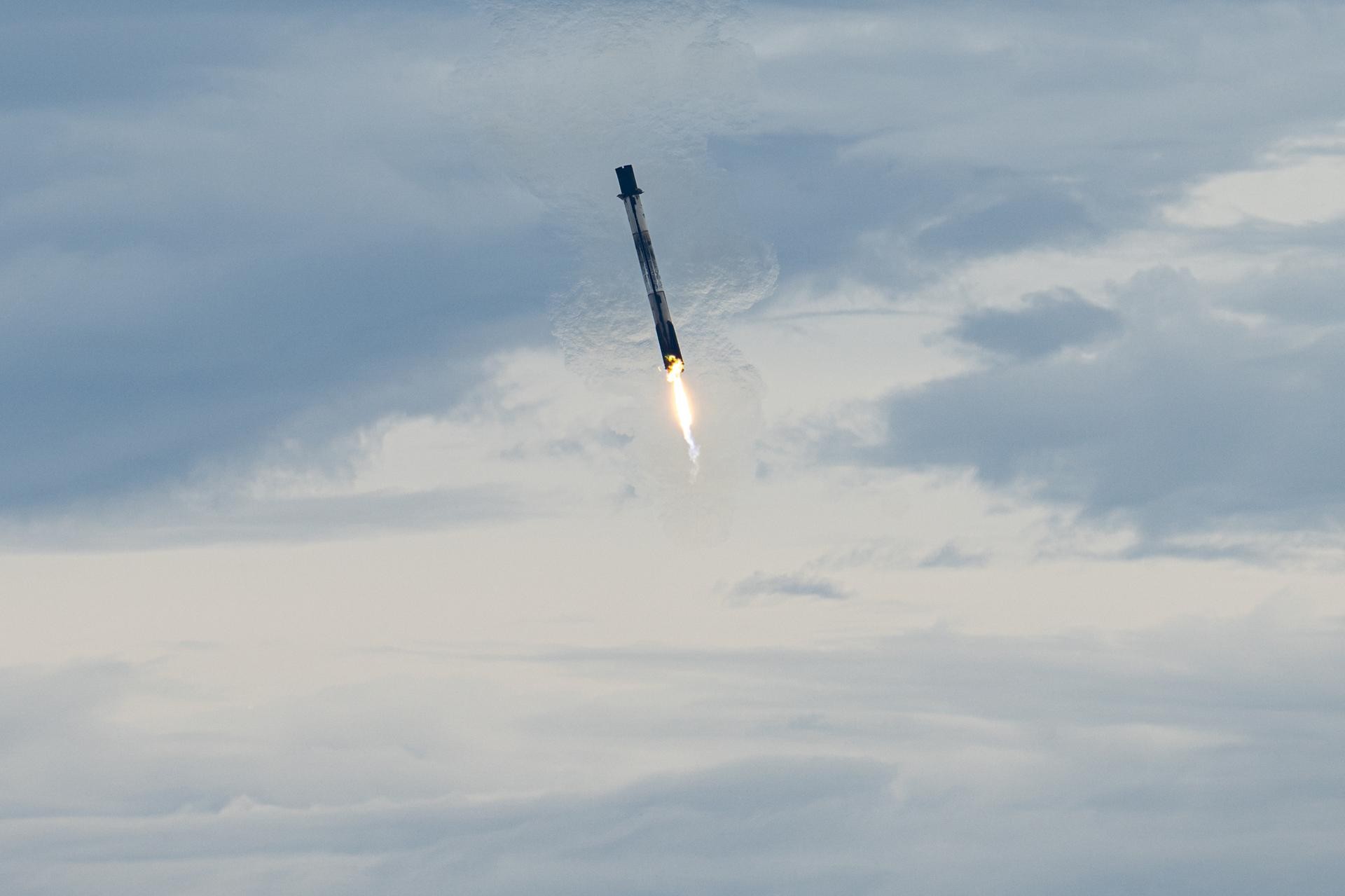
A SpaceX Falcon 9 first stage descends toward Landing Zone 40 at Cape Canaveral Space Force Station on October 1, 2026, after separating from Dragon Grace carrying the four Crew-13 astronauts.

Image source: NASA Image and Video Library. Photograph by NASA, public domain.


Crew Dragon Grace docked to the forward port of the International Space Station’s Harmony module at 7:05 PM Eastern time on Thursday, October 1, completing the fastest launch-to-ISS-docking transit in the history of U.S. human spaceflight. The four Crew-13 astronauts — NASA’s Jessica Watkins and Luke Delaney, Canadian Space Agency astronaut Joshua Kutryk, and Roscosmos cosmonaut Sergey Teteryatnikov — arrived at the orbital outpost seven hours and fifty-five minutes after their Falcon 9 lifted off from Cape Canaveral, with the spacecraft traveling 263 miles above the northeastern Pacific Ocean at contact. A welcome ceremony at the station’s hatch followed at 8:45 PM Eastern.

The fast-rendezvous profile is the headline. Most Crew Dragon flights to the ISS take 24 to 28 hours and complete roughly eighteen orbits before contact; the typical transit requires Dragon to make a series of calculated engine burns to gradually raise its orbit to match the station’s altitude and phase. The Crew-13 profile completed the same work in fewer orbits by setting Dragon’s initial orbit to a period slightly shorter than the station’s, allowing Dragon to catch up faster — a more propellant-intensive but faster approach. Spaceflight Now noted in pre-launch coverage that the choice of profile depends on orbital geometry at launch time, and that the specific 11:10 AM Eastern launch window was selected in part because it put the ISS in the right relative position to support the short rendezvous. NASA’s launch-day release called the transit the fastest launch-to-docking by a U.S. spacecraft in ISS history; the previous mark was set on Crew-4 in 2022 at roughly seventeen hours.

The booster that lofted Grace into orbit made its own contribution to SpaceX’s reusability ledger. B1101 returned to Cape Canaveral and touched down at Landing Zone 40 less than eight minutes after launch — the seventh landing at LZ-40 and SpaceX’s 664th Falcon booster landing overall. The booster was on its third flight: it had previously launched the Starlink 6-88 mission and Crew-12 in February 2026. B1101’s reuse profile, plus the use of a previously-flown Crew Dragon capsule, continues to be one of the structural arguments SpaceX makes for its pricing. Recent Dragon crew rotation flights cost NASA approximately $288 million per mission, or roughly $72 million per seat. Boeing’s Starliner was priced at roughly $90 to $99 million per seat under its original contract.

The flight carried more than just crew to orbit. Grace (tail number C-213) had flown before — she was the same Dragon that flew NASA’s SpaceX Crew-4 mission in April 2022, the mission on which Watkins made her first trip to space. SpaceX’s design certification for Crew Dragon, last reviewed against the manifest in 2024, allows each capsule to be reflown up to fifteen times across its service life. The Crew-13 mission flew with no public announcement of any hardware change to the capsule. The SpaceX contract for the flight did, however, expand: in a May 2026 announcement, NASA formally added six more Dragon commercial crew missions to its Commercial Crew Program manifest, replacing flights that had originally been awarded to Boeing’s Starliner. That addition, combined with a separate $946 million contract for three flights, means SpaceX now holds contracts for all remaining NASA ISS crew rotation missions through the station’s planned retirement around 2030.

The single-source-of-supply arrangement is not what NASA’s planners wanted. The original Commercial Crew Program was structured to fund two providers — SpaceX and Boeing — so the U.S. would not be wholly dependent on a single company for crew transport. That redundancy is now absent because of Boeing’s 2024 Crew Flight Test failure. In February 2026, NASA formally classified that failure as a “Type A mishap,” the agency’s most serious category, after multiple propulsion anomalies during transit — most notably a string of helium leaks in the service module and the failure of five of eight reaction-control thrusters in quick succession. NASA returned the vehicle uncrewed and brought the test crew home on a Dragon in March 2025. Boeing’s next Starliner mission is currently targeted as an uncrewed cargo flight no earlier than the fourth quarter of 2026, but Boeing’s own SEC filings describe NASA discussions as having an “uncertain” outcome.

Once aboard the ISS, Crew-13 will join Expedition 75 alongside the crew already on station. The handover will play out over the next week, after which Crew-12 — NASA’s Jessica Meir and Jack Hathaway, ESA’s Sophie Adenot, and Roscosmos’s Andrey Fedyaev — will board Dragon Freedom for the trip back to Earth. Watkins, Delaney, Kutryk, and Teteryatnikov are then expected to stay aboard through approximately next March and April, rotating through Expedition 75 and 76 as the station hands off twice during their stay. Their science agenda includes biology, materials science, Earth observation, and human physiology studies — including work that will feed into the cardiovascular, bone-density, vision, and immune-function research programs that inform Artemis-era lunar surface planning.

One piece of context that isn’t in NASA’s release but does change how the mission should be read: Grace is, according to a separate secondary-outlet report published today, the fifth and final Dragon capsule SpaceX has built. The company is not planning to construct another. The implication for ISS operations is significant — every operational NASA crew rotation to the station through 2030 will use one of those five Dragons, including a capsule that has been aloft for some of its life cycle. NASA’s Commercial Crew Program and Boeing’s recovery of Starliner will both be factors in how that plays out, but the operational constraint is set: there are five Crew Dragons, and there will be no more.

The next major event in the Crew-13 timeline is the handover, which is expected to take about a week and concludes when Crew-12 departs. NASA’s next crewed launch of any kind is currently scheduled to be the second lunar-flyby Orion mission, in late-stage processing at Kennedy. Crew-14 has not yet been publicly assigned.

For the moment, though, the four Crew-13 astronauts are aboard. Hatch opened at approximately 8:45 PM Eastern. The welcome ceremony was broadcast on NASA TV.