OrbitalHub

Where curiosity reaches escape velocity.

Domain is for sale. $50,000,000.00 USD. Direct any inquiries to contact@orbitalhub.com.

Archive for October, 2026


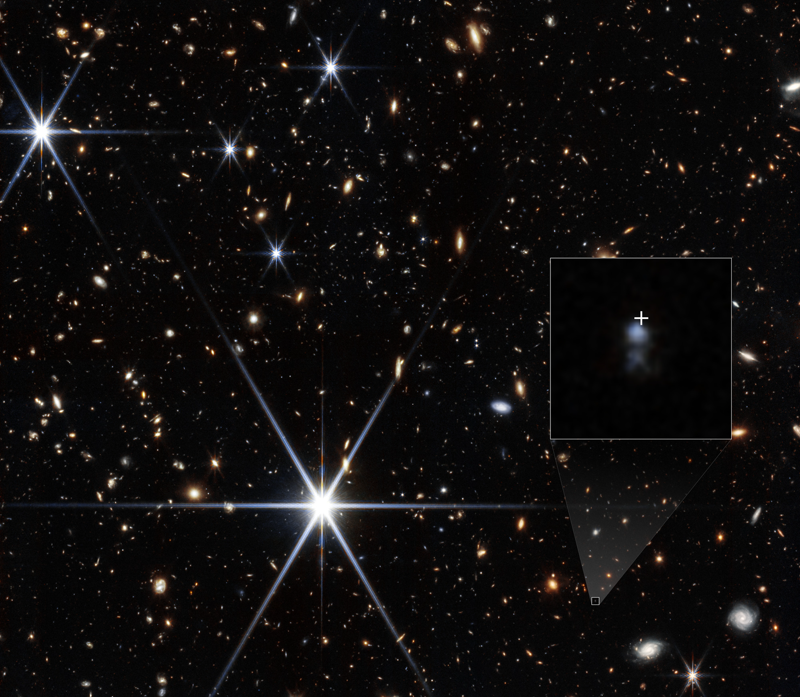
A composite NIRCam image centred on the host galaxy of FRB 20240304B in the constellation Virgo at right ascension 12:11:59 and declination +11:48:46, showing a faint blue dwarf galaxy inside a small inset box with a white cross marking the exact radio position of the burst, set against a crowded field of more distant galaxies and brighter foreground stars with diffraction spikes. Image: NASA Webb release assets at science.nasa.gov/asset/webb/frb-20240304b-nircam-image, credit NASA, ESA, CSA, STScI, Themiya Nanayakkara (USYD); image processing Joseph DePasquale (STScI).


On March 4, 2024, a 64-dish radio array in the South African Karoo picked up a flash that lasted less than a blink. The pulse, named FRB 20240304B and reported on the NASA Webb mission page, arrived at the MeerKAT telescope at 00:50:12.567 UTC with a dispersion measure of 2458 pc cm^-3, a value so high that the signal had clearly travelled through a vast column of ionised gas before reaching Earth. Localising it to within arc-second precision on the sky took another thirty seconds of offline processing. Doing anything useful with that position took the James Webb Space Telescope. In the October 8, 2026 issue of Science, the team led by Manisha Caleb and Themiya Nanayakkara at the University of Sydney report that Webb pinned the burst to a faint dwarf galaxy at a spectroscopic redshift of 2.148 plus or minus 0.001, a record that more than doubles the redshift reach of any previously localised fast radio burst.

The result matters because fast radio bursts, millisecond flashes of coherent radio emission whose origins are still debated, have until now been almost entirely local phenomena by cosmic standards. Of roughly one hundred FRBs with redshifts measured from their host galaxies, the great majority sit at redshifts below 0.5. Pushing that frontier to z = 2.148 means the team can now read the line-of-sight through roughly eighty percent of cosmic history in a single burst. The Macquart relation, which converts an FRB’s dispersion measure into an integrated electron-density estimate along the line of sight, has been constrained almost entirely by nearby events. A single very distant source stretches the calibration into the regime where cosmological ionised gas dominates the budget and where the missing baryons problem, once a curiosity of low-redshift surveys, becomes directly measurable.

To find a host, the team first searched public surveys and ran deep optical and near-infrared follow-up at the Keck and MMT observatories. The host stayed invisible down to five-sigma limiting magnitudes of R = 26.24 and J = 23.38 in the AB system. A faint, distant dwarf at redshift two is dim enough that ground-based eight- and ten-metre telescopes cannot pick it out of the foreground, which is exactly the regime where Webb’s cold infrared sensitivity overwhelms everything else in the astronomer toolkit. The team was awarded Director’s Discretionary Time on the observatory (programme 6779) and turned the Near Infrared Camera onto the field in the F200W and F322W2 filters on 26 December 2024. A candidate host appeared at an offset of about 0.3 arcseconds from the radio position. The Probabilistic Association of Transients to their Hosts (PATH) formalism gave a 97.5 percent posterior probability that the candidate is the real counterpart, with only a 2.4 percent residual chance of an unseen alternative.

The clincher was spectroscopy. Webb’s Near Infrared Spectrograph Integral Field Spectrograph caught strong H-alpha and [O III] lambda 5007 emission lines from the candidate, two of the canonical redshift markers at this cosmic epoch. The measured redshift of 2.148, defined to three decimal places, places the burst firmly in what cosmologists call cosmic noon, the era between roughly two and four billion years after the Big Bang when the cosmic star-formation rate reached its peak. MeerKAT’s dispersion measure had predicted a redshift of 2.8 with a 1.6 to 3.4 range, so the spectroscopic answer was consistent with the radio estimate but on the lower side of its confidence range.

The host galaxy itself turned out to be the bigger surprise. Most FRB host galaxies discovered to date are massive, dusty, vigorously star-forming systems. This host is none of those things. It has a stellar mass of about ten million solar masses, around a thousand times less than the team’s prior expectation, and a star-formation rate of about 0.2 solar masses per year. Its gas-phase metallicity is only ten to twenty percent of solar. By contrast, the FRB with the most well-studied host to date, FRB 20121102A, sits in a galaxy about ten times more luminous. The galaxy is, in the words of lead author Manisha Caleb, “a little dwarf galaxy, although it was actively forming stars.”

That mismatch is where the science gets sharp. There are two leading classes of FRB progenitor model in the current literature. The first invokes the merger of two neutron stars, compact objects whose orbit shrinks over billions of years through gravitational-wave emission until they collide, an end-stage process that should preferentially occur in older galaxies with evolved stellar populations. The second invokes young magnetars, the highly magnetised neutron stars left behind when a massive star ends its life in a supernova, that can power a fast radio burst through starquake-like activity within only millions of years of their birth. A dwarf host at cosmic noon with the metallicity of a primordial starburst fits the second scenario cleanly. The Milky Way’s own Galactic magnetar SGR J1935+2154, located only about ten kiloparsecs away, has produced FRB-like bursts in modern observations, and the metallicity of the new host is in the range where the initial mass function favours the formation of the very massive progenitors that become magnetars.

The team concludes that a neutron-star merger is unlikely to be the source of FRB 20240304B. The energetics back this up: the isotropic-equivalent energy of the burst is around ten to the forty-one erg, on the high end of what is reported for non-repeating FRBs but consistent with the magnetar picture.

FRBs are not just telephone signals from exotic objects, they are probes of everything their light passes through. Each burst carries an imprint of every free-electron it encountered between source and observer, which means a single very distant FRB can trace the cosmic web of ionised matter, the diffuse intergalactic medium, the circumgalactic halos of intervening galaxy clusters, and the warm interstellar medium of the Milky Way itself in one observation. The team’s dispersion-measure analysis for FRB 20240304B found the imprint of two structures along the sightline: an intervening galaxy group at a redshift of 0.3, about 3.5 billion light-years from Earth, and the nearby Virgo Cluster, which lies about 54 million light-years away in the constellation that gives the burst’s host its other nickname. Splitting the dispersion-measure budget across these contributions is what calibrates the Macquart relation across most of cosmic time.

The immediate next step is more of the same. The team estimates that MeerKAT can detect and localise several FRBs per year at redshifts above one, and the upcoming SKA-Mid array, with its order-of-magnitude jump in sensitivity, should push that rate higher. Each new burst becomes a Webb target for spectroscopy, and each new spectrum refines the picture of where and how these energetic flares arise. Whether most FRBs turn out to be magnetars, mergers, or some mixture is still an open question, but the new host galaxy, small, metal-poor, vigorously star-forming, and viewed as it was ten billion years ago, is the kind of place where a magnetar should be living. That is enough, for now, to weight the debate.
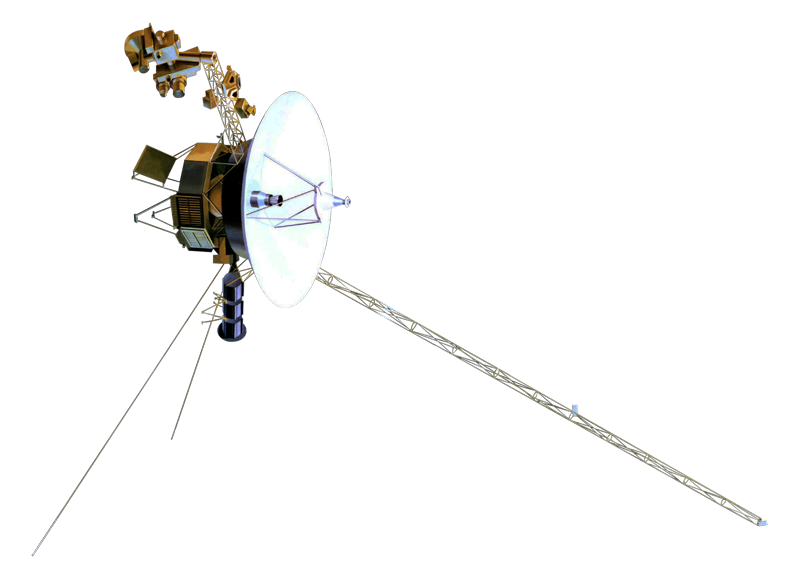



Artist's rendering of the Voyager spacecraft against a black background: a 3.7-meter high-gain dish antenna dominates the center, with the RTG booms extending to the right and the instrument platform on the left. (NASA / Wikimedia Commons)


On August 4, 2026, with a single coordinated command sequence, engineers at NASA’s Jet Propulsion Laboratory switched three power-hungry heaters on Voyager 2 for three lower-power substitutes and turned off a redundant device whose residual heat was already doing the job. The maneuver was nicknamed the “Big Bang” by the mission team because it had to be executed in one uninterrupted block: the probe cannot tolerate a half-finished sequence when the new configuration leaves critical fuel lines running on borrowed thermal margins. Forty-eight years after launch, with plutonium steadily depleting inside its three radioisotope thermoelectric generators, Voyager 2 was running on roughly four watts less available power than it had the year before, and the mission was weeks from a forced instrument shutdown. The swap changed that math. The savings should keep all three of Voyager 2’s remaining science instruments returning data from interstellar space for at least another year before the team has to choose which one to power down next.

Voyager 2 crossed the heliopause in November 2018 and is currently the only spacecraft in the solar system making direct in-situ measurements of the plasma, magnetic field, and energetic particle environment beyond the Sun’s magnetic bubble. Voyager 1 crossed the boundary six years earlier, but Voyager 2 is still returning plasma data that Voyager 1 cannot, because Voyager 1’s plasma science instrument failed in 1980 and was never replaced. The two spacecraft together form humanity’s only working sensor network in the local interstellar medium, and every instrument shutdown is permanent. Once powered off, Voyager’s 1970s electronics cannot be brought back. With Voyager 1 already down to two operating instruments after an unexpected February 2025 power drop forced the LECP shutdown in April of that year, losing a third instrument on Voyager 2 would have left the interstellar mission with a thinner, more asymmetric scientific footprint. The Big Bang also matters as an engineering template. Voyager’s power budget is now so thin that similar swaps will be needed every year or two until the RTGs decay below the threshold needed to run any science instruments at all, which NASA estimates will happen sometime in the 2030s. The procedure the JPL team developed for this swap is the same procedure they will repeat on Voyager 1, and likely on both spacecraft multiple more times before the mission ends.

The Voyager 2 swap was first reported by NASA’s Voyager mission blog on August 4, 2026. The Register’s follow-up the next day added the most concrete engineering detail: a NASA spokesperson told the paper that the swap involved “two heaters and a device that was being kept on since its residual heat was in the right location and it used less power than the actual nearby heater.” The trio was replaced with another three components that together still generated enough heat to keep the fuel lines warm, but at lower wattage. Past swaps on the Voyager spacecraft were usually one-for-one. The Big Bang’s innovation was doing three replacements at once and accepting the temporary thermal risk to the fuel lines in exchange for the combined power savings. Voyager 2 carries a single 70-centimeter titanium tank holding about 100 kilograms of hydrazine at launch, used for attitude control and trajectory correction maneuvers; keeping that fuel from freezing in interstellar space is one of the load-bearing thermal jobs on the spacecraft, and it is the constraint that bounds how aggressively JPL can trade heat-generating components for power savings. Voyager 2’s LECP instrument had already been turned off in March 2025; the plasma science instrument was shut down in September 2024; a third instrument on each Voyager has been off since long before that, leaving three on Voyager 2 and two on Voyager 1. Without the Big Bang, NASA confirmed, another Voyager 2 instrument would have had to be switched off before the end of 2026. With the savings from the swap, that decision has been pushed into 2027 at the earliest. JPL plans to run the same swap on Voyager 1 in the coming months. Voyager 1 is currently farther from Earth than Voyager 2, and both probes are still inside the solar system in the strict astronomical sense, even though both are now in the interstellar medium.

The Voyager power budget is governed by three multihundred-watt radioisotope thermoelectric generators, each containing 24 pressed plutonium-238 oxide spheres. At launch in August 1977, the three RTGs together produced about 470 watts of electrical power. The plutonium-238 half-life is 87.7 years, so the electrical output has dropped by roughly a factor of two over the mission’s lifetime. The probes lose about 4 watts of available power per year, and the drop is accelerating slowly as the thermocouple junctions age and the thermal gradient they exploit shrinks. NASA first began drawing on a backup power reservoir in April 2023; without that step, the mission would have lost at least one more instrument sooner. The thermal architecture is what makes the Big Bang clever. Many components on Voyager 2 give off waste heat as a side effect of operating, and several of those components are physically adjacent to fuel lines, propulsion latches, or science instruments that need to stay above their minimum operating temperatures. Replacing a high-power heater with a lower-power one usually means the heat budget has to be rearranged, but if the old heater was already heating something the new heater does not need to heat, the swap can be near-power-neutral. The Big Bang worked because the three devices that were turned off had already been “ghost heating” their neighbors, with the residual heat in the right place. The three replacements are less powerful individually, but together they keep the fuel lines and adjacent subsystems at the required temperature with a net lower draw from the RTGs. The constraint is sequencing. If the swap had been interrupted partway through, the spacecraft would have been left with an underheated fuel line and an instrument bay that was relying on a component that was about to be turned off. JPL engineers therefore treated the Big Bang as a single atomic operation, sent the entire command sequence as one batch, and then waited more than 23 hours for the signal to reach Voyager 2 and another 23 hours for the engineering telemetry to return confirming the new configuration was stable. The same near-24-hour round trip will apply when the team runs the swap on Voyager 1.

Voyager 2 is now expected to keep all three of its remaining science instruments (the magnetometer, the plasma wave subsystem, and the cosmic ray subsystem) returning interstellar data through at least late 2027, with the team planning to run the same Big Bang swap on Voyager 1 within the next several months. The next decision point is whether the LECP instrument that was shut off on Voyager 1 in April 2025 can be brought back online after that swap, which would give Voyager 1 a third working instrument for the first time in roughly a year. Beyond that, the Voyager power budget will continue to tighten by about four watts per year, and JPL will likely need to run a similar coordinated swap every twelve to twenty-four months until the RTGs decay below the threshold needed for any science operation sometime in the 2030s. The Big Bang is not a permanent fix. It is a way of buying one more year of an interstellar science mission that is now forty-eight years past its design life, using only the hardware that is already aboard the spacecraft.

Source: Wikimedia Commons file page.


A glowing neural network woven through the open pages of a NASA grant proposal, with the James Webb Space Telescope mirror in soft focus behind it, representing the intersection of peer review and super intelligence in American research


Two days before the second Tuesday in October, the same room at the U.S. Institute of Peace that has hosted peace talks for three decades filled instead with research administrators, lab directors, and the kind of people who can tell you the difference between a Bayesian prior and a proposal deadline. The occasion was the White House Office of Science and Technology Policy’s “Science: A New Golden Age Summit,” convened on October 8, 2026 to translate a July report to the President into a coordinated set of federal science bets. NASA showed up with two of them, and neither one was a new telescope.

The first was a quiet institutional commitment: a coordinated metascience program inside NASA’s Science Mission Directorate, with a permanent expansion of dual-anonymous peer review across the directorate’s research solicitations. The second was a fellowship: ten Genesis Mission Fellows, accelerated doctoral students who will be trained simultaneously in super intelligence and in a traditional NASA mission discipline, and placed inside NASA laboratories to work on real flight programs. Both came wrapped in Isaacman’s framing of a “new Golden Age” but, more usefully, both came with concrete structure: a named review mechanism that already exists, and a fellowship template lifted almost verbatim from a graduate research program that has been running since 2019.

Why does the peer-review expansion matter? The short version is that the agency has been running the experiment for six years and is now extending it. Dual-anonymous peer review, the form NASA Science began piloting in 2020 and folded into the Future Investigators in NASA Earth and Space Science and Technology (FINESST) solicitation in 2024, breaks the link between who writes a proposal and who grades it. Proposers rewrite their science cases to remove identifying details — author names, institution, even the kind of instrument references that flag a specific lab. Reviewers see only the science and the budget. The pilot was launched during the first Trump administration and is, in the agency’s own framing on its Dual Anonymous Peer Review page, a structural response to the cognitive biases Tversky and Kahneman laid out in 1974. The new initiative commits the Science Mission Directorate to expanding that practice further, into more of its Research Opportunities in Space and Earth Sciences (ROSES) programs, and to folding the operational lessons into a coordinated metascience capability that can study its own review outcomes in close to real time.

That is a quieter change than a new flagship, but it lands harder on day-to-day science. ROSES is the pipeline through which the bulk of NASA’s external science gets funded: a single solicitation umbrella that issues dozens of individual program elements each year, ranging from astrophysics theory to Earth-system modeling to heliophysics data analysis. If DAPR is the new default for most ROSES elements, then the median funded investigator — the one whose lab, whose postdocs, and whose instrument pipeline are not famous — is suddenly competing on a more level surface than they were a year ago. The biases that DAPR targets are not exotic. They are the usual ones: prestige-by-institution, halo effects from earlier work, name recognition that follows investigators across subfields. None of these are accusations against individual reviewers. They are properties of a system that puts people in front of proposals and asks them to choose.

The fellowship sits at a different altitude. Genesis Mission Fellows will be doctoral students whose training explicitly couples super intelligence — the federal government’s preferred term for advanced AI systems that can plan and reason across long horizons — with a traditional discipline, the way the original FINESST design already pairs a graduate student with a faculty mentor on a single research question. NASA will support ten such students in the first cohort, working on NASA mission areas at NASA laboratories. The fellowship inherits the bones of FINESST, including its structure as a research grant rather than a traditional fellowship and its $50,000-per-year award size, and bolts on the SI training component. The Department of Energy launched a parallel fellowship structure the same day, aimed at the same kind of dual-competency PhD, with the same general design and a 100-PhD-per-cohort scale, which makes the two programs the first coordinated federal attempt to grow a domestic SI-fluent research workforce rather than rent one from outside.

What makes this a coherent story is the compute underneath it. The White House fact sheet accompanying the announcements lists $2.4 billion in industry commitments to the Genesis Mission Consortium for SI compute and tooling: NVIDIA at $1 billion, AMD at $500 million, OpenAI at $200 million, Anthropic and Google at $150 million each, AMP and Emerald AI at $100 million each, and AWS, Armada, Crusoe, and Micron at $50 million each. That pool is the resource the new fellowships will be trained on, and the resource NASA’s metascience effort will be able to use to study its own review process. It is also the lever that the July expansion of the Genesis Mission pulled: the $5 billion federal commitment that pulled fifteen-plus agencies into the consortium, of which NASA’s two October 8 announcements are the first research-training deliverables.

The engineering question that makes or breaks this is whether the training tracks actually produce researchers who can do original work in their discipline, not researchers who can prompt an SI system about it. The federal design here leans on the rotation model: a doctoral student spends time inside a national lab, time inside an industry partner, and time inside the academic department that granted the degree. The expectation is that the rotation through an industry lab forces the AI work to meet engineering constraints — latency, cost, auditability, integration with real instruments — while the academic time forces it to meet peer-reviewed publication standards. The model is closer to the National Science Foundation’s Graduate Research Fellowships in structure than to anything AI-specific, and that is the point. The novel content is the SI training, not the fellowship scaffolding.

There are real risks. DAPR shifts work onto proposers, who have to rewrite their cases to strip identity, and onto panels, who have to learn to read proposals that read like abstracts. If the rewrite costs more time than the bias reduction saves, the program fails on its own terms. The fellowship, meanwhile, depends on industry partners actually opening their labs to doctoral students, and on academic departments accepting an SI training component that is not yet a recognized subfield. Both are bets about institutional behavior, not just about money.

What changes because of this is the federal science workforce itself. A decade from now, the average NASA principal investigator will be someone who competed for funding under DAPR and probably was reviewed by an anonymous panel rather than a familiar program officer. A cohort of researchers who finished their PhDs with hands-on super-intelligence experience inside a national lab will be the ones writing the next generation of mission proposals. Whether that produces better science depends on details that are still being written into the program’s implementation, but the direction is set. NASA has spent sixty-seven years building tools to look outward. Yesterday it turned two of those tools — peer review and graduate training — on its own house.


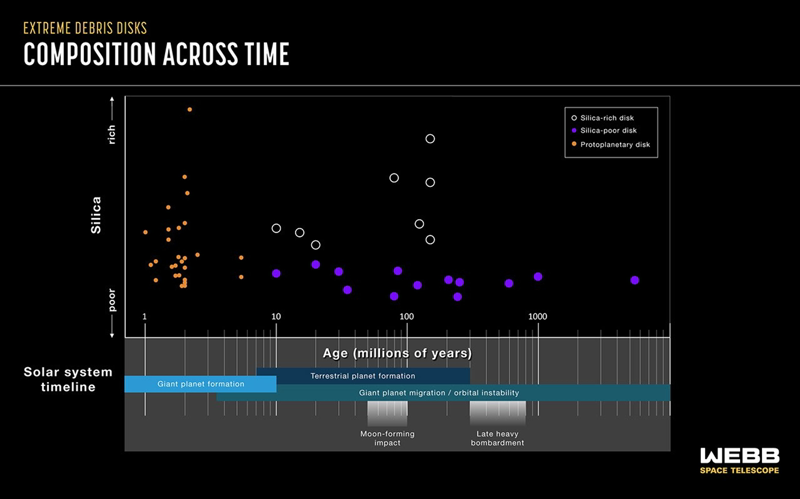
A scatter plot of disk chemistry versus stellar age: silica content from poor to rich on the y-axis and age from 1 to several thousand million years on a logarithmic x-axis, with black open circles marking silica-rich disks, purple filled circles marking silica-poor disks, and orange filled circles marking protoplanetary disks. A solar-system timeline below shows blue bands for giant planet formation, terrestrial planet formation, and giant planet migration, with gray bands marking the Moon-forming impact and the Late Heavy Bombardment. STScI image, derived from Su et al. 2026.


The figure every planetary scientist carries in their head is the Moon-forming impact: a Mars-sized body called Theia slamming into the infant Earth roughly 100 million years after the Sun was born, vaporising rock, blasting a disk of debris into orbit, and leaving behind a moon that still shows the chemical scar of that single catastrophic day. The trouble is that this picture has lived mostly inside models and inside Apollo-era geochemistry, with no direct way to watch an equivalent event happen elsewhere. NASA’s James Webb Space Telescope has now produced the largest mid-infrared sample yet of extreme debris disks, the rare young stellar systems whose warm dust tells astronomers that something inside them has just been smashed to pieces. The team, led by Kate Su at the Space Science Institute in Boulder, Colorado, reports that the sample splits cleanly into two populations whose separation lines up, almost uncannily, with the timing of the impact that built our Moon.

These collisions matter because they are how rocky planets finish being built. A young star starts life wrapped in a gas-rich protoplanetary disk where dust accretes into planetary seeds, then spends the next few hundred million years refining those seeds into fully grown worlds. By the time the gas is gone, what is left is a colder, thinner debris disk populated by asteroid and comet-like bodies. Most of those debris disks are quiet, with low infrared brightness and dust grains sitting at their original sizes, and a planetary scientist would describe such a system as a settled, post-construction environment. A small fraction are not quiet, and these are the extreme debris disks. They have unusually large amounts of warm dust close to the star, in the region where rocky planets orbit our Sun, and the only way to make that much warm dust is to start with recently shattered, vaporised, or melted rock. Estimates from Spitzer and early Webb data put the fraction at roughly one percent of young stars showing observable signs of this phase, a low number than what theorists expect from models of late-stage accretion, and possibly including our own solar system during the brief epoch when Earth was finishing its assembly.

For Su’s team the breakthrough was less about finding the disks and more about characterising them. Webb’s Mid-Infrared Instrument, with its 6.5-metre primary mirror sitting in the cold L2 environment, can read the chemical fingerprints of silicate minerals in the dust at wavelengths no previous instrument had enough sensitivity to pursue. Some of the disks are silica-rich, with spectra full of features from glassy, high-temperature minerals like the volcanic glass obsidian on Earth. Some are silica-poor, dominated instead by forsterite, the same mineral that gives some Hawaiian beaches their green tint. According to Su’s reading of the mineral record, a silica-rich disk is the sign of a high-energy impact between Mars-sized bodies, where collisions vaporise enough rock to leave behind freshly quenched silica glass. A silica-poor disk comes from gentler, lower-energy collisions between Moon-sized bodies, where the debris is just shattered rock rather than vapor. The geometry of the collision, not just its existence, shows up in the infrared spectrum.

The ages of the disks fall in line with their chemistry. Of the 21 disks the team compiled (five drawn from retired Spitzer archives and 16 from new Webb observations), about one third are silica-rich, and they appear only around stars younger than 300 million years. The remaining two thirds are silica-poor, persist across a much wider age range, and show larger swings in infrared brightness. The age boundary is doing real work. Silica-rich impacts, the team argues, are a young-system phenomenon, products of the chaotic last stage of terrestrial planet assembly. Once a system has settled into a stable architecture, the big bodies stop crashing into each other and only the smaller, lower-energy rubble collisions continue. This is what makes the boundary line up with the Moon-forming epoch. Geochemists place the giant impact at roughly 100 million years after the Sun formed, deep inside the silica-rich range. If the Sun went through its own extreme debris disk phase, the chemistry of its dust would have to be silica-rich.

The solar-system timeline beyond the Moon-forming impact also has a place in the picture. Su’s team points to the Late Heavy Bombardment as a possible silica-poor phase for the Sun, a window roughly 600 to 800 million years after formation when the giant planets migrated far enough to destabilise smaller orbits and trigger fresh cratering across the inner system. The age fits the silica-poor range, where the disks are still appearing a billion years into stellar life, and the mechanism fits the irregular brightness swings the team measures, since orbital instability produces bursts of dust rather than steady amounts. Both the Moon-forming phase and the Late Heavy Bombardment phase are inferred events that happened here, and both have plausible counterparts in the catalogue Su has now built. The chart accompanying the paper makes the alignment visible: protoplanetary disks fill the first ten million years, silica-rich disks take over between roughly ten and one hundred million years, and silica-poor disks continue to show up across the full timeline to several billion years.

There is an honest gap in the picture. Of the 21 disks, only three sit in the silica-poor, old-system range that the team needs to confirm the Late Heavy Bombardment analogy. As coauthor Attila Moor of Konkoly Observatory put it, three disks are not enough to test the hypothesis, and Webb time over the next several cycles will determine whether older silica-poor systems are simply rare or whether the picture needs to be redrawn. The current catalogue is enough to show that Mars-sized collisions leave a recognisable chemical fingerprint in the dust, that the fingerprint disappears after a few hundred million years, and that the disappearance happens for a reason that the Solar System’s own record independently supports.

For planetary science the lesson is operational rather than philosophical. When Su’s team says they have used Webb to bring together the big picture of how rocky planets formed and how giant planets evolved, what they mean is that infrared spectra can now resolve the difference between two collision regimes that previously looked the same in dust-mass measurements. That kind of resolution opens a path to testing formation theories on a per-system basis rather than inferring them only from our own neighbourhood. Earth is no longer the only place we can read the chemistry of giant impacts. There are now twenty-one other laboratories in the catalogue, with more on the way, and the odds that one of them catches a collision in progress just got measurably better.


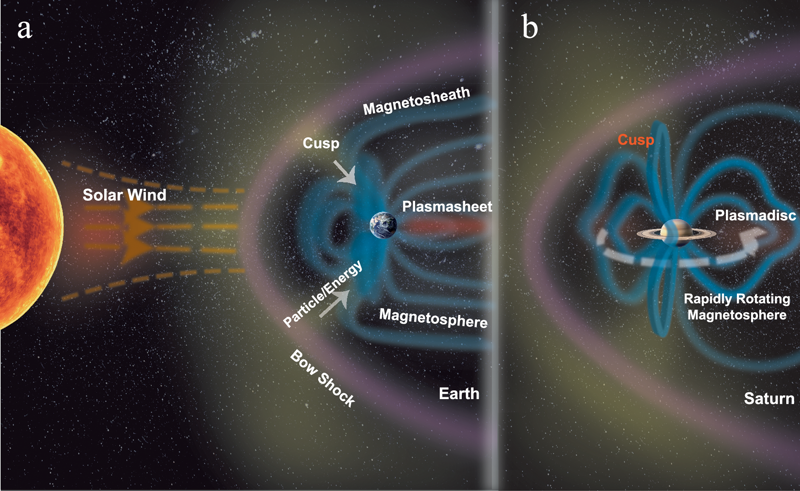
Schematic of Earth's (left) and Saturn's (right) magnetospheres, with the solar wind, bow shock, magnetosheath, plasmasheet or plasmadisc, and the magnetic cusps labelled. Saturn's field is more than ten times wider than the planet and rotates rapidly, dragging its cusp into the afternoon. Image credit: Xu et al., doi: 10.1038/s41467-026-69666-9, licensed under CC BY-NC-ND 4.0.


Earth’s magnetosphere is, by planetary standards, a tidy thing. The solar wind blows outward from the Sun, the planet’s magnetic field pushes back, and the funnel-shaped openings near the north and south poles, called cusps, sit almost directly under the Sun at local noon. That is the place where the incoming stream of charged particles most cleanly slips through the magnetic shield and into the atmosphere. Saturn does nothing of the kind. A team led by Dr. Yan Xu of the Southern University of Science and Technology has now mapped the kronian cusp using six years of archival Cassini magnetometer and plasma data, and found that the opening is dragged well into the afternoon. On average it sits between 13:00 and 15:00 local Saturn time, and in some events it extends toward 20:00, three to eight hours from where Earth’s equivalent sits. The culprit, the team argues, is not the solar wind at all. It is Saturn’s 10.7-hour rotation and the heavy load of ionized water vapor that the moon Enceladus pumps into the magnetosphere from its south-polar plumes.

The paper, published on 1 April 2026 in Nature Communications by Xu, Zhonghua Yao, Andrew Coates, Licia Ray, Sarah Badman, Chris Arridge and nine co-authors, is more than a curiosity about a single planet. The result is direct observational evidence for a long-standing theoretical claim: that on rapidly spinning gas giants with active moons, the planet’s own rotation can become the dominant force shaping its magnetosphere, more important than the Sun. If that is true at Saturn, it almost certainly extends to Jupiter, where the same physics plays out at larger scale, and to the growing catalog of exoplanets whose magnetic environments astronomers are now trying to characterize from a distance. “This study provides critical evidence for a long-held theory, that the rapid spin of massive planets like Saturn with active moons replaces the solar wind as the dominant force shaping magnetospheres,” Coates, a professor at University College London’s Mullard Space Science Laboratory, said in the UCL release.

There is a more practical reason the result matters. Saturn’s auroras are unusually bright and unusually variable, and one of the open questions in kronian physics has been why the most energetic emissions appear in the afternoon sector rather than at noon as on Earth (Lancaster University press release, August 10, 2026). A cusp that lives in the afternoon is also where magnetic reconnection, the explosive snapping and reconnecting of magnetic field lines that accelerates particles to keV energies and beyond, is most likely to fire. Knowing where the cusp sits helps the community locate the engine room of Saturn’s auroras, and the figure and full discussion have been widely covered in the planetary-science press (Sci.News writeup).

The analysis uses data from two of Cassini’s instruments, the magnetometer (MAG) and the Cassini Plasma Spectrometer (CAPS), collected between 2004 and 2010. Cassini spent thirteen years orbiting Saturn before its deliberate plunge into the planet’s cloud tops on 15 September 2017, and its archive is still turning up new science more than eight years after end of mission. For this study, the team pulled 67 discrete cusp crossings from the MAG and electron spectrometer data, then used a magnetic-field-line tracing model to localize each event in kronian local time. The result, summarized in the paper’s Figure 4, is a statistical map that looks nothing like Earth’s: instead of a single peak at noon, the kronian cusp occurrence rate is broadly distributed across the afternoon and early evening, with the centroid shifted several hours past local noon.

Two ingredients go into the explanation. The first is rotation. Saturn’s day is about 10.7 hours long, roughly 2.25 times shorter than Earth’s, and the planet’s deep interior is thought to rotate almost as a solid body. That fast spin drags the magnetic field, and everything locked to it, around the planet. The second is internal plasma loading. Enceladus, a small icy moon orbiting deep inside Saturn’s magnetosphere, vents water vapor from fractures near its south pole at a rate that turns out to be significant for the planet’s space environment. Cassini first imaged those plumes in 2005, and the ionized water they produce loads Saturn’s magnetosphere with heavy ions, including O+, OH+ and water-group species. Once ionized, this material is picked up by Saturn’s rotating magnetic field and pulled around the planet, where it contributes pressure that competes with the solar wind.

A 2019 paper in the Journal of Geophysical Research: Space Physics had already shown that Saturn’s equatorial current sheet oscillates with a period tied to the planet’s rotation rate, and that the sheet’s position depends on the balance between the solar wind pushing from outside and the internal plasma pushing from inside. The Xu et al. result extends that picture to the polar cusp, and shows that the imbalance is large enough to move the cusp by hours of local time.

The magnetosphere is the cavity carved out of the solar wind by a planet’s magnetic field. Its outer boundary, called the magnetopause, is the surface where the pressure of the planet’s field balances the pressure of the incoming solar wind. On Earth, the magnetopause is roughly ten Earth radii upstream, and the cusps are narrow funnel-shaped regions near the magnetic poles where field lines converge and dip back into the atmosphere. Charged particles from the solar wind can ride these open field lines directly into the upper atmosphere, which is why the cusps are preferred sites for auroral precipitation and direct solar wind entry into the magnetosphere.

The picture changes when a planet rotates fast and carries a lot of plasma around with it. At Saturn, the magnetosphere is enormous, more than ten times wider than the planet itself, and the heavy load of Enceladus-derived ions gives the internal plasma pressure enough weight to push the magnetopause outward on the night side and compress it on the day side. The fast rotation then drags the whole asymmetric structure around the planet. In the team’s high-resolution simulations, the net result is that the cusps are no longer located near local noon but are pushed several hours toward dusk.

That matters because of magnetic reconnection, the process by which oppositely directed magnetic field lines snap and reconnect across the magnetopause, releasing stored magnetic energy and accelerating particles to high energies. The location of the cusp sets the stage for where reconnection is most likely to occur, and where reconnection occurs is where the most energetic charged particles enter the magnetosphere. A cusp that sits in the afternoon sector therefore predicts afternoon-loaded energetic particles and auroral emissions concentrated on the afternoon and evening side of the polar cap.

The team also addressed a secondary question. Saturn’s magnetic field is famously hard to measure, because the planet’s radio emissions, the usual proxy for rotation rate, are unusually weak compared to Jupiter’s. The kronian rotation period has been a long-running puzzle. The Xu et al. result does not solve it, but it constrains one variable that goes into rotation-period models: the spatial distribution of plasma inside the magnetosphere.

Saturn’s magnetosphere is not a scaled-up Earth. The kronian cusp, the place where the solar wind enters the atmosphere most easily, is shifted into the afternoon because of two things the Earth does not have in any meaningful amount: a 10.7-hour rotation that drags magnetic field lines around the planet, and an active icy moon that loads the magnetosphere with water-group plasma. The Xu et al. 2026 paper compiles 67 such events from Cassini’s first six years at Saturn, and the statistical map of cusp occurrence has its centroid at 13:00 to 15:00 local time, with some events reaching 20:00.

The next test is at Jupiter, where Juno is still returning magnetometer data and where the same physics should produce a similarly skewed cusp distribution at larger scale. Looking further out, the framework should help astronomers reading magnetic signatures of hot Jupiters around other stars, where rapid rotation and intense plasma loading are the rule.


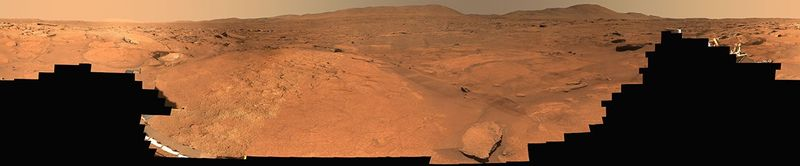
A 360-degree Mastcam-Z panorama of Turquoise Bay in the Margin Unit along the inner edge of Jezero Crater, stitched from 818 natural-color images Perseverance captured between October 5 and 16, 2023, sols 933 through 944 of the mission. The rolling brownish-red Martian terrain stretches to the horizon, with the rover itself visible as a small bright glint near the center of the panorama.


A piece of rock on the inner rim of Jezero Crater was soaked at least three times by very different waters over the course of Martian history, and NASA’s Perseverance rover has now read each of those chemical signatures off the same outcrop. The work, led by Candice Bedford at Purdue University, appears in the journal Communications Earth & Environment and was published online on September 21, 2026 (NASA Mars news, Sep 21 2026; Sci.News coverage). It turns a single strip of terrain along the crater’s former shoreline into one of the more interesting astrobiology sites on the planet, and it quietly resets a long-running debate about how the rocks there formed in the first place.

The location in question is called the Margin Unit, a band of rock that hugs the inner edge of Jezero’s rim where the ancient lake that once filled the crater met dry land. Mission scientists had been puzzling over it since before Perseverance even landed. Orbital instruments had shown strong carbonate signals along that shoreline, and carbonates are the sort of mineral that on Earth usually forms in shallow, life-friendly water, so the natural expectation was that the Margin Unit would turn out to be sedimentary rock, the layered, sandy stuff that is great at trapping microbial remains. Instead, Perseverance’s instruments showed that the band is mostly olivine-rich igneous rock, a coarse-grained material that on Earth typically crystallizes slowly underground from cooling magma. The carbonates are there, but they are not the original rock. They are an overprint, and the new paper unpacks how three separate waters, each with a different temperature and chemistry, left their own overprint on the same parent material over time (Universe Today, Sep 24 2026). That detail matters because the Margin Unit sits inside one of the largest carbonate exposures on Mars, and Jezero itself has been the centerpiece of NASA’s most ambitious astrobiology campaign in decades. If the orbital carbonate signal really does trace a single ancient lake, then the carbonates are essentially a fossil of that lake, and they should record the chemistry of habitable water. If the carbonates instead reflect a much messier history of groundwater, hydrothermal fluids, and lake water acting on the same rock at different times, the carbonates are not a snapshot of habitability, they are a stack of snapshots. Bedford’s team argues it is the latter, and they have the chemistry to show it.

The paper is built on more than 185 rock targets, all measured by SuperCam, the laser-and-spectrometer instrument perched on Perseverance’s mast. SuperCam fires a laser up to 6.5 meters away at a target rock and reads the spectrum of the resulting plasma to determine the rock’s chemistry. Across roughly 265 meters of vertical relief in the Margin Unit, the team at high elevations saw what they expected from a deep, slow-cooled igneous body: coarse olivine crystals with essentially no sign that water had ever reached them. About 265 meters lower, at the elevation where the ancient lake would have lapped against the crater wall, the same parent rock looks transformed. The olivine grains are fractured, and silica has filled the spaces between them. Some of those silica-bearing samples also contain the calcium-sulfate and fluorite veins that mark a third, much hotter stage of alteration (Space.com coverage). The sequence the team proposes runs as follows. Long before any lake existed in Jezero, carbon-dioxide-rich groundwater percolated through cracks in the olivine-rich bedrock. Where that groundwater met the right minerals, it produced carbonate. As the softer host rock around those carbonate-filled fractures eroded away over billions of years, the carbonates were left standing as ridges, which is the texture that first drew orbital attention to the Margin Unit in the first place. Then, in a window that the team cannot date precisely, water that may have been the Jezero paleolake, or a shift in the chemistry of groundwater connected to the lake, washed through the rock again. This second event partly remobilized the early carbonates and dropped silica into the pore spaces, with more silica appearing in rocks that sit below what would have been the old waterline. Finally, a third water event, this one clearly hotter, drove fluids through younger fractures in the eastern Margin Unit and deposited 25-centimeter-thick veins of calcium sulfate and fluorite. Fluorite, in particular, is a fingerprint of hydrothermal activity on Earth, and finding it on Mars is a strong hint that hot water was circulating through volcanic terrain long after the lake was gone.

Bedford has been working with Mars rovers for a decade, and her framing of the result is worth the gravity. “It is very rare that things are as we expect them to be from orbital data,” she said in a NASA press release accompanying the paper, adding that she hopes the work helps reshape how scientists view the history of water in Jezero and across Mars, and ultimately helps reconstruct the changing climate and habitability of early Mars (NASA Mars news). Her co-author Eleni Ravanis, who works on the SuperCam team at the University of Hawaii at Manoa, made a more specific point about what the silica signal is actually telling us: turning olivine into carbonate leaves silica behind, so the more silica you see, the closer the rock sat to the waterline, which makes silica a kind of paleoshoreline marker for a lake that no longer exists. The implication is that the Margin Unit is not just a place where water once flowed, it is a place where water acted multiple times, with each event leaving its own chemical signature stacked on top of the last.

Astrobiologically, that stacking is the most interesting part. On Earth, the reaction between water and olivine can release hydrogen, and there are microbes that can live off that hydrogen. The reaction also leaves behind carbonate and silica, both of which are good at preserving traces of those microbes. So a rock that has been soaked, reheated, and re-soaked in different fluids is not a worse biosignature target than a rock that has only been touched once. It is a record of a longer, more complicated habitability window, and the chemistry preserved inside it is denser. Perseverance has already drilled and cached samples from the Margin Unit, including cores named Pelican Point and Lefroy Bay, and those samples are expected to be among the most prized tubes in the future Mars Sample Return campaign. If any of those cached samples turn out to carry organic material, this paper will be the document that explains why those particular rocks were the right ones to pick up. The image below is a 360-degree Mastcam-Z panorama of Turquoise Bay, a region inside the Margin Unit, captured between October 5 and October 16, 2023, sols 933 through 944 of the mission, and it shows the kind of rolling, weathered terrain that SuperCam has been analyzing ever since (NASA Photojournal PIA26815).