 |
| Credits: JAXA |
If measures are not taken to address the effects of the greenhouse gases produced by our civilization, extreme climate changes will occur: droughts, heat waves, and floods.
Understanding the behavior of greenhouse gases is critical for developing effective measures to fight climate change.
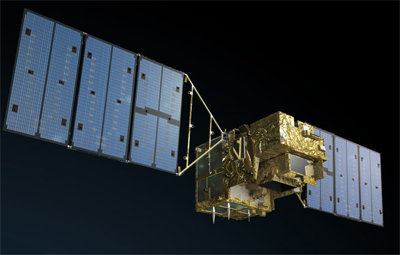
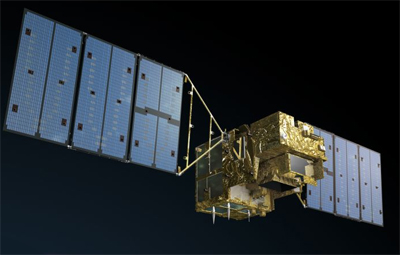
The Greenhouse Gases Observing Satellite (GOSAT) is the first satellite to observe greenhouse gases from space. The main contributors behind GOSAT are the Japan Aerospace Exploration Agency (JAXA), the National Institute for Environmental Studies (NIES), and the Ministry of Environment (MOE). The chosen nickname for GOSAT is IBUKI, which means breath or puff.
The data collected by the GOSAT satellite will help us make better estimates as to how different areas on Earth contribute to global warming through the emission of greenhouse gases. The data will also help us understand the behavior of the greenhouse gases by combining global observation data collected on orbit with data collected on the ground, and it will also help us improve simulation models.
 |
| Credits: JAXA |
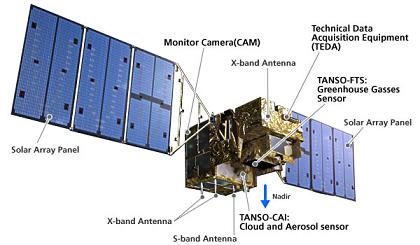
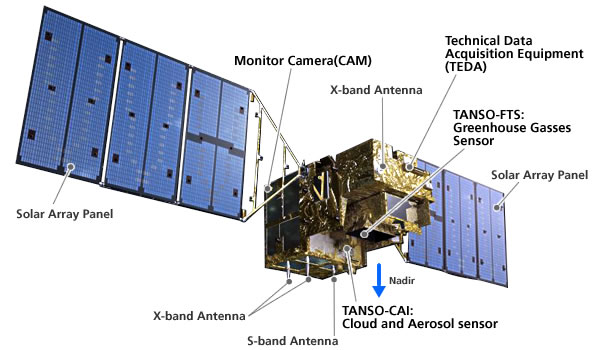
The observation instrument onboard GOSAT is called the Thermal And Near-infrared Sensor for carbon Observation (TANSO).
There are two sensors that collect data for the instrument: a Fourier Transform Spectrometer (FTS) and a Cloud Aerosol Imager (CAI).
The sensors will observe the infrared light from the Earth’s surface and will return measurements that can be used to calculate the abundance of carbon dioxide (CO2) and methane (CH4).
The operational orbit will allow GOSAT to circle the Earth in roughly 100 minutes and to return above the same Earth coordinates every three days. One thing to mention here is that the observations can be done only on cloud-free areas, meaning that on average only ten percent of the total number of measurements can be used for calculating the abundance of CO2 and CH4. However, the number of measurement points surpasses the current number of ground measuring points (under 200) and areas that have never been monitored will be covered by GOSAT observations.
 |
| Credits: JAXA / MHI |
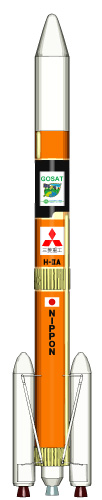
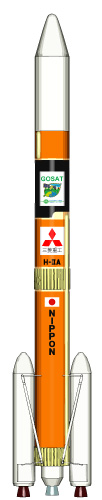
A Mitsubishi H-IIA launch vehicle will inject GOSAT into its predetermined orbit: a sun-synchronous sub-recurrent orbit at a perigee altitude of 667 km, apogee altitude of 683 km, and an inclination of 98 degrees. It will be the fifteenth flight of an H-IIA. The model used for this launch, H2A202, has two solid rocket boosters.
Besides GOSAT, which is the main payload, the payload includes several piggyback payloads. In the case of an excessive launch capability, it is common practice to include in the payload small satellites that are made by private companies or universities.
Seven micro-satellites, six selected through public tender and one JAXA satellite, will be launched by the H-IIA launch vehicle with Ibuki: KAGAYAKI / SORUN CORPORATION (debris detection and Aurora electric current observation mission), STARS / Kagawa University (tether space robot demonstration), KKS-1 / Tokyo Metropolitan College of Industrial Technology (demonstration of the micro cluster and three axis attitude control functions), PRISM / The University of Tokyo (earth image acquisition by using an expandable refracting telescope), SOHLA-1 / ASTRO TECHNOLOGY SOHLA (measurements of thunder and lightning), SPRITE-SAT / Tohoku University (observations of the sprite phenomenon and gamma radiation of the Earth’s origin), and Small Demonstration Satellite-1 (SDS-1) / JAXA (on-orbit verification of the space wire demonstration).
For more details on the additional payload for the GOSAT/Ibuki mission, you can check out the piggyback payload web page on the JAXA web site. Some of the links on the page require knowledge of Japanese or hands-on experience with the Google translation tool.
The launch date for GOSAT/Ibuki has been set. The H-IIA Launch Vehicle No.15 will liftoff sometime between 12:54 and 1:16 PM on January 21, 2009.
Check out the GOSAT / IBUKI program page on the JAXA web site for more information.






 Subscribe to blog posts using RSS








