OrbitalHub

Where curiosity reaches escape velocity.

Domain is for sale. $50,000,000.00 USD. Direct any inquiries to contact@orbitalhub.com.

September 29, 2026

First radio detection from an exoplanet

Posted by


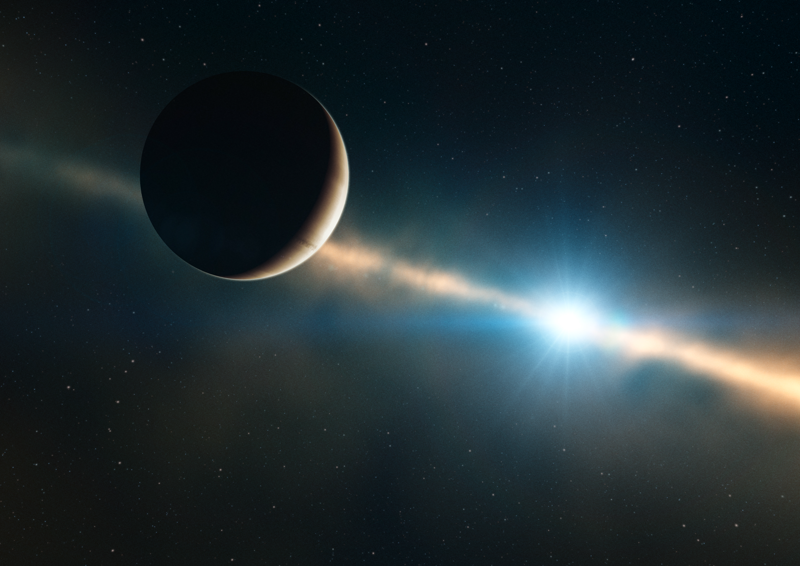
An artist's impression shows the gas giant Beta Pictoris b in the foreground as a thin crescent against a bright star, with the edge-on debris disk of the Beta Pictoris system stretching diagonally across the frame. ESO credit.


On 15 September 2026, a graduate student at the Harvard and Smithsonian Center for Astrophysics posted a 32-page preprint to arXiv announcing the first radio detection from a planet outside our solar system. The team, led by Kevin Ortiz Ceballos with co-author Edo Berger at Harvard and Yvette Cendes at the University of Oregon, had used the MeerKAT radio array in South Africa to pick up rapid, repeating, and strongly circularly polarized bursts coming from Beta Pictoris b, a 12-Jupiter-mass gas giant orbiting its host star at roughly ten astronomical units (Ortiz Ceballos et al. 2026, arXiv:2609.16720). The signal, picked up at frequencies between 0.85 and 3.5 gigahertz, was coherent, variable on timescales of seconds, and beamed. The most plausible source was auroral electron-cyclotron-maser emission generated in the planet’s own magnetosphere. From the highest observed frequency, the team inferred a magnetic field of at least 1.25 kilogauss at the emission site, the first direct magnetic-field measurement ever made on an exoplanet.

This matters for a reason that has nothing to do with technosignatures or aliens, even though those were the first things many readers searched for in the headlines. A planet’s magnetic field controls how its atmosphere weathers the wind of charged particles blowing off its host star. Earth has held onto its atmosphere for billions of years in part because its 0.5-gauss dipole field deflects the solar wind. Mars, with no global field to speak of, lost most of its. Measuring magnetic fields on exoplanets is therefore a prerequisite to asking whether any of them could be habitable, and until last week, every attempt to do so directly had failed.

The reason the failure rate was so high starts with the difference between magnetic activity on a star and magnetic activity on a planet. Both produce radio emission, and stars, especially young and magnetically active ones, are much louder than the planets that orbit them. Pinning a radio signal to a planet rather than its star requires angular resolution finer than the orbital separation, and Beta Pictoris b is the best natural laboratory available. Its host, Beta Pictoris, is an A6V star about 19.6 parsecs away in the constellation Pictor, magnetically quiet, with an upper limit of roughly 0.3 kilogauss on its dipole field. The planet itself sits about ten astronomical units out and reaches a peak angular separation near 0.55 arcseconds over its 24-year orbit, wide enough for a long-baseline radio interferometer to disentangle. The MeerKAT array in the Karoo desert is a 64-dish precursor to the Square Kilometre Array, and its sensitivity at decimetre wavelengths is the highest of any currently operating radio telescope in the southern hemisphere. The team observed Beta Pictoris four times between February 2025 and May 2026, twice in the L band between 0.856 and 1.712 gigahertz and twice in the S band between 1.75 and 3.5 gigahertz. The first epoch was a wide survey for quiescent radio emission from brown-dwarf and exoplanet analogues. It found a source. A nine-hour follow-up confirmed it, and subsequent S-band campaigns with the array split into two sub-bands pinned the emission to the planet’s coordinates relative to background quasars (Astrobiology.com summary, Sept 24 2026).

Two properties of the signal cinched the identification. First, it was highly circularly polarized, with the strongest S-band burst roughly 70 percent polarized in one handedness and the L-band bursts showing variable handedness between epochs. Coherent radio emission with that level of polarization and rapid time variability is the signature of the electron-cyclotron maser instability, a process in which electrons spiralling in a magnetic field release their kinetic energy as electromagnetic waves at the local cyclotron frequency. Incoherent gyrosynchrotron emission, the alternative mechanism, produces only modest circular polarization and cannot generate brightness temperatures above about 10^8 kelvin. The team’s brightest L-band burst of 307 microjanskys at 1.28 gigahertz, if it came from a region the size of the planet, would correspond to a brightness temperature above 6 times 10^10 kelvin. Second, the upper edge of the emission frequency mapped directly to the magnetic field strength at the source. For fundamental electron-cyclotron-maser emission, the cyclotron frequency is about 2.8 gigahertz per kilogauss, and the team observed emission extending all the way to 3.5 gigahertz, the top of their S-band coverage, which requires a field of at least 1.25 kilogauss at the emission site (Live Science, Sept 23 2026). That is roughly 290 times stronger than Jupiter’s surface field of 4.3 gauss and about 2500 times stronger than Earth’s, and it is consistent with the predictions of energy-flux dynamo scaling for a young, hot, super-Jupiter. The host star cannot produce it: its measured upper limit is a quarter of a kilogauss, and A stars do not generally host kilogauss surface fields anyway. The mechanism is the same one that powers Jupiter’s aurorae, scaled up. Jupiter’s aurorae, the brightest in the solar system after the Sun’s, are driven partly by the interaction of its magnetic field with the solar wind and partly by the tidal stripping of its volcanic moon Io, which loads the magnetosphere with plasma. Beta Pictoris b has no Io and probably no moon, but it orbits a young A star that is itself a few hundred times more luminous than the Sun and emits a correspondingly stronger wind. Charged particles streaming from the star are funneled along the planet’s magnetic field lines into the polar regions of its upper atmosphere, where they radiate. The result is the same pattern seen in brown-dwarf ultracool dwarfs that host similar kilogauss fields: coherent radio bursts at the rotation period, with circular polarization that flips sign depending on the orientation of the magnetic axis. The team also notes that previous weak X-ray emission attributed to the star may in fact originate from the planet, which would put Beta Pictoris b on the same radio-to-X-ray correlation as ultracool dwarfs and brown dwarfs, a unified scaling law that has held up across more than two orders of magnitude in magnetic field strength.

The implications extend beyond Beta Pictoris. Suzanne Aigrain of Oxford, who was not involved in the study, told Live Science that the detection “hopefully paves the way for many more,” and that future instruments will be able to make similar measurements for smaller planets (Live Science, Sept 23 2026). The Square Kilometre Array, currently under construction in South Africa and Australia, will be roughly an order of magnitude more sensitive than MeerKAT, and its low-frequency coverage will reach further into the parameter space where cooler, lower-mass planets generate their radio emission. By the end of the decade, magnetic-field measurements on Neptune-mass planets around nearby M dwarfs may be routine, and the question of which of those planets can hold onto an atmosphere will be answerable from observation rather than from theory. The preprint is not yet peer-reviewed, and the authors are careful to point out that no radio detection has previously been unambiguously localized to an extrasolar planet rather than its host star, with the previous tentative cases including the 2023 YZ Ceti bursts unable to fully exclude a stellar origin. The Beta Pictoris result rules that out by combining milliarcsecond astrometric localization with the polarization and timing structure, and Wired’s coverage flags the same caveat (Wired, Sept 24 2026). For now, the preprint remains the first clean detection, and a proof of concept for a method that will dominate exoplanet characterization once the SKA comes online. The image below shows the system as ESO imagined it before this result, with the planet a dark crescent in front of the bright star and the debris disk crossing edge-on. What the picture cannot show is what the MeerKAT data now adds: a kilogauss magnetic field wrapped around that crescent, the first one ever measured on a world beyond our Sun.
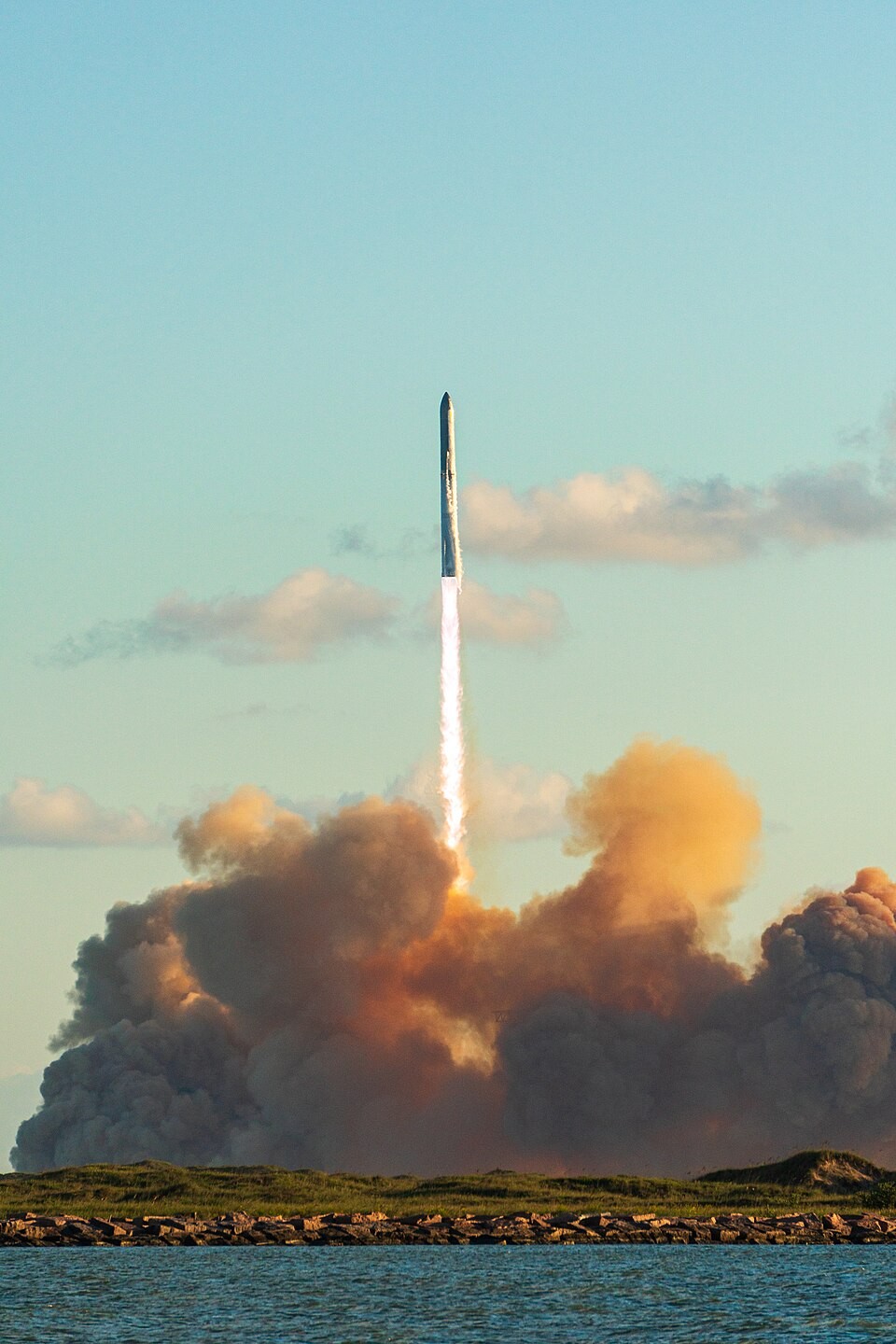


A SpaceX Starship lifts off from Starbase, Texas on a previous test flight; today's Flight 14 followed the same launch profile.

Image source: Wikimedia Commons. Photograph by Shujianyang, CC BY-SA 4.0.


A SpaceX Starship lifted off from Starbase in Boca Chica, Texas at 7:48 AM local time on Monday, September 28, and reached orbit for the first time on its fourteenth flight test. After a clean stage separation and a controlled splashdown of the Super Heavy booster in the Gulf of Mexico, the Starship upper stage completed its first orbital-insertion burn and deployed 26 Starlink V3 satellites into low-Earth orbit on a mission that SpaceX had earlier characterized as a step from developmental flight testing into operational service.

The launch was the first of the Block-3 vehicle series to fly with operational payload, and the first time a Starship vehicle has carried a Starlink batch into orbit. Three of the 26 satellites carry cameras intended to image the Starship heat shield while the upper stage is in orbit, extending the kind of data that an earlier camera-equipped batch gathered during a 2025 reentry test.

The countdown proceeded through propellant load on the booster and the ship, Raptor chill, and a final GO poll at T-30 seconds. Liftoff was at the opening of the day’s launch window. NPR, reporting live, described the 33 Raptor engines on Super Heavy as igniting together at the start of the climb. Max-Q, the moment of peak aerodynamic stress on the vehicle, cleared without incident. About two and a half minutes after launch, Starship separated from Super Heavy in the hot-staging sequence the company has used on the most recent flights, with the booster immediately turning back toward the Gulf of Mexico and the ship’s Raptor engines continuing the climb toward orbit.

Two anomalies shaped the early portion of the flight. First, SpaceX’s mission management decided during the climb that one of the six Raptor engines on the ship had failed during ascent, and the team weighed, for roughly twenty-two minutes, whether to continue to orbit. By the time Starship’s second-stage burns were scheduled to start, SpaceX confirmed it was safe to do so. Second, when Super Heavy began its boostback burn a few minutes after separation, only 26 of the 28 candidate engines relit — a partial relight rather than the full set SpaceX had planned to use. The landing burn that followed was also a partial relight: 11 of 13 engines fired. The booster nonetheless completed its boostback, descent, and landing burn sequence and executed a controlled soft splashdown in the Gulf of Mexico at roughly T+8 minutes, ten seconds after launch. SpaceX had deliberately planned an offshore splashdown for this flight rather than a return-to-launch-site catch, in part because the booster was being used to test upgraded software and hardware before the company re-attempts a tower catch on a later mission.

The ship’s first milestone after separation was a coast phase through the upper atmosphere. At T+25 minutes and 28 seconds the ship began its orbital-insertion burn; nineteen seconds later the burn ended and Starship was in a sustained orbit for the first time in the program’s history. About nine minutes after the insertion burn, the payload deployment sequence started and the 26 Starlink V3 satellites began releasing from the ship over the following half hour. The three camera-equipped satellites will spend their operational lifetime photographing Starship’s heat shield from a vantage point just behind the vehicle’s planned reentry trajectory, providing imagery that SpaceX says it will use to refine its reusable-heat-shield program.

The mission profile extended further than a suborbital hop. SpaceX had originally planned a roughly ten-hour mission with six orbits at an altitude around 170 miles, but reduced the flight plan during ascent to a shorter three-hour profile. The trade reflected, in the company’s judgment, the right margin for a vehicle running one engine short on its upper stage. After roughly nine hours in orbit, the ship is expected to perform a deorbit burn over the Pacific, descend through the atmosphere, and execute a controlled splashdown in the ocean. NPR noted that no earlier Starship flight had reached orbital velocity, which is roughly 17,500 miles per hour; today’s flight is the first vehicle in the line to do so.

Starship Flight 14 is the second flight of a Block-3 vehicle and the first of the year from Starbase. The booster, Booster 21, completed its full-duration static fire at Massey’s Test Site on August 28 after a qualification campaign that included the post-Flight-13 investigation into the landing-burn dynamics and an extended cryogenic proof sequence in mid-summer. The ship, Ship 41, completed a six-engine static fire on August 21 and a single-engine deorbit-burn simulation test two days earlier. Both vehicles were integrated, stacked, and rolled to OLP-2 ahead of the launch attempt.

The flight is also the first operational mission carrying Starlink satellites to use a Starship vehicle rather than a Falcon 9. SpaceX has been the dominant operator in commercial launch for the past several years using Falcon 9, but the larger V3 Starlink satellites only fit inside Starship’s fairing. NPR reported that SpaceX completed the final Falcon 9 launch of a Starlink batch from Florida last month and intends to move V3-class launches to Starship going forward. The shift matters to SpaceX’s plans for the constellation: in filings to the Federal Election Commission ahead of its IPO in June, the company called Starship’s launch cadence and reusability material to its growth strategy.

The flight is also material to NASA’s Artemis program. SpaceX is under contract to develop a Starship-derived Human Landing System for Artemis III, currently targeted for late next year. The Artemis III profile includes docking Starship with an Orion capsule in lunar orbit and transporting astronauts to the surface. NASA’s Administrator, Jared Isaacman, congratulated the SpaceX team on today’s milestone on social media; in earlier remarks, the agency has framed a successful first operational Starship flight as one of the gating milestones for the lunar landing timeline, alongside the unrelated second crewed Orion flight that lifted off in April.

Three of the satellites that lift with Starship today are designed to spend their working lives photographing the heat shield of the very vehicle that released them. That unusual arrangement — test instrumentation riding inside operational payload — has become a theme of the program. Cameras flew on earlier V2 Starlink satellites in 2024 and 2025 for similar purposes; SpaceX said the data from those missions was the basis for several heat-shield design changes that shipped on Block 3. Today’s cameras will, in turn, feed back into Block-4 hardware.

If the Pacific reentry and splashdown at the end of the mission go as planned, Flight 14 closes out a flight that began developmental flight testing and ended with operational payload deployment. The next ship in line, Ship 42, completed chopstick-catch tests at the tower in mid-September and remains weeks from flight readiness; the next booster, Booster 22, is also still in qualification. SpaceX has not announced a date for Flight 15, but company statements earlier in the year suggested it would follow within roughly two months of today’s flight, with a Falcon-class Starlink batch and a Super Heavy tower catch among the items on the next mission’s checklist.


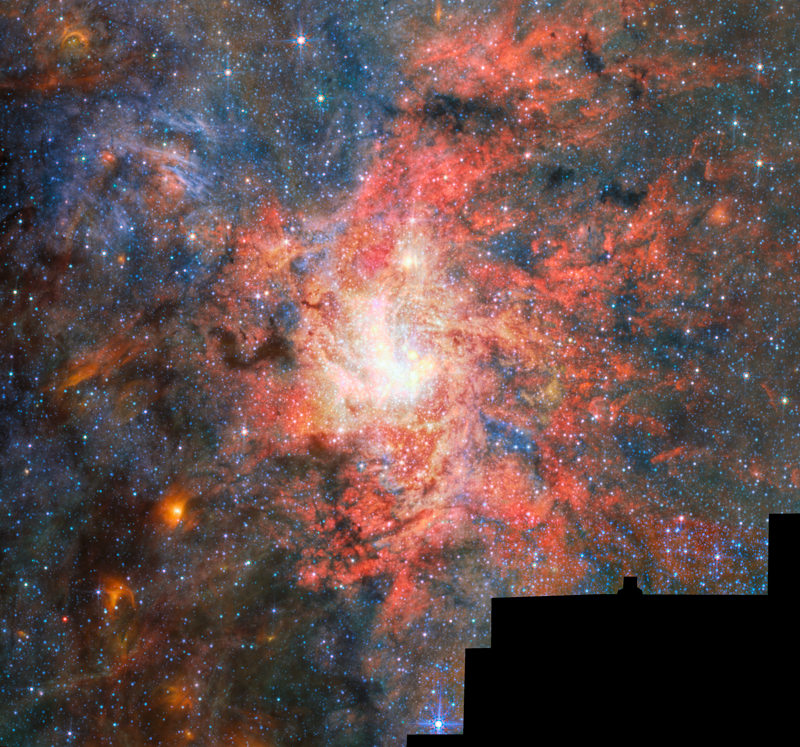
Mid-infrared view of the IRS 3 field taken with Webb's MIRI. The bright central object is IRS 3 itself, with its extended silicate-and-water envelope visible as the diffuse glow around it, set against the dense stellar background of the Milky Way's central parsec.


A star only 0.55 light-years from Sagittarius A* is still making water.

Astronomers working on the Mid-Infrared Characterisation of Nearby Iconic galaxy Centres programme (MICONIC) used Webb’s Mid-Infrared Instrument (MIRI) to take the first continuous mid-infrared spectrum of IRS 3, an oxygen-rich asymptotic giant branch star that sits inside the most punishing radiation environment in the Milky Way. The spectra carry clear silicate dust features and, for the first time in this object, a water signature inside the star’s outflowing envelope. The result, published on 11 August 2026 in Astronomy and Astrophysics, shifts a long-standing assumption about galactic centres: stars there can keep producing the kind of molecular and dusty material that future planetary systems are built from, even when they are essentially inside the black hole’s sphere of influence.

Why this matters comes down to where the chemistry of galaxies gets done. A normal disk galaxy gets most of its interstellar dust and much of its recycled gas from evolved, mass-losing stars like IRS 3. These stars puff off their outer layers as they age, and the ejecta cool into grains that seed the next generation of star and planet formation. Galactic centres are different in kind, not just degree. The supermassive black hole at the centre of every large galaxy pumps out enough ultraviolet and X-ray radiation to break water apart in seconds in unprotected gas, and its gravity roars past anything orbiting closer than a few parsecs. If stars near galactic centres cannot produce dust and molecules, the inner few hundred light-years of a galaxy should be remarkably dust-poor, with a different chemistry than the disk. That in turn changes how astronomers read the spectra of distant galactic cores taken by mid-infrared space observatories, since the same chemistry that runs in our own galactic centre runs in every other large galaxy’s centre. The MICONIC programme was created to test exactly that question, and IRS 3 is its flagship target.

The Webb observation tells the IRS 3 story in detail. Lead author Florian Peissker of the University of Cologne and his team, including Macarena Garcia Marin of ESA (the MICONIC principal investigator), pointed MIRI at IRS 3 during the 2025 Guaranteed Time Observations campaign (programme ID 1266) and collected a continuous spectrum across the mid-infrared. The MIRI medium-resolution spectroscopy mode spans wavelengths where cold dust and molecular gas both radiate, so a single exposure covers the silicate bands, the water rotational-vibrational lines, and the broader dust continuum that anchors the dust mass estimate. Two strong silicate features in the data reclassify the star: earlier studies had flagged it as a candidate carbon-rich AGB star, but the new spectrum is unambiguously oxygen-rich, with the silicon-oxygen grain signature that is the standard fingerprint for a dusty red giant shedding mass in an oxygen-dominated envelope. Layered on top of the silicate features is a water signature inside the envelope, which is the first clear molecular detection for this object and the headline result. The reclassification is important on its own terms: carbon-rich AGB chemistry would have implied a different set of grain types, and confirming that IRS 3 follows the oxygen-rich path is the precondition for the water finding being meaningful.

The numbers behind that headline make it sharper. IRS 3 lies about 0.55 light-years from Sgr A*, roughly 3,300 astronomical units, which puts it well inside the sphere where the black hole’s tidal forces are a factor in the star’s mass-loss budget. The dust envelope itself extends some 10,000 AU from the photosphere, with temperatures falling from roughly 1,200 Kelvin close to the star to around 100 Kelvin in the outer regions; the spectrum is consistent with a shell-like, layered distribution rather than a smooth outflow, which is useful because layered shells are exactly the structures models expect when an AGB star loses mass in pulses. Stellar modelling puts IRS 3 at about six solar masses and roughly 72 million years old, near the end of its AGB phase. Both the geometry of the envelope and the chemistry of its grains point to a star that is still very much in the business of enriching its surroundings, as the ESA/Webb release weic2617 lays out.

The deep dive into why the water survives is where the physics gets interesting. Water in space is fragile because ultraviolet photons break the molecule into hydrogen and oxygen on timescales of days in an unprotected environment, and the same harsh UV field also drives chemistry off the silicate grain surfaces that protect newly formed water in cooler clouds. Around Sgr A*, that radiation field is unusually intense because hot stars in the central parsec and the black hole’s own outflows pile ultraviolet photons on top of one another. The MICONIC result shows two things at once: the silicate dust itself has survived, which it would not have done if the radiation had sputtered the grains apart, and water has formed and persisted inside that dust. The standard interpretation is that the water molecules are locked onto grain surfaces in the cooler outer regions of the envelope, the same way water ice is locked onto silicate grains in dense molecular clouds in the solar neighbourhood. The fact that those ices survive this close to a supermassive black hole is the result that makes the paper more than a detection.

The takeaway for galactic evolution is the part that will move through the field. If IRS 3 is doing this, other AGB stars in the same neighbourhood almost certainly are, and the central parsec of the Milky Way likely contains a steady drizzle of newly formed silicate and icy grain material rather than the chemically barren zone some models had assumed. That material feeds the mini-spiral of gas and dust that orbits Sgr A*, the reservoir that has been indirectly imaged by the Event Horizon Telescope in 2022 and by GRAVITY at the Very Large Telescope in subsequent years. Over millions of years, even a small per-star dust contribution adds up, and the chemistry of the inner galaxy starts to look more like the chemistry of the disk than the chemistry of a void. The MICONIC programme is extending the same MIRI observations to other evolved stars in the inner parsec; the answer to how many more IRS 3s are out there is the next observational push, and the TechTimes coverage traces the working assumption that the survey will turn up several similar cases.

What we have learned is that proximity to a supermassive black hole is not, by itself, a death sentence for water or for silicate dust in evolved-star envelopes, and the next step is observing the same kind of spectroscopy on the next dozen AGB candidates inside the central parsec to see whether IRS 3 is representative or unusually resilient. The next MICONIC data release, plus parallel JWST spectroscopy of the dusty objects orbiting within a few arcseconds of Sgr A*, will pin that down.


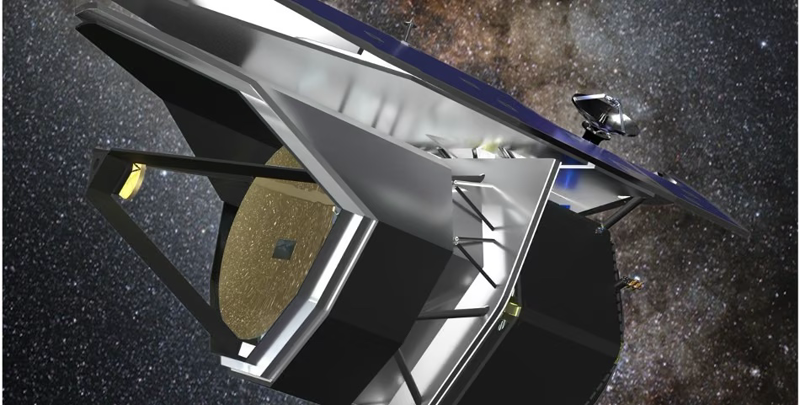
NASA/JPL-Caltech concept rendering of the PRIMA observatory, showing the gold-coated 1.8-meter primary mirror, dark sunshields, and the supporting truss against a starfield.


NASA announced on Wednesday, September 23, 2026 that its next great space observatory will be PRIMA, the PRobe far-Infrared Mission for Astrophysics, and that the $1.2 billion project has been advanced into Phase B development on a path toward a 2033 launch (NASA news release). PRIMA is the first in a new mission line NASA is calling Probe Explorers, a billion-dollar class that sits between the agency’s smaller Explorer-class satellites (such as SPHEREx and NICER) and its flagship observatories like the newly launched Nancy Grace Roman Space Telescope (SpaceNews). The observatory’s job is to do something neither Roman nor the James Webb Space Telescope was designed to do well: stare through the cold, dusty universe at wavelengths from 24 to 235 micrometers, the far-infrared window where most of the radiant energy from planet birth, black hole accretion, and interstellar dust actually emerges (Caltech announcement).

The reason far-infrared astronomy needs its own flagship is straightforward and a little humbling. Roughly half the energy released since the Big Bang has been absorbed by interstellar dust and re-radiated in the far-infrared, a band that is essentially opaque from the ground and that earlier infrared telescopes have only been able to nibble at. ESA’s Herschel Space Observatory, the last major far-infrared mission, ended in 2013. NASA’s Spitzer, the predecessor JPL ran for Caltech, ran from 2003 to 2020. SPHEREx, launched in March 2025, maps the whole sky in near-infrared colors but is not optimized for the deep, narrow surveys a 1.8-meter cryogenic far-infrared telescope can deliver (IPAC project page). JWST, for its part, runs from 0.6 to 28 micrometers and is fundamentally a near-and-mid-infrared observatory, leaving the long-wavelength half of the infrared spectrum to PRIMA (Live Science). The Astro 2020 Decadal Survey, led by Caltech physicist Fiona Harrison, asked NASA to fill that gap, and the question of how Earth’s water arrived is one of the targets the survey explicitly named as ripe for a far-infrared answer (NASA news release).

PRIMA is being designed to be, in Caltech President Ray Jayawardhana’s words, “orders of magnitude more sensitive than previous far-infrared space missions” (Caltech announcement). The trick is the same one Herschel and Spitzer used, but pushed harder: a 1.8-meter primary mirror and a detector array cooled to about 4.5 kelvin, so that thermal noise from the telescope itself stops drowning out the faint signals from distant galaxies and cold dust. At the back of the optics sit two science instruments. FIRESS, the Far-Infrared Enhanced Survey Spectrometer, is a four-band grating spectrometer covering the full 24 to 235 micrometer range, with a Fourier Transform Module that can be inserted to push spectral resolution as high as 20,000 (PRIMA instrument page). PRIMAger, the imager, splits into two sub-instruments: the Hyperspectral Imager (PHI), which scans 24 to 84 micrometers at a spectral resolution of about 8, and the Polarimetric Imager (PPI), which uses four filters from 92 to 235 micrometers to measure the I, Q, and U Stokes parameters of incoming light, the first dedicated far-infrared polarimeter ever flown on a NASA mission. Both instruments read out through superconducting kinetic inductance detectors (KIDs), a technology Jonas Zmuidzinas at Caltech and Rick LeDuc at JPL first sketched out in 1999 over coffee near campus and that has spent the intervening decades maturing in ground-based and balloon-borne instruments (Caltech announcement).

What those instruments let PRIMA actually do falls into three themes the 2020 Decadal Survey highlighted. First, the chemistry of planet formation. Far-infrared spectroscopy captures the cold molecular fingerprints (HD rotational lines, water vapor bands, OH, neutral carbon, nitrogen, oxygen, neon) that trace the disk midplanes where gas giants and ice giants are still accreting, the wavelengths JWST’s mid-infrared instruments struggle to reach from inside dust cocoons (NTRS PRIMA concept paper). Second, the co-evolution of galaxies and their central supermassive black holes. Far-infrared dust continuum tracks the obscured side of accretion that X-ray and optical surveys miss, and the new PRIMA Hyperspectral Imager is built to map dust temperature and star-formation rate across cosmic time in single pointed observations. Third, the build-up of dust and heavy elements from the first galaxies to today, the link between stellar nucleosynthesis and the cold universe that JWST and ALMA have been hinting at but cannot survey with the same speed (NASA news release). Twenty-five percent of the five-year prime mission goes to the PI-led science program; the remaining seventy-five percent is open to the broader community through a General Observer call, modeled on the same time-allocation structure Hubble and JWST use today (IPAC project page). The engineering challenges are also unusual for a Probe-class mission: holding a 1.8-meter telescope and two large instruments near 4.5 K for five years, in a Sun-Earth L2 halo orbit similar to Roman’s and JWST’s, requires a multi-stage mechanical cooler chain with no flight-qualified NASA heritage at that scale. The mission also leans on international partners more heavily than most Probe-class concepts typically do: CNES (France) is co-leading PRIMAger with the Laboratoire d’Astrophysique de Marseille and CEA, SRON (Netherlands) is co-developing both instruments, the Max-Planck Institute in Heidelberg built the beam-steering mirrors, and the Canadian Space Agency, DLR, ASI, KASI and KASA, JAXA, and the UK Space Agency all contributed to the Phase A studies (NASA news release). NASA has not yet chosen a launch vehicle, and the $1.2 billion cost cap explicitly excludes launch and other non-project costs, which is why the total mission price tag will be higher than the headline number.

PRIMA’s two-year Phase B is now the gating step. The team has to lock the optical design, demonstrate the cryocooler chain to NASA review board standards, and pass the confirmation review that lets the project enter Phase C implementation, with the same kind of cost-and-schedule scrutiny that pushed the Roman mission through development (SpaceNews). If everything lines up, a 2033 launch puts PRIMA into operation in the mid-2030s, after Roman’s prime five-year survey ends and as JWST enters its second decade of fuel-limited life. The selection also marks the formal opening of the Probe Explorer line, with the next call for proposals expected within the next two NASA budget cycles (NASA news release). In the words of Astrophysics Division director Shawn Domagal-Goldman, the goal is “a pipeline that will consistently have missions of this caliber ready to go,” one Probe Explorer per decade, each opening a wavelength band the current fleet cannot reach. The choice to start that pipeline with the far-infrared is not accidental. Roughly half the photons the universe has ever produced live in that band, and PRIMA is the first NASA mission in more than a decade built specifically to count them.


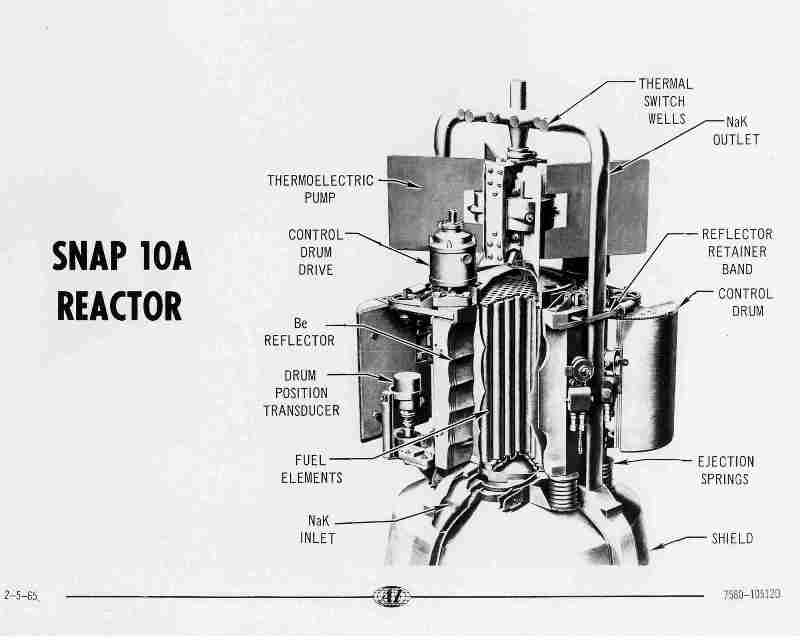
Labeled cutaway diagram of the SNAP-10A reactor, showing the Be reflector, fuel elements, control drum drive, thermoelectric pump, NaK inlet and outlet, and ejection springs, dated 2-5-65


Antares Nuclear, a three-year-old startup in Torrance, California, walked away from a September 14, 2026 award ceremony with what it calls the largest U.S. Department of War contract ever signed specifically for nuclear power in space: $161 million to design, ground-test, and eventually fly a fission reactor on a spacecraft. The Office of the Assistant Secretary of the Air Force for Space Acquisition and Integration structured the Strategic Breakthrough award around two related efforts, a ground demonstration of a reactor called R1-S followed by integration work on an electricity-producing variant called Mark-1 that Antares plans to begin testing in 2027. The company has not yet named a target launch date for R1-S or which mission it would eventually support, but the contract is the clearest signal yet that the U.S. government intends to put a fission reactor in orbit in this decade rather than the next (Defence Blog, September 14, 2026).

The strategic logic is straightforward, and it has very little to do with sending astronauts to Mars. Most satellites today run on solar panels paired with batteries sized for eclipse periods, which sets a hard ceiling on how much power is available onboard and how aggressively a spacecraft can maneuver without draining its reserves. A compact fission reactor gives a satellite continuous high-output power instead of the day-night cycle that solar arrays impose, supporting heavier onboard computers, sustained orbital maneuvers, and payloads such as directed-energy systems or electronic-warfare gear that today’s power budget cannot accommodate at all. Jordan Bramble, Antares’ chief executive and co-founder, framed the award the same way his investors do: “Fission will unlock strategic capabilities that are impossible today.” The Department of War’s appetite for those capabilities is not new, but the budget to actually build toward them has historically been small, scattered across NASA and Defense programs, and constrained by a decades-long absence of any American nuclear reactor actually running in space (Defence Blog, September 14, 2026).

The Antares award is the latest milestone in a sequence that began quietly six years before the contract was signed. On June 4, 2026, the company’s Mark-0 demonstrator reactor completed what is technically known as a zero-power fueled criticality at Idaho National Laboratory’s Reactor and Critical Experiment (RACE) facility, the moment at which a nuclear fission chain reaction becomes self-sustaining. The test, conducted under Department of Energy authorization and with nuclear fuel maker BWX Technologies fabricating the fuel, made Antares the first private company to bring an advanced reactor to criticality under the DOE’s Reactor Pilot Program. It was also the first novel reactor design to achieve criticality at the Idaho site in more than fifty years, according to INL Laboratory Director John Wagner, who emphasized that the Mark-0 test produced essentially no measurable thermal output: proof that the physics worked, not proof that the system could yet generate electricity (Power Magazine, June 2026; U.S. Department of Energy, June 4, 2026).

That single June milestone unlocked everything that followed. Data from the Mark-0 test is being shared with the Department of War’s Project Pele, a long-running program to build a transportable microreactor for forward military bases, and Antares is also a supplier under the U.S. Army’s separate Janus Program, which is installing microreactors at installations including Fort Benning, Georgia. The Space Force award is the third major customer the company has signed, after the Army and the Air Force itself, and Antares says it now holds agreements with NASA and the Defense Innovation Unit as well. Private capital has followed the same trajectory: the company closed a $96 million Series B round in December 2025, raising its total private funding above $600 million by mid-2026 (Defence Blog, September 14, 2026; Power Magazine, June 2026).

The policy backdrop is two documents rather than one. Executive Order 14369, signed in late 2025 and titled “Ensuring American Space Superiority,” directed the federal government to “deploy nuclear reactors on the Moon and in orbit, including a lunar surface reactor ready for launch by 2030” (Executive Order 14369, The American Presidency Project). The implementation memo, National Security and Technology Memorandum-3 (NSTM-3), issued on April 14, 2026, gave NASA and the Department of War thirty days to start parallel reactor competitions: a mid-power fission surface power (FSP) system targeted for the Moon by 2030, and a separate space-based reactor to support nuclear electric propulsion. The Antares award sits inside the second of those two tracks, where the schedule is even tighter: NSTM-3 calls for an American reactor in orbit as early as 2028 (SpaceNews, April 2026).

The hardware Antares is building toward looks much more like a 1965 satellite than a 2026 data center. The R1 microreactor, the commercial product the company’s ground-test reactors are iterating toward, uses tri-structural isotropic (TRISO) fuel, particles of high-assay low-enriched uranium (HALEU) coated in layers of carbon and ceramic, embedded in a prismatic graphite core. Passive sodium heat pipes carry heat from the core to a fin-and-tube primary heat exchanger, and a recuperated nitrogen-closed Brayton cycle converts that heat into electricity at outputs between 100 kilowatts and 1 megawatt depending on configuration. The R1 is rated to operate for six or more years between refueling and is designed to run without a connection to the commercial grid, exactly the operating envelope a spacecraft needs (Power Magazine, June 2026). The conceptual lineage runs straight back to SNAP-10A, the only fission reactor the United States has ever placed in orbit, which launched on April 3, 1965 aboard an Atlas-Agena D from Vandenberg and ran for forty-three days before a non-nuclear voltage regulator failed in its thermoelectric pump. The SNAP-10A core used a similar arrangement of uranium fuel elements, a beryllium reflector, sodium-potassium (NaK) coolant loops, and control drums rotated by an electric drive to manage reactivity (Wikipedia, SNAP-10A).

The diagram above, a 1965 U.S. Department of Energy drawing of the SNAP-10A core, illustrates the conceptual continuity. The beryllium reflector wraps the fuel elements and bounces neutrons back into the chain reaction; the control drums rotate to absorb neutrons and throttle reactor power; the NaK loops carry heat from the core to a thermoelectric pump that converts it directly into electricity without moving parts. Antares has replaced the thermoelectric pump with a closed Brayton cycle and swapped the SNAP-era fuel for HALEU TRISO, but the operating principle, a compact, passively cooled, six-year core with no moving coolant pumps, has not changed (Wikimedia Commons, File:SNAP-10A Reactor.jpg).

What has changed is the supply chain. The 1965 program drew on a single nuclear vendor (Atomics International, a division of North American Aviation) and a single satellite integrator; the 2026 program has at least three parallel microreactor vendors (Antares, plus the BWXT-led Project Pele team and at least one other Army Janus participant), HALEU production being stood up at multiple Department of Energy sites, and TRISO fuel fabrication running commercially at BWX Technologies since October 2025. If Antares meets its schedule, the United States will close a sixty-year gap between SNAP-10A and the next American fission reactor in orbit, and the Mark-1 testing campaign starting in 2027 will tell the industry whether the next one after that flies on a lunar lander or a Space Force satellite.


September 23, 2026

Saturn grew a decagon at its south pole

Posted by


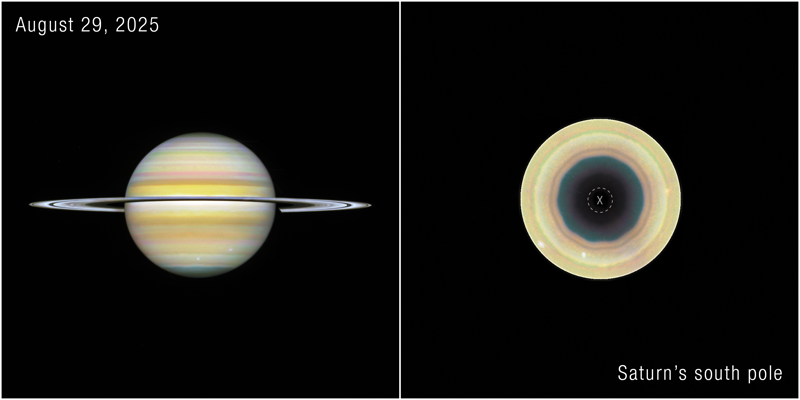
Side-by-side Hubble view of Saturn from August 29, 2025: a full-globe image at left showing the rings and banded atmosphere, and a south-polar projection at right with a dark 10-sided outline marking the decagon wave. Credit: NASA, ESA, STScI image released via NASA Science.


For forty-plus years, the hexagonal jet stream at Saturn’s north pole has been the canonical oddity in the outer solar system: a perfectly geometric, six-sided wave that has outlasted every spacecraft and every telescope pointed at it. As of early September 2026, Saturn has decided to compete with itself. The south pole, which never produced a long-lived polygonal feature in the four decades of Cassini and Voyager imaging, has now grown a 10-sided wave in one of its powerful jet streams. A team led by planetary scientist Agustín Sánchez-Lavega of the University of the Basque Country reports the find in a paper in Science Advances, with co-authors from NASA’s Goddard Space Flight Center and the University of California, Berkeley’s Space Sciences Laboratory (NASA Science). The data come from the Hubble Space Telescope’s Outer Planet Atmospheres Legacy (OPAL) program, and the wave is the first decagonal standing wave ever confirmed at Saturn’s southern hemisphere.

The decagon matters beyond the visual symmetry, because it changes how planetary scientists read Saturn’s atmosphere. Until this observation, the northern hexagon was treated as singular: an exceptional accident in a single jet stream. The southern decagon shows that polygonal standing waves are not unique to one latitude on Saturn. They can form in either hemisphere, in different jet streams, with different numbers of sides. That shifts the framing from “why does Saturn have one hexagon” to “why does Saturn’s jet stream physics tend toward polygonal standing waves when the conditions are right,” a framing that the OPAL team has already begun to push at scientific meetings (UC Berkeley SSL).

The path to the discovery started in 2024. Sánchez-Lavega runs the Planetary Virtual Observatory Laboratory (PVOL) at the University of the Basque Country, a site where amateur observers worldwide submit ground-based images of the planets. In 2024, two contributors, Trevor Barry and Jean-Paul Oger, sent in imagery that contained a subtle undulating band at Saturn’s southern pole. The wave looked similar to a transient perturbation NASA’s Cassini spacecraft had imaged briefly in 2004. Additional ground observations in 2025 strengthened the signal. Sánchez-Lavega then turned to the higher-resolution Hubble archive. He had been searching for a southern counterpart to the northern hexagon in Hubble images since 1990. The OPAL program’s annual Saturn portraits, taken since 2018, provided the resolution and the consistency to settle the question (Sci.News).

When the Hubble images from 2023 onward were projected onto a south-polar view, the decagon was clearly visible at roughly 63°S latitude, embedded inside the eastward-to-westward jet stream that flows along the 60.5°S parallel and winds at high speed around the pole. Cassini’s 13-year survey had found no long-lived polygonal feature there, only a fleeting wave that lasted a few days and was never seen again before Cassini’s deliberate plunge into Saturn’s atmosphere in September 2017. The decagon must have emerged between Cassini’s end and Hubble’s 2023 OPAL frame, a window of roughly five to six years. The Space Telescope Science Institute released the result alongside a press release dated 2 September 2026, and the NASA Astronomy Picture of the Day feature for 8 September 2026 carried the side-by-side globe-and-polar projection to a much wider audience than the team expected.

The structure is genuinely three-dimensional. The decagon shows up in OPAL images taken at multiple wavelengths, and each wavelength probes a different altitude in Saturn’s atmosphere. The visible wave is in the upper troposphere, where the wind speed at that latitude reaches about 400 kilometers per hour. The feature extends vertically through several atmospheric layers, which is what rules out the simpler explanation that this is just a cloud-top illusion: the wave has roots that go deeper than a single altitude. The aerosol that gives the decagon its blue color has not been identified. Its wavelength-dependent visibility is part of what made the feature easy to miss in ground-based data and easy to confirm in Hubble’s sharper, space-based imagery.

The team has a working hypothesis for why the decagon formed when it did. Just to its north, at about 55°S, an anticyclone vortex first appeared in 2023. By 2025 that vortex had darkened sharply, and shortly afterward the decagon emerged. The suspicion, in the words of co-author Michael Wong of UC Berkeley’s Space Sciences Laboratory, is that “perhaps the vortex caused the initial perturbation, and then the balance of forces caused the persistent decagon.” Sánchez-Lavega built a shallow-water equation model to test whether the geometry could arise from the right combination of zonal wind shear and forcing. The model produced a 10-sided wave under conditions consistent with what Saturn shows, which is encouraging but not yet a full explanation. Whether the decagon settles into the decades-long stability of the northern hexagon, or fades back into the background as Cassini’s transient did, is the open question the OPAL team will be tracking with each annual observation.

Saturn’s jet streams are forced by the same basic physics as Earth’s atmospheric circulation, but at a different scale: faster winds, deeper atmospheres, no solid surface to break up the flow. Standing polygonal waves are an unusual solution to that physics. They arise when the vertical shear of the jet stream and the rotation rate of the planet conspire to lock a wave into a stable shape. Saturn’s northern hexagon is the textbook example: a wave that has sat at the same latitude, with the same number of sides, for at least 40 years, surviving seasonal swings of sunlight that should have perturbed it (Wikipedia). The southern decagon gives planetary scientists a second data point under different conditions, which is exactly the kind of comparison needed to test models of why polygons form at all. It also raises a possibility that several groups have begun to explore: that the northern hexagon, the southern decagon, and the polygonal transients Cassini caught in 2004 are all manifestations of the same underlying physics, with the number of sides, the longevity, and the exact latitude set by the local jet stream conditions. Saturn’s atmospheric dynamics, it turns out, may have a stronger tendency toward polygonal standing waves than a single feature ever suggested.

The OPAL program, which began formally in 2018 to fill the post-Cassini observation gap, now has a fresh round of Saturn portraits scheduled through at least the rest of the decade. Whether the decagon survives into Hubble’s eventual successor era, or fades the way the 2004 perturbation did, is something readers will be able to check on a year-by-year basis. The headline result, for now, is the quiet reset: Saturn’s south pole is no longer the unmarked half of the planet. It has its own geometric weather, and the pattern is still changing.