OrbitalHub

Where curiosity reaches escape velocity.

Domain is for sale. $50,000,000.00 USD. Direct any inquiries to contact@orbitalhub.com.

January 24, 2009

Carnival of Space #87

Posted by


Credits: NASA


Carnival of Space #87 is hosted at The Martian Chronicles by Ryan Anderson.


This week, you can read about methane on Mars, NASA’s lunar rover, the ten space trends for 2009, building lunar outposts, space solar power, and much more.


OrbitalHub presents the Soyuz 4 and 5 missions. Soyuz 4 and 5 successfully carried out the first docking and crew transfer between two spacecraft on January 16, 1969.


January 17, 2009

Soyuz 4/5 Made History 40 Years Ago Today

Posted by


Credits: NASA


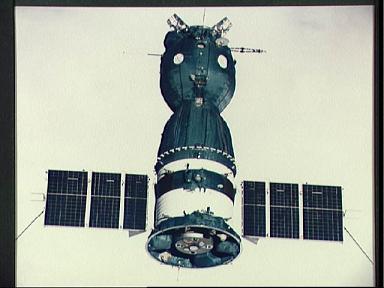
Forty years ago, on January 16, 1969, two Russian spacecraft (Soyuz 4 and Soyuz 5) carried out the first docking between two manned spacecraft and transfer of crew between the craft.


The Soyuz 4/5 mission was a critical milestone for the future of manned space missions, the rendezvous and docking of manned spacecraft being essential for the development of space stations.


Soyuz 4 was launched on January 14, 1969, with cosmonaut Vladimir Shatalov on board. Soyuz 5 was launched one day later. Soyuz 5 had three cosmonauts on board: Boris Volynov, Alexei Yeliseyev, and Yevgeny Khrunov. During the mission, Soyuz 5 acted as the passive ship, while Soyuz 4 was the active chaser craft.


The two spacecraft docked at 0820 UT over the Soviet territory. The docking mechanism did not connect the pressurized modules of the Soyuz spacecraft and two of the cosmonauts on board Soyuz 5, Yevgeny Khrunov and Alexei Yeliseyev, performed EVAs in order to transfer to Soyuz 4.
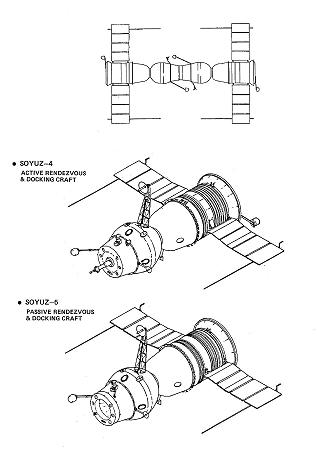
 

Credits: NASA/R.F.Gibbons


Soyuz 4 and 5 undocked after three hours and thirty-five minutes.


Soyuz 4 fired its retro-rockets on January 17 and landed somewhere near Karaganda, in Kazakhstan.


Soyuz 5 had an eventful landing. After the retro-fire, the instrument module failed to separate from the descent module, and the landing could have been catastrophic due to the fact that the heat shield was not oriented properly.


However, the re-entry heat caused the propellant tanks in the instrument module to explode and the two modules eventually separated. The parachute had problems deploying properly and a failure of the soft-landing rockets occurred, so the landing was much harder than usual. Apparently, the landing shock was so great that Boris Volynov was thrown across the cabin and broke some of his front teeth.


Volynov landed far off course, in the Ural Mountains near Orenburg, in Russia. The event was kept secret and it eventually came to light in 1997, when an official history book mentioned the incident.


Forty years later, the Soyuz spacecraft is still the workhorse of the Russian space program, and continues to this day to serve as a transfer vehicle to and from the International Space Station (ISS), performing rendezvous and docking maneuvers on each mission.

 

January 13, 2009

Falcon 9 Standing Tall At The Cape

Posted by


Credits: SpaceX


SpaceX has announced that the Falcon 9 launch vehicle was raised to vertical on its launch pad at Space Launch Complex 40 (SLC-40) in Cape Canaveral, Florida.


SpaceX was awarded a Commercial Resupply Service (CRS) contract in December 2008. The Falcon 9 launch vehicle and the Dragon spacecraft will be used as the primary means of transporting cargo to and from the International Space Station (ISS) after the Space Shuttle is retired by NASA.


The Falcon 9 launch vehicle will provide the lowest cost per kilogram to orbit. The 54.9 m long and 3.6 m wide launcher will be able to lift payloads with a mass of 12,500 kg to a low Earth orbit (LEO) for only $36.75 million. For more details on the pricing of the Falcon 9 missions, you can check out the page dedicated to Falcon 9 on SpaceX’s web site.


“This entire process has helped us validate key interfaces and operations prior to executing our launch campaign with the vehicle in its final flight configuration,” said Elon Musk, CEO and CTO of SpaceX. “We encountered no show-stoppers or significant delays. I am highly confident that we will achieve our goal of being able to go from hangar to liftoff in under 60 minutes, which would be a big leap forward in capability compared with the days to weeks required of other launch vehicles.”


January 13, 2009

Carnival of Space #86

Posted by


Credits: Orbital


Carnival of Space #86 is hosted by collectSPACE.


This week, you can take a tour of the sky, read about rare space artifacts, repulsive quantum forces, and stellar champagne, see images of an atypical galaxy, or take a class about Earth’s orbit around the Sun. The Canadian MOST (Yaay Canada!) is covered this week as well.


OrbitalHub presents Orbital’s Taurus II/Cygnus launch system. Orbital is one of the companies awarded Commercial Resupply Services (CRS) contracts by NASA. Taurus II/Cygnus will service the International Space Station.


Credits: ESA/CNES/ARIANESPACE-Service Optique CSG 2002


Arianespace accounted for 50 percent of all commercial launches to geostationary transfer orbit during 2008 and retained its strong market share, which represented 72 percent of the orders booked in 2008.


Arianespace was founded in 1980. Among its 23 shareholders are the French space agency CNES with thirty-four percent and EADS Astrium with thirty percent. With only around 300 employees, the company has generated sales of about one billion euros in 2008.


2009 will be the year of the launcher family for Arianespace, as Arianespace Chairman and CEO Jean-Yves Le Gall pointed out during the company’s New Year’s press conference in Paris. The development of the Vega launcher is being finalized, the maiden launch of the medium-lift Soyuz launcher from Kourou in French Guiana will take place this year, and more than six missions are scheduled for Ariane 5.


“As a result of our launcher family strategy, Arianespace has a sustained agility that allows us to be ever more responsive to our customers,” Le Gall told the journalists. “The agility has been demonstrated with our 28 consecutive mission successes for Ariane 5 and the 21 for Soyuz – and is underscored by launches that are on target, and on time.”


With a full range of payload lift capabilities, including Vega, Soyuz, and Ariane 5, Arianespace is able to meet the changing trends in satellite weights, orbiting everything from light weight scientific payloads to heavy telecommunication relay platforms.


January 9, 2009

IBUKI Closer To Launch

Posted by


Credits: JAXA


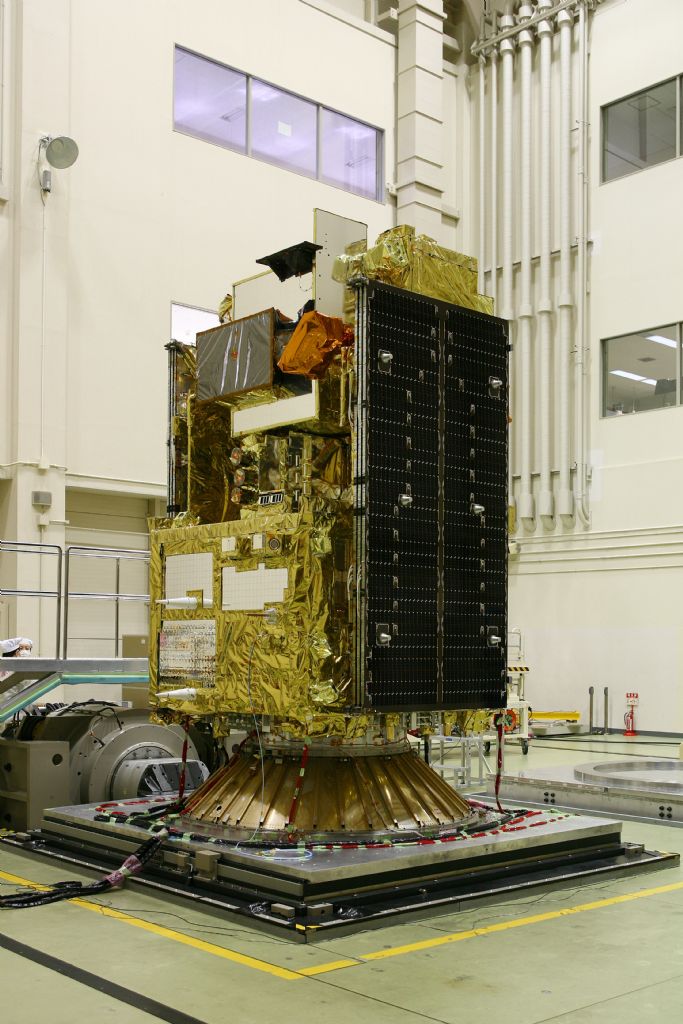
The Greenhouse Gases Observing Satellite or GOSAT for short, is getting closer to the launch scheduled for late January 2009. The chosen nickname for GOSAT is IBUKI, which means breath or puff.


IBUKI was encapsulated in the payload fairing after being mounted on the Payload Attach Fitting (PAF). The PAF is the base that connects the satellite and the launch vehicle. All of the integration operations are performed at the Spacecraft and Fairing Assembly building (SFA) at the Tanegashima Space Center (TNSC).


The final integration with the launch vehicle will be carried out at the Vehicle Assembly Building (VAB).


GOSAT is the first satellite to observe greenhouse gases from space. The main contributors behind GOSAT are the Japan Aerospace Exploration Agency (JAXA), the National Institute for Environmental Studies (NIES), and the Ministry of Environment (MOE).


The data collected by the GOSAT satellite will help us make better estimates as to how different areas on Earth contribute to global warming through the emission of greenhouse gases. The data will also help us understand the behavior of the greenhouse gases by combining global observation data collected on orbit with data collected on the ground, and it will also help us improve simulation models.