OrbitalHub

Where curiosity reaches escape velocity.

Domain is for sale. $50,000,000.00 USD. Direct any inquiries to contact@orbitalhub.com.

May 17, 2009

Skylab 1

Posted by


Skylab was launched on May 14, 1973, by a two-stage version of the Saturn V launch vehicle. This unmanned launch was designated as Skylab 1. During the launch, Skylab lost its micrometeorid shield/sun shade and one of the main solar panels. Skylab underwent repairs during a spacewalk by the first crew, which launched on May 25, 1973.

Find out more about the Skylab missions on the dedicated Skylab page on NASA Kennedy Space Center\’s website.


May 15, 2009

Herschel and Planck Launch

Posted by


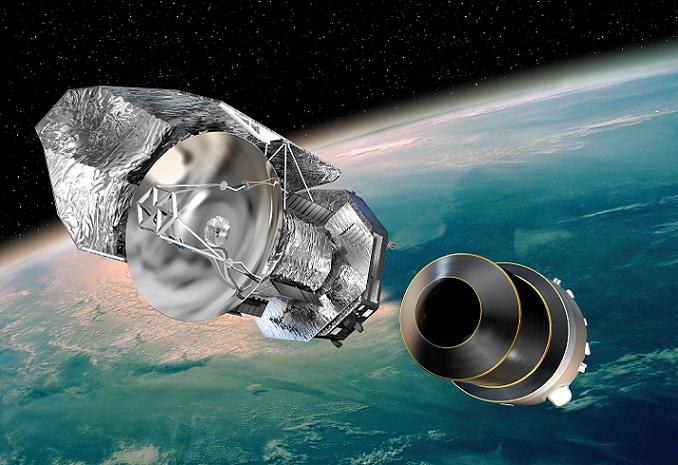
Herschel and Planck lifted of on board an Ariane 5 launch vehicle from Europe\’s Spaceport in Kourou, French Guiana, on May 14, 2009.

The objectives that ESA set for the Herschel Space Observatory are ambitious: the study of the galaxies in the early universe, the investigation of the creation of stars, the observation of the chemical composition of the atmosphere and surfaces of comets, planets and satellites, as well as examining the molecular chemistry of the universe.

ESA plans to answer questions like how did the Universe begin, how did it evolve to its present state, and how will it continue to evolve in the future? with Planck. The Planck Mission will collect CMB radiation measurements using highly sensitive sensors that are operating at very low temperatures. The measurements will be used to map the smallest variations of the CMB detected to date.

Read more about Herschel and Planck…


On May 12, 2009, Progress 33 docked to the International Space Station. Progress 33 arrived at the space station with more than 2,500 kg of supplies.

The Progress is a Russian expendable cargo spacecraft. Progress was derived from the Soyuz spacecraft and it is launched with a Soyuz launch vehicle. The cargo spacecraft is used to carry supplies to the International Space Station, and it is also used to de-orbit waste from the station. Progress is destroyed on re-entry.


May 12, 2009

Carnival of Space #102

Posted by


Credits: NASA


Carnival of Space #102 is presented in five acts at The Spacewriter’s Ramblings.


This week you can read about the Stardust mission, discoveries in the Saturn system, variable stars, ultra-long-period Cepheid variables, interstellar craft carrying frozen embryos, the David Dunlap Observatory, and much more.


May 12, 2009

Herschel And Planck Ready For Launch

Posted by


Credits: ESA – D. Ducros, 2009


While the media has been busy with the launch of the STS-125 Atlantis for the Hubble Servicing Mission #4 from Cape Canaveral, another exciting launch is undergoing preparations further south, in Kourou, French Guiana.


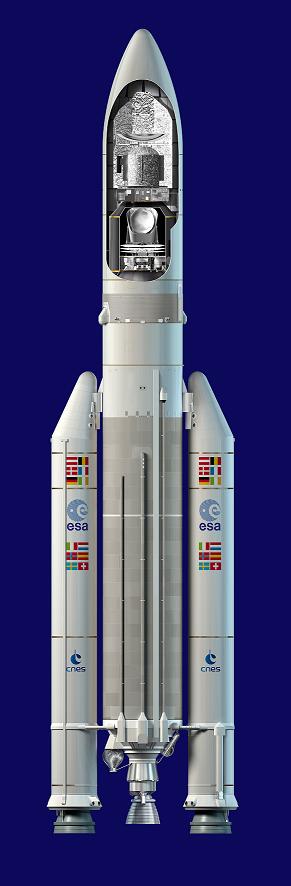
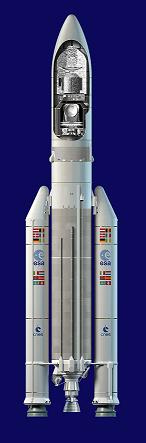
Herschel and Planck are scheduled to launch on May 14, 2009. They will be stacked on the same Ariane 5 launch vehicle.


The two spacecraft will separate shortly after the launch (Herschel a couple of minutes before Planck) and will proceed independently to the L2 point of the Sun-Earth system. L2 is a point in space that has some special characteristics situated at 1.5 million kilometers from Earth in the opposite direction to the Sun. Herschel and Planck will operate from independent orbits around the L2 point.
 

Credits: ESA – D. Ducros, 2009


Stacked together, Herschel and Planck measure around 11 m in length, 4.5 m in diameter, and have a mass of approximately 5,700 kg. The piece that holds them together is called Sylda. Sylda is a support structure for Herschel and forms a protective cover for Planck.


The final orbit for Herschel will be a large, 900×500-thousand km, Lissajous orbit around the L2. There are three trajectory-correction maneuvers (TCM) planned for Herschel, during days L+1, L+2, and L+12. Planck will require a total of 5 TCMs that will enable it to operate from a 300×200-thousand km Lissajous orbit also around the L2 point.


The Lissajou orbits are inherently unstable, so both spacecraft will need regular thruster burns throughout their missions to stay on track.


“Without regular trajectory corrections, they would naturally drift off into a useless orbit about the Sun or Earth, with the rate of drift increasing with time,” says Gottlob Gienger, the senior flight dynamics advisor for the Herschel and Planck missions.


To read more about the launch of Herschel and Planck, you can visit the dedicated page on ESA’s website.



May 12, 2009

STS-125 Space Shuttle Atlantis Launch

Posted by


Space Shuttle Atlantis blasted off at 2:01 PM EDT Monday, May 11, 2009, on the final Hubble Space Telescope servicing mission. The STS-125 crew consists of astronauts Michael J. Massimino, Michael T. Good, both mission specialists; Gregory C. Johnson, pilot; Scott D. Altman, commander; K. Megan McArthur, John M. Grunsfeld and Andrew J. Feustel, all mission specialists.

Read more about STS-125 on the Hubble Servicing Mission 4 page on NASA\’s website.