OrbitalHub

Where curiosity reaches escape velocity.

Domain is for sale. $50,000,000.00 USD. Direct any inquiries to contact@orbitalhub.com.

June 1, 2009

GOCE Free-Falls At Last

Posted by


Credits: ESA


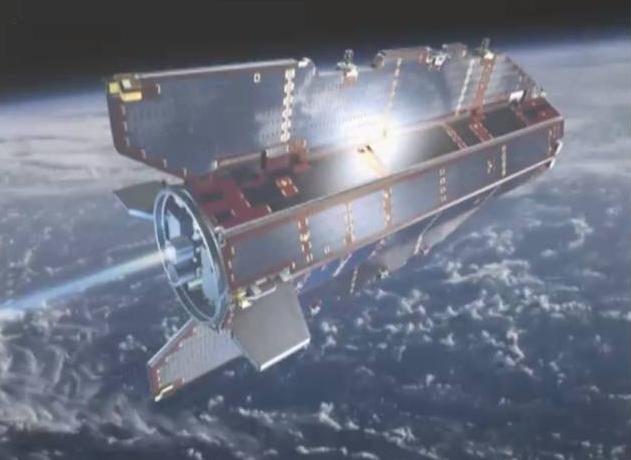
After a successful launch from the Plesetsk Cosmodrome in northern Russia by a Rockot launch vehicle, GOCE has to go through a number of preparation stages before becoming operational and starting to collect three-dimensional gravity data all over the globe.


On April 6, 2009, the GOCE’s propulsion system was switched on. The system was confirmed to be operating normally. Two days later, on April 8, 2009, the gradiometer was switched on as well. The instrument started to produce data instantly.


“With the ion engine and the gradiometer working, we have started to tune the satellite and its instruments,” GOCE System Manager Michael Fehringer said.


The payload, an Electrostatic Gravity Gradiometer, consists of six accelerometers mounted in pairs on three perpendicular axes on an ultra-stable carbon-carbon structure. Measurements of the tiny differences in the readings from the accelerometer pairs will render very accurate results for the geoid altitude and the detection of gravity-field anomalies.


Given the unique payload onboard the spacecraft, GOCE has to provide an undisturbed environment for the instruments. Two additional accelerometers mounted on the velocity axes will control the two low-power xenon ion engines in order to compensate for the atmospheric drag. The ion engines each can provide only 1 to 20 milli-Newtons of thrust, which does not sound like very much, but it is enough to overcome the drag experienced by the spacecraft in orbit.


GOCE has been losing altitude at a rate of 150m to 200m a day, until May 26, 2009, when the spacecraft entered the drag-free mode.


Rune Floberghagen, ESA’s GOCE Mission Manager, stated that, “Knowing that the drag-free control system works perfectly means we now have everything in place to carry out the complex process of calibrating the gradiometer instrument. Once calibration has been completed we will be able to see the true excellence of GOCE’s gravity-field measurements.”


The instruments have to undergo a further six weeks of commissioning and calibration. Mission operations are scheduled to start in summer 2009.


You can read more about the GOCE mission on the dedicated page on ESA’s web site.
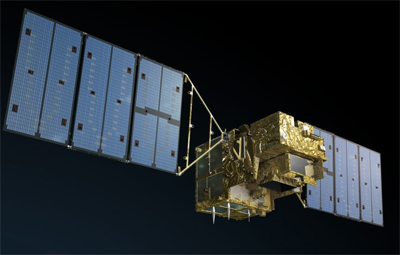


The data gathered so far by GOSAT, which describes the concentrations of carbon dioxide and methane, is preliminary and it needs further calibration and validation. JAXA is currently performing the initial calibration of the sensors mounted on GOSAT, as well as the tuning of the computer systems used to process the data downloaded from the satellite. The validation of the measurements consists of comparisons with ground-based observations.


JAXA plans to release validated carbon dioxide and methane distribution maps in late 2010. You can read more about GOSAT on the GOSAT Project web page.


May 31, 2009

LRO – The Lunar Scout

Posted by


NASA’s return to the Moon requires careful preparation. Finding safe landing sites, locating potential resources, and taking measurements of the radiation environment are some of the tasks the Lunar Reconnaissance Orbiter (LRO) spacecraft will perform while in lunar orbit. LRO is an unmanned mission that will create a comprehensive atlas of the moon’s surface and resources.

Read more about LRO…


May 29, 2009

Soyuz TMA-15 Docked To The ISS

Posted by


Soyuz TMA-15, launched from Baikonur on May 27, 2009, docked to the International Space Station on May 29, 2009. The crew aboard ISS now consists of six astronauts.


May 27, 2009

Carnival of Space #104

Posted by


Credits: NASA


Carnival of Space #104, the Arrow edition, is hosted by Mang (433rd) at Mang’s Bat Page.


This week you can read the story of Canada’s CF-105 Avro Arrow. You can also read about a full-scale Moonbase mock up, the Comet C/2008 Q3 Garrad, the Hubble repair missions, Centauri planets, Herschel and Planck, and much more.


May 27, 2009

STS-125 Recap

Posted by


Credits: NASA


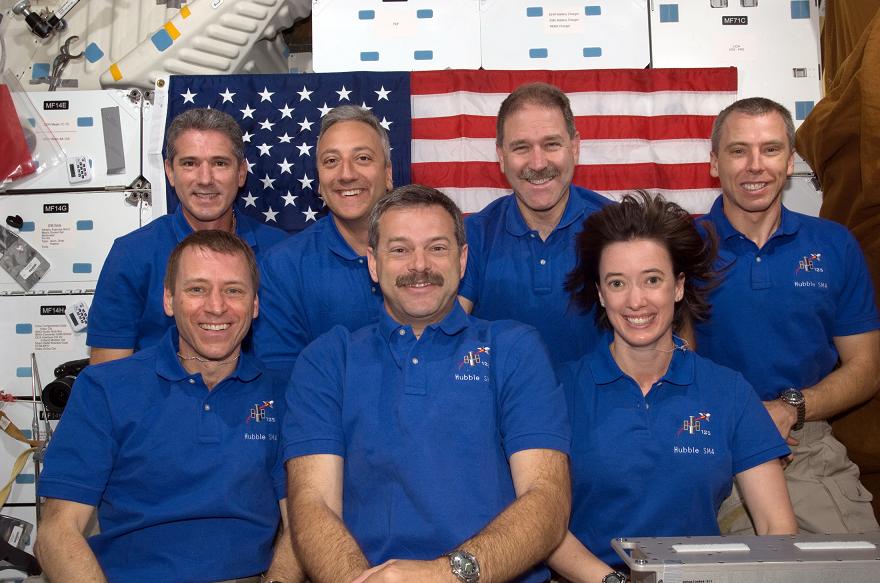
STS-125 Space Shuttle Atlantis was the final Hubble Space Telescope servicing mission (SM4). The STS-125 crew consisted of Gregory C. Johnson, pilot; Scott D. Altman, commander; Michael J. Massimino, Michael T. Good, K. Megan McArthur, John M. Grunsfeld, and Andrew J. Feustel, all mission specialists.


STS-125 has some history behind it. In 2004, NASA head Sean O’Keefe cancelled the long-planned Hubble Space Telescope Servicing Mission 4, invoking new safety rules that were applied to space shuttle flights after the Columbia disaster. By June 2004, NASA was considering a robotic servicing mission, which was also cancelled due to prohibitive costs. A change in NASA policy came with the new head of NASA, Michael Griffin. The risks associated with the SM4 mission were reassessed, and by 2008 SM4 was back on track.


On May 11, 2009, STS-125 Space Shuttle Atlantis launched at 2:01 PM EDT. There were no obvious debris events during launch and after going through the post-launch checklist, the crew prepared the orbiter for in-orbit operations and conducted a survey of the payload bay and the crew cabin using the robotic arm.


On May 13, 2009, at 17:14 UTC, flight day #3, Hubble Space Telescope was grappled and by 18:12 UTC, the telescope was berthed in the payload bay of Atlantis.


There were a total of five EVAs performed by the STS-125 crew. During EVA#1 (John Grunsfeld/ Andrew Feustel), the Wide Field and Planetary Camera 2 (WFPC2) was replaced with the new Wide Field Camera 3 (WFC3), and the Science Instrument Command and Data Handling Unit were replaced. A Soft Capture Mechanism (SCM) was also installed on Hubble. SCM will be used to capture and de-orbit Hubble at the end of its operational life. EVA#2 (Michael Massimino/ Michael Good) replaced all three gyroscope rate sensing units (RSUs) and one of the battery unit modules. EVA#3 (John Grunsfeld/ Andrew Feustel) removed and replaced COSTAR with the Cosmic Origins Spectrograph, and replaced faulty electronics cards from the Advanced Camera for Surveys. EVA#4 (Michael Massimino/ Michael Good) removed and replaced electronics cards for the Space Telescope Imaging Spectrograph (STIS). EVA#5 (John Grunsfeld/ Andrew Feustel) replaced the second battery unit module, installed the Fine Guidance Sensor #3, replaced degraded insulation panels with New Outer Blanket Layer (NOBL)s, and also replaced a protective cover around Hubble’s low-gain antenna.


Hubble was released on May 19, 2009 (flight day #9). The telescope was lifted out of the orbiter’s payload bay using the robotic arm. After running through the release checklist, the STS-125 crew released Hubble at 12:57 UTC. The new equipment and the upgrades installed on Hubble will be tested for several months before resuming operation in early September.


Due to weather, which was less than favorable for landing, STS-125 had to delay the return to Earth for two days. The de-orbit burn was initiated on May 24, 2009, at 14:24 UTC.

STS-125 Space Shuttle Atlantis landed at Edwards Air Force Base in California, on Sunday May 24, 2009, at 11:39 AM EDT.