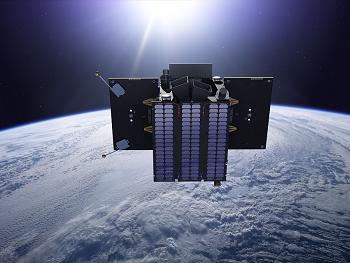
 |
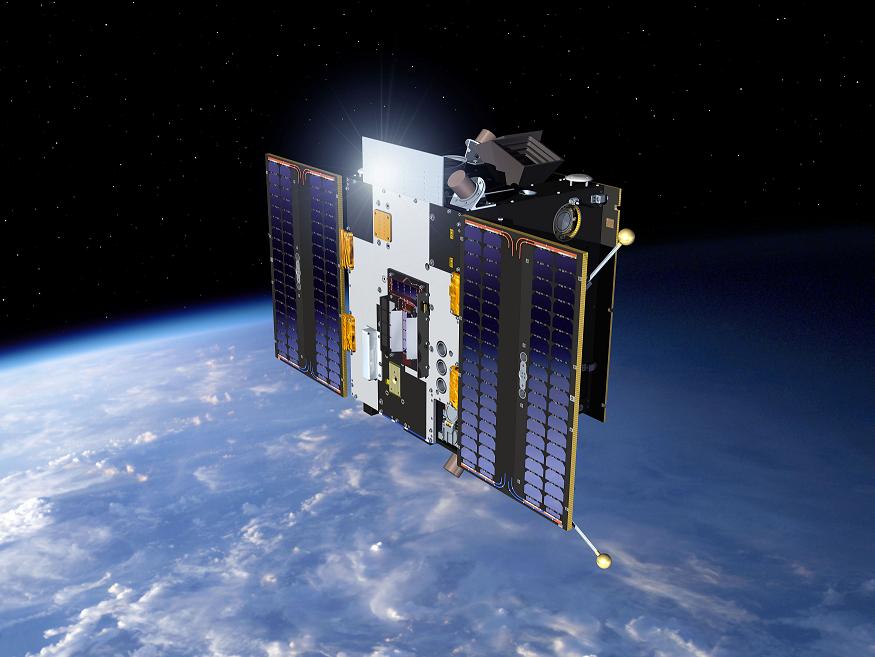
| Credits: ESA – P. Carril, 2009 |
PROBA-2 is part of an ESA program called In-Orbit Technology Demonstration Program, which is dedicated to the demonstration of innovative technologies.
The PROBA-2 payload consists of scientific instruments that will make observations of the Sun in the ultraviolet portion of the spectrum and will measure certain properties of the plasma surrounding the spacecraft.
Among the new equipment and technologies demonstrated by PROBA-2 are new models of star trackers, GPS receivers, and reaction wheels, a new type of lithium-ion battery, an advanced data and power management system, composite carbon-fibre and aluminum structural panels, and magnetometers. PROBA-2 also hosts a digital Sun-sensor, an experimental solar panel, and a xenon gas propulsion system.
PROBA-2 will be launched onboard the same launch vehicle as SMOS. While the SMOS Mission will provide global maps of moisture over the Earth’s landmasses and salinity over the oceans, PROBA-2 is a small technology demonstrator. Launched as a secondary payload, PROBA-2 will orbit in the same plane as SMOS, but at a lower altitude. The planned mission duration is two years.
The spacecraft is a 600 mm x 700 mm x 850 mm box-shaped structure, with a mass of 130 kg. Aluminum honeycomb panels make the primary mechanical structure of the spacecraft. The two deployable solar panels and the one outer solar panel provide a maximum of 110 Watts of electrical power. A lithium-ion battery provides power during eclipse periods. A single 20 mN thruster is used for orbit adjustments.
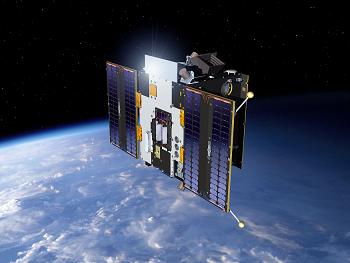 |
| Credits: ESA – P. Carril, 2009 |
PROBA-2 is three-axis stabilized. Attitude changes are performed using four reaction wheels that can be unloaded by magnetorquers, while the attitude determination is provided by star trackers, GPS sensors, and a three-axis magnetometer.
The spacecraft was built by Verhaert Design & Development NV, Belgium.
The scientific payload comprises of four experiments: two for solar observations (LYRA and SWAP) and two for space weather measurements (DSLP and TPMU).
LYRA is a Lyman-Alpha radiometer that will monitor four bands in a very wide ultraviolet spectrum. SWAP (the Sun Watcher using Active Pixel-sensor) will make measurements of the Sun’s corona. DSLP (Dual Segmented Langmuir Probes) will make measurements of the electron density and temperature in the background plasma. TPMU, which is the Thermal Plasma Measurement Unit, will measure ion densities and composition.
Launch services for the PROBA-2 mission are provided by EUROCKOT Launch Services GmbH. PROBA-2 will achieve its lower orbit by an orbit change maneuver of the Breeze-KM upper stage of the Rockot launch vehicle.
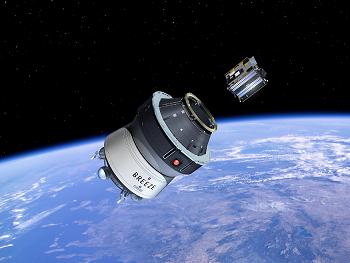 |
| Credits: ESA – P. Carril, 2009 |
Rockot is a three-stage liquid propellant launch vehicle based on the Russian SS-19 Intercontinental Ballistic Missile (ICMB).
Rockot’s first and second stages (provided by SS-19) are completed by a third re-ignitable stage, the Breeze-KM upper stage. Rockot can deliver 1950 kg payloads to Low Earth Orbits (LEOs).
The length of the launch vehicle is 29 m. The external diameter of the stages is 2.5 m, while the payload fairing has an external diameter of 2.6 m and a height of 6.7 m. The mass of the vehicle at launch is 107 metric tons.
PROBA-2 will be carried into orbit from Plesetsk Cosmodrome, Russia. The operational orbit is a 700 km sun-synchronous orbit, with a 98 degree inclination.
You can read more about PROBA-2 on ESA’s dedicated web site. ESA’s web site also provides information about PROBA-1, which is already flying, and future PROBA missions, like PROBA-3 and PROBA-V.





 Subscribe to blog posts using RSS








