OrbitalHub

Where curiosity reaches escape velocity.

Domain is for sale. $50,000,000.00 USD. Direct any inquiries to contact@orbitalhub.com.

October 10, 2009

LCROSS Impact

Posted by


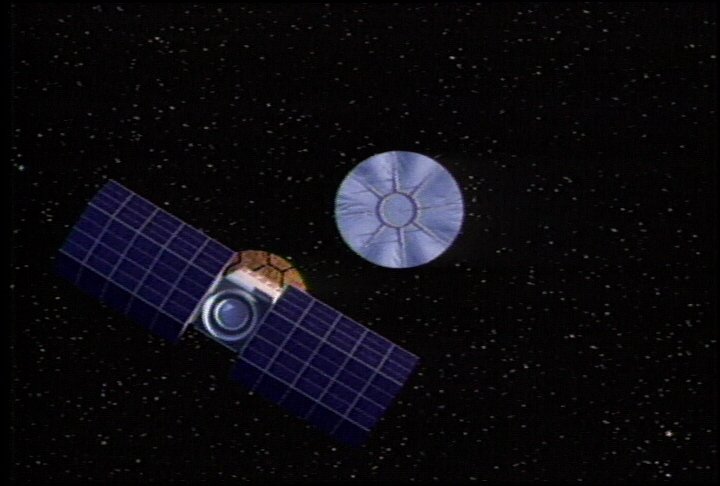
LCROSS crashed into the lunar surface on Friday, October 9, 2009, around 11:31 UTC, shortly after the Centaur upper stage of the Atlas V launch vehicle. The impact occurred in the Cabeus crater, which is situated about 100 km from the south pole of the Moon.

In 1999, the Lunar Prospector detected traces of concentrated hydrogen at the lunar poles. The LCROSS mission\’s main goal is to confirm the presence or absence of water in a permanently shadowed crater near a lunar polar region. The LCROSS mission used the Centaur upper stage as a kinetic impactor in order to excavate a crater on the surface of the Moon.

Read more about LCROSS…


October 2, 2009

Expedition 21 ISS Docking

Posted by


The Soyuz TMA 16 spacecraft, carrying Jeff Williams, Maxim Suraev, and Guy Laliberté, docks with the International Space Station.

Read more about Expedition 21…


September 30, 2009

Carnival of Space #122

Posted by


Credits: NASA/JPL-Caltech


Carnival of Space #122 is hosted at Cumbrian Sky.


This week you can read about possible practical applications for the water found on the Moon, the past ten years of Chandra science, space shuttle artifacts, relativistic effects on solar sails, the famous HR Diagram, the much-anticipated crash of LCROSS into the Moon, and much more.


September 30, 2009

Expedition 21 Launch

Posted by


Soyuz Commander Max Suraev, NASA Flight Engineer Jeff Williams and spaceflight participant Guy Laliberte launched aboard the Soyuz TMA-16 spacecraft from the Baikonur Cosmodrome in Kazakhstan on September 30, 2009 at 7:14 AM GMT. Guy Laliberte is the founder of Cirque du Soleil.

Read more about Expedition 21…


September 28, 2009

Fly Me to the Moon

Posted by


In Fly Me to the Moon : An insider’s guide to the new science of space travel, Ed Belbruno explains in simple terms advanced mathematical techniques using a general subject called dynamical systems theory. He describes how we can use chaos to change the way we maneuver in space.


Ed Belbruno makes the important point that chaos can be used as a way to get a handle on the unpredictability in sensitive motions of a spacecraft.


The unpredictability results from the subtle combination of gravitational pulls and tugs on a spacecraft moving in space. An immediate application is low-energy transfer trajectories to lunar orbits.


Belbruno tells the stories of Hiten, the Japanese lunar mission rescued in 1991; HGS-1, a commercial Earth orbiting satellite that had strayed into an undesired orbit; LGAS, a low-budget NASA mission; and SMART-1, the ESA mission that tested low-energy lunar transfers in 2003.


The low-energy trajectories can be used for purposes other than sending automated cargo spacecrafts to permanent settlements on the Moon. Ballistic captures, as they are also called, could be used for a robotic mission in the Jovian system, to shed light on the apparently unpredictable trajectories of comets and other Kuiper Belt objects, and to explain the origin of our Moon or the Panspermia hypothesis.


While it is written for a non-technical audience, the book is grounded in solid theoretical research, and would be of interest to engineers and space enthusiasts alike.


September 25, 2009

Carnival of Space #121

Posted by


Credits: NASA/MSFC


Carnival of Space #121 is hosted by Brian Wang at Next Big Future.


This week you can read about laser-powered launch technology, the Lunar Lander Challenge and the success of Armadillo Aerospace, first observation results from Lunar Reconnaissance Orbiter, ambitious Japanese space-based solar power plants, a beginner’s guide to ISS, an investigation that could lead to the unification of general relativity theory and quantum mechanics, and much more.