


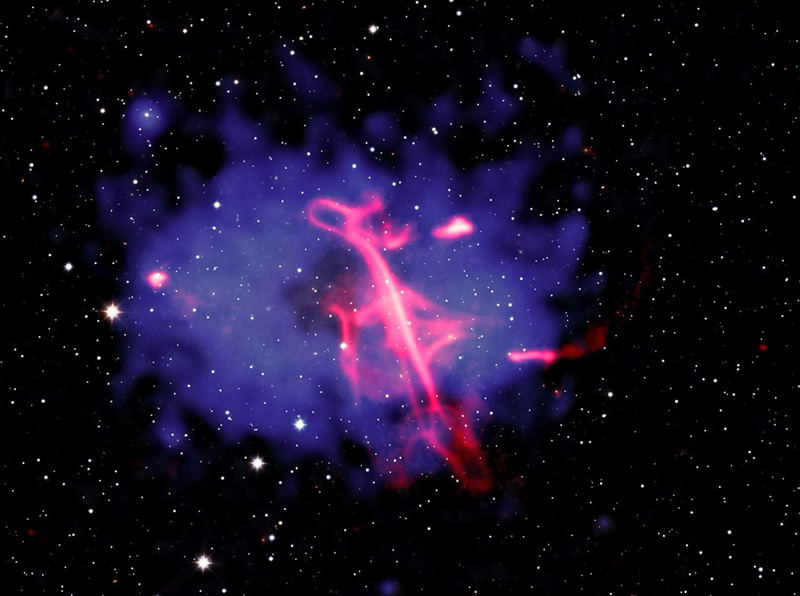
When a radio source was first catalogued three decades ago as VLSS J0318.9+5755, it looked ordinary enough: a faint filament at low galactic latitude, originally mistaken for a pulsar and shelved. Then a team led by Andrea Botteon at Italy’s National Institute for Astrophysics (INAF) took a closer look with the LOFAR Two-metre Sky Survey, and the source turned out to be doing something the radio sky almost never shows. Curling from top to bottom in a single continuous line, it traces out a shape that looks, unmistakably, like a treble clef. In a paper published Wednesday in Astronomy & Astrophysics, the team combined new radio observations with NASA’s Chandra X-ray Observatory and the German-built SRG/eROSITA X-ray telescope to trace the formation to two events that happened hundreds of millions of years apart: an old outburst from a supermassive black hole, then a galaxy cluster collision that re-energised the fossil plasma. The NASA press release that landed on 14 October 2026 calls the shape a case of pareidolia – the human habit of seeing familiar patterns in random data – which is fair, since the resemblance is the most striking thing about it but says nothing about the physics that built it.
The reason the Treble Clef took so long to pin down is geography, not distance. The source sits at galactic latitude b ≈ 0.5°, almost directly behind the plane of the Milky Way. Stars, dust, and gas in our own galaxy block the optical light from anything that lies in that band, and the same obscuration makes it hard to identify the host. Optical surveys simply cannot reach that patch of sky, which is why this strip of celestial real estate has its own name among extragalactic astronomers: the Zone of Avoidance. Surveys that look through other parts of the electromagnetic spectrum have no such problem. X-rays punch through the galactic gas easily, and radio waves ignore it almost entirely, so a combination of LOFAR for the radio skeleton and Chandra and eROSITA for the hot intracluster medium turns out to be exactly the right pair of tools for the Treble Clef. Once that combination was applied, the source fell into place.
What the data shows is a textbook example of a radio phoenix. A radio phoenix is fossil plasma – relativistic electrons and magnetic fields that were puffed out by a previous activity, lost most of their energy through synchrotron and inverse-Compton cooling, and went dark at radio wavelengths. They sit in clusters for tens to hundreds of millions of years as invisible reservoirs of stored energy, and then something comes along to re-energise them. In the Treble Clef, that something is the merger of two galaxy clusters. The collision drove through the intracluster gas and generated shock waves, the same kind of weak shocks that are responsible for sonic booms from supersonic aircraft. When those shock fronts swept over the fossil plasma cloud, they re-accelerated the electrons and the cloud lit back up at radio wavelengths. The Treble Clef is the fossil turned visible again, and the merger shock is the trigger.
The host cluster, named after its coordinates in the VLSS catalogue, sits in the Zone of Avoidance but is otherwise a perfectly ordinary massive merging cluster. The Chandra and eROSITA X-ray observations show a roughly oval cloud of multimillion-degree gas, hundreds of galaxies, and a complex dynamical state. To pull the merger signature out of the X-ray image, the team used a residual technique: they subtracted the symmetric, oval-shaped hot gas that any relaxed cluster would have, and looked at what was left. The leftover emission was brightest at the left and right edges of the cluster and faintest in the middle, exactly what you would expect if the collision had been along the left-right axis. That residual image is what the new Chandra composite is built around. The radio image, taken from LOFAR’s LoTSS and LoLSS surveys plus new uGMRT follow-up, was then laid on top in red. The X-rays go in blue and purple, the infrared background from the United Kingdom Infrared Telescope goes in white, and the result is the magenta-on-blue image released on 14 October.
The shape itself is not a symbol that the universe was trying to draw. The vertical stroke of the clef is a long filament of old radio plasma that points roughly along the merger axis, and the loops at the bottom are short curls drawn into the plasma by gas motions in the merging intracluster medium. As the two clusters passed through each other, their gravitational potentials dragged the intracluster gas into a turbulent, asymmetric state, and the turbulence carved the curled loops out of what would otherwise have been a fairly straight filament. The resemblance to a treble clef is incidental. What is not incidental is that the structure is a remarkably clean laboratory for a specific question in plasma astrophysics: how do fossil relativistic plasmas respond to weak shocks, and what does the answer tell us about the energy budget of merging clusters.
The spectrum of the radio source tells its own story. Between 400 and 650 MHz, the radio spectrum is extremely steep, with a spectral index steeper than α = 4 in places, which means the source is unusually dim at high frequencies and bright at low frequencies. That is exactly the signature of an old, revived plasma cloud rather than a fresh injection from an active galactic nucleus. A new outburst from a supermassive black hole would have a flatter spectrum and would not be confined to a single, coherent filament. The steepness, combined with the morphology, is what convinced the team that this is a phoenix and not something else.
For the broader study of cluster mergers, the Treble Clef is interesting for two reasons. The first is that it sits in the Zone of Avoidance, where systematic surveys of radio halos and phoenixes have been patchy because optical and near-infrared work is hard. Adding a clean, well-characterised example to the catalogue is a reminder that the radio sky keeps surprises waiting behind the Milky Way. The second is that the paper reports a tentative radio halo near the cluster centre, the diffuse radio glow that is the canonical signature of a recent merger, which would make this cluster a textbook laboratory for studying the link between mergers, turbulence, and particle re-acceleration. The Botteon team plans to follow up with high-resolution, very-low-frequency observations using LOFAR 2.0, the upgraded array now being commissioned in Europe, which will resolve the curled loops at sub-arcsecond scales and constrain how the plasma is being re-accelerated.
The short version is that a source first catalogued in the 1990s as a faint low-frequency radio blip, almost written off as a pulsar, turned out to be a clean case study of how a galaxy cluster merger can light up the fossil plasma from an old black hole outburst. Chandra and eROSITA saw the cluster, LOFAR and uGMRT drew the clef, and the team from INAF put the story together. The clef shape is the eye-catcher, but the physics it illustrates is the real story, and the cluster is now on the short list for the next generation of low-frequency radio follow-up.
 Subscribe to our RSS feed









There are no comments.
Add A Comment