OrbitalHub

Where curiosity reaches escape velocity.

Domain is for sale. $50,000,000.00 USD. Direct any inquiries to contact@orbitalhub.com.

Archive for the Space Exploration category

June 25, 2017

20 Years of 24/7 Mars Exploration

Posted by


NASA dixit:

“No one under 20 has experienced a day without NASA at Mars. The Pathfinder mission, carrying the Sojourner rover, landed on Mars on July 4, 1997. In the 20 years since Pathfinder’s touchdown, eight other NASA landers and orbiters have arrived successfully, and not a day has passed without the United States having at least one active robot on Mars or in orbit around Mars.”

Mars Pathfinder

Mars Global Surveyor

2001 Mars Odyssey

Mars Exploration Rover

Mars Reconnaissance Orbiter

Phoenix

Curiosity

MAVEN

Video credit: NASA


June 22, 2017

Catching Helene

Posted by


NASA dixit:

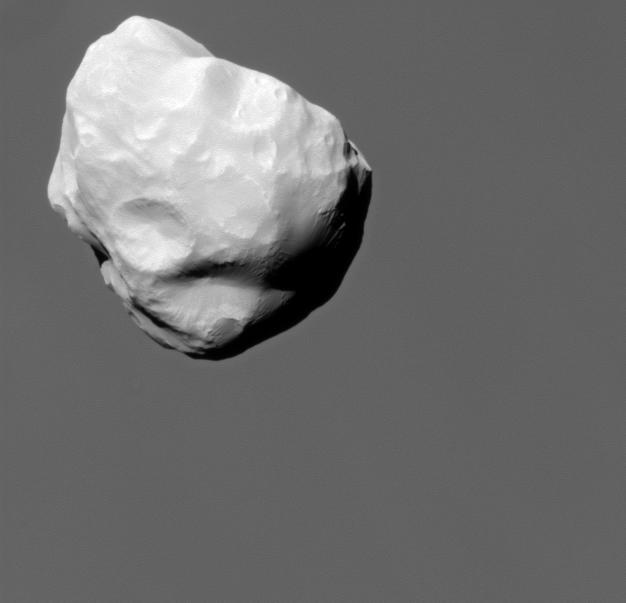
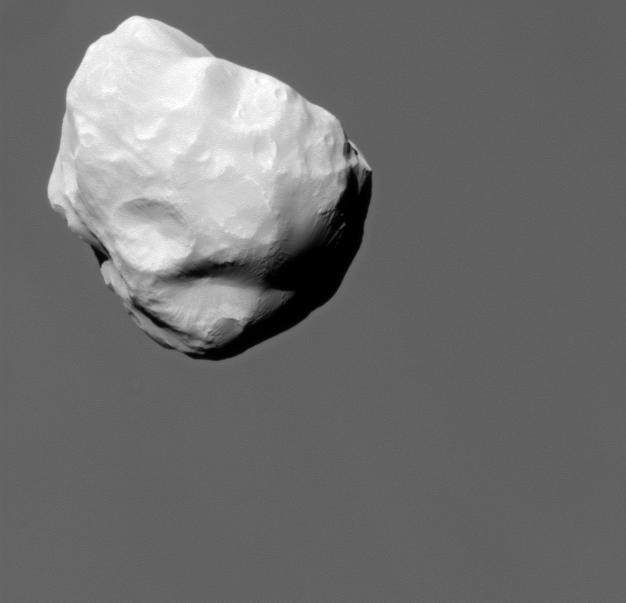
“March 3, 2010. Although traveling at great speed, the Cassini spacecraft managed to capture this close view of Saturn’s small moon Helene during a flyby. Saturn’s atmosphere makes up the background of this composition. This view looks toward the anti-Saturn side of Helene (33 kilometers, or 21 miles across). North on Helene is up and rotated 44 degrees to the right.

The image was taken in visible light with the Cassini spacecraft narrow-angle camera. The view was obtained at a distance of approximately 19,000 kilometers (12,000 miles) from Helene and at a sun-Helene-spacecraft, or phase, angle of 25 degrees. Image scale is 113 meters (371 feet) per pixel.”

“After almost 20 years in space, NASA’s Cassini spacecraft begins the final chapter of its remarkable story of exploration: its Grand Finale. Between April and September 2017, Cassini will undertake a daring set of orbits that is, in many ways, like a whole new mission. Following a final close flyby of Saturn’s moon Titan, Cassini will leap over the planet’s icy rings and begin a series of 22 weekly dives between the planet and the rings.

No other mission has ever explored this unique region. What we learn from these final orbits will help to improve our understanding of how giant planets – and planetary systems everywhere – form and evolve.

On the final orbit, Cassini will plunge into Saturn’s atmosphere, sending back new and unique science to the very end. After losing contact with Earth, the spacecraft will burn up like a meteor, becoming part of the planet itself.

Cassini’s Grand Finale is about so much more than the spacecraft’s final dive into Saturn. That dramatic event is the capstone of six months of daring exploration and scientific discovery. And those six months are the thrilling final chapter in a historic 20-year journey.”

Image credit: NASA

 

June 21, 2017

EO-1

Posted by


Wikipedia dixit:

“Earth Observing-1 (EO-1) is a NASA Earth observation satellite created to develop and validate a number of instrument and spacecraft bus breakthrough technologies. These will enable the development of future Earth imaging observatories that will have a significant increase in performance while also having reduced cost and mass. The spacecraft is part of the New Millennium Program.

Its Advanced Land Imager (ALI) measures nine different wavelengths simultaneously, instead of the seven measured by the imager in Landsat 7. This permits a greater flexibility in false-color imagery. Another improvement is that instead of having an imaging spectrometer that sweeps from side to side, the ALI has a linear array of spectrometers that each scan a strip of ground parallel to that of adjacent spectrometers. In order to compare the two imagers, EO-1 follows Landsat 7 in its orbit by exactly one minute. Other new technologies include: Hyperion imaging spectrometer recording more than 200 wavelengths; phased array communications antenna; optical fiber cables connect the data logger with the two IBM RAD6000s; teflon-fueled pulsed plasma thruster; lightweight, flexible solar panel; carbon-coated radiators for thermal control; Linear Etalon Imaging Spectrometer Array equipped with a new atmospheric correction device.

EO-1 has also been used to test new software, like the Autonomous Sciencecraft Experiment. This allows the spacecraft to decide for itself how best to create a desired image. It is only limited by a priority list of different types of images, and by forecasts of cloud cover provided by the NOAA.

It was expected to function for twelve months and was designed to function for eighteen months. Those expectations were greatly exceeded however the hydrazine fuel was mostly depleted in February 2011. Small maneuvers have been successful for debris avoidance but long duration burns for orbit maintenance are not being performed due to insufficient fuel. EO-1 was deactivated on 30 March 2017. At its current altitude, it is estimated that the satellite will remain in orbit until the 2050s, when it will burn up in Earth’s atmosphere.”

Video credit: NASA Goddard


June 18, 2017

Reiner Gamma

Posted by


Wikipedia dixit:

“Reiner Gamma (γ) is a geographical feature of the Moon known as a lunar swirl. It is one of the most visible lunar swirls from Earth, visible from most telescopes. It was originally thought to be a lunar highland, but scientists eventually realized that it cast no shadow on the moon. Until recently, Reiner Gamma’s origin was a mystery. Historically, it was not associated with any particular irregularities in the surface. Recently, similar features were discovered in Mare Ingenii and Mare Marginis by orbiting spacecraft. The feature on Mare Ingenii is located at the lunar opposite point from the center of Mare Imbrium. Likewise the feature on Mare Marginis is opposite the midpoint of Mare Orientale. Thus scientists believe that the feature resulted from seismic energies generated by the impacts that created these maria. Unfortunately there is no such lunar mare formation on the opposite surface of the Moon (although the large crater Tsiolkovskiy lies within one crater diameter).

Reiner Gamma is located on the Oceanus Procellarum, west of the crater Reiner. Its center is located at selenographic coordinates 7.5°N 59.0°W. It has an overall dimension of about 70 kilometres. The feature has a higher albedo than the relatively dark mare surface, with a diffuse appearance and a distinctive swirling, concentric oval shape. Related albedo features continue across the surface to the east and southwest, forming loop-like patterns over the mare. The central feature of Reiner Gamma resembles the dipolar formation created by iron filings on a surface with a bar magnet on the underside. Low-orbiting spacecraft have observed a relatively strong magnetic field associated with each of these albedo markings. Some have speculated that this magnetic field and the patterns were created by cometary impacts. However the true cause remains uncertain.

Reiner Gamma’s magnetic field strength is approximately 15 nT, measured from an altitude of 28 km. This is one of the strongest localized magnetic anomalies on the Moon. The surface field strength of this feature is sufficient to form a mini-magnetosphere that spans 360 km at the surface, forming a 300 km thick region of enhanced plasma where the solar wind flows around the field. As the particles in the solar wind are known to darken the lunar surface, the magnetic field at this site may account for the survival of this albedo feature.

In early lunar maps by Francesco Maria Grimaldi, this feature was incorrectly identified as a crater. His colleague Giovanni Riccioli then named it Galilaeus, after Galileo Galilei. The name was later transferred northwest to the current crater Galilaei.”

Video credit: NASA Goddard


June 17, 2017

Progress MS-06 Arrives at the Station

Posted by


NASA dixit:

“The unpiloted Russian ISS Progress 67 cargo ship automatically docked to the rear port of the station’s Zvezda Service Module on June 16, completing a two-day journey following its launch atop a Soyuz booster from the Baikonur Cosmodrome in Kazakhstan on June 14. The new Progress is delivering three tons of food, fuel and supplies to the residents of the station and will remain attached to the outpost through December.”

Video credit: NASA


June 14, 2017

Mimas and Pan

Posted by


NASA dixit:

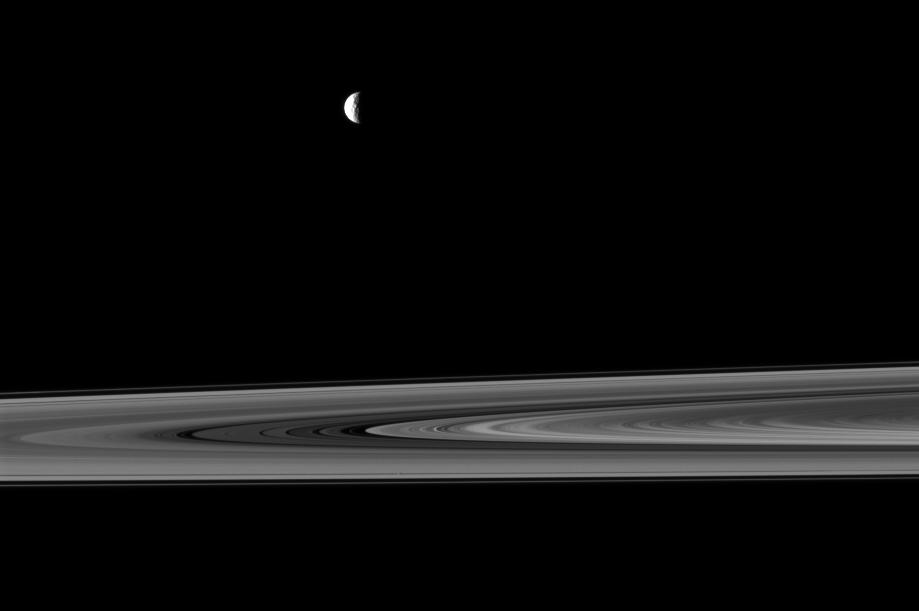
“October 19, 2009. The Cassini spacecraft captures a couple of small moons in this image taken while the spacecraft was nearly in the plane of Saturn’s rings. Near the top of this image, a crescent Mimas (396 kilometers, or 246 miles across) is closer to Cassini than the rings are. Pan (28 kilometers, or 17 miles across) is visible as a tiny dot in the Encke Gap of the A ring near the middle of the bottom of the image. This view looks toward the northern, sunlit side of the rings from just above the ringplane.

The image was taken in visible light with the Cassini spacecraft narrow-angle camera. The view was obtained at a distance of approximately 2.1 million kilometers (1.3 million miles) from Pan. Image scale is 13 kilometers (8 miles) per pixel.”

“After almost 20 years in space, NASA’s Cassini spacecraft begins the final chapter of its remarkable story of exploration: its Grand Finale. Between April and September 2017, Cassini will undertake a daring set of orbits that is, in many ways, like a whole new mission. Following a final close flyby of Saturn’s moon Titan, Cassini will leap over the planet’s icy rings and begin a series of 22 weekly dives between the planet and the rings.

No other mission has ever explored this unique region. What we learn from these final orbits will help to improve our understanding of how giant planets – and planetary systems everywhere – form and evolve.

On the final orbit, Cassini will plunge into Saturn’s atmosphere, sending back new and unique science to the very end. After losing contact with Earth, the spacecraft will burn up like a meteor, becoming part of the planet itself.

Cassini’s Grand Finale is about so much more than the spacecraft’s final dive into Saturn. That dramatic event is the capstone of six months of daring exploration and scientific discovery. And those six months are the thrilling final chapter in a historic 20-year journey.”

Image credit: NASA